


 |
市場調查報告書
商品編碼
2072764
雲端工作負載效率和碳感知調度軟體:市場佔有率分析、行業趨勢和統計數據以及成長預測(2026-2031 年)Cloud Workload Efficiency and Carbon-Aware Scheduling Software - Market Share Analysis, Industry Trends & Statistics, Growth Forecasts (2026 - 2031) |
||||||

※ 本網頁內容可能與最新版本有所差異。詳細情況請與我們聯繫。
根據 Mordor Intelligence 預測,雲端工作負載效率和碳感知調度軟體的市場規模預計將在 2025 年達到 4.5 億美元,在 2026 年達到 5.7 億美元,並在 2031 年達到 19.1 億美元。
預計從 2026 年到 2031 年,其複合年成長率將達到 27.36%。
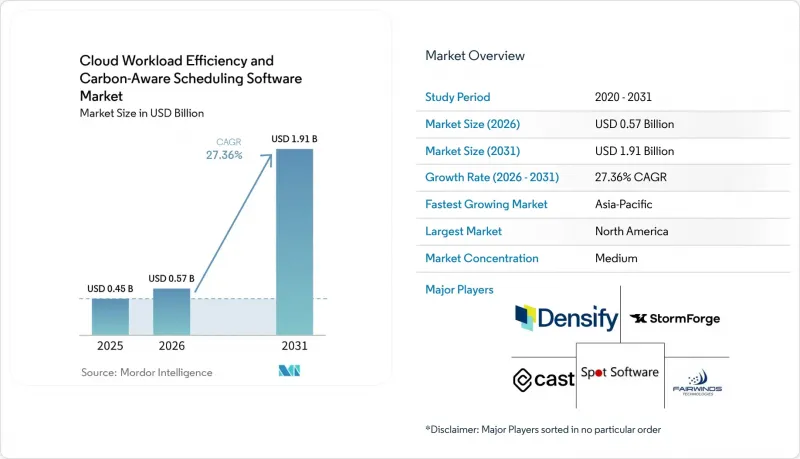
本報告按組件(平台和服務)、部署模式(雲端等)、企業規模(大型企業和中小企業)、應用(碳感知工作負載調度等)、最終用戶行業(工業製造業等)和地區進行細分。市場預測以價值(美元)表示。
全球雲端工作負載效率與碳感知調度軟體市場趨勢與洞察
擴大 FinOps 的應用範圍,以共同最佳化雲端成本和碳排放
雲端工作負載效率和碳感知調度軟體市場正受益於碳追蹤向雲端成本管理統籌營運模式的轉變。根據《2026 年 FinOps 現狀》報告,78% 的 FinOps 實踐已由技術長 (CTO) 或資訊長 (CIO) 整合到組織內部,這表明最佳化決策現在更接近工程團隊而非獨立的財務部門。同一份 2026 年 FinOps 資料集也顯示,98% 的受訪者已在 FinOps 框架內管理 AI 支出,高於 2025 年的 63%。這凸顯了對能夠持續管理波動運算需求的工具的需求。 FinOps 基金會也在 2026 年正式將雲端永續性指定為官方框架功能,為企業將碳指標整合到其多重雲端成本管理實踐中提供了一個通用框架。這項轉變對雲端工作負載效率和碳感知調度軟體市場意義重大,因為買家不再將排放可見度作為獨立的儀表板購買,而是將其作為雲端營運控制層的一部分。隨著各組織將財務課責和雲端排放報告納入考量,雲端工作負載效率和碳感知調度軟體市場正從臨時工具轉向更標準化的採購要求。
電網碳排放強度 API 可實現即時工作負載部署。
雲端工作負載效率和碳感知調度軟體市場也受益於外部電網數據的快速改進。這些數據現在可以直接整合到調度邏輯中。 Electricity Maps 已將其 API 覆蓋範圍擴展至 200 多個國家和地區,並在 100 多個區域推出了 72 小時電網預測。這使得該平台能夠為批量處理和靈活的工作負載提供更長的規劃週期。 WattTime 更新了其 2025 年北美模型,增加了關於天然氣和煤炭發電的更詳細訊號。該公司表示,與先前的 API 版本相比,此次更新可將碳減排量提高 25%。弗勞恩霍夫 ISST 的一項研究發現,將工作負載從德國轉移到瑞典、挪威和法國等低碳電網,可將電力碳排放強度降低高達 96%;而將工作負載轉移到更清潔的時區,則可將排放減少 21%。 IBM 的一項研究報告顯示,其 Caspian 調度器在按時完成 98% 工作負載的同時,減少了 33% 的碳排放,這為雲端工作負載效率和碳感知調度軟體市場提供了強力的證據。隨著預測精度的提高和地理覆蓋範圍的擴大,自動部署將比人工干預更具實用性,這將有利於雲端工作負載效率和碳感知調度軟體市場的發展。
跨異質雲端和傳統環境整合的複雜性
隨著企業嘗試將公共雲端、私有雲端、本地虛擬基礎架構和傳統調度系統整合到單一最佳化層,雲端工作負載效率和碳感知調度軟體市場持續面臨引進週期延遲的問題。許多組織同時運行 AWS、Azure 和 GCP,以及 VMware 環境、裸機系統和傳統企業軟體環境,甚至在調度邏輯啟動之前就面臨實際的資料規範化問題。 CNCF 的一項研究表明,儘管 Kubernetes 的全面部署已十分普遍,但許多組織仍處於早期階段或尚未實現雲原生,這凸顯了採用者群體中基礎設施成熟度的差異。雲端工作負載效率和碳感知調度軟體市場成熟度的這種差異正在延長採購週期,因為買家通常需要在全面最佳化之前確保連接器、資料映射和管治的一致性。在製造業、醫療保健和政府部門,這個問題尤其突出,因為這些部門的傳統批次系統和合規性關鍵基礎設施與新型容器化環境並存。雖然在這種情況下需求不會消失,但更長的部署週期和更高的初始擁有成本正在減緩雲端工作負載效率和碳感知調度軟體市場的短期成長。
細分市場分析
預計到 2025 年,平台解決方案將佔據雲端工作負載效率和碳感知調度軟體市場 70.12% 的佔有率,這表明買家仍然更傾向於整合式編配環境,而不是分散的單一功能工具。在雲端工作負載效率和碳感知調度軟體產業,平台仍然是關鍵決策的核心,因為它們將碳資料擷取、調度邏輯、成本視覺化和策略控制整合到一個統一的環境中。這種定位意義重大,因為企業希望從單一營運層獲得可衡量的結果,而不是使用單獨的產品來進行支出管理、永續性追蹤和工作負載部署。在這一類別中,供應商仍然主要專注於碳感知調度器、工作負載編配引擎和基於 AI 的部署工具,因為這些功能與日常基礎設施決策最為直接相關。事實上,對組件組合的分析表明,即使後續添加了輔助部署和調優的服務,軟體主導的控制仍然是雲端工作負載效率和碳感知調度軟體市場的首選。
預計到 2031 年,服務業務將以 28.45% 的複合年成長率成長,成為雲端工作負載效率和碳感知調度軟體市場中成長最快的組成部分。這一成長反映了市場對部署諮詢、託管最佳化方案、培訓和管治支援的需求,尤其是在缺乏內部高階平台工程團隊的買家中。 IBM 擴展了 Turbonomic 的功能,增加了虛擬機器能耗和碳足跡的報表功能。這些增強功能表明,為什麼服務通常與平台部署並行提供,而不是取代平台部署。對於許多企業客戶而言,最初的諮詢合約會演變為持續的託管服務契約,從而提高客戶維繫並增加已部署基本客群的長期價值。因此,在雲端工作負載效率和碳感知調度軟體市場中,可以觀察到一種清晰的模式:平台產品啟動客戶獲取,而服務則隨著時間的推移深化部署並穩定使用。
到2025年,基於雲端的部署將佔據67.34%的市場佔有率,成為整個雲端工作負載效率和碳感知調度軟體市場的預設營運模式。這一格局反映了買家對SaaS工具的偏好,這些工具能夠獲取最新的電網數據、更新最佳化模型並應用策略變更,而無需本地軟體維護。這也符合那些已經在公共雲端上運行大規模工作負載並希望最大限度減少最佳化層基礎設施開銷的公司的採購趨勢。就部署模式而言,雲端工作負載效率和碳感知調度軟體市場的規模主要由雲端交付驅動,雲端交付提供了從資料收集到主動控制的最短路徑。隨著雲端原生買家繼續偏好基於訂閱、可根據使用情況擴展並能隨著調度邏輯快速演進的工具,預計這一主導地位將保持強勁。
預計到 2031 年,混合部署的複合年成長率將達到 27.89%,使其成為雲端工作負載效率和碳感知調度軟體市場中成長最快的部署模式。主要需求來自受監管行業和公共部門環境,這些機構希望將特定功能擴展到公共雲端,同時仍將高度敏感的工作負載保留在本地。這些買家需要一個單一的策略層,能夠提供環境兩端的碳強度、成本風險和部署限制的洞察。混合部署的成長也反映了對資料居住的需求,因為企業通常希望在不放棄對受限工作負載和自主基礎設施需求的本地控制的情況下,實現碳感知最佳化。雖然本地部署的規模仍然相對較小,但在外部連接受限且必須用快取資料和本地規則集替代即時調度訊號的空氣間隙和關鍵基礎設施環境中,它們仍將繼續發揮作用。
區域分析
到2025年,北美將佔據雲端工作負載效率和碳感知調度軟體市場34.85%的佔有率,成為最大的貢獻地區。這一地位反映了FinOps的早期成熟、超大規模資料中心業者提供的強大基礎設施,以及眾多已在多重雲端和Kubernetes密集型環境中運營的企業所擁有的龐大用戶群。加州SB 253法案將符合資格的加州企業提交範圍1和範圍2報告的截止日期設定為2026年8月10日,這進一步凸顯了該地區相關工作的緊迫性。此外,該地區的採購環境仍然活躍且競爭激烈,多家競爭供應商繼續將美國作為其成本最佳化、Kubernetes自動化和碳感知營運的主要市場。雖然加拿大和墨西哥的市場規模仍然較小,但隨著區域子公司遵守公司層面的永續發展和基礎設施政策,金融服務和製造業的採用率正在不斷提高。
預計到2031年,亞太地區將以28.67%的複合年成長率成長,成為雲端工作負載效率和碳感知調度軟體市場成長最快的地區。這一成長動能主要得益於印度、韓國、澳洲和紐西蘭、日本以及中國等國家超大規模雲端的快速擴張,這些地區的企業雲端容量和人工智慧工作負載都在不斷成長。亞太地區雲端工作負載效率和碳感知調度軟體市場正經歷快速成長,這源於對能夠同時解決成本、容量和資料全部區域。數位政策的進一步發展和本地雲端區域的興起也推動了市場成長,使得將效能要求與特定區域的調度規則結合變得更加容易。
歐洲在雲端工作負載效率和碳感知調度軟體市場中繼續佔據著重要的結構性地位,這得益於其在主要地區中最成熟的報告框架下運作。歐盟指令 (EU) 2026/470 加強了大型企業永續發展資訊揭露的法規結構,並維持了對可審計、細粒度雲端排放資料的需求。氣候中和資料中心協議也持續關注將目標與可再生能源相匹配,這提高了能夠將靈活運算資源轉移到綠能供應時段的工具的實用價值。以巴西為首的南美洲以及中東和非洲仍處於早期市場階段,但對主權雲、資料居住法規和超大規模資料中心業者擴張的投資正在逐步改善全部區域雲端工作負載效率和碳感知調度軟體市場的前景。
其他好處:
- Excel格式的市場預測(ME)表
- 3個月的分析師支持
目錄
第1章:引言
- 研究假設和市場定義
- 調查範圍
第2章:調查方法
第3章執行摘要
第4章 市場狀況
- 市場概覽
- 市場促進因素
- 擴大 FinOps 的應用範圍,以同時最佳化雲端成本和碳排放
- 電網碳排放強度 API 可實現即時工作負載部署。
- 雲端原生公司對 Kubernetes 原生自動化的需求
- 強制性永續發展報告加強了符合審計要求的排放管理。
- 多重雲端的擴展催生了對區域感知調度的需求。
- 人工智慧和GPU工作負載對彈性和能源效率的需求日益成長。
- 市場限制因素
- 異質雲端環境與傳統環境整合的複雜性
- 碳數據標準化程度不足及預測準確性
- 主動採取碳排放意識強的延期政策可能會對工作負載造成效能風險。
- 資料居住要求和合規性限制會限制跨區域調度
- 產業價值鏈分析
- 宏觀經濟因素對市場的影響
- 監理情勢
- 技術展望
- 波特五力分析
第5章 市場規模與成長預測
- 按組件
- 平台
- 碳排放感知調度器
- 工作負載編配引擎
- 雲端最佳化平台
- 碳強度分析
- 多重雲端最佳化系統
- 人工智慧驅動的工作負載分配工具
- 永續性自動化引擎
- 服務
- 平台
- 部署模式
- 基於雲端的
- 混合
- 現場
- 按公司規模
- 大公司
- 小型企業
- 透過使用
- 碳工作量調度
- 資源利用最佳化
- 多重雲端工作負載部署
- 最佳化人工智慧基礎設施
- 永續的DevOps和測試
- 節能資料處理
- 按最終用戶行業分類
- 工業製造
- 能源公用事業
- BFSI
- 零售和消費品
- 資訊科技/通訊
- 醫療保健和生命科學
- 政府/公共部門
- 運輸/物流
- 其他終端用戶產業
- 按地區
- 北美洲
- 美國
- 加拿大
- 墨西哥
- 南美洲
- 巴西
- 阿根廷
- 其他南美國家
- 歐洲
- 德國
- 英國
- 法國
- 義大利
- 西班牙
- 俄羅斯
- 荷蘭
- 其他歐洲國家
- 亞太地區
- 中國
- 日本
- 印度
- 韓國
- 澳洲和紐西蘭
- 其他亞太國家
- 中東
- 沙烏地阿拉伯
- 阿拉伯聯合大公國
- 其他中東國家
- 非洲
- 南非
- 奈及利亞
- 其他非洲國家
- 北美洲
第6章 競爭情勢
- 市場集中度
- 策略趨勢
- 市佔率分析
- 公司簡介
- Cast AI
- Densify, Inc.
- GramLabs, Inc. d/b/a StormForge
- IBM Corporation
- Spot Software, Inc.
- Fairwinds, LLC
- Greenpixie Limited
- Electricity Maps SAS
- WattTime, Inc.
- EasyVirt SAS
- CloudBolt Software, Inc.
- Harness, Inc.
- Turbonomic, Inc.
- ProsperOps, Inc.
- Spot by NetApp(formerly Spot.io)
- Apptio(IBM)
- Kubecost, Inc.
- CloudZero, Inc.
- Replex GmbH
- SAP SE
第7章 市場機會與未來展望
According to Mordor Intelligence, the cloud workload efficiency and carbon-aware scheduling software market size is projected to be USD 0.45 billion in 2025, USD 0.57 billion in 2026, and reach USD 1.91 billion by 2031, growing at a CAGR of 27.36% from 2026 to 2031.
This report is Segmented by Component (Platform, and Services), Deployment (Cloud-Based, and More), Enterprise Size (Large Enterprises, and Small and Medium Enterprises), Application (Carbon-Aware Workload Scheduling, and More), End-User Industry (Industrial Manufacturing, and More), and Geography. The Market Forecasts are Provided in Terms of Value (USD).
Global Cloud Workload Efficiency and Carbon-Aware Scheduling Software Market Trends and Insights
Rising FinOps Adoption for Cloud Cost and Carbon Co-Optimization
The cloud workload efficiency and carbon-aware scheduling software market is benefiting from the shift of carbon tracking into the same operating model that already governs cloud cost control. The State of FinOps 2026 showed that 78% of FinOps practices were embedded within CTO or CIO organizations, indicating that optimization decisions are now handled closer to engineering teams than to stand-alone finance groups. The same 2026 FinOps dataset showed that 98% of respondents already managed AI spend within the FinOps scope, up from 63% in 2025, underscoring the need for tools that can consistently govern volatile compute demand. The FinOps Foundation also formally designated cloud sustainability as an official framework capability in 2026, providing enterprises with a common structure for integrating carbon metrics into multi-cloud cost management practices. That shift matters for the cloud workload efficiency and carbon-aware scheduling software market because buyers no longer see emissions visibility as a separate dashboard purchase; they see it as part of the control layer for cloud operations. As organizations combine financial accountability with cloud emissions reporting, the cloud workload efficiency and carbon-aware scheduling software market is moving from discretionary tooling toward a more standard procurement requirement.
Grid Carbon Intensity APIs Enabling Real-Time Workload Placement
The cloud workload efficiency and carbon-aware scheduling software market is also supported by the rapid improvement in external grid data, which can now be fed directly into scheduler logic. Electricity Maps expanded its API coverage to more than 200 countries and territories and introduced 72-hour grid forecasts across more than 100 zones, giving platforms a longer planning window for batch and flexible workloads. WattTime updated its North American model in 2025 with more granular signals for gas and coal generation and said the release enabled 25% more carbon-reduction impact than earlier API versions. Fraunhofer ISST found that shifting workloads spatially from Germany to lower-carbon grids such as Sweden, Norway, or France could reduce electricity carbon intensity by up to 96%, while temporal shifting toward cleaner windows could cut emissions by 21%. IBM Research reported that its Caspian scheduler reduced carbon emissions by 33% while completing 98% of workloads on schedule, providing a strong proof point for the cloud workload efficiency and carbon-aware scheduling software market. As forecast quality improves and geographic coverage deepens, the cloud workload efficiency and carbon-aware scheduling software markets benefit, as automated placement becomes more practical than manual intervention.
Integration Complexity Across Heterogeneous Cloud and Legacy Environments
The cloud workload efficiency and carbon-aware scheduling software market still faces slower adoption cycles as enterprises try to integrate public cloud, private cloud, on-premises virtual infrastructure, and legacy scheduling systems into a single optimization layer. Many organizations run AWS, Azure, and GCP alongside VMware estates, bare-metal systems, and older enterprise software environments, creating real data normalization problems before scheduling logic can even begin. The CNCF survey showed that Kubernetes production use is broad, yet it also identified a group of organizations still in early or non-cloud-native stages, underscoring how uneven infrastructure maturity remains across the installed base. In the cloud workload efficiency and carbon-aware scheduling software market, the uneven maturity of the market lengthens procurement cycles because buyers often need connectors, data mapping, and governance alignment before they can move into active optimization. The issue is more visible in industrial manufacturing, healthcare, and government, where older batch systems and compliance-heavy infrastructure coexist with newer containerized environments. Demand does not disappear under these conditions, but deployment timelines stretch and initial ownership costs rise, which slows near-term scale-up in the cloud workload efficiency and carbon-aware scheduling software market.
Other drivers and restraints analyzed in the detailed report include:
- Kubernetes-Native Automation Demand Across Cloud-Native Enterprises
- Mandatory Sustainability Reporting Increasing Audit-Ready Emissions Controls
- Limited Carbon Data Standardization and Forecast Accuracy
For complete list of drivers and restraints, kindly check the Table Of Contents.
Segment Analysis
Platform solutions captured 70.12% of the cloud workload efficiency and carbon-aware scheduling software market in 2025, which showed that buyers still preferred integrated orchestration environments over fragmented point tools. Within the cloud workload efficiency and carbon-aware scheduling software industry, platforms remain the primary decision-making center because they combine carbon data ingestion, scheduling logic, cost visibility, and policy control in a single environment. That position is important because enterprises want measurable outcomes from a single operational layer rather than separate products for spend control, sustainability tracking, and workload placement. The largest vendor focus inside this category remains carbon-aware schedulers, workload orchestration engines, and AI-based placement tools, since those functions connect most directly with daily infrastructure decisions. In practice, the component mix shows that the cloud workload efficiency and carbon-aware scheduling software markets still favor software-led control, even when services are attached later to support rollout and tuning.
Services are projected to grow at a 28.45% CAGR through 2031, making them the fastest-growing component of the cloud workload efficiency and carbon-aware scheduling software market. That growth reflects demand for implementation consulting, managed optimization programs, training, and governance support, especially among buyers that lack deep internal platform engineering teams. IBM expanded Turbonomic to include energy consumption and carbon footprint reporting for virtual machines, and that kind of enhancement shows why services often sit alongside platform adoption rather than replace it. In many enterprise accounts, the initial consulting engagement becomes an ongoing managed service contract, which improves retention and increases the long-term value of the installed customer base. The cloud workload efficiency and carbon-aware scheduling software market, therefore, shows a clear pattern where platform products open the account, while services deepen adoption and stabilize usage over time.
Cloud-based deployment commanded a 67.34% share in 2025, making it the default operating model across the cloud workload efficiency and carbon-aware scheduling software market. This structure reflects buyer preference for SaaS tools that can ingest fresh grid data, update optimization models, and push policy changes without requiring local software maintenance. It also aligns with the purchasing profile of enterprises that already run significant workloads in the public cloud and want minimal infrastructure overhead from the optimization layer itself. In deployment terms, the cloud workload efficiency and carbon-aware scheduling software market size remained centered on cloud delivery because it offered the fastest route from data collection to active control. That lead position is likely to remain firm because cloud-native buyers continue to favor subscription-based tools that can scale with usage and evolve quickly with scheduler logic.
Hybrid deployment is projected to record a 27.89% CAGR through 2031, making it the fastest-growing mode in the cloud workload efficiency and carbon-aware scheduling software market. The main demand comes from regulated industries and public-sector environments that still keep sensitive workloads on-premises while expanding selected functions to the public cloud. These buyers need a single policy layer that can view carbon intensity, cost exposure, and placement constraints across both sides of the estate. Hybrid growth also reflects data residency needs, because enterprises often want carbon-aware optimization without giving up local control over restricted workloads or sovereign infrastructure requirements. On-premises deployment will remain smaller, but it will continue to serve air-gapped and critical infrastructure settings where external connectivity is limited and live scheduling signals must be replaced with cached data and local rule sets.
Complete Report Scope:
- By Component
- Platform
- Carbon-aware schedulers
- Workload orchestration engines
- Cloud optimization platforms
- Carbon-intensity analytics
- Multi-cloud optimization systems
- AI-based workload placement tools
- Sustainability automation engines
- Services
- Platform
- By Deployment
- Cloud-Based
- Hybrid
- On-Premises
- By Enterprise Size
- Large Enterprises
- Small and Medium Enterprises
- By Application
- Carbon-Aware Workload Scheduling
- Resource Utilization Optimization
- Multi-Cloud Workload Placement
- AI Infrastructure Optimization
- Sustainable DevOps and Testing
- Energy-Efficient Data Processing
- By End-user Industry
- Industrial Manufacturing
- Energy and Utilities
- BFSI
- Retail and Consumer Goods
- IT and Telecom
- Healthcare and Life Sciences
- Government and Public Sector
- Transportation and Logistics
- Other End-user Industries
- By Geography
- North America
- United States
- Canada
- Mexico
- South America
- Brazil
- Argentina
- Rest of South America
- Europe
- Germany
- United Kingdom
- France
- Italy
- Spain
- Russia
- Netherlands
- Rest of Europe
- Asia-Pacific
- China
- Japan
- India
- South Korea
- Australia and New Zealand
- Rest of Asia-Pacific
- Middle East
- Saudi Arabia
- United Arab Emirates
- Rest of Middle East
- Africa
- South Africa
- Nigeria
- Rest of Africa
- North America
Geography Analysis
North America held 34.85% of the cloud workload efficiency and carbon-aware scheduling software market share in 2025, which made it the leading regional contributor. That position reflected early FinOps maturity, deep hyperscaler infrastructure, and a large installed base of enterprises already running multi-cloud and Kubernetes-heavy environments. California SB 253 raised the region's urgency by setting an initial Scope 1 and Scope 2 reporting deadline of August 10, 2026, for qualifying companies that do business in the state. The United States also remains the main focus for several competing vendors in cost optimization, Kubernetes automation, and carbon-aware operations, keeping the regional buying environment active and competitive. Canada and Mexico remain smaller contributors, but adoption is widening in financial services and manufacturing as regional subsidiaries align with enterprise-wide sustainability and infrastructure policies.
Asia-Pacific is projected to grow at 28.67% CAGR through 2031, making it the fastest-growing geography in the cloud workload efficiency and carbon-aware scheduling software market. The region's momentum comes from rapid hyperscale cloud build-out across India, South Korea, Australia and New Zealand, Japan, and China, where enterprise cloud capacity and AI workloads are both increasing. The cloud workload efficiency and carbon-aware scheduling software market is growing rapidly in Asia-Pacific as buyers increasingly need region-aware workload placement that can respond to cost, capacity, and data location constraints simultaneously. The March 2026 Wirtschaftsrat report on data centers described AI-guided workload energy management as a strategic issue for data center operations, and that logic maps directly to the large and expanding digital estates seen across Asia-Pacific. Growth is also supported by digital policy developments and the rise of local cloud regions, which make it easier to combine performance requirements with region-specific scheduling rules.
Europe remains a structurally important part of the cloud workload efficiency and carbon-aware scheduling software market because it operates under the most mature reporting framework among major regions. Directive (EU) 2026/470 reinforced the regulatory framework for large-enterprise sustainability disclosures, keeping demand focused on auditable, granular cloud emissions data. The Climate Neutral Data Center Pact also kept attention on renewable matching targets, which strengthened the practical value of tools that can shift flexible compute toward cleaner power windows. South America, led by Brazil, and the Middle East and Africa remain earlier-stage opportunities, yet sovereign cloud investment, data residency rules, and expanding hyperscaler footprints are gradually improving the case for the cloud workload efficiency and carbon-aware scheduling software market across those regions.
- Cast AI
- Densify, Inc.
- GramLabs, Inc. d/b/a StormForge
- IBM Corporation
- Spot Software, Inc.
- Fairwinds, LLC
- Greenpixie Limited
- Electricity Maps SAS
- WattTime, Inc.
- EasyVirt SAS
- CloudBolt Software, Inc.
- Harness, Inc.
- Turbonomic, Inc.
- ProsperOps, Inc.
- Spot by NetApp (formerly Spot.io)
- Apptio (IBM)
- Kubecost, Inc.
- CloudZero, Inc.
- Replex GmbH
- SAP SE
Additional Benefits:
- The market estimate (ME) sheet in Excel format
- 3 months of analyst support
TABLE OF CONTENTS
1 INTRODUCTION
- 1.1 Study Assumptions and Market Definition
- 1.2 Scope of the Study
2 RESEARCH METHODOLOGY
3 EXECUTIVE SUMMARY
4 MARKET LANDSCAPE
- 4.1 Market Overview
- 4.2 Market Drivers
- 4.2.1 Rising FinOps Adoption for Cloud Cost and Carbon Co-Optimization
- 4.2.2 Grid Carbon Intensity APIs Enabling Real-Time Workload Placement
- 4.2.3 Kubernetes-Native Automation Demand Across Cloud-Native Enterprises
- 4.2.4 Mandatory Sustainability Reporting Increasing Audit-Ready Emissions Controls
- 4.2.5 Multi-Cloud Expansion Creating Region-Aware Scheduling Demand
- 4.2.6 AI and GPU Workloads Increasing Elasticity and Energy Efficiency Needs
- 4.3 Market Restraints
- 4.3.1 Integration Complexity Across Heterogeneous Cloud and Legacy Environments
- 4.3.2 Limited Carbon Data Standardization and Forecast Accuracy
- 4.3.3 Workload Performance Risk from Aggressive Carbon-Aware Deferral Policies
- 4.3.4 Data Residency and Compliance Constraints Restricting Cross-Region Scheduling
- 4.4 Industry Value-Chain Analysis
- 4.5 Impact of Macroeconomic Factors on the Market
- 4.6 Regulatory Landscape
- 4.7 Technological Outlook
- 4.8 Porter's Five Forces Analysis
- 4.8.1 Threat of New Entrants
- 4.8.2 Bargaining Power of Buyers
- 4.8.3 Bargaining Power of Suppliers
- 4.8.4 Threat of Substitutes
- 4.8.5 Intensity of Competitive Rivalry
5 MARKET SIZE AND GROWTH FORECASTS (VALUE)
- 5.1 By Component
- 5.1.1 Platform
- 5.1.1.1 Carbon-aware schedulers
- 5.1.1.2 Workload orchestration engines
- 5.1.1.3 Cloud optimization platforms
- 5.1.1.4 Carbon-intensity analytics
- 5.1.1.5 Multi-cloud optimization systems
- 5.1.1.6 AI-based workload placement tools
- 5.1.1.7 Sustainability automation engines
- 5.1.2 Services
- 5.1.1 Platform
- 5.2 By Deployment
- 5.2.1 Cloud-Based
- 5.2.2 Hybrid
- 5.2.3 On-Premises
- 5.3 By Enterprise Size
- 5.3.1 Large Enterprises
- 5.3.2 Small and Medium Enterprises
- 5.4 By Application
- 5.4.1 Carbon-Aware Workload Scheduling
- 5.4.2 Resource Utilization Optimization
- 5.4.3 Multi-Cloud Workload Placement
- 5.4.4 AI Infrastructure Optimization
- 5.4.5 Sustainable DevOps and Testing
- 5.4.6 Energy-Efficient Data Processing
- 5.5 By End-user Industry
- 5.5.1 Industrial Manufacturing
- 5.5.2 Energy and Utilities
- 5.5.3 BFSI
- 5.5.4 Retail and Consumer Goods
- 5.5.5 IT and Telecom
- 5.5.6 Healthcare and Life Sciences
- 5.5.7 Government and Public Sector
- 5.5.8 Transportation and Logistics
- 5.5.9 Other End-user Industries
- 5.6 By Geography
- 5.6.1 North America
- 5.6.1.1 United States
- 5.6.1.2 Canada
- 5.6.1.3 Mexico
- 5.6.2 South America
- 5.6.2.1 Brazil
- 5.6.2.2 Argentina
- 5.6.2.3 Rest of South America
- 5.6.3 Europe
- 5.6.3.1 Germany
- 5.6.3.2 United Kingdom
- 5.6.3.3 France
- 5.6.3.4 Italy
- 5.6.3.5 Spain
- 5.6.3.6 Russia
- 5.6.3.7 Netherlands
- 5.6.3.8 Rest of Europe
- 5.6.4 Asia-Pacific
- 5.6.4.1 China
- 5.6.4.2 Japan
- 5.6.4.3 India
- 5.6.4.4 South Korea
- 5.6.4.5 Australia and New Zealand
- 5.6.4.6 Rest of Asia-Pacific
- 5.6.5 Middle East
- 5.6.5.1 Saudi Arabia
- 5.6.5.2 United Arab Emirates
- 5.6.5.3 Rest of Middle East
- 5.6.6 Africa
- 5.6.6.1 South Africa
- 5.6.6.2 Nigeria
- 5.6.6.3 Rest of Africa
- 5.6.1 North America
6 COMPETITIVE LANDSCAPE
- 6.1 Market Concentration
- 6.2 Strategic Moves
- 6.3 Market Share Analysis
- 6.4 Company Profiles (includes Global Level Overview, Market Level Overview, Core Segments, Financials as available, Strategic Information, Market Rank/Share, Products and Services, Recent Developments)
- 6.4.1 Cast AI
- 6.4.2 Densify, Inc.
- 6.4.3 GramLabs, Inc. d/b/a StormForge
- 6.4.4 IBM Corporation
- 6.4.5 Spot Software, Inc.
- 6.4.6 Fairwinds, LLC
- 6.4.7 Greenpixie Limited
- 6.4.8 Electricity Maps SAS
- 6.4.9 WattTime, Inc.
- 6.4.10 EasyVirt SAS
- 6.4.11 CloudBolt Software, Inc.
- 6.4.12 Harness, Inc.
- 6.4.13 Turbonomic, Inc.
- 6.4.14 ProsperOps, Inc.
- 6.4.15 Spot by NetApp (formerly Spot.io)
- 6.4.16 Apptio (IBM)
- 6.4.17 Kubecost, Inc.
- 6.4.18 CloudZero, Inc.
- 6.4.19 Replex GmbH
- 6.4.20 SAP SE
7 MARKET OPPORTUNITIES AND FUTURE OUTLOOK
- 7.1 White-Space and Unmet-Need Assessment

 Frost Radar™:雲端工作負載保護平台,2026 年
 雲端工作負載保護:市場佔有率分析、行業趨勢和統計數據、成長預測(2026-2031 年)雲端工作負載保護平台市場規模、佔有率、成長及全球產業分析:按類型、應用和地區的洞察,2026-2034年的預測
 雲端工作負載保護市場:按工作負載類型、服務類型、組織規模、部署模式和產業分類 - 全球預測(2026-2032 年)
 2026年全球雲端工作負載保護市場報告
 雲端工作負載保護平台 (CWPP) 市場分析及預測(至 2035 年):按類型、產品類型、服務、技術、組件、應用、部署模式、最終用戶、功能和解決方案分類雲端工作負載保護市場分析及預測(至 2035 年):按類型、產品、服務、技術、組件、應用、部署類型、最終用戶和解決方案分類全球雲端工作負載保護平台市場規模、佔有率、趨勢和成長分析報告(2026-2034年)
 雲端工作負載保護市場 - 全球產業規模、佔有率、趨勢、機會及預測(按組件、部署、最終用戶、地區和競爭格局分類,2021-2031 年)全球 CWPP/CSPM 市場(2024-2030 年)