


 |
市場調查報告書
商品編碼
2072571
黑麥粉回收:市場佔有率分析、產業趨勢與統計、成長預測(2026-2031)Black Mass Recycling - Market Share Analysis, Industry Trends & Statistics, Growth Forecasts (2026 - 2031) |
||||||

※ 本網頁內容可能與最新版本有所差異。詳細情況請與我們聯繫。
根據 Mordor Intelligence 預測,黑彌撒回收市場規模預計將在 2026 年達到 164.2 億美元,到 2031 年達到 390.4 億美元,2026 年至 2031 年的複合年成長率為 18.91%。
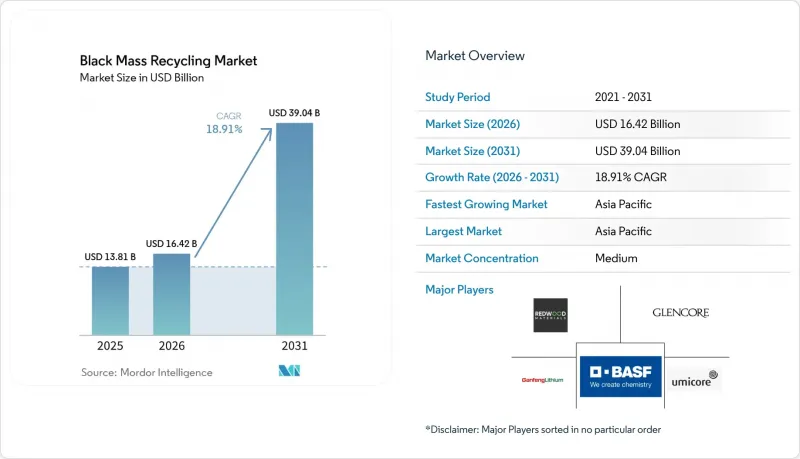
本報告按電池類型(鋰離子電池、鉛酸電池、全固體及其他)、材料類型(鋰、鈷及其他)、來源(電動汽車電池、消費性電子產品電池及其他)、技術(熱冶金、濕法冶金及其他技術)和地區(亞太地區、北美地區、歐洲地區、南美地區、中東和非洲地區)進行細分。市場預測以美元計價。
全球黑麥粉回收市場趨勢與洞察
鋰離子超級工廠的快速擴張
至2025年,全球電池產能將超過2,200吉瓦時,並計畫在2028年再增加800吉瓦時。位於內華達州,位置Panasonic和特斯拉的Redwood Materials公司,已證明將回收設施整合到同一廠址內,可將物流運輸時間縮短至48小時以內。同樣,在湖南省,寧德時代(CATL)和博普(Brunp)公司正將生產廢棄物直接再投資於其正極前驅體供應鏈。資本密集度仍然是一個主要障礙。 Ascend Elements公司已投資3.1億美元在肯塔基州建立了一座年處理量3萬噸的工廠,這凸顯了承購合約在工廠資金籌措中的必要性。因此,黑料回收市場越來越傾向於那些能夠確保長期原料供應的垂直整合型製造商和回收商。
歐盟和中國電動車製造商的召回義務
2027年,歐盟電池法規將強制要求攜帶式電池的回收率達到63%,並自2026年12月起禁止出口廢棄鋰。 [1] 到2031年,汽車製造商將被要求在新電池中使用16%的再生鈷和6%的再生鋰,這促進了與國內加工企業的早期合作。中國的可追溯性代碼要求容量超過20kWh的電池組的回收率達到95%,這使得回收系統對中國本土汽車製造商至關重要。 2025年,福斯汽車在薩爾茲吉特的試點計畫處理了3,600噸ID系列電池組,但由於廢鋰回收市場價格下跌,該計畫仍未虧損。
微量金屬污染會降低產品的純度。
在黑料回收市場,由於破碎和研磨過程中混入的鐵、鋁和銅屑,雜質含量可能超過0.5%。這導致回收的鋰鹽失去作為優質正極材料的性能。為了解決這個問題,回收商正在引入渦流隔膜和高頻感應感測器,這些感測器能夠檢測小至20微米的雜質。增加結晶製程會使營運成本增加12%,並降低鋰的整體回收率。如果純度達不到標準,加工商將被迫以折扣價出售給利潤率較低的應用領域,例如潤滑油和陶瓷,從而導致盈利下降。目前,一項與分析儀器製造商的聯合研發專案正致力於引入線上雷射誘導擊穿光譜(LIBS)技術,但由於混合化學品校準方面的挑戰,該技術的實用化仍處於早期階段。
細分市場分析
到2025年,電動車電池將主導黑色廢料回收市場,佔58.23%的市場。預計該市場將以20.45%的複合年成長率穩定成長,鞏固其主導地位。每個汽車電池組可產出60-75公斤濃縮物,進而提高工廠的運作效率。隨著電網電池壽命達到10-12年,能源儲存系統正成為盈利的後端業務機會。儘管中國的規範回收率接近87%,但北美仍低於50%,凸顯了原料穩定供應的區域差異。
利用二次能源儲存系統可望將電動車電池組的回收壽命延長至15年以上。雖然這種延長可能會導致未來供應量下降,但都市區家用電器有望填補這一缺口。工業電動工具、醫療設備和航太電池僅佔總噸位的6%,但其多樣化的化學成分增加了製程控制的複雜性。在中國,OEM可追溯性代碼和歐洲的強制回收計劃相結合,有望提高驅動電池的回收效率。加州的新立法效仿歐盟政策,正為融入北美市場鋪路。
鋰離子電池(包括NMC、NCA和LFP等化學成分)預計到2025年將佔黑色廢料回收市場規模的49.35%,這得益於成熟的浸出工藝,該工藝能夠回收高達95%的鋰和鈷。高處理能力、成熟的設備和可預測的物料流使得處理成本具有競爭力。該領域受益於加工工藝的整合,特別是微波輔助浸出工藝,該工藝可將停留時間縮短40%。然而,固態電池的陶瓷電解質含有氧化鋁和硫化物基質,需要客製化的化學或機械分離方法,目前這些方法正處於試驗測試階段。隨著產品組合的演變,能夠改進可在液態和固體廢棄物之間切換的多功能流程的回收公司有望獲得先發優勢。
這一領域的轉變將推動對能夠保持正極材料形態以進行再鋰化的直接回收方法的研究,從而顯著降低轉化成本。鎳氫電池在混合動力汽車中仍然至關重要,但黑料處理量正在下降,專業加工商正尋求與車隊營運商建立戰略合作夥伴關係以確保處理量。由於化學性質不同,鉛酸電池基本上被排除在現代黑料處理生產線之外,其現有的閉合迴路網路仍然保持獨立運作。隨著需求的成長,具有可調節氧化還原電位的靈活濕式處理生產線將成為標準配置,使加工商能夠靈活調整產品純度,以匹配屆時有望獲得高價的電池化學系統。
區域分析
預計到2025年,亞太地區將佔全球黑色金屬廢料回收市場的48.89%,並將在2030年之前維持22.25%的複合年成長率,這主要得益於以中國、日本和韓國為中心的垂直整合電池價值鏈。中國將於2024年12月生效的石墨出口限制措施,正在擴大國內對再生負極材料的需求,並吸引歐洲正極材料製造商設立合資企業以確保原料供應。政府提供的高達30%的資本成本補貼和優惠電價進一步鞏固了該地區的主導地位。日本JX Metals公司正在利用可再生能源最佳化其水冶工廠,而韓國SK Taes公司則將電子廢棄物與汽車電池組結合,以應對化學成分的波動。
在北美,受聯邦稅額扣抵的推動,廢料回收市場產能擴張加速,這些政策提高了新設施的內部收益率。 Redwood Materials公司正在擴大其位於內華達州和南卡羅來納州的多階段綜合設施,而BASF則與當地電力公司合作,以確保獲得低碳電力。加拿大各省正在根據《美墨加協定》(USMCA)調整其回收目標,並與汽車原始設備製造商(OEM)的生產預測保持一致,同時促進跨境物料流動,以簡化物流。墨西哥的組裝正在考慮自行破碎廢料,以降低將笨重的電池組運送到北部工廠的成本。
在歐洲嚴格的監管環境下,德國、瑞典和波蘭的黑料回收市場中,對高純度濕式冶煉中心的投資正蓬勃發展,這些中心均與當地的超級工廠叢集建立了合作關係。歐盟電池護照計畫於2027年啟動,該計畫強制要求提供詳細的生命週期數據,從而促進資金流入可追溯、低排放的回收解決方案。與非洲礦商的合作透過向歐洲冶煉廠供應預處理精礦,分散了供應風險。中東和非洲的小規模市場則瞄準預處理和耐火儲存等細分領域,利用其靠近主要航運路線的優勢,但仍受到下游需求有限的限制。
其他好處
- Excel格式的市場預測(ME)表
- 3個月的分析師支持
目錄
第1章:引言
- 研究假設和市場定義
- 調查範圍
第2章:調查方法
第3章執行摘要
第4章 市場狀況
- 市場概覽
- 市場促進因素
- 鋰離子超級工廠的快速擴張
- 歐盟和中國電動車製造商的召回義務
- 根據《通膨控制法》可獲得清潔材料稅額扣抵
- 與化學成分從LFP轉化為NMC相關的下游需求
- 透過市政電子廢棄物夥伴關係利用都市區的原料
- 市場限制因素
- 由於混入了微量金屬,產品純度降低。
- 在黑市物流方面投入巨資,並採取了防火措施。
- 新建回收廠許可證審核流程延誤
- 價值鏈分析
- 波特五力模型
第5章 市場規模與成長預測
- 依電池類型
- 鋰離子電池(NMC、NCA、LFP)
- 鎳氫電池(NiMH)
- 鉛酸
- 全固體(新興)
- 其他
- 依材料類型
- 鋰
- 鈷
- 鎳
- 錳
- 石墨
- 其他
- 按供應來源
- 電動汽車電池
- 家用電器
- 能源儲存系統
- 工業電動工具
- 其他
- 透過技術
- 熱冶金法
- 濕式冶金
- 混合方法
- 直接回收/物理分離
- 生物瀝取
- 按地區
- 亞太地區
- 中國
- 印度
- 日本
- 韓國
- 其他亞太國家
- 北美洲
- 美國
- 加拿大
- 墨西哥
- 歐洲
- 德國
- 英國
- 法國
- 義大利
- 其他歐洲國家
- 南美洲
- 巴西
- 阿根廷
- 其他南美國家
- 中東和非洲
- 南非
- 阿拉伯聯合大公國
- 其他中東和非洲國家
- 亞太地區
第6章 競爭情勢
- 市場集中度
- 策略趨勢
- 市佔率和排名分析
- 公司簡介
- American Battery Technology Company
- Ascend Elements, Inc.
- BASF
- Duesenfeld GmbH
- Fortum
- Ganfeng Lithium Group Co., Ltd
- Glencore
- Graphite One Inc.
- Li-Cycle Corp.
- Lithion Technologies
- Livium
- Metso
- Neometals Ltd
- Primobius GmbH
- RecycLiCo Battery Materials Inc.
- Redwood Materials Inc.
- SK Tes
- SungEel HiTech
- Umicore
第7章 市場機會與未來展望
第8章:執行長應考慮的關鍵策略問題
According to Mordor Intelligence, the black mass recycling market size is projected to be USD 16.42 billion in 2026 and reach USD 39.04 billion by 2031, growing at an 18.91% CAGR over 2026-2031.
This report is Segmented by Battery Type (Lithium-Ion, Lead-Acid, Solid-State, Others), Material Type (Lithium, Cobalt, Others), Source (EV Batteries, Consumer Electronics, Others), Technology (Pyrometallurgical, Hydrometallurgical, and Other Technology), and Geography (Asia-Pacific, North America, Europe, South America, Middle-East and Africa). The Market Forecasts are Provided in Terms of Value (USD).
Global Black Mass Recycling Market Trends and Insights
Rapid Scale-up of Li-ion Gigafactories
In 2025, global cell production capacity exceeded 2,200 GWh, with an additional 800 GWh slated for completion before 2028. Redwood Materials, strategically positioned alongside Panasonic and Tesla in Nevada, demonstrates how co-located recycling can streamline logistics to under 48 hours. Similarly, in Hunan Province, CATL and Brunp are channeling production scrap directly back into their cathode precursor supply chains. Capital intensity is a significant hurdle: Ascend Elements invested a hefty USD 310 million to establish a 30,000-ton annual capacity in Kentucky, underscoring the necessity of offtake agreements for plant financing. As a result, the black mass recycling market increasingly favors vertically integrated manufacturers and recyclers that can secure long-term feedstock.
EV-OEM Take-back Mandates in EU & China
By 2027, the EU Battery Regulation mandates a 63% collection rate for portable cells and prohibits black mass exports starting December 2026[1]. By 2031, automakers are required to incorporate 16% recycled cobalt and 6% recycled lithium into new batteries, which is driving them to engage with domestic processors sooner. China's traceability-code system demands a 95% recovery rate for packs exceeding 20 kWh, making it essential for local OEMs to ensure collection. In 2025, Volkswagen's pilot in Salzgitter processed 3,600 tons of ID series packs, yet it continues to operate at a loss due to falling lithium prices in the black mass recycling market.
Trace-metal Contamination Reducing Output Purity
Iron, aluminium, and copper shavings introduced during shredding and milling in the black mass recycling market can push impurity levels beyond 0.5%, disqualifying recycled salts from premium cathode use. Recyclers respond by installing eddy-current separators and high-frequency inductive sensors that spot inclusions down to 20 microns. Additional crystallisation passes lift operating costs by 12% and shrink overall lithium yield. Failure to meet purity benchmarks forces processors to sell at discounts into lower-margin applications such as lubricants or ceramics, eroding profitability. Collaborative R&D projects with analytical-instrument suppliers now target in-line laser-induced breakdown spectroscopy, yet commercial deployment remains nascent given calibration challenges for mixed chemistries.
Other drivers and restraints analyzed in the detailed report include:
- Inflation Reduction Act Clean-material Tax Credits (US)
- Down-stream Demand from LFP-to-NMC Chemistry Switch
- High Capex for Fire-safe Black-mass Logistics
For complete list of drivers and restraints, kindly check the Table Of Contents.
Segment Analysis
In 2025, EV batteries dominated the black mass recycling market, holding a 58.23% share. Forecasts predict a robust 20.45% CAGR growth for them, solidifying their leading position. Each automotive pack produces a concentrate yield of 60-75 kilograms, streamlining plant operations. As grid batteries reach the end of their 10-12 year lifespan, energy-storage systems are emerging as a lucrative back-end opportunity. While China boasts regulatory capture rates nearing 87%, North America lags with figures under 50%, highlighting regional disparities in feedstock security.
Utilizing second-life energy-storage could extend the recycling timeline for EV packs past the 15-year threshold. This extension might lead to a future supply dip, but urban consumer electronics could bridge the gap. Though industrial power tools, medical devices, and aerospace cells account for only 6% of the tonnage, their diverse chemistry introduces complexities in process control. In China, OEM traceability codes, combined with Europe's mandatory take-back schemes, are set to boost collection efficiency for traction batteries. California's new statewide law, echoing EU policies, paves the way for a unified North American market.
Lithium-ion packs, spanning NMC, NCA and LFP chemistries, generated 49.35% of Black Mass Recycling market size in 2025 owing to well-established leaching routes that recover up to 95% of lithium and cobalt. High throughput, familiar equipment, and predictable material flows keep processing costs competitive. The segment benefits from process intensification, notably microwave-assisted leaching that cuts residence times by 40%. However, solid-state cells are on a steep 20.23% CAGR trajectory toward 2030, fuelled by their safety and energy-density edge sought by premium automakers. Their ceramic electrolytes, though, introduce alumina and sulfide matrices that demand bespoke chemical or mechanical liberation methods now in pilot trials. Recycling firms that refine polyvalent flowsheets capable of toggling between liquid and solid-state waste are likely to gain early-mover advantage as product mix shifts.
The segmental shift boosts research into direct-recycling approaches that preserve cathode morphology for relithiation, thereby slashing conversion costs. Nickel-metal hydride batteries retain relevance in hybrid cars but contribute diminishing black-mass tonnage, pushing specialised processors toward strategic alliances with fleet operators to secure volume. Lead-acid units are largely excluded from modern black-mass lines due to divergent chemistry; their entrenched closed-loop networks remain distinct. As demand climbs, flexible hydromet lines with adjustable oxidation-reduction potentials will become standard, allowing processors to pivot output purity toward whichever battery chemistry commands premium pricing at any given time.
Complete Report Scope:
- By Battery Type
- Lithium-ion (NMC, NCA, LFP)
- Nickel-metal Hydride (NiMH)
- Lead-acid
- Solid-state (Emerging)
- Others
- By Material Type
- Lithium
- Cobalt
- Nickel
- Manganese
- Graphite
- Others
- By Source
- EV Batteries
- Consumer Electronics
- Energy-storage Systems
- Industrial Power Tools
- Others
- By Technology
- Pyrometallurgical Process
- Hydrometallurgical Process
- Combined (Hybrid) Processes
- Direct Recycling / Physical Separation
- Bio-leaching
- By Geography
- Asia-Pacific
- China
- India
- Japan
- South Korea
- Rest of Asia-Pacific
- North America
- United States
- Canada
- Mexico
- Europe
- Germany
- United Kingdom
- France
- Italy
- Rest of Europe
- South America
- Brazil
- Argentina
- Rest of South America
- Middle-East and Africa
- South Africa
- United Arab Emirates
- Rest of Middle-East and Africa
- Asia-Pacific
Geography Analysis
Asia-Pacific produced 48.89% of the global Black Mass Recycling market size in 2025 and is forecast to post a 22.25% CAGR through 2030 as it leverages vertically integrated battery value chains centered in China, Japan, and South Korea. Chinese export controls on graphite, effective from December 2024, amplify domestic demand for recycled anode material and attract joint ventures from European cathode makers looking to safeguard feedstock. Government subsidies covering up to 30% of capital costs and preferential electricity tariffs further cement regional leadership. Japan's JX Metals optimises hydromet plants with renewable power, while Korea's SK tes combines e-waste streams with automotive packs to hedge chemistry fluctuations.
North America accelerates capacity in the black mass recycling market on the back of federal tax credits that enhance internal rates of return for new facilities. Redwood Materials expands multi-phase complexes in Nevada and South Carolina, while BASF partners with local utilities to secure low-carbon electricity. Canadian provinces align provincial recycling targets with automotive OEM production forecasts, fostering cross-border material flows that streamline logistics under the United States-Mexico-Canada Agreement (USMCA) trade pact. Mexican assemblers explore in-house shredding to reduce the cost of transporting bulky packs to northern facilities.
Europe's regulatory stringency fuels investment in high-purity hydrometallurgical hubs in the black mass recycling market located in Germany, Sweden and Poland, each tied to local gigafactory clusters. The EU Battery Passport, operational in 2027, mandates granular life-cycle data, steering capital towards traceable, low-emission recycling solutions. Collaborations with African miners supply pre-processed concentrates to European smelters, balancing supply risk. Smaller markets in the Middle East and Africa target niche roles in preprocessing and fire-safe storage, benefiting from proximity to shipping arteries but still constrained by limited downstream demand.
- American Battery Technology Company
- Ascend Elements, Inc.
- BASF
- Duesenfeld GmbH
- Fortum
- Ganfeng Lithium Group Co., Ltd
- Glencore
- Graphite One Inc.
- Li-Cycle Corp.
- Lithion Technologies
- Livium
- Metso
- Neometals Ltd
- Primobius GmbH
- RecycLiCo Battery Materials Inc.
- Redwood Materials Inc.
- SK Tes
- SungEel HITech
- Umicore
Additional Benefits:
- The market estimate (ME) sheet in Excel format
- 3 months of analyst support
TABLE OF CONTENTS
1 Introduction
- 1.1 Study Assumptions and Market Definition
- 1.2 Scope of the Study
2 Research Methodology
3 Executive Summary
4 Market Landscape
- 4.1 Market Overview
- 4.2 Market Drivers
- 4.2.1 Rapid scale-up of Li-ion gigafactories
- 4.2.2 EV-OEM take-back mandates in European Union and China
- 4.2.3 Inflation Reduction Act clean-material tax credits
- 4.2.4 Down-stream demand from LFP-to-NMC chemistry switch
- 4.2.5 Municipal e-waste partnerships unlocking urban feedstock
- 4.3 Market Restraints
- 4.3.1 Trace-metal contamination reducing output purity
- 4.3.2 High capex for fire-safe black-mass logistics
- 4.3.3 Slow permitting cycles for new recycling plants
- 4.4 Value Chain Analysis
- 4.5 Porter's Five Forces
- 4.5.1 Bargaining Power of Suppliers
- 4.5.2 Bargaining Power of Buyers
- 4.5.3 Threat of New Entrants
- 4.5.4 Threat of Substitutes
- 4.5.5 Degree of Competition
5 Market Size and Growth Forecasts (Value)
- 5.1 By Battery Type
- 5.1.1 Lithium-ion (NMC, NCA, LFP)
- 5.1.2 Nickel-metal Hydride (NiMH)
- 5.1.3 Lead-acid
- 5.1.4 Solid-state (Emerging)
- 5.1.5 Others
- 5.2 By Material Type
- 5.2.1 Lithium
- 5.2.2 Cobalt
- 5.2.3 Nickel
- 5.2.4 Manganese
- 5.2.5 Graphite
- 5.2.6 Others
- 5.3 By Source
- 5.3.1 EV Batteries
- 5.3.2 Consumer Electronics
- 5.3.3 Energy-storage Systems
- 5.3.4 Industrial Power Tools
- 5.3.5 Others
- 5.4 By Technology
- 5.4.1 Pyrometallurgical Process
- 5.4.2 Hydrometallurgical Process
- 5.4.3 Combined (Hybrid) Processes
- 5.4.4 Direct Recycling / Physical Separation
- 5.4.5 Bio-leaching
- 5.5 By Geography
- 5.5.1 Asia-Pacific
- 5.5.1.1 China
- 5.5.1.2 India
- 5.5.1.3 Japan
- 5.5.1.4 South Korea
- 5.5.1.5 Rest of Asia-Pacific
- 5.5.2 North America
- 5.5.2.1 United States
- 5.5.2.2 Canada
- 5.5.2.3 Mexico
- 5.5.3 Europe
- 5.5.3.1 Germany
- 5.5.3.2 United Kingdom
- 5.5.3.3 France
- 5.5.3.4 Italy
- 5.5.3.5 Rest of Europe
- 5.5.4 South America
- 5.5.4.1 Brazil
- 5.5.4.2 Argentina
- 5.5.4.3 Rest of South America
- 5.5.5 Middle-East and Africa
- 5.5.5.1 South Africa
- 5.5.5.2 United Arab Emirates
- 5.5.5.3 Rest of Middle-East and Africa
- 5.5.1 Asia-Pacific
6 Competitive Landscape
- 6.1 Market Concentration
- 6.2 Strategic Moves
- 6.3 Market Share(%)/Ranking Analysis
- 6.4 Company Profiles (includes Global Overview, Market Overview, Core Segments, Financials, Strategic Information, Products and Services, Recent Developments)
- 6.4.1 American Battery Technology Company
- 6.4.2 Ascend Elements, Inc.
- 6.4.3 BASF
- 6.4.4 Duesenfeld GmbH
- 6.4.5 Fortum
- 6.4.6 Ganfeng Lithium Group Co., Ltd
- 6.4.7 Glencore
- 6.4.8 Graphite One Inc.
- 6.4.9 Li-Cycle Corp.
- 6.4.10 Lithion Technologies
- 6.4.11 Livium
- 6.4.12 Metso
- 6.4.13 Neometals Ltd
- 6.4.14 Primobius GmbH
- 6.4.15 RecycLiCo Battery Materials Inc.
- 6.4.16 Redwood Materials Inc.
- 6.4.17 SK Tes
- 6.4.18 SungEel HiTech
- 6.4.19 Umicore
7 Market Opportunities and Future Outlook
- 7.1 White-space and Unmet-need Assessment
8 Key Strategic Questions for CEOs

 黑麥粉回收市場預測至2034年-按來源、回收製程、回收材料、輸出形式、最終用戶和地區分類的全球分析
 黑麥粉回收市場機會、成長要素、產業趨勢分析及2026-2035年預測
 黑球回收市場規模、佔有率和成長分析:按電池來源、技術類型、回收金屬類型、最終用途產業、銷售管道和地區分類-2026-2033年產業預測
 黑麥粉回收市場:2026-2030年全球市場預測(依來源、材料、加工技術及最終用戶分類)
 2026年全球黑麥粉回收市場報告
 2026-2030年全球黑麥粉回收市場
 黑集體的印度市場評估:各電池來源,電池類別,各回收流程,各地區,機會,預測,2019年~2033年
 鋰電池黑粉回收的市場規模,佔有率,預測,趨勢分析:電池類別,電池供給來源,各回收流程 - 2032年為止的世界預測
 黑色物質回收市場 - 全球及區域分析:按應用、產品、國家 - 分析和預測(2025 年至 2034 年)
 黑色物質回收市場報告:2031 年趨勢、預測與競爭分析