


 |
市場調查報告書
商品編碼
2101582
黑麥粉回收市場機會、成長要素、產業趨勢分析及2026-2035年預測Black Mass Recycling Market Opportunity, Growth Drivers, Industry Trend Analysis, and Forecast 2026 - 2035 |
||||||

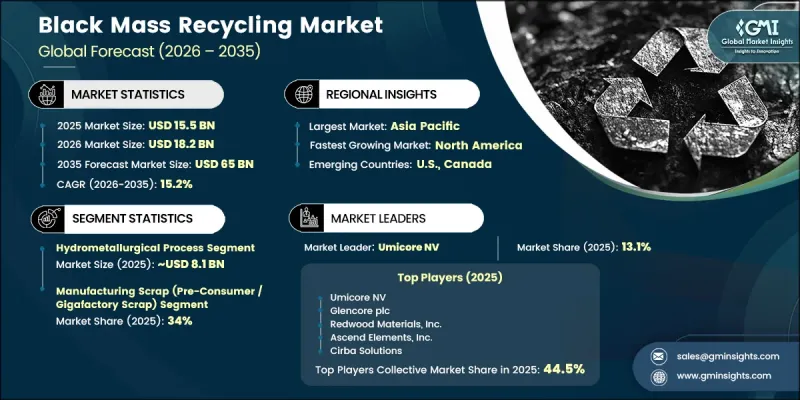
全球黑檀木回收市場預計到 2025 年將價值 155 億美元,並將以 15.2% 的複合年成長率成長,到 2035 年達到 650 億美元。
隨著電池回收業從主要處理製造廢棄物轉向管理日益增多的廢舊電池,黑料回收市場正經歷快速擴張。這種轉變正在重塑整個回收價值鏈,推動回收系統、材料分類、預處理製程和精煉技術的改進。隨著電池廢棄物類型日益多樣化和技術複雜化,回收公司正在投資先進的回收工藝,以高效處理更廣泛的電池化學成分。該市場正在超越其傳統的廢棄物管理角色,透過為新電池生產提供寶貴的再生原料,成為電池材料供應鏈中不可或缺的一部分。回收技術的不斷進步提高了回收率、材料純度和營運效率,使回收商能夠生產出滿足電池製造要求的高品質產品。對循環經濟計劃、資源安全和永續電池生產的日益關注進一步加速了市場成長。預計在整個預測期內,對先進回收基礎設施的投資增加、材料回收技術的改進以及對電池關鍵礦物需求的成長,將為黑料回收市場創造巨大的長期機會。
| 市場範圍 | |
|---|---|
| 開始年份 | 2025 |
| 預測期 | 2026-2035 |
| 上市時的市場規模 | 155億美元 |
| 預測金額 | 650億美元 |
| 複合年成長率 | 15.2% |
濕式冶金製程目前佔據52%的市場佔有率,預計到2025年市場規模將達到81億美元,到2035年將以15.6%的複合年成長率成長。該工藝仍然是首選的回收技術,因為它能夠有效地回收有價值的電池材料,同時確保電池級應用所需的純度。整合加工技術的不斷改進正在提高營運效率、降低加工成本並簡化回收操作。目前針對替代回收方法的研究可望進一步提升永續性和資源利用效率,並推動整個產業未來的技術進步。
預計到2025年,製造廢棄物(消費前/超級工廠廢料)市佔率將達到34%。由於製造廢料品質穩定、成分均勻且加工效率高,此細分市場持續為市場收入做出顯著貢獻。然而,隨著大量廢棄電池進入回收流程,其整體市佔率正逐漸下降。另一方面,現有的回收系統和可預測的更換週期確保了原料的穩定供應,而來自新電池來源的穩定供應也持續支撐著回收活動的持續發展。
到2025年,北美黑電池回收市場將佔據16%的市場。推動區域市場擴張的因素包括:國內電池回收基礎設施投資增加、日益重視在地化的電池材料供應鏈以及電動車產量的成長。回收能力的提升、技術創新以及閉合迴路材料回收系統的日益普及,持續增強區域市場。同時,行業相關人員仍致力於提高營運效率、材料可追溯性和合規性,以滿足不斷成長的再生電池材料需求,並支持永續的長期成長。
目錄
第1章:調查方法和範圍
第2章執行摘要
第3章 行業洞察
- 產業生態系分析
- 供應商情況
- 利潤率
- 每個階段增加的價值
- 影響價值鏈的因素
- 中斷
- 影響產業的因素
- 促進因素
- 產業潛在風險與挑戰
- 市場機遇
- 成長潛力分析
- 監理情勢
- 波特的分析
- PESTLE分析
- 價格趨勢
- 按地區
- 依原料類型
- 未來市場趨勢
- 技術與創新展望
- 最新科技趨勢
- 新興技術
- 專利趨勢
- 貿易統計
- 主要進口國
- 主要出口國
- 永續性和環境方面
- 永續計劃
- 減少廢棄物策略
- 生產中的能源效率
- 具有環保意識的舉措
- 考慮碳足跡
第4章 競爭情勢
- 介紹
- 企業市佔率分析
- 按地區
- 北美洲
- 歐洲
- 亞太地區
- LATAM
- 中東和非洲
- 按地區
- 主要市場公司的競爭分析
- 競爭定位矩陣
- 主要進展
- 併購
- 夥伴關係和聯盟
- 新產品發布
- 業務拓展計劃
第5章 市場估算與預測:依回收技術分類,2022-2035年
- 濕式冶金工藝
- 酸浸
- 鹼法/氨浸法
- 熱冶金工藝
- 高溫熔煉
- 熱預處理(煅燒/熱解)
- 直接回收/物理分離
- 混合/組合工藝
- 生物瀝取
第6章 市場估價與預測:依電池類型分類,2022-2035年
- 汽車和電動車 (EV) 電池
- 電池式電動車(BEV)
- 插電式混合動力車(PHEV)
- 混合動力電動車(HEV)
- 家用電子電器電池
- 智慧型手機和平板電腦
- 筆記型電腦和可攜式電腦
- 穿戴式裝置及其他
- 能源儲存系統(ESS)電池
- 用於電網級/公用事業應用的儲能系統
- 商用和工業用儲能系統
- 住宅儲能系統
- 工業電池
- 堆高機和物料輸送設備
- 電動工具和攜帶式工業設備
- UPS和緊急電源系統
- 航太和國防電池
- 生產廢棄物(消費前/超級工廠廢料)
- 其他
第7章 市場估計與預測:電池化學成分,2022-2035年
- 鋰離子電池(Li-ion)
- NMC(鎳錳鈷氧化物)
- NCA(鎳鈷鋁氧化物)
- 磷酸鋰鐵(LFP)
- LCO(鈷酸鋰)
- 鎳氫電池(NiMH)
- 固態電池
- 其他(鎳鎘合金、鹼性合金、常規化學品)
第8章 市場估算與預測:依再生金屬分類,2022-2035年
- 鋰
- 碳酸鋰(Li2CO3)
- 氫氧化鋰(LiOH)
- 鈷
- 鎳
- 錳
- 銅
- 石墨
- 其他(鋁、電解質鹽、特殊金屬)
第9章 市場估計與預測:依最終用途分類,2022-2035年
- 電動汽車電池製造(正極活性材料的再利用)
- 能源儲存系統(ESS)電池的製造
- 家用電子電器電池製造
- 工業及特殊應用(合金、電鍍)
- 其他(航太、醫療設備、新興應用)
第10章 市場估價與預測:依地區分類,2022-2035年
- 北美洲
- 美國
- 加拿大
- 歐洲
- 德國
- 英國
- 法國
- 西班牙
- 義大利
- 其他歐洲國家
- 亞太地區
- 中國
- 印度
- 日本
- 澳洲
- 韓國
- 其他亞太國家
- 拉丁美洲
- 巴西
- 墨西哥
- 阿根廷
- 其他拉丁美洲國家
- 中東和非洲
- 沙烏地阿拉伯
- 南非
- UAE
- 其他中東和非洲國家
第11章:公司簡介
- Umicore NV
- Glencore plc
- Redwood Materials, Inc.
- Ascend Elements, Inc.
- Cirba Solutions
- SungEel HiTech Co., Ltd.
- GEM Co., Ltd.
- Brunp Recycling Technology Co., Ltd.
- SK Tes(formerly TES-AMM)
- Stena Recycling AB
- Accurec Recycling GmbH
- Electra Battery Materials Corporation
- ACE Green Recycling Inc.
- Altilium Metals Ltd.
- 6K Inc.
The Global Black Mass Recycling Market was valued at USD 15.5 billion in 2025 and is estimated to grow at a CAGR of 15.2% to reach USD 65 billion by 2035.
The black mass recycling market is experiencing rapid expansion as the battery recycling industry transitions from processing primarily manufacturing waste to managing increasing volumes of end-of-life batteries. This transformation is reshaping the entire recycling value chain, driving improvements in collection systems, material sorting, pre-processing operations, and refining technologies. As battery waste becomes more diverse and technologically advanced, recycling companies are investing in sophisticated recovery processes capable of efficiently handling a broader range of battery chemistries. The market is evolving beyond its traditional role in waste management and is becoming an essential component of the battery materials supply chain by supplying valuable secondary raw materials for new battery production. Continuous advancements in recycling technologies are improving recovery rates, material purity, and operational efficiency, enabling recyclers to produce high-quality outputs that meet battery manufacturing requirements. Growing emphasis on circular economy initiatives, resource security, and sustainable battery production is further accelerating market growth. Increasing investments in advanced recycling infrastructure, improvements in material recovery techniques, and rising demand for critical battery minerals are expected to create substantial long-term opportunities for the black mass recycling market throughout the forecast period.
| Market Scope | |
|---|---|
| Start Year | 2025 |
| Forecast Year | 2026-2035 |
| Start Value | $15.5 Billion |
| Forecast Value | $65 Billion |
| CAGR | 15.2% |
The hydrometallurgical process segment held 52% share, generating USD 8.1 billion in 2025, and is projected to grow at a CAGR of 15.6% through 2035. This process remains the preferred recycling technology because it delivers high recovery rates for valuable battery materials while producing the purity levels required for battery-grade applications. Continuous improvements in integrated processing technologies are enhancing operational efficiency, reducing processing costs, and simplifying recovery operations. Ongoing research focused on alternative recovery methods is expected to further improve sustainability and resource efficiency while supporting future technological advancements across the industry.
The manufacturing scrap (pre-consumer/gigafactory scrap) segment held 34% share in 2025. This segment continues to contribute significantly to market revenue due to the consistent quality, uniform composition, and efficient processing characteristics of manufacturing scrap. However, its overall market share is gradually declining as larger volumes of end-of-life batteries enter the recycling stream. At the same time, stable supply from additional battery sources continues to support consistent recycling activity, benefiting from established collection systems and predictable replacement cycles that contribute to reliable feedstock availability.
North America Black Mass Recycling Market accounted for 16% share in 2025. Regional market expansion is supported by increasing investments in domestic battery recycling infrastructure, growing emphasis on localized battery material supply chains, and rising production of electric vehicles. Expanding recycling capacity, technological innovation, and growing adoption of closed-loop material recovery systems continue to strengthen the regional market. At the same time, industry participants remain focused on improving operational efficiency, material traceability, and regulatory compliance to support sustainable long-term growth while meeting increasing demand for recycled battery materials.
Major companies operating in the global black mass recycling market include Umicore NV, Glencore plc, Redwood Materials, Inc., Ascend Elements, Inc., Cirba Solutions, SungEel HiTech Co., Ltd., GEM Co., Ltd., Brunp Recycling Technology Co., Ltd., SK Tes, Stena Recycling AB, Accurec Recycling GmbH, Electra Battery Materials Corporation, ACE Green Recycling Inc., Altilium Metals Ltd., and 6K Inc. Companies operating in the black mass recycling market are strengthening their competitive position through continuous investment in advanced recycling technologies, capacity expansion, and strategic partnerships across the battery value chain. Market participants are enhancing hydrometallurgical processing capabilities, improving material recovery efficiency, and developing technologies that deliver battery-grade recycled materials. Businesses are also expanding processing facilities and strengthening collection networks to secure reliable feedstock supplies as battery volumes continue to increase. Strategic collaborations with battery manufacturers, automotive companies, and raw material suppliers are helping establish integrated closed-loop recycling systems.
Table of Contents
Chapter 1 Methodology & Scope
- 1.1 Research approach
- 1.2 Quality Commitments
- 1.2.1 GMI AI policy & data integrity commitment
- 1.2.1.1 Source consistency protocol
- 1.2.1 GMI AI policy & data integrity commitment
- 1.3 Research Trail & Confidence Scoring
- 1.3.1 Research Trail Components
- 1.3.2 Scoring Components
- 1.4 Data Collection
- 1.4.1 Partial list of primary sources
- 1.5 Data mining sources
- 1.5.1 Paid sources
- 1.5.1.1 Sources, by region
- 1.5.1 Paid sources
- 1.6 Base estimates and calculations
- 1.6.1 Base year calculation for any one approach
- 1.7 Forecast model
- 1.7.1 Quantified market impact analysis
- 1.7.1.1 Mathematical impact of growth parameters on forecast
- 1.7.1 Quantified market impact analysis
- 1.8 Research transparency addendum
- 1.8.1 Source attribution framework
- 1.8.2 Quality assurance metrics
- 1.8.3 Our commitment to trust
Chapter 2 Executive Summary
- 2.1 Industry 360° synopsis
- 2.2 Key market trends
- 2.2.1 Regional
- 2.2.2 Recycling Technology
- 2.2.3 Battery Source
- 2.2.4 Battery Chemistry
- 2.2.5 Recovered Metal
- 2.2.6 End-Use Application
Chapter 3 Industry Insights
- 3.1 Industry ecosystem analysis
- 3.1.1 Supplier landscape
- 3.1.2 Profit margin
- 3.1.3 Value addition at each stage
- 3.1.4 Factor affecting the value chain
- 3.1.5 Disruptions
- 3.2 Industry impact forces
- 3.2.1 Growth drivers
- 3.2.2 Industry pitfalls and challenges
- 3.2.3 Market opportunities
- 3.3 Growth potential analysis
- 3.4 Regulatory landscape
- 3.4.1 North America
- 3.4.2 Europe
- 3.4.3 Asia Pacific
- 3.4.4 Latin America
- 3.4.5 Middle East & Africa
- 3.5 Porter’s analysis
- 3.6 PESTEL analysis
- 3.7 Price trends
- 3.7.1 By region
- 3.7.2 By feedstock type
- 3.8 Future market trends
- 3.9 Technology and innovation landscape
- 3.9.1 Current technological trends
- 3.9.2 Emerging technologies
- 3.10 Patent Landscape
- 3.11 Trade statistics (HS code)
- 3.11.1 Major importing countries
- 3.11.2 Major exporting countries
- 3.12 Sustainability and environmental aspects
- 3.12.1 Sustainable practices
- 3.12.2 Waste reduction strategies
- 3.12.3 Energy efficiency in production
- 3.12.4 Eco-friendly initiatives
- 3.13 Carbon footprint consideration
Chapter 4 Competitive Landscape, 2025
- 4.1 Introduction
- 4.2 Company market share analysis
- 4.2.1 By region
- 4.2.1.1 North America
- 4.2.1.2 Europe
- 4.2.1.3 Asia Pacific
- 4.2.1.4 LATAM
- 4.2.1.5 MEA
- 4.2.1 By region
- 4.3 Competitive analysis of major market players
- 4.4 Competitive positioning matrix
- 4.5 Key developments
- 4.5.1 Mergers & acquisitions
- 4.5.2 Partnerships & collaborations
- 4.5.3 New Product Launches
- 4.5.4 Expansion Plans
Chapter 5 Market Estimates and Forecast, By Recycling Technology, 2022–2035 (USD Billion) (Kilo Tons)
- 5.1 Key trends
- 5.2 Hydrometallurgical Process
- 5.2.1 Acid Leaching
- 5.2.2 Alkaline / Ammoniacal Leaching
- 5.3 Pyrometallurgical Process
- 5.3.1 High-Temperature Smelting
- 5.3.2 Thermal Pre-Treatment (Calcination / Pyrolysis)
- 5.4 Direct Recycling / Physical Separation
- 5.5 Hybrid / Combined Process
- 5.6 Bio-leaching
Chapter 6 Market Estimates and Forecast, By Battery Source, 2022–2035 (USD Billion) (Kilo Tons)
- 6.1 Key trends
- 6.2 Automotive & Electric Vehicle (EV) Batteries
- 6.2.1 Battery Electric Vehicles (BEV)
- 6.2.2 Plug-in Hybrid Electric Vehicles (PHEV)
- 6.2.3 Hybrid Electric Vehicles (HEV)
- 6.3 Consumer Electronics Batteries
- 6.3.1 Smartphones & Tablets
- 6.3.2 Laptops & Portable Computers
- 6.3.3 Wearables & Others
- 6.4 Energy Storage System (ESS) Batteries
- 6.4.1 Grid-Scale / Utility ESS
- 6.4.2 Commercial & Industrial ESS
- 6.4.3 Residential ESS
- 6.5 Industrial Batteries
- 6.5.1 Forklifts & Material Handling Equipment
- 6.5.2 Power Tools & Portable Industrial Equipment
- 6.5.3 UPS & Backup Power Systems
- 6.6 Aerospace & Defense Batteries
- 6.7 Manufacturing Scrap (Pre-Consumer / Gigafactory Scrap)
- 6.8 Others
Chapter 7 Market Estimates and Forecast, By Battery Chemistry, 2022–2035 (USD Billion) (Kilo Tons)
- 7.1 Key trends
- 7.2 Lithium-Ion (Li-ion)
- 7.2.1 NMC (Nickel Manganese Cobalt Oxide)
- 7.2.2 NCA (Nickel Cobalt Aluminium Oxide)
- 7.2.3 LFP (Lithium Iron Phosphate)
- 7.2.4 LCO (Lithium Cobalt Oxide)
- 7.3 Nickel-Metal Hydride (NiMH)
- 7.4 Solid-State
- 7.5 Others (NiCd, Alkaline, Legacy Chemistries)
Chapter 8 Market Estimates and Forecast, By Recovered Metal, 2022–2035 (USD Billion) (Kilo Tons)
- 8.1 Key trends
- 8.2 Lithium
- 8.2.1 Lithium Carbonate (Li₂CO₃)
- 8.2.2 Lithium Hydroxide (LiOH)
- 8.3 Cobalt
- 8.4 Nickel
- 8.5 Manganese
- 8.6 Copper
- 8.7 Graphite
- 8.8 Others (Aluminium, Electrolyte Salts, Specialty Metals)
Chapter 9 Market Estimates and Forecast, By End-Use Application, 2022–2035 (USD Billion) (Kilo Tons)
- 9.1 Key trends
- 9.2 EV Battery Manufacturing (Cathode Active Material Re-entry)
- 9.3 Energy Storage System (ESS) Battery Manufacturing
- 9.4 Consumer Electronics Battery Manufacturing
- 9.5 Industrial & Specialty Applications (Alloys, Electroplating)
- 9.6 Others (Aerospace, Medical Devices, Emerging Applications)
Chapter 10 Market Estimates and Forecast, By Region, 2022–2035 (USD Billion) (Kilo Tons)
- 10.1 Key trends
- 10.2 North America
- 10.2.1 U.S.
- 10.2.2 Canada
- 10.3 Europe
- 10.3.1 Germany
- 10.3.2 UK
- 10.3.3 France
- 10.3.4 Spain
- 10.3.5 Italy
- 10.3.6 Rest of Europe
- 10.4 Asia Pacific
- 10.4.1 China
- 10.4.2 India
- 10.4.3 Japan
- 10.4.4 Australia
- 10.4.5 South Korea
- 10.4.6 Rest of Asia Pacific
- 10.5 Latin America
- 10.5.1 Brazil
- 10.5.2 Mexico
- 10.5.3 Argentina
- 10.5.4 Rest of Latin America
- 10.6 Middle East and Africa
- 10.6.1 Saudi Arabia
- 10.6.2 South Africa
- 10.6.3 UAE
- 10.6.4 Rest of Middle East and Africa
Chapter 11 Company Profiles
- 11.1 Umicore NV
- 11.2 Glencore plc
- 11.3 Redwood Materials, Inc.
- 11.4 Ascend Elements, Inc.
- 11.5 Cirba Solutions
- 11.6 SungEel HiTech Co., Ltd.
- 11.7 GEM Co., Ltd.
- 11.8 Brunp Recycling Technology Co., Ltd.
- 11.9 SK Tes (formerly TES-AMM)
- 11.10 Stena Recycling AB
- 11.11 Accurec Recycling GmbH
- 11.12 Electra Battery Materials Corporation
- 11.13 ACE Green Recycling Inc.
- 11.14 Altilium Metals Ltd.
- 11.15 6K Inc.

 黑麥粉回收市場預測至2034年-按來源、回收製程、回收材料、輸出形式、最終用戶和地區分類的全球分析
 黑麥粉回收:市場佔有率分析、產業趨勢與統計、成長預測(2026-2031)
 黑球回收市場規模、佔有率和成長分析:按電池來源、技術類型、回收金屬類型、最終用途產業、銷售管道和地區分類-2026-2033年產業預測
 黑麥粉回收市場:2026-2030年全球市場預測(依來源、材料、加工技術及最終用戶分類)
 2026年全球黑麥粉回收市場報告
 2026-2030年全球黑麥粉回收市場
 黑集體的印度市場評估:各電池來源,電池類別,各回收流程,各地區,機會,預測,2019年~2033年
 鋰電池黑粉回收的市場規模,佔有率,預測,趨勢分析:電池類別,電池供給來源,各回收流程 - 2032年為止的世界預測
 黑色物質回收市場 - 全球及區域分析:按應用、產品、國家 - 分析和預測(2025 年至 2034 年)
 黑色物質回收市場報告:2031 年趨勢、預測與競爭分析