


 |
市場調查報告書
商品編碼
2072566
印刷軟包裝:市場佔有率分析、產業趨勢與統計、成長預測(2026-2031)Printed Flexible Packaging - Market Share Analysis, Industry Trends & Statistics, Growth Forecasts (2026 - 2031) |
||||||

※ 本網頁內容可能與最新版本有所差異。詳細情況請與我們聯繫。
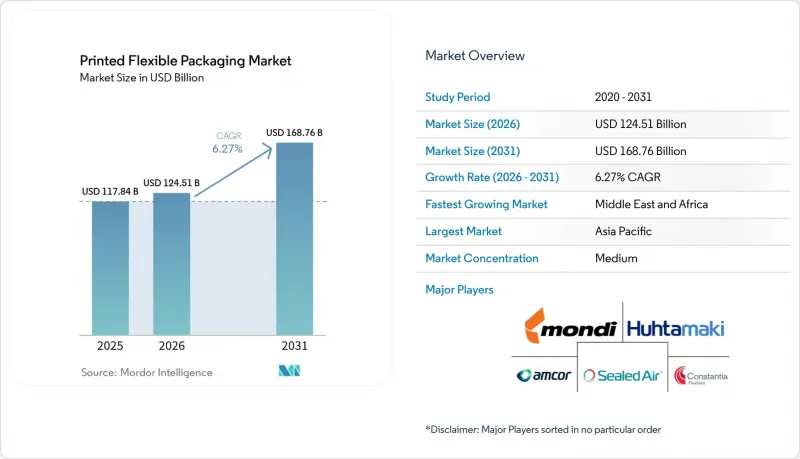
根據 Mordor Intelligence 預測,印刷軟包裝市場規模預計將從 2025 年的 1,178.4 億美元和 2026 年的 1,245.1 億美元成長到 2031 年的 1,687.6 億美元,2026 年至 2031 年的複合年成長率為 6.27%。
本報告按印刷技術(柔版印刷、凹版印刷等)、包裝類型(卷材和薄膜、袋子、標籤和收縮套標等)、終端用戶行業(食品飲料、家居和工業等)、基材[塑膠(PE、PP、PET等)、紙張和紙基材料等]以及地區進行細分。市場預測以美元計價。
全球印刷軟包裝市場趨勢與洞察
對適合商店展示的零售包裝的需求不斷成長。
隨著零售商對包裝的要求越來越高,希望包裝能最大程度地減少從運輸到展示過程中的搬運,展示包裝正成為印刷軟包裝市場需求成長的重要驅動力。這種轉變使得印刷圖形的角色更加重要,因為加工者需要在同一結構中同時提供視覺衝擊力、易讀性和操作一致性。歐洲大型連鎖超市不斷統一展示規格,這增加了對直接在軟性基材上進行高品質印刷的需求,而非使用單獨的標籤。這也縮短了從設計稿核准到商店展示的時間,使能夠管理更快、更頻繁生產週期的印刷軟包裝供應商在市場中佔據優勢。隨著越來越多的品牌所有者進行季節性、促銷性和區域性包裝調整,擁有柔版印刷和數位印刷能力的加工商在確保重複訂單和維持價格方面更具優勢。
阻隔性單材料結構的快速普及
隨著可回收性目標的日益重要,可印刷軟包裝市場正迅速向阻隔性單材料結構轉型,因為可回收性目標如今影響著材料選擇和印刷化學品。 2025年9月,Siegwerk、Borouge和TPN Food Packaging聯合推出了一個單層PE立式袋,其氧氣透過率低於1 cc/m²/天,且完全無需油墨。這表明,以往只有在更複雜的複合材料中才能實現的阻隔性能,如今在可回收設計中也能實現。 BOBST也報告稱,其「oneBARRIER PrimeCycle」單層PE結構在所有評估類別中均比鋁箔基替代品具有更低的環境影響,這進一步增強了加工商投資可回收薄膜解決方案的商業性理由。歐盟關於包裝和包裝廢棄物的法規正在推動這一轉變,這些法規強制要求包裝設計必須能夠大規模回收。因此,印刷用軟包裝市場的資金正轉向適用於印刷的單層材料薄膜、無油墨塗層以及兼顧外觀和可回收性的表面處理技術。
樹脂、薄膜和油墨的變動投入成本。
由於加工商的營運深受樹脂、薄膜、箔材和油墨價格波動的影響,原料成本波動仍然是可印刷軟包裝市場最明顯的限制之一。聚乙烯和聚丙烯的成本仍然容易受到原料和能源價格波動的影響,而這種影響在依賴進口聚合物供應的地區更為顯著。油墨系統也面臨壓力,因為加工商必須同時兼顧性能、合規性和供應穩定性。 Siegwerk推出的用於聚烯基材表面印刷的無硝基纖維素油墨著色系統表明,合規主導的配方變更正成為可印刷軟包裝市場原料成本管理的重要組成部分。推遲材料或油墨變更的加工商處境更加艱難,因為他們可能同時面臨成本波動和可回收性風險。
細分市場分析
2025年,柔版印刷佔據了印刷軟包裝市場49.34%的佔有率,並持續在食品、個人護理和居家醫療等領域保持領先地位。由於加工商持續優先考慮每米成本優勢、與多種承印物的兼容性以及印刷品質的穩步提升,柔版印刷的地位仍然穩固。自2020年以來,網版速度的提升、色彩系統的擴展以及更快速的換版方式,縮小了柔版印刷和凹版印刷之間曾經存在的明顯品質差距。 2026年4月,安姆科決定在荷蘭哈登貝格投資數百萬歐元新建一條柔版印刷生產線,新增年產能達6,000噸。這體現了安姆科對大規模柔版印刷生產的持續信心。
預計到2031年,數位印刷將以11.71%的複合年成長率成長,成為軟性包裝市場中印刷技術成長最快的製程。其主要原因是數位系統非常適合小批量生產、可變包裝、可變內容以及需要快速交付的專案。這正在改變印刷軟性包裝市場的供應商選擇標準,因為越來越多的買家現在要求加工商能夠在同一平台上處理大量類比印刷和快速交付的數位印刷工作。凹版印刷在高階應用中仍然保持強勁勢頭,尤其是在對長期視覺一致性要求極高的領域,這些應用需要極其穩定的油墨應用和極高的生產線速度。其他技術,包括混合印刷和特種印刷系統,繼續滿足更具體的需求,例如安全印刷效果和觸感表面處理,但它們的市場規模落後於彈性凸版印刷印刷,目前的成長速度也落後於數位印刷。
到2025年,軟包裝袋將佔印刷軟包裝市場的35.98%,反映出其在食品、醫療保健和個人保健產品領域的廣泛應用。自立袋、平袋和吸嘴袋因其高貨架可見度、材料用量少和便利性強而持續受到青睞。立式袋已成為品牌從玻璃瓶、硬質塑膠傳統包裝形式,或那些笨重、設計靈活性有限的包裝形式過渡的常見升級選擇。 2025年9月,Siegwerk、Borouge和TPN Food Packaging推出了可回收的阻隔性單材料立式袋。這表明,印刷軟包裝市場中軟包裝袋的成長與便利性和可回收性的提高密切相關。
捲材和薄膜在可印刷軟包裝市場中仍然扮演著核心角色,它們支撐著大規模生產的模塑-填充-封口 (FFS) 工藝,並為眾多加工商網路維持了高效的生產基礎。儘管捲材的單位價值低於一些成品包裝,但它為加工商提供了穩定的產量和長期的生產機會,有助於他們為數位印刷機、塗料和可回收複合材料的投資提供資金。在工業和農業散裝應用中,包裝袋仍然發揮著重要作用,這些應用的印刷要求相對簡單,但出貨量巨大。標籤和收縮套標作為以圖形主導的細分市場仍然十分重要,CCL Industries 於 2026 年 6 月收購了 Sleeve International,進一步拓展了這一業務領域,鞏固了其在全球包裝市場消費品和醫療保健應用整體軟膜和套標方面的地位。這要求加工商在可印製軟包裝市場中保持清晰的平衡,因為包裝袋生產的成長會吸引資本,而捲材仍能維持工廠的產能運轉率和現金流。
區域分析
到2025年,亞太地區將佔據印刷軟包裝市場37.89%的佔有率,成為最大的區域市場。該地區受益於中國龐大的加工企業基礎、印度不斷擴張的食品加工活動以及日本對高階、高規格包裝應用的強勁需求。隨著快速生產響應和本地化客製化包裝設計在電子商務、食品和消費品通路中變得日益重要,中國仍然是至關重要的市場。在印度,隨著包裝食品和日常消費品在都市區和半都市區市場的分銷不斷擴大,對包裝袋、複合材料和捲材的需求持續成長,推動了市場持續擴張。在日本,醫藥和高階食品領域對印刷品質、法規合規性和一致性的要求仍然很高,這支撐了印刷軟包裝市場的高價值細分領域。
歐洲仍然是印刷軟包裝的第二大市場,該市場受到嚴格的永續性法規和印刷標準的限制。歐盟包裝廢棄物法規是推動加工商投資的主要動力,加速了該地區從不可回收的多層結構轉向具有功能塗層的單層薄膜。德國和義大利仍然是重要的生產中心,而波蘭作為軟包裝加工領域的競爭製造地,也持續吸引人們的注意。北美在印刷軟包裝市場保持強勁的地位,醫療保健包裝、品牌推廣印刷和特殊薄膜應用等需求持續推動對先進印刷和材料技術的投資。
預計到2031年,中東和非洲地區的複合年成長率將達到7.04%,成為印刷軟包裝市場成長最快的區域板塊。沙烏地阿拉伯正增加對下游製造業的投入,這鞏固了其在食品、乳製品、零食和個人護理等領域的軟包裝生產基礎。土耳其正強化其作為北非供應和貿易樞紐的地位,尤其是在卷材和成品包裝袋的分銷方面。南非和奈及利亞仍然是撒哈拉以南非洲地區的主要需求來源,而南美洲的成長速度較慢,儘管巴西正在推動食品包裝形式的現代化,並持續擴大數位印刷在消費品和電商通路的應用。
其他好處
- Excel格式的市場預測(ME)表
- 3個月的分析師支持
目錄
第1章:引言
- 研究假設和市場定義
- 調查範圍
第2章:調查方法
第3章執行摘要
第4章 市場狀況
- 市場概覽
- 市場促進因素
- 商店展示所需的零售包裝需求不斷成長
- 過渡到更輕、更節約材料的包裝
- 加速採用阻隔性單材料結構
- 小批量數位印刷和變體印刷的成長
- 包裝食品的擴張和以便利性為優先的消費。
- 受永續發展理念驅動,形式正從僵化轉變為靈活。
- 市場限制因素
- 樹脂、薄膜和油墨的原料成本波動很大。
- 多層結構回收的複雜性
- 向先進印刷生產線進行資本密集轉型
- 食品接觸和生產者延伸責任的合規負擔
- 產業價值鏈分析
- 監理情勢
- 技術展望
- 宏觀經濟因素對市場的影響
- 波特五力分析
第5章 市場規模與成長預測
- 透過印刷技術
- 柔版印刷
- 凹版印刷
- 數位(噴墨、靜電複印)
- 其他印刷技術
- 按包裝類型
- 包裝袋(立式、扁平式、附傾倒嘴)
- 捲材和膠片
- 袋子和小袋
- 標籤和收縮套
- 其他
- 按最終用戶行業分類
- 飲食
- 藥物
- 個人護理化妝品
- 家用和工業用途
- 其他
- 按基礎材料
- 塑膠(PE、PP、PET 等)
- 紙/紙基
- 鋁箔和金屬化薄膜
- 其他基質
- 按地區
- 北美洲
- 美國
- 加拿大
- 墨西哥
- 南美洲
- 巴西
- 阿根廷
- 其他南美國家
- 歐洲
- 德國
- 英國
- 法國
- 義大利
- 西班牙
- 俄羅斯
- 其他歐洲國家
- 亞太地區
- 中國
- 日本
- 印度
- 韓國
- 澳洲
- 泰國
- 印尼
- 其他亞太國家
- 中東和非洲
- 中東
- 沙烏地阿拉伯
- 阿拉伯聯合大公國
- 土耳其
- 其他中東國家
- 非洲
- 南非
- 奈及利亞
- 埃及
- 其他非洲地區
- 中東
- 北美洲
第6章 競爭情勢
- 市場集中度
- 策略趨勢
- 市佔率分析
- 公司簡介
- Amcor plc
- Mondi plc
- Huhtamaki Oyj
- Sealed Air Corporation
- Constantia Flexibles Group GmbH
- Sonoco Products Company
- UFlex Limited
- Printpack Inc.
- Glenroy, Inc.
- CCL Industries Inc.
- Winpak Ltd.
- Coveris Holdings SA
- Sudpack Verpackungen GmbH & Co. KG
- Bischof+Klein SE & Co. KG
- ePac Holdings, LLC
- Clondalkin Group Holdings BV
- Goglio SpA
第7章 市場機會與未來展望
According to Mordor Intelligence, the printed flexible packaging market size is projected to expand from USD 117.84 billion in 2025 and USD 124.51 billion in 2026 to USD 168.76 billion by 2031, registering a CAGR of 6.27% between 2026 and 2031.
This report is Segmented by Printing Technology (Flexography, Rotogravure, and More), Packaging Type (Rollstock and Films, Bags and Sacks, Labels and Shrink Sleeves, and More), End-User Industry (Food and Beverage, Home Care and Industrial, and More), Substrate [Plastics (PE, PP, PET, Others), Paper and Paper-Based, and More], and Geography. The Market Forecasts are Provided in Terms of Value (USD).
Global Printed Flexible Packaging Market Trends and Insights
Rising Demand for Shelf-Ready Retail Packaging
Shelf-ready formats are becoming a stronger demand driver in the printed flexible packaging market, as retailers seek packs that move from transit to display with less handling. That change gives printed graphics a more central role because converters are expected to deliver visual impact, legibility, and operational consistency on the same structure. Large grocery chains in Europe have continued to standardize on display-ready specifications, which has increased the need for high-quality print directly on flexible substrates rather than on separate labels. It also shortens the time between artwork approval and store placement, favoring suppliers that can manage faster, more frequent production cycles in the printed flexible packaging market. As more brand owners run seasonal, promotional, and regional pack changes, converters with flexographic and digital capability are better placed to retain repeat work and protect pricing.
Faster Adoption of High-Barrier Mono-Material Structures
The printed flexible packaging market is moving more quickly toward high-barrier mono-material structures because recyclability targets now affect both material choice and print chemistry. In September 2025, Siegwerk, Borouge, and TPN Food Packaging commercialized a fully de-inkable mono-PE stand-up pouch with an oxygen transmission rate below 1 cc/m2/day, demonstrating that recyclable designs can now deliver barrier performance previously associated with more complex laminates. BOBST also reported that its oneBARRIER PrimeCycle mono-PE structure had a lower environmental impact than foil-based alternatives across all assessed categories, which strengthens the commercial case for converters investing in recyclable film solutions. The EU packaging and packaging waste rules are reinforcing this shift by requiring packaging to be designed for recyclability at scale. As a result, the printed flexible packaging market is seeing capital move toward print-compatible mono-material films, de-inking coatings, and surface treatments that preserve both appearance and recyclability.
Volatile Resin, Film, and Ink Input Costs
Input cost swings remain one of the clearest constraints on the printed flexible packaging market because converters are heavily exposed to resin, film, foil, and ink pricing. Polyethylene and polypropylene costs remain sensitive to feedstock and energy prices, and that exposure is stronger in regions that depend on imported polymer supply. Ink systems are also under pressure because converters must balance performance, compliance, and availability simultaneously. Siegwerk introduced an NC-free ink color system for surface printing on polyolefin-based structures, and that move showed how compliance-driven reformulation is also becoming part of input cost management in the printed flexible packaging market. Converters that delay material and ink changes face a more difficult position because they may face both cost volatility and recyclability risk simultaneously.
Other drivers and restraints analyzed in the detailed report include:
- Growth In Short-Run Digital and Versioned Printing
- Expansion of Packaged Food and Convenience Consumption
- Recycling Complexity of Multilayer Laminate Structures
For complete list of drivers and restraints, kindly check the Table Of Contents.
Segment Analysis
Flexography held 49.34% of the printed flexible packaging market in 2025, which kept it in the lead across long-run applications in food, personal care, and home care. Its position remained strong because converters continued to rely on favorable cost-per-meter economics, broad substrate compatibility, and steady improvements in print quality. Post-2020 progress in line-screen capability, expanded color systems, and faster plate change methods reduced the older quality gap that had once separated flexography more clearly from gravure. In April 2026, Amcor committed a multi-million-euro investment in a new flexographic printing line at Hardenberg in the Netherlands, adding capacity for up to 6,000 metric tonnes per year, which showed continued confidence in large-scale flexographic output.
Digital printing is projected to expand at an 11.71% CAGR through 2031, which makes it the fastest-growing process in the printed flexible packaging market size among printing technologies. The main reason is that digital systems are better suited to short runs, versioned packs, and jobs that need variable content or faster turnaround. That is changing supplier selection in the printed flexible packaging market because more buyers now want a converter that can manage both large-volume analog work and quick-turn digital work from the same platform. Rotogravure still retains a strong position in premium applications that demand very stable ink laydown and very high line speeds, especially where visual consistency remains critical over long runs. Other technologies, including hybrid and specialty systems, continue to serve narrower needs such as security print effects or tactile finishes, but they do not challenge the scale held by flexography and the growth pace now seen in digital.
Pouches accounted for 35.98% of the printed flexible packaging market in 2025, reflecting their widespread use across food, healthcare, and personal care products. Stand-up, flat, and spouted pouch designs continue to attract demand because they combine strong shelf visibility with lower material use and good handling convenience. The stand-up pouch has become a common upgrade route for brands moving away from glass, rigid plastic, or older pack types that carry higher weight or less flexible design space. In September 2025, Siegwerk, Borouge, and TPN Food Packaging introduced a recyclable high-barrier mono-material stand-up pouch, showing that pouch growth in the printed flexible packaging market is now tied to both convenience and improved recyclability.
Rollstock and films remain central to the printed flexible packaging market because they support high-volume form-fill-seal operations and provide the production base that keeps many converter networks efficient. While the value per unit is lower than in several pre-made formats, rollstock provides converters with steady volume and longer runs that help fund investment in digital presses, coatings, and recycle-ready laminates. Bags and sacks still serve bulk industrial and agricultural use where print requirements are simpler but shipment volumes are large. Labels and shrink sleeves stay important as a graphics-led niche, and CCL Industries expanded that area in June 2026 through its acquisition of Sleever International, strengthening its flexible film and sleeve position across consumer goods and healthcare uses in global packaging. This leaves converters with a clear balancing act in the printed flexible packaging market because pouch-making growth attracts capital, while rollstock remains the format that often supports plant-level utilization and cash generation.
Complete Report Scope:
- By Printing Technology
- Flexography
- Rotogravure
- Digital (Inkjet, Electrophotography)
- Other Printing Technologies
- By Packaging Type
- Pouches (Stand-up, Flat, Spouted)
- Rollstock and Films
- Bags and Sacks
- Labels and Shrink Sleeves
- Other Packaging Types
- By End-User Industry
- Food and Beverage
- Healthcare and Pharmaceuticals
- Personal Care and Cosmetics
- Home Care and Industrial
- Other End-User Industries
- By Substrate
- Plastics (PE, PP, PET, Others)
- Paper and Paper-based
- Aluminum Foil and Metallised Films
- Other Substrate Types
- By Geography
- North America
- United States
- Canada
- Mexico
- South America
- Brazil
- Argentina
- Rest of South America
- Europe
- Germany
- United Kingdom
- France
- Italy
- Spain
- Russia
- Rest of Europe
- Asia-Pacific
- China
- Japan
- India
- South Korea
- Australia
- Thailand
- Indonesia
- Rest of Asia-Pacific
- Middle East and Africa
- Middle East
- Saudi Arabia
- United Arab Emirates
- Turkey
- Rest of Middle East
- Africa
- South Africa
- Nigeria
- Egypt
- Rest of Africa
- Middle East
- North America
Geography Analysis
Asia-Pacific accounted for 37.89% of the printed flexible packaging market share in 2025, making it the largest regional market. The region benefits from China's large converting base, India's expanding food processing activity, and Japan's strong demand for premium and tightly specified packaging applications. China remains important because fast production response and localized pack design are increasingly valued across e-commerce, food, and consumer goods channels. India continues to add volume through pouch, laminate, and rollstock demand as packaged food and fast-moving consumer goods distribution deepen across urban and semi-urban markets. Japan supports the higher-value side of the printed flexible packaging market because pharmaceutical and premium food categories continue to require strong print quality, compliance, and consistency.
Europe remained the second-largest region in the printed flexible packaging market, and it continues to be shaped by strict sustainability rules and demanding print standards. The EU Packaging and Packaging Waste Regulation is a major driver of converter investment, pushing the region away from non-recyclable multilayer structures toward mono-material films with functional coatings. Germany and Italy remain important production centers, while Poland continues to attract activity as a competitive manufacturing base for flexible packaging conversion. North America keeps a strong position in the printed flexible packaging market because healthcare packaging, promotional brand runs, and specialty film applications continue to support investment in advanced print and material capability.
The Middle East and Africa is projected to expand at a 7.04% CAGR through 2031, which makes it the fastest-growing regional block in the printed flexible packaging market. Saudi Arabia is directing more attention toward downstream manufacturing, and that is improving the local base for flexible pack production in food, dairy, snacks, and personal care. Turkey is strengthening its role as a supply and trade link into North Africa, especially in rollstock and pre-made pouch movement. South Africa and Nigeria remain the main Sub-Saharan demand anchors, while South America is growing at a slower pace as Brazil continues to modernize food packaging formats and add more digitally printed applications in consumer and e-commerce channels.
- Amcor plc
- Mondi plc
- Huhtamaki Oyj
- Sealed Air Corporation
- Constantia Flexibles Group GmbH
- Sonoco Products Company
- UFlex Limited
- Printpack Inc.
- Glenroy, Inc.
- CCL Industries Inc.
- Winpak Ltd.
- Coveris Holdings S.A.
- Sudpack Verpackungen GmbH & Co. KG
- Bischof + Klein SE & Co. KG
- ePac Holdings, LLC
- Clondalkin Group Holdings B.V.
- Goglio S.p.A.
Additional Benefits:
- The market estimate (ME) sheet in Excel format
- 3 months of analyst support
TABLE OF CONTENTS
1 INTRODUCTION
- 1.1 Study Assumptions and Market Definition
- 1.2 Scope of the Study
2 RESEARCH METHODOLOGY
3 EXECUTIVE SUMMARY
4 MARKET LANDSCAPE
- 4.1 Market Overview
- 4.2 Market Drivers
- 4.2.1 Rising Demand for Shelf-Ready Retail Packaging
- 4.2.2 Shift Toward Lightweight and Material-Efficient Packs
- 4.2.3 Faster Adoption of High-Barrier Mono-Material Structures
- 4.2.4 Growth in Short-Run Digital and Versioned Printing
- 4.2.5 Expansion of Packaged Food and Convenience Consumption
- 4.2.6 Sustainability-Led Conversion from Rigid to Flexible Formats
- 4.3 Market Restraints
- 4.3.1 Volatile Resin, Film, and Ink Input Costs
- 4.3.2 Recycling Complexity of Multilayer Laminate Structures
- 4.3.3 Capital Intensive Migration to Advanced Printing Lines
- 4.3.4 Food Contact and Extended Producer Responsibility Compliance Burden
- 4.4 Industry Value Chain Analysis
- 4.5 Regulatory Landscape
- 4.6 Technological Outlook
- 4.7 Impact of Macroeconomic Factors on the Market
- 4.8 Porter's Five Forces Analysis
- 4.8.1 Threat of New Entrants
- 4.8.2 Bargaining Power of Buyers
- 4.8.3 Bargaining Power of Suppliers
- 4.8.4 Threat of Substitutes
- 4.8.5 Industry Rivalry
5 MARKET SIZE AND GROWTH FORECASTS (VALUE)
- 5.1 By Printing Technology
- 5.1.1 Flexography
- 5.1.2 Rotogravure
- 5.1.3 Digital (Inkjet, Electrophotography)
- 5.1.4 Other Printing Technologies
- 5.2 By Packaging Type
- 5.2.1 Pouches (Stand-up, Flat, Spouted)
- 5.2.2 Rollstock and Films
- 5.2.3 Bags and Sacks
- 5.2.4 Labels and Shrink Sleeves
- 5.2.5 Other Packaging Types
- 5.3 By End-User Industry
- 5.3.1 Food and Beverage
- 5.3.2 Healthcare and Pharmaceuticals
- 5.3.3 Personal Care and Cosmetics
- 5.3.4 Home Care and Industrial
- 5.3.5 Other End-User Industries
- 5.4 By Substrate
- 5.4.1 Plastics (PE, PP, PET, Others)
- 5.4.2 Paper and Paper-based
- 5.4.3 Aluminum Foil and Metallised Films
- 5.4.4 Other Substrate Types
- 5.5 By Geography
- 5.5.1 North America
- 5.5.1.1 United States
- 5.5.1.2 Canada
- 5.5.1.3 Mexico
- 5.5.2 South America
- 5.5.2.1 Brazil
- 5.5.2.2 Argentina
- 5.5.2.3 Rest of South America
- 5.5.3 Europe
- 5.5.3.1 Germany
- 5.5.3.2 United Kingdom
- 5.5.3.3 France
- 5.5.3.4 Italy
- 5.5.3.5 Spain
- 5.5.3.6 Russia
- 5.5.3.7 Rest of Europe
- 5.5.4 Asia-Pacific
- 5.5.4.1 China
- 5.5.4.2 Japan
- 5.5.4.3 India
- 5.5.4.4 South Korea
- 5.5.4.5 Australia
- 5.5.4.6 Thailand
- 5.5.4.7 Indonesia
- 5.5.4.8 Rest of Asia-Pacific
- 5.5.5 Middle East and Africa
- 5.5.5.1 Middle East
- 5.5.5.1.1 Saudi Arabia
- 5.5.5.1.2 United Arab Emirates
- 5.5.5.1.3 Turkey
- 5.5.5.1.4 Rest of Middle East
- 5.5.5.2 Africa
- 5.5.5.2.1 South Africa
- 5.5.5.2.2 Nigeria
- 5.5.5.2.3 Egypt
- 5.5.5.2.4 Rest of Africa
- 5.5.5.1 Middle East
- 5.5.1 North America
6 COMPETITIVE LANDSCAPE
- 6.1 Market Concentration
- 6.2 Strategic Moves
- 6.3 Market Share Analysis
- 6.4 Company Profiles (includes Global Level Overview, Market Level Overview, Core Segments, Financials as available, Strategic Information, Market Rank/Share, Products and Services, Recent Developments)
- 6.4.1 Amcor plc
- 6.4.2 Mondi plc
- 6.4.3 Huhtamaki Oyj
- 6.4.4 Sealed Air Corporation
- 6.4.5 Constantia Flexibles Group GmbH
- 6.4.6 Sonoco Products Company
- 6.4.7 UFlex Limited
- 6.4.8 Printpack Inc.
- 6.4.9 Glenroy, Inc.
- 6.4.10 CCL Industries Inc.
- 6.4.11 Winpak Ltd.
- 6.4.12 Coveris Holdings S.A.
- 6.4.13 Sudpack Verpackungen GmbH & Co. KG
- 6.4.14 Bischof + Klein SE & Co. KG
- 6.4.15 ePac Holdings, LLC
- 6.4.16 Clondalkin Group Holdings B.V.
- 6.4.17 Goglio S.p.A.
7 MARKET OPPORTUNITIES AND FUTURE OUTLOOK
- 7.1 White-Space and Unmet-Need Assessment

 軟包裝:市佔率分析、產業趨勢與統計、成長預測(2026-2031)
 全球軟性包裝材料市場預測(至2034年):依材料、產品、包裝層、應用、最終用戶和地區分類
 加工軟包裝市場:依材料、產品類型、最終用途產業、製造流程及阻隔性能分類-2026-2032年全球市場預測
 軟質包裝轉換市場-全球產業規模、佔有率、趨勢、機會、預測:按材料、應用、地區和競爭對手分類,2021-2031年塑膠載帶市場:2026-2032年全球預測(按材料、類型、寬度和應用分類)
 軟性包裝市場預測(2026-2031年)
 軟性包裝市場規模、佔有率、成長分析(依材料類型、產品類型、最終用途產業、製程類型、阻隔等級和地區分類)-2026-2033年產業預測轉換軟包裝市場,2032 年全球預測:按產品類型、材料、技術、應用和地區
 全球加工軟質市場(2024-2028)