


 |
市場調查報告書
商品編碼
2123990
軟包裝:市佔率分析、產業趨勢與統計、成長預測(2026-2031)Converted Flexible Packaging - Market Share Analysis, Industry Trends & Statistics, Growth Forecasts (2026 - 2031) |
||||||

※ 本網頁內容可能與最新版本有所差異。詳細情況請與我們聯繫。
據 Mordor Intelligence 稱,2025 年加工軟包裝市場價值為 2620.6 億美元,預計到 2031 年將達到 3519.2 億美元,而 2026 年為 2752.3 億美元,預測期(2026-2031 年)複合年成長率為 5.03%。
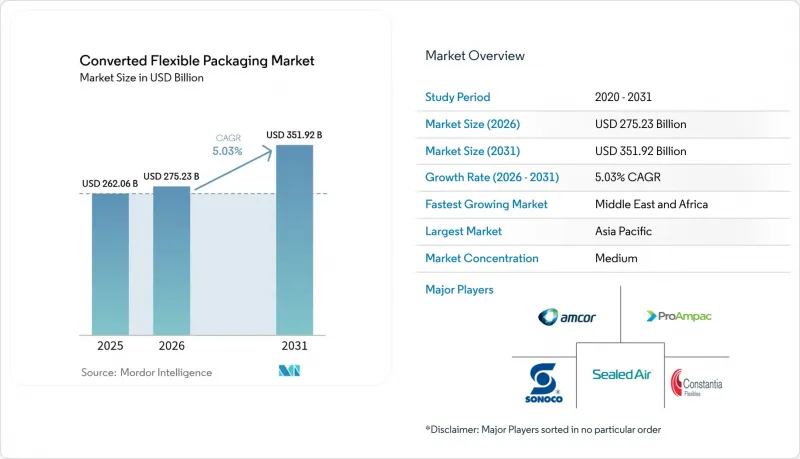
本報告按材料(塑膠薄膜、紙/紙板、鋁箔、生質塑膠)、包裝類型(袋裝、捲材/裝載膜等)、終端用戶行業(食品、醫藥/保健、個人護理/化妝品等)、分銷管道(直銷、間接銷售)和地區進行細分。市場預測以美元計價。
全球加工軟包裝市場趨勢及洞察
外出活動時食品和飲料消費量激增。
都市區生活方式導致用餐時間日益縮短,推動了即食零食、單份飲料和可重複密封包裝袋的需求成長。根據美國農業部2024年食品趨勢數據,超過50%的美國消費者希望產品兼具便攜性和包裝上的環保資訊。為此,各大品牌紛紛採用輕便的立式袋,與托盤和瓶裝產品相比,這種包裝可以降低運輸成本,從而減少全通路分銷中的體積重量費用。諸如HP Indigo 200K之類的數位印刷機能夠快速更換設計稿,幫助區域品牌測試限量版口味,而無需承擔製版成本。美國食品藥物管理局(FDA)的「更智慧食品安全新時代藍圖」加強了監管,強調直接面對消費者的配送包裝完整性,進一步提升了軟包裝市場對阻隔性、可重複密封解決方案的需求。
電子商務正在加速防護性郵寄包裝的需求。
宅配業者處理的營養補充劑、服裝和小型電子設備的數量不斷增加,他們正逐漸從紙箱轉向氣泡膜郵袋和可回收聚乙烯運輸袋,這些包裝既能保護貨物,又能減輕包裝重量。軟性包裝協會 (FPA) 於 2024 年發布的生命週期評估 (LCA) 證實,與同等規格的硬紙盒相比,聚乙烯郵袋產生的溫室氣體排放量更少,化石能源消耗量也減少了 47%。亞馬遜和 Mondi 共同開發的可回收郵袋在 2024 年榮獲三項永續發展獎,這表明更環保的「最後一公里」配送解決方案能夠提升品牌價值。根據美國農業部對大豆衍生生物聚合物的研究,未來企業或許能夠將防護郵袋轉化為可堆肥材料,同時不影響其跌落測試性能。
複雜多層回收基礎設施面臨的挑戰
雖然押金返還計劃主要針對瓶子,但很少涵蓋薄膜包裝,導致消費者無法回收複合零嘴零食和藥品包裝。歐盟的《塑膠包裝廢棄物法規》(PPWR)設定了2029年的瓶子回收目標,但並未提及軟包裝,這造成了合規性的不不確定性。億滋國際(Mondelez)和安姆科(Amcor)等領先的回收合作夥伴為吉百利(Cadbury)提供由80%化學回收材料製成的包裝,這表明技術上可行,但其應用仍依賴於尚未大規模生產的熱解設施。超過100億美元的資金需求可能會減緩東南亞和拉丁美洲的基礎建設,從而阻礙循環經濟的發展。
細分市場分析
2025年,塑膠薄膜在加工軟包裝市場中仍將佔據38.14%的佔有率,這得益於其成熟的擠出設備和在零食、乳製品和電商包裝信封領域的成功經驗。其中,聚乙烯用於冷凍食品和拉伸食品,而聚丙烯則透過單一材料舉措不斷擴大其市場佔有率,該計畫旨在支持歐盟指令2025/40規定的可回收性目標。聚對苯二甲酸乙二醇酯(PET)佔據著一個需要阻隔性的細分市場,例如咖啡包裝,但其多層結構增加了生產者責任召回(EPR)的負擔。鋁箔仍然是藥品和即溶飲料等需要100%阻隔性材料。
生質塑膠雖然起步規模較小,但憑藉澱粉混合物和符合ASTM家用可堆肥材料WK81525草案標準的PLA技術的進步,正以7.62%的複合年成長率快速成長。全球主要樹脂製造商和本地新創企業的投資表明,產能正在擴大,到2030年供應量預計將加倍。在甘蔗制乙醇價格穩定和政策獎勵的推動下,生物塑膠相對於化石基聚合物的成本溢價正在縮小。隨著地方政府擴大採用有機垃圾收集系統,食品品牌也開始使用可堆肥薄膜包裝新鮮農產品和單份咖啡膠囊。因此,採用生質塑膠加工的軟包裝市場正在蓬勃發展,強制性的再生材料含量標準鼓勵人們試驗使用可再生材料,以取代難以回收的複合材料。
到2025年,軟包裝袋將佔據軟包裝市場的主導地位,佔有率高達61.63%。這主要得益於自立袋的普及,自立袋最佳化了貨架展示效果,並允許在灌裝前平放運輸,從而顯著減少運輸過程中的浪費。吸嘴袋正擴展至即飲運動飲料領域,而蒸餾蒸煮袋則瞄準了常溫保存的寵物食品和嬰兒食品市場。數位印刷技術正在加速產品SKU的分層,並支援季節性設計和網紅合作,且無需設定較高的最低訂購量(MOQ)。捲材和蓋膜則為零食和優格等產品的高速成型、填充和封口生產線提供支持,使其在資本投資攤銷階段保持領先地位。
預計到2031年,用於軟包裝袋的加工軟包裝市場將以7.01%的複合年成長率成長,這主要得益於單層聚乙烯(PE)複合技術的進步,該技術彌補了單層PE複合與PET/鋁箔複合在阻隔性能上的差距。內層塗有生物塗層的紙質立式袋正出現在高階Granola和糖果甜點中,符合減少塑膠垃圾的趨勢。包裝袋適用於散裝運輸穀物和化學品,但由於電子商務的普及速度緩慢,其成長受到限制。在競爭激烈的零售空間中,包裝袋的形狀和拉鍊設計使其具有差異化優勢,而再封功能有助於減少食物廢棄物——這是許多零售商關注的指標。隨著全通路商務模糊了傳統的行業界限,軟包裝袋的多功能性正在鞏固其成長勢頭。
區域分析
預計到2025年,亞太地區將以39.62%的市佔率引領全球市場,這主要得益於其從樹脂到薄膜的一體化複合材料生產體系、龐大的消費群體以及高度靈活的加工商生態系統。 2023年,中國軟包裝產值達到1,213.4億元人民幣,預計到2027年將以7.16%的複合年成長率成長,這主要得益於零嘴零食出口的成長以及調理食品日益普及。在印度,隨著包裝食品的普及,需求不斷擴大,但產能成長卻跟不上,進口正在填補缺口。 UFlex公司公佈,2024年第一季淨銷售額為368.25億印度盧比。儘管BOPP/BOPET薄膜的供應過剩對價格構成壓力,但其長期基本面仍強勁。
在北美,成熟的回收基礎設施和電子商務的廣泛普及為企業發展提供了助力。各州推行的生產者責任召回(EPR)法規促使品牌商轉向使用單一材質包裝袋,而由於颶風襲擊墨西哥灣沿岸帶來的聚合物採購風險,供應鏈多元化已成為一項關鍵的經營團隊要務。北美在數位印刷技術的應用方面領先於世界其他地區,ePac 在其北美 23 個生產基地擴大小批量生產能力,正在提升該地區的技術水平。
在嚴格的塑膠包裝廢棄物法規 (PPWR) 和不斷上漲的生產者責任回收 (EPR) 費用的推動下,歐洲處於循環經濟創新的前沿。德國零售商強制要求自有品牌軟包裝到 2028 年必須含有至少 30% 的再生材料,加速化學回收領域的研發。英國將於 2024 年正式實施收費系統,這將迫使多層複合材料即時重新設計。東歐是西方品牌具有成本競爭力的生產中心,但必須遵守歐盟關於可回收性的指令。
中東和非洲地區以8.51%的複合年成長率位居全球之首,這主要得益於海灣國家餐飲服務業的擴張以及非洲快速消費品市場的製度化。 「沙烏地阿拉伯2030願景」的目標是實現42%的糧食自給率,這就需要生產包裝袋和蓋膜。奈及利亞的飲用水袋裝市場仍然大量使用低密度聚乙烯(LDPE)薄膜,但環保機構正在推動轉向使用更厚、可回收的包裝結構。
南美洲經濟正經歷溫和成長,巴西農產品的出口支撐了對咖啡和肉類包裝袋的需求。儘管阿根廷貨幣波動抑制了資本流入,但像Grupo HZ這樣的本土企業仍在繼續投資雷射劃線和水性油墨技術,以實現差異化競爭。
其他好處:
- Excel格式的市場預測(ME)表
- 3個月的分析師支持
目錄
第1章:引言
- 研究假設和市場定義
- 調查範圍
第2章:調查方法
第3章執行摘要
第4章 市場狀況
- 市場概覽
- 市場促進因素
- 外出時食品和飲料消費激增
- 電子商務的興起正在加速對防護性郵寄信封的需求。
- 採用阻隔性單材料薄膜以提高可回收性。
- 先進的數位印刷技術能夠以較低的最低訂購量 (MOQ) 實現 SKU 擴展。
- 政府禁止在生鮮食品配送領域使用硬質塑膠。
- 市場限制因素
- 複雜且多層次的回收基礎設施存在差異
- 原油價格波動會影響聚合物成本
- 生產者延伸責任制(EPR)費用正在擠壓利潤空間。
- BOPP/BOPET薄膜供應過剩導致價格競爭加劇。
- 供應鏈分析
- 監理情勢
- 技術展望
- 波特五力分析
- 宏觀經濟因素對市場的影響
第5章 市場規模與成長預測
- 材料
- 塑膠薄膜
- 聚乙烯
- 聚丙烯
- 聚對苯二甲酸乙二酯
- 其他塑膠薄膜
- 紙張和紙板
- 鋁箔
- 生質塑膠
- 塑膠薄膜
- 按包裝類型
- 小袋
- 捲材和蓋膜
- 包包
- 其他包裝形式
- 按最終用途行業分類
- 食物
- 麵包店
- 乳製品
- 糖果糕餅
- 調理食品
- 其他食物
- 飲料
- 非酒精性
- 酒精飲料
- 藥品和醫療保健
- 個人護理化妝品
- 家用產品
- 其他終端用戶產業
- 食物
- 透過分銷管道
- 直銷通路
- 間接銷售管道
- 按地區
- 北美洲
- 美國
- 加拿大
- 墨西哥
- 歐洲
- 德國
- 英國
- 法國
- 義大利
- 西班牙
- 荷蘭
- 其他歐洲國家
- 亞太地區
- 中國
- 日本
- 印度
- 韓國
- 澳洲
- 新加坡
- 其他亞太國家
- 中東和非洲
- 中東
- 沙烏地阿拉伯
- 阿拉伯聯合大公國
- 土耳其
- 其他中東國家
- 非洲
- 南非
- 奈及利亞
- 埃及
- 其他非洲國家
- 中東
- 南美洲
- 巴西
- 阿根廷
- 其他南美國家
- 北美洲
第6章 競爭情勢
- 市場集中度
- 策略趨勢
- 市佔率分析
- 公司簡介
- Amcor Plc
- Sealed Air Corporation
- Mondi Group
- Constantia Flexibles
- Sonoco Products Company
- ProAmpac
- Transcontinental Inc.
- Huhtamaki Oyj
- Coveris Holdings SA
- Uflex Ltd.
- Bemis(Amcor Flexibles)
- Bischof+Klein SE & Co. KG
- FlexPak Services LLC
- Winpak Ltd.
- Glenroy Inc.
- Clondalkin Group
- Printpack Inc.
- AR Packaging(Graphic Packaging)
- AptarGroup Inc.
第7章 市場機會與未來展望
According to Mordor Intelligence, the converted flexible packaging market size was valued at USD 262.06 billion in 2025 and estimated to grow from USD 275.23 billion in 2026 to reach USD 351.92 billion by 2031, at a CAGR of 5.03% during the forecast period (2026-2031).
This report is Segmented by Material (Plastic Film, Paper and Paperboard, Aluminum Foil, and Bioplastics), Packaging Format (Pouches, Rollstock and Lidding Films, and More), End-Use Industry (Food, Pharmaceutical and Healthcare, Personal Care and Cosmetics, and More), Distribution Channel (Direct Sales, and Indirect Sales), and Geography. The Market Forecasts are Provided in Terms of Value (USD).
Global Converted Flexible Packaging Market Trends and Insights
Surge in On-the-Go Food and Beverage Consumption
Urban lifestyles continue to compress mealtimes, prompting higher demand for ready-to-eat snacks, single-serve beverages, and resealable pouches. USDA 2024 food trend data showed more than 50% of U.S. consumers seek products that combine portability and environmental information on the pack. Brands respond with lightweight stand-up pouches that lower shipping costs versus trays and jars, decreasing dimensional weight fees for omnichannel distribution. Digital presses such as HP Indigo 200K allow rapid artwork changes, helping regional brands trial limited-edition flavors without tying up working capital in plates. Regulatory scrutiny under the FDA's New Era of Smarter Food Safety Blueprint elevates pack integrity during direct-to-consumer fulfillment, further reinforcing the converted flexible packaging market demand for high-barrier, resealable solutions.
E-commerce Accelerating Demand for Protective Mailer Formats
Parcel carriers process rising volumes of nutraceuticals, apparel and small electronics, prompting a pivot from corrugate to bubble mailers and recyclable polyethylene shippers that protect items while shrinking package weight. A 2024 Flexible Packaging Association LCA confirmed that poly mailers show lower greenhouse-gas footprints and 47% less fossil energy use than comparable rigid cartons. Amazon and Mondi co-developed curbside-recyclable mailers that won three sustainability awards in 2024, proving the brand equity upside of greener last-mile solutions. U.S. Department of Agriculture research into soy-based biopolymers indicates future entrants could shift protective mailers toward compostable substrates without compromising drop-test performance.
Complex Multi-Layer Recycling Infrastructure Gaps
Deposit-return schemes cover bottles but rarely target films, leaving consumers without pathways to recycle laminated snack or pharma packs. EU PPWR sets 2029 bottle collection targets but is silent on flexible formats, creating compliance uncertainty. Advanced recycling alliances, such as Mondelez and Amcor, delivering Cadbury wrappers with 80% chemically recycled content, prove technical viability yet hinge on unscaled pyrolysis hubs. Capital needs exceeding USD 10 billion may delay infrastructure roll-out in Southeast Asia and LatAm, slowing circularity progress.
Other drivers and restraints analyzed in the detailed report include:
- Adoption of High-Barrier Mono-Material Films for Recyclability
- Advanced Digital Printing Enabling Low-MOQ SKU Proliferation
- Crude-Oil Price Volatility Affecting Polymer Costs
For complete list of drivers and restraints, kindly check the Table Of Contents.
Segment Analysis
Plastic films retained 38.14% converted flexible packaging market share in 2025 due to entrenched extrusion assets and proven performance in snack, dairy and e-commerce mailer applications. Within this cohort, polyethylene serves frozen foods and stretch hooding, whereas polypropylene gains traction via mono-material initiatives that support recyclability targets under EU 2025/40. Polyethylene terephthalate occupies high-barrier niches like coffee, but its multilayered nature intensifies EPR penalties. Aluminum foil remains critical for pharmaceuticals and instant beverages where 100% moisture-oxygen barrier is non-negotiable.
Bioplastics, although from a smaller base, chart a 7.62% CAGR anchored by starch-blend and PLA advancements that satisfy ASTM backyard-compostable draft standard WK81525. Investments by global resin majors and local start-ups signal capacity ramps that could double supply by 2030. Cost premiums over fossil polymers are narrowing, aided by sugarcane ethanol price stability and policy incentives. Food brands exploit compostable films for produce and single-serve coffee pods, aligning with municipal organics collection roll-outs. The converted flexible packaging market size for bioplastics, therefore, gains momentum as mandatory recycled-content thresholds spur trials of renewable substitutes for hard-to-recycle laminates.
Pouches dominated with 61.63% converted flexible packaging market share in 2025, driven by stand-up models that optimize shelf visibility and ship flat pre-fill, slashing freight emissions. Spout pouches expand into ready-to-drink sports beverages, while retortable variants target ambient pet food and baby food. Digital printing accelerates SKU tiering, enabling seasonal artwork and influencer collaborations without high MOQs. Rollstock and lidding films support high-speed form-fill-seal lines in snacks and yogurt, holding ground where capital equipment is amortized.
The converted flexible packaging market size for pouches is forecast to rise 7.01% CAGR through 2031 as mono-PE laminate breakthroughs close barrier gaps versus PET/foil. Paper-based stand-up pouches with internal bio-coatings debut in premium granola and confectionery, appealing to plastic reduction pledges. Bags and sacks address bulk grains and chemicals, yet slower e-commerce uptake caps expansion. Shaped and zipper formats provide differentiation in crowded aisles, and reseal features curb food waste, a metric tracked by many retailers. As omnichannel commerce blurs traditional trade boundaries, pouch versatility secures its growth trajectory.
Complete Report Scope:
- By Material
- Plastic Film
- Polyethylene
- Polypropylene
- Polyethylene Terephthalate
- Other Plastic Films
- Paper and Paperboard
- Aluminum Foil
- Bioplastics
- Plastic Film
- By Packaging Format
- Pouches
- Rollstock and Lidding Films
- Bags and Sacks
- Other Packaging Formats
- By End-use Industry
- Food
- Bakery
- Dairy
- Confectionery
- Ready Meals
- Other Food Products
- Beverage
- Non-Alcoholic
- Alcoholic
- Pharmaceutical and Healthcare
- Personal Care and Cosmetics
- Household Products
- Other End-use Industries
- Food
- By Distribution Channel
- Direct Sales Channel
- Indirect Sales Channel
- By Geography
- North America
- United States
- Canada
- Mexico
- Europe
- Germany
- United Kingdom
- France
- Italy
- Spain
- Netherlands
- Rest of Europe
- Asia-Pacific
- China
- Japan
- India
- South Korea
- Australia
- Singapore
- Rest of Asia-Pacific
- Middle East and Africa
- Middle East
- Saudi Arabia
- United Arab Emirates
- Turkey
- Rest of Middle East
- Africa
- South Africa
- Nigeria
- Egypt
- Rest of Africa
- Middle East
- South America
- Brazil
- Argentina
- Rest of South America
- North America
Geography Analysis
Asia-Pacific led with 39.62% share in 2025 on the back of integrated resin-to-film complexes, populous consumer bases, and agile converter ecosystems. China's flexible packaging output hit RMB 121.34 billion in 2023 and is poised for 7.16% CAGR through 2027, buoyed by snack exports and rising ready-meal adoption. Indian demand advances alongside packaged food uptake, yet capacity lags, prompting UFlex to report INR 36,825 million net revenue in Q1 2024 as imports fill gaps. Oversupply of BOPP/BOPET films creates pricing headwinds, but long-term fundamentals remain intact.
North America benefits from a mature recycling infrastructure and e-commerce penetration. State-level EPR legislation drives brand conversions to mono-material pouches, while polymer sourcing risks from Gulf Coast hurricanes keep supply-chain diversification on executive agendas. Digital printing adoption leads globally, with ePac scaling 23 North American sites to service short runs, which raises the region's technology benchmark.
Europe's stringent PPWR and escalating EPR fees place it at the forefront of circular-economy innovation. German retailers stipulate minimum 30% recycled content in private-label flexible packs by 2028, accelerating R&D in chemical recycling. The United Kingdom formalized fee schedules in 2024, compelling immediate redesign of multilayer laminates. Eastern Europe serves as cost-competitive production base for Western brands, yet must align with EU recyclability directives.
The Middle East and Africa post the fastest 8.51% CAGR, buoyed by Gulf food-service expansion and African FMCG formalization. Saudi Vision 2030 targets 42% local food self-sufficiency, necessitating pouch and lidding film lines. Nigeria's sachet water market remains a high-volume user of LDPE film, though environmental agencies push for thicker, recyclable structures.
South America records moderate growth, with Brazil's agribusiness exports supporting barrier bag demand for coffee and meat. Argentina's currency volatility tempers capital imports, yet regional players such as Grupo HZ continue to invest in laser scoring and water-based inks for differentiation.
- Amcor Plc
- Sealed Air Corporation
- Mondi Group
- Constantia Flexibles
- Sonoco Products Company
- ProAmpac
- Transcontinental Inc.
- Huhtamaki Oyj
- Coveris Holdings SA
- Uflex Ltd.
- Bemis (Amcor Flexibles)
- Bischof + Klein SE & Co. KG
- FlexPak Services LLC
- Winpak Ltd.
- Glenroy Inc.
- Clondalkin Group
- Printpack Inc.
- AR Packaging (Graphic Packaging)
- AptarGroup Inc.
Additional Benefits:
- The market estimate (ME) sheet in Excel format
- 3 months of analyst support
TABLE OF CONTENTS
1 INTRODUCTION
- 1.1 Study Assumptions and Market Definition
- 1.2 Scope of the Study
2 RESEARCH METHODOLOGY
3 EXECUTIVE SUMMARY
4 MARKET LANDSCAPE
- 4.1 Market Overview
- 4.2 Market Drivers
- 4.2.1 Surge in on-the-go food and beverage consumption
- 4.2.2 E-commerce accelerating demand for protective mailer formats
- 4.2.3 Adoption of high-barrier mono-material films for recyclability
- 4.2.4 Advanced digital printing enabling low-MOQ SKU proliferation
- 4.2.5 Government bans on rigid plastics in fresh-produce channels
- 4.3 Market Restraints
- 4.3.1 Complex multi-layer recycling infrastructure gaps
- 4.3.2 Crude-oil price volatility affecting polymer costs
- 4.3.3 Extended-Producer-Responsibility (EPR) fees squeezing margins
- 4.3.4 BOPP/BOPET film overcapacity driving price wars
- 4.4 Supply Chain Analysis
- 4.5 Regulatory Landscape
- 4.6 Technological Outlook
- 4.7 Porter's Five Forces Analysis
- 4.7.1 Threat of New Entrants
- 4.7.2 Bargaining Power of Buyers
- 4.7.3 Bargaining Power of Suppliers
- 4.7.4 Threat of Substitutes
- 4.7.5 Intensity of Competitive Rivalry
- 4.8 Impact of Macroeconomic Factors on the Market
5 MARKET SIZE AND GROWTH FORECASTS (VALUES)
- 5.1 By Material
- 5.1.1 Plastic Film
- 5.1.1.1 Polyethylene
- 5.1.1.2 Polypropylene
- 5.1.1.3 Polyethylene Terephthalate
- 5.1.1.4 Other Plastic Films
- 5.1.2 Paper and Paperboard
- 5.1.3 Aluminum Foil
- 5.1.4 Bioplastics
- 5.1.1 Plastic Film
- 5.2 By Packaging Format
- 5.2.1 Pouches
- 5.2.2 Rollstock and Lidding Films
- 5.2.3 Bags and Sacks
- 5.2.4 Other Packaging Formats
- 5.3 By End-use Industry
- 5.3.1 Food
- 5.3.1.1 Bakery
- 5.3.1.2 Dairy
- 5.3.1.3 Confectionery
- 5.3.1.4 Ready Meals
- 5.3.1.5 Other Food Products
- 5.3.2 Beverage
- 5.3.2.1 Non-Alcoholic
- 5.3.2.2 Alcoholic
- 5.3.3 Pharmaceutical and Healthcare
- 5.3.4 Personal Care and Cosmetics
- 5.3.5 Household Products
- 5.3.6 Other End-use Industries
- 5.3.1 Food
- 5.4 By Distribution Channel
- 5.4.1 Direct Sales Channel
- 5.4.2 Indirect Sales Channel
- 5.5 By Geography
- 5.5.1 North America
- 5.5.1.1 United States
- 5.5.1.2 Canada
- 5.5.1.3 Mexico
- 5.5.2 Europe
- 5.5.2.1 Germany
- 5.5.2.2 United Kingdom
- 5.5.2.3 France
- 5.5.2.4 Italy
- 5.5.2.5 Spain
- 5.5.2.6 Netherlands
- 5.5.2.7 Rest of Europe
- 5.5.3 Asia-Pacific
- 5.5.3.1 China
- 5.5.3.2 Japan
- 5.5.3.3 India
- 5.5.3.4 South Korea
- 5.5.3.5 Australia
- 5.5.3.6 Singapore
- 5.5.3.7 Rest of Asia-Pacific
- 5.5.4 Middle East and Africa
- 5.5.4.1 Middle East
- 5.5.4.1.1 Saudi Arabia
- 5.5.4.1.2 United Arab Emirates
- 5.5.4.1.3 Turkey
- 5.5.4.1.4 Rest of Middle East
- 5.5.4.2 Africa
- 5.5.4.2.1 South Africa
- 5.5.4.2.2 Nigeria
- 5.5.4.2.3 Egypt
- 5.5.4.2.4 Rest of Africa
- 5.5.4.1 Middle East
- 5.5.5 South America
- 5.5.5.2 Brazil
- 5.5.5.3 Argentina
- 5.5.5.4 Rest of South America
- 5.5.1 North America
6 COMPETITIVE LANDSCAPE
- 6.1 Market Concentration
- 6.2 Strategic Moves
- 6.3 Market Share Analysis
- 6.4 Company Profiles (includes Global level Overview, Market level overview, Core Segments, Financials, Strategic Information, Market Rank/Share, Products and Services, Recent Developments)
- 6.4.1 Amcor Plc
- 6.4.2 Sealed Air Corporation
- 6.4.3 Mondi Group
- 6.4.4 Constantia Flexibles
- 6.4.5 Sonoco Products Company
- 6.4.6 ProAmpac
- 6.4.7 Transcontinental Inc.
- 6.4.8 Huhtamaki Oyj
- 6.4.9 Coveris Holdings SA
- 6.4.10 Uflex Ltd.
- 6.4.11 Bemis (Amcor Flexibles)
- 6.4.12 Bischof + Klein SE & Co. KG
- 6.4.13 FlexPak Services LLC
- 6.4.14 Winpak Ltd.
- 6.4.15 Glenroy Inc.
- 6.4.16 Clondalkin Group
- 6.4.17 Printpack Inc.
- 6.4.18 AR Packaging (Graphic Packaging)
- 6.4.19 AptarGroup Inc.
7 MARKET OPPORTUNITIES AND FUTURE OUTLOOK
- 7.1 White-space and Unmet-need Assessment

 全球軟性包裝材料市場預測(至2034年):依材料、產品、包裝層、應用、最終用戶和地區分類
 印刷軟包裝:市場佔有率分析、產業趨勢與統計、成長預測(2026-2031)
 加工軟包裝市場:依材料、產品類型、最終用途產業、製造流程及阻隔性能分類-2026-2032年全球市場預測
 軟質包裝轉換市場-全球產業規模、佔有率、趨勢、機會、預測:按材料、應用、地區和競爭對手分類,2021-2031年塑膠載帶市場:2026-2032年全球預測(按材料、類型、寬度和應用分類)
 軟性包裝市場預測(2026-2031年)
 軟性包裝市場規模、佔有率、成長分析(依材料類型、產品類型、最終用途產業、製程類型、阻隔等級和地區分類)-2026-2033年產業預測轉換軟包裝市場,2032 年全球預測:按產品類型、材料、技術、應用和地區
 全球加工軟質市場(2024-2028)