


 |
市場調查報告書
商品編碼
2072549
旅館業機器人:市場佔有率分析、產業趨勢與統計及成長預測(2026-2031 年)Hospitality Robots - Market Share Analysis, Industry Trends & Statistics, Growth Forecasts (2026 - 2031) |
||||||

※ 本網頁內容可能與最新版本有所差異。詳細情況請與我們聯繫。
據 Mordor Intelligence 稱,2025 年酒店業機器人市場價值 6.1 億美元,預計到 2031 年將從 2026 年的 7.6 億美元成長到 22.3 億美元,預測期(2026-2031 年)的複合年成長率為 24.10%。
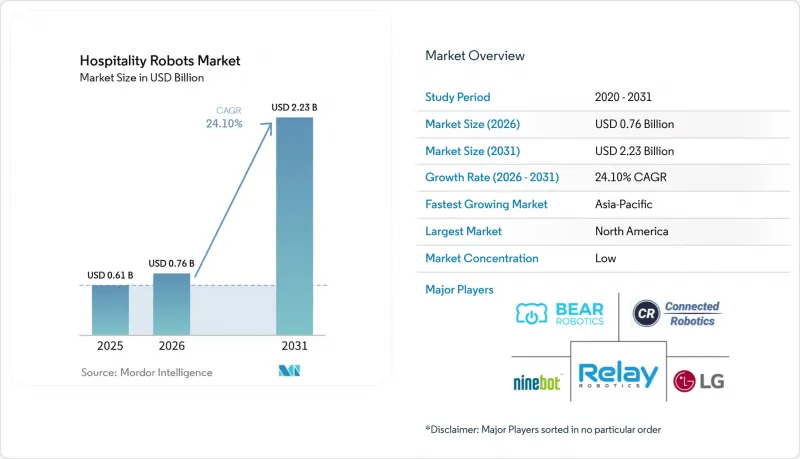
本報告按機器人類型(接待/引導機器人、配送機器人等)、組件(硬體、軟體、服務)、最終用戶(飯店、餐廳/酒吧等)、部署位置(前廳和後廚)以及地區(北美、南美、歐洲、亞太、中東和非洲)進行細分。市場預測以美元計價。
全球酒店機器人市場趨勢與洞察
數位和自動化技術的廣泛應用
隨著數位轉型 (DX) 專案的廣泛應用,企業在追求統一、數據驅動的服務模式的過程中,正積極推動機器人技術的應用。將機器人與基於雲端的飯店和餐飲管理軟體整合的設施報告稱,客房服務準時率和客房清潔處理時間等營運指標提升了 15% 至 30%。機器人群集管理儀錶板使管理人員能夠即時監控機器人的位置和任務狀態,從而主動調整機器人和人工員工之間的工作量平衡。隨著物聯網感測器和建築管理系統開放 API,機器人可以獲得有關電梯可用性、宴會廳運作和環境狀況的詳細信息,從而提高營運效率。同時,透過機載攝影機和雷射雷達收集的數據用於創建匿名化的賓客移動熱圖,使員工能夠精準地定位在最需要人工干預的區域。供應商正在重點推廣可在本地處理影像的邊緣人工智慧模組,以降低延遲並解決歐洲和亞洲部分地區的資料主權問題。
疫情後飯店餐飲業人手不足
即使到了2024年,餐飲住宿的離職率仍比2020年以前高出76%。因此,經營團隊已將部分員工重新部署到高價值的客戶服務職位,並部署機器人來處理重複性工作,例如走廊送餐、餐桌清理和走廊吸塵。已採用送餐機器人的場所,客房送餐服務減少了20%至35%,使員工能夠專注於前台的提升銷售和會員忠誠度計畫。在廚房,半自動炸鍋站可在班次間隙維持生產水平,即使在尖峰時段也能保持訂單處理時間的穩定,從而確保整個服務期間的品質始終如一。這種生產力的提升有助於降低人事費用上升的風險,並在因移民政策導致季節性勞動力供應緊張的市場中穩定服務品質。
小規模企業初始資本支出(CAPEX)較高
單一機器人的購買價格在 1.5 萬美元到 5 萬美元之間,這對利潤率極低的家庭旅館和獨立咖啡館來說是一筆不小的開銷。雖然訂閱式機器人和收益分成模式等資金籌措方案正在湧現,但在連鎖網路之外的普及程度仍參差不齊。小規模企業也面臨培訓相關的營運成本挑戰。由於缺乏內部 IT 團隊,他們通常將維護工作外包給外部整合商,導致整體擁有成本增加。為了解決這個難題,供應商現在提供多年服務計劃和租賃計劃,根據預期的人事費用節省調整付款方式,但從經濟角度來看,擁有多家分店的大規模企業仍然具有顯著優勢。
細分市場分析
預計到2025年,配送機器人將佔據飯店機器人市場39.05%的佔有率,其優勢在於投資回報率高且易於整合到工作流程中。同時,安防監控平台預計將在2031年之前以26.1%的複合年成長率加速成長,這主要得益於財產保險公司為實施主動監控的設施提供的優惠保費。這些機器人會在大廳和停車場巡邏,將360度影像串流傳輸到中央指揮中心,並對可疑活動發出即時警報。此外,接待機器人可以引導旅客完成多語言入住手續,清潔機器人則可以處理諸如走廊吸塵和會議室紫外線消毒等任務。在2024年國際消費電子展(CES)上,包括Richtech公司的ADAM調酒機器人在內的烹飪機器人的演示,展現了機器人技術在專業烹飪任務中的巨大潛力。
更完善的法規結構確保了人類與自主機器的安全共存。 UL 3320認證現已成為許多全方位服務連鎖飯店(尤其是在北美)的採購要求,這進一步提升了符合該認證標準的供應商的競爭優勢。隨著安全標準的日趨成熟,飯店業主預計機器人將得到更廣泛的應用,並將其視為未來智慧飯店藍圖中不可或缺的支柱。在整個預測期內,涵蓋配送、保全、清潔和引導等多元化的服務組合將有助於供應商抵禦特定應用領域需求的波動,並使其即使在零件成本下降的情況下也能保持穩定的利潤率。
預計到2025年,硬體支出佔總支出的59.12%,營運商將投資於底盤、電池和感測器組件等機器人自主運作所需的零件。然而,軟體層面的成長速度最快,複合年成長率高達25.05%,人工智慧驅動的路線最佳化、自然語言處理和預測性維護演算法最大限度地提升了實體資產的價值。供應商透過車隊管理入口網站提供空中下載(OTA)更新,以延長設備的使用壽命,並透過無需機械改造即可應用新功能,將收入轉向高利潤的經常性授權收入。對於營運商而言,分析儀表板整合了配送、清潔和保全車隊的各項績效指標,提供全公司範圍的洞察,以輔助人員配置決策。
服務領域,包括安裝、培訓和全天候遠端支持,規模雖小,但戰略意義重大。隨著擁有多家飯店的飯店集團在其連鎖飯店中部署機器人,對能夠校準雷射雷達設備、整合式飯店管理系統應用程式介面 (PMS API) 以及協調合規性檢查的認證技術人員的需求日益成長。與區域系統整合商的合作正在加速這些能力的擴展。尤其是在拉丁美洲和中東地區,本地支援正在降低運轉率率高峰期停機帶來的聲譽風險。
區域分析
北美地區佔據37.70%的市場佔有率,這反映了其早期試點部署經驗和強大的創業投資支持。連鎖協議使供應商能夠快速擴展業務。例如,Relay Robotics的多設施部署正在提高飯店電梯的利用率,這些電梯針對機器人API進行了最佳化。一家加拿大營運商正專注於為路邊設施停車場部署保全機器人,以解決人手不足期間的安全問題。在墨西哥度假區,雙語送貨機器人正被用於透過展示數位化提升銷售資訊來提高客房送餐服務量。
亞太地區25.8%的複合年成長率主要得益於政策支持、製造效率的提升以及顧客對科技的親和性。在中國,大多數三星級及以上飯店都至少配備了一台服務機器人,而像九號機器人這樣的本土品牌正在大都會圈開展行銷宣傳活動,力求讓機器人送餐服務成為常態。在日本,人口老化和飯店業嚴重的人手不足促使商務旅館開始使用機器人深夜送餐。在新加坡樟宜機場酒店叢集,一款與機場系統協同工作的多功能導航機器人正在試點運行,該機器人能夠實現從到達大廳到酒店大廳的無縫導航。
在歐洲,人們正在努力平衡基於GDPR的隱私權要求和環境保護需求。在德國,住宿設施必須現場處理數據,這迫使供應商採用邊緣人工智慧模型,避免將數據上傳到雲端。在法國,精品酒店專注於設計美學,並選擇了外觀可客製化以契合其品牌主題的機器人。在西班牙一家海濱度假村,配備戶外功能的保全機器人會在泳池邊巡邏,讓工作人員能夠專注於與客人互動。
其他好處:
- Excel格式的市場預測(ME)表
- 3個月的分析師支持
目錄
第1章:引言
- 研究假設和市場定義
- 調查範圍
第2章:調查方法
第3章執行摘要
第4章 市場狀況
- 市場概覽
- 市場促進因素
- 數位化和自動化技術正變得越來越普及。
- 疫情後飯店餐飲業人手不足
- 感測器和組件價格下降
- 對非接觸式賓客體驗的需求激增
- 政府鼓勵引入服務型機器人
- 邊緣人工智慧可實現即時本地分析。
- 市場限制因素
- 對於小規模企業來說,初始資本支出(CAPEX)很高。
- 與傳統PMS系統互通性和整合面臨的挑戰
- 客戶使用案例中的資料隱私問題
- 除一級房產外,其他房產的投資報酬率有限。
- 產業價值鏈分析
- 監理情勢
- 技術展望
- 宏觀經濟因素的影響
- 波特五力分析
第5章 市場規模與成長預測
- 按機器人類型
- 接收和導航機器人
- 配送機器人
- 機器人吸塵器
- 烹飪機器人
- 安防監控機器人
- 按組件
- 硬體
- 軟體
- 服務
- 最終用戶
- 飯店
- 餐廳和酒吧
- 觀光企業
- 休閒設施、活動、景點
- 不同的發展
- 前廳
- 後廚
- 按地區
- 北美洲
- 美國
- 加拿大
- 墨西哥
- 南美洲
- 巴西
- 阿根廷
- 其他南美國家
- 歐洲
- 德國
- 英國
- 法國
- 義大利
- 西班牙
- 其他歐洲國家
- 亞太地區
- 中國
- 日本
- 印度
- 韓國
- 東南亞
- 其他亞太國家
- 中東
- 沙烏地阿拉伯
- 阿拉伯聯合大公國
- 土耳其
- 其他中東國家
- 非洲
- 南非
- 奈及利亞
- 其他非洲國家
- 北美洲
第6章 競爭情勢
- 市場集中度
- 策略趨勢
- 市佔率分析
- 公司簡介
- Relay Robotics Inc.
- LG Electronics Inc.
- Bear Robotics Inc.
- Ninebot Limited
- Connected Robotics Inc.
- Aethon Inc.
- SoftBank Robotics Group Corp.
- Knightscope Inc.
- Pudu Robotics Co. Ltd.
- Keenon Robotics Co. Ltd.
- PAL Robotics SL
- Tailos Inc.
- Robotemi Ltd.
- UBTECH Robotics Inc.
- Savioke Inc.
- Service Robots GmbH
- Innova Robotics and Automation
- OrionStar Robotics Co. Ltd.
- Cobalt Robotics Inc.
- Richtech Robotics Inc.
第7章 市場機會與未來展望
According to Mordor Intelligence, the hospitality robots market size was valued at USD 0.61 billion in 2025 and estimated to grow from USD 0.76 billion in 2026 to reach USD 2.23 billion by 2031, at a CAGR of 24.10% during the forecast period (2026-2031).
This report is Segmented by Robot Type (Reception and Mobile Guidance Robots, Delivery Robots, and More), Component (Hardware, Software, and Services), End-User (Hotels, Restaurants and Bars, Tand More), Deployment (Front-Of-House and Back-Of-House), and Geography (North America, South America, Europe, Asia Pacific, Middle East, and Africa). The Market Forecasts are Provided in Terms of Value (USD).
Global Hospitality Robots Market Trends and Insights
Growing Penetration of Digital and Automation Technologies
Widespread digital transformation programs are pushing operators toward robotics as they seek unified, data-driven service models. Properties that integrate robots with cloud-based hotel and hospitality management software report 15%-30% uplifts in operational metrics such as room-service punctuality and housekeeping turnaround. Fleet-management dashboards provide managers with real-time location and task status, enabling proactive load balancing between robots and human staff. As IoT sensors and building-management systems expose their APIs, robots receive granular inputs on elevator availability, banquet hall occupancy, and environmental conditions, thereby improving task efficiency. At the same time, data captured through onboard cameras and lidar builds anonymized heat maps of guest traffic, allowing for the precise scheduling of staff where human touch delivers the most value. Suppliers highlight edge-AI modules that process images locally, reducing latency and addressing data-sovereignty concerns in Europe and parts of Asia.
Post-Pandemic Labour Shortages in Hospitality
Turnover rates remained 76% higher than pre-2020 levels in 2024 for food-service and lodging businesses. Managers consequently reassigned human staff to high-value interactions and deployed robots to handle repetitive workloads, including corridor deliveries, table busing, and corridor vacuuming. Properties using delivery robots have documented 20%-35% reductions in manual room-service runs, freeing attendants to focus on upselling or loyalty-program engagement at the front desk. In kitchens, semi-autonomous fry stations maintain output during shift gaps, ensuring consistent ticket times across service peaks, thereby maintaining consistency throughout service periods. These productivity gains mitigate wage-pressure risks and stabilize service quality in markets where immigration policy tightens the supply of seasonal workers.
High Upfront CAPEX for Small Operators
Purchase prices ranging from USD 15,000 to USD 50,000 per robot deter family-owned inns and independent cafes, which operate on razor-thin margins. Financing solutions are emerging in subscription robotics and revenue-sharing models, but adoption outside chain networks remains uneven. Small operators also face training overheads; lacking in-house IT teams, they often outsource maintenance to third-party integrators, thereby increasing the total cost of ownership. Vendors responding to this barrier now bundle multi-year service agreements, while leasing packages align payments with projected labor savings, yet the economics still favor larger properties with multi-unit rollouts.
Other drivers and restraints analyzed in the detailed report include:
- Surge in Demand for Contact-less Guest Experiences
- Government Incentives for Service-Robot Adoption
- Interoperability and Integration Issues with Legacy PMS
For complete list of drivers and restraints, kindly check the Table Of Contents.
Segment Analysis
Delivery units retained a 39.05% slice of the hospitality robots market in 2025, underscoring their rapid ROI and straightforward workflow integration. Security and surveillance platforms, however, are expected to accelerate at a 26.1% CAGR to 2031, buoyed by property insurers' favorable premiums for sites employing active monitoring. These robots patrol lobbies and parking structures, streaming 360-degree video to centralized command centers and triggering real-time alerts when they detect suspicious patterns. In parallel, reception robots guide travelers through multilingual check-in steps, while cleaning robots tackle corridor vacuuming and UV-C disinfection of meeting rooms. Demonstrations of food-preparation robots, including Richtech's ADAM bartender at CES 2024, validate robotics' potential even in skilled culinary tasks.
A tightening regulatory framework ensures safe cohabitation between humans and autonomous machines. UL 3320 certification now serves as a procurement prerequisite for many full-service hotel chains, particularly in North America, thereby reinforcing the competitive advantage of compliant vendors. As safety standards mature, property owners anticipate broader integration, positioning robots as an indispensable pillar of forthcoming smart-hotel blueprints. Throughout the forecast horizon, diversified portfolios delivery, security, cleaning, and guidance will insulate suppliers from demand swings in any one application cluster, supporting stable contribution margins even as component costs decline.
Hardware accounted for 59.12% of 2025 spending, as operators paid for chassis, battery, and sensor assemblies crucial to robot autonomy. Yet the software layer is scaling fastest, advancing at a 25.05% CAGR, because AI-driven route optimization, natural language processing, and predictive maintenance algorithms unlock the full value of physical assets. Vendors are packaging over-the-air updates that extend the functional life of units; fleet-management portals push new behaviors without mechanical alteration, shifting revenue toward high-margin recurring licenses. For operators, analytics dashboards consolidate performance metrics across delivery, cleaning, and security fleets, offering enterprise-wide insights that inform staffing decisions.
The services slice, including installation, training, and 24/7 remote support, remains the smallest but strategically critical. As multi-property hotel groups roll out robots chain-wide, demand rises for certified technicians able to calibrate lidar units, integrate PMS APIs, and coordinate compliance inspections. Partnerships with regional systems integrators accelerate this capability build-out, particularly in Latin America and the Middle East, where localized support mitigates reputational risk associated with downtime during high-occupancy periods.
Complete Report Scope:
- By Robot Type
- Reception and Mobile Guidance Robots
- Delivery Robots
- Cleaning Robots
- Food-Preparation Robots
- Security and Surveillance Robots
- By Component
- Hardware
- Software
- Services
- By End-User
- Hotels
- Restaurants and Bars
- Travel and Tourism Operators
- Recreational Facilities, Events and Attractions
- By Deployment
- Front-of-House
- Back-of-House
- By Geography
- North America
- United States
- Canada
- Mexico
- South America
- Brazil
- Argentina
- Rest of South America
- Europe
- Germany
- United Kingdom
- France
- Italy
- Spain
- Rest of Europe
- Asia Pacific
- China
- Japan
- India
- South Korea
- South-East Asia
- Rest of Asia Pacific
- Middle East
- Saudi Arabia
- United Arab Emirates
- Turkey
- Rest of Middle East
- Africa
- South Africa
- Nigeria
- Rest of Africa
- North America
Geography Analysis
North America's dominant 37.70% share mirrors its history of early pilots and strong venture capital backing. Chain agreements allow suppliers to scale rapidly: Relay Robotics' multi-property installations improve the utilization of hotel elevators optimized for robot APIs. Canadian operators are focusing on security robots for parking lots at roadside properties, addressing safety concerns during labor shortages. Mexican resort corridors utilize bilingual delivery robots that enhance room-service basket sizes by displaying digital upsell prompts.
Asia Pacific's 25.8% CAGR underlines a convergence of policy support, manufacturing efficiencies, and guest tech affinity. In China, most three-star and above hotels deploy at least one service robot, and domestic brands such as Ninebot roll out metropolitan marketing campaigns to normalize robot-delivered amenities. Japan's aging population intensifies labor gaps in the hotel industry, and robots now handle late-night ramen deliveries in business hotels. Singapore's Changi hospitality cluster trials multi-function guidance robots that integrate with airport systems, creating seamless transitions from the arrival gate to the hotel lobby.
Europe balances GDPR-driven privacy requirements with environmental imperatives. German properties demand on-premise data processing, pushing vendors to enable edge-AI models that bypass cloud uploads. French boutique hotels emphasize design aesthetics, selecting robots with customizable exteriors that align with brand themes. Spain's coastal resorts deploy outdoor-rated security robots that patrol pool decks, freeing staff for guest-engagement activities.
- Relay Robotics Inc.
- LG Electronics Inc.
- Bear Robotics Inc.
- Ninebot Limited
- Connected Robotics Inc.
- Aethon Inc.
- SoftBank Robotics Group Corp.
- Knightscope Inc.
- Pudu Robotics Co. Ltd.
- Keenon Robotics Co. Ltd.
- PAL Robotics SL
- Tailos Inc.
- Robotemi Ltd.
- UBTECH Robotics Inc.
- Savioke Inc.
- Service Robots GmbH
- Innova Robotics and Automation
- OrionStar Robotics Co. Ltd.
- Cobalt Robotics Inc.
- Richtech Robotics Inc.
Additional Benefits:
- The market estimate (ME) sheet in Excel format
- 3 months of analyst support
TABLE OF CONTENTS
1 INTRODUCTION
- 1.1 Study Assumptions and Market Definition
- 1.2 Scope of the Study
2 RESEARCH METHODOLOGY
3 EXECUTIVE SUMMARY
4 MARKET LANDSCAPE
- 4.1 Market Overview
- 4.2 Market Drivers
- 4.2.1 Growing penetration of digital and automation technologies
- 4.2.2 Post-pandemic labour shortages in hospitality
- 4.2.3 Declining sensor and component prices
- 4.2.4 Surge in demand for contact-less guest experiences
- 4.2.5 Government incentives for service-robot adoption
- 4.2.6 Edge-AI enabling real-time on-premise analytics
- 4.3 Market Restraints
- 4.3.1 High upfront CAPEX for small operators
- 4.3.2 Interoperability and integration issues with legacy PMS
- 4.3.3 Data-privacy concerns in guest-facing use-cases
- 4.3.4 Limited ROI outside tier-1 properties
- 4.4 Industry Value Chain Analysis
- 4.5 Regulatory Landscape
- 4.6 Technological Outlook
- 4.7 Impact of Macroeconomic Factors
- 4.8 Porter's Five Forces Analysis
- 4.8.1 Threat of New Entrants
- 4.8.2 Bargaining Power of Buyers
- 4.8.3 Bargaining Power of Suppliers
- 4.8.4 Threat of Substitute Products
- 4.8.5 Intensity of Competitive Rivalry
5 MARKET SIZE AND GROWTH FORECASTS (VALUE)
- 5.1 By Robot Type
- 5.1.1 Reception and Mobile Guidance Robots
- 5.1.2 Delivery Robots
- 5.1.3 Cleaning Robots
- 5.1.4 Food-Preparation Robots
- 5.1.5 Security and Surveillance Robots
- 5.2 By Component
- 5.2.1 Hardware
- 5.2.2 Software
- 5.2.3 Services
- 5.3 By End-User
- 5.3.1 Hotels
- 5.3.2 Restaurants and Bars
- 5.3.3 Travel and Tourism Operators
- 5.3.4 Recreational Facilities, Events and Attractions
- 5.4 By Deployment
- 5.4.1 Front-of-House
- 5.4.2 Back-of-House
- 5.5 By Geography
- 5.5.1 North America
- 5.5.1.1 United States
- 5.5.1.2 Canada
- 5.5.1.3 Mexico
- 5.5.2 South America
- 5.5.2.1 Brazil
- 5.5.2.2 Argentina
- 5.5.2.3 Rest of South America
- 5.5.3 Europe
- 5.5.3.1 Germany
- 5.5.3.2 United Kingdom
- 5.5.3.3 France
- 5.5.3.4 Italy
- 5.5.3.5 Spain
- 5.5.3.6 Rest of Europe
- 5.5.4 Asia Pacific
- 5.5.4.1 China
- 5.5.4.2 Japan
- 5.5.4.3 India
- 5.5.4.4 South Korea
- 5.5.4.5 South-East Asia
- 5.5.4.6 Rest of Asia Pacific
- 5.5.5 Middle East
- 5.5.5.1 Saudi Arabia
- 5.5.5.2 United Arab Emirates
- 5.5.5.3 Turkey
- 5.5.5.4 Rest of Middle East
- 5.5.6 Africa
- 5.5.6.1 South Africa
- 5.5.6.2 Nigeria
- 5.5.6.3 Rest of Africa
- 5.5.1 North America
6 COMPETITIVE LANDSCAPE
- 6.1 Market Concentration
- 6.2 Strategic Moves
- 6.3 Market Share Analysis
- 6.4 Company Profiles (includes Global level Overview, Market level overview, Core Segments, Financials as available, Strategic Information, Market Rank/Share for key companies, Products and Services, and Recent Developments)
- 6.4.1 Relay Robotics Inc.
- 6.4.2 LG Electronics Inc.
- 6.4.3 Bear Robotics Inc.
- 6.4.4 Ninebot Limited
- 6.4.5 Connected Robotics Inc.
- 6.4.6 Aethon Inc.
- 6.4.7 SoftBank Robotics Group Corp.
- 6.4.8 Knightscope Inc.
- 6.4.9 Pudu Robotics Co. Ltd.
- 6.4.10 Keenon Robotics Co. Ltd.
- 6.4.11 PAL Robotics SL
- 6.4.12 Tailos Inc.
- 6.4.13 Robotemi Ltd.
- 6.4.14 UBTECH Robotics Inc.
- 6.4.15 Savioke Inc.
- 6.4.16 Service Robots GmbH
- 6.4.17 Innova Robotics and Automation
- 6.4.18 OrionStar Robotics Co. Ltd.
- 6.4.19 Cobalt Robotics Inc.
- 6.4.20 Richtech Robotics Inc.
7 MARKET OPPORTUNITIES AND FUTURE OUTLOOK
- 7.1 White-space and Unmet-Need Assessment


