


 |
市場調查報告書
商品編碼
2072509
原油流動性改進劑:市場佔有率分析、行業趨勢和統計數據、成長預測(2026-2031 年)Crude Oil Flow Improvers - Market Share Analysis, Industry Trends & Statistics, Growth Forecasts (2026 - 2031) |
||||||

※ 本網頁內容可能與最新版本有所差異。詳細情況請與我們聯繫。
根據 Mordor Intelligence 預測,原油流動性改進劑的市場規模預計將從 2025 年的 19.3 億美元成長到 2026 年的 20.2 億美元,然後從 2026 年到 2031 年以 4.72% 的複合年成長率成長,到 2031 億美元達到 25.4 年。
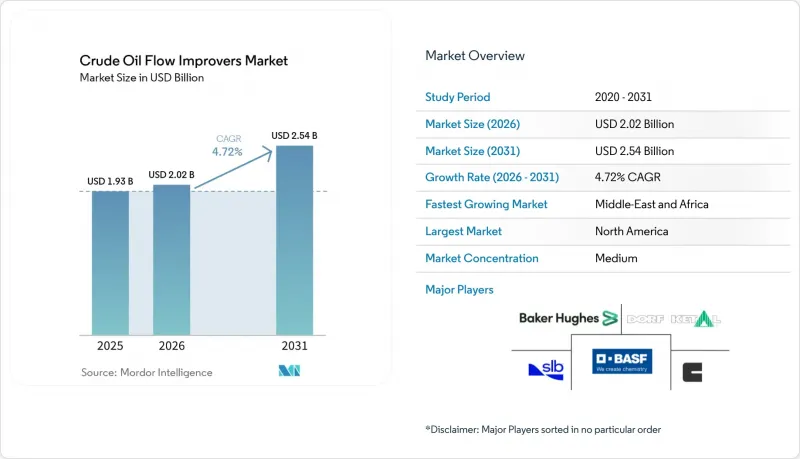
本報告按添加劑類型(石蠟和瀝青質抑制劑、抗黏性劑、阻垢劑和腐蝕抑制劑等)、原油類型(輕質、中質、重質和特重質)、引入地點(陸上和海上)、應用(開採、管道和運輸等)以及地區(亞太地區、北美、歐洲、南美以及中東和非洲)進行分類。
全球原油流動改善市場趨勢與洞察
頁岩油和緻密油管長度增加
北美頁岩油產量的成長導致原油收集管網的黏度和蠟含量升高,迫使業者使用抗黏劑來維持原油流動性,使其高於經濟閾值。超高分子量聚烯可改善低溫性能,從而為加拿大和達科他州的管道提供支持,因為在這些地區,傳統化學品在零度以下劣化。數位化控制的注入撬裝設備可即時調整製程,最佳化用量以配合原油混合物的波動,從而在不影響處理能力的前提下降低化學品成本。隨著頁岩油井輸送管路長度的增加以及與現有幹線管的互聯,這些優勢將進一步擴大,從而進一步推動原油流動性改進劑市場的發展。
深海FPSO計畫激增,需要使用水合物抑制劑。
在水深超過1500公尺的超深水開發中,水合物形成的風險增加。與體積龐大的甲醇處理相比,低劑量動態抑制劑和抗凝血劑具有更優異的性能,可減少地面儲存空間和碳排放。即使在硫化氫濃度超過70000ppm的情況下,與酸性氣體相容的添加劑組合仍能保持穩定,從而能夠用於巴西鹽層下油井和安哥拉近海新發現油田的開發。營運商正在部署與海底增壓裝置同步的供應連系管化學管線,這推動了原油流動性增強劑市場中各種專用配方產品的持續成長。
更嚴格的 PFAS 法規限制了含氟流動性改良劑的使用。
PFAS法規的擴展正迫使配方快速調整。多年來一直用於極端溫度應用的氟基界面活性劑正被逐步淘汰,製造商正投資研發矽酮、碳氫化合物或生物基替代品。 DIC公司的無PFAS消泡技術原計劃於2024年實現商業化,但目前的供不應求推高了成本並延長了認證週期。由氟橡膠製成的設備零件也需要更換,這種衝擊不僅限於純化學品領域,還減緩了原油流動改進劑市場的短期成長。
細分市場分析
預計到2025年,石蠟和瀝青質抑制劑的銷售額將最大,佔市場佔有率的38.62%。這主要是由於業者在低溫管道中面臨著蠟沉積的難題。隨著重質原油產量的增加以及深海流體在流經海底時迅速冷卻,使用這些添加劑的原油流動改進劑的市場規模預計將穩定成長。防污劑雖然銷售額小規模,但成長速度最快,複合年成長率達7.41%,這反映出在不進行資本投資和擴建的情況下提高老舊管道輸送能力的需求。集蠟控制、瀝青質分散和防污性能於一體的多功能製劑正在減少現場化學品種類,並將整合解決方案推向原油流動改進劑市場的前沿。
預計到2025年,重質和超重質原油將佔市場佔有率的47.02%,其複合年成長率(CAGR)將超過輕質原油6.08%。這主要是由於隨著傳統油田的成熟,全球石油生產結構正向高黏度資源轉變。剪切穩定聚合物透過降低壓力損失和抑製石蠟結晶,為跨山輸油管和安第斯輸油管等跨國管道提供支撐。實驗室測試表明,將機械空化技術與最佳化的添加劑組合結合,可將黏度降低60%以上。這種混合方法增強了人們對高密度原油可透過現有管道運輸的信心,從而推動了對原油流動性改進劑市場的持續投資。
中質原油在寒冷地區仍需要流動性支持,且需求範圍廣泛。輕質原油混合油也受益於超深水環境中水合物抑制技術,證實了化學品需求正在所有原油等級範圍內擴展,而不僅依賴最重質原油。
區域分析
到2025年,在頁岩油管道和墨西哥灣基礎設施的支持下,北美將佔全球整體銷售額的33.28%。自動化和高負載聚合物將有助於提升產品在零度以下地區的性能,並維持原油流動性改進劑市場的持續需求。
預計到2031年,中東和非洲地區將以5.84%的複合年成長率快速成長,這主要得益於各國旨在將酸性原油貨幣化並加速西非深海樞紐發展的計畫。亞太地區的成長與煉油廠擴建以及向沿海進口碼頭輸送原油的新國際管道建設密切相關。在歐洲,對北海管線網路更新的需求依然強勁,而嚴格的PFAS法規正在加速無氟化學品的應用。
阿曼酸性氣體控制抑制劑的最新進展以及印度混合蠟控管道的研發,都是區域性工程技術的典範,供應商應掌握這些技術以深化其區域市場滲透。政府鼓勵國內煉油自給自足的指南,進一步提升了全部區域對可靠的流動保障方案的需求。
其他好處:
- Excel格式的市場預測(ME)表
- 3個月的分析師支持
目錄
第1章:引言
- 研究假設和市場定義
- 調查範圍
第2章:調查方法
第3章執行摘要
第4章 市場狀況
- 市場概覽
- 市場促進因素
- 頁岩油和緻密油管長度增加
- 深海FPSO計畫激增,需要使用水合物抑制劑。
- 對石蠟和瀝青質抑制劑的需求不斷成長
- 在老化的主幹管中擴大聚合物基DRA的應用
- 石油產品需求增加
- 市場限制因素
- 更嚴格的 PFAS 法規限制了含氟流動性改進劑化學品的使用。
- 能源轉型承諾做出後,上游產業資本投資週期出現波動
- 高分子量聚α烯烴供應瓶頸
- 價值鏈分析
- 波特五力模型
第5章 市場規模與成長預測
- 改良型
- 石蠟和瀝青質抑制劑
- 抗摩擦劑
- 水垢和腐蝕抑制劑
- 水合物和硫化氫抑制劑
- 其他類型的添加劑(例如去乳化劑和殺菌劑)
- 按油型
- 輕質和中質(蠟含量低於25 wt%)
- 重質和特重質蠟(蠟含量超過 25 wt%)
- 按安裝位置
- 陸上
- 近海(淺海、深海、超深海)
- 透過使用
- 萃取
- 管道和運輸
- 加工
- 其他用途
- 按地區
- 亞太地區
- 中國
- 印度
- 日本
- 韓國
- 其他亞太國家
- 北美洲
- 美國
- 加拿大
- 墨西哥
- 歐洲
- 德國
- 英國
- 義大利
- 法國
- 其他歐洲國家
- 南美洲
- 巴西
- 阿根廷
- 其他南美國家
- 中東和非洲
- 沙烏地阿拉伯
- 南非
- 其他中東和非洲國家
- 亞太地區
第6章 競爭情勢
- 市場集中度
- 策略趨勢
- 市佔率和排名分析
- 公司簡介
- Ashland
- Baker Hughes
- BASF
- Clariant
- Croda International Plc
- Dorf Ketal
- Dow
- Evonik Industries AG
- Halliburton
- Innospec
- LiquidPower Specialty Products Inc.
- NuGenTec
- Oil Flux
- SLB(Schlumberger)
- The Lubrizol Corporation
- The Zoranoc Oilfield Chemical
第7章 市場機會與未來展望
According to Mordor Intelligence, the crude oil flow improvers market size is expected to grow from USD 1.93 billion in 2025 to USD 2.02 billion in 2026 and is forecast to reach USD 2.54 billion by 2031 at 4.72% CAGR over 2026-2031.
This report is Segmented by Improver Type (Paraffin and Asphaltene Inhibitors, Drag Reducing Agents, Scale and Corrosion Inhibitors, and More), Oil Type (Light and Medium, Heavy and Extra-Heavy), Deployment Location (Onshore and Offshore), Application (Extraction, Pipelines and Transportation, and More), and Geography (Asia-Pacific, North America, Europe, South America, and Middle-East and Africa).
Global Crude Oil Flow Improvers Market Trends and Insights
Increased Shale and Tight-Oil Pipeline Mileage
North American shale output lifts viscosity and wax load in gathering networks, compelling operators to dose drag-reducing agents that keep flow above economic thresholds. Ultra-high-molecular-weight polyolefins enhance low-temperature performance, supporting lines in Canada and the Dakotas where sub-zero seasons degrade legacy chemistries. Digital injection skids now modulate treatment in real time, aligning dosage with crude blend variability to trim chemical cost without throttling capacity. These efficiencies are scaling as shale wellhead pipelines grow in mileage and interconnect existing trunk lines, reinforcing momentum in the crude oil flow improvers market.
Surge in Deep-Water FPSO Projects Requiring Hydrate Inhibitors
Ultra-deep developments past 1,500 m water depth intensify hydrate formation risk. Low-dosage kinetic and anti-agglomerant inhibitors outperform bulky methanol campaigns, easing topside storage and cutting carbon footprints. Sour-gas-compatible packages show stability at hydrogen sulfide levels above 70,000 ppm, unlocking pre-salt wells in Brazil and new finds off Angola. Operators deploy umbilical chemical lines that synchronize with subsea boosting units, driving sustained uptake of specialized formulations across the crude oil flow improvers market.
Stricter PFAS Bans Limiting Fluorinated Flow Improver Chemistries
Widening PFAS regulation compels rapid reformulation. Fluorinated surfactants that long served extreme temperature applications face phase-out, prompting manufacturers to invest in silicone, hydrocarbon, or bio-based alternatives. DIC Corporation's PFAS-free antifoam technology reached commercial readiness in 2024, but interim supply gaps elevate costs and prolong qualification cycles. Equipment components made of fluoro-elastomers also require substitution, extending disruption beyond pure chemicals and tempering near-term growth in the crude oil flow improvers market.
Other drivers and restraints analyzed in the detailed report include:
- Growing Demand for Paraffin and Asphaltene Inhibitors
- Growing Adoption of Polymer-Based DRAs in Aging Trunk Lines
- Volatility in Upstream CAPEX Cycles Post-Energy Transition Pledges
For complete list of drivers and restraints, kindly check the Table Of Contents.
Segment Analysis
Paraffin and asphaltene inhibitors generated the largest revenue, delivering 38.62% market share in 2025 as operators battled wax deposition in cooler pipelines. The crude oil flow improvers market size for these additives is forecast to expand steadily because heavy-crude output rises and deepwater fluids cool rapidly during seabed transit. Drag reducing agents, though smaller by revenue, advance fastest at 7.41% CAGR, mirroring the need to lift throughput in aging lines without capital expansion. Multifunctional packages that merge wax control, asphaltene dispersion, and anti-foul properties reduce chemical SKUs onsite, pushing integrated solutions to the forefront of the crude oil flow improvers market.
Heavy and extra-heavy feeds secured a 47.02% share in 2025 and outpace lighter grades with a 6.08% CAGR because the global production mix tilts toward viscous resources as conventional reservoirs mature. Shear-stable polymers cut pressure drop and stave off paraffin crystallization, supporting cross-border pipelines such as Trans Mountain and Andean links. Laboratory trials demonstrate over 60% viscosity reduction when mechanical cavitation technologies partner with tailored additive packages. Such hybrid methods bolster confidence that existing rights-of-way can carry denser barrels, sustaining investment in the crude oil flow improvers market.
Medium crudes still need flow support in frigid climates, keeping demand broad-based. Light blends also benefit from hydrate suppression in ultra-deep environments, confirming that chemical demand grows across the crude grade spectrum rather than relying solely on the heaviest cuts.
Complete Report Scope:
- By Improver Type
- Paraffin and Asphaltene Inhibitors
- Drag Reducing Agents
- Scale and Corrosion Inhibitors
- Hydrate and Hydrogen Sulfide Inhibitors
- Other Improver Types (Demulsifiers and Biocides, etc.)
- By Oil Type
- Light and Medium (Less than 25 wt% wax)
- Heavy and Extra-Heavy (Greater than 25 wt% wax)
- By Deployment Location
- Onshore
- Offshore (Shallow, Deep, Ultra-Deep)
- By Application
- Extraction
- Pipelines and Transportation
- Processing
- Other Applications
- By Geography
- Asia-Pacific
- China
- India
- Japan
- South Korea
- Rest of Asia-Pacific
- North America
- United States
- Canada
- Mexico
- Europe
- Germany
- United Kingdom
- Italy
- France
- Rest of Europe
- South America
- Brazil
- Argentina
- Rest of South America
- Middle-East and Africa
- Saudi Arabia
- South Africa
- Rest of Middle-East and Africa
- Asia-Pacific
Geography Analysis
North America controlled 33.28% of worldwide revenue in 2025, underwritten by shale pipelines and Gulf of Mexico infrastructure. Automation and high-load polymers buttress performance in below-freezing territories, sustaining replacement demand across the crude oil flow improvers market.
The Middle East and Africa surge at 5.84% CAGR through 2031, buoyed by national plans to monetize sour crudes and fast-track West African deepwater hubs. Asia-Pacific growth tracks refinery expansions and new transnational lines feeding coastal import terminals. Europe maintains replacement demand in North Sea networks and adheres to strict PFAS curbs that accelerate fluorine-free chemistry adoption.
Recent breakthroughs in sour-gas compatible inhibitors in Oman and hybrid wax-control pipelines in India exemplify the localized engineering that vendors must master to deepen geographic penetration. Government directives urging domestic refining self-sufficiency further amplify the call for robust flow assurance programs across developing regions.
- Ashland
- Baker Hughes
- BASF
- Clariant
- Croda International Plc
- Dorf Ketal
- Dow
- Evonik Industries AG
- Halliburton
- Innospec
- LiquidPower Specialty Products Inc.
- NuGenTec
- Oil Flux
- SLB (Schlumberger)
- The Lubrizol Corporation
- The Zoranoc Oilfield Chemical
Additional Benefits:
- The market estimate (ME) sheet in Excel format
- 3 months of analyst support
TABLE OF CONTENTS
1 Introduction
- 1.1 Study Assumptions and Market Definition
- 1.2 Scope of the Study
2 Research Methodology
3 Executive Summary
4 Market Landscape
- 4.1 Market Overview
- 4.2 Market Drivers
- 4.2.1 Increased shale and tight-oil pipeline mileage
- 4.2.2 Surge in deep-water FPSO projects requiring hydrate inhibitors
- 4.2.3 Growing Demand For Paraffin and Asphaltene Inhibitors
- 4.2.4 Growing adoption of polymer-based DRAs in aging trunk lines
- 4.2.5 Increasing Demand for Petroleum Based Products
- 4.3 Market Restraints
- 4.3.1 Stricter PFAS bans limiting fluorinated flow improver chemistries
- 4.3.2 Volatility in upstream CAPEX cycles post-energy transition pledges
- 4.3.3 Supply bottlenecks for high-molecular-weight poly-alpha-olefins
- 4.4 Value Chain Analysis
- 4.5 Porter's Five Forces
- 4.5.1 Bargaining Power of Suppliers
- 4.5.2 Bargaining Power of Buyers
- 4.5.3 Threat of New Entrants
- 4.5.4 Threat of Substitutes
- 4.5.5 Degree of Competition
5 Market Size and Growth Forecasts (Value)
- 5.1 By Improver Type
- 5.1.1 Paraffin and Asphaltene Inhibitors
- 5.1.2 Drag Reducing Agents
- 5.1.3 Scale and Corrosion Inhibitors
- 5.1.4 Hydrate and Hydrogen Sulfide Inhibitors
- 5.1.5 Other Improver Types (Demulsifiers and Biocides, etc.)
- 5.2 By Oil Type
- 5.2.1 Light and Medium (Less than 25 wt% wax)
- 5.2.2 Heavy and Extra-Heavy (Greater than 25 wt% wax)
- 5.3 By Deployment Location
- 5.3.1 Onshore
- 5.3.2 Offshore (Shallow, Deep, Ultra-Deep)
- 5.4 By Application
- 5.4.1 Extraction
- 5.4.2 Pipelines and Transportation
- 5.4.3 Processing
- 5.4.4 Other Applications
- 5.5 By Geography
- 5.5.1 Asia-Pacific
- 5.5.1.1 China
- 5.5.1.2 India
- 5.5.1.3 Japan
- 5.5.1.4 South Korea
- 5.5.1.5 Rest of Asia-Pacific
- 5.5.2 North America
- 5.5.2.1 United States
- 5.5.2.2 Canada
- 5.5.2.3 Mexico
- 5.5.3 Europe
- 5.5.3.1 Germany
- 5.5.3.2 United Kingdom
- 5.5.3.3 Italy
- 5.5.3.4 France
- 5.5.3.5 Rest of Europe
- 5.5.4 South America
- 5.5.4.1 Brazil
- 5.5.4.2 Argentina
- 5.5.4.3 Rest of South America
- 5.5.5 Middle-East and Africa
- 5.5.5.1 Saudi Arabia
- 5.5.5.2 South Africa
- 5.5.5.3 Rest of Middle-East and Africa
- 5.5.1 Asia-Pacific
6 Competitive Landscape
- 6.1 Market Concentration
- 6.2 Strategic Moves
- 6.3 Market Share(%)/Ranking Analysis
- 6.4 Company Profiles (includes Global level Overview, Market level overview, Core Segments, Financials as available, Strategic Information, Market Rank/Share for key companies, Products and Services, and Recent Developments)
- 6.4.1 Ashland
- 6.4.2 Baker Hughes
- 6.4.3 BASF
- 6.4.4 Clariant
- 6.4.5 Croda International Plc
- 6.4.6 Dorf Ketal
- 6.4.7 Dow
- 6.4.8 Evonik Industries AG
- 6.4.9 Halliburton
- 6.4.10 Innospec
- 6.4.11 LiquidPower Specialty Products Inc.
- 6.4.12 NuGenTec
- 6.4.13 Oil Flux
- 6.4.14 SLB (Schlumberger)
- 6.4.15 The Lubrizol Corporation
- 6.4.16 The Zoranoc Oilfield Chemical
7 Market Opportunities and Future Outlook
- 7.1 White-space and Unmet-Need Assessment

 水合物抑制劑:市場佔有率分析、產業趨勢與統計、成長預測(2026-2031)
 原油流動性改進劑市場:依產品類型、應用和地區分類
 原油流動改進劑市場:按類型、劑型和應用分類-2026年至2032年全球預測
 原油流動性改進劑市場規模、佔有率、趨勢和預測:按產品、應用和地區分類,2026-2034年
 油氣市場流動保障:市場分析及至2035年預測:依類型、產品、服務、技術、組件、應用、材料類型、製程、最終用戶及設備分類水合物抑制劑市場:依抑制劑類型和地區分類
 2026年全球原油流動改進劑市場報告
 原油流動改進劑市場-全球產業規模、佔有率、趨勢、機會與預測:依改進劑類型、應用、地區和競爭格局分類,2021-2031年
 水合物抑制劑市場規模、佔有率和成長分析(按產品類型、應用、終端用戶產業、配方類型、分銷管道和地區分類)-2026-2033年產業預測
 原油流動改進劑市場規模、佔有率和成長分析(按類型、供應類型、應用和地區分類)-2026-2033年產業預測