


 |
市場調查報告書
商品編碼
2066765
西班牙智慧家庭:市場佔有率分析、產業趨勢與統計及成長預測(2026-2031)Spain Smart Home - Market Share Analysis, Industry Trends & Statistics, Growth Forecasts (2026 - 2031) |
||||||

※ 本網頁內容可能與最新版本有所差異。詳細情況請與我們聯繫。
據 Mordor Intelligence 稱,西班牙智慧家庭市場預計到 2026 年價值 10.1 億美元,高於 2025 年的 9.2 億美元,預計到 2031 年將達到 15.7 億美元。
預計從 2026 年到 2031 年,其複合年成長率將達到 9.27%。
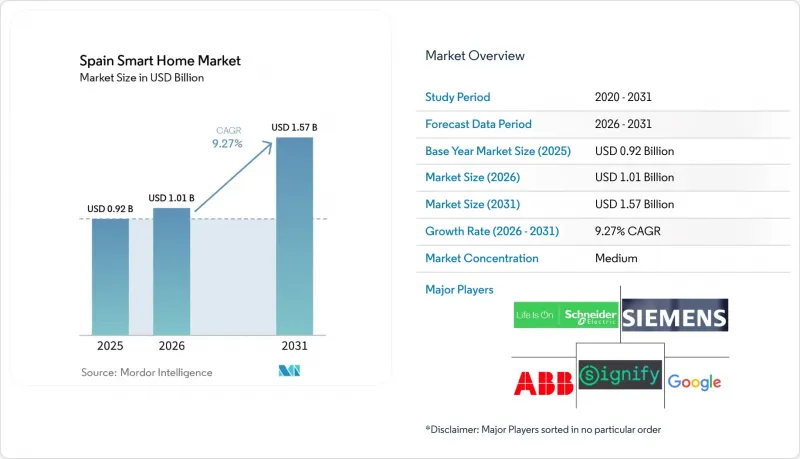
本報告按產品(舒適照明、控制與連接、其他)、連接技術(Wi-Fi、藍牙、其他)、安裝類型(新建、維修及現有住宅)、銷售管道(電子商務、電氣設備批發商、其他)、最終用戶(獨棟住宅、多用戶住宅)和地區進行細分。市場預測以美元計價。
西班牙智慧家庭市場的趨勢與洞察
政府支持的住宅維修節能補貼
「PREE 5000」計畫和高達60%符合資格成本的所得稅抵扣等獎勵,正在縮短互聯能源管理系統的投資回收期,將潛在興趣轉化為實際需求。 「ERESEE 2030」計劃旨在維修120萬戶住宅,確保了永續的需求來源;而西班牙家庭普遍採用的分階段維修計劃,也為後續設備的部署創造了持續的機會。
FTTH和5G的快速部署正在提高設備的可靠性。
西班牙光纖網路覆蓋率高達93%,在歐洲超高容量網路普及率方面遙遙領先,為依賴雲端的語音助理和安防攝影機提供了至關重要的低延遲。 「數位西班牙2026」計畫將額外的5G資金分配給各省,助力西班牙智慧家庭市場拓展至大都會圈。
西班牙消費者對資料隱私根深蒂固的懷疑態度
儘管有GDPR的保護,但仍有30%的西班牙網路用戶表示在使用連網服務時遇到技術問題,而且人們對始終開啟的監聽設備越來越感到擔憂(歐盟統計局資料)。進入西班牙智慧家庭市場的製造商需要提供透明的數據處理和本地數據處理方案,以消除信任障礙。
細分市場分析
到2025年,「舒適與照明解決方案」將佔西班牙智慧家庭市場佔有率的37.92%。這反映出智慧LED燈、恆溫器和遮陽控制系統等產品已被廣泛應用,並適應了人們的日常生活方式。 「智慧家電」成長潛力最大,年複合成長率將達到10.18%,這主要得益於更嚴格的能源標籤法規以及透過動態定價系統實現的智慧日程安排優勢。寬頻的普及推動了家庭娛樂的興起,但由於市場趨於飽和,都市區的成長速度有所放緩。安防系統持續穩定成長,尤其是在度假租賃市場,遠端監控帶來的安心感備受青睞。整合能源管理平台將屋頂太陽能、熱泵和家庭用電設備連接起來,推動西班牙智慧家居市場向併網服務轉型,與該國蓬勃發展的太陽能產業相輔相成。西班牙公司如Fermax正在為多用戶住宅客製化整合對講機的照明方案,凸顯了受地中海建築傳統影響的當地設計偏好。
家用電器中整合Wi-Fi晶片和經濟實惠的單板控制器等創新技術,正在拓展入門級產品選擇,降低首次購機者的門檻。冷藏庫和洗衣機整合語音助手,提升了使用便利性;而監管機構強制推行的節能模式,則推動了注重成本的家庭採用連網型設備家庭產品。如果歐盟的生態設計提案得以推進,基於使用時間的最佳化成為預設設置,到2030年,西班牙智慧家電市場預計將占到連網設備總銷量的五分之一。一些保險公司正在試點為配備洩漏檢測功能的洗碗機提供保費折扣,這為保險公司開闢了新的收入來源。那些從產品上市之初就整合無線更新和Matter相容性的製造商,最有希望贏得那些尋求面向未來的多品牌家庭的青睞。
Wi-Fi 仍佔據核心地位,預計到 2025 年將佔已安裝節點的 45.88%,但支援 Thread/Matter 技術的晶片出貨量正以 11.62% 的複合年成長率成長,各品牌競相提供無縫配對和更低的待機功耗。低功耗藍牙 (BLE) 支援穿戴式裝置和可攜式感測器,而 Zigbee 和 Z-Wave 在傳統集線器中的應用仍然有限。在西班牙智慧家庭市場,能夠智慧切換協定的設備需求旺盛,促使晶片組製造商將 Wi-Fi、BLE 和 802.15.4 無線功能整合到單一晶片上。可在本地執行意圖識別的邊緣 AI 處理器正在減少雲端流量並解決隱私問題。通訊業者透過將多重通訊協定路由器與新的光纖合約捆綁銷售,鞏固了其作為安全隔離網閘的角色,引導每個家庭融入整合生態系統。
隨著 Matter 技術逐步滲透到家用電器、暖通空調和保全攝影機領域,消費者的購買決策變得更加簡單,零售店的退貨率也下降。零售商表示,隨著客戶轉向單一應用程式環境,技術支援諮詢量驟減。此外,一家電力公司開展的需量反應響應試點計畫正在利用整合到智慧音箱中的支援 Thread 技術的邊界路由器,在無需額外硬體的情況下快速發送負載削減訊號。在西班牙智慧家居市場,具備無線升級能力的供應商仍備受青睞,產品開發也在穩步推進,以應對歐盟提案的網路安全標籤監管變更。
其他好處:
- Excel格式的市場預測(ME)表
- 3個月的分析師支持
目錄
第1章:引言
- 研究假設和市場定義
- 調查範圍
第2章:調查方法
第3章執行摘要
第4章 市場狀況
- 市場概覽
- 市場促進因素
- 政府主導的住宅維修節能補貼
- FTTH和5G的快速部署正在提高設備的可靠性。
- 單身家庭和老年家庭對自動化照護支援服務的需求激增。
- Matter 標準實現了品牌間的互通性。
- 不斷上漲的電價正在加速能源管理系統的普及應用。
- 房地產科技和智慧租賃平台引領承包智慧公寓的發展方向
- 市場限制因素
- 西班牙消費者對資料隱私根深蒂固的懷疑態度
- 高昂的初始設備成本與平均家庭收入的比較
- 將售後服務網分散到一線城市以外的地區
- 智慧家庭設備缺乏增值稅優惠,並與太陽能發電進行比較
- 產業生態系分析
- 技術展望
- 波特五力分析
第5章 市場規模與成長預測
- 依產品
- 舒適度和照明
- 控制和連接
- 能源管理
- 家庭娛樂
- 安全
- 智慧家庭設備
- 透過連接技術
- Wi-Fi
- Bluetooth
- Zigbee
- Z-Wave
- Thread/Matter相容積體電路
- 按安裝類型
- 新建工程
- 房屋維修/現有住宅
- 按銷售管道
- 電子商務
- 量販店
- 電氣設備批發商
- 專業安裝公司/整合商
- 最終用戶
- 獨立式住宅
- 多用戶住宅(MDU)
第6章 競爭情勢
- 市場集中度
- 策略趨勢
- 市佔率分析
- 公司簡介
- Schneider Electric SE
- ABB Ltd
- Siemens AG
- Signify Holding
- Google LLC
- GE Lighting(a Savant Co.)
- EVVR ApS
- Fibaro Group SA
- Samsung Electronics Co. Ltd
- LG Electronics
- Amazon.com Inc.
- Apple Inc.
- Bosch Smart Home GmbH
- Somfy SA
- Fermax Electronica SAU
- Wallbox NV
- Legrand SA/Netatmo
- Nice SpA
- Philips Hue
- Huawei Technologies Co. Ltd(HiLink)
第7章 市場機會與未來展望
According to Mordor Intelligence, spain smart home market size in 2026 is estimated at USD 1.01 billion, growing from 2025 value of USD 0.92 billion with 2031 projections showing USD 1.57 billion, growing at 9.27% CAGR over 2026-2031.
This report is Segmented by Product (Comfort and Lighting, Control and Connectivity, and More), Connectivity Technology (Wi-Fi, Bluetooth, and More), Installation Type (New Construction, Retrofit/Existing Homes), Sales Channel (E-Commerce, Electrical Wholesalers, and More), End-User Profile (Single-Family Houses, Multi-Dwelling Units), and Geography. The Market Forecasts are Provided in Terms of Value (USD).
Spain Smart Home Market Trends and Insights
Government-backed Energy-efficiency Subsidies for Residential Retrofits
Incentives such as the PREE 5000 program and income-tax deductions covering up to 60% of qualifying costs narrow payback periods for connected energy-management systems, converting latent interest into active demand. The ERESEE 2030 target of 1.2 million dwelling upgrades ensures a persistent pipeline, while staged renovation roadmaps common in Spanish households translate into recurring opportunities for device add-ons.
Rapid FTTH and 5G Rollout Boosting Device Reliability
With 93% population coverage in fiber, Spain leads Europe in very-high-capacity network reach, delivering low-latency performance critical for cloud-dependent voice assistants and security cameras. Digital Spain 2026 allocates additional 5G funding to rural provinces, enabling Spain smart home market growth beyond metropolitan hubs.
Persistent Data-privacy Scepticism Among Spanish Consumers
Despite GDPR safeguards, 30% of Spanish Internet users report technical concerns when interacting with connected services, reinforcing caution toward always-listening devices Eurostat. Manufacturers pursuing the Spain smart home market must offer transparent data handling and local processing options to ease trust barriers.
Other drivers and restraints analyzed in the detailed report include:
- Growth in single-person and elderly households
- Matter-enabled interoperability
- High Upfront Device Costs vs Average Household Income
For complete list of drivers and restraints, kindly check the Table Of Contents.
Segment Analysis
Comfort and Lighting solutions contributed 37.92% of Spain smart home market share in 2025, reflecting widespread acceptance of smart LEDs, thermostats, and shading controls that align with daily lifestyle patterns. Smart Appliances hold the strongest upside, expanding at 10.18% CAGR as energy-label rules tighten and dynamic tariffs reward intelligent scheduling. Home Entertainment adoption rides on ubiquitous broadband, though growth moderates with saturation in larger cities. Security systems sustain steady uptake, especially in holiday rentals seeking remote monitoring assurance. Integrated Energy Management platforms link rooftop PV, heat pumps, and household loads, positioning the Spain smart home market for grid-interactive services that complement the national solar boom. Spanish firms such as Fermax tailor intercom-linked lighting packages for multi-dwelling units, underscoring local design preferences shaped by Mediterranean building traditions.
Innovations in appliance-embedded Wi-Fi chips and cost-effective single-board controllers expand entry-level options, lowering barriers for first-time buyers. Voice assistant tie-ins with refrigerators and washing machines amplify convenience, while regulator-mandated eco-modes foster adoption among cost-sensitive households. The Spain smart home market size for appliances could represent a fifth of all connected-device revenue by 2030 if EU eco-design proposals progress, introducing time-of-use optimization as a default feature. Insurance firms piloting premium discounts for leak-sensing dishwashers illustrate new monetization pathways. Manufacturers that integrate over-the-air updates and Matter compliance from launch are best placed to capture cross-brand households seeking future-proof investments.
Wi-Fi remains the backbone, hosting 45.88% of installed nodes in 2025, yet Thread/Matter-ready chip shipments are posting 11.62% CAGR as brands race to offer frictionless pairing and lower standby power. Bluetooth Low Energy underpins wearables and portable sensors, while Zigbee and Z-Wave sustain modest use in legacy hubs. The Spain smart home market values devices capable of switching intelligently between protocols, hence chipset makers bundle Wi-Fi, BLE, and 802.15.4 radios on a single die. Edge-AI processors that run local intent recognition reduce cloud traffic, answering privacy worries. Telecom providers bundle multi-protocol routers with new fiber contracts, cementing their gatekeeper role and nudging households toward unified ecosystems.
Matter's gradual reach into appliances, HVAC, and security cameras simplifies purchase decisions and cuts return rates at retail. Retailers report drop-in support calls once customers migrate to single-app environments. Furthermore, utility-managed demand-response pilots exploit Thread border routers embedded in smart speakers to deliver rapid load-shed signals without extra hardware. The Spain smart home market continues to reward vendors that maintain over-the-air upgradability, positioning products for regulatory changes around cybersecurity labeling proposed by the EU.
List of Companies Covered in this Report:
- Schneider Electric SE
- ABB Ltd
- Siemens AG
- Signify Holding
- Google LLC
- GE Lighting (a Savant Co.)
- EVVR ApS
- Fibaro Group SA
- Samsung Electronics Co. Ltd
- LG Electronics
- Amazon.com Inc.
- Apple Inc.
- Bosch Smart Home GmbH
- Somfy SA
- Fermax Electronica S.A.U.
- Wallbox N.V.
- Legrand SA/Netatmo
- Nice SpA
- Philips Hue
- Huawei Technologies Co. Ltd (HiLink)
Additional Benefits:
- The market estimate (ME) sheet in Excel format
- 3 months of analyst support
TABLE OF CONTENTS
1 INTRODUCTION
- 1.1 Study Assumptions and Market Definition
- 1.2 Scope of the Study
2 RESEARCH METHODOLOGY
3 EXECUTIVE SUMMARY
4 MARKET LANDSCAPE
- 4.1 Market Overview
- 4.2 Market Drivers
- 4.2.1 Government-backed energy-efficiency subsidies for residential retrofits
- 4.2.2 Rapid FTTH and 5G rollout boosting device reliability
- 4.2.3 Surge in single-person and elderly households demanding assisted-living automation
- 4.2.4 Matter standard enabling cross-brand interoperability
- 4.2.5 Rising electricity prices intensifying energy-management adoption
- 4.2.6 PropTech and smart-rental platforms driving turnkey smart apartments
- 4.3 Market Restraints
- 4.3.1 Persistent data-privacy scepticism among Spanish consumers
- 4.3.2 High upfront device costs vs average household income
- 4.3.3 Fragmented after-sales service network outside tier-1 cities
- 4.3.4 Lack of VAT incentives for smart-home devices vs solar PV
- 4.4 Industry Ecosystem Analysis
- 4.5 Technological Outlook
- 4.6 Porter's Five Forces Analysis
- 4.6.1 Bargaining Power of Suppliers
- 4.6.2 Bargaining Power of Buyers
- 4.6.3 Threat of New Entrants
- 4.6.4 Intensity of Competitive Rivalry
- 4.6.5 Threat of Substitutes
5 MARKET SIZE AND GROWTH FORECASTS (VALUES)
- 5.1 By Product
- 5.1.1 Comfort and Lighting
- 5.1.2 Control and Connectivity
- 5.1.3 Energy Management
- 5.1.4 Home Entertainment
- 5.1.5 Security
- 5.1.6 Smart Appliances
- 5.2 By Connectivity Technology
- 5.2.1 Wi-Fi
- 5.2.2 Bluetooth
- 5.2.3 Zigbee
- 5.2.4 Z-Wave
- 5.2.5 Thread/Matter-ready ICs
- 5.3 By Installation Type
- 5.3.1 New Construction
- 5.3.2 Retrofit/Existing Homes
- 5.4 By Sales Channel
- 5.4.1 E-commerce
- 5.4.2 Consumer Electronics Retailers
- 5.4.3 Electrical Wholesalers
- 5.4.4 Professional Installers/Integrators
- 5.5 By End-user Profile
- 5.5.1 Single-family Houses
- 5.5.2 Multi-dwelling Units (MDUs)
6 COMPETITIVE LANDSCAPE
- 6.1 Market Concentration
- 6.2 Strategic Moves
- 6.3 Market Share Analysis
- 6.4 Company Profiles (includes Global level Overview, Market level overview, Core Segments, Financials as available, Strategic Information, Market Rank/Share for key companies, Products and Services, and Recent Developments)
- 6.4.1 Schneider Electric SE
- 6.4.2 ABB Ltd
- 6.4.3 Siemens AG
- 6.4.4 Signify Holding
- 6.4.5 Google LLC
- 6.4.6 GE Lighting (a Savant Co.)
- 6.4.7 EVVR ApS
- 6.4.8 Fibaro Group SA
- 6.4.9 Samsung Electronics Co. Ltd
- 6.4.10 LG Electronics
- 6.4.11 Amazon.com Inc.
- 6.4.12 Apple Inc.
- 6.4.13 Bosch Smart Home GmbH
- 6.4.14 Somfy SA
- 6.4.15 Fermax Electronica S.A.U.
- 6.4.16 Wallbox N.V.
- 6.4.17 Legrand SA/Netatmo
- 6.4.18 Nice SpA
- 6.4.19 Philips Hue
- 6.4.20 Huawei Technologies Co. Ltd (HiLink)
7 MARKET OPPORTUNITIES AND FUTURE OUTLOOK
- 7.1 White-space and Unmet-need Assessment

 2026年全球自主防禦平台市場報告
 智慧家庭市場:2026-2032年全球市場預測(按產品、使用者介面、安裝類型、技術、應用、最終用戶和分銷管道分類)環境生活輔助和智慧家庭市場:按組件、服務、連接方式、部署模式、動力來源、應用、分銷管道、最終用戶和部署類型分類——2026-2032年全球市場預測
 智慧公寓生態系統市場預測至2034年—按解決方案類型、組件、技術、應用、最終用戶和地區分類的全球分析
 多智慧體系統平台市場(2026-2032 年):按系統類型、應用和產業分類。
 智慧家庭市場商機、成長要素、產業趨勢分析及2026-2035年預測2026年全球智慧冷藏櫃支付市場報告
 環境生活輔助和智慧家庭市場規模、佔有率和成長分析:按組件、應用、最終用戶、分銷管道和地區分類-2026-2033年產業預測全球智慧家庭市場:機會與策略展望(至2035年)2026年全球低軌道(LEO)連結服務管理市場報告