


 |
市場調查報告書
商品編碼
2066735
亞太地區交叉層壓材料:市場佔有率分析、行業趨勢和統計數據以及成長預測(2026-2031 年)Asia-Pacific Cross-Laminated Timber - Market Share Analysis, Industry Trends & Statistics, Growth Forecasts (2026 - 2031) |
||||||

※ 本網頁內容可能與最新版本有所差異。詳細情況請與我們聯繫。
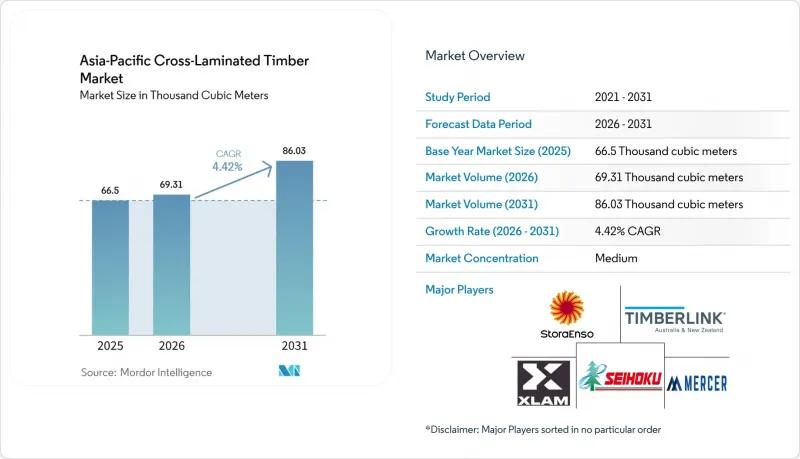
據 Mordor Intelligence 稱,亞太地區的交叉層壓木材 (CLT) 市場預計將從 2025 年的 66,500 立方米成長到 2026 年的 69,310 立方米,到 2031 年達到 86,030 立方米,預計 2026 年的複合成長率為 2032%。
本報告按類型(黏接和機械緊固)、應用(住宅和非住宅)以及地區(中國、印度、日本、韓國、澳洲和紐西蘭以及其他亞太地區)進行細分。市場規模和預測以體積(立方米)表示。
亞太地區交叉層壓板市場趨勢及洞察。
中國和印度的都市區中高層建築建設迅速蓬勃發展
中國和印度合計佔全球中層住宅年開工量的60%以上,新的政策趨勢正推動相當一部分住宅轉向現代木造建築。江蘇省於2026年1月發布的一項指令規定,要求對面積超過5000平方米的公共項目進行CLT(交錯層壓木材)評估,預計這將使該省每年新增8000至12000立方米的木材需求。在印度,該國首個大型木造住宅已在果阿邦建成,印度理工學院盧克利學院投資1.2億印度盧比(約138萬美元)的培訓中心正在培養當地的設計能力並建立供應鏈基礎。建築公司高度重視CLT的輕量特性,其重量比其他材料輕20%至25%。這使得在土地稀缺、地價飛漲的大都會圈,CLT可以最大限度地減少對深基礎的需求。由於預計到 2028 年,工程人才將主要透過新設立的教育計畫培養出來,因此大部分需求成長預計將從 2027 年開始出現。
日本、韓國和澳洲的綠建築獎勵
CASBEE、G-SEED 和 Green Star 認證系統現在為經環境產品聲明 (EPD)檢驗的低碳材料提供額外加分。日本 2024 年的指導方針允許國產 CLT(交錯層壓木材)獲得高達 10% 的容積率加成,三井不動產利用這一加成,於 2025 年在其日本橋項目中增建了一層。在韓國,所有公共建築都必須獲得「綠色 2」認證,實際上,提交環境產品聲明 (EPD) 已成為供應商進入市場的必要條件。澳洲清潔能源金融公司 (CEFC) 設立了 3 億澳元的低息貸款機制,用於支持旨在實現淨零排放的大型木結構項目,並保證在 2026 年第一季獲得 4.2 萬立方米的板材。雖然這些獎勵目前主要針對黏合劑CLT,但它們很可能會持續到 2031 年以後,進一步提高該規範的採用率。
熱帶氣候潮濕環境下有分層和發霉的風險
當濕度持續高於75%時,層壓板的含水量會超過黏合劑的耐受範圍。馬來西亞和澳洲北部的實地研究表明,8%至12%的未保護板材在兩年內發生分層。在印尼、馬來西亞和泰國所進行的34個後續計畫中,26%的計畫在一年內出現黴菌滋生,導致維修成本抵銷了CLT的價格優勢。矽烷改質聚氨酯可以解決化學問題,但其價格仍高出30%至40%,且未獲得結構用途認證。在建築規範強制要求設置防潮層或黏合劑性能改進之前,熱帶地區的高濕度仍將是CLT推廣應用的限制因素。
細分市場分析
黏合劑材是高層建築核心構件的關鍵組成部分,憑藉連續膠合線帶來的高剪切強度,佔據了68.12%的市場佔有率。 Binderholz位於Burg 伯恩 2的工廠目前以1批生產長度達18公尺的CLT板材,這充分體現了膠合系統維持價格競爭力所需的規模經濟效益。儘管黏合劑板材預計將在亞太地區交叉層壓材料市場(用於抗震和大跨度應用)中繼續保持主導地位,但隨著循環經濟標準的日益嚴格,預計到2031年,機械粘合板材的市場佔有率將超過膠粘板材。
預計到2031年,機械固定層壓木材(CLT)的複合年成長率將達到7.31%,超過亞太地區整體交叉層積木材(CLT)市場的成長速度。由於日本和韓國的評估系統對可逆施工方法(即使用後可拆的CLT)給予額外加分,市場需求正在加速成長。不列顛哥倫比亞大學2024年的一項測試表明,五層機械固定CLT的抗彎強度達到了黏結板材的92%,縮小了住宅地板的性能差距。東京和首爾的建築公司已經開始在低應力隔板中使用機械固定CLT,以確保其在永續性方面獲得加分。
其他好處:
- Excel格式的市場預測(ME)表
- 3個月的分析師支持
目錄
第1章:引言
- 研究假設和市場定義
- 調查範圍
第2章:調查方法
第3章執行摘要
第4章 市場狀況
- 市場概覽
- 市場促進因素
- 中國和印度的都市區出現了中高層建築的快速建設熱潮。
- 日本、韓國和澳洲的綠建築獎勵措施
- 受新冠疫情後物流變化的影響,對預製房屋、大體量木造房屋和模組化房屋的需求增加。
- 木鋼骨混合高層建築的核准通過創造了新的需求。
- 利用中國和東南亞本土竹種進行CLT的研究和開發
- 市場限制因素
- 熱帶氣候潮濕,有剝落和發霉的風險。
- CLT(交錯層壓木材)行業缺乏技術純熟勞工和檢測技術。
- 建築規範的不一致導致工程核准延誤。
- 價值鏈分析
- 監理情勢
- 波特五力模型
第5章 市場規模與成長預測
- 按類型
- 黏合劑
- 機械緊固
- 透過使用
- 住宅
- 非住宅
- 商業
- 工業和公共設施
- 其他用途
- 按地區
- 中國
- 印度
- 日本
- 韓國
- 澳洲和紐西蘭
- 其他亞太國家
第6章 競爭情勢
- 市場集中度
- 策略趨勢
- 市佔率和排名分析
- 公司簡介
- AGROP NOVA as
- B&K Structures
- Binderholz GmbH
- Eugen Decker Holzindustrie KG
- HASSLACHER Holding GmbH
- HESS Timber GmbH
- Holmen AB
- KLH Massivholz GmbH
- Mayr-Melnhof Holz Holding AG
- Meiken Lamwood Corp.
- Mercer International Inc.
- Pfeifer Group
- Schilliger Holz AG
- SEIHOKU Corporation
- SIPEUROPE sro
- SmartLam NA
- Sterling Structural
- Stora Enso
- Structurlam Mass Timber
- Timberlink Australia & New Zealand
- XLam Australia Pty Ltd
第7章 市場機會與未來展望
According to Mordor Intelligence, the asia-Pacific cross-Laminated timber market size is expected to increase from 66.5 Thousand cubic meters in 2025 to 69.31 Thousand cubic meters in 2026 and reach 86.03 Thousand cubic meters by 2031, growing at a CAGR of 4.42% over 2026-2031.
This report is Segmented by Type (Adhesive Bonded and Mechanically Fastened), Application (Residential and Non-Residential), and Geography (China, India, Japan, South Korea, Australia and Zealand, and the Rest of Asia-Pacific). The Market Size and Forecasts are Provided in Terms of Volume (Cubic Meters).
Asia-Pacific Cross-Laminated Timber Market Trends and Insights
Rapid Urban Mid-Rise Construction Boom in China and India
China and India together contribute more than 60% of annual mid-rise residential starts, and fresh policy signals are directing a measurable fraction toward modern wood structures. Jiangsu's January 2026 directive obliges public projects above 5,000 m2 to evaluate CLT, adding 8,000-12,000 m3 of yearly demand inside the province. India's first mass-timber residence in Goa and IIT Roorkee's INR 120 million (USD 1.38 million) training center are creating local design capacity and anchoring supply chains. Builders value CLT's 20-25% weight advantage because it limits deep foundations in land-scarce metros where plots command premium prices. With engineering talent graduating from new programs by 2028, most incremental volume is expected to appear from 2027 onward.
Green-Building Incentives Across Japan, South Korea, Australia
CASBEE, G-SEED, and Green Star certifications now award extra points for low-embodied-carbon materials validated by Environmental Product Declarations. Japan's 2024 guidelines grant up to 10% floor-area-ratio bonuses for domestic CLT, which Mitsui Fudosan used to add an additional storey to its 2025 Nihonbashi project. South Korea mandates Green 2 for all public buildings, effectively making Environmental Product Declaration (EPD) documentation a market-entry requirement for suppliers. Australia's Clean Energy Finance Corporation has set aside AUD 300 million in low-interest loans for net-zero mass-timber projects, underwriting 42,000 m3 of panels by Q1 2026. These incentives disproportionately support adhesive-bonded CLT today but are likely to persist well beyond 2031 and continue lifting specification rates.
Moisture-Induced Delamination and Mold Risk in Tropical Climates
Sustained humidity above 75% pushes lamella moisture beyond adhesive tolerance, and field surveys in Malaysia and northern Australia documented delamination in 8-12% of unprotected panels within two years. Mold appeared within one year on 26% of 34 tracked projects across Indonesia, Malaysia, and Thailand, forcing remedial costs that neutralize CLT's price advantage. Silane-modified polyurethane solves the chemistry but is still 30-40% more expensive and remains uncertified for structural use. Until codes mandate vapor control layers or adhesives improve, tropical humidity will remain a drag on adoption.
Other drivers and restraints analyzed in the detailed report include:
- Prefabricated Mass-Timber Modular Demand Post-COVID Logistics Shift
- Hybrid Timber-Steel High-Rise Approvals Unlocking New Volume
- Shortage of CLT-Skilled Labor and Inspection Expertise
For complete list of drivers and restraints, kindly check the Table Of Contents.
Segment Analysis
Adhesive-bonded panels command 68.12% share because continuous glue lines deliver higher shear capacity, critical for tall-building cores. Binderholz's Burgbernheim Plant II now produces lot-size-one CLT panels up to 18 m long, underlining economies of scale that keep bonded systems price-competitive. The Asia-Pacific cross-laminated timber market size for adhesive panels should retain leadership in seismic and long-span applications, yet mechanically fastened formats are on track to reach a higher market share by 2031 as circular-economy standards tighten.
Mechanically fastened laminated timber is forecast to expand at 7.31% CAGR to 2031, outperforming the wider Asia-Pacific cross-laminated timber market. Demand accelerates because Japanese and South Korean rating systems grant extra credits for reversible construction methods that allow post-use disassembly. A University of British Columbia test in 2024 showed five-ply mechanically fastened CLT reached 92% of the bending strength of bonded panels, narrowing performance gaps for residential floors. Builders in Tokyo and Seoul have already substituted mechanically fastened CLT in low-stress diaphragms to secure sustainability bonuses.
List of Companies Covered in this Report:
- AGROP NOVA a.s.
- B&K Structures
- Binderholz GmbH
- Eugen Decker Holzindustrie KG
- HASSLACHER Holding GmbH
- HESS Timber GmbH
- Holmen AB
- KLH Massivholz GmbH
- Mayr-Melnhof Holz Holding AG
- Meiken Lamwood Corp.
- Mercer International Inc.
- Pfeifer Group
- Schilliger Holz AG
- SEIHOKU Corporation
- SIPEUROPE s.r.o.
- SmartLam NA
- Sterling Structural
- Stora Enso
- Structurlam Mass Timber
- Timberlink Australia & New Zealand
- XLam Australia Pty Ltd
Additional Benefits:
- The market estimate (ME) sheet in Excel format
- 3 months of analyst support
TABLE OF CONTENTS
1 Introduction
- 1.1 Study Assumptions and Market Definition
- 1.2 Scope of the Study
2 Research Methodology
3 Executive Summary
4 Market Landscape
- 4.1 Market Overview
- 4.2 Market Drivers
- 4.2.1 Rapid urban mid-rise construction boom in China and India
- 4.2.2 Green-building incentives across Japan, South Korea, Australia
- 4.2.3 Prefabricated mass-timber modular demand post-COVID logistics shift
- 4.2.4 Hybrid timber-steel high-rise approvals unlocking new volume
- 4.2.5 Indigenous bamboo-reinforced CLT RandD in China and South-East Asia
- 4.3 Market Restraints
- 4.3.1 Moisture-induced delamination and mold risk in tropical climates
- 4.3.2 Shortage of CLT-skilled labor and inspection expertise
- 4.3.3 Building-code fragmentation slowing project approvals
- 4.4 Value Chain Analysis
- 4.5 Regulatory Landscape
- 4.6 Porter's Five Forces
- 4.6.1 Bargaining Power of Suppliers
- 4.6.2 Bargaining Power of Consumers
- 4.6.3 Threat of New Entrants
- 4.6.4 Threat of Substitute Products and Services
- 4.6.5 Intensity of Competitive Rivalry
5 Market Size and Growth Forecasts (Volume)
- 5.1 By Type
- 5.1.1 Adhesive Bonded
- 5.1.2 Mechanically Fastened
- 5.2 By Application
- 5.2.1 Residential
- 5.2.2 Non-Residential
- 5.2.2.1 Commercial
- 5.2.2.2 Industrial / Institutional
- 5.2.2.3 Other Applications
- 5.3 By Geography
- 5.3.1 China
- 5.3.2 India
- 5.3.3 Japan
- 5.3.4 South Korea
- 5.3.5 Australia and New Zealand
- 5.3.6 Rest of Asia-Pacific
6 Competitive Landscape
- 6.1 Market Concentration
- 6.2 Strategic Moves
- 6.3 Market Share(%)/Ranking Analysis
- 6.4 Company Profiles (includes Global level Overview, Market level overview, Core Segments, Financials as available, Strategic Information, Products and Services, and Recent Developments)
- 6.4.1 AGROP NOVA a.s.
- 6.4.2 B&K Structures
- 6.4.3 Binderholz GmbH
- 6.4.4 Eugen Decker Holzindustrie KG
- 6.4.5 HASSLACHER Holding GmbH
- 6.4.6 HESS Timber GmbH
- 6.4.7 Holmen AB
- 6.4.8 KLH Massivholz GmbH
- 6.4.9 Mayr-Melnhof Holz Holding AG
- 6.4.10 Meiken Lamwood Corp.
- 6.4.11 Mercer International Inc.
- 6.4.12 Pfeifer Group
- 6.4.13 Schilliger Holz AG
- 6.4.14 SEIHOKU Corporation
- 6.4.15 SIPEUROPE s.r.o.
- 6.4.16 SmartLam NA
- 6.4.17 Sterling Structural
- 6.4.18 Stora Enso
- 6.4.19 Structurlam Mass Timber
- 6.4.20 Timberlink Australia & New Zealand
- 6.4.21 XLam Australia Pty Ltd
7 Market Opportunities and Future Outlook
- 7.1 White-space and Unmet-Need Assessment

 交叉層壓木材市場-2026-2032年全球市場預測
 2026-2030年全球交叉層壓材料市場
 交叉層壓木材(CLT)市場規模、佔有率和趨勢分析報告:按產品、應用、地區和細分市場預測(2026-2033 年)
 交叉層壓材料:市場佔有率分析、行業趨勢和統計數據、成長預測(2026-2031 年)
 複合板市場報告:按最終用途、應用領域和地區分類(2026-2034年)
 2026年全球膠合層壓板市場報告複合板市場:2026-2032年全球預測(依產品形式、黏合劑類型、木材種類、製造技術、銷售管道和最終用途產業分類)交叉複合板市場:按產品類型、材質等級、應用、最終用途和分銷管道分類-2026年至2032年全球預測
 異形層壓交叉層壓板(CLT)市場規模、佔有率和成長分析:按產品類型、應用、最終用途產業、厚度和地區分類-2026-2033年產業預測
 全球交叉層壓木材(CLT)市場規模、佔有率、趨勢和成長分析報告(2026-2034年)