


 |
市場調查報告書
商品編碼
2061646
交叉層壓材料:市場佔有率分析、行業趨勢和統計數據、成長預測(2026-2031 年)Cross Laminated Timber - Market Share Analysis, Industry Trends & Statistics, Growth Forecasts (2026 - 2031) |
||||||

※ 本網頁內容可能與最新版本有所差異。詳細情況請與我們聯繫。
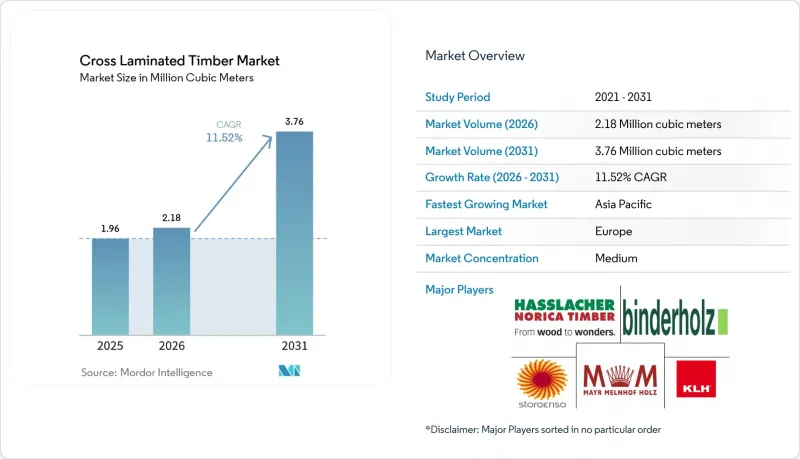
根據 Mordor Intelligence 預測,交叉層壓木材 (CLT) 市場規模將從 2025 年的 196 萬立方米和 2026 年的 218 萬立方米成長到 2031 年的 376 萬立方米,2026 年至 2031 年的年複合成長率(CAGR)為 11.15%。
本報告按黏合技術(黏合劑和機械緊固)、原料類型(雲杉、松木等)、組件類型(牆板、地板等)、應用領域(住宅和非住宅)以及地區(亞太地區、北美地區、歐洲地區、南美地區、中東和非洲地區)進行細分。市場預測以體積(立方米)為單位。
全球交錯層壓木材(CLT)市場趨勢與洞察
歐盟和北美地區的政府獎勵和低碳建築標準
根據歐盟指令2024/1275,自2028年起,建築面積超過2000平方公尺的建築物必須進行全生命週期碳排放評估,這鼓勵設計師優先考慮木結構系統。與鋼筋混凝土相比,木結構系統可將全球暖化潛勢值降低高達75%。加州修訂後的「清潔採購2024」計畫將環境產品聲明(EPD)規則應用於價值超過500萬美元的公共項目中的大宗木材,有效地將不符合標準的供應商排除在外。不列顛哥倫比亞省的「階梯式規範」為生物基結構提供排放積分,加速了溫哥華和維多利亞多用戶住宅項目中交叉層壓木材(CLT)的採用。由於製造商現在可以在72小時內提交檢驗的碳足跡,開發商在許可證申請流程中獲得了合規優勢。由此產生的需求正在推動交叉層壓木材市場的快速擴張。
對模組化和異地建造的中高層建築的需求不斷成長
工廠預製的CLT模組可減少30-40%的現場施工,並縮短20-25%的工期。這在人事費用高昂的都市區是一項決定性的優勢。在斯德哥爾摩的一個開發項目中,使用預製CLT模組僅需11週即可完成防水和防風處理,而傳統的混凝土結構則需要18週,從而節省了180萬美元的初始成本。 2024年至2025年間,德國的模組化住宅產量增加了18%。符合DIN 4109標準的隔音CLT板材可實現更薄的樓板結構。日本累計120億日圓用於津貼農村地區的CLT模組化住宅,目標是在2028年前建成5,000套,這將促進亞太地區的成長。
俄烏衝突後雲杉和冷杉價格的波動增加了歐盟的成本。
受俄羅斯木材製裁的影響,2022年初至2024年中期,中歐雲杉和冷杉價格飆升22%至28%。這導致主要生產商的息稅折舊攤提前利潤(EBITDA)下降2.3個百分點,並迫使七家中型工廠關閉或合併。 9至12個月的固定價格競標要求增加了風險,延誤了專案投標,並阻礙了交錯層壓木材(CLT)市場的產能擴張。
細分市場分析
到2025年,黏合劑黏接將佔總產量的90.91%,這主要得益於聚氨酯和MUF黏合劑,它們的剪切強度可達6-8兆帕,並符合全球建築規範。預計該細分市場將以12.16%的複合年成長率成長,而交叉層壓木材(CLT)市場規模預計將繼續與建築規範驅動的高層建築需求密切相關。此外,循環經濟項目中對錯亂型的日益重視也導致對機械緊固方法替代方案的需求不斷成長。
儘管DLT(拆卸結構)「生命建築挑戰」認證吸引了一些小眾用戶,但面板厚度增加20-25%會導致材料成本增加15-18%。新興的木質素衍生生物基黏合劑有望在保持PRG 320性能的同時,減少40-50%的化石碳排放,從而進一步增強黏合劑黏接技術的優勢。機械緊固系統可能仍將是歷史建築和臨時建築維修一個有價值的小眾市場,而非廣泛應用的替代方案。
雲杉因其在中歐的豐富供應和優異的剛度重量比,預計到2025年將佔到出貨量的48.21%,佔據交錯層壓木材(CLT)市場的最大佔有率。松木和冷杉緊隨其後,主要用於對成本要求較高的應用和低層建築。花旗鬆的複合年成長率預計將達到12.60%,因為美國太平洋沿岸的鋸木廠利用其高出15-20%的抗剪強度來建造抗震建築。
花旗松CLT在奧勒岡州和加州越來越受歡迎,這兩個州修訂後的建築規範建議使用高密度樹種。硬木CLT(主要是鵝掌楸)因其固有的D級防火性能和美觀的外觀,在高檔精品項目中需求量很大。
區域分析
到2025年,歐洲將佔全球產量的54.33%,這主要得益於德國對標準木材認證的高度限制為18米,以及北歐國家垂直一體化的發展,從而支撐了國內和出口需求。芬蘭的產量在2025年也將有所成長,這主要歸功於其對英國的板材出口,英國正朝著淨零排放的目標邁進,推動了進口。南歐也正經歷快速成長,因為輕質CLT系統被廣泛應用於歷史建築的抗震維修和屋頂維修。
北美市佔率主要集中在美國太平洋沿岸和加州走廊地區,這些地區2021年版《國際建築規範》(IBC)允許建造18層高的巨型塔樓。加拿大「CleanBC」計畫已累計5000萬加元用於巨型塔樓試點項目,提振了不列顛哥倫比亞省的需求。儘管防火黏合劑選擇有限以及原料價格波動仍限制市場成長,但花旗鬆的供應優勢使其保持了成長動能。
亞太地區是CLT市場成長最快的地區,年複合成長率達17.38%。日本修訂後的《建築標準法》允許建造四層CLT結構而無需獲得部長級批准,從而為都市區的住宅補貼和中層建築項目提供了便利。在中國,國產CLT板材正在深圳和杭州的試點項目中進行測試,但黏合劑認證的延遲限制了其供應。在韓國,綠建築認證正在推動市場佔有率的擴張,而東南亞市場仍處於起步階段,因為濕度帶來的耐久性成本問題。南美和中東地區在全球市場中落後,但巴西計劃在2024年進行工廠投資,這表明CLT板材在該地區具有潛在的市場滲透潛力。
其他好處:
- Excel格式的市場預測(ME)表
- 3個月的分析師支持
目錄
第1章:引言
- 研究假設和市場定義
- 調查範圍
第2章:調查方法
第3章執行摘要
第4章 市場狀況
- 市場概覽
- 市場促進因素
- 歐盟和北美的政府獎勵和低碳建築標準
- 對中高層建築模組化和異地建造的需求不斷成長
- 歐洲碳價上漲刺激了對低碳交叉層壓材料的需求。
- 採用大跨距 CLT 肋/混合樓板系統(12 公尺或以上)後產生的新應用案例。
- 利用人工智慧驅動的製造設計平台縮短工程前置作業時間。
- 市場限制因素
- 俄烏衝突後雲杉和冷杉價格的波動推高了歐盟的成本。
- 與吸濕性相關的耐久性風險
- 符合附錄 B 測試標準的耐火黏合劑的選擇有限(美國)。
- 價值鏈分析
- 監理展望
- 波特五力分析
第5章 市場規模與成長預測
- 鍵合技術
- 黏合劑
- 機械黏接
- 依原料類型
- 雲杉
- 松
- 冷杉
- 道格拉斯毛皮
- 硬木(例如,鵝掌楸、橡木)
- 部分
- 牆板
- 地板
- 屋頂板
- 其他(電梯和樓梯核心筒、橋面及其他基礎設施)
- 透過使用
- 住宅
- 非住宅
- 商業
- 工業和公共設施
- 其他用途(軍用住宅、緊急避難所、活動場地)
- 按地區
- 亞太地區
- 中國
- 日本
- 印度
- 韓國
- 泰國
- 越南
- 馬來西亞
- 印尼
- 其他亞太國家
- 北美洲
- 美國
- 加拿大
- 墨西哥
- 歐洲
- 德國
- 英國
- 法國
- 義大利
- 西班牙
- 北歐國家
- 其他歐洲國家
- 南美洲
- 巴西
- 阿根廷
- 哥倫比亞
- 其他南美國家
- 中東和非洲
- 沙烏地阿拉伯
- 阿拉伯聯合大公國
- 卡達
- 南非
- 奈及利亞
- 埃及
- 其他中東和非洲國家
- 亞太地區
第6章 競爭情勢
- 市場集中度
- 策略趨勢
- 市佔率和排名分析
- 公司簡介
- B&K Structures
- Binderholz GmbH
- Dold Holzwerke GmbH
- DRJ Wood Innovations
- Eugen Decker
- HASSLACHER Holding GmbH
- KLH Massivholz GmbH
- Mayr-Melnhof Holz Holding AG
- Mercer International Inc.
- Nordic Structures
- Pfeifer Group
- Schilliger Holz AG
- SmartLam
- Sterling Solutions LLC
- Stora Enso
- Structa
- XLAM INDUSTRIE
- ZUBLIN Timber GmbH
第7章 市場機會與未來展望
According to Mordor Intelligence, the cross laminated timber market size is projected to expand from 1.96 Million cubic meters in 2025 and 2.18 Million cubic meters in 2026 to 3.76 Million cubic meters by 2031, registering a CAGR of 11.52% between 2026 to 2031.
This report is Segmented by Bonding Technology (Adhesive-Bonded and Mechanically Fastened), Raw-Material Species (Spruce, Pine, and More), Element Type (Wall Panels, Floor Panels, and More), Application (Residential and Non-Residential), and Geography (Asia-Pacific, North America, Europe, South America, Middle East and Africa). The Market Forecasts are Provided in Terms of Volume (Cubic Meters).
Global Cross Laminated Timber Market Trends and Insights
Government Incentives and Low-Carbon Building Codes in the European Union and North America
Mandatory whole-life-carbon assessments for buildings above 2,000 m2 from 2028 under EU Directive 2024/1275 are prompting specifiers to prioritize timber systems that cut global-warming potential by up to 75% versus steel-concrete frames. California's 2024 Buy Clean update extends environmental-product-declaration rules to mass-timber in public projects above USD 5 million, effectively gating non-compliant suppliers. British Columbia's Step Code offers emissions credits for bio-based structures, accelerating CLT uptake in Vancouver and Victoria multifamily schemes. Because fabricators can now deliver verified carbon footprints within 72 hours, developers gain a compliance edge in permitting queues. Resulting demand underpins the cross laminated timber market's rapid volume gains.
Growing Modular and Off-Site Mid-rise Construction Demand
Factory-built CLT modules trim on-site labor needs by 30-40% and shorten schedules 20-25%, a decisive benefit in high-wage urban centers. A Stockholm development reached weathertight status in 11 weeks using prefabricated CLT cassettes versus 18 weeks for concrete, saving USD 1.8 million in preliminaries. Germany's modular housing output climbed 18% during 2024-2025; acoustic-performing CLT panels meeting DIN 4109 standards enable thinner floor assemblies. Japan earmarked JPY 12 billion to subsidize rural CLT modular homes, targeting 5,000 units by 2028 and reinforcing Asia-Pacific growth.
Volatile Spruce and Fir Prices Post-Russia-Ukraine Conflict Raising EU Costs
Central European spruce and fir prices jumped 22-28% between early 2022 and mid-2024 following sanctions on Russian timber, trimming large fabricator EBITDA by 2.3 points and forcing seven mid-sized plants to shutter or merge. Fixed-price bid requirements of 9-12 months exacerbate risk, delaying project awards and tempering capacity expansions within the cross laminated timber market.
Other drivers and restraints analyzed in the detailed report include:
- Carbon-Pricing Escalation in Europe Favouring Low-Embodied-Carbon Cross-Laminated Timber
- Adoption of Long-Span CLT Rib / Hybrid Floor Systems (more than 12 M) Unlocking New Use-Cases
- Moisture Absorption Related Durability Risks
For complete list of drivers and restraints, kindly check the Table Of Contents.
Segment Analysis
Adhesive-bonded represented 90.91% of 2025 volume, underpinned by polyurethane and MUF chemistries that deliver 6-8 MPa shear strength and global code acceptance. This segment is forecast to grow at 12.16% CAGR, keeping the cross laminated timber market size firmly aligned with code-driven high-rise demand. Mechanically fastened alternatives are also expanding as circular-economy projects prize disassembly.
DLT's Living Building Challenge credentials entice niche adopters, yet 20-25% thicker panels raise material outlays by 15-18%. Emerging bio-based adhesives derived from lignin promise 40-50% fossil-carbon reduction while retaining PRG 320 performance, reinforcing adhesive-bonded leadership. Mechanically fastened systems will remain a valuable niche for heritage retrofits and temporary structures rather than a broad substitute.
Spruce captured 48.21% of 2025 volume thanks to abundant Central European supply and favorable stiffness-to-weight attributes, securing the largest slice of cross laminated timber market share. Pine and fir follow, serving cost-sensitive or low-rise applications. Douglas-fir records a 12.60% CAGR as U.S. Pacific mills exploit its 15-20% superior shear resistance for seismic zones.
Douglas-fir CLT has gained traction in Oregon and California where updated codes favor high-density species. Hardwood CLT - principally tulipwood - commands premium boutique projects due to intrinsic Class D fire ratings and visual appeal.
Geography Analysis
Europe maintained 54.33% of 2025 volume, supported by Germany's 18-meter height allowance for standard timber approvals and Nordic vertical integration that feeds domestic and export demand. Finland's 2025 output grew owing to shipping panels to the UK, where net-zero pathways drive imports. Southern Europe shows rapid catch-up as seismic retrofits and heritage rooftop conversions adopt lightweight CLT systems.
North America's share concentrates in the United States in the Pacific and Californian corridors, where the 2021 IBC permits 18-story mass-timber buildings. Canada's CleanBC program reserved CAD 50 million for mass-timber pilots, elevating British Columbia's provincial demand. Growth is tempered by still-limited fire-rated adhesive options and intermittent feedstock volatility, yet Douglas-fir supply advantages sustain momentum.
Asia-Pacific is the fastest-growing cross laminated timber market region at 17.38% CAGR. Japan's revised Building Standard Law allows four-story CLT structures without ministerial approval, unlocking rural housing subsidies and mid-rise urban projects. China's pilot builds in Shenzhen and Hangzhou test domestic panels, but adhesive certification delays restrain volume. Green-building credits drive South Korea's share, while Southeast Asia remains nascent because of humidity-related durability costs. South America and the Middle East trail with global share apiece, though Brazil's 2024 plant investment hints at latent regional adoption.
- B&K Structures
- Binderholz GmbH
- Dold Holzwerke GmbH
- DRJ Wood Innovations
- Eugen Decker
- HASSLACHER Holding GmbH
- KLH Massivholz GmbH
- Mayr-Melnhof Holz Holding AG
- Mercer International Inc.
- Nordic Structures
- Pfeifer Group
- Schilliger Holz AG
- SmartLam
- Sterling Solutions LLC
- Stora Enso
- Structa
- XLAM INDUSTRIE
- ZUBLIN Timber GmbH
Additional Benefits:
- The market estimate (ME) sheet in Excel format
- 3 months of analyst support
TABLE OF CONTENTS
1 Introduction
- 1.1 Study Assumptions and Market Definition
- 1.2 Scope of the Study
2 Research Methodology
3 Executive Summary
4 Market Landscape
- 4.1 Market Overview
- 4.2 Market Drivers
- 4.2.1 Government Incentives and Low-Carbon Building Codes in the European Union and North America
- 4.2.2 Growing Modular and Off-Site Mid-Rise Construction Demand
- 4.2.3 Carbon-Pricing Escalation in Europe Favouring Low-Embodied-Carbon Cross-Laminated Timber
- 4.2.4 Adoption of Long-Span CLT Rib / Hybrid Floor Systems (more than 12 M) Unlocking New Use-Cases
- 4.2.5 AI-Driven Design for Manufacture Platforms Cutting Engineering Lead-Times
- 4.3 Market Restraints
- 4.3.1 Volatile Spruce and Fir Prices Post-Russia-Ukraine Conflict Raising EU Costs
- 4.3.2 Moisture Absorption Related Durability Risks
- 4.3.3 Limited Fire Rated Adhesive Options That Pass Annex B Tests (U.S.)
- 4.4 Value Chain Analysis
- 4.5 Regulatory Outlook
- 4.6 Porter's Five Forces Analysis
- 4.6.1 Bargaining Power of Suppliers
- 4.6.2 Bargaining Power of Buyers
- 4.6.3 Threat of New Entrants
- 4.6.4 Threat of Substitutes
- 4.6.5 Degree of Competition
5 Market Size and Growth Forecasts (Volume)
- 5.1 By Bonding Technology
- 5.1.1 Adhesive-Bonded
- 5.1.2 Mechanically Fastened
- 5.2 By Raw-Material Species
- 5.2.1 Spruce
- 5.2.2 Pine
- 5.2.3 Fir
- 5.2.4 Douglas-Fir
- 5.2.5 Hardwood (e.g., Tulipwood, Oak)
- 5.3 By Element Type
- 5.3.1 Wall Panels
- 5.3.2 Floor Panels
- 5.3.3 Roof Panels
- 5.3.4 Others (Elevator/Stair Cores, Bridge Decks, and Other Infrastructure)
- 5.4 By Application
- 5.4.1 Residential
- 5.4.2 Non-Residential
- 5.4.2.1 Commercial
- 5.4.2.2 Industrial / Institutional
- 5.4.2.3 Other Applications (Military Housing, Emergency Shelters, Event Structures)
- 5.5 By Geography
- 5.5.1 Asia-Pacific
- 5.5.1.1 China
- 5.5.1.2 Japan
- 5.5.1.3 India
- 5.5.1.4 South Korea
- 5.5.1.5 Thailand
- 5.5.1.6 Vietnam
- 5.5.1.7 Malaysia
- 5.5.1.8 Indonesia
- 5.5.1.9 Rest of Asia-Pacific
- 5.5.2 North America
- 5.5.2.1 United States
- 5.5.2.2 Canada
- 5.5.2.3 Mexico
- 5.5.3 Europe
- 5.5.3.1 Germany
- 5.5.3.2 United Kingdom
- 5.5.3.3 France
- 5.5.3.4 Italy
- 5.5.3.5 Spain
- 5.5.3.6 NORDIC Countries
- 5.5.3.7 Rest of Europe
- 5.5.4 South America
- 5.5.4.1 Brazil
- 5.5.4.2 Argentina
- 5.5.4.3 Colombia
- 5.5.4.4 Rest of South America
- 5.5.5 Middle East and Africa
- 5.5.5.1 Saudi Arabia
- 5.5.5.2 United Arab Emirates
- 5.5.5.3 Qatar
- 5.5.5.4 South Africa
- 5.5.5.5 Nigeria
- 5.5.5.6 Egypt
- 5.5.5.7 Rest of Middle East and Africa
- 5.5.1 Asia-Pacific
6 Competitive Landscape
- 6.1 Market Concentration
- 6.2 Strategic Moves
- 6.3 Market Share/Ranking Analysis
- 6.4 Company Profiles (includes global and market-level overview, core segments, financials, strategic info, market rank/share, products and services, recent developments)
- 6.4.1 B&K Structures
- 6.4.2 Binderholz GmbH
- 6.4.3 Dold Holzwerke GmbH
- 6.4.4 DRJ Wood Innovations
- 6.4.5 Eugen Decker
- 6.4.6 HASSLACHER Holding GmbH
- 6.4.7 KLH Massivholz GmbH
- 6.4.8 Mayr-Melnhof Holz Holding AG
- 6.4.9 Mercer International Inc.
- 6.4.10 Nordic Structures
- 6.4.11 Pfeifer Group
- 6.4.12 Schilliger Holz AG
- 6.4.13 SmartLam
- 6.4.14 Sterling Solutions LLC
- 6.4.15 Stora Enso
- 6.4.16 Structa
- 6.4.17 XLAM INDUSTRIE
- 6.4.18 ZUBLIN Timber GmbH
7 Market Opportunities and Future Outlook
- 7.1 Technological Advancements and Innovations in CLT Manufacturing
- 7.2 White-space and Unmet-Need Assessment

 交叉層壓木材(CLT)在建築市場的應用-2026-2032年全球市場預測
 複合板市場規模、佔有率和趨勢分析報告:按應用、地區和細分市場預測(2026-2033 年)交叉層壓木材市場-2026-2032年全球市場預測交叉層壓木材(CLT)市場規模、佔有率和趨勢分析報告:按產品、應用、地區和細分市場預測(2026-2033 年)
 複合板市場報告:按最終用途、應用領域和地區分類(2026-2034年)
 2026年全球膠合層壓板市場報告複合板市場:2026-2032年全球預測(依產品形式、黏合劑類型、木材種類、製造技術、銷售管道和最終用途產業分類)交叉複合板市場:按產品類型、材質等級、應用、最終用途和分銷管道分類-2026年至2032年全球預測
 異形層壓交叉層壓板(CLT)市場規模、佔有率和成長分析:按產品類型、應用、最終用途產業、厚度和地區分類-2026-2033年產業預測
 全球交叉層壓木材(CLT)市場規模、佔有率、趨勢和成長分析報告(2026-2034年)