


 |
市場調查報告書
商品編碼
2066707
歐洲輕型商用車:市場佔有率分析、產業趨勢與統計及成長預測(2026-2031 年)Europe Light Commercial Vehicles - Market Share Analysis, Industry Trends & Statistics, Growth Forecasts (2026 - 2031) |
||||||

※ 本網頁內容可能與最新版本有所差異。詳細情況請與我們聯繫。
根據 Mordor Intelligence 預測,歐洲輕型商用車市場規模將從 2025 年的 513.5 億美元成長到 2026 年的 556.2 億美元,然後在 2031 年達到 829 億美元,2026 年至 2031 年的複合年成長率為 8.31%。
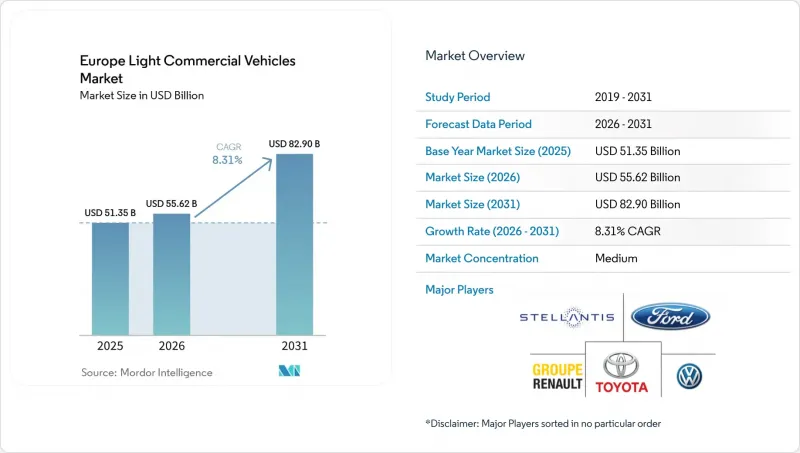
本報告按車輛類型(輕型商用車、輕型皮卡、底盤駕駛室等)、總重量(2.0噸以下、2.0噸以上)、動力類型(純電動汽車、插電式混合動力汽車、混合動力汽車、燃料電池電動汽車、內燃機汽車)、最終用途行業(都市區最後一公里配送等)、所有權類型(企業)和地區進行細分。市場預測以貨幣價值(美元)和銷售(輛)兩種形式呈現。
歐洲輕型商用車市場趨勢與洞察
電子商務推動了最後一公里配送的快速成長。
受電子商務和當日達需求的推動,歐洲小包裹量預計將持續成長。德國、英國和法國等主要市場每年處理數十億件小包裹,預計歐洲整體小包裹量將逐年穩定成長。為了滿足這項需求,物流供應商正在部署零排放貨車,以便暢通無阻地進入城市地區。亞馬遜已與Rivian和梅賽德斯-奔馳達成協議,計劃在2026年底在德國、法國和西班牙部署1萬輛電動送貨車。 Gethill和Gorillaz等電商公司青睞兩噸以下的微型貨車,推動此重量級車型實現兩位數成長。零售商為了維護品牌體驗,繼續使用自有配送服務,因此對配備遠端資訊處理和路線最佳化軟體的專用電動輕型商用車(LCV)的需求強勁。
歐盟收緊與進入都市區相關的二氧化碳和氮氧化物排放限制
根據歐盟二氧化碳排放性能標準法規((EU) 2019/631 號法規),現行法律要求到 2030 年,新型貨車(輕型商用車)的平均二氧化碳排放必須比 2021 年的水平降低約 50%。汽車製造商正在加速推出電池式電動車。例如,Stellantis 將於 2025 年 3 月推出標緻 e-Partner 和雪鐵龍 e-Berlingo,目標客戶是每天在低排放氣體區行駛的技術工人。 2025 年 8 月,倫敦將其超低排放氣體區 (ULEZ) 擴展至全部 32 個行政區,並透過對不符合標準的貨車徵收每天 12.50 英鎊的收費來加快車輛更換週期。 2025 年 1 月,巴黎禁止柴油貨車在環城公路 (Périphérique) 上行駛。此外,將於 2027 年推出的歐盟 7 標準將強制要求進行實際排放氣體測試,這將從經濟角度進一步加速向零排放動力傳動系統的過渡。
電動貨車初始成本溢價
截至2025年,中型純電動貨車比柴油車貴12,000至18,000歐元,補貼後價格降至8,000至10,000歐元,但對於東歐地區難以獲得低成本融資的中小企業而言,這仍然是一筆不小的購車障礙。預計到2025年,波蘭電動輕型商用車的註冊量僅成長9%,與德國34%的增幅形成鮮明對比,反映出補貼體系的不足。雖然電池即服務(BaaS)合約可以將購車價格降低6,000至8,000歐元,但加上月租費後,對於行駛里程較少的農村運營商而言,其成本仍然低於盈虧平衡點。
細分市場分析
到2025年,輕型商用車將佔歐洲輕型商用車市場的46.11%。這主要歸功於配備標準化50-80千瓦時電池組的常見廂型車的主導地位,這些電池組可提供240-300公里的實際續航里程。由於郵政服務和宅配公司的大宗訂單可進一步降低電池組成本14%,預計到2031年,該類別的複合年成長率將達到18.67%。雖然柴油車在建築和農業用皮卡領域仍佔據主導地位,但電動車車型也開始進行測試,因為雙向電源插座允許在現場使用工具。像雪鐵龍Ami Cargo這樣的微型輕型商用車預計到2025年註冊量將成長兩倍,目前正吸引那些優先考慮路邊停車便利性的快速電器公司的注意。
平台駕駛室和底盤駕駛室配置佔總銷售量的18%,其車身本體設計使其易於改裝成冷藏車、行動維修車間或自動卸貨卡車。 Stellantis的模組化架構將車身更換前置作業時間縮短至6-8週,僅為行業平均水平的一半,使車隊營運商能夠在不同的營運週期內重新部署底盤。雖然歐盟整車類型認證對於特定車身類型仍需6-9個月,但數位雙胞胎和虛擬測試技術的引入正在縮短實際車輛碰撞測試所需的時間。
到2025年,2.6-3噸級輕型商用車將佔歐洲輕型商用車市場41.34%的佔有率,在都市區和郊區物流方面實現了負載容量和續航里程的最佳平衡。業者非常重視駕駛人只需持有標準的B類駕照即可駕駛這類貨車,無需額外訓練或提高薪資。儘管尺寸較小,但預計到2031年,2噸以下貨車的複合年成長率將達到12.28%。這是因為市場需要高度靈活的平台,使快速電商公司能夠在堵塞收費時段內靈活通行,而無需支付基於重量的額外通行費。
在3.1-3.5噸級車型中,這類車輛適用於家具配送和輕型建築工程,但由於車輛總重增加會限制電池組的能量密度,柴油車仍佔據78%的市場佔有率。寧德時代(CATL)轉向使用成本效益更高的磷酸鋰鐵鋰(LFP)化學電池,目前已向雷諾和日產供應該電池,這使得電池組價格降低了15-20%,從而讓電動車在中型車市場的推廣變得更加現實。
其他好處:
- Excel格式的市場預測(ME)表
- 3個月的分析師支持
目錄
第1章:引言
- 研究假設和市場定義
- 調查範圍
第2章:調查方法
第3章執行摘要
第4章 主要產業趨勢
- 都市化、人口以及對汽車和大眾運輸的需求
- 燃油價格與電費差異(每公里,內燃機汽車與電動車)
- 電動車和內燃機汽車的總擁有成本(TCO)差異
- 資金籌措和所有權模式(貸款、租賃、認購)
- 電池化學成分構成比與電池組能量密度(LFP 與 NMC)
- 家中、職場和公共場所的充電樁數量/密度
- 快速充電網路覆蓋範圍和輸出頻寬
- 替代燃料基礎設施(燃料電池電動車的氫氣)
- 補貼和消費者獎勵(購房、稅收、通行費和停車費減免)的價值
- 汽車製造商的電動車產品陣容和未來車型發展
- 價值鍊和通路分析
- 監管、財政和產業政策框架
第5章 市場狀況
- 市場概覽
- 市場促進因素
- 電子商務推動了最後一公里配送的蓬勃發展。
- 歐盟收緊城市地區二氧化碳和氮氧化物排放標準。
- 政府車輛更換獎勵和報廢計劃
- 都市區低排放區(LEZ)的擴張
- 模組化改裝平台,可實現車身快速更換
- 透過車網互動(V2G)收入結構改善整體擁有成本(TCO)
- 市場限制因素
- 電動貨車初始成本溢價
- 半導體和電池供應受限
- 由於電池組過重,負載容量降低
- 燃料電池輕型商用車型式認證流程延誤
- 價值/供應鏈分析
- 監理情勢
- 技術展望
- 波特五力模型
第6章 市場規模與成長預測
- 車輛類型
- 小型商用貨車
- 小型皮卡(總重量小於3.5噸)
- 底盤駕駛室/平台駕駛室
- 小型卡車/微型輕型商用車
- 小巴(少於20個座位)
- 按車輛總重 (GVW) 等級
- 不足2.0噸
- 2.1~2.5 t
- 2.6~3.0 t
- 3.1~3.5 t
- 3.6~5.0 t
- 依推進類型
- 電池式電動車(BEV)
- 插電式混合動力車(PHEV)
- 混合動力電動車 (HEV)
- 燃料電池電動車 (FCEV)
- 內燃機(ICE)
- 按最終用途行業分類
- 都市區最後一公里配送與宅配
- 公共產業及現場服務
- 建材
- 郵件和小包裹
- 農業和農村服務
- 移動作業車輛和特殊車輛
- 依所有權類型
- 企業用車
- 中小企業擁有車輛
- 自營業者/自僱人士
- 租賃公司
- 政府和地方政府車輛
- 國家
- 奧地利
- 比利時
- 捷克共和國
- 丹麥
- 愛沙尼亞
- 法國
- 德國
- 愛爾蘭
- 義大利
- 拉脫維亞
- 立陶宛
- 挪威
- 波蘭
- 俄羅斯
- 西班牙
- 瑞典
- 英國
- 其他歐洲國家
第7章 競爭情勢
- 市場集中度
- 策略趨勢
- 市佔率分析
- 公司簡介
- Stellantis NV
- Ford Motor Company
- Renault Group
- Mercedes-Benz Group AG
- Volkswagen AG
- Toyota Motor Corporation
- Iveco Group NV
- Nissan Motor Co., Ltd.
- MAN Truck & Bus SE
- SAIC Motor-Maxus
- Hyundai Motor Company
- Arrival Ltd.
- Isuzu Motors Ltd.
- Mitsubishi Fuso Truck & Bus Corp.
- DFSK Motor
- Rivian Automotive, Inc.
- StreetScooter GmbH
- Volta Trucks AB
- Opel Automobile GmbH
- Piaggio Commercial Vehicles
第8章 市場機會與未來展望
- 評估閒置頻段和未滿足的需求
According to Mordor Intelligence, the european light commercial vehicles market size is expected to grow from USD 51.35 billion in 2025 to USD 55.62 billion in 2026 and is forecast to reach USD 82.90 billion by 2031 at an 8.31% CAGR over 2026-2031.
This report is Segmented by Vehicle Type (Light Commercial Vans, Light Pick-Up Trucks, Chassis-Cab, and More), Gross Vehicle Weight (Less Than 2. 0 T, and More), Propulsion Type (BEV, PHEV, HEV, FCEV, ICE), End-Use Industry (Urban Last-Mile, and More), Ownership Type (Corporate, and More), and Geography. The Market Forecasts are Provided in Terms of Value (USD) and Volume (Units).
Europe Light Commercial Vehicles Market Trends and Insights
E-Commerce-Driven Last-Mile Delivery Boom
Parcel volumes in Europe are projected to continue growing, driven by e-commerce and same-day delivery demand. Leading markets such as Germany, the UK, and France each handle several billion parcels annually, with overall European parcel volumes expected to increase steadily year-on-year. Logistics operators respond by adding zero-emission vans that secure unrestricted access to the city center. Amazon is committed to deploying 10,000 electric delivery vans across Germany, France, and Spain by the end of 2026, following agreements with Rivian and Mercedes-Benz. Quick-commerce firms such as Getir and Gorillas prefer sub-2.0-ton micro-vans, reinforcing double-digit growth in that weight class. Retailers continue to offer in-house delivery to protect brand experience, creating captive demand for purpose-built electric LCVs pre-equipped with telematics and route-optimization software.
Stricter EU CO2 and NOx Limits for City Access
The EU's CO2 emission performance standards regulation (Regulation (EU) 2019/631) requires that the average CO2 emissions of new vans (light commercial vehicles) be reduced by approximately 50 % by 2030 compared to 2021 levels, under current law. OEMs are front-loading battery electric launches, for instance, Stellantis released the Peugeot e-Partner and Citroen e-Berlingo in March 2025, targeting tradespeople traversing daily low-emission zones. London expanded its Ultra-Low Emission Zone to all 32 boroughs in August 2025, imposing a GBP 12.50 daily charge on non-compliant vans, accelerating fleet replacement cycles. Paris enforced a diesel van ban within the Peripherique in January 2025, while Euro 7 standards, coming in 2027, mandate real-world emissions tests that further shift economics toward zero-emission powertrains.
Up-Front EV Van Cost Premium
A mid-size BEV van in 2025 carried a EUR 12,000-18,000 premium over diesel, shrinking to EUR 8,000-10,000 after incentives, yet still deterring SMEs in Eastern Europe with limited access to low-cost credit. Poland's electric LCV registrations rose only 9% in 2025, compared with 34% in Germany, mirroring weaker subsidy structures. Battery-as-a-service contracts reduce purchase prices by EUR 6,000-8,000 but add monthly fees, leaving rural operators with lower mileage outside the break-even range.
Other drivers and restraints analyzed in the detailed report include:
- Government Fleet-Renewal Incentives and Scrappage
- Proliferation of Urban Low-Emission Zones (LEZs)
- Semiconductor and Battery-Cell Supply Constraints
For complete list of drivers and restraints, kindly check the Table Of Contents.
Segment Analysis
Light commercial vans captured 46.11% of Europe's light commercial vehicle market share in 2025, anchored by familiar box-van formats that now ship with standardized 50-80 kWh battery packs capable of 240-300 km real-world range. The category is forecast to post an 18.67% CAGR through 2031 as postal services and courier companies lock in bulk orders that lower pack costs by a further 14%. Pick-ups serving construction and agriculture remain dominated by diesel, yet electric variants are entering pilot trials as bidirectional-power sockets enable on-site tool use. Micro-LCVs such as the Citroen Ami Cargo tripled registrations in 2025 and now appeal to quick-commerce firms that value ease of curbside parking.
Platform-cab and chassis-cab variants accounted for 18% of volume, with body-in-white designs that simplify upfitting for refrigeration, mobile workshops, or tipper beds. Modular architectures adopted by Stellantis cut body-swap lead times to 6-8 weeks, half the industry average, allowing fleets to redeploy chassis across duty cycles. Homologation under EU Whole Vehicle Type Approval continues to add 6-9 months for niche bodies, although digital twins and virtual testing are shortening physical crash-validation phases.
The 2.6-3.0 ton class accounted for 41.34% of Europe's light commercial vehicle market in 2025, offering the best payload-to-range compromise for urban and peri-urban logistics. Operators appreciate that drivers can operate these vans with standard Category B licenses, eliminating the need for additional training or higher wages. Sub-2.0-ton vans, while smaller, are growing at a 12.28% CAGR to 2031 as quick-commerce firms require agile platforms able to slip through congestion-charge windows without weight-based toll surcharges.
The 3.1-3.5 ton bracket supports furniture delivery and light construction, yet diesel still commands 78% share, given energy-density limitations for battery packs at higher curb weights. CATL's shift toward cost-efficient LFP chemistry now supplies Renault and Nissan, trimming pack pricing by 15-20% and starting to make electric adoption viable in the mid-weight segment.
List of Companies Covered in this Report:
- Stellantis N.V.
- Ford Motor Company
- Renault Group
- Mercedes-Benz Group AG
- Volkswagen AG
- Toyota Motor Corporation
- Iveco Group N.V.
- Nissan Motor Co., Ltd.
- MAN Truck & Bus SE
- SAIC Motor - Maxus
- Hyundai Motor Company
- Arrival Ltd.
- Isuzu Motors Ltd.
- Mitsubishi Fuso Truck & Bus Corp.
- DFSK Motor
- Rivian Automotive, Inc.
- StreetScooter GmbH
- Volta Trucks AB
- Opel Automobile GmbH
- Piaggio Commercial Vehicles
Additional Benefits:
- The market estimate (ME) sheet in Excel format
- 3 months of analyst support
TABLE OF CONTENTS
1 Introduction
- 1.1 Study Assumptions and Market Definition
- 1.2 Scope of the Study
2 Research Methodology
3 Executive Summary
4 Key Industry Trend
- 4.1 Urbanization, Population and Vehicle/Transit Demand
- 4.2 Fuel vs Electricity Price Spread (Per km, ICE vs EV)
- 4.3 EV vs ICE Total Cost of Ownership (TCO) Gap
- 4.4 Financing and Ownership Models (Loans, Leasing, Subscription)
- 4.5 Battery Chemistry Mix and Pack Energy Density (LFP vs NMC)
- 4.6 Home, Workplace and Public Charger Access/Density
- 4.7 Fast-Charging Network Coverage and Power Bands
- 4.8 Alternative Fuels Infrastructure (Hydrogen for FCEVs)
- 4.9 Subsidy and Consumer Incentive Value (Purchase, Tax, Toll/Parking Benefits)
- 4.10 OEM EV Line-up and Model Pipeline
- 4.11 Value-Chain and Distribution-Channel Analysis
- 4.12 Regulatory, Fiscal and Industrial Policy Framework
5 Market Landscape
- 5.1 Market Overview
- 5.2 Market Drivers
- 5.2.1 E-Commerce-Driven Last-Mile Delivery Boom
- 5.2.2 Stricter EU CO2 and NOx Limits for City Access
- 5.2.3 Government Fleet-Renewal Incentives and Scrappage
- 5.2.4 Proliferation of Urban Low-Emission Zones (LEZs)
- 5.2.5 Modular Up-Fitting Platforms Enabling Quick Body Swaps
- 5.2.6 Vehicle-to-Grid (V2G) Revenue Stacks Enhancing TCO
- 5.3 Market Restraints
- 5.3.1 Up-Front EV Van Cost Premium
- 5.3.2 Semiconductor and Battery-Cell Supply Constraints
- 5.3.3 Payload Penalties from Heavy Battery Packs
- 5.3.4 Slow Homologation Cycles for Fuel-Cell LCVs
- 5.4 Value/Supply-Chain Analysis
- 5.5 Regulatory Landscape
- 5.6 Technological Outlook
- 5.7 Porter's Five Forces
- 5.7.1 Threat of New Entrants
- 5.7.2 Bargaining Power of Suppliers
- 5.7.3 Bargaining Power of Buyers
- 5.7.4 Threat of Substitutes
- 5.7.5 Competitive Rivalry
6 Market Size and Growth Forecasts (Value (USD) and Volume (Units))
- 6.1 By Vehicle Type
- 6.1.1 Light Commercial Vans
- 6.1.2 Light Pick-up Trucks (Less than 3.5 t GVW)
- 6.1.3 Chassis-Cab / Platform Cab
- 6.1.4 Mini-Trucks / Micro-LCVs
- 6.1.5 Minibuses (Less than 20 seats)
- 6.2 By Gross Vehicle Weight (GVW) Class
- 6.2.1 Less than 2.0 t
- 6.2.2 2.1 to 2.5 t
- 6.2.3 2.6 to 3.0 t
- 6.2.4 3.1 to 3.5 t
- 6.2.5 3.6 to 5.0 t
- 6.3 By Propulsion Type
- 6.3.1 BEV (Battery Electric Vehicle)
- 6.3.2 PHEV (Plug-in Hybrid Electric Vehicle)
- 6.3.3 HEV (Hybrid Electric Vehicle)
- 6.3.4 FCEV (Fuel Cell Electric Vehicle)
- 6.3.5 ICE (Internal Combustion Engine)
- 6.4 By End-Use Industry
- 6.4.1 Urban Last-Mile Delivery and Courier
- 6.4.2 Utilities and Field Services
- 6.4.3 Construction and Building Supplies
- 6.4.4 Postal and Parcel
- 6.4.5 Agriculture and Rural Services
- 6.4.6 Mobile Workshops and Special Purpose
- 6.5 By Ownership/Fleet Type
- 6.5.1 Corporate Fleets
- 6.5.2 SME Fleets
- 6.5.3 Self-Employed/Sole Proprietors
- 6.5.4 Rental and Leasing Companies
- 6.5.5 Government and Municipal Fleets
- 6.6 By Country
- 6.6.1 Austria
- 6.6.2 Belgium
- 6.6.3 Czech Republic
- 6.6.4 Denmark
- 6.6.5 Estonia
- 6.6.6 France
- 6.6.7 Germany
- 6.6.8 Ireland
- 6.6.9 Italy
- 6.6.10 Latvia
- 6.6.11 Lithuania
- 6.6.12 Norway
- 6.6.13 Poland
- 6.6.14 Russia
- 6.6.15 Spain
- 6.6.16 Sweden
- 6.6.17 United Kingdom
- 6.6.18 Rest of Europe
7 Competitive Landscape
- 7.1 Market Concentration
- 7.2 Strategic Moves
- 7.3 Market Share Analysis
- 7.4 Company Profiles (Includes Global level Overview, Market level overview, Core Segments, Financials as available, Strategic Information, Market Rank/Share for key companies, Products and Services, and Recent Developments)
- 7.4.1 Stellantis N.V.
- 7.4.2 Ford Motor Company
- 7.4.3 Renault Group
- 7.4.4 Mercedes-Benz Group AG
- 7.4.5 Volkswagen AG
- 7.4.6 Toyota Motor Corporation
- 7.4.7 Iveco Group N.V.
- 7.4.8 Nissan Motor Co., Ltd.
- 7.4.9 MAN Truck & Bus SE
- 7.4.10 SAIC Motor - Maxus
- 7.4.11 Hyundai Motor Company
- 7.4.12 Arrival Ltd.
- 7.4.13 Isuzu Motors Ltd.
- 7.4.14 Mitsubishi Fuso Truck & Bus Corp.
- 7.4.15 DFSK Motor
- 7.4.16 Rivian Automotive, Inc.
- 7.4.17 StreetScooter GmbH
- 7.4.18 Volta Trucks AB
- 7.4.19 Opel Automobile GmbH
- 7.4.20 Piaggio Commercial Vehicles
8 Market Opportunities and Future Outlook
- 8.1 White-Space and Unmet-Need Assessment

 全球輕型商用車市場規模、佔有率、趨勢和成長分析報告(2026-2034)
 輕型商用車市場-2026-2032年全球市場預測
 輕型商用車中冷器市場-全球產業規模、佔有率、趨勢、機會、預測:按類型、引擎類型、設計類型、地區和競爭格局分類,2021-2031年
 輕型商用車市場:按動力類型、車輛等級和地區分類輕型商用車市場-全球產業規模、佔有率、趨勢、機會及預測(依車輛類型、酬載能力、燃料類型、地區及競爭格局分類,2021-2031年)
 輕型商用車市場規模、佔有率及成長分析(按車輛類型、燃料類型、所有權類型和地區分類)-2026-2033年產業預測北美和歐洲輕型商用車服務市場(2024 年和 2030 年)歐洲輕型商用車市場:銷售預測與成長機會,2024-2032年