


 |
市場調查報告書
商品編碼
2066706
歐洲化妝品塑膠包裝:市場佔有率分析、產業趨勢與統計及成長預測(2026-2031)Europe Cosmetic Plastic Packaging - Market Share Analysis, Industry Trends & Statistics, Growth Forecasts (2026 - 2031) |
||||||

※ 本網頁內容可能與最新版本有所差異。詳細情況請與我們聯繫。
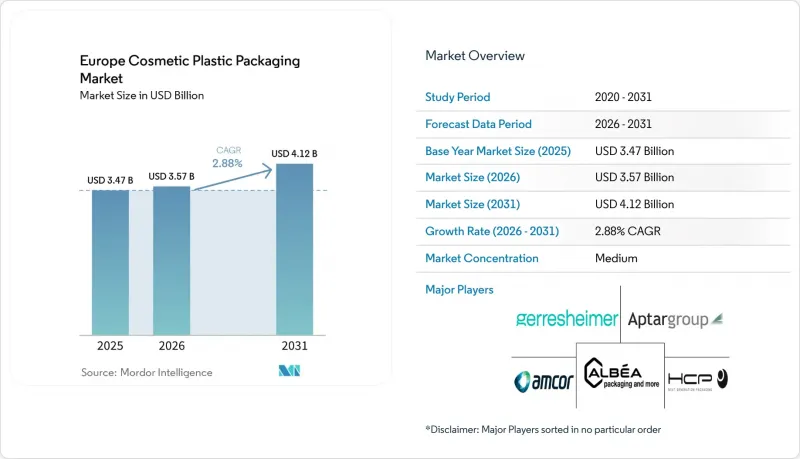
據 Mordor Intelligence 稱,歐洲化妝品塑膠包裝市場預計到 2026 年價值 35.7 億美元,高於 2025 年的 34.7 億美元,預計到 2031 年將達到 41.2 億美元。
預計 2026 年至 2031 年的複合年成長率為 2.88%。
本報告按樹脂類型(PET、PE、PP、可生物分解塑膠和生物基塑膠等)、產品類型(瓶裝、管裝和棒狀、泵裝和分配器等)、應用領域(護膚、護髮品、彩妝產品等)、永續性概況(傳統包裝、永續包裝)和國家進行細分。市場預測以美元(USD)為單位。
歐洲化妝品塑膠包裝市場的趨勢與洞察
護膚和皮膚化妝品的優質化
臨床護膚產品線需要使用無氣泵和真空室來保護不穩定的活性成分,這會使包裝的單位成本增加25-40%,但品牌仍能維持40-60%的利潤率溢價。德國和法國的消費者最願意為經過皮膚病學檢驗的包裝買單,這使得這兩個國家成為高階包裝的主要市場。像Gerresheimer這樣的領先加工商預計,到2024年,銷售額將達到19億歐元(20.5億美元),這主要歸功於化妝品行業15%的成長,而這種成長與增強阻隔性能的塑膠系統密切相關。歐洲藥品管理局(EMA)的指導方針模糊了化妝品和藥品之間的界限,要求供應商記錄洗脫液和萃取物,這進一步鞏固了精密射出成型和特殊樹脂的作用。中期來看,隨著更多大規模生產商推出更接近藥品的子品牌,優質化預計將推動歐洲化妝品塑膠包裝市場以0.7個百分點的複合年成長率成長。
高階美妝市場中可替換/重複使用經營模式的興起
高階品牌正轉向可重複填充的煙彈和煙盒,從而減少高達 85% 的原生塑膠使用。生產者責任延伸制度 (EPR) 與重複使用率掛鉤,並以此作為補償,加速了這一趨勢。奢侈品牌則透過 SKU 鎖定和初始包裝採購價格的 30-50% 溢價,收回在逆向物流的高額資本投入。 Quadpak 報告稱,2024 年可重複填充產品的銷售額將成長 25%,領先品牌的目標是到 2027 年實現可重複填充產品 60% 的市場滲透率。支援 NFC 的認證功能提升了消費者的購買體驗,同時為監管機構提供了關於重複使用週期的可審計資料。雖然初始成本減緩了中端市場的普及速度,但預計長期(超過 4 年)影響將使歐洲化妝品塑膠包裝市場成長 0.5 個百分點。
通貨膨脹導致原料成本上漲,給加工商帶來了壓力。
歐洲央行工業定價數據顯示,2024年聚乙烯價格18%至25%的波動將使加工商的毛利率下降8%至12%。沒有避險策略的中小型企業將被迫進行併購或退出市場,這將加速產業重組,並推動赫芬達爾-赫希曼指數自2023年以來上漲11%。高電力消耗量,儘管有監管獎勵,消費後回收(PCR)的使用仍將暫時放緩。在現貨價格恢復正常之前,這些限制因素預計將使歐洲化妝品塑膠包裝市場的短期成長率下降0.4個百分點。
細分市場分析
預計到2025年,聚乙烯仍將佔歐洲化妝品塑膠包裝市場總產量的33.72%,這再次印證了其在瓶子、瓶蓋和軟包裝薄膜等產品中的成本績效優勢。然而,生物分解性塑膠的年成長率為4.55%,其成長主要受生產者延伸責任(EPR)費用降低和企業績效考核指標的推動,而非絕對成本優勢。預計到2031年,歐洲化妝品塑膠包裝市場中與可生物分解塑膠相關的市場規模將達到6.4億美元,主要得益於PHA在乳液和擦拭巾產品中優於PLA的優異防潮性能。然而,目前所有應用領域的產能僅240萬噸,供需失衡導致其價格仍比聚乙烯高出兩到三倍。
歐洲化妝品塑膠包裝市場正經歷著另一個變革,加工商們正嘗試利用纖維素混合物的酵素解聚技術,在滿足堆肥標準的同時,實現類似PET的透明度。專利趨勢也印證了這一發展勢頭,2024年將有127項與可生物分解包裝相關的專利獲得批准,其中35%專注於化妝品領域。隨著品牌商揭露其在使用再生材料方面的進展,化學相容性測試也日益受到重視。單體遷移風險仍受到嚴格監管,尤其是在類視色素精華液領域。在生產者延伸責任制(EPR)下,採用消費後回收材料(PCR)的單一材料聚乙烯(PE)管和罐更受青睞,預計到2031年,聚乙烯的市場佔有率將下降至30.1%,儘管其絕對噸位仍在持續成長。
由於瓶裝產品在洗髮精、卸妝水和潤膚露等領域廣受歡迎,其市佔率仍維持在32.10%。但輕量化設計降低了瓶身平均壁厚,使單位樹脂用量減少了8-12%。隨著數位印刷技術的引入,軟管和棒狀包裝已成為成長最快的品類,年複合成長率達3.55%,為整個歐洲化妝品塑膠包裝市場的季節性產品和網紅合作產品提供客製化的圖案設計。由於獨立品牌傾向於較低的最低訂購量(MOQ),預計在2026年至2031年間,由軟管驅動的歐洲化妝品塑膠包裝市場規模將成長約1.6億美元。
無氣泵技術一度僅限於高階產品,但隨著2024年中端價位祛痘產品開始採用此技術,精密組件的市場也隨之拓展。然而,歐盟關於繫繩瓶蓋的法規迫使3公升以下翻蓋式瓶蓋的鉸鏈形狀進行重新設計,導致模具成本增加20-25%。軟包裝袋傳統上填充用,但由於其比硬質瓶裝產品減少了25-35%的材料用量,因此吸引了注重環保、追求更高品質產品的消費者。然而,與阻隔層壓材料的可回收性相關的權衡取捨,正在減緩其在德國等高回收率市場之外的成長。
其他好處:
- Excel格式的市場預測(ME)表
- 3個月的分析師支持
目錄
第1章:引言
- 研究假設和市場定義
- 調查範圍
第2章:調查方法
第3章執行摘要
第4章 市場狀況
- 市場概覽
- 市場促進因素
- 護膚和皮膚化妝品的優質化
- 奢侈化妝品市場中可填充和可重複使用經營模式的興起
- 品牌所有者承諾在2030年使用超過50%的消費後回收塑膠。
- 利用小批量數位印刷的獨立品牌迅速發展
- 歐盟一次性塑膠指令鼓勵設計變更
- 在2024年截止日期前引入繫繩式帽子
- 市場限制因素
- 通貨膨脹導致原料成本上漲,給加工商帶來了壓力。
- 零售商在「無塑膠」自有品牌的努力
- 彩色和多層PET的回收途徑有限。
- 提高不可回收包裝材料的生產者責任延伸(EPR)費用
- 產業價值鏈分析
- 監理情勢
- 技術展望
- 波特五力分析
- 宏觀經濟因素對市場的影響
第5章 市場規模與成長預測
- 依樹脂類型
- 聚對苯二甲酸乙二醇酯(PET)
- 聚乙烯(PE)
- 高密度聚苯乙烯(HDPE)
- 低密度線性LDPE
- 線型低密度聚乙烯(LLDPE)
- 聚丙烯(PP)
- 可生物分解和生物基塑膠
- 其他樹脂類型
- 依產品類型
- 瓶子
- 管子和棍子
- 泵浦和分配器
- 小袋
- 其他產品類型
- 透過使用
- 護膚
- 護髮
- 化妝品
- 除臭劑和香水
- 其他用途
- 永續性概況
- 傳統包裝
- 永續包裝
- 國家
- 英國
- 德國
- 法國
- 義大利
- 西班牙
- 其他歐洲國家
第6章 競爭情勢
- 市場集中度
- 策略趨勢
- 市佔率分析
- 公司簡介
- Albea SA
- HCP Packaging Co., Ltd.
- Gerresheimer AG
- Amcor plc
- AptarGroup, Inc.
- Cosmopak USA LLC
- Quadpack Industries, SA
- Libo Cosmetics Co., Ltd.
- Mpack Poland Sp. z oo
- Politech Sp. z oo
- Huhtamaki Oyj
- Rieke Corporation(TriMas Corporation)
- Berlin Packaging LLC
- Mktg Industry Srl
- Silgan Dispensing Systems Corporation
- Coveris Holdings SA
- Wipak Oy
- International Paper Company
- Takemoto Packaging, Inc.
第7章 市場機會與未來展望
According to Mordor Intelligence, europe cosmetic plastic packaging market size in 2026 is estimated at USD 3.57 billion, growing from 2025 value of USD 3.47 billion with 2031 projections showing USD 4.12 billion, growing at 2.88% CAGR over 2026-2031.
This report is Segmented by Resin Type (PET, PE, PP, Biodegradable and Bio-Based Plastics, and More), Product Type (Bottles, Tubes and Sticks, Pumps and Dispensers, and More), Application (Skin Care, Hair Care, Make-Up Products, and More), Sustainability Profile (Conventional Packaging, Sustainable Packaging), and Country. The Market Forecasts are Provided in Terms of Value (USD).
Europe Cosmetic Plastic Packaging Market Trends and Insights
Premiumisation of Skin-Care and Dermo-Cosmetics
Clinical skin-care lines require airless pumps and vacuum chambers that safeguard unstable actives, lifting packaging cost-per-unit by 25-40% yet allowing brands to preserve 40-60% margin premiums. German and French consumers display the strongest willingness to pay for dermatologically validated formats, turning those two countries into anchor markets for high-spec packaging. Leading converters such as Gerresheimer reported EUR 1.9 billion (USD 2.05 billion) revenue in 2024, citing 15% cosmetic growth linked to barrier-enhanced plastic systems. EMA guidance blurs the cosmetic-pharma boundary, compelling suppliers to document leachables and extractables, which further cements the role of precision injection-molding and specialty resins. Over the medium term, premiumization is expected to add 0.7 percentage points to the Europe cosmetic plastic packaging market CAGR as more mass manufacturers launch quasi-pharma sub-brands.
Rise of Refill/Re-Use Business Models in Prestige Beauty
Prestige houses are switching to refill pods and cartridges that slash virgin-plastic intensity by up to 85%, a shift accelerated by EPR fee rebates tied to re-use ratios. Luxury brands recover the higher capex for reverse logistics through SKU lock-in and 30-50% price premiums on initial pack purchases. Quadpack logged 25% revenue growth from refill formats in 2024, and major maisons target 60% refillable penetration by 2027. NFC-enabled authentication extends the consumer journey while furnishing regulators with auditable data on reuse cycles. Although roll-out costs slow mid-market adoption, long-term (>= 4 years) impact is pegged at +0.5 percentage points for the Europe cosmetic plastic packaging market.
Inflation-Driven Material Cost Spikes Squeezing Converters
Polyethylene price volatility of 18-25% during 2024 wiped 8-12% off converter gross margins, as outlined by European Central Bank industrial price data. Smaller firms lacking hedging programs were forced into M and A or market exit, fuelling consolidation that has lifted the Herfindahl-Hirschman Index by 11 % since 2023. Electricity-intensive recycling operations faced twin pressure from energy tariffs and feedstock scarcity, temporarily dampening PCR usage despite regulatory incentives. Until spot prices normalize, the restraint subtracts 0.4 percentage points from near-term growth in the Europe cosmetic plastic packaging market.
Other drivers and restraints analyzed in the detailed report include:
- Brand-Owner Commitments to >=50% PCR Plastics by 2030
- Rapid Growth of Indie Brands Using Short-Run Digital Printing
- Rising EPR Fees for Non-Recyclable Packs
For complete list of drivers and restraints, kindly check the Table Of Contents.
Segment Analysis
Polyethylene continues to underpin 33.72% of 2025 volumes, reaffirming its cost-performance balance across bottles, caps and flexible films in the Europe cosmetic plastic packaging market. Yet biodegradable plastics are rising 4.55% annually, their advance linked more to EPR fee relief and corporate scorecard metrics than to absolute cost advantage. Europe cosmetic plastic packaging market size tied to biodegradable grades is forecast to reach USD 0.64 billion by 2031, propelled by PHA's superior moisture barrier relative to PLA for lotions and wipes. Production capacity, however, remains 2.4 million tonnes across all uses, a mismatch that sustains price premiums of 2-3X over PE.
The Europe cosmetic plastic packaging market pivots further as converters experiment with enzymatic depolymerization of cellulose blends to match PET-like clarity while matching compostability standards. Patent activity validates momentum: 127 biodegradable-packaging patents were granted in 2024, 35% of them cosmetic-focused. As brand owners publicize recycled-content progress, chemical compatibility tests intensify, especially for retinoid serums, where monomer migration risk remains tightly regulated. Because EPR schemes reward mono-material PE tubes and jars that incorporate PCR, polyethylene still expands in absolute tonnage even as share slips to an anticipated 30.1% by 2031.
Bottle formats keep 32.10% share through their ubiquity in shampoos, micellar waters, and body lotions, but average wall thickness is declining under light-weighting programs, trimming resin usage per unit by 8-12%. Digital print adoption transforms tubes and sticks into the fastest-growing 3.55% CAGR cohort, providing bespoke graphics for seasonal drops and influencer capsules across the Europe cosmetic plastic packaging market. The Europe cosmetic plastic packaging market size attributable to tubes will add nearly USD 0.16 billion between 2026 and 2031 as indie brands favor MOQ-friendly runs.
Airless pumps, once a luxury exclusive, migrated into mid-tier acne treatments in 2024, widening the addressable base for precision components. However, the EU tethered-cap rule is compelling a rethink of hinge geometry for flip-top dispensers under 3 liters, escalating tooling spends by 20-25%. Pouches, historically niche in hair-conditioner refills, now capture eco-trade-up consumers, given 25-35% material savings versus rigid bottles. Still, recyclability trade-offs for barrier laminates temper momentum outside high-return-rate markets such as Germany.
List of Companies Covered in this Report:
- Albea S.A.
- HCP Packaging Co., Ltd.
- Gerresheimer AG
- Amcor plc
- AptarGroup, Inc.
- Cosmopak USA LLC
- Quadpack Industries, S.A.
- Libo Cosmetics Co., Ltd.
- Mpack Poland Sp. z o.o.
- Politech Sp. z o.o.
- Huhtamaki Oyj
- Rieke Corporation (TriMas Corporation)
- Berlin Packaging LLC
- Mktg Industry S.r.l.
- Silgan Dispensing Systems Corporation
- Coveris Holdings S.A.
- Wipak Oy
- International Paper Company
- Takemoto Packaging, Inc.
Additional Benefits:
- The market estimate (ME) sheet in Excel format
- 3 months of analyst support
TABLE OF CONTENTS
1 INTRODUCTION
- 1.1 Study Assumptions and Market Definition
- 1.2 Scope of the Study
2 RESEARCH METHODOLOGY
3 EXECUTIVE SUMMARY
4 MARKET LANDSCAPE
- 4.1 Market Overview
- 4.2 Market Drivers
- 4.2.1 Premiumisation of skin-care and dermo-cosmetics
- 4.2.2 Rise of refill/re-use business models in prestige beauty
- 4.2.3 Brand-owner commitments to >=50% PCR plastics by 2030
- 4.2.4 Rapid growth of indie brands using short-run digital printing
- 4.2.5 EU Single-Use Plastics Directive catalysing design change
- 4.2.6 Adoption of tethered caps ahead of 2024 deadline
- 4.3 Market Restraints
- 4.3.1 Inflation-driven material cost spikes squeezing converters
- 4.3.2 Retailer "no-plastics" private-label pledges
- 4.3.3 Limited recycling streams for coloured / multilayer PET
- 4.3.4 Rising EPR fees for non-recyclable packs
- 4.4 Industry Value Chain Analysis
- 4.5 Regulatory Landscape
- 4.6 Technological Outlook
- 4.7 Porter's Five Forces Analysis
- 4.7.1 Bargaining Power of Suppliers
- 4.7.2 Bargaining Power of Buyers
- 4.7.3 Threat of New Entrants
- 4.7.4 Threat of Substitute Products
- 4.7.5 Intensity of Competitive Rivalry
- 4.8 The Impact of Macroeconomic Factors on the Market
5 MARKET SIZE AND GROWTH FORECASTS (VALUE)
- 5.1 By Resin Type
- 5.1.1 Polyethylene Terephthalate (PET)
- 5.1.2 Polyethylene (PE)
- 5.1.2.1 High-Density Polyethylene (HDPE)
- 5.1.2.2 Low-Density and Linear-LDPE
- 5.1.2.3 Linear Low-Density Polyethylene (LLDPE)
- 5.1.3 Polypropylene (PP)
- 5.1.4 Biodegradable and Bio-based Plastics
- 5.1.5 Other Resin Types
- 5.2 By Product Type
- 5.2.1 Bottles
- 5.2.2 Tubes and Sticks
- 5.2.3 Pumps and Dispensers
- 5.2.4 Pouches
- 5.2.5 Other Product Types
- 5.3 By Application
- 5.3.1 Skin Care
- 5.3.2 Hair Care
- 5.3.3 Make-up Products
- 5.3.4 Deodorants and Fragrances
- 5.3.5 Other Applications
- 5.4 By Sustainability Profile
- 5.4.1 Conventional Packaging
- 5.4.2 Sustainable Packaging
- 5.5 By Country
- 5.5.1 United Kingdom
- 5.5.2 Germany
- 5.5.3 France
- 5.5.4 Italy
- 5.5.5 Spain
- 5.5.6 Rest of Europe
6 COMPETITIVE LANDSCAPE
- 6.1 Market Concentration
- 6.2 Strategic Moves
- 6.3 Market Share Analysis
- 6.4 Company Profiles (includes Global level Overview, Market level overview, Core Segments, Financials as available, Strategic Information, Market Rank/Share for key companies, Products and Services, and Recent Developments)
- 6.4.1 Albea S.A.
- 6.4.2 HCP Packaging Co., Ltd.
- 6.4.3 Gerresheimer AG
- 6.4.4 Amcor plc
- 6.4.5 AptarGroup, Inc.
- 6.4.6 Cosmopak USA LLC
- 6.4.7 Quadpack Industries, S.A.
- 6.4.8 Libo Cosmetics Co., Ltd.
- 6.4.9 Mpack Poland Sp. z o.o.
- 6.4.10 Politech Sp. z o.o.
- 6.4.11 Huhtamaki Oyj
- 6.4.12 Rieke Corporation (TriMas Corporation)
- 6.4.13 Berlin Packaging LLC
- 6.4.14 Mktg Industry S.r.l.
- 6.4.15 Silgan Dispensing Systems Corporation
- 6.4.16 Coveris Holdings S.A.
- 6.4.17 Wipak Oy
- 6.4.18 International Paper Company
- 6.4.19 Takemoto Packaging, Inc.
7 MARKET OPPORTUNITIES AND FUTURE OUTLOOK
- 7.1 White-space and Unmet-Need Assessment

 化妝品包裝市場:2026-2032年全球市場預測(依產品類型、材料類型、包裝類型、通路和最終用途分類)化妝品罐包裝市場:依材質、容量、形狀、瓶口類型、密封方式與應用分類-2026-2032年全球市場預測
 化妝品包裝器材市場機會、成長要素、產業趨勢分析及2026-2035年預測
 化妝品包裝市場報告:按產品類型、材料類型、容量、化妝品類型和地區分類(2026-2034 年)
 玻璃化妝品瓶市場規模、佔有率和趨勢分析報告:按產品類型、應用、產能、地區和細分市場預測(2026-2033 年)化妝品塑膠包裝市場:商業機會、成長要素、產業趨勢分析及2026-2035年預測化妝品包裝市場機會、成長促進因素、產業趨勢分析及預測(2026-2035年)
 全球化妝品包裝市場:市場規模、趨勢與預測(至2034年)
 化妝品包裝市場:按材料、產品類型、應用和地區分類化妝品包裝市場:按材料、產品類型、應用和地區分類