


 |
市場調查報告書
商品編碼
2066583
纖維增強聚合物(FRP)複合材料:市場佔有率分析、行業趨勢和統計數據以及成長預測(2026-2031 年)Fiber-Reinforced Polymer (FRP) Composites - Market Share Analysis, Industry Trends & Statistics, Growth Forecasts (2026 - 2031) |
||||||

※ 本網頁內容可能與最新版本有所差異。詳細情況請與我們聯繫。
據 Mordor Intelligence 稱,纖維增強聚合物複合材料的市場規模預計將從 2025 年的 790.7 億美元成長到 2026 年的 831.7 億美元,到 2031 年達到 1071.6 億美元,2026 年至 2031 年的複合成長率為 5.20%。
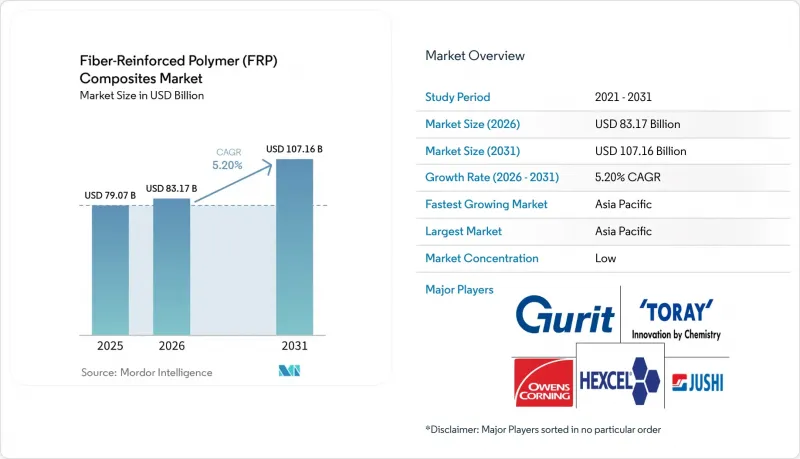
本報告按樹脂類型(熱固性樹脂和熱塑性樹脂)、纖維類型(玻璃纖維增強聚合物(GFRP)、碳纖維增強聚合物(CFRP)等)、增強材料形式(粗紗、預浸料等)、最終用戶行業(交通運輸、建築施工等)和地區(亞太地區、北美、歐洲、南美、中東和非洲)進行分類。
全球纖維增強聚合物(FRP)複合材料市場趨勢與洞察
建築支出正轉向使用防腐蝕鋼筋和橋樑面板。
美國、日本和海灣國家的相關機構正擴大採用玻璃纖維和玄武岩纖維增強材料作為橋樑抗氯化物腐蝕的保護措施,以延長橋樑的使用壽命。到2025年,美國61.7萬座橋樑中將有42%的橋齡超過50年,每年的腐蝕修復費用高達83億美元。因此,採用玻璃纖維增強複合材料(GFRP)的橋樑維修專案在全生命週期成本方面可節省35%。在日本,東京灣Aqua-Line沿線進行了為期15年的暴露試驗並取得成功後,沿海公路已強制要求使用纖維增強複合材料(FRP)進行加固。在沙烏地阿拉伯的NEOM計畫中,80%的水泥建築物都使用了GFRP,以防止鋼材在45 度C的環境溫度下氧化。拉擠成型的橋面比鋼筋混凝土輕 75%,可減少高達 30% 的基礎要求,並且到 2025 年,西維吉尼亞州 2 號公路已證明其設計使用壽命可達 40 年。
長度超過 120 公尺的風力發電機葉片需要超高強度的 GFRP(玻璃纖維增強聚合物)。
渦輪機製造商目前推出的機型轉子直徑超過240米,這意味著葉片長度超過120米,葉輪蓋的抗張強度超過1200兆帕。 2024年,維斯塔斯公司發布了一款15兆瓦的渦輪機,其葉片長115.5米,採用高模量玻璃纖維製成,單片葉片質量減輕了8噸。預計2025年,中國將新增75吉瓦的風電裝置容量,其中60%為離岸風力發電。製造商們也積極採用低空隙率樹脂傳遞模塑(RTM)工藝,以承受1000萬次的疲勞負荷。西門子歌美颯的熱塑性「可回收葉片」材料回收率高達95%,符合歐盟2028年的回收法規。
碳纖維價格波動威脅汽車產業的成本目標。
預計俄羅斯聚丙烯腈出口限制將導致其前體價格在2025年上漲18%,迫使整車製造商承擔每公斤4-6美元的漲幅,並危及售價低於3.5萬美元的電動車專案。豐田汽車已將2026年式普銳斯的車頂面板從碳纖維增強複合材料(CFRP)改為鋁製,以確保其利潤率。 SGL Carbon和東麗公司簽署了一項為期五年的採購協議,價格比2024年現貨價格高出12%,將價格波動風險轉移到了上游。 ELG公司的再生纖維比原生纖維便宜40%,強度維持率高達90%,但只能用於非結構性零件。 Hexel公司已將其30%的前驅生產轉移到成本更低的美國工廠,以減輕歐洲能源價格上漲的影響。
細分市場分析
2025年,熱固性樹脂的銷售額佔比達到71.06%,其中環氧樹脂和聚酯基材料佔據主導地位,這些材料需要耐腐蝕性和低成本的開模加工過程。環氧樹脂因其優異的黏合性而佔據熱固性樹脂市場的大部分需求,這增強了其與航太預浸料中碳纖維的相容性。聚酯樹脂則應用於對成本要求較高的造船和儲槽市場,而乙烯基酯類樹脂則被用於高腐蝕性化工廠。
隨著汽車製造商轉向可回收基材材料,熱塑性塑膠預計到2031年將以6.15%的複合年成長率成長。一種含40%玻璃纖維的聚丙烯化合物目前被用作車門模組的承載材料,重量減輕了35%,並且能夠在90秒內完成成型,年產量超過50萬件。聚醯胺6和66正在為引擎室零件提供熱塑性塑膠,這些零件可在高達150 度C的環境下運作。高性能PEEK雖然成本高昂,但在飛機座椅結構領域的需求不斷成長,因為該領域需要符合有關阻燃性、煙霧排放和毒性的法規。科思創的「PolyLoop」系統已成功回收500噸廢棄PA6-CFRP,並保持了其90%的強度,從而證明了閉合迴路系統的可行性,而熱固性樹脂則無法實現這一點。 BMW展示了一種混合結構的例子,進一步擴大了纖維增強聚合物複合材料在其電池蓋中的應用,將熱塑性樹脂外層與環氧樹脂芯材相結合,在保持剛性的同時增強了減震性能。
玻璃纖維增強聚合物(GFRP)成本為2.50美元/公斤,抗張強度為2400兆帕,預計滿足建築、風電和海洋領域的需求,到2025年將佔總產量的91.18%。中國巨石公司計劃在2025年將其產能擴大到320萬噸,這將使玻璃纖維的價格下降8%,給西方供應商帶來壓力。
預計到2031年,碳纖維增強塑膠(CFRP)將以11.14%的複合年成長率成長,這主要得益於航太原始設備製造商(OEM)增加複合材料機身的產量,以及高階電動車採用結構性電池外殼。波音787和空中巴士A350計畫在2025年共消耗了3000噸纖維。保時捷2024年式Taycan的頂棚和隔板透過降低12毫米的重心,展現了其卓越的結構性能。標準模量等級的碳纖維促進了CFRP產量的成長,而高模量等級的碳纖維則被用於衛星和F1賽車單體殼,這些應用需要超過200 GPa的剛度重量比。玄武岩纖維被用於耐火隧道襯砌,即使在600 度C的高溫下也能保持85%的強度。
區域分析
預計到2025年,亞太地區將以45.22%的市佔率引領纖維增強聚合物複合材料市場,年複合成長率達6.08%。中國新增75吉瓦風電裝置容量,每千瓦風電將消耗18公斤玻璃纖維增強複合材料(GFRP),這將推動該地區領先企業新增52萬噸玻璃纖維產能。印度1.4兆美元的國家基礎設施計畫將12%的預算分配給耐腐蝕材料,預計到2028年,這將推動GFRP鋼筋的年需求量達到18萬噸。在日本,海岸公路強制使用FRP鋼筋,因為FRP鋼筋經15年暴露試驗證明性能零劣化。
在北美,美國橋樑投資計畫累計到2025年將達到24億美元,其中18%將用於1,200座橋樑的FRP塗層。波音公司位於南卡羅來納州和華盛頓州的工廠在2025年將消耗1200噸CFRP用於787和777X專案。在安大略省,通用汽車和Stellantis公司在當地生產的電動車底盤零件已吸引了4.2億美元的複合材料相關投資。
在歐洲,德國計畫在2025年安裝8.2吉瓦的風力發電裝置容量,其中55%為離岸風力發電。這增加了對長度超過100公尺且帶有碳玻璃混合翼帽的風力渦輪機葉片的需求。歐盟《廢棄物框架指令》規定,到2028年,複合材料必須包含25%的回收材料,促使歐文斯科寧和威立雅投資3,800萬歐元用於熱解設備。空中巴士已將A350的月產量提高到9架,這使得施塔德和伊萊斯卡斯工廠對碳纖維增強複合材料(CFRP)的需求增加了1800噸。
在南美洲,巴西的風電裝置容量已達28吉瓦,其中85%集中在東北部高產風電區,預計到2025年將需要9,600噸玻璃纖維增強複合材料(GFRP)葉片。雖然中東和非洲的總合目前較低,但預計在不久的將來會有所成長。沙烏地阿拉伯的NEOM計畫到2030年需要14萬噸GFRP加固材料。南非將在2024年至2025年間新增3.2吉瓦的風電裝置容量,西門子歌美颯將供應115公尺長的葉片,每千瓦功率使用16公斤GFRP。
其他好處:
- Excel格式的市場預測(ME)表
- 3個月的分析師支持
目錄
第1章:引言
- 研究假設和市場定義
- 調查範圍
第2章:調查方法
第3章執行摘要
第4章 市場狀況
- 市場概覽
- 市場促進因素
- 建築支出正轉向耐腐蝕鋼筋和橋樑面板。
- 長度超過 120 公尺的風力發電機葉片需要超高強度的 GFRP(玻璃纖維增強聚合物)。
- 電動車平台的輕量化要求正在推動熱塑性碳纖維增強複合材料(CFRP)的使用。
- 美國、日本和歐盟採用FRP包裹加強老舊橋樑。
- 用於3D列印混凝土水泥建築物的模組化複合鋼筋
- 市場限制因素
- 碳纖維價格波動對汽車產業的成本目標產生了負面影響。
- 金屬和複合板的替代品供應情況
- 歐盟內部在廢棄產品回收利用方面存在的差異,導致了掩埋法規的推出。
- 價值鏈分析
- 波特五力模型
第5章 市場規模與成長預測
- 依樹脂類型
- 熱固性
- 熱塑性樹脂
- 依纖維類型
- 玻璃纖維增強塑膠(GFRP)
- 碳纖維增強塑膠(CFRP)
- 醯胺纖維增強聚合物
- 玄武岩纖維增強聚合物
- 其他纖維類型
- 加固類型
- 粗紗
- 紡織品和墊子
- 斷枝
- 預孕
- SMC 和 BMC
- 按最終用戶行業分類
- 運輸
- 建築/施工
- 電氣和電子設備
- 其他終端用戶產業
- 按地區
- 亞太地區
- 中國
- 印度
- 日本
- 韓國
- 東南亞國協
- 其他亞太國家
- 北美洲
- 美國
- 加拿大
- 墨西哥
- 歐洲
- 德國
- 英國
- 義大利
- 法國
- 北歐國家
- 其他歐洲國家
- 南美洲
- 巴西
- 阿根廷
- 其他南美國家
- 中東和非洲
- 沙烏地阿拉伯
- 南非
- 其他中東和非洲國家
- 亞太地區
第6章 競爭情勢
- 市場集中度
- 策略趨勢
- 市佔率分析
- 公司簡介
- AGY
- China Jushi Co., Ltd.
- Exel Composites
- Gurit Services AG
- Hexcel Corporation
- Hitachi, Ltd.
- Kineco Limited
- Kordsa Teknik Tekstil Anonim Sirketi
- KraussMaffei
- Mitsubishi Chemical Carbon Fiber and Composites, Inc.
- Nippon Electric Glass Co., Ltd.
- Norplex Micarta
- Olin Corporation
- Owens Corning
- Park Aerospace Corp.
- SAERTEX GmbH & Co.KG
- SGL Carbon
- Solvay
- Strongwell Corporation
- TEIJIN LIMITED
- TORAY INDUSTRIES, INC.
第7章 市場機會與未來展望
According to Mordor Intelligence, the fiber-Reinforced polymer composites market size is expected to increase from USD 79.07 billion in 2025 to USD 83.17 billion in 2026 and reach USD 107.16 billion by 2031, growing at a CAGR of 5.20% over 2026-2031.
This report is Segmented by Resin Type (Thermoset and Thermoplastic), Fiber Type (Glass Fiber-Reinforced Polymer (GFRP), Carbon Fiber-Reinforced Polymer (CFRP), and More), Reinforcement Form (Rovings, Prepreg, and More), End-User Industry (Transportation, Building and Construction, and More), and Geography (Asia-Pacific, North America, Europe, South America, and Middle-East and Africa).
Global Fiber-Reinforced Polymer (FRP) Composites Market Trends and Insights
Construction Spend Shifting to Corrosion-Free Rebar and Bridge Decks
United States, Japan, and Gulf agencies are increasingly specifying glass- and basalt-fiber rebar to prolong bridge life under chloride attack. In 2025, 42% of the 617,000 U.S. bridges were over 50 years old, and corrosion repairs cost USD 8.3 billion annually, giving GFRP retrofits a 35% life-cycle cost advantage. Japan mandated FRP rebar in coastal highways after 15 years of successful exposure testing along the Tokyo Bay Aqua-Line. Saudi Arabia's NEOM project adopted GFRP for 80% of concrete structures to avoid steel oxidation in 45°C ambient conditions. Pultruded bridge decks weigh 75% less than reinforced concrete, reduce foundations by up to 30%, and demonstrated a 40-year design life on West Virginia Route 2 in 2025.
Wind-Turbine Blade Length Exceeding 120 Meters Demanding Ultra-High-Strength GFRP
Turbine makers now deploy rotor diameters above 240 m, which push blade lengths past 120 m and require spar caps with tensile strength over 1,200 MPa. Vestas introduced a 15 MW turbine in 2024 featuring 115.5-m blades incorporating high-modulus glass fiber that cuts blade mass by 8 t per unit. China installed 75 GW of wind capacity in 2025, 60% offshore, and manufacturers shifted to low-void resin-transfer molding to withstand ten-million-cycle fatigue loads. Siemens Gamesa's thermoplastic RecyclableBlade enables 95% material recovery, aligning with the EU 2028 recycling rule.
Volatile Carbon-Fiber Prices Hurting Automotive Cost Targets
Export restrictions on Russian polyacrylonitrile raised precursor prices 18% in 2025, forcing OEMs to absorb USD 4-6 per-kg increases that jeopardize sub-USD 35,000 EV programs. Toyota replaced planned CFRP roof panels on the 2026 Prius with aluminum to protect margins. SGL Carbon and Toray fixed five-year offtake contracts at 12% above 2024 spot prices, transferring volatility upstream. Recycled fiber from ELG retains 90% strength at 40% below virgin cost but suits only non-structural parts. Hexcel shifted 30% of precursor output to a lower-cost U.S. site to blunt European energy spikes.
Other drivers and restraints analyzed in the detailed report include:
- Lightweighting Mandates in EV Platforms Favoring Thermoplastic CFRP
- Retrofitting of Aging Bridges in U.S., Japan, and EU With FRP Wraps
- EU End-of-Life Recycling Gap Triggering Landfill Restrictions
For complete list of drivers and restraints, kindly check the Table Of Contents.
Segment Analysis
Thermoset held 71.06% of 2025 revenue, dominated by epoxy and polyester chemistries specified for corrosion resistance and low-cost open-mold processing. Epoxy captured high thermoset demand because its superior adhesion pairs with carbon fiber in aerospace prepregs. Polyester served in cost-driven marine and tank markets, while vinyl ester filled in highly corrosive chemical plants.
Thermoplastic will grow at 6.15% CAGR through 2031 as carmakers pivot to recyclable matrices. Polypropylene compounds reinforced with 40% glass fiber now form door-module carriers that cut weight 35% and mold in 90 seconds at annual volumes above 500,000 units. Polyamide 6 and 66 secure thermoplastic revenue for under-hood parts operating up to 150 °C. High-performance PEEK, though costly, expanded in aircraft seat structures that demand flame-smoke-toxicity compliance. Covestro's PolyLoop recovered 500 t of end-of-life PA6-CFRP in 2025 with 90% strength retention, proving a closed-loop route unavailable to thermosets. BMW combines thermoplastic skins with epoxy cores in battery covers for higher impact absorption while retaining stiffness, illustrating hybrid architectures that deepen fiber reinforced polymer composites market adoption.
Glass Fiber-Reinforced Polymer (GFRP) accounted for 91.18% of 2025 volume because its USD 2.50/kg cost and 2,400 MPa tensile strength satisfy construction, wind, and marine needs. China Jushi raised capacity to 3.2 million t in 2025, lowering glass fiber prices 8% and squeezing Western suppliers.
Carbon Fiber-Reinforced Polymer (CFRP) will expand at an 11.14% CAGR to 2031 as aerospace OEMs ramp composite airframes and premium EVs adopt structural battery enclosures. Boeing's 787 and Airbus A350 programs jointly consumed 3,000 t of fiber in 2025. Porsche's 2024 Taycan roof and bulkhead lowered center-of-gravity 12 mm, validating structural performance premiums. Standard-modulus grades delivered higher CFRP volume, while high-modulus variants served satellites and Formula 1 monocoques requiring more than 200 GPa stiffness-to-weight ratios. Basalt fiber is used for fire-resistant tunnel linings, retaining 85% strength at 600 °C.
Geography Analysis
Asia-Pacific dominated the fiber reinforced polymer composites market with a 45.22% share in 2025 and is projected to grow at 6.08% CAGR. China's 75 GW wind additions used 18 kg GFRP per kW and spurred 520,000 t of new glass-fiber capacity by regional leaders. India's USD 1.4 trillion National Infrastructure Pipeline allocates 12% to corrosion-resistant materials, translating to 180,000 t annual GFRP rebar demand by 2028. Japan now mandates FRP rebar in coastal highways after 15-year exposure trials proved zero degradation.
In North America, U.S. Bridge Investment Program earmarked USD 2.4 billion in 2025, with 18% for FRP wraps on 1,200 bridges. Boeing's South Carolina and Washington plants consumed 1,200 t CFRP for 787 and 777X programs in 2025. Ontario attracted USD 420 million composite capital as GM and Stellantis localized EV underbody parts.
In Europe, Germany installed 8.2 GW of wind capacity in 2025, 55% offshore, demanding blades above 100 m with hybrid carbon-glass spar caps. The EU Waste Framework Directive requires 25% recycled content in composites by 2028, triggering EUR 38 million pyrolysis investments by Owens Corning and Veolia. Airbus increased A350 output to nine per month, adding 1,800 t CFRP demand at Stade and Illescas.
South America captured demand as Brazil's wind fleet reached 28 GW with 85% located in high-capacity Northeast zones demanding 9,600 t GFRP blades in 2025. Middle East and Africa together held lower share yet promise growth in the near future. Saudi Arabia's NEOM calls for 140,000 t GFRP rebar through 2030. South Africa added 3.2 GW wind capacity in 2024-2025, with Siemens Gamesa supplying 115-m blades using 16 kg GFRP per kW.
- AGY
- China Jushi Co., Ltd.
- Exel Composites
- Gurit Services AG
- Hexcel Corporation
- Hitachi, Ltd.
- Kineco Limited
- Kordsa Teknik Tekstil Anonim Sirketi
- KraussMaffei
- Mitsubishi Chemical Carbon Fiber and Composites, Inc.
- Nippon Electric Glass Co., Ltd.
- Norplex Micarta
- Olin Corporation
- Owens Corning
- Park Aerospace Corp.
- SAERTEX GmbH & Co.KG
- SGL Carbon
- Solvay
- Strongwell Corporation
- TEIJIN LIMITED
- TORAY INDUSTRIES, INC.
Additional Benefits:
- The market estimate (ME) sheet in Excel format
- 3 months of analyst support
TABLE OF CONTENTS
1 Introduction
- 1.1 Study Assumptions and Market Definition
- 1.2 Scope of the Study
2 Research Methodology
3 Executive Summary
4 Market Landscape
- 4.1 Market Overview
- 4.2 Market Drivers
- 4.2.1 Construction Spend Shifting to Corrosion-Free Rebar and Bridge Decks
- 4.2.2 Wind-Turbine Blade Length More than 120 M Demanding Ultra-High-Strength GFRP
- 4.2.3 Lightweighting Mandates in EV Platforms Favouring Thermoplastic CFRP
- 4.2.4 Retrofitting of Aging Bridges in US, Japan, and EU With FRP Wraps
- 4.2.5 Modular Composite Rebar for 3-D-Printed Concrete Structures
- 4.3 Market Restraints
- 4.3.1 Volatile Carbon-Fiber Prices Hurt Automotive Cost Targets
- 4.3.2 Availability of Metal and Engineered-Wood Substitutes
- 4.3.3 EU End-of-Life Recycling Gap Triggering Landfill Restrictions
- 4.4 Value Chain Analysis
- 4.5 Porter's Five Forces
- 4.5.1 Bargaining Power of Suppliers
- 4.5.2 Bargaining Power of Buyers
- 4.5.3 Threat of New Entrants
- 4.5.4 Threat of Substitutes
- 4.5.5 Degree of Competition
5 Market Size and Growth Forecasts (Value)
- 5.1 By Resin Type
- 5.1.1 Thermoset
- 5.1.2 Thermoplastic
- 5.2 By Fiber Type
- 5.2.1 Glass Fiber-Reinforced Polymer (GFRP)
- 5.2.2 Carbon Fiber-Reinforced Polymer (CFRP)
- 5.2.3 Aramid Fiber-Reinforced Polymer
- 5.2.4 Basalt Fiber-Reinforced Polymer
- 5.2.5 Other Fiber Types
- 5.3 By Reinforcement Form
- 5.3.1 Rovings
- 5.3.2 Woven Fabrics and Mats
- 5.3.3 Chopped Strands
- 5.3.4 Prepreg
- 5.3.5 SMC and BMC
- 5.4 By End-user Industry
- 5.4.1 Transportation
- 5.4.2 Building and Construction
- 5.4.3 Electrical and Electronics
- 5.4.4 Other End-user Industries
- 5.5 By Geography
- 5.5.1 Asia-Pacific
- 5.5.1.1 China
- 5.5.1.2 India
- 5.5.1.3 Japan
- 5.5.1.4 South Korea
- 5.5.1.5 ASEAN Countries
- 5.5.1.6 Rest of Asia-Pacific
- 5.5.2 North America
- 5.5.2.1 United States
- 5.5.2.2 Canada
- 5.5.2.3 Mexico
- 5.5.3 Europe
- 5.5.3.1 Germany
- 5.5.3.2 United Kingdom
- 5.5.3.3 Italy
- 5.5.3.4 France
- 5.5.3.5 NORDIC Countries
- 5.5.3.6 Rest of Europe
- 5.5.4 South America
- 5.5.4.1 Brazil
- 5.5.4.2 Argentina
- 5.5.4.3 Rest of South America
- 5.5.5 Middle-East and Africa
- 5.5.5.1 Saudi Arabia
- 5.5.5.2 South Africa
- 5.5.5.3 Rest of Middle-East and Africa
- 5.5.1 Asia-Pacific
6 Competitive Landscape
- 6.1 Market Concentration
- 6.2 Strategic Moves
- 6.3 Market Share Analysis
- 6.4 Company Profiles (includes Global level Overview, Market level overview, Core Segments, Financials as available, Strategic Information, Products and Services, and Recent Developments)
- 6.4.1 AGY
- 6.4.2 China Jushi Co., Ltd.
- 6.4.3 Exel Composites
- 6.4.4 Gurit Services AG
- 6.4.5 Hexcel Corporation
- 6.4.6 Hitachi, Ltd.
- 6.4.7 Kineco Limited
- 6.4.8 Kordsa Teknik Tekstil Anonim Sirketi
- 6.4.9 KraussMaffei
- 6.4.10 Mitsubishi Chemical Carbon Fiber and Composites, Inc.
- 6.4.11 Nippon Electric Glass Co., Ltd.
- 6.4.12 Norplex Micarta
- 6.4.13 Olin Corporation
- 6.4.14 Owens Corning
- 6.4.15 Park Aerospace Corp.
- 6.4.16 SAERTEX GmbH & Co.KG
- 6.4.17 SGL Carbon
- 6.4.18 Solvay
- 6.4.19 Strongwell Corporation
- 6.4.20 TEIJIN LIMITED
- 6.4.21 TORAY INDUSTRIES, INC.
7 Market Opportunities and Future Outlook
- 7.1 White-space and Unmet-Need Assessment
- 7.2 Development of New Advanced Forms of FRP Materials

 全球纖維強化塑膠(FRP)板材市場
 纖維增強聚合物市場預測至 2034 年—按纖維類型、樹脂類型、產品類型、最終用途產業和地區進行全球分析。
 2026年全球鋼筋連接系統市場報告
 纖維增強聚合物複合材料市場規模、佔有率、成長和全球產業分析:按類型、應用和地區分類,並提供 2026-2034 年的洞察和預測。2026年全球玻璃纖維增強聚合物市場報告
 纖維增強聚合物市場:依產品材料、應用、國家及地區分類-全球產業分析、市場規模、市場佔有率及2026年至2033年預測
 纖維增強聚合物(FRP)市場:按產品、應用和地區分類
 玻璃纖維增強液晶聚合物市場:按纖維含量、聚合物類型、等級、應用和最終用途行業分類的全球預測(2026-2032年)
 玻璃纖維增強聚合物:市場佔有率分析、產業趨勢與統計、成長預測(2026-2031)2032年全球纖維增強聚合物複合材料市場預測:依纖維類型、樹脂類型、增強形式、製造流程、應用和地區分析