


 |
市場調查報告書
商品編碼
2066571
消磁系統:市場佔有率分析、產業趨勢與統計、成長預測(2026-2031)Degaussing Systems - Market Share Analysis, Industry Trends & Statistics, Growth Forecasts (2026 - 2031) |
||||||

※ 本網頁內容可能與最新版本有所差異。詳細情況請與我們聯繫。
根據 Mordor Intelligence 預測,除臭系統市場規模將從 2025 年的 8.7 億美元成長到 2026 年的 9.2 億美元,到 2031 年將達到 12 億美元,2026 年至 2031 年的複合年成長率為 5.45%。
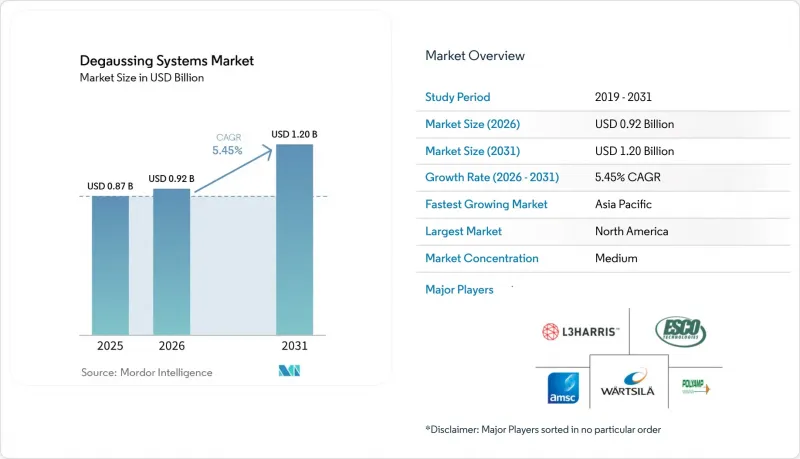
本報告按艦艇類型(航空母艦、驅逐艦、巡防艦、輕型護衛艦、潛艇等)、解決方案(退磁、消磁、測距)、組件(控制單元、功率放大器、線圈和電纜等)、安裝類型(新艦安裝和維修)以及地區(北美、歐洲等)進行細分。市場預測以美元計價。
全球除臭系統市場趨勢及洞察
海軍現代化預算增加加快了採購速度。
不斷擴大的國防投資正在加強多年期的造船和維護計劃,這些計劃將消磁系統升級與作戰系統現代化相結合。美國已為2026會計年度的國防開支累計3,843億美元,其中650億美元用於造船和海上系統,包括水面作戰艦艇生存能力和特徵控制方面的工作。加拿大2026年國防工業戰略強調「建造、合作、採購」模式,使該國的造船藍圖與水面艦艇的電磁相容性標準保持一致。北約成員國也在採用人工智慧技術,尤其是在造船平台上,這表明在現代化過程中,將硬體和軟體結合以實現即時現場控制的趨勢日益明顯。隨著海軍將更多艦艇送入維修船塢,並將測距、消磁和艦載線圈重新校準與其他任務包工作整合在一起,消磁系統市場正從中受益。到 2031 年,北美地區的短期採購和亞太地區的快速成長是推動除塵系統需求成長的主要因素。
磁性地雷推動了對特徵控制的需求。
根據美國國防情報局(DIA)的評估,北韓擁有大量水雷,包括配備磁性引信的侵入式水雷,這些水雷可能對限制區域內的水面作戰艦艇構成迫在眉睫的威脅。南海的水雷威脅與北韓類似,在較淺水域,水下和錨碇水雷的威脅甚至更大。為了應對這些水雷風險,美國海軍於2025年透過海軍海上系統司令部向RTX公司和德事隆公司授予了一份反水雷措施載荷的合約。這是將部署在瀕海戰鬥艦(LCS)上的模組化水雷對抗系統的一部分,控制這些艦艇的磁性特徵至關重要。同時,正如多項研究指出的那樣,中國在銣基量子磁力計方面的研發活動凸顯了控制磁特徵的重要性,即使是對於配備消磁裝置的艦艇而言也是如此。
不斷增加的資本投入和長期維護成本限制了其更廣泛的應用。
負責人需要在生存能力、火力以及戰備狀態的投資之間做出權衡,這可能會減緩部分艦隊的消磁升級進度。總擁有成本包括安裝、定期維護和測距等費用,這些支出項目在採購計畫中會與其他項目相互競爭。新興市場的專案對初始成本和全壽命週期成本最為敏感,這可能導致消磁工作推遲到後期階段。決策者通常選擇將消磁與其他中期維護工作結合的維修方案,以降低人事費用和停泊時間。這種成本計算方式可以確保部署進度穩定,但可能會導致當年優先順序較低的艦艇部署延遲。
細分市場分析
到2025年,潛艦業務將佔該業務板塊收入的30.67%。這主要得益於潛艦艦隊在新艇和整個艦隊的升級改造中採用了磁特徵控制技術。到2031年,掃雷艇的複合年成長率將達到7.65%,這反映了一種利用低磁場航母和無人艇搜索和排除水雷的戰術戰略。北美地區的採購重點在於延壽項目,旨在滿足亞太地區未來的成長需求。亞太地區與有爭議的沿海水域以及從設計階段就對磁特徵控制進行定義的新型水下項目密切相關。隨著無人系統在掃雷中發揮越來越重要的作用,航空母艦和支援艦艇也在標準化降低磁場基準值,以減少受影響區域的作業風險。隨著海軍根據任務需求和艦艇使用年限逐步進行升級改造,除磁系統產業也從這種平衡的市場模式中受益。
對於包括驅逐艦和巡防艦在內的水面作戰艦艇而言,隨著艦隊適應低特徵巡航和即時導航控制,市場需求仍然強勁。掃雷需求也延伸至巡邏艇和支援遠徵任務的輔助艦艇,從而擴大了小型線圈組和緊湊型控制設備的應用範圍。盟軍2026年造船藍圖強調更高的生存能力標準和更嚴格的電磁相容性,使得消磁成為一項核心要求,而不僅僅是可選的維修。因此,大型艦艇的需求保持穩定,而對在水雷威脅水域作業的專用艦艇的需求則成長更為迅速。這種「兩極化」趨勢構成了需求預測的基礎,並影響著消磁系統市場中不同類型艦艇的供應商策略。
到2025年,消磁解決方案將佔該領域支出的61.25%,因為海軍優先考慮艦載線圈系統,以在日常操作中抑制訊號特徵。測距和校準仍然是調試和維修工作流程的核心,用於在消磁和退磁過程中設定和檢驗磁場目標。軟體定義控制透過學習船體在不同方位和緯度下的行為來增強容錯能力,從而減輕船員的工作量,並縮短在港口和海上達到目標磁場所需的時間。採購團隊正在透過將這些功能整合到更廣泛的生存能力範圍內,使現代化計劃與艦艇的運作保持一致。消磁系統產業正在透過模組化放大器、智慧控制器和數位雙胞胎來應對這一挑戰,從而縮短設計和驗收測試週期。
隨著海軍為維持較低的常規磁場水準而增加永久磁鐵重置頻率,到2031年,永磁消磁技術將以6.27%的複合年成長率快速發展。攜帶式和碼頭消磁方式日益普及,最大限度地減少了前往固定設施的航行時間,使船舶能夠留在指定並降低調度風險。消磁技術透過減少殘餘磁漂移來提高船載線圈的效率,許多艦隊將消磁週期與測距數據更新相結合,以鞏固其效果。基於模型的設計也在改進線圈佈局和消磁曲線,並提高不同製程流程結果的可重複性。這些努力共同豐富了解決方案,並鞏固了即時消磁技術在消磁系統市場的主導地位。
區域分析
預計到2025年,北美將佔全球除塵系統市場規模的35.65%。這得歸功於美國持續的造船和現代化投入,以及加拿大優先發展國內能力的產業政策。美國2026財政年度預算提案撥款650億美元用於造船和海上系統,同時維持對反水雷措施和生存能力提升措施的資金投入。加拿大2026年國防工業戰略正式概述了加強海軍生產能力並使供應商與長期平台需求保持一致的路徑,包括解決未來水面艦艇的電磁相容性。美國海軍的MCM無人水面艇計畫正在推動分散式水雷戰,並將平台採購與低磁場作戰的任務需求連結起來。這些因素共同為該地區的除塵系統市場奠定了穩定的基礎。
在亞太地區,海軍規模的擴張,以及爭議航道和自主掃雷技術的廣泛應用,預計到2031年將以8.12%的複合年成長率成長。在全部區域,無人系統專案正著重發展微型消磁和軟體定義控制技術,使無人水面載具(USV)和母艦能夠在磁場強度較低的雷區作業。合作夥伴不斷調整技術選擇以適應生存能力目標,並加強基於模型的設計和校準框架。隨著供應商針對本地運行環境和測距資料集最佳化演算法,軟體創新預計將加速發展。這些因素共同促成了亞太地區在消磁系統市場相較於其他地區的卓越表現。
在歐洲,隨著北約框架內水雷戰和標準化進程的推進,相關技術正穩步普及。成員國正在投資自主水雷反水雷措施及相關消磁調整,2026 年的供應商公告也確認了人工智慧工程資源在艦船平台和特徵管理方面的專業化應用。採購週期保持謹慎的節奏,以滿足電磁相容性 (EMC) 和抗衝擊性要求,確保短期預算內採購量的穩定性。歐洲的優先事項反映了全球大規模維修和新造艦艇選擇性部署的趨勢,並強調模組化和軟體定義控制。這種方法有助於在消磁系統市場創造可預測的商業機會,並避免其他國防領域常見的波動。
其他好處:
- Excel格式的市場預測(ME)表
- 3個月的分析師支持
目錄
第1章:引言
- 研究假設和市場定義
- 調查範圍
第2章:調查方法
第3章執行摘要
第4章 市場狀況
- 市場概覽
- 市場促進因素
- 海軍現代化預算的增加正在加速對除塵系統的投資。
- 磁性地雷的日益廣泛部署推動了對磁性特徵控制的需求。
- 擴大維修項目,以增強老舊水面艦艇的消磁能力。
- 高溫超導性(HTS)線圈技術的出現,使得緊湊高效的系統成為可能。
- 整合人工智慧驅動的自適應演算法以實現即時簽章管理
- 隱形型無人水面和水下航行器對微型除塵系統的需求日益成長。
- 市場限制因素
- 高昂的資本投入和長期的維護成本阻礙了其更廣泛的應用。
- 由於國防採購程序複雜,採購週期延長。
- 將資源重新分配給新興的電磁軌道炮和定向能量武器系統,導致可用資金減少。
- 高溫超導薄膜和稀土元素磁感測器的供應鏈脆弱性阻礙了生產規模的擴大。
- 價值鏈分析
- 監理情勢
- 技術展望
- 波特五力分析
第5章 市場規模與成長預測
- 按船舶類型
- 航空母艦
- 驅逐艦
- 護衛艦
- 克爾維特
- 潛水艇
- 反水雷措施
- 其他船型
- 透過解決方案
- 退磁
- 退磁
- 距離測量
- 按組件
- 控制單元(DCU)
- 功率放大器
- 線圈和電纜
- 磁力計和感測器
- 軟體和分析
- 按安裝類型
- 在新建的房產中進行安裝
- 改裝
- 按地區
- 北美洲
- 美國
- 加拿大
- 墨西哥
- 歐洲
- 英國
- 德國
- 法國
- 其他歐洲國家
- 亞太地區
- 中國
- 印度
- 日本
- 韓國
- 其他亞太國家
- 南美洲
- 巴西
- 其他南美國家
- 中東和非洲
- 中東
- 阿拉伯聯合大公國
- 沙烏地阿拉伯
- 其他中東國家
- 非洲
- 南非
- 其他非洲國家
- 中東
- 北美洲
第6章 競爭情勢
- 市場集中度
- 策略趨勢
- 市佔率分析
- 公司簡介
- L3Harris Technologies, Inc.
- Wartsila Corporation
- Polyamp AB
- Larsen & Toubro Limited
- Exail SAS
- IFEN SpA
- American Superconductor Corporation(AMSC)
- Dayatech Merin Sdn Bhd
- DA Group
- Ultra Electronics Holdings Ltd.
- Babcock International Group PLC
- Thales Group
- ESCO Technologies inc.
第7章 市場機會與未來展望
According to Mordor Intelligence, the degaussing systems market size is expected to grow from USD 0.87 billion in 2025 to USD 0.92 billion in 2026 and is forecasted to reach USD 1.2 billion by 2031 at a 5.45% CAGR over 2026-2031.
This report is Segmented by Vessel Type (Aircraft Carriers, Destroyers, Frigates, Corvettes, Submarines, and More), Solution (Degaussing, Deperming, and Ranging), Component (Control Units, Power Amplifiers, Coils and Cabling, and More), Installation Type (New-Build Installation and Retrofit), and Geography (North America, Europe, and More). The Market Forecasts are Provided in Terms of Value (USD).
Global Degaussing Systems Market Trends and Insights
Rising Naval Modernization Budgets Accelerate Procurement
Higher defense investment is reinforcing multi-year shipbuilding and sustainment programs that bundle degaussing upgrades with combat-system refresh. The US allocates USD 384.3 billion for FY2026 defense investment, with USD 65 billion directed to shipbuilding and maritime systems, including survivability and signature-management work on surface combatants. Canada's 2026 defense industrial strategy emphasizes a build-partner-buy approach, aligning national shipbuilding roadmaps with electromagnetic-compatibility standards for surface ships. NATO members are also introducing AI-enabled capabilities around ship platforms, signaling that modernizations increasingly combine hardware and software for real-time field control. The degaussing systems market benefits as navies move more hulls through upgrade docks and sync ranging, deperming, and onboard-coil recalibration with other mission package work. Near-term buys in North America and faster growth in Asia-Pacific are the central volume drivers for the degaussing systems market through 2031.
Magnetic-Influence Sea Mines Propel Signature Control Demand
The Defense Intelligence Agency has evaluated that North Korea possesses a significant stockpile of naval mines, which include influence mines equipped with magnetic fuzes, which can cause imminent danger to surface warships in restricted areas. The threat from mines is equally present in the South China Sea, where shallow waters can enhance the effectiveness of bottom- and moored-mine hazards. To address these mine risks, the US Navy awarded contracts to RTX Corporation and Textron Inc. in 2025 for mine countermeasure payloads through the Naval Sea Systems Command, which is part of modular mine-sweeping equipment carried by Littoral Combat Ships, where it is critical to control magnetic signatures from these vessels. At the same time, Chinese research and development activities, as noted in various studies, on rubidium-based quantum magnetometers highlight the importance of controlling magnetic signatures, even from degaussing-equipped vessels.
Elevated Capital Expenditure and Long-Term Maintenance Costs Limit Broader Adoption
Budget planners face trade-offs among survivability investments, lethality, and readiness, which can slow the pace of degaussing upgrades in some fleets. Total cost of ownership includes installation, periodic maintenance, and ranging, and these line items compete with other line items in procurement plans. Programs in emerging markets are the most sensitive to upfront and lifecycle costs, which can push degaussing work into later phases. Decision makers often choose retrofit packages that combine degaussing with other mid-life tasks to secure savings on labor and dock time. This cost calculus keeps adoption steady, yet it can delay deployment across lower-priority hulls in any given year.
Other drivers and restraints analyzed in the detailed report include:
- Expansion of Retrofit Initiatives Targeting Older Surface Vessels for Degaussing Upgrades
- Emergence of High-Temperature Superconducting Coil Technology Enabling Compact and Efficient Systems
- Supply-Chain Vulnerabilities for HTS Tape and Rare-Earth-Based Magnetic Sensors Hinder Production Scalability
For complete list of drivers and restraints, kindly check the Table Of Contents.
Segment Analysis
Submarines accounted for 30.67% of segment revenue in 2025 as undersea fleets embedded magnetic-signature control into new builds and through-class upgrades. Mine countermeasure vessels are advancing at a 7.65% CAGR through 2031, which reflects a doctrine that relies on low-field motherships and unmanned craft to hunt and neutralize mines. Procurement in North America centers on life-extension plans for Asia-Pacific growth, which is tied to contested littorals and new undersea programs that specify signature control at the blueprint stage. As unmanned systems take on more minehunting roles, motherships and support vessels also standardize lower magnetic baselines to reduce operational risk in influence fields. The degaussing systems industry benefits from this balanced mix as navies sequence upgrades by mission need and hull age.
Surface combatants, including destroyers and frigates, continue to sustain demand as fleets calibrate real-time control for low-signature patrols and transits. Mine warfare requirements extend to patrol craft and auxiliary vessels that support expeditionary missions, broadening the installed base for smaller coil sets and compact controllers. Allied shipbuilding roadmaps in 2026 emphasize higher survivability standards and tighter electromagnetic compatibility, which makes degaussing a core requirement rather than an optional retrofit. The result is stable volume from large hulls and faster growth in specialized vessels that operate in mine-threatened zones. This two-speed pattern anchors forecast demand and shapes vendor strategies across vessel classes within the degaussing systems market.
Degaussing solutions led with 61.25% of segment spend in 2025 as navies prioritized onboard coil systems that suppress signatures during routine operations. Ranging and calibration remain central to commissioning and refit workflows because they set and validate field targets for both degaussing and deperming. Software-defined control adds resilience by learning how hulls behave across headings and latitudes, thereby reducing crew workload and shortening time to goal fields in port and at sea. Procurement teams integrate these capabilities within broader survivability scopes so modernization timelines align with ship availability windows. The degaussing systems industry is responding with modular amplifiers, smart controllers, and digital twins that compress design and acceptance testing.
Deperming is growing at a 6.27% CAGR through 2031 as navies increase the cadence of permanent magnetism resets to support lower day-to-day field levels. Portable and pierside approaches that minimize transit time to fixed facilities are gaining traction, keeping ships on station and reducing schedule risk. Since deperming improves the effectiveness of onboard coils by reducing remanence drift, many fleets pair deperming cycles with ranging updates to lock in gains. Model-based design is also improving coil layouts and deperming profiles, which supports more repeatable results between treatments. Together, these practices reinforce solution diversity and maintain real-time degaussing's leadership in the degaussing systems market.
Geography Analysis
North America held 35.65% of the degaussing systems market size in 2025, supported by sustained US shipbuilding and modernization outlays and Canadian industrial policy that prioritizes domestic capability. The US FY2026 portfolio directs USD 65 billion to shipbuilding and maritime systems and maintains funding for mine countermeasures and survivability enablers. Canada's 2026 defense industrial strategy formalizes a pathway to strengthen naval production capacity and align suppliers with long-term platform needs, including electromagnetic compatibility readiness for future surface ships. The US Navy's MCM USV program advances distributed mine warfare, bridging platform procurement with mission demand for low-field operations. These conditions secure a stable base for the degaussing systems market in the region.
Asia-Pacific is projected to grow at an 8.12% CAGR through 2031 as naval expansion aligns with contested sea lanes and broader adoption of autonomous mine countermeasures. Unmanned programs across the region place a premium on micro-degaussing and software-defined control, enabling USVs and motherships to operate in influence-mine areas with lower field strength. Partners continue to align technical choices with survivability goals, which reinforces model-based design and calibration discipline. Software innovation is likely to scale quickly as suppliers tailor algorithms to local operating environments and range datasets. These elements underpin Asia-Pacific's outperformance in the degaussing systems market.
Europe sustains steady adoption, anchored in its mine warfare legacy and in standardization within NATO frameworks. Member states invest in autonomous mine countermeasures and associated degaussing coordination, and 2026 supplier announcements confirm AI engineering resources dedicated to ship platforms and signature management. Procurement cycles remain deliberate to align with electromagnetic compatibility and shock requirements, which keeps throughput consistent across near-term budgets. European priorities mirror the global mix of retrofit volume and selective new-build adoption, with an emphasis on modular and software-defined control. This stance supports predictable opportunities for the degaussing systems market without the volatility seen in other defense categories.
- L3Harris Technologies, Inc.
- Wartsila Corporation
- Polyamp AB
- Larsen & Toubro Limited
- Exail SAS
- IFEN S.p.A.
- American Superconductor Corporation (AMSC)
- Dayatech Merin Sdn Bhd
- DA Group
- Ultra Electronics Holdings Ltd.
- Babcock International Group PLC
- Thales Group
- ESCO Technologies inc.
Additional Benefits:
- The market estimate (ME) sheet in Excel format
- 3 months of analyst support
TABLE OF CONTENTS
1 INTRODUCTION
- 1.1 Study Assumptions and Market Definition
- 1.2 Scope of the Study
2 RESEARCH METHODOLOGY
3 EXECUTIVE SUMMARY
4 MARKET LANDSCAPE
- 4.1 Market Overview
- 4.2 Market Drivers
- 4.2.1 Rising naval modernization budgets accelerating investment in degaussing systems
- 4.2.2 Increased deployment of magnetic-influence sea mines driving demand for magnetic signature control
- 4.2.3 Expansion of retrofit initiatives targeting older surface vessels for degaussing upgrades
- 4.2.4 Emergence of high-temperature superconducting (HTS) coil technology enabling compact and efficient systems
- 4.2.5 Integration of AI-powered adaptive algorithms for real-time signature management
- 4.2.6 Growing requirement for micro-degaussing systems in stealthy unmanned surface and underwater vehicles
- 4.3 Market Restraints
- 4.3.1 Elevated capital expenditure and long-term maintenance costs limit broader adoption
- 4.3.2 Extended acquisition timelines due to complex defense procurement procedures
- 4.3.3 Resource reallocation toward emerging railgun and directed-energy weapon systems reduces funding availability
- 4.3.4 Supply-chain vulnerabilities for HTS tape and rare-earth-based magnetic sensors hinder production scalability
- 4.4 Value Chain Analysis
- 4.5 Regulatory Landscape
- 4.6 Technological Outlook
- 4.7 Porter's Five Forces Analysis
- 4.7.1 Threat of New Entrants
- 4.7.2 Bargaining Power of Suppliers
- 4.7.3 Bargaining Power of Buyers
- 4.7.4 Threat of Substitutes
- 4.7.5 Intensity of Competitive Rivalry
5 MARKET SIZE AND GROWTH FORECASTS (VALUE)
- 5.1 By Vessel Type
- 5.1.1 Aircraft Carriers
- 5.1.2 Destroyers
- 5.1.3 Frigates
- 5.1.4 Corvettes
- 5.1.5 Submarines
- 5.1.6 Mine Countermeasure Vessels
- 5.1.7 Other Vessel Types
- 5.2 By Solution
- 5.2.1 Degaussing
- 5.2.2 Deperming
- 5.2.3 Ranging
- 5.3 By Component
- 5.3.1 Control Units (DCU)
- 5.3.2 Power Amplifiers
- 5.3.3 Coils and Cabling
- 5.3.4 Magnetometers and Sensors
- 5.3.5 Software and Analytics
- 5.4 By Installation Type
- 5.4.1 New-Build Installation
- 5.4.2 Retrofit
- 5.5 By Geography
- 5.5.1 North America
- 5.5.1.1 United States
- 5.5.1.2 Canada
- 5.5.1.3 Mexico
- 5.5.2 Europe
- 5.5.2.1 United Kingdom
- 5.5.2.2 Germany
- 5.5.2.3 France
- 5.5.2.4 Rest of Europe
- 5.5.3 Asia-Pacific
- 5.5.3.1 China
- 5.5.3.2 India
- 5.5.3.3 Japan
- 5.5.3.4 South Korea
- 5.5.3.5 Rest of Asia-Pacific
- 5.5.4 South America
- 5.5.4.1 Brazil
- 5.5.4.2 Rest of South America
- 5.5.5 Middle East and Africa
- 5.5.5.1 Middle East
- 5.5.5.1.1 United Arab Emirates
- 5.5.5.1.2 Saudi Arabia
- 5.5.5.1.3 Rest of Middle East
- 5.5.5.2 Africa
- 5.5.5.2.1 South Africa
- 5.5.5.2.2 Rest of Africa
- 5.5.5.1 Middle East
- 5.5.1 North America
6 COMPETITIVE LANDSCAPE
- 6.1 Market Concentration
- 6.2 Strategic Moves
- 6.3 Market Share Analysis
- 6.4 Company Profiles (includes Global level Overview, Market level overview, Core Segments, Financials as available, Strategic Information, Market Rank/Share for key companies, Products and Services, and Recent Developments)
- 6.4.1 L3Harris Technologies, Inc.
- 6.4.2 Wartsila Corporation
- 6.4.3 Polyamp AB
- 6.4.4 Larsen & Toubro Limited
- 6.4.5 Exail SAS
- 6.4.6 IFEN S.p.A.
- 6.4.7 American Superconductor Corporation (AMSC)
- 6.4.8 Dayatech Merin Sdn Bhd
- 6.4.9 DA Group
- 6.4.10 Ultra Electronics Holdings Ltd.
- 6.4.11 Babcock International Group PLC
- 6.4.12 Thales Group
- 6.4.13 ESCO Technologies inc.
7 MARKET OPPORTUNITIES AND FUTURE OUTLOOK
- 7.1 White-space and Unmet-Need Assessment

 退磁系統市場:全球市場預測,2026-2032年
 消磁系統市場分析及預測(至2035年):類型、產品類型、服務、技術、組件、應用、部署狀態、最終用戶、功能
 2034年全球退磁系統市場預測-依產品類型、容器類型、最終用戶和地區分類的分析
 消磁系統市場規模、佔有率、成長率及全球產業分析:按類型、應用和地區分類的洞察,2026-2034 年預測
 退磁系統市場:商業機會、成長要素、產業趨勢分析及2026-2035年預測海軍艦艇消磁系統市場:按艦艇類型、組件、安裝類型、技術和最終用途分類的全球預測,2026-2032年
 退磁系統市場 - 全球產業規模、佔有率、趨勢、機會、預測:按船舶類型、解決方案、地區和競爭對手分類,2021-2031年
 船舶類型、解決方案、最終用戶和地區分類的退磁系統市場規模、佔有率和成長分析 - 2026-2033 年產業預測