


 |
市場調查報告書
商品編碼
2066547
線上影片平台:市場佔有率分析、產業趨勢與統計、成長預測(2026-2031)Online Video Platforms - Market Share Analysis, Industry Trends & Statistics, Growth Forecasts (2026 - 2031) |
||||||

※ 本網頁內容可能與最新版本有所差異。詳細情況請與我們聯繫。
根據 Mordor Intelligence 估計,線上影片平台市場規模在 2026 年將達到 13.9 億美元,高於 2025 年的 12.3 億美元,預計到 2031 年將達到 25.7 億美元。
預計從 2026 年到 2031 年,其複合年成長率將達到 13.1%。
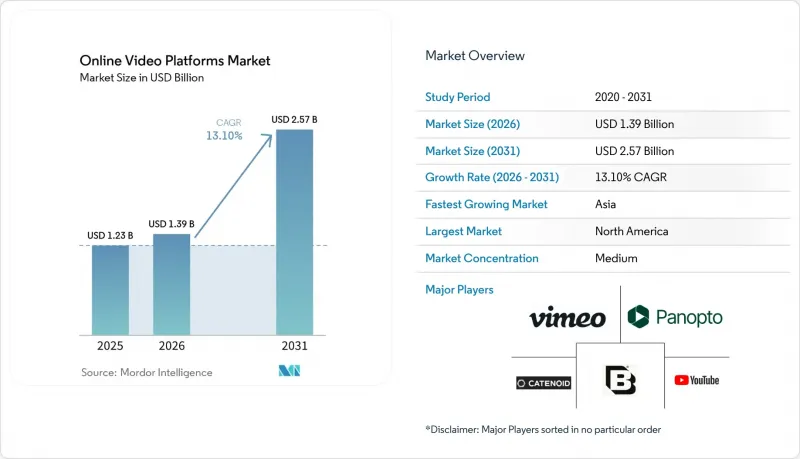
本報告按類型(直播、影片內容管理、影片分析、用戶生成內容平台、自助服務/DIY、SaaS 專業版)、組件(解決方案、服務)、串流媒體類型(直播、點播)、部署模式(雲端、本地部署、混合部署)、最終用戶(媒體與娛樂、數位學習、銀行、金融服務和保險等)以及地區進行細分。市場規模和預測均以美元計價。
全球線上影片平台市場趨勢及洞察
程序化廣告正在徹底改變影片獲利模式。
截至2025年,約60%的電視和影片廣告支出將透過程式化採購實現,從而簡化廣告主和發布商之間的交易。自動化競標整合了第一方數據,提高了聯網電視和行動廣告領域的定向精準度。自助服務工具擴大了廣告投放範圍,使中小企業能夠與全球品牌競爭。因此,內容擁有者無需擴充銷售團隊即可增加收入。 《紐約時報》在2024年實施程序化影片廣告後,銷售額成長了30%,充分證明了此模式的擴充性。
行動優先的影片觀看方式正在徹底改變內容策略。
超過70%的觀眾透過智慧型手機觀看串流內容,在許多新興市場,這一比例甚至超過80%。為了迎合用戶以滾動瀏覽為主的習慣,出版商正在最佳化垂直螢幕格式和長度小於60秒的短影片。行動端廣告單元(例如激勵廣告和互動式廣告)的引入,提高了廣告完成率,並推高了短影片廣告的CPM溢價。一些成功的獲利案例,例如BuzzFeed在推廣垂直螢幕影片後,2024年的營收成長了40%,正在推動垂直螢幕影片的更廣泛應用。這一趨勢也帶來了製作成本的降低、內容傳送頻率的提高以及更精細的受眾細分。
內容傳送成本將是拓展新興市場的一大挑戰。
骨幹網路容量的限制推高了CDN成本,擠壓了亞洲和拉丁美洲廣告支援型服務的利潤空間。雖然5G和邊緣節點的引入有望改善這種情況,但目前的成本結構使得在ARPU(每用戶平均收入)落後於其他地區的較已開發地區,難以實施免費增值策略。供應商正試圖透過引入對等輔助分發和基於QUIC的媒體傳輸來降低頻寬成本。
細分市場分析
預計到2025年,直播將佔據線上影片平台市場47.35%的佔有率,凸顯其在娛樂、體育和企業活動等各個領域的廣泛應用。由於採用5G技術帶來的更低延遲和更高可靠性,平台能夠將直播影片定位為一種高階互動工具,從而推動其普及。這一領域持續吸引著尋求與受眾即時互動的品牌。影片分析雖然目前營收規模較小,但其複合年成長率高達17.8%,反映出企業在數據驅動最佳化方面的投入不斷增加。雲端API的出現,實現了物件偵測、情緒分析和內容審核的自動化,正將影片轉變為決策支援工具。隨著企業透過提升互動指標和轉換率來量化投資報酬率,分析預算也隨之增加,進一步豐富了線上影片平台市場的收入來源。
其餘類別——用戶生成內容 (UGC)、自助平台和基於 SaaS 的專業套件——各自面向不同的用戶群體,但都受益於相同的底層基礎設施。面向消費者的 UGC 應用專注於社群媒體病毒式傳播和創作工具,而專業套件則整合了資產管理和多 CDN 路由等工作流程。這些細分市場共同拓寬了平台選擇範圍,並維持著激烈的競爭。
到2025年,解決方案將佔總收入的69.20%,這主要主導高品質串流媒體播放所需的影片分發和傳輸工具包。多重DRM庫和浮水印等安全模組完善了分發流程,尤其對工作室和體育聯盟而言意義重大。分析附加元件推動了訂閱和授權收入的成長,獎勵供應商將功能捆綁銷售。然而,隨著企業從資本支出(CAPEX)模式轉向營運支出(OPEX)模式,線上影片平台服務市場正在快速擴張。託管服務的複合年成長率(CAGR)高達14.5%,因為企業更傾向於將編碼、本地化和全天候監控等工作外包給能夠利用規模經濟的專業人士。
在將視訊技術堆疊整合到複雜的IT環境中時,專業服務仍然至關重要。客製化播放器開發、API編配和合規性審核可確保平台部署符合技術和監管要求。這種諮詢服務正是全方位服務供應商與純軟體供應商之間的差異所在。
區域分析
由於成熟的寬頻環境、高ARPU值和高聯網電視設備普及率,預計到2025年,北美將佔全球整體收入的34.72%。該地區的媒體購買者計劃到2025年將近60%的電視和影片預算總合給數位影片,這一趨勢正在拓展該平台的收入來源。由雲端服務供應商、軟體供應商和內容創作者組成的強大生態系統,正在推動人工智慧驅動的個人化和互動形式的快速試驗。
亞太地區正以14.8%的複合年成長率(CAGR)實現最快成長,預計2024年至2029年間將創造162億美元的營收成長。這一快速成長主要得益於智慧型手機普及率的提高、資料通訊流量費用的下降以及對本地語言內容日益成長的需求。光是印度一國預計就將貢獻超過四分之一的優質影片增量收入,主要得益於本地語言原創內容和體育賽事轉播權。中國平台正利用其超級應用生態系統交叉銷售訂閱和微交易,從而提高用戶留存率。在東南亞,行動資料通訊套餐正在推動價格敏感型消費者初步接受串流媒體服務。
歐洲憑藉企業採納和監管支持,保持強勁的地位。歐盟的《視聽媒體服務指令》要求全球平台投資歐洲內容創作,並將資金再投資於當地工作室和創造就業機會。同時,隨著光纖網路覆蓋到農村地區,拉丁美洲正經歷加速成長,串流品質和廣告資源也得到提升。中東和非洲仍在發展中,但潛力巨大。 4G和5G網路覆蓋範圍的擴大,以及不斷成長的年輕人口,正在推動對具有文化相關性的內容的需求。
其他好處:
- Excel格式的市場預測(ME)表
- 3個月的分析師支持
目錄
第1章:引言
- 研究假設和市場定義
- 調查範圍
第2章:調查方法
第3章執行摘要
第4章 市場狀況
- 市場概覽
- 市場促進因素
- 北美程序化廣告的成長帶來了快速的獲利機會
- 亞洲短影片觀看量激增。
- 5G的廣泛應用使得超低延遲直播成為可能。
- 歐洲企業採用影片進行培訓和內部溝通
- 利用雲端原生人工智慧驅動的影片分析來提升觀眾參與度
- 中東地區本地內容分配相關法規的進步正在推動對平台的投資。
- 市場限制因素
- 新興市場高昂的CDN成本限制了盈利。
- 廣告攔截器的廣泛使用正在減少廣告收入。
- 數位版權管理 (DRM) 標準的差異使全球發行變得複雜。
- 平台營運中資料隱私合規的負擔日益加重(GDPR、CPRA)
- 技術展望
- 波特五力分析
- 評估宏觀經濟因素對產業的影響
- 投資分析
第5章 市場規模與成長預測
- 按類型
- 直播
- 視訊內容管理系統
- 影片分析
- 用戶生成內容(UGC)平台
- 自助/DIY平台
- 基於SaaS的專業平台
- 按組件
- 解決方案
- 轉碼和處理
- 影片串流媒體和配送網路
- 影片分析與互動
- 影像安全與數位版權管理
- 影片內容管理
- 服務
- 專業服務
- 託管服務
- 解決方案
- 透過串流方法
- 居住
- 視訊點播 (VoD)
- 部署模式
- 雲
- 現場
- 混合
- 最終用戶
- 媒體與娛樂
- 數位學習與教育
- BFSI
- 零售與電子商務
- 資訊科技/通訊
- 醫療保健和生命科學
- 政府/公共部門
- 其他
- 按地區
- 北美洲
- 美國
- 加拿大
- 墨西哥
- 南美洲
- 巴西
- 阿根廷
- 智利
- 秘魯
- 其他南美國家
- 歐洲
- 德國
- 英國
- 法國
- 義大利
- 西班牙
- 其他歐洲國家
- 亞太地區
- 中國
- 日本
- 韓國
- 印度
- 澳洲
- 紐西蘭
- 其他亞太國家
- 中東
- 阿拉伯聯合大公國
- 沙烏地阿拉伯
- 土耳其
- 其他中東國家
- 非洲
- 南非
- 其他非洲國家
- 北美洲
第6章 競爭情勢
- Strategic Developments
- Vendor Positioning Analysis
- 公司簡介
- Alphabet Inc.(YouTube LLC)
- Vimeo Inc.(IAC/InterActiveCorp)
- Brightcove Inc.
- IBM Corporation(IBM Video Streaming)
- Catenoid Inc.
- Kaltura Inc.
- Panopto Inc.
- Wistia Inc.
- JW Player(Longtail Ad Solutions Inc.)
- Vidyard(BuildScale Inc.)
- Mux Inc.
- Dacast Inc.
- Qumu Corporation
- Dailymotion
- Wowza Media Systems LLC
- MediaPlatform Inc.
- Muvi LLC
- SproutVideo LLC
- Cloudflare Stream
- Bitmovin Inc.
- Vbrick Systems Inc.
第7章 市場機會與未來展望
According to Mordor Intelligence, online video platforms market size in 2026 is estimated at USD 1.39 billion, growing from 2025 value of USD 1.23 billion with 2031 projections showing USD 2.57 billion, growing at 13.1% CAGR over 2026-2031.
This report is Segmented by Type (Live Streaming, Video Content Management, Video Analytics, UGC Platforms, Self-service/DIY, Saas Professional), Component (Solutions, Services), Streaming Type (Live, Vod), Deployment Mode (Cloud, On-Premises, Hybrid), End User (Media and Entertainment, E-Learning, BFSI, and More) and Geography. The Market Sizes and Forecasts are Provided in Terms of Value (USD).
Global Online Video Platforms Market Trends and Insights
Programmatic Advertising Revolutionizes Video Monetization
Programmatic buying now underpins nearly 60% of TV and video ad spend in 2025, streamlining transactions between advertisers and publishers. Automated auctions integrate first-party data, boosting targeting accuracy across connected-TV and mobile inventory. Self-serve tools widen access, enabling small businesses to compete alongside global brands. As a result, content owners unlock incremental revenue without expanding sales teams. The New York Times recorded a 30% uplift after adopting programmatic video in 2024, confirming the model's scalability
Mobile-First Video Consumption Reshapes Content Strategies
More than 70% of viewers watch streaming content on smartphones; in many emerging markets the ratio exceeds 80% . Publishers are optimizing vertical formats and sub-60-second clips to suit scroll-based behavior. Implementation of mobile-centric ad units-including rewarded and interactive overlays-improves completion rates, driving CPM premiums for short-form inventory. Monetization success stories, such as BuzzFeed's 40% revenue spike following a vertical-video push in 2024, encourage broader adoption. The trend also lowers production costs, supporting higher content cadence and granular audience segmentation.
Content Delivery Costs Challenge Emerging-Market Expansion
Limited backbone capacity inflates CDN fees, compressing margins for ad-supported services in Asia and Latin America. While 5G and edge nodes promise relief, current cost structures complicate freemium strategies where ARPU lags developed regions. Vendors experiment with peer-assisted delivery and Media over QUIC to tame bandwidth bills
Other drivers and restraints analyzed in the detailed report include:
- 5G Infrastructure Enables Next-Generation Experiences
- Corporate Adoption Accelerates Digital Transformation
- Ad-Blocking Technologies Threaten Revenue Models
For complete list of drivers and restraints, kindly check the Table Of Contents.
Segment Analysis
Live Streaming captured 47.35% share of the online video platforms market in 2025, underscoring its ubiquity across entertainment, sports, and corporate events. Adoption widened as 5G decreased latency and boosted reliability, allowing platforms to position live video as a premium engagement lever. The segment continues to attract brands seeking real-time interaction with audiences. Video Analytics, although smaller in revenue, is advancing at an 17.8% CAGR, reflecting higher enterprise spending on data-driven optimization. The availability of cloud APIs that automate object detection, sentiment analysis, and content moderation is transforming video into a decision-support asset. As enterprises quantify ROI through engagement metrics and conversion lift, analytics budgets rise accordingly, further diversifying revenue inside the online video platforms market.
The remaining categories-User-Generated Content, DIY platforms, and SaaS-based professional suites-serve varied user personas yet benefit from the same underlying infrastructure. Consumer-facing UGC apps emphasize social virality and creator tools, whereas professional suites integrate workflows like asset management and multi-CDN routing. Collectively, these niches reinforce platform choice and keep competitive intensity high.
Solutions commanded 69.20% revenue in 2025, led by video delivery and distribution toolkits essential for high-quality streaming. Security modules such as multi-DRM vaults and watermarking complement delivery pipelines, especially for studios and sports leagues. Analytics add-ons unlock incremental subscription or licensing revenue, incentivizing vendors to bundle features. The online video platforms market size for services, however, is scaling quickly as organizations shift from capital expenditure to operating expenditure models. Managed Services show 14.5% CAGR because enterprises prefer outsourcing encoding, localization, and 24/7 monitoring to specialists with economies of scale.
Professional Services remain indispensable when integrating video stacks into complex IT environments. Custom player development, API orchestration, and compliance audits ensure that platform rollouts meet both technical and regulatory requirements. This consultative layer differentiates full-service vendors from pure-play software providers.
Geography Analysis
North America generated 34.72% of global revenue in 2025, fueled by mature broadband, high ARPU, and deep penetration of connected-TV devices. Media buyers in the region allocate nearly 60% of combined TV and video budgets to digital video in 2025, a trend that amplifies platform revenue streams. The robust ecosystem of cloud providers, software vendors, and content creators fosters rapid experimentation with AI-driven personalization and interactive formats.
Asia-Pacific is advancing fastest at a 14.8% CAGR and is projected to add USD 16.2 billion in revenue between 2024 and 2029. The surge stems from smartphone ubiquity, lower data tariffs, and escalating demand for local-language content. India alone is forecast to deliver over one quarter of incremental premium video revenue, helped by regional language originals and sports rights. Chinese platforms leverage super-app ecosystems to cross-sell subscriptions and micro-transactions, reinforcing user stickiness. In Southeast Asia, bundled mobile-data plans stimulate first-time streaming adoption among price-sensitive consumers.
Europe retains solid position owing to enterprise adoption and regulatory impetus. The EU's Audiovisual Media Service Directive obliges global platforms to invest in European storytelling, channeling funds into regional studios and jobs. Meanwhile, Latin America sees accelerating growth as fiber deployments reach secondary cities, lifting streaming quality and ad inventory. The Middle East and Africa remain nascent but promising; expanding 4G and 5G coverage, plus rising youth populations, underpin demand for culturally relevant content.
- Alphabet Inc. (YouTube LLC)
- Vimeo Inc. (IAC/InterActiveCorp)
- Brightcove Inc.
- IBM Corporation (IBM Video Streaming)
- Catenoid Inc.
- Kaltura Inc.
- Panopto Inc.
- Wistia Inc.
- JW Player (Longtail Ad Solutions Inc.)
- Vidyard (BuildScale Inc.)
- Mux Inc.
- Dacast Inc.
- Qumu Corporation
- Dailymotion
- Wowza Media Systems LLC
- MediaPlatform Inc.
- Muvi LLC
- SproutVideo LLC
- Cloudflare Stream
- Bitmovin Inc.
- Vbrick Systems Inc.
Additional Benefits:
- The market estimate (ME) sheet in Excel format
- 3 months of analyst support
TABLE OF CONTENTS
1 INTRODUCTION
- 1.1 Study Assumptions and Market Definition
- 1.2 Scope of the Study
2 RESEARCH METHODOLOGY
3 EXECUTIVE SUMMARY
4 MARKET LANDSCAPE
- 4.1 Market Overview
- 4.2 Market Drivers
- 4.2.1 Rapid Monetization Opportunities through Programmatic Advertising Growth in North America
- 4.2.2 Surge of Short-Form Mobile Video Consumption in Asia
- 4.2.3 Increasing 5G Penetration Enabling Ultra-Low-Latency Live Streaming
- 4.2.4 Corporate Adoption of Video for Training and Internal Communications in Europe
- 4.2.5 Cloud-native AI-powered Video Analytics Enhancing Viewer Engagement
- 4.2.6 Regulatory Push for Local Content Quotas Driving Platform Investments in Middle East
- 4.3 Market Restraints
- 4.3.1 High CDN Costs in Emerging Markets Limiting Profitability
- 4.3.2 Ad-blocking Adoption Reducing Advertising Revenues
- 4.3.3 Fragmented Digital Rights Management Standards Complicating Global Distribution
- 4.3.4 Rising Data-privacy Compliance Burden (GDPR, CPRA) on Platform Operations
- 4.4 Technological Outlook
- 4.5 Porter's Five Forces Analysis
- 4.5.1 Bargaining Power of Suppliers
- 4.5.2 Bargaining Power of Buyers
- 4.5.3 Threat of New Entrants
- 4.5.4 Threat of Substitutes
- 4.5.5 Intensity of Competitive Rivalry
- 4.6 Assessment of Macroeconomic factors Impact on the Industry
- 4.7 Investment Analysis
5 MARKET SIZE AND GROWTH FORECASTS (VALUE)
- 5.1 By Type
- 5.1.1 Live Streaming
- 5.1.2 Video Content Management Systems
- 5.1.3 Video Analytics
- 5.1.4 User-Generated Content Platforms (UGC)
- 5.1.5 Self-service/DIY Platforms
- 5.1.6 SaaS-based Professional Platforms
- 5.2 By Component
- 5.2.1 Solutions
- 5.2.1.1 Transcoding and Processing
- 5.2.1.2 Video Delivery and Distribution
- 5.2.1.3 Video Analytics and Engagement
- 5.2.1.4 Video Security and DRM
- 5.2.1.5 Video Content Management
- 5.2.2 Services
- 5.2.2.1 Professional Services
- 5.2.2.2 Managed Services
- 5.2.1 Solutions
- 5.3 By Streaming Type
- 5.3.1 Live
- 5.3.2 Video on Demand (VoD)
- 5.4 By Deployment Mode
- 5.4.1 Cloud
- 5.4.2 On-premises
- 5.4.3 Hybrid
- 5.5 By End User
- 5.5.1 Media and Entertainment
- 5.5.2 E-learning and Education
- 5.5.3 BFSI
- 5.5.4 Retail and eCommerce
- 5.5.5 IT and Telecommunications
- 5.5.6 Healthcare and Life Sciences
- 5.5.7 Government and Public Sector
- 5.5.8 Others
- 5.6 By Geography
- 5.6.1 North America
- 5.6.1.1 United States
- 5.6.1.2 Canada
- 5.6.1.3 Mexico
- 5.6.2 South America
- 5.6.2.1 Brazil
- 5.6.2.2 Argentina
- 5.6.2.3 Chile
- 5.6.2.4 Peru
- 5.6.2.5 Rest of South America
- 5.6.3 Europe
- 5.6.3.1 Germany
- 5.6.3.2 United Kingdom
- 5.6.3.3 France
- 5.6.3.4 Italy
- 5.6.3.5 Spain
- 5.6.3.6 Rest of Europe
- 5.6.4 Asia-Pacific
- 5.6.4.1 China
- 5.6.4.2 Japan
- 5.6.4.3 South Korea
- 5.6.4.4 India
- 5.6.4.5 Australia
- 5.6.4.6 New Zealand
- 5.6.4.7 Rest of Asia-Pacific
- 5.6.5 Middle East
- 5.6.5.1 United Arab Emirates
- 5.6.5.2 Saudi Arabia
- 5.6.5.3 Turkey
- 5.6.5.4 Rest of Middle East
- 5.6.6 Africa
- 5.6.6.1 South Africa
- 5.6.6.2 Rest of Africa
- 5.6.1 North America
6 COMPETITIVE LANDSCAPE
- 6.1 Strategic Developments
- 6.2 Vendor Positioning Analysis
- 6.3 Company Profiles (includes Global level Overview, Market level overview, Core Segments, Financials as available, Strategic Information, Products and Services, and Recent Developments)
- 6.3.1 Alphabet Inc. (YouTube LLC)
- 6.3.2 Vimeo Inc. (IAC/InterActiveCorp)
- 6.3.3 Brightcove Inc.
- 6.3.4 IBM Corporation (IBM Video Streaming)
- 6.3.5 Catenoid Inc.
- 6.3.6 Kaltura Inc.
- 6.3.7 Panopto Inc.
- 6.3.8 Wistia Inc.
- 6.3.9 JW Player (Longtail Ad Solutions Inc.)
- 6.3.10 Vidyard (BuildScale Inc.)
- 6.3.11 Mux Inc.
- 6.3.12 Dacast Inc.
- 6.3.13 Qumu Corporation
- 6.3.14 Dailymotion
- 6.3.15 Wowza Media Systems LLC
- 6.3.16 MediaPlatform Inc.
- 6.3.17 Muvi LLC
- 6.3.18 SproutVideo LLC
- 6.3.19 Cloudflare Stream
- 6.3.20 Bitmovin Inc.
- 6.3.21 Vbrick Systems Inc.
7 MARKET OPPORTUNITIES AND FUTURE OUTLOOK
- 7.1 White-space and Unmet-need Assessment

 全球線上影片平台市場規模、佔有率、趨勢和成長分析報告(2026-2034)Frost Radar™:面向媒體和娛樂的線上影片平台,2026 年
 OTT視訊轉碼:市佔率分析、產業趨勢與統計及成長預測(2026-2031年)
 線上影片平台市場-2026-2032年全球市場預測媒體與娛樂產業線上影片平台市場:2026-2032年全球市場預測
 短影片平台市場 - 全球產業規模、佔有率、趨勢、機會、預測:按類型、部署方式、最終用途、地區和競爭格局分類,2021-2031年
 線上影片平台市場規模、佔有率、趨勢和預測:按模型類型、應用、產品類型和地區分類,2026-2034 年
 線上影片平台市場:按組件、分發方式、最終用戶產業和地區分類。短影片平台市場:按平台類型、獲利模式和地區分類
 2026年全球線上視訊平台市場報告