


 |
市場調查報告書
商品編碼
2066522
丙烷:市場佔有率分析、產業趨勢與統計、成長預測(2026-2031)Propane - Market Share Analysis, Industry Trends & Statistics, Growth Forecasts (2026 - 2031) |
||||||

※ 本網頁內容可能與最新版本有所差異。詳細情況請與我們聯繫。
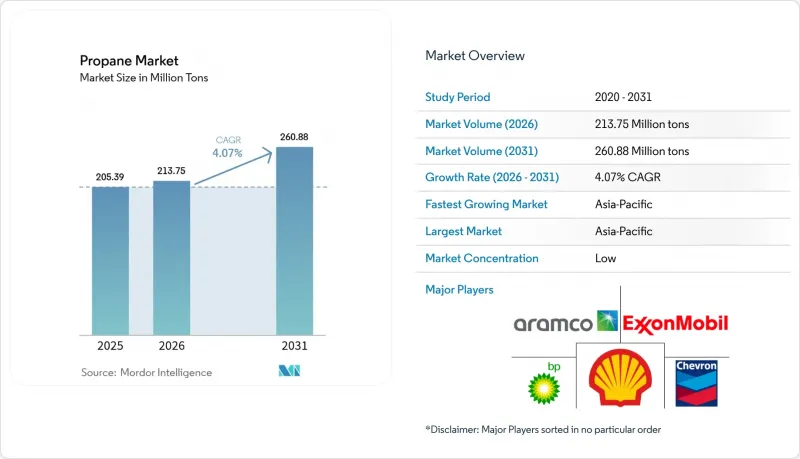
根據 Mordor Intelligence 預測,丙烷市場將從 2025 年的 2.0539 億噸成長到 2026 年的 2.1375 億噸,然後在 2031 年達到 2.6088 億噸,2026 年至 2031 年的複合年成長率為 4.07%。
本報告按供應來源(煉油廠、聯產氣、異源氣、生物丙烷)、終端用戶行業(住宅、商業、工業、交通運輸等)、分銷管道(散裝配送、鋼瓶配送等)和地區(亞太、北美、歐洲、南美、中東和非洲)進行細分。市場預測以噸為單位。
全球丙烷市場趨勢及洞察
儘管大力推動電氣化,但對住宅產品的需求依然強勁。
儘管強制實施了低碳加熱要求,但佔2024年全球消費量40%的核心住宅能源消耗並未下降。在美國,使用天然氣或丙烷加熱的住宅平均每年比全電住宅節省1,132美元,凸顯了丙烷的成本優勢。超過2400萬戶家庭依賴丙烷,尤其是在中西部地區,農村地區的依賴程度更高。雖然馬薩諸塞州在2024年取消了大部分設備購買補貼,但對低收入家庭高效節能設備的獎勵得以保留,體現了務實的政策方針。全國零售價格回落,2024年5月平均價格為每加侖2.475美元,有助於維持需求。這些趨勢表明,即使熱泵的普及率不斷提高,成熟市場的溫和成長也將得以維持。
工業應用推動高成長率
隨著石化生產商擴建其專用丙烷脫氫(PDH)裝置以將丙烷轉化為丙烯,工業應用增速超過了丙烷行業的整體增速,年複合成長率(CAGR)達到5.25%。 2024年,亞洲的新計畫加速了丙烯的生產,縮小了價差,同時擴大了丙烷的加工能力。為了實現永續性目標,營運商正在試點碳捕獲解決方案,並與可再生丙烷混合,以在不影響製程效率的前提下減少範圍1的排放。憑藉可靠的原料和低風險的脫碳路徑,預計工業需求將在整個預測期內成為永續成長的支柱。
天然氣凝液現貨價格波動
丙烷價格對原油價格和庫存週期波動十分敏感,對獨立經銷商的利潤空間造成壓力。根據康威指數,頁岩氣產量強勁時,中西部地區的丙烷價格往往下跌;而冬季需求旺盛時,價格則往往飆升,這使得避險策略變得複雜。這種價格波動可能會阻礙中小企業投資儲能基礎設施,並減緩汽車燃氣加氣站的建設,從而在短期內略微抑制丙烷產業的擴張。
細分市場分析
到2025年,異源氣將佔全球供應量的51.25%,這主要得益於頁岩氣開發的活躍和中游基礎設施的擴張。 2025年,光是美國就將生產300萬桶/日的液化天然氣(NGL),其中包括丙烷,較去年同期成長10%。二疊紀盆地和阿巴拉契亞地區低溫加工技術的擴張確保了原料的持續供應,為丙烷市場奠定了穩定的基礎。煉油廠和聯產氣的供應提供了補充,但成長較為溫和,受到煉油廠產運轉率限制和減少火炬燃燒措施的限制。
生物丙烷8.75%的複合年成長率凸顯了其在能源轉型中的關鍵作用。專用氫化植物油(HVO)工廠和共享加工生產線的產能擴張預計將使全球可再生丙烷日產量從2023年的1.9萬桶增加到2025年的5.1萬桶。供應多元化正在推進,東南亞和拉丁美洲等開發中國家正在實施利用廢油的試點計畫。隨著可再生能源認證體系的日趨成熟,貿易商預計價格溢價將會降低,這將加速生物丙烷在住宅混合燃料和工業爐灶中的應用。
區域分析
預計到2025年,亞太地區將佔全球丙烷市場佔有率的40.75%,並在工業化、人口成長以及推動液化石油氣(LPG)普及的扶持措施的推動下,以5.98%的複合年成長率持續成長至2031年。 2022年,中國的丙烷消費量達到7,390萬噸,隨著丙烯脫氫(PDH)裝置的擴建以滿足汽車內裝和消費品包裝對聚丙烯的需求,消費運作。印度的「總理烏賈瓦拉計畫」(Pradan Mantri Ujjawara Yojana)持續提高農村地區的燃氣罐普及率,並促進了家用燃料的轉型。加拿大出口商Altagas計劃在2026年將其位於里德利島的丙烷出口加工能力加倍,凸顯了北美和亞洲買家之間供應鏈的緊密聯繫。
北美地區持續保持可觀的產量和出口盈餘。 2024年,美國石油日出口量達180萬桶,連續第17年達到年度成長。豐富的頁岩氣液儲量和不斷擴大的墨西哥灣沿岸港口吞吐能力,確保了全球客戶原料的穩定供應。國內需求成長依然強勁,儘管住宅供暖需求趨於平穩,但汽車燃氣和可再生丙烷混合燃料的需求正逐步提振國內需求。
在歐洲,儘管傳統供暖應用的需求已趨於穩定,但可再生丙烷混合能源產業正展現出強勁的發展勢頭。 《可再生能源指令III》和「Fit for 55」一攬子計畫鼓勵供應商加快其大宗產品系列和航空燃料產品流的脫碳進程。透過重複利用處理混合氣體的基礎設施,該地區預計在2030年前實現供應結構的逐步轉型。
在中東和非洲,豐富的聯產氣正推動當地石化產業在丙烷市場的擴張。同時,在巴西氣瓶供應計畫的擴展和阿根廷對農業乾燥設備需求的推動下,南美市場也在穩步發展。
其他好處:
- Excel格式的市場預測(ME)表
- 3個月的分析師支持
目錄
第1章:引言
- 研究假設和市場定義
- 調查範圍
第2章:調查方法
第3章執行摘要
第4章 市場狀況
- 市場概覽
- 市場促進因素
- 住宅部門需求增加
- 石油化工產業的需求
- 歐洲交通運輸領域政府強制規定的生物丙烷摻混目標(歐洲)
- 農業部門需求增加
- 運輸業需求增加
- 市場限制因素
- 高濃度丙烷的有害影響
- 在全球範圍內,現貨天然氣凝液價格波動給獨立經銷商的利潤率帶來了壓力。
- 儲存和安全風險
- 價值鏈分析
- 波特五力模型
第5章 市場規模與成長預測
- 來源
- 煉油廠
- 聯產氣
- 異源氣
- 生物丙烷
- 按最終用戶行業分類
- 住宅
- 商業的
- 產業
- 運輸
- 其他終端用戶產業
- 透過分銷管道
- 批量交付
- 汽缸分佈
- 汽車燃氣瓦斯加氣網路
- 零售包裝(1磅裝和露營裝)
- 按地區
- 亞太地區
- 中國
- 印度
- 日本
- 韓國
- 其他亞太國家
- 北美洲
- 美國
- 加拿大
- 墨西哥
- 歐洲
- 德國
- 英國
- 義大利
- 法國
- 其他歐洲國家
- 南美洲
- 巴西
- 阿根廷
- 其他南美國家
- 中東和非洲
- 沙烏地阿拉伯
- 南非
- 其他中東和非洲國家
- 亞太地區
第6章 競爭情勢
- 市場集中度
- 策略趨勢
- 市佔率分析
- 公司簡介
- AltaGas Ltd.
- BP plc
- Chevron Corporation
- China Petrochemical Corporation
- DCC Plc
- Energy Transfer LP
- Eni SpA
- Enterprise Products Partners LP
- Equinor ASA
- Exxon Mobil Corporation
- GAIL(India)Limited
- Gazprom
- Linde PLC
- PDVSA
- PetroChina Company Limited(China National Petroleum Corp.)
- Phillips 66 Company
- Repsol
- Saudi Arabian Oil Co.
- Shell PLC
- SHV Energy
- Suburban Propane
- TotalEnergies
- UGI Corporation
第7章 市場機會與未來展望
According to Mordor Intelligence, the propane market size is expected to grow from 205.39 Million tons in 2025 to 213.75 Million tons in 2026 and is forecast to reach 260.88 Million tons by 2031 at 4.07% CAGR over 2026-2031.
This report is Segmented by Source (Refinery, Associated Gas, Non-Associated Gas, and Bio-Propane), End-User Industry (Residential, Commercial, Industrial, Transportation, and More), Distribution Channel (Bulk Delivery, Cylinder Distribution, and More), and Geography (Asia-Pacific, North America, Europe, South America, and Middle East and Africa). The Market Forecasts are Provided in Terms of Volume (tons).
Global Propane Market Trends and Insights
Residential demand resilience despite electrification push
Lower-carbon heating mandates did not erode core residential consumption, which accounted for 40% of global offtake in 2024. Natural-gas or propane-heated homes in the United States saved an average of USD 1,132 a year relative to all-electric dwellings, reinforcing propane's cost proposition. Rural dependence is pronounced, with more than 24 million US households relying on propane, especially across the Midwest. Although Massachusetts ended most equipment rebates in 2024, incentives for high-efficiency units remained for low-income residents, signalling policy pragmatism. Retail prices softened nationwide-averaging USD 2.475 per gallon in May 2024-helping maintain demand. These dynamics are expected to uphold moderate growth in mature markets even as heat-pump adoption rises.
Industrial applications driving higher growth rates
Industrial uptake is outpacing overall growth in the propane industry, advancing at a 5.25% CAGR as petrochemical producers add dedicated PDH plants to convert propane into propylene. New Asian projects accelerated propylene output in 2024, narrowing spreads yet widening propane throughput. Sustainability targets are prompting operators to trial carbon-capture solutions and renewable-propane blending to curb Scope 1 emissions without compromising process efficiency. The combination of feedstock reliability and de-risked decarbonization paths positions industry demand as a durable growth pillar across the forecast horizon.
Spot NGL price volatility
Propane prices remain sensitive to crude-oil swings and inventory cycles , compressing marketing margins for independent distributors. The Conway Index illustrates Midwest price dips during bumper shale output, followed by sharp spikes in high-demand winters, complicating hedging strategies. Volatility discourages capital investment in storage infrastructure among smaller firms and can slow autogas station roll-outs, marginally tempering near-term expansion in the propane industry.
Other drivers and restraints analyzed in the detailed report include:
- Bio-propane: transformative growth amid decarbonization
- Transportation sector: autogas expansion despite EV competition
- Storage and safety risks
For complete list of drivers and restraints, kindly check the Table Of Contents.
Segment Analysis
Non-associated gas yielded 51.25% of global supply in 2025, anchored by prolific shale development and midstream build-outs. The United States alone produced 3.0 million barrels per day of NGLs-including propane-in 2025, up 10% on the previous year. Incremental cryogenic processing in the Permian Basin and Appalachian region secured feedstock continuity, ensuring a stable base for the propane market. Refinery and associated-gas streams provided complementary volumes but grew more slowly, constrained by refinery utilization ceilings and flaring-reduction initiatives.
Bio-propane's 8.75% CAGR underscores its pivotal role in the energy-transition narrative. Capacity expansions at dedicated hydrotreated-vegetable-oil (HVO) units and co-processing lines are set to lift global renewable-propane output from 19,000 barrels per day in 2023 to 51,000 barrels per day by 2025. Developing economies in Southeast Asia and Latin America are also piloting waste-oil pathways, broadening geographic supply diversity. As renewable certification schemes mature, traders expect price premiums to compress, fostering mainstream uptake across residential blends and industrial furnaces.
Geography Analysis
Asia Pacific anchored 40.75% of propane market volumes in 2025 and is forecast to expand at a 5.98% CAGR to 2031, buoyed by industrialization, population growth, and supportive LPG adoption schemes. Chinese consumption climbed to 73.9 million tons in 2022 and continues to climb as PDH capacity ramps to satisfy polypropylene demand in automotive interiors and consumer packaging. India's Pradhan Mantri Ujjwala Yojana keeps rural cylinder penetration rising, aiding household fuel switching. Canadian exporter AltaGas plans to double Ridley Island propane export throughput by 2026, underscoring the supply-chain link between North America and Asian buyers.
North America retains a substantial production and export surplus. US shipments reached 1.8 million barrels per day in 2024, marking the 17th consecutive annual increase. Ample shale gas liquids and expanding Gulf Coast dock capacity ensure reliable feedstock for global customers. Domestic demand growth is steadier, with residential heating plateauing but autogas and renewable-propane blending providing incremental lift.
Europe confronts mature demand in traditional heating uses but posts vigorous momentum in renewable-propane blending. The Renewable Energy Directive III and fit-for-55 packages incentivize suppliers to decarbonize bulk portfolios and aviation-fuel coproduct streams. Infrastructure repurposing to handle blended molecules positions the region for a gradual supply-mix transition through 2030.
The Middle East and Africa leverage abundant associated-gas streams to feed growing domestic petrochemical ambitions in the propane market, while South America's market progresses steadily on the back of Brazil's cylinder program expansions and Argentina's agricultural drying needs.
- AltaGas Ltd.
- BP p.l.c.
- Chevron Corporation
- China Petrochemical Corporation
- DCC Plc
- Energy Transfer LP
- Eni SpA
- Enterprise Products Partners L.P.
- Equinor ASA
- Exxon Mobil Corporation
- GAIL (India) Limited
- Gazprom
- Linde PLC
- PDVSA
- PetroChina Company Limited (China National Petroleum Corp.)
- Phillips 66 Company
- Repsol
- Saudi Arabian Oil Co.
- Shell PLC
- SHV Energy
- Suburban Propane
- TotalEnergies
- UGI Corporation
Additional Benefits:
- The market estimate (ME) sheet in Excel format
- 3 months of analyst support
TABLE OF CONTENTS
1 Introduction
- 1.1 Study Assumptions and Market Definition
- 1.2 Scope of the Study
2 Research Methodology
3 Executive Summary
4 Market Landscape
- 4.1 Market Overview
- 4.2 Market Drivers
- 4.2.1 Increase in Demand from the Residential Sectors
- 4.2.2 Demand in the Petrochemical Industry
- 4.2.3 Government-Mandated Bio-Propane Blending Targets in the Europe Transport Sector (Europe)
- 4.2.4 Rising Demand in Agriculture
- 4.2.5 Increase in Demand from the Transportation Sector
- 4.3 Market Restraints
- 4.3.1 Harmful Effects of Propane at Higher Concentrations
- 4.3.2 Spot NGL Price Volatility Compressing Margins for Independent Marketers (Global)
- 4.3.3 Storage and Safety Risks
- 4.4 Value Chain Analysis
- 4.5 Porter's Five Forces
- 4.5.1 Bargaining Power of Suppliers
- 4.5.2 Bargaining Power of Buyers
- 4.5.3 Threat of New Entrants
- 4.5.4 Threat of Substitutes
- 4.5.5 Degree of Competition
5 Market Size and Growth Forecasts (Volume)
- 5.1 By Source
- 5.1.1 Refinery
- 5.1.2 Associated Gas
- 5.1.3 Non-Associated Gas
- 5.1.4 Bio-Propane
- 5.2 By End-user Industry
- 5.2.1 Residential
- 5.2.2 Commercial
- 5.2.3 Industrial
- 5.2.4 Transportation
- 5.2.5 Other End-user Industries
- 5.3 By Distribution Channel
- 5.3.1 Bulk Delivery
- 5.3.2 Cylinder Distribution
- 5.3.3 Autogas Refueling Network
- 5.3.4 Retail Packaged (1-lb and Camping)
- 5.4 By Geography
- 5.4.1 Asia-Pacific
- 5.4.1.1 China
- 5.4.1.2 India
- 5.4.1.3 Japan
- 5.4.1.4 South Korea
- 5.4.1.5 Rest of Asia-Pacific
- 5.4.2 North America
- 5.4.2.1 United States
- 5.4.2.2 Canada
- 5.4.2.3 Mexico
- 5.4.3 Europe
- 5.4.3.1 Germany
- 5.4.3.2 United Kingdom
- 5.4.3.3 Italy
- 5.4.3.4 France
- 5.4.3.5 Rest of Europe
- 5.4.4 South America
- 5.4.4.1 Brazil
- 5.4.4.2 Argentina
- 5.4.4.3 Rest of South America
- 5.4.5 Middle East and Africa
- 5.4.5.1 Saudi Arabia
- 5.4.5.2 South Africa
- 5.4.5.3 Rest of Middle East and Africa
- 5.4.1 Asia-Pacific
6 Competitive Landscape
- 6.1 Market Concentration
- 6.2 Strategic Moves
- 6.3 Market Share Analysis
- 6.4 Company Profiles {(includes Global level Overview, Market level overview, Core Segments, Financials as available, Strategic Information, Market Rank/Share for key companies, Products and Services, and Recent Developments)}
- 6.4.1 AltaGas Ltd.
- 6.4.2 BP p.l.c.
- 6.4.3 Chevron Corporation
- 6.4.4 China Petrochemical Corporation
- 6.4.5 DCC Plc
- 6.4.6 Energy Transfer LP
- 6.4.7 Eni SpA
- 6.4.8 Enterprise Products Partners L.P.
- 6.4.9 Equinor ASA
- 6.4.10 Exxon Mobil Corporation
- 6.4.11 GAIL (India) Limited
- 6.4.12 Gazprom
- 6.4.13 Linde PLC
- 6.4.14 PDVSA
- 6.4.15 PetroChina Company Limited (China National Petroleum Corp.)
- 6.4.16 Phillips 66 Company
- 6.4.17 Repsol
- 6.4.18 Saudi Arabian Oil Co.
- 6.4.19 Shell PLC
- 6.4.20 SHV Energy
- 6.4.21 Suburban Propane
- 6.4.22 TotalEnergies
- 6.4.23 UGI Corporation
7 Market Opportunities and Future Outlook
- 7.1 White-space and Unmet-Need Assessment
- 7.2 Usage of Propane in Power Generation

 電子級丙烷市場:全球市場預測,2026-2032年丙烷市場:2026-2032年全球市場預測(依產品類型、儲存形式、銷售管道及最終用途產業分類)
 丙烷市場預測至2034年:按形態、等級、最終用戶和地區分類的全球分析
 丙烷市場規模、佔有率、成長及全球產業分析:按類型、應用和地區分類,並預測至2026-2034年
 全球丙烷市場:依等級、最終用途及地區分類的分析-市場規模、產業趨勢、機會分析及2026年至2035年預測
 美國丙烷:市場佔有率分析、行業趨勢和統計數據、成長預測(2026-2031 年)
 丙烷市場規模、佔有率、趨勢和預測:按形態、等級、最終用途行業和地區分類,2026-2034年三羥甲基丙烷市場按技術、形態和應用分類,全球預測(2026-2032年)全球三羥甲基丙烷市場規模、佔有率、趨勢和成長分析報告(2026-2034年)
 2026年全球丙烷市場報告