


 |
市場調查報告書
商品編碼
2066492
包裝黏合劑:市場佔有率分析、行業趨勢和統計數據、成長預測(2026-2031)Packaging Adhesives - Market Share Analysis, Industry Trends & Statistics, Growth Forecasts (2026 - 2031) |
||||||

※ 本網頁內容可能與最新版本有所差異。詳細情況請與我們聯繫。
根據 Mordor Intelligence 預測,包裝黏合劑市場將從 2025 年的 207 億美元成長到 2026 年的 219.1 億美元,然後在 2031 年達到 291.1 億美元,2026 年至 2031 年的複合年成長率為 5.85%。
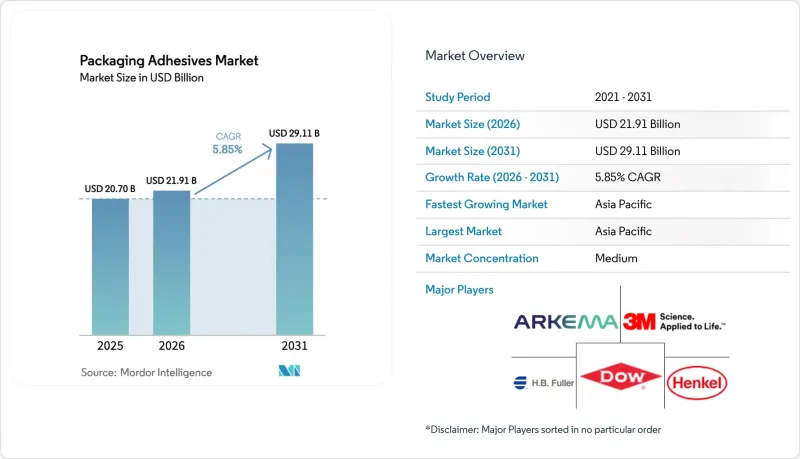
本報告按技術(水性、溶劑型、熱熔型)、樹脂化學(丙烯酸、聚氨酯、EVA、苯乙烯、生物基)、應用(軟包裝、紙盒、標籤、密封等)、終端用戶行業(食品飲料、醫藥、個人護理等)和地區(亞太、北美等)進行細分。市場預測以美元計價。
全球包裝黏合劑市場趨勢與洞察
食品飲料加工商的需求正在激增。
在食品飲料行業,加工商正在對其黏合劑線進行標準化,以適應複合速度並符合零遷移法規。漢高的「Aquanence」可縮短固化時間和降低烘箱能耗,從而縮短生產線並減少排放。單層聚乙烯包裝袋的興起增加了對能夠黏附於電暈處理薄膜且易於在回收槽中清洗的底塗劑的需求。化學家們正在微調羥基和羧基的功能範圍,以確保產品在保存期限內的穩定性,同時便於在清洗槽中移除。擁有中試生產線的全球供應商在這方面擁有卓越的技術。此外,快速蒸餾滅菌技術的廣泛應用促使加工商傾向於選擇水性聚氨酯,因為這種材料可在短時間內提供完全的黏合強度。這些趨勢正在推動包裝黏合劑市場對高性能水性化學品的需求激增。
電子商務推動了瓦楞紙板和郵寄包裝的成長。
2025年,全球小包裹量激增,帶動了對瓦楞紙箱黏合劑的需求。如今,履約中心正採用視覺引導式點膠機器人,實現輪胎邊緣寬度的即時調整,減少廢棄物。這種自動化程度不僅加強了與提供數位分析服務的供應商的夥伴關係,也為企業創造了相對於一般商品製造商的競爭優勢。熱熔EVA共聚物因其優異的開放時間和初始黏合強度,已成為高速生產線的首選材料。因此,電子商務正在樹立新的行業標準,並對包裝黏合劑市場的其他領域產生影響。
石化原料價格波動
丙烯價格飆升正對EVA和聚烯基黏合劑的利潤率構成壓力。缺乏避險手段的中小型加工商被迫透過季度附加費將成本轉嫁出去,從而破壞了合約的穩定性。儘管2024年上半年乙烯供應過剩抑制了價格,但中東裂解裝置的延誤在2025年底抵消了這些利好。陶氏化學的自有乙烯生產凸顯了垂直整合的保護作用。持續的價格波動不僅阻礙了擴大產能的投資,也為包裝黏合劑市場蒙上了一層陰影。
細分市場分析
預計到2025年,水性產品將佔總銷售額的57.42%,維持6.19%的複合年成長率,並繼續成為成長最快的技術類別。這一成長趨勢得益於對揮發性有機化合物(VOC)的監管限制以及加工商逐步淘汰溶劑型乾燥爐的措施。低溫固化聚氨酯因其節能優勢,在歐洲和北美的新型複合生產線中尤其受歡迎。雖然溶劑型產品仍用於需要高剝離強度的鋁箔吸塑包裝,但熱熔EVA憑藉其快速固化特性,在高速紙箱封口領域保持主導地位。對壓敏黏著劑日益成長的需求,推動了對耐塑化劑遷移、使用壽命長的丙烯酸乳化的需求。混合底塗-面塗體系彌補了電暈處理聚丙烯黏合力不足的問題,並實現了連續高速加工。這些組合使水性化學物質成為包裝黏合劑市場長期價值創造的核心。
2025年,EVA佔銷售額的30.61%,其配方可實現自動化瓦楞紙板包裝生產線的最佳開放時間。聚氨酯的高階細分市場要求產品能夠耐受121 度C以上的蒸餾蒸氣滅菌。丙烯酸乳液因其耐紫外線照射和抗塑化劑滲出的特性,成為感壓標籤的首選材料,其價格溢價也因此得以體現。生物基樹脂正以每年6.82%的速度成長,這主要得益於跨國品牌承諾在2030年前強制使用可再生碳。先進的解決方案兼具永續性和低溫穩定性。雖然苯乙烯基嵌段共聚物的市佔率正在下降,但具有類似脫模性能且VOC含量較低的生物基聚烯正日益受到關注。天然澱粉基體系在瓦楞紙板應用中開闢了一個獨特的細分市場,該應用最大限度地降低了水分風險。擁有中試生產線和分析實驗室的樹脂供應商脫穎而出,他們透過客製化混合物來確保在包裝黏合劑市場中的競爭優勢。
區域分析
預計到2025年,亞太地區將佔據40.35%的市場佔有率,並以每年6.62%的速度成長至2031年。 2025年,隨著自動化生產線的引入,中國市場需求激增,對數位整合熱熔膠系統提出了更高的要求。印度市場也呈現成長態勢,主要得益於包裝食品消費量的成長,其中古吉拉突邦水性黏合劑產能的提升尤為顯著。日本和韓國透過採用可在兩秒鐘內固化的紫外線固化標籤,開闢了高性能細分市場。同時,隨著品牌將業務拓展至中國以外的地區,東南亞國協也實現了成長。
到2025年,北美將佔據全球整體大部分產量,這得益於履約自動化技術的進步和可回收單一材料包裝的普及。在美國,受新建物流中心的推動,熱熔膠的需求量有所增加。加拿大安大略省和魁北克省的製藥產業叢集對特種標籤的需求增加,而墨西哥的近岸外包措施則推動了蒙特雷和克雷塔羅的業務擴張。
歐洲市場佔有率顯著,儘管市場已趨於成熟,但仍保持成長。德國在生物基產品的推廣方面處於領先地位,並於2025年宣布將共同開發一種含有可再生成分的澱粉基黏合劑。英國帶來了許多問題,導致每份配方成本增加。同時,法國和義大利正透過出口高階化妝品實現成長,而高階化妝品市場對全像壓敏黏著劑的需求也在不斷成長。
在南美洲,巴西發揮了主導作用,推動了2025年的成長。這主要歸功於軟包裝的引入,降低了南美洲廣大地域的配送成本。阿根廷的成長主要由農產品出口包裝所驅動。中東和非洲雖然目前在全球需求中所佔佔有率仍然較小,但其需求卻持續逐年成長。沙烏地阿拉伯對糧食安全的投入以及南非製藥業的快速發展,都為此成長提供了支撐。這些區域趨勢共同造就了多個成長中心,確保了包裝黏合劑市場的持續擴張。
其他好處:
- Excel格式的市場預測(ME)表
- 3個月的分析師支持
目錄
第1章:引言
- 研究假設和市場定義
- 調查範圍
第2章:調查方法
第3章執行摘要
第4章 市場狀況
- 市場概覽
- 市場促進因素
- 食品飲料加工商的需求激增。
- 電子商務推動瓦楞紙板和郵寄信封市場成長
- 向永續的水基和無溶劑系統過渡
- 人工智慧最佳化的高速點膠生產線
- 低溫運輸直接面對消費者的包裝需要即使在極低溫環境下也能保持穩定的黏合劑。
- 市場限制因素
- 石化原料價格波動
- 對揮發性有機化合物及其在食品接觸過程中的滲出和轉移有嚴格的規定。
- 機械回收過程中分層問題的挑戰
- 價值鏈分析
- 波特五力模型
第5章 市場規模與成長預測
- 透過技術
- 水溶液
- 溶劑型
- 熱熔膠
- 通過樹脂化學
- 丙烯酸樹脂
- 聚氨酯
- 乙烯-醋酸乙烯酯共聚物(EVA)
- 苯乙烯基嵌段共聚物
- 天然和生物衍生
- 透過使用
- 軟包裝
- 折疊式紙箱和包裝盒
- 標籤和膠帶
- 天花板
- 其他用途(例如用於紙巾、毛巾、圖案設計和特殊應用)
- 產業最終用途
- 食品/飲料
- 藥品和醫療保健
- 個人護理化妝品
- 工業/消費品
- 電子商務、零售與履約
- 按地區
- 亞太地區
- 中國
- 印度
- 日本
- 韓國
- 東南亞國協
- 其他亞太國家
- 北美洲
- 美國
- 加拿大
- 墨西哥
- 歐洲
- 德國
- 英國
- 法國
- 義大利
- 其他歐洲國家
- 南美洲
- 巴西
- 阿根廷
- 其他南美國家
- 中東和非洲
- 沙烏地阿拉伯
- 南非
- 其他中東和非洲國家
- 亞太地區
第6章 競爭情勢
- 市場集中度
- 策略趨勢
- 市佔率和排名分析
- 公司簡介
- 3M
- Arkema
- Ashland
- Avery Dennison Corporation
- Dow
- Dymax
- Franklin International
- HB Fuller Company
- Henkel AG & Co. KGaA
- Jowat SE
- Paramelt
- Pidilite Industries Limited
- Synthomer plc
- Wacker Chemie AG
第7章 市場機會與未來展望
According to Mordor Intelligence, the packaging adhesives market size is expected to grow from USD 20.70 billion in 2025 to USD 21.91 billion in 2026 and is forecast to reach USD 29.11 billion by 2031 at 5.85% CAGR over 2026-2031.
This report is Segmented by Technology (Water-Based, Solvent-Based, and Hot-Melt), Resin Chemistry (Acrylics, Polyurethanes, EVA, Styrenic, and Bio-Based), Application (Flexible Packaging, Cartons, Labels, Sealing, and Others), End-Use Industry (Food and Beverage, Pharmaceuticals, Personal Care, and More), and Geography (Asia-Pacific, North America, and More). Market Forecasts are in Value (USD).
Global Packaging Adhesives Market Trends and Insights
Surging Demand From Food and Beverage Converters
In the food and beverage sector, converters are standardizing adhesive portfolios to meet lamination speeds and adhere to zero-migration mandates. Henkel's launch of Aquanence achieved a reduction in curing time and a decrease in oven energy consumption, leading to shorter production lines and diminished emissions. The rise of mono-material polyethylene pouches amplifies the demand for primers that can adhere to corona-treated films but easily wash off in recycling baths. Chemists are fine-tuning the windows of hydroxyl and carboxyl functionalities to ensure shelf-life integrity while facilitating wash-tank release, a skill often dominated by global suppliers with pilot-line capabilities. Additionally, rapid retort sterilization is pushing converters to favor water-based polyurethanes, which achieve full bond strength quickly. These trends are driving a surge in the adoption of high-performance water-based chemistries in the packaging adhesives market.
E-Commerce-Driven Corrugated and Mailer Growth
In 2025, global parcel volumes surged, driving up the demand for corrugated-box adhesives. Fulfillment centers are now utilizing vision-guided dispensing robots, which can adjust bead width in real-time, leading to a reduction in waste. This level of automation not only solidifies partnerships with suppliers offering digital analytics but also creates a competitive edge against commodity players. Hot-melt EVA copolymers are the go-to choice for high-speed lines, thanks to their optimal open time and green strength. As a result, e-commerce is setting new standards, influencing other segments of the packaging adhesives market.
Volatility in Petrochemical Feedstock Prices
Propylene prices are putting pressure on EVA and polyolefin hot-melt margins. Smaller converters, without access to hedging tools, resort to quarterly surcharges to pass on costs, disrupting contract stability. While an ethylene oversupply tempered prices in H1 2024, delays at Middle Eastern crackers negated those gains by late 2025. Dow's in-house ethylene production underscores the protective benefits of vertical integration. This ongoing volatility not only deters investments in additional capacity but also casts a shadow over the packaging adhesives market.
Other drivers and restraints analyzed in the detailed report include:
- Shift Toward Sustainable Water-Based and Solvent-Free Systems
- AI-Optimised High-Speed Dispensing Lines
- Stringent VOC and Food-Contact Migration Regulations
For complete list of drivers and restraints, kindly check the Table Of Contents.
Segment Analysis
Water-based products accounted for a 57.42% share of 2025 revenue, and their 6.19% CAGR keeps them the fastest-growing technology tier. Regulatory VOC caps and converter moves to eliminate solvent ovens anchor this trajectory. Adoption is especially strong on new European and North American lamination lines, where cold-curing polyurethanes reduce energy consumption. Solvent-based options persist in aluminum-foil blisters that demand high peel strength, while hot-melt EVA retains dominance in high-speed case sealing thanks to rapid set times. Pressure-sensitive label demand boosts acrylic emulsions that resist plasticizer migration over multiyear life cycles. Hybrid primer-plus-topcoat systems bridge adhesion gaps on corona-treated polypropylene, allowing continuous high-speed throughput. This mix positions water-based chemistries at the center of long-term value creation for the packaging adhesives market.
EVA held 30.61% of 2025 revenue, leveraging formulations designed for open times ideal for automated carton lines. Premium niches in polyurethanes demand retort or steam sterilization resistance, surpassing 121 °C. Acrylic emulsions, favored for pressure-sensitive labels, resist UV exposure and plasticizer bleed, justifying their price premium. Bio-based resins are growing 6.82% annually, fueled by multi-national brand mandates for renewable carbon by 2030. Sustainability and cryogenic stability coexist in advanced solutions. While styrenic block copolymers lose ground, bio-polyolefins, offering similar peel properties and reduced VOCs, gain traction. Natural starch systems find their niche in corrugated applications, where moisture risk remains minimal. Resin suppliers equipped with pilot lines and analytical labs stand out, customizing blends for a competitive edge in the packaging adhesives market.
Geography Analysis
Asia-Pacific held a commanding 40.35% share in 2025 and will grow 6.62% annually through 2031. In 2025, China's demand surged as automated lines were rolled out, necessitating digitally integrated hot-melt systems. Driven by rising consumption of packaged foods, India experienced growth, highlighted by the addition of water-based capacity in Gujarat. Japan and South Korea carved out high-performance niches, opting for UV-curable labels that set in under 2 seconds. Meanwhile, ASEAN countries enjoyed growth as brands began diversifying their focus beyond China.
In 2025, North America accounted for a significant portion of the global volume, bolstered by advancements in fulfillment automation and a shift towards recyclable mono-material packaging. Hot-melt demand in the U.S. climbed, spurred by the inauguration of new distribution centers. Specialty label usage in Canada's Ontario and Quebec pharma clusters is on the rise, while Mexico's near-shoring initiatives are driving expansions in Monterrey and Queretaro.
Europe, holding a notable market share, is witnessing growth despite its mature status. Germany is at the forefront of bio-based adoption, with the unveiling of a co-developed starch adhesive boasting renewable content in 2025. The U.K. grapples with post-Brexit dossier duplications, incurring added costs per formulation. Meanwhile, France and Italy are capitalizing on luxury cosmetics exports, which increasingly demand holographic pressure-sensitive labels.
Brazil led South America, driving growth in 2025, as the adoption of flexible packaging helped mitigate distribution costs across the continent's expansive geographies. Argentina's growth was largely attributed to packaging for agricultural exports. The Middle East and Africa, while still representing a modest portion of global demand, are advancing annually. This growth is buoyed by Saudi Arabia's investments in food security and a burgeoning pharmaceutical manufacturing sector in South Africa. Collectively, these regional dynamics are fostering multiple growth nodes, ensuring the continued expansion of the packaging adhesives market.
- 3M
- Arkema
- Ashland
- Avery Dennison Corporation
- Dow
- Dymax
- Franklin International
- H.B. Fuller Company
- Henkel AG & Co. KGaA
- Jowat SE
- Paramelt
- Pidilite Industries Limited
- Synthomer plc
- Wacker Chemie AG
Additional Benefits:
- The market estimate (ME) sheet in Excel format
- 3 months of analyst support
TABLE OF CONTENTS
1 Introduction
- 1.1 Study Assumptions and Market Definition
- 1.2 Scope of the Study
2 Research Methodology
3 Executive Summary
4 Market Landscape
- 4.1 Market Overview
- 4.2 Market Drivers
- 4.2.1 Surging demand from food and beverage converters
- 4.2.2 E-commerce-driven corrugated and mailer growth
- 4.2.3 Shift toward sustainable water-based and solvent-free systems
- 4.2.4 AI-optimised high-speed dispensing lines
- 4.2.5 Cold-chain direct-to-consumer packaging needs cryogenic-stable bonds
- 4.3 Market Restraints
- 4.3.1 Volatility in petrochemical feedstock prices
- 4.3.2 Stringent VOC and food-contact migration regulations
- 4.3.3 Delamination challenges in mechanical recycling streams
- 4.4 Value Chain Analysis
- 4.5 Porter's Five Forces
- 4.5.1 Bargaining Power of Suppliers
- 4.5.2 Bargaining Power of Buyers
- 4.5.3 Threat of New Entrants
- 4.5.4 Threat of Substitutes
- 4.5.5 Competitive Rivalry
5 Market Size and Growth Forecasts (Value)
- 5.1 By Technology
- 5.1.1 Water-based
- 5.1.2 Solvent-based
- 5.1.3 Hot-Melt
- 5.2 By Resin Chemistry
- 5.2.1 Acrylics
- 5.2.2 Polyurethanes
- 5.2.3 Ethylene-Vinyl Acetate (EVA)
- 5.2.4 Styrenic Block Copolymers
- 5.2.5 Natural/Bio-based
- 5.3 By Application
- 5.3.1 Flexible Packaging
- 5.3.2 Folding Cartons and Boxes
- 5.3.3 Labels and Tapes
- 5.3.4 Sealing
- 5.3.5 Other Applications (Tissue and Towel Over-wrap, Graphics and Specialty)
- 5.4 By End-Use Industry
- 5.4.1 Food and Beverage
- 5.4.2 Pharmaceuticals and Healthcare
- 5.4.3 Personal Care and Cosmetics
- 5.4.4 Industrial and Consumer Goods
- 5.4.5 E-Commerce Retail Fulfilment
- 5.5 By Geography
- 5.5.1 Asia-Pacific
- 5.5.1.1 China
- 5.5.1.2 India
- 5.5.1.3 Japan
- 5.5.1.4 South Korea
- 5.5.1.5 ASEAN Countries
- 5.5.1.6 Rest of Asia-Pacific
- 5.5.2 North America
- 5.5.2.1 United States
- 5.5.2.2 Canada
- 5.5.2.3 Mexico
- 5.5.3 Europe
- 5.5.3.1 Germany
- 5.5.3.2 United Kingdom
- 5.5.3.3 France
- 5.5.3.4 Italy
- 5.5.3.5 Rest of Europe
- 5.5.4 South America
- 5.5.4.1 Brazil
- 5.5.4.2 Argentina
- 5.5.4.3 Rest of South America
- 5.5.5 Middle-East and Africa
- 5.5.5.1 Saudi Arabia
- 5.5.5.2 South Africa
- 5.5.5.3 Rest of Middle-East and Africa
- 5.5.1 Asia-Pacific
6 Competitive Landscape
- 6.1 Market Concentration
- 6.2 Strategic Moves
- 6.3 Market Share(%)/Ranking Analysis
- 6.4 Company Profiles (includes Global Level Overview, Market Level Overview, Core Segments, Financials as available, Strategic Information, Products and Services, Recent Developments)
- 6.4.1 3M
- 6.4.2 Arkema
- 6.4.3 Ashland
- 6.4.4 Avery Dennison Corporation
- 6.4.5 Dow
- 6.4.6 Dymax
- 6.4.7 Franklin International
- 6.4.8 H.B. Fuller Company
- 6.4.9 Henkel AG & Co. KGaA
- 6.4.10 Jowat SE
- 6.4.11 Paramelt
- 6.4.12 Pidilite Industries Limited
- 6.4.13 Synthomer plc
- 6.4.14 Wacker Chemie AG
7 Market Opportunities and Future Outlook
- 7.1 White-Space and Unmet-Need Assessment

 半導體封裝黏合劑市場預測至2034年-按黏合劑類型、封裝類型、應用、最終用戶和地區分類的全球分析
 紙類包裝用黏合劑和密封劑市場分析及預測(至2035年):類型、產品、技術、應用、形式、材料類型、製程、最終用戶、功能
 包裝黏合劑市場-2026-2032年全球市場預測
 包裝黏合劑市場:按技術、應用和地區分類聚醯亞胺包裝膠帶市場(按膠帶類型、黏合劑類型、膠帶厚度、膠頻寬度、應用和最終用戶產業分類),全球預測,2026-2032年
 包裝黏合劑市場規模、佔有率和成長分析(按樹脂、技術、應用和地區分類)—2026-2033年產業預測
 全球包裝黏合劑市場未來展望(至2030年)
 包裝黏合劑市場機會、成長動力、產業趨勢分析及 2025 - 2034 年預測
 包裝黏劑市場報告:2030 年趨勢、預測與競爭分析