


 |
市場調查報告書
商品編碼
2066490
大型開放式網路課程(MOOC):市場佔有率分析、產業趨勢與統計資料、成長預測(2026-2031)Massive Open Online Course (MOOC) - Market Share Analysis, Industry Trends & Statistics, Growth Forecasts (2026 - 2031) |
||||||

※ 本網頁內容可能與最新版本有所差異。詳細情況請與我們聯繫。
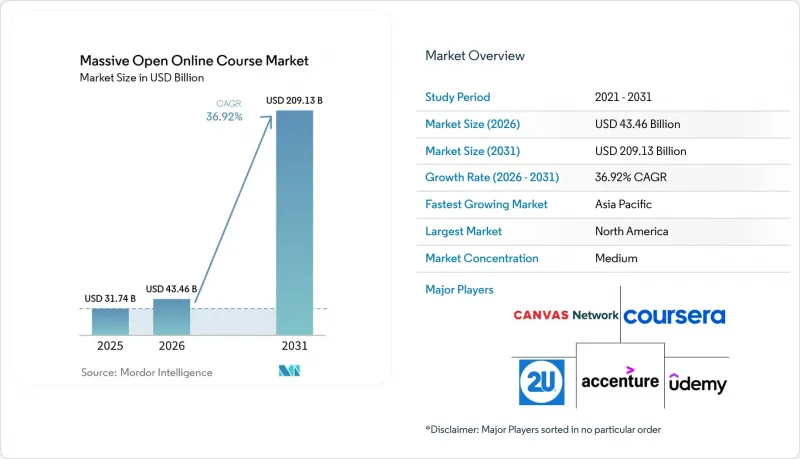
據 Mordor Intelligence 稱,2025 年大規模開放式線上課程 (MOOC) 市場價值為 317.4 億美元,預計在預測期 (2026-2031 年) 內將以 36.92% 的複合年成長率成長,從 2026 年的 434.6 億美元成長到 2031.391 年的 20391.391 年。
本報告按平台類型(cMOOC、xMOOC、混合/SPOC)、目標領域(科技與電腦科學、商業與管理等)、最終用戶(高等教育機構學生、K-12學生等)、獲利模式(僅免費收聽、免費增值等)和地區進行細分。市場預測以美元(USD)計價。
全球大型開放式網路課程(MOOC)市場趨勢與洞察
企業技能發展需求正在推動企業採用MOOC課程。
隨著雇主將持續技能更新與競爭優勢連結起來,預計到2025年,企業學習預算將超過3,500億美元。 FPT集團與Udemy的合作清晰地展現了這一趨勢。該公司已投資1,873億越南盾(約760萬美元)培訓日本和韓國的員工,並將部分MOOC課程納入其績效評估系統。 Skillsoft和Accenture旗下的LearnVantage等公司也進行了類似的以人才為中心的投資,透過將認證結業證書與內部職涯發展路徑掛鉤,進一步推動了對學習平台的需求。
政府資金正在加速數位教育基礎設施的發展。
加拿大在其「CanCode」計畫中撥款3,920萬加元(約2,910萬美元)用於人工智慧課程;澳洲撥款4.364億澳元(約2.916億美元)用於「教育與就業技能」計畫;歐盟的「數位歐洲計畫」投資1.08億歐元(約1.177億美元)用於提昇高級技能。這些津貼將用於津貼內容開發、微證書認證和寬頻容量擴展,使MOOC成為提升國家競爭力的關鍵基礎設施。
儘管不斷進行創新,但完成率仍然極低。
主流平台的平均課程完成率在5%到15%之間,即使是麻省理工學院和哈佛大學共同推出的MOOC課程,完成率也僅3.13%。印度的SWAYAM平台雖然獲得了政府學分認可,但完成率卻低於4%,這凸顯了學員缺乏持續學習動機。研究表明,早期輟學與缺乏數位素養有關,而後期輟學則與時間管理能力和學習能力不匹配有關。各平台正嘗試透過小組輔導、微學習模式和遊戲化里程碑等方式來降低輟學率,但尚未取得顯著成效。
細分市場分析
混合式/SPOC解決方案預計在2031年實現40.11%的複合年成長率,因為雇主需要融合非同步影片和即時輔導的結構化學習小組。 xMOOC(基於大學的合作模式)在滿足合規性和認證要求以及明確課程系統的支撐下,預計到2025年將繼續佔據48.76%的收入佔有率。 cMOOC(基於課程的MOOC)雖然規模有限,但仍在持續為協作知識社群做出貢獻。
企業正將混合式/SPOC平台直接整合到學習管理系統中,並將短時虛擬課程融入日常工作中。皇家馬德里大學與Coursera合作推出了12門體育產業課程,這些課程結合了同儕計畫和教師指導的網路研討會,面向全球受眾。與自主學習的xMOOC相比,這些結構化的學習體驗增強了社交互動和責任感,提高了回饋週期和課程完成率。
預計到2025年,科技與電腦科學領域在大型開放式網路課程(MOOC)市場將維持32.52%的市場佔有率,以滿足對程式設計、人工智慧和網路安全技能的持續需求。語言學習領域是MOOC市場中成長最快的領域,隨著遠距辦公的興起,多語言溝通的需求日益成長,其複合年成長率(CAGR)高達37.68%。商業與管理以及科學與工程領域也呈現穩定成長,但面臨競爭趨於飽和的情況。
Duolingo預計2024年營收將達到7.48億美元,凸顯了消費者對遊戲化語言學習應用的熱情,而這類應用正無縫過渡到企業級服務。同時,101 Blockchains與Accredible合作,向超過3萬名專業人士頒發數位證書,展現了尖端技術內容與認證創新相結合的成果。
區域分析
預計到2025年,北美將維持31.65%的大規模開放式線上課程(MOOC)市場佔有率。這得益於創業投資的強勁流入、企業培訓預算的增加以及微證書相關監管規定的早期明確。美國佔了該市場的大部分佔有率,Accenture以10億美元收購Udacity也凸顯了人們對平台經濟的信心。加拿大CanCode計畫正致力於將人工智慧課程融入K-12教育,而在墨西哥,近岸外包的蓬勃發展正在推動對雙語人才的需求,以提升他們的技能。
亞太地區是成長最快的地區,年複合成長率高達37.25%。印度的SWAYAM和中國的國內MOOC生態系統正利用龐大的學習者群體和政府支持,將MOOC打造成為解決高等教育容量限制的擴充性方案。澳洲斥資4.364億澳元的「教育與就業技能舉措」正在加強該地區的公私合營,而FPT和Udemy的培訓則展現了日本、韓國和越南之間跨境企業學習的協同效應。
在歐洲、中東和非洲,儘管由於監管和基礎設施的差異,普及速度略慢,但整體呈現穩定趨勢。歐盟的「數位歐洲」津貼正在推動認證標準的統一,並為與高級數位技能相關的課程提供資金支持。同時,薩里大學的擴增實境/虛擬實境課程體現了身臨其境型學習的學術方法。在中東,洲際酒店管理學院(IHG Academy)面向酒店業的阿拉伯語大型開放式網路課程(MOOC)正在滿足當地勞動力的需求。在撒哈拉以南非洲,以行動優先的教學模式正被用於彌補校園容量不足的問題;而在南美洲,巴西和阿根廷等國在教育科技領域擁有強勁的投資環境,推動了相關領域的發展。
其他好處:
- Excel格式的市場預測(ME)表
- 3個月的分析師支持
目錄
第1章:引言
- 研究假設和市場定義
- 調查範圍
第2章:調查方法
第3章執行摘要
第4章 市場狀況
- 市場概覽
- 市場促進因素
- 對經濟高效且靈活的學習方式的需求日益成長。
- 企業為提升和重新培訓技能所做的努力
- 智慧型手機和寬頻的普及
- 政府對微證書的推廣與資助
- 人工智慧驅動的自適應學習領域取得突破性進展(一個被低估的領域)
- 一個由雇主組成的全球聯盟(雖然未公開承認),負責認證 MOOC 徽章。
- 市場約束
- 完成率和參與率仍然很低。
- 品質保證/認證方面的缺陷
- 更嚴格的資料隱私法規(尚未引起公眾太多關注)限制了對學習者的分析。
- 疫情後的數位疲勞正在減少螢幕使用時間(這是一個被低估的趨勢)。
- 價值供應鏈分析
- 監理情勢
- 技術展望
- 波特五力分析
第5章 市場規模與成長預測
- 依平台類型
- cMOOC
- xMOOC
- 混合/SPOC
- 按學科領域
- 技術與電腦科學
- 企業管理
- 科學/工程
- 藝術與人文
- 語言學習
- 最終用戶
- 高等教育機構的學生
- K-12學習者
- 積極工作的人/公司
- 終身學習者
- 按收入模式
- 免費(僅限觀看)
- 免費增值
- 訂閱(B2C)
- 課程專用收費/結業證書
- 企業許可(B2B)
- 按地區
- 北美洲
- 美國
- 加拿大
- 墨西哥
- 歐洲
- 德國
- 英國
- 法國
- 俄羅斯
- 其他歐洲國家
- 亞太地區
- 中國
- 日本
- 印度
- 韓國
- 澳洲
- 其他亞太國家
- 中東和非洲
- 中東
- 沙烏地阿拉伯
- 阿拉伯聯合大公國
- 其他中東國家
- 非洲
- 南非
- 埃及
- 其他非洲國家
- 中東
- 南美洲
- 巴西
- 阿根廷
- 其他南美國家
- 北美洲
第6章 競爭情勢
- 市場集中度
- 策略趨勢
- 市佔率分析
- 公司簡介
- Coursera Inc.
- Udemy, Inc.
- edX LLC(2U, Inc.)
- LinkedIn Learning(Microsoft Corp.)
- FutureLearn Ltd.(Global University Systems)
- Khan Academy, Inc.
- Pluralsight LLC
- Instructure Holdings, Inc.(Canvas)
- Blackboard Inc.(Anthology)
- 360training.com, Inc.
- openSAP(SAP SE)
- Skillshare, Inc.
- Alison Ltd.
- Swayam(NPTEL, Govt. of India)
- Iversity GmbH(Springer Nature)
- Miriadax(Telefonica Learning Services)
- OpenWHO(World Health Organization)
- Udacity Inc.(Accenture plc)
- WizIQ Inc.
- OpenLearn(Open University)
第7章 市場機會與未來趨勢
- 評估未開發的領域和未滿足的需求
According to Mordor Intelligence, the massive open online course (MOOC) market size was valued at USD 31.74 billion in 2025 and estimated to grow from USD 43.46 billion in 2026 to reach USD 209.13 billion by 2031, at a CAGR of 36.92% during the forecast period (2026-2031).
This report is Segmented by Platform Type (cMOOC, XMOOC, Hybrid/SPOC), Subject Area (Technology and Computer Science, Business and Management, and More), End User (Higher-Education Students, K-12 Learners, and More), Revenue Model (Free Audit-Only, Freemium, and More), and Geography. The Market Forecasts are Provided in Terms of Value (USD).
Global Massive Open Online Course (MOOC) Market Trends and Insights
Corporate upskilling mandates drive enterprise adoption
Enterprise learning budgets surpassed USD 350 billion in 2025 as employers tied competitive advantage to continuous skill renewal. FPT Corporation's alliance with Udemy illustrates this momentum: the firm invested VND 187.3 billion (USD 7.6 million) to train staff across Japan and Korea, embedding curated MOOCs into its performance framework Similar talent-centric investments from Skillsoft and Accenture's LearnVantage accelerate platform demand by connecting verified certificates to internal career ladders.
Government funding accelerates digital education infrastructure
Canada earmarked CAD 39.2 million (USD 29.1 million) for the CanCode program's AI track, Australia allocated AUD 436.4 million (USD 291.6 million) to Skills for Education and Employment, and the EU's Digital Europe Programme injected EUR 108 million (USD 117.7 million) into advanced digital skills. These grants subsidize content development, subsidize micro-credential recognition, and upgrade broadband capacity, positioning MOOCs as critical national competitiveness infrastructure
Completion rates remain critically low despite innovation
Average course completion hovers between 5% and 15% on major platforms, and even MIT-Harvard joint MOOCs close at a 3.13% rate. India's SWAYAM registers sub-4% completions despite government credit recognition, underscoring a persistent motivation gap. Research links early dropout to limited digital literacy, while later attrition correlates with time-management and academic skill mismatches. Platforms experiment with cohort mentors, micro-learning formats, and gamified milestones to mitigate attrition, yet material improvement remains elusive.
Other drivers and restraints analyzed in the detailed report include:
- AI-driven personalization transforms learning outcomes
- Blockchain credentials gain enterprise recognition
- Data-privacy regulations constrain personalization capabilities
For complete list of drivers and restraints, kindly check the Table Of Contents.
Segment Analysis
Hybrid/SPOC solutions captured 40.11% CAGR potential through 2031 as employers seek structured cohorts that blend asynchronous video with live coaching. xMOOCs still hold 48.76% of 2025 revenue, buoyed by university partnerships and well-defined curricula that address compliance and accreditation requirements. cMOOC offerings continue to serve collaborative knowledge communities but command limited scale.
Enterprises integrate Hybrid/SPOC platforms directly into learning-management systems to embed bite-sized virtual sessions into the workday. Real Madrid University School's Coursera tie-up delivers 12 sports-industry courses that combine peer projects and faculty webinars to global cohorts. These structured experiences improve social presence and accountability, elevating feedback cycles and completion metrics compared with self-paced xMOOCs.
Technology and Computer Science retained 32.52% of the Massive Open Online Course market share in 2025 by catering to relentless demand for programming, AI, and cybersecurity competencies. Massive Open Online Course market size in language learning is rising fastest, expanding at a 37.68% CAGR as remote work multiplies multilingual communication needs. Business and Management and Science and Engineering segments post steady gains but face competitive saturation.
Duolingo's USD 748 million 2024 revenue validates consumer enthusiasm for gamified language apps that transition seamlessly into enterprise offerings. Simultaneously, 101 Blockchains collaborates with Accredible to issue digital certificates for over 30,000 professionals, demonstrating convergence between advanced tech content and credential innovation.
Geography Analysis
North America retained 31.65% of the Massive Open Online Course (MOOC) market share in 2025, anchored by robust venture-capital flows, deep corporate learning budgets, and early regulatory clarity on micro-credentials. The United States accounts for the lion's share, with Accenture's USD 1 billion Udacity acquisition underscoring confidence in platform economics. Canada's CanCode funding embeds AI curricula into K-12 pipelines, while Mexico's near-shoring boom fuels bilingual upskilling demand.
Asia-Pacific is the fastest-growing territory, expanding at a 37.25% CAGR. India's SWAYAM and China's domestic MOOC ecosystems tap colossal learner bases and government sponsorship that recognize MOOCs as scalable answers to higher-education capacity constraints. Australia's AUD 436.4 million Skills for Education and Employment initiative reinforces regional public-private collaboration, and FPT-Udemy training illustrates cross-border enterprise learning synergies spanning Japan, Korea, and Vietnam.
Europe, the Middle East, and Africa show steady uptake moderated by regulatory and infrastructure diversity. The EU's Digital Europe grants foster coordinated credential standards and fund advanced digital-skills content, while the University of Surrey's AR/VR course portfolio illustrates an academic push toward immersive learning. In the Middle East, IHG Academy's Arabic-language hospitality MOOC addresses local workforce needs. Sub-Saharan Africa leverages mobile-first delivery to mitigate campus capacity gaps, while South America advances through Brazil and Argentina's ed-tech investment climates.
- Coursera Inc.
- Udemy, Inc.
- edX LLC (2U, Inc.)
- LinkedIn Learning (Microsoft Corp.)
- FutureLearn Ltd. (Global University Systems)
- Khan Academy, Inc.
- Pluralsight LLC
- Instructure Holdings, Inc. (Canvas)
- Blackboard Inc. (Anthology)
- 360training.com, Inc.
- openSAP (SAP SE)
- Skillshare, Inc.
- Alison Ltd.
- Swayam (NPTEL, Govt. of India)
- Iversity GmbH (Springer Nature)
- Miriadax (Telefonica Learning Services)
- OpenWHO (World Health Organization)
- Udacity Inc. (Accenture plc)
- WizIQ Inc.
- OpenLearn (Open University)
Additional Benefits:
- The market estimate (ME) sheet in Excel format
- 3 months of analyst support
TABLE OF CONTENTS
1 INTRODUCTION
- 1.1 Study Assumptions and Market Definition
- 1.2 Scope of the Study
2 RESEARCH METHODOLOGY
3 EXECUTIVE SUMMARY
4 MARKET LANDSCAPE
- 4.1 Market Overview
- 4.2 Market Drivers
- 4.2.1 Rising demand for cost-effective, flexible learning
- 4.2.2 Corporate upskilling and reskilling mandates
- 4.2.3 Smartphone and broadband proliferation
- 4.2.4 Government push for micro-credentials and funding
- 4.2.5 AI-driven adaptive learning breakthroughs (under-radar)
- 4.2.6 Global employer consortiums validating MOOC badges (under-radar)
- 4.3 Markeat Restraints
- 4.3.1 Persistently low completion and engagement rates
- 4.3.2 Quality-assurance / accreditation gaps
- 4.3.3 Stricter data-privacy rules limiting learner analytics (under-radar)
- 4.3.4 Post-pandemic digital-fatigue dampening screen time (under-radar)
- 4.4 Value / Supply-Chain Analysis
- 4.5 Regulatory Landscape
- 4.6 Technological Outlook
- 4.7 Porter's Five Forces Analysis
- 4.7.1 Threat of New Entrants
- 4.7.2 Bargaining Power of Buyers
- 4.7.3 Bargaining Power of Suppliers
- 4.7.4 Threat of Substitutes
- 4.7.5 Intensity of Competitive Rivalry
5 MARKET SIZE AND GROWTH FORECASTS (VALUE)
- 5.1 By Platform Type
- 5.1.1 cMOOC
- 5.1.2 xMOOC
- 5.1.3 Hybrid / SPOC
- 5.2 By Subject Area
- 5.2.1 Technology and Computer Science
- 5.2.2 Business and Management
- 5.2.3 Science and Engineering
- 5.2.4 Arts and Humanities
- 5.2.5 Language Learning
- 5.3 By End User
- 5.3.1 Higher-Education Students
- 5.3.2 K-12 Learners
- 5.3.3 Working Professionals / Corporate
- 5.3.4 Lifelong Learners
- 5.4 By Revenue Model
- 5.4.1 Free (Audit-only)
- 5.4.2 Freemium
- 5.4.3 Subscription (B2C)
- 5.4.4 Pay-per-course / Certificate
- 5.4.5 Enterprise Licensing (B2B)
- 5.5 By Geography
- 5.5.1 North America
- 5.5.1.1 United States
- 5.5.1.2 Canada
- 5.5.1.3 Mexico
- 5.5.2 Europe
- 5.5.2.1 Germany
- 5.5.2.2 United Kingdom
- 5.5.2.3 France
- 5.5.2.4 Russia
- 5.5.2.5 Rest of Europe
- 5.5.3 Asia-Pacific
- 5.5.3.1 China
- 5.5.3.2 Japan
- 5.5.3.3 India
- 5.5.3.4 South Korea
- 5.5.3.5 Australia
- 5.5.3.6 Rest of Asia-Pacific
- 5.5.4 Middle East and Africa
- 5.5.4.1 Middle East
- 5.5.4.1.1 Saudi Arabia
- 5.5.4.1.2 United Arab Emirates
- 5.5.4.1.3 Rest of Middle East
- 5.5.4.2 Africa
- 5.5.4.2.1 South Africa
- 5.5.4.2.2 Egypt
- 5.5.4.2.3 Rest of Africa
- 5.5.4.1 Middle East
- 5.5.5 South America
- 5.5.5.1 Brazil
- 5.5.5.2 Argentina
- 5.5.5.3 Rest of South America
- 5.5.1 North America
6 COMPETITIVE LANDSCAPE
- 6.1 Market Concentration
- 6.2 Strategic Moves
- 6.3 Market Share Analysis
- 6.4 Company Profiles (includes Global-level Overview, Market-level Overview, Core Segments, Financials, Strategic Info, Market Rank/Share, Products and Services, Recent Developments)
- 6.4.1 Coursera Inc.
- 6.4.2 Udemy, Inc.
- 6.4.3 edX LLC (2U, Inc.)
- 6.4.4 LinkedIn Learning (Microsoft Corp.)
- 6.4.5 FutureLearn Ltd. (Global University Systems)
- 6.4.6 Khan Academy, Inc.
- 6.4.7 Pluralsight LLC
- 6.4.8 Instructure Holdings, Inc. (Canvas)
- 6.4.9 Blackboard Inc. (Anthology)
- 6.4.10 360training.com, Inc.
- 6.4.11 openSAP (SAP SE)
- 6.4.12 Skillshare, Inc.
- 6.4.13 Alison Ltd.
- 6.4.14 Swayam (NPTEL, Govt. of India)
- 6.4.15 Iversity GmbH (Springer Nature)
- 6.4.16 Miriadax (Telefonica Learning Services)
- 6.4.17 OpenWHO (World Health Organization)
- 6.4.18 Udacity Inc. (Accenture plc)
- 6.4.19 WizIQ Inc.
- 6.4.20 OpenLearn (Open University)
7 MARKET OPPORTUNITIES AND FUTURE TRENDS
- 7.1 White-space and Unmet-Need Assessment

 2026年全球語言學習平台市場報告
 大型開放式網路課程(MOOC)市場:預測至2034年-按課程類型、學科、交付方式、設備、平台類型、最終用戶和地區分類
 大型開放式網路課程(MOOC)市場:按類型、課程主題、收入模式、平台類型、交付方式和提供者類型分類-2026-2032年全球市場預測
 繼續教育市場規模、佔有率和成長分析:按學習形式、課程類型、最終用戶、提供者類型、產業、時長和地區分類-2026-2033年產業預測
 大型開放式網路課程(MOOC)市場規模、佔有率和成長分析:按平台結構類型、專業領域、目標學習者群體、獲利模式和地區分類-2026-2033年產業預測
 2026 年至 2035 年大型開放式網路課程 (MMOPC) 的市場機會、成長促進因素、產業趨勢和預測。全球小組學習平台市場預測至2034年:依產品模式、課程類型、功能、應用、最終用戶和地區分類的分析線上教學平台市場預測-全球分析(按組成部分、教學方法、學科領域、應用、最終用戶和地區分類)——2034年繼續教育平台市場預測至2034年—按組成部分、課程類型、交付方式、應用、最終用戶和地區分類的全球分析
 大型開放式網路課程(MOOC)市場報告:按組成部分、課程、最終用戶和地區分類(2026-2034 年)