

 |
市場調查報告書
商品編碼
2083330
2026 年至 2035 年大型開放式網路課程 (MMOPC) 的市場機會、成長促進因素、產業趨勢和預測。Massive Open Online Courses (MOOCs) Market Opportunity, Growth Drivers, Industry Trend Analysis, and Forecast 2026 - 2035 |
||||||

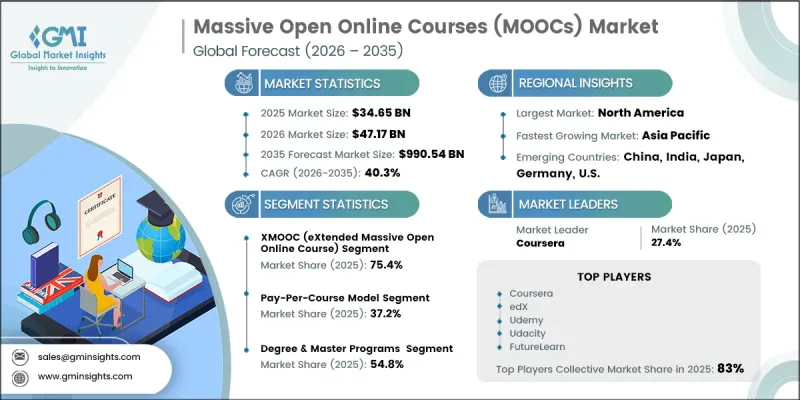
全球大型開放式網路課程(MOOC)市場預計到 2025 年價值 346.5 億美元,並將以 40.3% 的複合年成長率成長,到 2035 年達到 9,905.4 億美元。
該市場的快速成長源於學術界、專業和企業界對便利、靈活且經濟高效的學習解決方案日益成長的需求。隨著數位轉型不斷改變教育方式,線上學習平台正成為技能發展、職業認證、員工培訓和高等教育的重要工具。網際網路連接和數位技術的廣泛應用顯著提升了全球線上教育資源的獲取途徑。此外,學習者越來越傾向於自主學習,以便平衡學習與個人及專業責任。企業和教育機構也正在採用擴充性的學習模式,以擴大教育覆蓋範圍並提高培訓效率。數位學習生態系統的技術進步,例如使用者體驗的提升、個人化學習路徑和互動式課程交付方式,進一步推動了市場擴張。隨著終身學習和就業技能的日益普及,大規模開放式線上課程(MOOC)正成為全球教育和職業發展策略的關鍵組成部分。
| 市場範圍 | |
|---|---|
| 開始年份 | 2025 |
| 預測期 | 2026-2035 |
| 起始金額 | 346.5億美元 |
| 預測金額 | 9905.4億美元 |
| 複合年成長率 | 40.3% |
預計到2025年,XMOOC(擴展型大型開放式網路課程)市佔率將達到75.4%。此細分市場的強勁地位得益於教育機構、企業和專業學習者對結構化、教師指導式學習體驗的廣泛採用。這些課程通常結合了結構化的內容傳遞、評估和教學支持,使其非常適合認證課程、學術教育和人才發展舉措。對擴充性、柔軟性的數位化教育解決方案日益成長的需求,持續鞏固該細分市場的主導地位和長期成長潛力。
預計到2025年,「課程收費模式」市佔率將達到37.2%。該模式的主導地位源於學習者越來越傾向於靈活的付費方式,這種方式允許他們根據個人學習和職業發展目標選擇特定課程。這種模式使用戶無需長期訂閱或承擔沉重的經濟負擔即可獲得所需的知識和專業技能。對經濟實惠、注重實效的數位化學習解決方案日益成長的需求,持續推動著各類線上教育平台的普及。
到2025年,北美大型開放式網路課程(MOOC)市佔率將達到32.5%。該地區的主導地位得益於教育機構、企業和個人學習者對線上教育、專業認證課程和人才發展舉措的強勁需求。先進的數位基礎設施、高技術普及率以及虛擬學習環境的廣泛接受度也為市場成長提供了支撐。線上教育在企業培訓、高等教育和職業發展領域的日益普及,並持續推動全部區域對先進學習平台的需求。
目錄
第1章:調查方法和範圍
第2章執行摘要
第3章 行業洞察
- 產業生態系分析
- 供應商情況
- 利潤率
- 成本結構
- 每個階段增加的價值
- 影響價值鏈的因素
- 中斷
- 影響產業的因素
- 成長促進因素
- 對靈活且價格合理的線上教育的需求日益成長
- 人們越來越重視專業技能發展和再培訓。
- 快速數位化且不斷提高的網路普及率
- 人工智慧驅動學習平台的技術進步
- 擴大大學、企業和MOOC提供者之間的合作關係
- 產業潛在風險與挑戰
- 課程完成率低,學員參與度低。
- 某些行業對線上認證的認知度較低
- 市場機遇
- 線上培訓的興起
- 新興市場MOOC平台的擴張
- 成長促進因素
- 成長潛力分析
- 監理情勢
- 波特的分析
- PESTLE分析
- 技術與創新展望
- 最新科技趨勢
- 新興技術
- 專利和智慧財產權分析
- 價格分析
- 歷史價格分析(2022-2025)
- 依球員類型分類的定價策略(高級球員、超值球員、成本加成球員)
- 貿易數據分析
- 進出口量及進口額趨勢
- 主要貿易路線及關稅的影響
- 人工智慧和生成式人工智慧對市場的影響
- 利用人工智慧改造現有經營模式
- 按細分市場分類的生成式人工智慧用例和部署藍圖
- 風險、限制和監管考量
- 生產能力和生產情況
- 設備產能:按地區和主要生產商分類
- 運轉率和擴張計劃
第4章 競爭情勢
- 企業市佔率分析
- 按地區
- 北美洲
- 歐洲
- 亞太地區
- 拉丁美洲
- 中東和非洲
- 市場集中度分析
- 按地區
- 主要市場公司的競爭分析
- 競爭定位矩陣
- 主要進展
- 併購
- 夥伴關係和聯盟
- 新產品發布
- 業務拓展計劃及資金籌措
- 按公司規模進行基準測試
- 排名分類標準與遴選標準
- 按收入、地區和創新能力分類的層級定位矩陣。
第5章 市場估價與預測:依課程類型分類,2022-2035年
- XMOOC(可擴展大型開放式網路課程)
- CMOOC(聯結主義大規模開放式線上課程)
第6章 市場估價與預測:依課程類別分類,2022-2035年
- 認證課程/專業課程
- 學位/碩士課程
第7章 市場估計與預測:依經營模式,2022-2035年
- 免費增值模式
- 訂閱模式
- 基於課程的收費模式
- 政府和非營利組織的資助
第8章 市場估算與預測:依產業分類,2022-2035年
- 商業管理
- 電腦科學程式設計
- 科學
- 人文科學
- 健康與醫療保健
- 教育/指導
- 工程
- 藝術與設計
- 數學
- 其他
第9章 市場估算與預測:依服務供應商類型分類,2022-2035年
- 大學合作平台
- 私人教育科技公司
- 非營利和政府支持的平台
第10章 市場估價與預測:以交付方式分類,2022-2035年
- 按自己的步調學習
- 講師主導
第11章 市場估價與預測:依語言分類,2022-2035年
- 英語
- 西班牙語
- 中國人
- 其他
第12章 市場估計與預測:依最終用戶分類,2022-2035年
- 個人
- 高中生
- 大學生
- 研究生
- 終身學習者
- 企業/公司
- 小型企業
- 大型公司
- 教育機構
- 其他
第13章 市場估計與預測:依地區分類,2022-2035年
- 北美洲
- 美國
- 加拿大
- 歐洲
- 德國
- 英國
- 法國
- 西班牙
- 義大利
- 亞太地區
- 中國
- 印度
- 日本
- 澳洲
- 韓國
- 拉丁美洲
- 巴西
- 墨西哥
- 阿根廷
- 中東和非洲
- 南非
- 沙烏地阿拉伯
- UAE
第14章:公司簡介
- 全球主要公司
- Coursera
- edX
- Udemy
- Udacity
- FutureLearn
- 該地區的主要公司
- 北美洲
- Canvas Network
- Khan Academy
- 亞太地區
- Swayam
- OpenLearning
- ThaiMOOC
- 歐洲
- France Universite Numerique
- Miriadax
- 北美洲
- 小眾玩家/顛覆者
- Photonics Industries International, Inc.
- Laser Quantum Ltd
- Alison
- EduOpen
- OpenClassrooms
- OpenEdu
The Global Massive Open Online Courses Market was valued at USD 34.65 billion in 2025 and is estimated to grow at a CAGR of 40.3% to reach USD 990.54 billion by 2035.
The market's rapid growth is driven by the increasing demand for accessible, flexible, and cost-efficient learning solutions across academic, professional, and corporate environments. As digital transformation continues to reshape the education landscape, online learning platforms are becoming an essential tool for skill development, professional certification, workforce training, and higher education. The growing availability of internet connectivity and widespread adoption of digital technologies have significantly improved access to online educational resources worldwide. In addition, learners are increasingly seeking self-directed learning opportunities that allow them to balance education with personal and professional responsibilities. Organizations and educational institutions are also embracing scalable learning models to expand educational reach and improve training efficiency. Technological advancements within digital learning ecosystems, including enhanced user experiences, personalized learning pathways, and interactive course delivery methods, are further supporting market expansion. As the emphasis on lifelong learning and workforce readiness continues to grow, massive open online courses are becoming a critical component of global education and professional development strategies.
| Market Scope | |
|---|---|
| Start Year | 2025 |
| Forecast Year | 2026-2035 |
| Start Value | $34.65 Billion |
| Forecast Value | $990.54 Billion |
| CAGR | 40.3% |
The XMOOC (eXtended Massive Open Online Course) segment held a 75.4% share in 2025. The segment's strong position is supported by widespread adoption among educational institutions, enterprises, and professional learners seeking structured and instructor-guided learning experiences. These courses typically combine organized content delivery, assessments, and instructional support, making them highly suitable for certification programs, academic education, and workforce development initiatives. Growing demand for scalable and flexible digital education solutions continues to strengthen the segment's market leadership and long-term growth potential.
The pay-per-course model segment held a 37.2% share in 2025. The segment's leadership is attributed to the growing preference among learners for flexible payment structures that allow access to specific courses based on individual learning objectives and career advancement goals. This model enables users to acquire targeted knowledge and specialized skills without committing to long-term subscriptions or extensive financial obligations. Increasing demand for affordable, outcome-oriented digital learning solutions continues to support adoption across a broad range of online education platforms.
North America Massive Open Online Courses Market accounted for 32.5% share in 2025. The region maintains a leading position owing to strong demand for online education, professional certification programs, and workforce development initiatives among educational institutions, businesses, and individual learners. Market growth is supported by advanced digital infrastructure, high levels of technology adoption, and widespread acceptance of virtual learning environments. Expanding use of online education across corporate training, higher education, and professional development applications continues to drive demand for sophisticated learning platforms throughout the region.
Key companies operating in the global massive open online courses market include Udemy, Coursera, FutureLearn, OpenClassrooms, edX, Khan Academy, Alison, OpenLearning, Udacity, Canvas Network, France Universite Numerique, Swayam, EduOpen, FutureLearn Ltd., OpenEdu, ThaiMOOC, and Miriadax. Companies operating in the massive open online courses market are implementing a variety of strategic initiatives to strengthen their market presence and enhance competitive positioning. Investments in platform innovation remain a major focus, with providers continuously improving user experience, content delivery, and learning personalization capabilities. Strategic collaborations with educational institutions, industry organizations, and corporate employers are helping companies expand course offerings and improve the relevance of certification programs. Market participants are also focusing on developing industry-specific learning pathways, professional credentials, and workforce training solutions that address evolving labor market requirements. Geographic expansion, multilingual content development, and mobile-first learning experiences are supporting broader audience engagement.
Table of Contents
Chapter 1 Methodology and Scope
- 1.1 Market scope and definition
- 1.2 Research design
- 1.2.1 Research approach
- 1.2.2 Data collection methods
- 1.3 Data mining sources
- 1.3.1 Global
- 1.3.2 Regional/Country
- 1.4 Base estimates and calculations
- 1.4.1 Base year calculation
- 1.4.2 Key trends for market estimation
- 1.5 Primary research and validation
- 1.5.1 Primary sources
- 1.6 Forecast model
- 1.7 Research assumptions and limitations
Chapter 2 Executive Summary
- 2.1 Industry 360° synopsis, 2022 - 2035
- 2.2 Key market trends
- 2.2.1 Course Type trends
- 2.2.2 Course Category trends
- 2.2.3 Business Model trends
- 2.2.4 Subject Area trends
- 2.2.5 Service Provider Type trends
- 2.2.6 Delivery Mode trends
- 2.2.7 Language trends
- 2.2.8 End User trends
- 2.2.9 Regional trends
- 2.3 TAM Analysis, 2026-2035
- 2.4 CXO perspectives: Strategic imperatives
Chapter 3 Industry Insights
- 3.1 Industry ecosystem analysis
- 3.1.1 Supplier Landscape
- 3.1.2 Profit Margin
- 3.1.3 Cost structure
- 3.1.4 Value addition at each stage
- 3.1.5 Factor affecting the value chain
- 3.1.6 Disruptions
- 3.2 Industry impact forces
- 3.2.1 Growth drivers
- 3.2.1.1 Increasing demand for flexible and affordable online education
- 3.2.1.2 Growing emphasis on professional upskilling and reskilling
- 3.2.1.3 Rapid digitalization and rising internet penetration
- 3.2.1.4 Technological advancements in AI-driven learning platforms
- 3.2.1.5 Growing partnerships between universities and enterprises with MOOCs providers
- 3.2.2 Industry pitfalls and challenges
- 3.2.2.1 Low course completion and learner engagement rates
- 3.2.2.2 Limited recognition of online certifications in certain industries
- 3.2.3 Market opportunities
- 3.2.3.1 Rising online training
- 3.2.3.2 Expansion of MOOCs platforms in emerging economies
- 3.2.1 Growth drivers
- 3.3 Growth potential analysis
- 3.4 Regulatory landscape
- 3.4.1 North America
- 3.4.2 Europe
- 3.4.3 Asia Pacific
- 3.4.4 Latin America
- 3.4.5 Middle East & Africa
- 3.5 Porter's analysis
- 3.6 PESTEL analysis
- 3.7 Technology and Innovation landscape
- 3.7.1 Current technological trends
- 3.7.2 Emerging technologies
- 3.8 Patent and IP analysis
- 3.9 Pricing Analysis (Driven by Primary Research)
- 3.9.1 Historical Price Analysis (2022-2025)
- 3.9.2 Pricing Strategy by Player Type (Premium / Value / Cost-plus)
- 3.10 Trade Data Analysis (HS Code) (Based on Paid Database)
- 3.10.1 Import/Export Volume & Value Trends
- 3.10.2 Key Trade Corridors & Tariff Impact
- 3.11 Impact of AI & Generative AI on the Market (Driven by Primary Research)
- 3.11.1 AI-Driven Disruption of Existing Business Models
- 3.11.2 GenAI Use Cases & Adoption Roadmap by Segment
- 3.11.3 Risks, Limitations & Regulatory Considerations
- 3.12 Capacity & Production Landscape (Driven by Primary Research)
- 3.12.1 Installed Capacity by Region & Key Producer
- 3.12.2 Capacity Utilization Rates & Expansion Pipelines
Chapter 4 Competitive Landscape, 2025
- 4.1 Company market share analysis, 2025
- 4.1.1 By Region
- 4.1.1.1 North America
- 4.1.1.2 Europe
- 4.1.1.3 Asia-Pacific
- 4.1.1.4 Latin America
- 4.1.1.5 Middle East and Africa
- 4.1.2 Market Concentration Analysis
- 4.1.1 By Region
- 4.2 Competitive analysis of major market players
- 4.3 Competitive positioning matrix
- 4.4 Key developments
- 4.4.1 Mergers & acquisitions
- 4.4.2 Partnerships & collaborations
- 4.4.3 New product launches
- 4.4.4 Expansion plans and funding
- 4.5 Company tier benchmarking
- 4.5.1 Tier classification criteria & qualifying thresholds
- 4.6 Tier positioning matrix by revenue, geography & innovation
Chapter 5 Market Estimates and Forecast, By Course Type, 2022 - 2035 (USD Billion)
- 5.1 Key trends
- 5.2 XMOOC (eXtended Massive Open Online Course)
- 5.3 CMOOC (Connectivist Massive Open Online Course)
Chapter 6 Market Estimates and Forecast, By Course Category, 2022 - 2035 (USD Billion)
- 6.1 Key trends
- 6.2 Certificate & Professional Courses
- 6.3 Degree & Master Programs
Chapter 7 Market Estimates and Forecast, By Business Model, 2022 - 2035 (USD Billion)
- 7.1 Key trends
- 7.2 Freemium Model
- 7.3 Subscription-Based Model
- 7.4 Pay-Per-Course Model
- 7.5 Government/Non-Profit Funded
Chapter 8 Market Estimates and Forecast, By Subject Area, 2022 - 2035 (USD Billion)
- 8.1 Key trends
- 8.2 Business management
- 8.3 Computer science and programming
- 8.4 Science
- 8.5 Humanities
- 8.6 Health and medicine
- 8.7 Education and teaching
- 8.8 Engineering
- 8.9 Arts and design
- 8.10 Mathematics
- 8.11 Others
Chapter 9 Market Estimates and Forecast, By Service Provider Type, 2022 - 2035 (USD Billion)
- 9.1 Key trends
- 9.2 University-Affiliated Platforms
- 9.3 Private EdTech Companies
- 9.4 Nonprofit & Government-Supported Platforms
Chapter 10 Market Estimates and Forecast, By Delivery Mode, 2022 - 2035 (USD Billion)
- 10.1 Key trends
- 10.2 Self-paced
- 10.3 Instructor-led
Chapter 11 Market Estimates and Forecast, By Language, 2022 - 2035 (USD Billion)
- 11.1 Key trends
- 11.2 English
- 11.3 Spanish
- 11.4 Mandarin
- 11.5 Others
Chapter 12 Market Estimates and Forecast, By End User, 2022 - 2035 (USD Billion)
- 12.1 Key trends
- 12.2 Individual
- 12.2.1 High school students
- 12.2.2 Undergraduate students
- 12.2.3 Graduate students
- 12.2.4 Lifelong learners
- 12.3 Enterprise/Corporate
- 12.3.1 SMEs
- 12.3.2 Large Scale Enterprises
- 12.4 Educational Institutes
- 12.5 Others
Chapter 13 Market Estimates and Forecast, By Region, 2022 - 2035 (USD Billion)
- 13.1 Key trends
- 13.2 North America
- 13.2.1 U.S.
- 13.2.2 Canada
- 13.3 Europe
- 13.3.1 Germany
- 13.3.2 UK
- 13.3.3 France
- 13.3.4 Spain
- 13.3.5 Italy
- 13.4 Asia Pacific
- 13.4.1 China
- 13.4.2 India
- 13.4.3 Japan
- 13.4.4 Australia
- 13.4.5 South Korea
- 13.5 Latin America
- 13.5.1 Brazil
- 13.5.2 Mexico
- 13.5.3 Argentina
- 13.6 Middle East and Africa
- 13.6.1 South Africa
- 13.6.2 Saudi Arabia
- 13.6.3 UAE
Chapter 14 Company Profiles
- 14.1 Global Key Players
- 14.1.1 Coursera
- 14.1.2 edX
- 14.1.3 Udemy
- 14.1.4 Udacity
- 14.1.5 FutureLearn
- 14.2 Regional key players
- 14.2.1 North America
- 14.2.1.1 Canvas Network
- 14.2.1.2 Khan Academy
- 14.2.2 Asia Pacific
- 14.2.2.1 Swayam
- 14.2.2.2 OpenLearning
- 14.2.2.3 ThaiMOOC
- 14.2.2.4 Europe
- 14.2.2.5 France Universite Numerique
- 14.2.2.6 Miriadax
- 14.2.1 North America
- 14.3 Niche Players/Disruptors
- 14.3.1 Photonics Industries International, Inc.
- 14.3.2 Laser Quantum Ltd
- 14.3.3 Alison
- 14.3.4 EduOpen
- 14.3.5 OpenClassrooms
- 14.3.6 OpenEdu

 2026年全球語言學習平台市場報告
 大型開放式網路課程(MOOC)市場:預測至2034年-按課程類型、學科、交付方式、設備、平台類型、最終用戶和地區分類
 大型開放式網路課程(MOOC)市場:按類型、課程主題、收入模式、平台類型、交付方式和提供者類型分類-2026-2032年全球市場預測
 繼續教育市場規模、佔有率和成長分析:按學習形式、課程類型、最終用戶、提供者類型、產業、時長和地區分類-2026-2033年產業預測
 大型開放式網路課程(MOOC)市場規模、佔有率和成長分析:按平台結構類型、專業領域、目標學習者群體、獲利模式和地區分類-2026-2033年產業預測
 大型開放式網路課程(MOOC):市場佔有率分析、產業趨勢與統計資料、成長預測(2026-2031)全球小組學習平台市場預測至2034年:依產品模式、課程類型、功能、應用、最終用戶和地區分類的分析線上教學平台市場預測-全球分析(按組成部分、教學方法、學科領域、應用、最終用戶和地區分類)——2034年繼續教育平台市場預測至2034年—按組成部分、課程類型、交付方式、應用、最終用戶和地區分類的全球分析
 大型開放式網路課程(MOOC)市場報告:按組成部分、課程、最終用戶和地區分類(2026-2034 年)