


 |
市場調查報告書
商品編碼
2066479
音訊翻譯:市場佔有率分析、行業趨勢和統計數據、成長預測(2026-2031)Speech To Speech Translation - Market Share Analysis, Industry Trends & Statistics, Growth Forecasts (2026 - 2031) |
||||||

※ 本網頁內容可能與最新版本有所差異。詳細情況請與我們聯繫。
根據 Mordor Intelligence 預測,語音翻譯市場規模將從 2025 年的 6.9 億美元成長到 2026 年的 7.6204 億美元,然後在 2031 年達到 12.5 億美元,2026 年至 2031 年的複合年成長率為 10.44%。
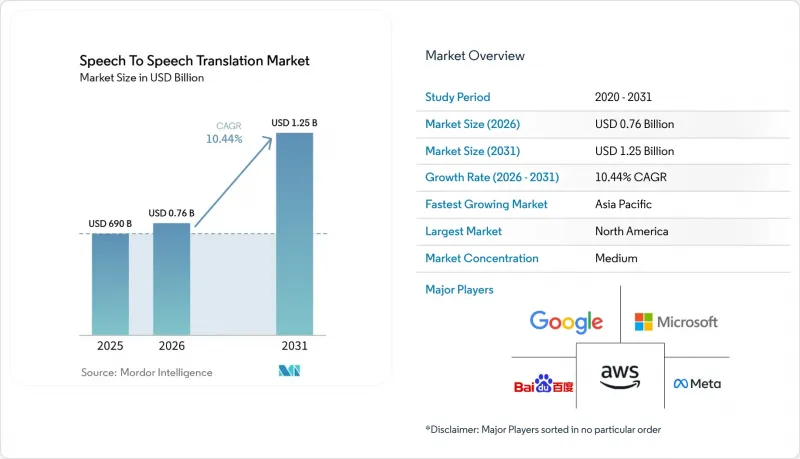
本報告按類型(硬體、軟體)、部署模式(本地部署、雲端部署、邊緣部署)、應用領域(旅遊業、醫療保健等)、最終用戶(個人消費者、企業等)、技術(神經機器翻譯、統計機器翻譯、基於規則的翻譯等)和地區進行細分。市場預測以美元(USD)為單位。
全球語音翻譯市場趨勢及洞察
5G的部署將實現低延遲的雲端推理。
目前,獨立組網的5G網路往返延遲已低於20毫秒,消除了雲端串流翻譯的一大技術障礙。預計到2024年中期,美國通訊業者將在200多個大都會圈運作5G核心網路。預計到2025年初,中國三大電信業者將在95%的縣級城市實現類似的覆蓋。搭載高通驍龍8 Gen 3處理器的智慧型手機以45 TOPS的運算速度運行本地模型,僅在需要高精度時才將複雜查詢上報至邊緣雲端。這種混合架構降低了資料傳輸成本,並允許敏感語音資料保留在設備上,從而滿足美國等市場更嚴格的醫療隱私法規要求。
大型科技公司對語音人工智慧生態系統的投資
微軟、Google、亞馬遜和 Meta 在 2024 年總合投資 2,000 億美元用於人工智慧運算,將強大的處理能力投入即時語音翻譯領域。 Azure AI Speech 目前支援 Teams 和 Dynamics 365 中的 120 種語言對,到 2024 年底,企業 API 呼叫量年增 140%。同期,Google的串流媒體翻譯 API 在 Workspace 的使用量增加了 180%。亞馬遜將轉錄和翻譯功能整合到 Connect 中,使早期用戶的平均通話處理時間縮短了 30%。 Meta 則選擇了設備端處理。其 SeamlessM4T 模型在本地處理加密的 WhatsApp 音頻,強化了其隱私保護策略,以吸引那些對雲端儲存持謹慎態度的市場。超大規模資料中心業者正利用數十億用戶的回饋循環,將翻譯視為高留存率的功能,融入更廣泛的生產力套件中,從而實現盈利。
對隱私和資料安全的擔憂
由於語音頻譜特徵符合 GDPR、CCPA 和中國《個人資訊保護法》中關於生物識別資訊的定義,企業必須獲得使用者的明確同意,並以加密狀態保存這些資訊。在醫療保健領域,企業還必須遵守 HIPAA 的審計和資料保留規定,這增加了整合成本,並限制了雲端供應商的選擇。微軟在 2024 財政年度額外累計12 億美元用於隱私合規。為了應對深度造假詐騙的興起,銀行正在轉向採用生物辨識檢測技術,但這可能會造成延遲並影響對話體驗。 NIST 2025 年的指導草案將聯邦學習列為潛在的解決方案,但其應用受到過高的計算開銷的阻礙。
細分市場分析
預計到2025年,軟體收入將佔總收入的56.85%,並將以11.63%的複合年成長率持續成長至2031年。來自微軟、谷歌和亞馬遜的計量收費API將使客服中心無需硬體資本投資即可添加即時多語言語音功能。訂閱模式也將確保用戶始終擁有最新的變壓器查核點。硬體在離線環境和需要環境適應性的應用中仍然至關重要。獨立耳機面向一般旅行者,而伺服器級GPU機架則支援受監管的企業。具有神經協處理器和雲端回退功能的混合設備成長最快,這主要得益於汽車和工業IoT設計對亞毫秒延遲的需求。 ISO正在持續推進網路化模型壓縮,這將模糊軟體和硬體之間的界限,進一步加速混合技術的普及。
硬體供應商現在將OTA韌體與雲端的型號更新同步,模糊了軟體和更新週期之間的界線。然而,隨著智慧型手機作業系統供應商免費提供基本的翻譯功能,消費級硬體的利潤率正在下降。語音翻譯市場依賴波束成形麥克風陣列、噪音抑制和節能型NPU等硬體創新,這些創新使其與通用智慧型手機區分開來。堅固耐用的機殼和合規認證推高了轉換成本,使得在細分工業和國防市場佔據穩固地位的供應商不易受價格波動的影響,預計這一趨勢將持續到2031年。
預計到2025年,雲端運算將佔總營收的58.20%,並以11.74%的複合年成長率成長,因為企業優先考慮彈性擴展和SLA等級的運轉率。超大規模資料中心業者可保證超過100種語言對的亞秒延遲,並將翻譯功能無縫整合到現有的身分管理和分析堆疊中。在國防和金融領域,由於空氣間隙網路至關重要,本地部署系統仍維持著28.35%的市場佔有率。邊緣處理雖然佔有率較小,但同樣至關重要,佔13.45%。智慧型手機的NPU現在能夠處理多達100億個參數的模型。到2025年,蘋果iPhone將40%的翻譯請求在本地處理。到2031年,由於更嚴格的隱私法規和晶片效能的提升,邊緣運算的作用將變得更加重要。然而,雲端運算仍將繼續發揮核心作用,成為處理稀有語言等高階運算任務的中心樞紐。
結合邊緣和雲端的混合模式最符合企業隱私保護政策。客服中心可以在本地分析日常用語,並將專業術語回報雲端以提高準確性。這種路由方式顯著降低了資料傳輸成本,並最大限度地減少了違反 GDPR 的風險,因此許多歐洲銀行已於 2025 年開始試行混合閘道器。硬體供應商正在整合 SIM 模組以維護安全的備用通道,從而確保即使公司 VPN 出現故障,業務也能持續運作。假設晶片成本如預期下降,預計到 2031 年,與邊緣優先架構相關的語音翻譯市場規模將達到 1.682 億美元,佔該細分市場收入的 13.45%。
區域分析
預計到2025年,北美將維持36.35%的營收佔有率,這得益於超大規模資料中心業者雲端API和強大的5G部署。美國公司正在推動訂單,主要得益於ADA殘障人士和全通路客戶體驗策略。聯邦政府提供的90億美元5G津貼正在加速遍遠地區網路的建設,從而促進行動翻譯服務的交付。加拿大的雙語政策正在推動醫療保健和移民領域持續成長的需求。在墨西哥的馬基拉多拉走廊,Telcel公司部署了覆蓋60%人口的5G網路,並計劃在2025年初完成部署,之後該地區實施了多語言語音介面,以同步西班牙語和英語的工作流程。預計到2031年,北美語音翻譯市場規模將達到5.126億美元,主要得益於持續的雲端服務升級。
亞太地區預計將以12.52%的複合年成長率成長,成為成長最快的地區。中國正透過百度、科大訊飛和阿里巴巴的生態系統推動市場規模的擴大。根據日本產業通商資源部(MIIT)的報告顯示,到2024年中期,中國將有超過350萬個5G基地台運作。在日本,翻譯技術正被用來解決旅館業的人手不足,Pocketalk設備的累計銷量已超過120萬台。印度的Bhashini平台正在利用開放原始碼API,以支援22種官方語言的部署。韓國的「數位新政」已投資15億美元用於人工智慧基礎設施建設,三星和LG已將多語言翻譯功能直接整合到智慧型手機和家用電器中。澳洲也出現了類似的趨勢,尤其是在旅遊業和多元文化公共服務領域。
預計到2025年,歐洲將佔全球總銷售額的20.85%。這主要歸功於歐盟的24種官方語言以及嚴格的隱私監管。德國在汽車語音助理領域處於領先地位。英國金融業已採用雲端翻譯技術,以滿足「公平對待客戶」的指南。法國傾向於採用本地部署方案來滿足資料在地化要求,法國國家資訊自由委員會(CNIL)對生物識別授權進行嚴格審核。將於2025年6月生效的《歐洲無障礙法案》將強制要求通訊業者和公共網站提供多語言支持,預計將引發新一輪需求。歐盟《數位服務法案》的相關條款已要求電子商務供應商支援成員國語言的語音機器人。
南美洲、中東和非洲的總合市佔率為15.20%。巴西跨境電商平台Mercado Libre將於2024年底新增整合翻譯功能,以促進葡萄牙語和西班牙語用戶之間的無縫交易。在阿拉伯聯合大公國,一項智慧城市計畫要求政府自助服務終端具備阿拉伯語和英語的即時翻譯功能;沙烏地阿拉伯也在推動類似目標,以契合其「2030願景」。在南非,一款支援祖魯語和科薩語的多語言簽證申請處理工具正在試行。在奈及利亞,儘管存在口音方面的挑戰,但客戶服務翻譯試點計畫仍在進行中;當地通訊業者營運商MTN和Airtel正與新創公司合作,以增強對本地語言的支援。
其他好處:
- Excel格式的市場預測(ME)表
- 3個月的分析師支持
目錄
第1章:引言
- 研究假設和市場定義
- 調查範圍
第2章:調查方法
第3章執行摘要
第4章 市場狀況
- 市場概覽
- 市場促進因素
- 智慧語音助理的普及
- 國際觀光和跨境電子商務的成長
- 5G部署可實現低延遲雲推理。
- 大型科技公司對語音人工智慧生態系統的投資
- 工業IoT對多語言語音控制的需求
- 以少數族裔語言引入遠端醫療
- 市場限制因素
- 方言與語碼轉換準確性的差異
- 隱私和資料安全問題
- 設備上安裝的即時翻譯硬體高成本
- 社會文化對機器中介對話的抵制
- 宏觀經濟因素的影響
- 產業價值鏈分析
- 監理情勢
- 技術展望
- 波特五力分析
第5章 市場規模與成長預測
- 按類型
- 硬體
- 獨立版
- 基於伺服器的
- 混合
- 軟體
- 硬體
- 部署模式
- 現場
- 基於雲端的
- 邊緣
- 透過使用
- 觀光觀光
- 衛生保健
- 客戶服務及客服中心
- 媒體與娛樂
- 教育和數位學習
- 其他用途
- 最終用戶
- 個人消費者
- 公司
- 政府/國防
- 透過技術
- 神經機器翻譯
- 統計機器翻譯
- 基於規則的翻譯
- 混合翻譯
- 按地區
- 北美洲
- 美國
- 加拿大
- 墨西哥
- 南美洲
- 巴西
- 阿根廷
- 其他南美國家
- 歐洲
- 德國
- 英國
- 法國
- 義大利
- 西班牙
- 俄羅斯
- 其他歐洲國家
- 亞太地區
- 中國
- 日本
- 印度
- 韓國
- 澳洲
- 其他亞太國家
- 中東和非洲
- 中東
- 沙烏地阿拉伯
- 阿拉伯聯合大公國
- 土耳其
- 其他中東國家
- 非洲
- 南非
- 奈及利亞
- 埃及
- 其他非洲國家
- 中東
- 北美洲
第6章 競爭情勢
- 市場集中度
- 策略趨勢
- 市佔率分析
- 公司簡介
- Microsoft Corporation
- Google LLC
- Amazon.com Inc.
- Meta Platforms Inc.
- Baidu Inc.
- Cheetah Mobile Inc.
- IAC Search AND Media Technologies Ltd(APALON)
- Langogo Technology Co. Ltd.
- Shenzhen Timekettle Technologies Ltd.
- SSK Corporation
- Anhui USTC iFLYTEK Co. Ltd.
- TripLingo LLC
- Travis BV
- Logbar Inc.
- Waverly Labs Inc.
- Lingmo International Ltd.
- Mesay Technology Co. Ltd.
- Jarvisen Inc.
- Sourcenext Corporation
- Shenzhen Buoth Industry Co. Ltd.
- SpeechTrans Inc.
- ECTACO Inc.
- Nuance Communications Inc.
第7章 市場機會與未來展望
According to Mordor Intelligence, the speech to Speech Translation market size is expected to grow from USD 690 million in 2025 to USD 762.04 million in 2026 and is forecast to reach USD 1.25 billion by 2031 at 10.44% CAGR over 2026-2031.
This report is Segmented by Type (Hardware, Software), Deployment Mode (On-Premise, Cloud-Based, Edge), Application (Travel and Tourism, Healthcare, and More), End-User (Individual Consumers, Enterprises, and More), Technology (Neural Machine Translation, Statistical Machine Translation, Rule-Based Translation, and More), and Geography. The Market Forecasts are Provided in Terms of Value (USD).
Global Speech To Speech Translation Market Trends and Insights
5G Roll-outs Enabling Low-Latency Cloud Inference
Standalone 5G networks now deliver sub-20-millisecond round-trip latency, erasing the chief technical barrier to cloud-based streaming translation. U.S. carriers are expected to activate 5G cores across more than 200 metropolitan areas by mid-2024. China's three mobile giants are expected to extend comparable coverage to 95% of prefecture-level cities by early 2025. Smartphones powered by the Qualcomm Snapdragon 8 Gen 3 run local models at 45 TOPS and escalate complex queries to the edge cloud only when accuracy demands it. The hybrid architecture lowers egress fees, keeps sensitive voice on the device, and satisfies stricter healthcare privacy rules in markets such as the United States.
Big-Tech Investments in Voice AI Ecosystems
Microsoft, Google, Amazon, and Meta collectively spent nearly USD 200 billion on AI compute in 2024, funneling substantial capacity into real-time speech translation. Azure AI Speech now supports 120 language pairs in Teams and Dynamics 365, with enterprise API calls up 140% YoY in late-2024. Google's streaming Cloud Translation API posted 180% usage growth inside Workspace during the same period. Amazon stitched Transcribe and Translate into Connect, trimming average call-handling time by 30% for early adopters. Meta opted for an on-device path: its SeamlessM4T model processes encrypted WhatsApp audio locally, reinforcing privacy claims that appeal to markets wary of cloud storage. Hyperscalers exploit feedback loops across billions of users, monetizing translation as a sticky feature inside broader productivity suites.
Privacy and Data-Security Concerns
Voice spectral features qualify as biometric identifiers under GDPR, CCPA, and China's PIPL, forcing enterprises to obtain explicit consent and maintain encrypted storage. Healthcare deployments must also comply with HIPAA audit and retention rules, which add to the integration cost and limit cloud vendor selection. Microsoft recorded USD 1.2 billion in additional privacy compliance expenditures in fiscal 2024. Rising deepfake fraud has prompted banks to adopt liveness detection, which introduces latency that can hinder conversational experiences. NIST's 2025 draft guidance highlights federated learning as a potential remedy, but its adoption is hindered by excessive compute overhead.
Other drivers and restraints analyzed in the detailed report include:
- Industrial IoT Demand for Multilingual Voice Control
- Growth of International Tourism and Cross-Border E-Commerce
- Dialect and Code-Switching Accuracy Gaps
For complete list of drivers and restraints, kindly check the Table Of Contents.
Segment Analysis
Software captured 56.85% of 2025 revenue and is on track for 11.63% CAGR to 2031. Usage-based APIs from Microsoft, Google, and Amazon enable contact centers to add real-time multilingual voice capabilities with no hardware capital outlay. Subscription models also ensure users always run the newest transformer checkpoints. Hardware remains important for offline or ruggedized roles. Standalone earbuds catered to mass-market travelers, while server-grade GPU racks supported regulated enterprises. Hybrid devices with neural coprocessors and cloud fallback are the fastest risers, driven by automotive and industrial IoT designs that seek latency under 100 milliseconds. Ongoing ISO work on network-aware model compression should narrow the software-hardware distinction and further boost hybrid adoption.
Hardware suppliers now bundle OTA firmware that syncs with cloud model updates, blurring update cycles with software. Even so, consumer hardware margins are thinning because smartphone OS vendors bundle basic translation at no incremental cost. The Speech to Speech Translation market relies on hardware innovations, such as beam-forming mic arrays, noise suppression, and battery-efficient NPUs, to continue differentiating itself from commodity phones. Vendors that secure defensible industrial or defense niches enjoy price insulation because compliance certificates and rugged housings raise switching costs, a trend likely to persist through 2031.
Cloud held 58.20% of 2025 revenue and is expected to grow at a 11.74% CAGR as enterprises value elastic scaling and SLA-grade uptime. Hyperscalers guarantee sub-second latency for over 100 language pairs, seamlessly integrating translation into existing identity and analytics stacks. On-premise systems maintained a 28.35% share within defense and finance, where air-gapped networks are mandatory. Edge processing's 13.45% share is small but pivotal: smartphone NPUs now handle up to 10-billion-parameter models. Apple's iPhone processed 40% of translation requests locally in 2025. By 2031, tighter privacy statutes and improved chip performance will elevate the edge's role, even as the cloud remains the hub for heavy computation for rare languages.
The hybrid model, combining edge and cloud, best aligns with enterprise privacy policies. A call center can parse routine phrases locally, then escalate domain-specific jargon to the cloud for higher accuracy. This routing slashes data-egress fees and minimizes GDPR exposure, leading many European banks to pilot hybrid gateways in 2025. Hardware vendors embed SIM modules to maintain secure fallback channels, ensuring continuity when corporate VPNs fail. The Speech to Speech Translation market size linked to edge-first architectures is projected to reach USD 168.2 million by 2031, accounting for 13.45% of the segment revenue, provided that chip costs decline as forecast.
Geography Analysis
North America retained 36.35% revenue share in 2025, benefiting from hyperscaler cloud APIs and robust 5G roll-outs. U.S. enterprises led orders, driven by ADA compliance and omnichannel customer-experience strategies. Federal 5G grants totaling USD 9 billion accelerated rural coverage, enabling mobile translation services. Canada's bilingual mandates boost steady demand across health and immigration. Mexico's maquiladora corridor adopted multilingual voice interfaces to synchronize Spanish-English workflows, aided by Telcel's 60% 5G population coverage by early 2025. The Speech to Speech Translation market size for North America is forecast to reach USD 512.6 million in 2031, driven by ongoing cloud-service upgrades.
The Asia Pacific will be the fastest-growing region, expanding at a 12.52% CAGR. China dominates the volume through its Baidu, iFLYTEK, and Alibaba ecosystems; the MIIT reported that more than 3.5 million 5G base stations were in operation by mid-2024. Japan leverages translation technology to offset labor shortages in the hospitality industry, with Pocketalk devices surpassing 1.2 million cumulative sales. India's Bhashini platform harnesses open-source APIs to spur adoption across 22 official languages. South Korea's Digital New Deal invests USD 1.5 billion into AI infrastructure, while Samsung and LG embed multilingual translation directly into smartphones and appliances. Australia mirrors these trends in tourism and multicultural public services.
Europe accounted for 20.85% of 2025 revenue, shaped by 24 official EU languages and strong privacy oversight. Germany spearheads automotive voice assistants. The U.K. financial sector adopted cloud translation to meet the 'treating customers fairly' guidance. France tends to gravitate toward on-premise deployments to satisfy data localization preferences, and the CNIL enforces strict biometric consent audits. The implementation of the European Accessibility Act in June 2025 will make multilingual access compulsory for telecoms and public websites, promising a new wave of demand. EU Digital Services Act clauses already push e-commerce vendors to support voice bots in member-state languages.
South America and the Middle East and Africa contribute 15.20% combined. Brazil's cross-border e-commerce platform Mercado Libre added embedded translation in late 2024, facilitating seamless transactions between Portuguese and Spanish speakers. The UAE's smart-city projects require Arabic-English real-time translation across government kiosks, while Saudi Arabia pursues similar goals tied to Vision 2030. South Africa pilots multilingual visa-processing tools covering Zulu and Xhosa. Nigeria experiments with customer-service translation despite accent challenges; local telcos MTN and Airtel collaborate with startups to strengthen vernacular support.
- Microsoft Corporation
- Google LLC
- Amazon.com Inc.
- Meta Platforms Inc.
- Baidu Inc.
- Cheetah Mobile Inc.
- IAC Search AND Media Technologies Ltd (APALON)
- Langogo Technology Co. Ltd.
- Shenzhen Timekettle Technologies Ltd.
- SSK Corporation
- Anhui USTC iFLYTEK Co. Ltd.
- TripLingo LLC
- Travis B.V.
- Logbar Inc.
- Waverly Labs Inc.
- Lingmo International Ltd.
- Mesay Technology Co. Ltd.
- Jarvisen Inc.
- Sourcenext Corporation
- Shenzhen Buoth Industry Co. Ltd.
- SpeechTrans Inc.
- ECTACO Inc.
- Nuance Communications Inc.
Additional Benefits:
- The market estimate (ME) sheet in Excel format
- 3 months of analyst support
TABLE OF CONTENTS
1 INTRODUCTION
- 1.1 Study Assumptions and Market Definition
- 1.2 Scope of the Study
2 RESEARCH METHODOLOGY
3 EXECUTIVE SUMMARY
4 MARKET LANDSCAPE
- 4.1 Market Overview
- 4.2 Market Drivers
- 4.2.1 Proliferation of Intelligent Voice Assistants
- 4.2.2 Growth of International Tourism and Cross-Border E-Commerce
- 4.2.3 5G Roll-outs Enabling Low-Latency Cloud Inference
- 4.2.4 Big-Tech Investments in Voice AI Ecosystems
- 4.2.5 Industrial IoT Demand for Multilingual Voice Control
- 4.2.6 Tele-health Adoption for Minority Languages
- 4.3 Market Restraints
- 4.3.1 Dialect and Code-Switching Accuracy Gaps
- 4.3.2 Privacy and Data-Security Concerns
- 4.3.3 High Cost of On-Device Real-Time Translation Hardware
- 4.3.4 Socio-Cultural Resistance to Machine-Mediated Dialogue
- 4.4 Impact of Macroeconomic Factors
- 4.5 Industry Value Chain Analysis
- 4.6 Regulatory Landscape
- 4.7 Technological Outlook
- 4.8 Porter's Five Forces Analysis
- 4.8.1 Bargaining Power of Suppliers
- 4.8.2 Bargaining Power of Buyers
- 4.8.3 Threat of New Entrants
- 4.8.4 Threat of Substitute Products
- 4.8.5 Intensity of Competitive Rivalry
5 MARKET SIZE AND GROWTH FORECASTS (VALUE)
- 5.1 By Type
- 5.1.1 Hardware
- 5.1.1.1 Stand-Alone
- 5.1.1.2 Server-Based
- 5.1.1.3 Hybrid
- 5.1.2 Software
- 5.1.1 Hardware
- 5.2 By Deployment Mode
- 5.2.1 On-Premise
- 5.2.2 Cloud-Based
- 5.2.3 Edge
- 5.3 By Application
- 5.3.1 Travel and Tourism
- 5.3.2 Healthcare
- 5.3.3 Customer Service and Contact Centers
- 5.3.4 Media and Entertainment
- 5.3.5 Education and E-Learning
- 5.3.6 Other Application
- 5.4 By End-user
- 5.4.1 Individual Consumers
- 5.4.2 Enterprises
- 5.4.3 Government and Defense
- 5.5 By Technology
- 5.5.1 Neural Machine Translation
- 5.5.2 Statistical Machine Translation
- 5.5.3 Rule-Based Translation
- 5.5.4 Hybrid Translation
- 5.6 By Geography
- 5.6.1 North America
- 5.6.1.1 United States
- 5.6.1.2 Canada
- 5.6.1.3 Mexico
- 5.6.2 South America
- 5.6.2.1 Brazil
- 5.6.2.2 Argentina
- 5.6.2.3 Rest of South America
- 5.6.3 Europe
- 5.6.3.1 Germany
- 5.6.3.2 United Kingdom
- 5.6.3.3 France
- 5.6.3.4 Italy
- 5.6.3.5 Spain
- 5.6.3.6 Russia
- 5.6.3.7 Rest of Europe
- 5.6.4 Asia Pacific
- 5.6.4.1 China
- 5.6.4.2 Japan
- 5.6.4.3 India
- 5.6.4.4 South Korea
- 5.6.4.5 Australia
- 5.6.4.6 Rest of Asia Pacific
- 5.6.5 Middle East and Africa
- 5.6.5.1 Middle East
- 5.6.5.1.1 Saudi Arabia
- 5.6.5.1.2 United Arab Emirates
- 5.6.5.1.3 Turkey
- 5.6.5.1.4 Rest of Middle East
- 5.6.5.2 Africa
- 5.6.5.2.1 South Africa
- 5.6.5.2.2 Nigeria
- 5.6.5.2.3 Egypt
- 5.6.5.2.4 Rest of Africa
- 5.6.5.1 Middle East
- 5.6.1 North America
6 COMPETITIVE LANDSCAPE
- 6.1 Market Concentration
- 6.2 Strategic Moves
- 6.3 Market Share Analysis
- 6.4 Company Profiles (includes Global Level Overview, Market Level Overview, Core Segments, Financials as Available, Strategic Information, Market Rank/Share for Key Companies, Products and Services, and Recent Developments)
- 6.4.1 Microsoft Corporation
- 6.4.2 Google LLC
- 6.4.3 Amazon.com Inc.
- 6.4.4 Meta Platforms Inc.
- 6.4.5 Baidu Inc.
- 6.4.6 Cheetah Mobile Inc.
- 6.4.7 IAC Search AND Media Technologies Ltd (APALON)
- 6.4.8 Langogo Technology Co. Ltd.
- 6.4.9 Shenzhen Timekettle Technologies Ltd.
- 6.4.10 SSK Corporation
- 6.4.11 Anhui USTC iFLYTEK Co. Ltd.
- 6.4.12 TripLingo LLC
- 6.4.13 Travis B.V.
- 6.4.14 Logbar Inc.
- 6.4.15 Waverly Labs Inc.
- 6.4.16 Lingmo International Ltd.
- 6.4.17 Mesay Technology Co. Ltd.
- 6.4.18 Jarvisen Inc.
- 6.4.19 Sourcenext Corporation
- 6.4.20 Shenzhen Buoth Industry Co. Ltd.
- 6.4.21 SpeechTrans Inc.
- 6.4.22 ECTACO Inc.
- 6.4.23 Nuance Communications Inc.
7 MARKET OPPORTUNITIES AND FUTURE OUTLOOK
- 7.1 White-Space and Unmet-Need Assessment

 即時翻譯智慧眼鏡市場:全球市場預測(2026-2032年)即時翻譯眼鏡市場:全球市場預測,2026-2032年影片翻譯軟體市場:全球市場預測,2026-2032年
 2026-2030年全球人工智慧翻譯服務市場翻譯記憶軟體市場:全球市場預測,2026-2032年
 語音翻譯市場:按類型和地區分類,2026-2034 年
 語言翻譯軟體市場分析及預測(至2035年):按類型、產品、服務、技術、組件、應用、部署、最終用戶及解決方案分類即時語音翻譯軟體市場:按部署模式、組件、組織規模、類型、設備類型和最終用途分類的全球預測(2026-2032 年)
 人工智慧翻譯服務市場-全球產業規模、佔有率、趨勢、機會、預測:按類型、應用、地區和競爭格局分類,2021-2031年語言翻譯設備市場-全球產業規模、佔有率、趨勢、機會和預測:按產品類型、類型、操作類型、最終用戶、分銷管道、地區和競爭格局分類,2021-2031年