


 |
市場調查報告書
商品編碼
2066461
非洲米市場:市場佔有率分析、產業趨勢與統計、成長預測(2026-2031年)Africa Rice - Market Share Analysis, Industry Trends & Statistics, Growth Forecasts (2026 - 2031) |
||||||

※ 本網頁內容可能與最新版本有所差異。詳細情況請與我們聯繫。
根據 Mordor Intelligence 預測,非洲米市場規模將從 2025 年的 299.8 億美元成長到 2026 年的 312.3 億美元,到 2031 年將達到 383 億美元,2026 年至 2031 年的複合年成長率為 4.17%。
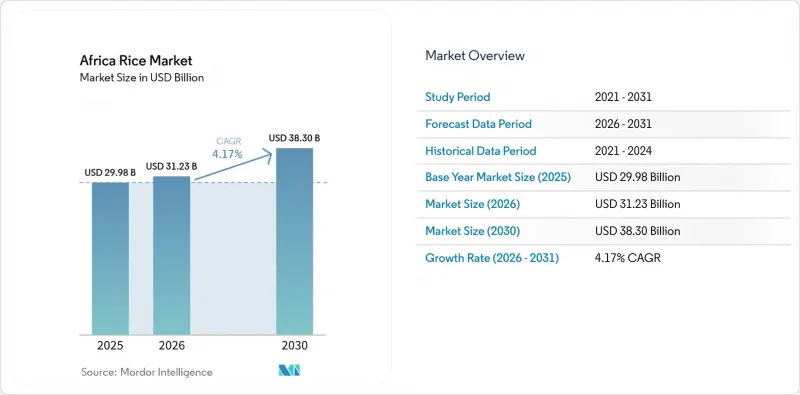
本報告按地區(奈及利亞、坦尚尼亞、象牙海岸共和國等)分類,內容包括生產分析(數量)、消費分析(價值和數量)、進口分析(價值和數量)、出口分析(價值和數量)、批發價格趨勢分析和預測以及法律規範。市場預測以價值(美元)和數量(公噸)表示。
非洲米市場的趨勢和洞察
都市區。
從2020年到2025年,非洲特大城市的居民可支配所得穩定成長。同期,拉各斯高所得家庭的食品預算中米的比例也有所上升。由於蒸穀米能夠耐受潮濕的儲存環境,且只需少量電力即可快速烹調,因此成為注重便利飲食人群的主食。 2024年至2025年,阿比讓、達累斯薩拉姆及阿克拉方圓50公里內的碾米產能顯著提升,運輸物流成本最多可降低14%。因此,統籌收米、加工和品牌分銷於一體的綜合營運商能夠確保供應穩定和高利潤率。為因應假日期間零售需求的激增,加工商已開始建造筒倉式倉儲設施,以平衡加工量的季節性波動。由於穩定的現金流能夠降低信用風險,金融機構越來越青睞這種垂直整合模式。
小規模重力式和太陽能灌溉系統的擴展
在坦尚尼亞,一套售價約800至1200美元的離網太陽能水泵,使小規模農戶能夠在旱季進行第二次水稻種植,從而提高每戶的年產量。按需隨收隨付的資金籌措允許長期分期支付資本成本,使得利用這些設備灌溉小規模土地,並將雨養田地轉變為商業農地成為可能。在馬利共和國的尼日河流域,運作的重力灌溉管道降低了柴油燃料成本,並降低了每噸稻米的生產成本,使該地區成為非洲最具競爭力的地區之一。基礎設施的建設顯著降低了因降雨量不穩定而造成的產量波動,增強了農民投資高價值種子和機械化的信心。因此,灌溉面積為農業用品零售商、機械化提供服務業者和小額信貸機構拓展目標市場奠定了基礎。這些協同效應提高了銷售量和成本競爭力,鞏固了非洲米市場的中期成長動能。
因乾燥和儲存系統不足造成的收穫後損失
在撒哈拉以南非洲地區,15%至18%的稻米在運往碾米廠之前劣化。在油布上日曬乾燥會延長稻米與水分的接觸時間,導致雨季稻米含水量往往超過14%,進而滋生黴菌和黃麴毒素。因此,碾米廠將這些稻米的價格降低高達20%,侵蝕農民的收入,並抑制他們投資於能提高產量的投入品。聚丙烯編織袋容易受到昆蟲和囓齒動物的侵害;2025年奈及利亞北部的一項研究發現,23%的儲存稻米在六週內變質。雖然密封袋和機械烘乾機可以將損失降低到個位數,但對於絕大多數面臨資產貸款利息負擔的小規模農戶來說,這些設備仍然難以負擔。合作所有權模式可以降低每位農民的成本,但這需要強而有力的管治,而許多分散的生產者團體恰恰缺乏這種管理。在價格合理的收穫後處理技術普及之前,非洲米市場將失去很大一部分潛在供應,成長速度也將放緩。
其他好處:
- Excel格式的市場預測(ME)表
- 3個月的分析師支持
目錄
第1章:引言
- 研究假設和市場定義
- 調查範圍
第2章:調查方法
第3章執行摘要
第4章 市場狀況
- 市場概覽
- 市場促進因素
- 都市區對高熱量主食的需求爆炸性成長
- 小規模重力式和太陽能灌溉系統的擴展
- 非洲大陸自由貿易區(AfCFTA)下的關稅減讓正在加速非洲內部米貿易。
- 透過公共肥料和種子補貼計畫恢復產量
- 引進耐旱、早熟水稻品種
- 透過自願碳權額將稻田甲烷排放貨幣化
- 市場限制因素
- 由於乾燥和儲存系統簡陋而造成的收穫後損失
- 國內生產成本仍高於與亞洲的進口成本。
- 外匯和柴油價格的波動給製粉利潤帶來了壓力。
- 土地所有權的不穩定性阻礙了對農場的長期投資。
- 機會
- 任務
- 價值鏈分析
- 人工智慧技術及其在產業的應用
- 原物料市場分析
- 種子
- 肥料
- 殺蟲劑
- 分銷通路分析
- 市場情緒分析
- PESTLE分析
第5章 市場區隔
- 地區
- 奈及利亞
- 生產分析(種植面積、產量、產量)
- 消費分析(消費量和消費體積)
- 進口市場分析(進口額、進口量、主要供應市場)
- 出口市場分析(出口額、出口量、主要出口目的地市場)
- 批發價格趨勢分析與預測。
- 法律規範
- 主要公司列表
- 物流和基礎設施
- 季節性分析
- 坦尚尼亞
- 生產分析(種植面積、產量、產量)
- 消費分析(消費量和消費體積)
- 進口市場分析(進口額、進口量、主要供應市場)
- 出口市場分析(出口額、出口量、主要出口目的地市場)
- 批發價格趨勢分析與預測。
- 法律規範
- 主要公司列表
- 物流和基礎設施
- 季節性分析
- 象牙海岸共和國
- 生產分析(種植面積、產量、產量)
- 消費分析(消費量和消費體積)
- 進口市場分析(進口額、進口量、主要供應市場)
- 出口市場分析(出口額、出口量、主要出口目的地市場)
- 批發價格趨勢分析與預測。
- 法律規範
- 主要公司列表
- 物流和基礎設施
- 季節性分析
- 馬達加斯加
- 生產分析(種植面積、產量、產量)
- 消費分析(消費量和消費體積)
- 進口市場分析(進口額、進口量、主要供應市場)
- 出口市場分析(出口額、出口量、主要出口目的地市場)
- 批發價格趨勢分析與預測。
- 法律規範
- 主要公司列表
- 物流和基礎設施
- 季節性分析
- 馬利共和國
- 生產分析(種植面積、產量、產量)
- 消費分析(消費量和消費體積)
- 進口市場分析(進口額、進口量、主要供應市場)
- 出口市場分析(出口額、出口量、主要出口目的地市場)
- 批發價格趨勢分析與預測。
- 法律規範
- 主要公司列表
- 物流和基礎設施
- 季節性分析
- 迦納
- 生產分析(種植面積、產量、產量)
- 消費分析(消費量和消費體積)
- 進口市場分析(進口額、進口量、主要供應市場)
- 出口市場分析(出口額、出口量、主要出口目的地市場)
- 批發價格趨勢分析與預測。
- 法律規範
- 主要公司列表
- 物流和基礎設施
- 季節性分析
- 塞內加爾
- 生產分析(種植面積、產量、產量)
- 消費分析(消費量和消費體積)
- 進口市場分析(進口額、進口量、主要供應市場)
- 出口市場分析(出口額、出口量、主要出口目的地市場)
- 批發價格趨勢分析與預測。
- 法律規範
- 主要公司列表
- 物流和基礎設施
- 季節性分析
- 喀麥隆
- 生產分析(種植面積、產量、產量)
- 消費分析(消費量和消費體積)
- 進口市場分析(進口額、進口量、主要供應市場)
- 出口市場分析(出口額、出口量、主要出口目的地市場)
- 批發價格趨勢分析與預測。
- 法律規範
- 主要公司列表
- 物流和基礎設施
- 季節性分析
- 幾內亞
- 生產分析(種植面積、產量、產量)
- 消費分析(消費量和消費體積)
- 進口市場分析(進口額、進口量、主要供應市場)
- 出口市場分析(出口額、出口量、主要出口目的地市場)
- 批發價格趨勢分析與預測。
- 法律規範
- 主要公司列表
- 物流和基礎設施
- 季節性分析
- 獅子山
- 生產分析(種植面積、產量、產量)
- 消費分析(消費量和消費體積)
- 進口市場分析(進口額、進口量、主要供應市場)
- 出口市場分析(出口額、出口量、主要出口目的地市場)
- 批發價格趨勢分析與預測。
- 法律規範
- 主要公司列表
- 物流和基礎設施
- 季節性分析
- 尼日
- 生產分析(種植面積、產量、產量)
- 消費分析(消費量和消費體積)
- 進口市場分析(進口額、進口量、主要供應市場)
- 出口市場分析(出口額、出口量、主要出口目的地市場)
- 批發價格趨勢分析與預測。
- 法律規範
- 主要公司列表
- 物流和基礎設施
- 季節性分析
- 南非
- 生產分析(種植面積、產量、產量)
- 消費分析(消費量和消費體積)
- 進口市場分析(進口額、進口量、主要供應市場)
- 出口市場分析(出口額、出口量、主要出口目的地市場)
- 批發價格趨勢分析與預測
- 法律規範
- 主要公司列表
- 物流和基礎設施
- 季節性分析
- 奈及利亞
第6章 最終用途和行業
- 主要應用和新興應用
- 產業特定消費細分
第7章 競爭情勢
- 競爭格局概述
- 市場集中度分析
第8章 市場機會與未來趨勢
According to Mordor Intelligence, the africa rice market size is projected to grow from USD 29.98 billion in 2025 to USD 31.23 billion in 2026 and is forecast to reach USD 38.30 billion by 2031 at a 4.17% CAGR over 2026-2031.
This report is Segmented by Geography (Nigeria, Tanzania, Cote D'Ivoire, and More). The Report Includes Production Analysis (Volume), Consumption Analysis (Value and Volume), Import Analysis (Value and Volume), Export Analysis (Value and Volume), Wholesale Price Trend Analysis and Forecast, Regulatory Framework, and More. The Market Forecasts are Provided in Terms of Value (USD) and Volume (Metric Tons).
Africa Rice Market Trends and Insights
Exploding Urban Demand for Calorie-dense Staples
Disposable incomes in Africa's megacities climbed steadily between 2020 and 2025, and higher-income households in Lagos increased the share of their food budgets allocated to rice over the period. Parboiled formats dominate because they tolerate humid storage conditions and cook quickly on limited electricity, making them the default grain in convenience-driven diets. Milling capacity located within 50 kilometers of Abidjan, Dar es Salaam, and Accra expanded significantly between 2024 and 2025, trimming inbound logistics costs by up to 14%. Integrated operators that control aggregation, processing, and branded distribution, therefore secure both supply stability and higher margins. Retail demand spikes during festive seasons have prompted processors to build silo storage for de-seasonalizing throughput. Financiers increasingly favor such vertically integrated models because consistent cash flow reduces credit risk.
Expansion of Small-scale Gravity and Solar Irrigation Schemes
Off-grid solar pumps costing about USD 800 to USD 1,200 per kit enable Tanzanian smallholders to cultivate a second rice crop during the dry season, lifting annual farm output per holding. Pay-as-you-go financing distributes capital costs over time, enabling the kits to irrigate small plot sizes and transform previously rain-fed fields into commercial farmland. In Mali's Office du Niger, additional gravity-fed canals came online, eliminating diesel expenses and lowering per-ton production costs, placing the region among the continent's most competitive benchmarks. These infrastructure upgrades sharply reduce yield variability linked to erratic rainfall, boosting farmer confidence to invest in higher-value seed and mechanization. Irrigated acreage thus serves as a platform for input retailers, mechanization service providers, and micro-lenders to expand their addressable market. The combined effect enhances the medium-term growth trajectory of the Africa rice market by improving both volumes and cost competitiveness.
Post-harvest Losses from Rudimentary Drying and Storage Systems
Across sub-Saharan Africa, 15% to 18% of harvested paddy spoils before reaching mills. Sun-drying on tarpaulins prolongs exposure to humidity, moisture content often remains above 14% during rainy months, enabling mold and aflatoxin. Millers accordingly discount such paddy by up to 20%, eroding farm income and discouraging investment in yield-enhancing inputs. Woven polypropylene bags permit insect and rodent damage, a 2025 survey in northern Nigeria found 23% of stored paddy downgraded in less than six weeks. Hermetic bags and mechanical dryers could cut losses to single digits but remain unaffordable for most smallholders who face interest rates on asset-finance loans. Cooperative ownership models lower per-farmer cost, yet require strong governance that many fragmented producer groups lack. Until affordable post-harvest technology scales, the Africa rice market forfeits a significant share of potential supply, dampening growth.
Other drivers and restraints analyzed in the detailed report include:
- African Continental Free Trade Area (AfCFTA) Tariff Cuts Accelerating Intra-Africa Paddy Trade
- Public Fertilizer and Seed Subsidy Programs Reviving Yields
- Domestic Cost of Production still above Asian Import Parity
For complete list of drivers and restraints, kindly check the Table Of Contents.
Additional Benefits:
- The market estimate (ME) sheet in Excel format
- 3 months of analyst support
TABLE OF CONTENTS
1 Introduction
- 1.1 Study Assumptions and Market Definition
- 1.2 Scope of the Study
2 Research Methodology
3 Executive Summary
4 Market Landscape
- 4.1 Market Overview
- 4.2 Market Drivers
- 4.2.1 Exploding Urban Demand for Calorie-dense Staples
- 4.2.2 Expansion of Small-scale Gravity and Solar Irrigation Schemes
- 4.2.3 African Continental Free Trade Area (AfCFTA) Tariff Cuts Accelerating Intra-Africa Paddy Trade
- 4.2.4 Public Fertilizer and Seed Subsidy Programs Reviving Yields
- 4.2.5 Adoption of Flood-tolerant, Early-maturing Rice Genetics
- 4.2.6 Monetising Paddy-methane Abatement via Voluntary Carbon Credits
- 4.3 Market Restraints
- 4.3.1 Post-harvest Losses from Rudimentary Drying and Storage Systems
- 4.3.2 Domestic Cost of Production still above Asian Import Parity
- 4.3.3 Currency and Diesel-price Volatility Squeezing Milling Margins
- 4.3.4 Land-tenure Insecurity Limiting Long-term On-farm Investment
- 4.4 Opportunities
- 4.5 Challenges
- 4.6 Value Chain Analysis
- 4.7 Technologies and Usage of AI in the Industry
- 4.8 Input Market Analysis
- 4.8.1 Seeds
- 4.8.2 Fertilizers
- 4.8.3 Crop Protection Chemicals
- 4.9 Distribution Channel Analysis
- 4.10 Market Sentiment Analysis
- 4.11 PESTLE Analysis
5 Market Segmentation
- 5.1 Geography
- 5.1.1 Nigeria
- 5.1.1.1 Production Analysis (Area Harvested, Yield, and Production Volume)
- 5.1.1.2 Consumption Analysis (Consumption Value and Volume)
- 5.1.1.3 Import Market Analysis (Import Value, Volume, and Key Supplying Markets)
- 5.1.1.4 Export Market Analysis (Export Value, Volume, and Key Destination Markets)
- 5.1.1.5 Wholesale Price Trend Analysis and Forecast
- 5.1.1.6 Regulatory Framework
- 5.1.1.7 List of Key Players
- 5.1.1.8 Logistics and Infrastructure
- 5.1.1.9 Seasonality Analysis
- 5.1.2 Tanzania
- 5.1.2.1 Production Analysis (Area Harvested, Yield, and Production Volume)
- 5.1.2.2 Consumption Analysis (Consumption Value and Volume)
- 5.1.2.3 Import Market Analysis (Import Value, Volume, and Key Supplying Markets)
- 5.1.2.4 Export Market Analysis (Export Value, Volume, and Key Destination Markets)
- 5.1.2.5 Wholesale Price Trend Analysis and Forecast
- 5.1.2.6 Regulatory Framework
- 5.1.2.7 List of Key Players
- 5.1.2.8 Logistics and Infrastructure
- 5.1.2.9 Seasonality Analysis
- 5.1.3 Cote d'Ivoire
- 5.1.3.1 Production Analysis (Area Harvested, Yield, and Production Volume)
- 5.1.3.2 Consumption Analysis (Consumption Value and Volume)
- 5.1.3.3 Import Market Analysis (Import Value, Volume, and Key Supplying Markets)
- 5.1.3.4 Export Market Analysis (Export Value, Volume, and Key Destination Markets)
- 5.1.3.5 Wholesale Price Trend Analysis and Forecast
- 5.1.3.6 Regulatory Framework
- 5.1.3.7 List of Key Players
- 5.1.3.8 Logistics and Infrastructure
- 5.1.3.9 Seasonality Analysis
- 5.1.4 Madagascar
- 5.1.4.1 Production Analysis (Area Harvested, Yield, and Production Volume)
- 5.1.4.2 Consumption Analysis (Consumption Value and Volume)
- 5.1.4.3 Import Market Analysis (Import Value, Volume, and Key Supplying Markets)
- 5.1.4.4 Export Market Analysis (Export Value, Volume, and Key Destination Markets)
- 5.1.4.5 Wholesale Price Trend Analysis and Forecast
- 5.1.4.6 Regulatory Framework
- 5.1.4.7 List of Key Players
- 5.1.4.8 Logistics and Infrastructure
- 5.1.4.9 Seasonality Analysis
- 5.1.5 Mali
- 5.1.5.1 Production Analysis (Area Harvested, Yield, and Production Volume)
- 5.1.5.2 Consumption Analysis (Consumption Value and Volume)
- 5.1.5.3 Import Market Analysis (Import Value, Volume, and Key Supplying Markets)
- 5.1.5.4 Export Market Analysis (Export Value, Volume, and Key Destination Markets)
- 5.1.5.5 Wholesale Price Trend Analysis and Forecast
- 5.1.5.6 Regulatory Framework
- 5.1.5.7 List of Key Players
- 5.1.5.8 Logistics and Infrastructure
- 5.1.5.9 Seasonality Analysis
- 5.1.6 Ghana
- 5.1.6.1 Production Analysis (Area Harvested, Yield, and Production Volume)
- 5.1.6.2 Consumption Analysis (Consumption Value and Volume)
- 5.1.6.3 Import Market Analysis (Import Value, Volume, and Key Supplying Markets)
- 5.1.6.4 Export Market Analysis (Export Value, Volume, and Key Destination Markets)
- 5.1.6.5 Wholesale Price Trend Analysis and Forecast
- 5.1.6.6 Regulatory Framework
- 5.1.6.7 List of Key Players
- 5.1.6.8 Logistics and Infrastructure
- 5.1.6.9 Seasonality Analysis
- 5.1.7 Senegal
- 5.1.7.1 Production Analysis (Area Harvested, Yield, and Production Volume)
- 5.1.7.2 Consumption Analysis (Consumption Value and Volume)
- 5.1.7.3 Import Market Analysis (Import Value, Volume, and Key Supplying Markets)
- 5.1.7.4 Export Market Analysis (Export Value, Volume, and Key Destination Markets)
- 5.1.7.5 Wholesale Price Trend Analysis and Forecast
- 5.1.7.6 Regulatory Framework
- 5.1.7.7 List of Key Players
- 5.1.7.8 Logistics and Infrastructure
- 5.1.7.9 Seasonality Analysis
- 5.1.8 Cameroon
- 5.1.8.1 Production Analysis (Area Harvested, Yield, and Production Volume)
- 5.1.8.2 Consumption Analysis (Consumption Value and Volume)
- 5.1.8.3 Import Market Analysis (Import Value, Volume, and Key Supplying Markets)
- 5.1.8.4 Export Market Analysis (Export Value, Volume, and Key Destination Markets)
- 5.1.8.5 Wholesale Price Trend Analysis and Forecast
- 5.1.8.6 Regulatory Framework
- 5.1.8.7 List of Key Players
- 5.1.8.8 Logistics and Infrastructure
- 5.1.8.9 Seasonality Analysis
- 5.1.9 Guinea
- 5.1.9.1 Production Analysis (Area Harvested, Yield, and Production Volume)
- 5.1.9.2 Consumption Analysis (Consumption Value and Volume)
- 5.1.9.3 Import Market Analysis (Import Value, Volume, and Key Supplying Markets)
- 5.1.9.4 Export Market Analysis (Export Value, Volume, and Key Destination Markets)
- 5.1.9.5 Wholesale Price Trend Analysis and Forecast
- 5.1.9.6 Regulatory Framework
- 5.1.9.7 List of Key Players
- 5.1.9.8 Logistics and Infrastructure
- 5.1.9.9 Seasonality Analysis
- 5.1.10 Sierra Leone
- 5.1.10.1 Production Analysis (Area Harvested, Yield, and Production Volume)
- 5.1.10.2 Consumption Analysis (Consumption Value and Volume)
- 5.1.10.3 Import Market Analysis (Import Value, Volume, and Key Supplying Markets)
- 5.1.10.4 Export Market Analysis (Export Value, Volume, and Key Destination Markets)
- 5.1.10.5 Wholesale Price Trend Analysis and Forecast
- 5.1.10.6 Regulatory Framework
- 5.1.10.7 List of Key Players
- 5.1.10.8 Logistics and Infrastructure
- 5.1.10.9 Seasonality Analysis
- 5.1.11 Niger
- 5.1.11.1 Production Analysis (Area Harvested, Yield, and Production Volume)
- 5.1.11.2 Consumption Analysis (Consumption Value and Volume)
- 5.1.11.3 Import Market Analysis (Import Value, Volume, and Key Supplying Markets)
- 5.1.11.4 Export Market Analysis (Export Value, Volume, and Key Destination Markets)
- 5.1.11.5 Wholesale Price Trend Analysis and Forecast
- 5.1.11.6 Regulatory Framework
- 5.1.11.7 List of Key Players
- 5.1.11.8 Logistics and Infrastructure
- 5.1.11.9 Seasonality Analysis
- 5.1.12 South Africa
- 5.1.12.1 Production Analysis (Area Harvested, Yield, and Production Volume)
- 5.1.12.2 Consumption Analysis (Consumption Value and Volume)
- 5.1.12.3 Import Market Analysis (Import Value, Volume, and Key Supplying Markets)
- 5.1.12.4 Export Market Analysis (Export Value, Volume, and Key Destination Markets)
- 5.1.12.5 Wholesale Price Trend Analysis and Forecast
- 5.1.12.6 Regulatory Framework
- 5.1.12.7 List of Key Players
- 5.1.12.8 Logistics and Infrastructure
- 5.1.12.9 Seasonality Analysis
- 5.1.1 Nigeria
6 End Use Applications and Industries
- 6.1 Primary Applications and Emerging Applications
- 6.2 Consumption Breakdown by Industries
7 Competitive Landscape
- 7.1 Overview of the Competition
- 7.2 Recent Developments
- 7.3 Market Concentration Analysis
8 Market Opportunities and Future Trends

 2026年全球米和醬料混合料市場報告
 美國市場預測至2034年—按產品類型、顏色、香氣、顆粒長度、分銷管道、最終用戶和地區分類的全球分析
 美國市場報告:趨勢、預測與競爭分析(至2035年)
 全球低升糖指數米市場規模、佔有率、趨勢及成長分析報告(2026-2034年)
 米製品市場-全球產業規模、佔有率、趨勢、機會及預測,依產品、配銷通路、地區及競爭格局分類,2021-2031年預測
 美國商品市場規模、佔有率和成長分析(按產品、產品類型、分銷管道、最終用途和地區分類)—產業預測,2026-2033年
 美國市場規模、佔有率和成長分析(按產品、類型、通路和地區分類)—2026-2033年產業預測
 低GI蜂蜜的全球市場:類型·價格分佈·形狀·類別·加工·份量·用途·流通管道·終端用戶·各地區 (~2032年)