


 |
市場調查報告書
商品編碼
2066403
群發通知系統:市場佔有率分析、產業趨勢與統計、成長預測(2026-2031)Mass Notification Systems - Market Share Analysis, Industry Trends & Statistics, Growth Forecasts (2026 - 2031) |
||||||

※ 本網頁內容可能與最新版本有所差異。詳細情況請與我們聯繫。
根據 Mordor Intelligence 預測,大規模通知系統的市場規模預計將從 2025 年的 256.6 億美元成長到 2026 年的 294.6 億美元,然後在 2031 年達到 587.9 億美元,2026 年至 2031 年的複合年成長率為 14.82%。
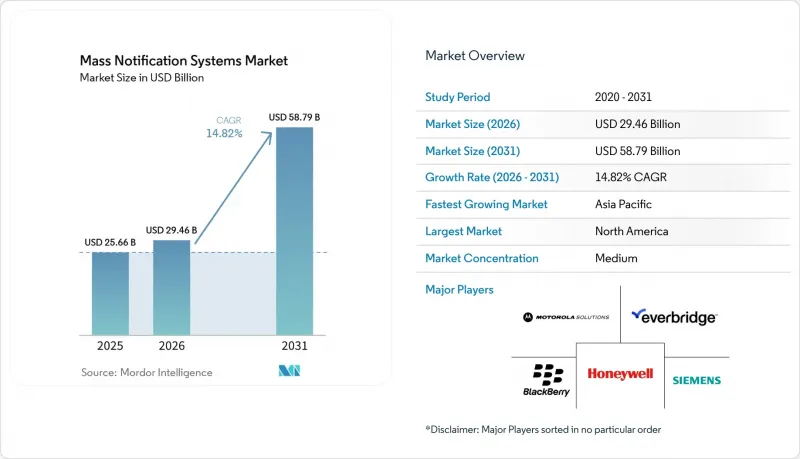
本報告按「組件(解決方案、服務、硬體)」、「部署模式(雲端、本地、混合)」、「應用(室內、廣域等)」、「解決方案目標(業務永續營運和災害復原等)」、「最終用戶產業(政府、國防等)」和「地區」對產業進行分類。市場規模和預測以美元計價。
全球群發通知系統市場趨勢與洞察
5G部署的加速將使即時多媒體警報成為可能。
5G 提供Gigabit級吞吐量和毫秒級延遲,使平台不僅能夠傳輸文字,還能傳輸高清影片、樓層平面圖和互動式疏散地圖。基於位置的警報能夠隨著接收者在城市中的移動而自動調整,目前已在日本、韓國和新加坡的都市區投入使用。據通訊業者,在大型活動中,5G 的連接滿意度比 4G 高出 20%,這一數據對於製定網路擁塞應對計劃的負責人來說無疑是個好消息。能夠整合網路切片和邊緣運算功能的供應商在速度、冗餘性和內容豐富性方面脫穎而出。隨著頻譜競標的持續進行和終端普及率的提高,與 5G 覆蓋目標相關的公共安全領域將獲得更多資金支持,推動大規模通知系統的發展。
歐盟《歐洲經濟合作條例》第 110 條促進多通路能力。
該指令要求所有27個歐盟成員國必須覆蓋“盡可能多的受影響人群”,迫使各國政府將區域廣播、基於位置的短信和應用程式警報相結合。為確保合規性而撥出的資金正在加速部署支援多語言內容、雙向通訊和跨境互通性的混合平台。商業用戶也在採用類似的架構來簡化業務永續營運通訊,這推動了私人投資以超出預期的速度湧入大眾通知系統市場。
非洲地區分散的頻率政策阻礙了其普及。
區域廣播依賴統一的頻段準則,但非洲54個國家的政策差異顯著。供應商被迫為每個通訊業者制定單獨的整合策略,導致試點專案週期延長,成本飆升。因此,儘管3G和4G覆蓋率超過90%,但在公共安全領域的部署卻落後。目前,區域協調工作正在進行中,但在這些努力成熟之前,非洲的成長速度預計將低於其他新興地區。
細分市場分析
預計2025年,解決方案領域的通報系統系統市場規模將達168億美元,市佔率高達65.50%。這一成長主要得益於政府機構和企業從以硬體為中心的系統轉向指揮中心軟體。該軟體將簡訊、語音、電子郵件、警報器和指示牌整合到一個統一的主機中,從而減少了培訓需求和許可證重複使用。預計在未來五年中,預測接收者行為的分析模組將推動現有客戶的升級,解決方案收入也將維持兩位數的成長。服務領域的市佔率雖然較小,但由於整合、客製化和全天候監控所需的專業技能,其複合年成長率(CAGR)仍高達17.9%。
閃光燈、壁掛式揚聲器和戶外警報器等硬體在工廠、機場和學校仍然至關重要。然而,製造商現在正將IP連接功能整合到這些設備中,使其能夠向中央平台報告狀態。專業服務團隊將評估、法規諮詢和生命週期維護打包到多年合約中,為供應商提供可預測的現金流,並降低客戶的意外成本。這種管理模式進一步增強了此解決方案在大規模通知系統市場的競爭優勢。
到2025年,雲端將佔據群發通知系統市場70.30%的佔有率,這主要得益於管理者對即時擴充性、付費使用制和便利升級的偏好。 SaaS平台也簡化了跨數十個地點的大型企業的多租戶管理。這種模式也越來越受到沒有專職IT人員的中小型企業的青睞,推動了新用戶數的成長。然而,數據主權相關法規、對本地容錯的需求以及對供應商鎖定的擔憂,正促使金融服務、公共產業和醫院等行業轉向混合模式。預計混合模式的採用率將以19.65%的複合年成長率成長,是所有採用類型中成長最快的。
儘管本地部署正在減少,但不會完全消失。關鍵基礎架構的擁有者通常會在強大的伺服器上運作本機實例,以確保即使外部連線中斷,訊息流也能保持暢通。容器化架構允許負責人在公共雲端和本地叢集之間遷移工作負載,從而平衡成本和控制。隨著這種柔軟性逐漸成為主流,在通報系統系統市場中,「雲端」和「本地」之間的界限將變得模糊,買家將選擇針對特定工作負載的策略,而不是單一的統一模型。
區域分析
預計到2025年,北美將佔全球收入的39.60%,這反映了該地區成熟的通訊基礎設施、津貼以及極端天氣事件的歷史。目前,地方政府正在將大規模預警功能整合到廣泛的智慧城市平台中,這些平台將交通感測器、水位計和野火監視錄影機與自動訊息連接起來。雲端原生升級以及該地區嚴格的網路保險要求,確保了資料保護融入每個部署。
亞太地區正以16.9%的複合年成長率成長,成長速度在所有地區中位居榜首。韓國、日本和澳洲加速推進5G部署,使得政府機構能夠將影片片段和多語言字幕添加到警報中,從而提高人口密集城市的民眾理解能力。菲律賓等颱風多發國家為提升抗災能力所採取的經濟措施,正為大眾通知系統市場帶來新的資金。同時,中國的特大城市計畫正在將警報系統與配備監視錄影機和電子錢包功能的超級應用程式相結合,將公共安全與日常數位化行為融為一體。
歐洲的情況介於這兩個極端之間,但其成長主要由監管合規主導。 《歐洲經濟共同體公約》第110條的最後期限迫使所有成員國為多通路警報分配預算,而《一般資料保護規範》(GDPR)則迫使供應商投資於使用者同意管理和資料最小化。北歐地區對多語言內容的重視雖然減緩了一些專案的進展,但最終將提升產品的出口能力。英國在歐盟指令的約束之外,制定了符合區域廣播最佳實踐的自身標準,從而確保了互通性的持續性。
其他好處:
- Excel格式的市場預測(ME)表
- 3個月的分析師支持
目錄
第1章:引言
- 研究假設和市場定義
- 調查範圍
第2章:調查方法
第3章執行摘要
第4章 市場狀況
- 市場概覽
- 市場促進因素
- 亞太地區 5G 部署的加速將使即時多媒體警報成為可能。
- 歐盟法規要求多管道發佈公共警告(EECC 第 110 條)
- 北美氣候相關災害的加劇正促使地方政府採用這些系統。
- 高等教育機構校園的快速數位化正在創建一個支持 BYOD(自帶設備)的安全生態系統。
- 電力公司的電網現代化專案需要一個OT/IT整合的警報平台。
- 市場限制因素
- 非洲碎片化的頻率政策阻礙了區域廣播的普及。
- 網路保險費的上漲推高了醫療保健產業基於雲端的行動網路系統 (MNS) 的總擁有成本 (TCO)。
- 由於擔心警報疲勞,大型公司正在減少訊息傳輸頻率。
- 北歐國家缺乏多語言內容庫,減緩了其普及速度。
- 價值供應鏈分析
- 監理展望
- 技術展望
- 波特五力分析
- 投資分析
第5章 市場規模與成長預測
- 按組件
- 硬體
- 火災警報控制面板
- 公共廣播及語音疏散引導系統
- 通知信標數位電子看板
- 解決方案
- 緊急/通報系統軟體
- 事件管理和情境察覺
- 服務
- 專業(諮詢、整合)
- 託管服務
- 硬體
- 部署模式
- 現場
- 雲
- 混合
- 透過應用提供的解決方案
- 業務永續營運和災害復原
- 綜合公共預警與諮詢系統
- 可互通的應急通訊
- 按組織規模
- 大公司
- 中小企業
- 透過使用
- 室內的
- 廣大區域
- 去中心化接收器
- 按最終用戶行業分類
- 政府/國防
- 能源公用事業
- 衛生保健
- 教育
- 商業和工業用途
- 運輸/物流
- 資訊科技/通訊
- 其他
- 按地區
- 北美洲
- 美國
- 加拿大
- 墨西哥
- 南美洲
- 巴西
- 阿根廷
- 歐洲
- 德國
- 英國
- 法國
- 義大利
- 其他歐洲國家
- 中東
- GCC
- 土耳其
- 其他中東國家
- 非洲
- 南非
- 奈及利亞
- 其他非洲國家
- 亞太地區
- 中國
- 日本
- 印度
- 韓國
- 東南亞
- 北美洲
第6章 競爭情勢
- 市場集中度
- 策略趨勢
- 市佔率分析
- 公司簡介
- Everbridge Inc.
- Motorola Solutions Inc.
- Honeywell International Inc.
- Siemens AG
- Blackberry AtHoc Inc.
- Eaton Corp.
- OnSolve LLC
- Singlewire Software LLC
- Alertus Technologies LLC
- xMatters
- AlertMedia Inc.
- F24 AG
- Rave Mobile Safety
- Regroup Mass Notification
- HipLink Software
- Volo(Volo Alert)
- BlackBoard Connect(Anthology)
- Preparis(Agility Recovery)
- Pocketstop RedFlag
- Vecima Networks(Engage IP)
第7章 市場機會與未來展望
According to Mordor Intelligence, the mass notification systems market size is expected to grow from USD 25.66 billion in 2025 to USD 29.46 billion in 2026 and is forecast to reach USD 58.79 billion by 2031 at 14.82% CAGR over 2026-2031.
This report Segments the Industry Into Component (Solution, Services, Hardware), Deployment (Cloud, On-Premise, Hybrid), Application (In-Building, Wide-Area and More), Solution Purpose (Business Continuity and Disaster Recovery, and More), End-User Vertical (Government and Defense, and More), and Geography. The Market Sizes and Forecasts are Provided in Terms of Value (USD).
Global Mass Notification Systems Market Trends and Insights
Accelerated 5G roll-outs enabling real-time multimedia alerting
5G brings gigabit throughput and millisecond latency, allowing platforms to push high-definition video, floor plans, and interactive evacuation maps rather than plain text. Urban centers in Japan, South Korea, and Singapore already use location-based warnings that adapt as recipients move through a city. Operators report 20% higher connectivity satisfaction during large events compared with 4G, a data point that reassures emergency managers planning for congested networks. Vendors able to embed network- slicing and edge-compute features are differentiating on speed, redundancy, and content richness. As spectrum auctions continue and device penetration rises, the mass notification systems market will capture incremental public-safety funding tied to 5G coverage targets.
EU's EECC Article 110 driving multi-channel compliance
The code obliges all 27 EU states to reach "the maximum possible affected population," pushing governments to marry cell broadcast, location-based SMS, and app alerts. Funding streams earmarked for compliance have accelerated roll-outs of hybrid platforms that support multilingual content, two-way messaging, and cross-border interoperability. Commercial users are following the same architecture to streamline business continuity communications, pulling private investment into the mass notification systems market sooner than projected.
Fragmented spectrum policies hampering African adoption
Cell broadcast relies on harmonized spectrum guidelines, yet policies vary widely across 54 African nations. Vendors face custom integrations for each carrier, prolonging pilots and inflating costs, which slows public-safety deployments even as 3G and 4G coverage climbs above 90%. Regional harmonization efforts are underway, but until they mature, growth lags other emerging regions.
Other drivers and restraints analyzed in the detailed report include:
- Escalating climate catastrophes accelerating municipal deployments
- Campus digitization transforming educational safety
- Cyber-insurance premiums elevating cloud TCO in healthcare
For complete list of drivers and restraints, kindly check the Table Of Contents.
Segment Analysis
The mass notification systems market size for solutions reached USD 16.8 billion in 2025, translating to a 65.50% share as agencies and enterprises replaced hardware-centric setups with command-center software. Software unifies SMS, voice, email, sirens, and signage under one console, reducing training needs and license duplication. In the second half of the decade, analytics modules that predict recipient behavior are expected to prompt upgrades among existing customers, keeping solutions revenue on a double-digit climb. Services, while a smaller slice, are advancing at an 17.9% CAGR because integration, customization, and 24/7 monitoring demand specialist skills.
Hardware retains a foothold in plants, airports, and schools where strobe beacons, wall-mounted speakers, and outdoor sirens remain mission critical. Yet manufacturers are embedding IP connectivity in these devices so they can report status back to the central platform. Professional services teams are packaging assessments, regulatory consulting, and lifecycle maintenance into multi-year contracts, creating predictable cash flow for vendors and lowering surprise costs for clients. Such managed models are further widening the solutions edge within the mass notification systems market.
Cloud captured 70.30% of the mass notification systems market in 2025 as administrators favored instant scale, pay-as-you-go pricing, and hassle-free upgrades. SaaS platforms also simplified multi-tenant management for large enterprises spanning dozens of sites. That model resonates with SMEs that lack IT staff, fueling the highest net-new logo count. Even so, data-sovereignty rules, the need for on-site survivability, and concerns over vendor lock-in are steering financial services, utilities, and hospitals toward hybrid approaches. Hybrid adoption is forecast to grow at 19.65% CAGR, the fastest rate in deployment choices.
On-premise deployments are shrinking but will not disappear. Critical infrastructure owners often keep a local instance running on hardened servers so messages still flow when external links fail. Containerized architectures now let operators shift workloads between public clouds and local clusters, balancing cost and control. As such flexibility becomes mainstream, the mass notification systems market will likely see blurred lines between "cloud" and "on-premise," with buyers selecting per-workload policies rather than a single blanket model.
Geography Analysis
North America retained 39.60% of 2025 revenue, reflecting mature telecommunications infrastructure, grant funding, and a track record of extreme weather events. Municipalities now embed mass alerting into broader smart-city platforms that tie traffic sensors, flood gauges, and wildfire cameras to automatic outbound messaging. Cloud-native upgrades also coincide with the region's high cyber-insurance requirements, ensuring data protection features are woven into every deployment.
Asia-Pacific is expanding at a 16.9% CAGR, the highest among all regions. Accelerated 5G roll-outs in South Korea, Japan, and Australia let agencies attach video clips and multilingual subtitles to alerts, boosting comprehension in dense cities. Government stimulus for disaster resilience in typhoon-prone nations such as the Philippines is funneling fresh capital into the mass notification systems market. Meanwhile China's mega-city projects integrate alerts with surveillance cameras and e-wallet super-apps, blending public safety with everyday digital behavior.
Europe sits between these extremes, but its growth is dominated by regulatory compliance. The EECC Article 110 deadline drove every member state to budget for multi-channel warnings, while GDPR pushed vendors to invest in consent management and data minimization. The Nordic region's focus on multilingual content slows some projects but ultimately broadens product capability for export. The United Kingdom, operating outside EU directives, is drafting its own standards that still align with cell broadcast best practice, ensuring continued cross-border interoperability.
- Everbridge Inc.
- Motorola Solutions Inc.
- Honeywell International Inc.
- Siemens AG
- Blackberry AtHoc Inc.
- Eaton Corp.
- OnSolve LLC
- Singlewire Software LLC
- Alertus Technologies LLC
- xMatters
- AlertMedia Inc.
- F24 AG
- Rave Mobile Safety
- Regroup Mass Notification
- HipLink Software
- Volo (Volo Alert)
- BlackBoard Connect (Anthology)
- Preparis (Agility Recovery)
- Pocketstop RedFlag
- Vecima Networks (Engage IP)
Additional Benefits:
- The market estimate (ME) sheet in Excel format
- 3 months of analyst support
TABLE OF CONTENTS
1 INTRODUCTION
- 1.1 Study Assumptions and Market Definition
- 1.2 Scope of the Study
2 RESEARCH METHODOLOGY
3 EXECUTIVE SUMMARY
4 MARKET LANDSCAPE
- 4.1 Market Overview
- 4.2 Market Drivers
- 4.2.1 Accelerated 5G roll-outs enabling real-time, multimedia alerting in APAC
- 4.2.2 Mandated multi-channel public-warning regulations in EU (EECC Article 110)
- 4.2.3 Escalating climate-induced catastrophes in North America driving municipal deployments
- 4.2.4 Rapid campus digitization creating BYOD-ready safety ecosystems in Higher-Ed
- 4.2.5 Utilities' grid-modernization projects demanding OT/IT converged alert platforms
- 4.3 Market Restraints
- 4.3.1 Fragmented spectrum policies delaying cell-broadcast adoption in Africa
- 4.3.2 Rising cyber-insurance premiums increasing TCO for cloud MNS in healthcare
- 4.3.3 Alarm fatigue concerns curbing message frequency in large enterprises
- 4.3.4 Limited multilingual content libraries slowing uptake in the Nordics
- 4.4 Value / Supply-Chain Analysis
- 4.5 Regulatory Outlook
- 4.6 Technological Outlook
- 4.7 Porter's Five Forces Analysis
- 4.7.1 Bargaining Power of Suppliers
- 4.7.2 Bargaining Power of Buyers
- 4.7.3 Threat of New Entrants
- 4.7.4 Threat of Substitute Products
- 4.7.5 Intensity of Competitive Rivalry
- 4.8 Investment Analysis
5 MARKET SIZE AND GROWTH FORECASTS (VALUE)
- 5.1 By Component
- 5.1.1 Hardware
- 5.1.1.1 Fire Alarm Control Panels
- 5.1.1.2 Public Address and Voice Evacuation Systems
- 5.1.1.3 Notification Beacons and Digital Signage
- 5.1.2 Solutions
- 5.1.2.1 Emergency/Mass Notification Software
- 5.1.2.2 Incident Management and Situation Awareness
- 5.1.3 Services
- 5.1.3.1 Professional (Consulting, Integration)
- 5.1.3.2 Managed Services
- 5.1.1 Hardware
- 5.2 By Deployment Mode
- 5.2.1 On-premise
- 5.2.2 Cloud
- 5.2.3 Hybrid
- 5.3 By Solution Purpose
- 5.3.1 Business Continuity and Disaster Recovery
- 5.3.2 Integrated Public Alert and Warning
- 5.3.3 Interoperable Emergency Communication
- 5.4 By Organization Size
- 5.4.1 Large Enterprises
- 5.4.2 Small and Mid-size Enterprises (SMEs)
- 5.5 By Application
- 5.5.1 In-Building
- 5.5.2 Wide-Area
- 5.5.3 Distributed Recipient
- 5.6 By End-User Vertical
- 5.6.1 Government and Defense
- 5.6.2 Energy and Utilities
- 5.6.3 Healthcare
- 5.6.4 Education
- 5.6.5 Commercial and Industrial
- 5.6.6 Transportation and Logistics
- 5.6.7 IT and Telecommunications
- 5.6.8 Others
- 5.7 By Geography
- 5.7.1 North America
- 5.7.1.1 United States
- 5.7.1.2 Canada
- 5.7.1.3 Mexico
- 5.7.2 South America
- 5.7.2.1 Brazil
- 5.7.2.2 Argentina
- 5.7.3 Europe
- 5.7.3.1 Germany
- 5.7.3.2 United Kingdom
- 5.7.3.3 France
- 5.7.3.4 Italy
- 5.7.3.5 Rest of Europe
- 5.7.4 Middle East
- 5.7.4.1 GCC
- 5.7.4.2 Turkey
- 5.7.4.3 Rest of Middle East
- 5.7.5 Africa
- 5.7.5.1 South Africa
- 5.7.5.2 Nigeria
- 5.7.5.3 Rest of Africa
- 5.7.6 Asia-Pacific
- 5.7.6.1 China
- 5.7.6.2 Japan
- 5.7.6.3 India
- 5.7.6.4 South Korea
- 5.7.6.5 Southeast Asia
- 5.7.1 North America
6 COMPETITIVE LANDSCAPE
- 6.1 Market Concentration
- 6.2 Strategic Moves
- 6.3 Market Share Analysis
- 6.4 Company Profiles (includes Global level Overview, Market level overview, Core Segments, Financials as available, Strategic Information, Market Rank/Share for key companies, Products and Services, and Recent Developments)
- 6.4.1 Everbridge Inc.
- 6.4.2 Motorola Solutions Inc.
- 6.4.3 Honeywell International Inc.
- 6.4.4 Siemens AG
- 6.4.5 Blackberry AtHoc Inc.
- 6.4.6 Eaton Corp.
- 6.4.7 OnSolve LLC
- 6.4.8 Singlewire Software LLC
- 6.4.9 Alertus Technologies LLC
- 6.4.10 xMatters
- 6.4.11 AlertMedia Inc.
- 6.4.12 F24 AG
- 6.4.13 Rave Mobile Safety
- 6.4.14 Regroup Mass Notification
- 6.4.15 HipLink Software
- 6.4.16 Volo (Volo Alert)
- 6.4.17 BlackBoard Connect (Anthology)
- 6.4.18 Preparis (Agility Recovery)
- 6.4.19 Pocketstop RedFlag
- 6.4.20 Vecima Networks (Engage IP)
7 MARKET OPPORTUNITIES AND FUTURE OUTLOOK
- 7.1 White-space and Unmet-need Assessment

 美國大眾通知系統:市場佔有率分析、產業趨勢與統計及成長預測(2026-2031 年)
 通報系統系統市場-2026-2032年全球市場預測臨床警報和通知系統市場:按類型、通知方式、最終用戶、應用和部署模式分類-2026-2032年全球市場預測
 大眾通知系統市場 - 全球產業規模、佔有率、趨勢、機會、預測:按組件、部署模式、組織規模、應用、最終用戶產業、地區和競爭格局分類,2021-2031年
 通報系統系統市場規模、佔有率、趨勢和預測:按組件、解決方案、部署類型、組織規模、應用、產業和地區分類,2026-2034 年
 通報系統系統市場:按解決方案、應用、產業、產品和地區分類
 軍事通報系統系統市場規模、佔有率和趨勢分析:按組件、整合、部署、通訊方式、系統類型、應用、地區和細分市場分類(2026-2033 年)
 2026年全球大型通知系統市場報告軍事大眾通知系統市場:按組件、部署模式、應用程式和最終用戶分類,全球預測,2026-2032年2026年全球會計教育系統市場報告