


 |
市場調查報告書
商品編碼
2116040
美國大眾通知系統:市場佔有率分析、產業趨勢與統計及成長預測(2026-2031 年)United States Mass Notification Systems - Market Share Analysis, Industry Trends & Statistics, Growth Forecasts (2026 - 2031) |
||||||

※ 本網頁內容可能與最新版本有所差異。詳細情況請與我們聯繫。
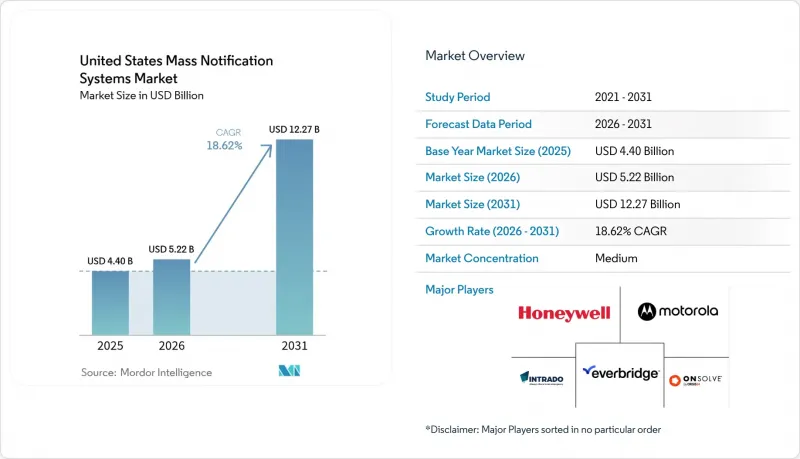
據 Mordor Intelligence 稱,美國大眾通知系統市場預計到 2026 年價值 52.2 億美元,高於 2025 年的 44 億美元,預計到 2031 年將達到 122.7 億美元。
預計 2026 年至 2031 年的複合年成長率為 18.62%。
本報告按組件(硬體、軟體等)、部署模式(本地部署、雲端部署、混合部署)、應用領域(室內、廣域室外等)、通訊管道(簡訊/小區廣播、語音通話、VoIP等)以及最終用戶產業(政府/公共安全、教育等)進行細分。市場預測以美元計價。
美國群發通知系統市場趨勢與洞察。
聯邦政府對 IPAWS-Open 3.0 的推廣,正在加速各個機構對其的採用。
到2024年,IPAWS-Open 3.0的授權用戶已超過1800家警報機構,聯邦、州、地方、部落和領地各級政府部門都在積極推動升級。美國聯邦通訊委員會(FCC)於2024年12月發布的法規強制要求使用基於IP的緊急警報系統進行傳輸,這縮短了合規期限,也促使大量與BlackBerry AtHoc相容的解決方案合約湧入市場。同時,公共廣播公司(CPB)提供的1.36億美元津貼正在加速服務不足的農村和部落廣播公司的基礎設施現代化改造。
《克萊里法案》規定的校園安全義務正在增加高等教育機構的支出。
由於教育部現在可以對校園警報系統不完善的違規行為處以每次3萬美元的罰款,各大學被迫實施整合事件管理和大眾傳播功能的平台。范德堡大學升級到AlertVU系統就是轉變為集中式指揮系統的典型例子。最近的調查顯示,超過80%的高等教育機構安全負責人認為這些平台能夠有效推動即時行為改變。
與傳統P25和5G網路的互通性差距
美國網路安全與基礎設施安全局 (CISA) 的 LMR/LTE 最佳實務指南強調,將 P25 通話群組連接到寬頻頻道時仍存在技術障礙。聖塔菲縣耗資 810 萬美元的 P25 系統改造(其中僅 42.5 萬美元來自州政府補貼)清楚地表明了無線系統升級帶來的巨大經濟負擔。如果現有無線網路無法滿足新的標準,例如 FCC 2025 年 NG911 可靠性計畫中提出的標準,那麼這種差距可能會進一步擴大。
細分市場分析
預計到2025年,美國大規模警報系統市場中,解決方案部分將佔67.25%的市場佔有率,顯示企業在核心警報平台上的投入已相當可觀。然而,隨著企業依賴託管整合來滿足IPAWS-Open 3.0和FedRAMP標準,業務收益正以18.95%的複合年成長率成長。專業服務供應商正受益於對人工智慧驅動的分析配置和全天候系統監控日益成長的需求。
隨著雲端架構減少本地面積,硬體利潤率正在下降,但像 Alertus Beacon 這樣的專用設備在醫院和校園等需要聲學和視覺冗餘的場所仍然至關重要。基於訂閱的授權模式使供應商和買家能夠就持續更新藍圖保持一致,同時,利用機器學習進行威脅偵測的培訓服務也正在出現。因此,服務業預計將擴大其在美國大規模警報系統市場的佔有率,尤其是在缺乏內部專業知識的中型市政機構中。
到2025年,基於雲端的交付模式將佔據美國群發通知系統市場71.80%的佔有率,但以20.05%的複合年成長率成長的混合模式,在可擴展性和數據主權要求之間實現了最佳平衡。擁有敏感工作負載的聯邦機構需要將本地儲存與雲端交付層結合,這種配置得到了FedRAMP High框架的增強,該框架目前支援BlackBerry AtHoc的部署。
醫療服務提供者正在採用混合方法來保護基於 HIPAA 標準的電子健康訊息,同時確保使用行動裝置的醫護人員能夠快速收到警報。同樣,向下一代 911 (NG911) 的過渡也促使各州公共緊急呼叫接收中心 (PSAP) 要求公共雲端具備容錯能力。隨著 5G 的普及,混合架構預計將在美國大規模通知系統市場佔據更大的佔有率,因為各公司正在將傳統的 P25 無線電與寬頻一鍵通話(PTT) 應用整合。
其他好處:
- Excel格式的市場預測(ME)表
- 3個月的分析師支持
目錄
第1章:引言
- 研究假設和市場定義
- 調查範圍
第2章:調查方法
第3章執行摘要
第4章 市場狀況
- 市場概覽
- 市場促進因素
- 聯邦政府擴大部署 IPAWS-Open 3.0 正在加速各個機構對其的採用。
- 《克萊里法案》規定的強制性校園安全措施正在促進高等教育領域的支出。
- 人工智慧和機器學習等新興技術正在徹底改變安全和緊急應變能力。
- 協調聯邦政府對下一代大規模警報系統的安全標準。
- 一個雲端原生平台,支援混合辦公環境中的大規模警報用例。
- 現代化下一代9/11基礎設施
- 市場限制因素
- 與傳統P25和5G網路的互通性差距
- 地方政府預算短缺
- 「警報疲勞」和虛假警報導致公眾信任度下降。
- 對各州個人資料外洩法律下的資料隱私和問責制的擔憂。
- 價值供應鏈分析
- 監管和技術展望
- 波特五力模型
第5章 市場規模與成長預測
- 按組件
- 硬體
- 軟體
- 專業服務
- 託管服務
- 不同的發展
- 現場
- 雲
- 混合
- 透過使用
- 室內的
- 大面積戶外
- 分散式接收者/個人化提醒
- 透過通訊管道
- 簡訊/區域廣播
- 語音通話和 VoIP
- 電子郵件和桌面彈出視窗
- 公共廣播和警報系統
- 社群媒體與網路資訊流
- 來自物聯網和連網型設備的通知
- 按最終用戶行業分類
- 政府/公共安全
- 教育(K-12 和高等教育)
- 醫療機構
- 能源公用事業
- 運輸/物流
- 工業和製造業
- 商業/企業
第6章 競爭情勢
- 市場集中度
- 策略趨勢
- 市佔率分析
- 公司簡介
- Everbridge, Inc.
- Motorola Solutions, Inc.
- OnSolve, LLC
- Intrado Life & Safety(West Corp.)
- Blackboard Connect(Anthology Inc.)
- BlackBerry AtHoc
- Eaton Corporation plc
- Honeywell International Inc.
- Federal Signal Corporation
- Singlewire Software, LLC
- Alertus Technologies, LLC
- Omnilert, LLC
- Regroup Mass Notification
- Rave Mobile Safety
- AlertMedia, Inc.
- xMatters, Inc.
- Siemens AG
- Johnson Controls International plc
- ATI Systems(Acoustic Technology Inc.)
- Cisco Systems, Inc.
- Genasys Inc.
- Advanced Network Devices
第7章 市場機會與未來展望
According to Mordor Intelligence, United States mass notification systems market size in 2026 is estimated at USD 5.22 billion, growing from 2025 value of USD 4.40 billion with 2031 projections showing USD 12.27 billion, growing at 18.62% CAGR over 2026-2031.
This report is Segmented by Component (Hardware, Software, and More), Deployment (On-Premise, Cloud, Hybrid), Application (In-Building, Wide-Area Outdoor, and More), Communication Channel (SMS/Cell Broadcast, Voice Call and VoIP, and More), End-User Vertical (Government and Public Safety, Education, and More). The Market Forecasts are Provided in Terms of Value (USD).
United States Mass Notification Systems Market Trends and Insights
Federal Expansion of IPAWS-Open 3.0 Accelerating Agency Deployments
IPAWS-Open 3.0 authorizations surpassed 1,800 alerting authorities in 2024, compelling upgrades across federal, state, local, tribal, and territorial jurisdictions. The FCC's December 2024 rule requiring IP-based Emergency Alert System transmissions intensified compliance timelines, catalyzing rapid contract awards for BlackBerry AtHoc-compatible solutions . Concurrently, a USD 136 million Corporation for Public Broadcasting grant accelerates infrastructure modernization for underserved rural and tribal broadcasters.
Clery-Act-Driven Campus Safety Mandates Fueling Higher-Ed Spend
The Department of Education can now levy USD 35,000 per violation for deficient campus alerts, compelling universities to adopt integrated platforms that bundle incident management with mass communication. Vanderbilt University's AlertVU upgrade illustrates the shift toward centralized command systems. Recent studies indicate more than 80% of higher-education safety professionals find these platforms effective in shaping real-time behavior.
Interoperability Gaps with Legacy P25 and 5G Networks
CISA's LMR/LTE best-practices guide underscores persistent technical hurdles in patching P25 talk groups to broadband channels. Santa Fe County's USD 8.1 million P25 overhaul-backed by just USD 425,000 in state aid-illustrates the fiscal weight of radio upgrades. The FCC's 2025 NG911 reliability docket may further widen the gap if existing radio networks cannot meet new standards.
Other drivers and restraints analyzed in the detailed report include:
- AI and ML to Revolutionize Security and Emergency Response
- Convergence of Federal Safety Mandates on Next-Generation Notification Systems
- Budget Shortfalls in Rural Municipalities
For complete list of drivers and restraints, kindly check the Table Of Contents.
Segment Analysis
The solutions segment accounted for 67.25% of the United States mass notification systems market in 2025, underscoring entrenched spending on core alerting platforms. Services revenue, however, is rising at a 18.95% CAGR as organizations rely on managed integrations to meet IPAWS-Open 3.0 and FedRAMP benchmarks. Professional-services providers benefit from growing demand for AI-enabled analytics configuration and 24/7 system monitoring.
Hardware margins are tightening as cloud architectures reduce on-premises footprint, yet specialized devices such as Alertus Beacons remain indispensable in hospitals and campuses requiring audible and visual redundancy. Subscription licensing aligns vendors and buyers to continuous-update roadmaps, while training services emerge to unlock machine-learning-based threat detection. As a result, services are positioned to capture a growing share of the United States mass notification systems market size, particularly among mid-tier municipalities lacking in-house expertise.
Cloud delivery dominated 71.80% of the United States mass notification systems market in 2025, but hybrid models-expanding at 20.05% CAGR-offer the preferred compromise between scalability and data-sovereignty requirements. Federal agencies with classified workloads demand on-premises storage paired with cloud distribution layers, a configuration reinforced by the FedRAMP High framework now supporting BlackBerry AtHoc deployments.
Healthcare providers adopt hybrid to safeguard electronic health information under HIPAA while retaining rapid alert dissemination to mobile caregivers. NG911 migration likewise pulls state PSAPs toward public-cloud resilience. As 5G expands, hybrid architectures are poised to capture a larger portion of the United States mass notification systems market share among enterprises integrating legacy P25 radios with broadband push-to-talk applications.
Complete Report Scope:
- By Component
- Hardware
- Software
- Professional Services
- Managed Services
- By Deployment
- On-Premise
- Cloud
- Hybrid
- By Application
- In-Building
- Wide-Area Outdoor
- Distributed Recipient / Personal Alerting
- By Communication Channel
- SMS / Cell Broadcast
- Voice Call and VoIP
- Email and Desktop Pop-Ups
- Public Address and Siren Systems
- Social Media and Web Feed
- IoT and Connected Device Notifications
- By End-User Vertical
- Government and Public Safety
- Education (K-12 and Higher-Ed)
- Healthcare Facilities
- Energy and Utilities
- Transportation and Logistics
- Industrial and Manufacturing
- Commercial and Corporate Enterprises
List of Companies Covered in this Report:
- Everbridge, Inc.
- Motorola Solutions, Inc.
- OnSolve, LLC
- Intrado Life & Safety (West Corp.)
- Blackboard Connect (Anthology Inc.)
- BlackBerry AtHoc
- Eaton Corporation plc
- Honeywell International Inc.
- Federal Signal Corporation
- Singlewire Software, LLC
- Alertus Technologies, LLC
- Omnilert, LLC
- Regroup Mass Notification
- Rave Mobile Safety
- AlertMedia, Inc.
- xMatters, Inc.
- Siemens AG
- Johnson Controls International plc
- ATI Systems (Acoustic Technology Inc.)
- Cisco Systems, Inc.
- Genasys Inc.
- Advanced Network Devices
Additional Benefits:
- The market estimate (ME) sheet in Excel format
- 3 months of analyst support
TABLE OF CONTENTS
1 INTRODUCTION
- 1.1 Study Assumptions and Market Definition
- 1.2 Scope of the Study
2 RESEARCH METHODOLOGY
3 EXECUTIVE SUMMARY
4 MARKET LANDSCAPE
- 4.1 Market Overview
- 4.2 Market Drivers
- 4.2.1 Federal Expansion of IPAWS-Open 3.0 Accelerating Agency Deployments
- 4.2.2 Clery-Act-Driven Campus Safety Mandates Fueling Higher-Ed Spend
- 4.2.3 Rising Technologies such as AI and ML to revolutionize security and emergence response capabilities
- 4.2.4 Convergence of Federal Safety Mandates on next-generation mass-notification systems
- 4.2.5 Cloud-Native Platforms Enabling Hybrid-Work Mass Alert Use-Cases
- 4.2.6 Next Generation 911 infrastructure modernization
- 4.3 Market Restraints
- 4.3.1 Interoperability Gaps with Legacy P25 and 5G Networks
- 4.3.2 Budget Shortfalls in Rural Municipalities
- 4.3.3 Alert-Fatigue and Public Trust Erosion Post False-Alarm Incidents
- 4.3.4 Data-Privacy and Liability Concerns Under State Breach Acts
- 4.4 Value / Supply-Chain Analysis
- 4.5 Regulatory and Technological Outlook
- 4.6 Porter's Five Forces
- 4.6.1 Threat of New Entrants
- 4.6.2 Bargaining Power of Buyers
- 4.6.3 Bargaining Power of Suppliers
- 4.6.4 Threat of Substitutes
- 4.6.5 Intensity of Competitive Rivalry
5 MARKET SIZE AND GROWTH FORECASTS (VALUE)
- 5.1 By Component
- 5.1.1 Hardware
- 5.1.2 Software
- 5.1.3 Professional Services
- 5.1.4 Managed Services
- 5.2 By Deployment
- 5.2.1 On-Premise
- 5.2.2 Cloud
- 5.2.3 Hybrid
- 5.3 By Application
- 5.3.1 In-Building
- 5.3.2 Wide-Area Outdoor
- 5.3.3 Distributed Recipient / Personal Alerting
- 5.4 By Communication Channel
- 5.4.1 SMS / Cell Broadcast
- 5.4.2 Voice Call and VoIP
- 5.4.3 Email and Desktop Pop-Ups
- 5.4.4 Public Address and Siren Systems
- 5.4.5 Social Media and Web Feed
- 5.4.6 IoT and Connected Device Notifications
- 5.5 By End-User Vertical
- 5.5.1 Government and Public Safety
- 5.5.2 Education (K-12 and Higher-Ed)
- 5.5.3 Healthcare Facilities
- 5.5.4 Energy and Utilities
- 5.5.5 Transportation and Logistics
- 5.5.6 Industrial and Manufacturing
- 5.5.7 Commercial and Corporate Enterprises
6 COMPETITIVE LANDSCAPE
- 6.1 Market Concentration
- 6.2 Strategic Moves
- 6.3 Market Share Analysis
- 6.4 Company Profiles (includes Global-level Overview, Market-level Overview, Core Segments, Financials as available, Strategic Information, Market Rank/Share, Products and Services, Recent Developments)
- 6.4.1 Everbridge, Inc.
- 6.4.2 Motorola Solutions, Inc.
- 6.4.3 OnSolve, LLC
- 6.4.4 Intrado Life & Safety (West Corp.)
- 6.4.5 Blackboard Connect (Anthology Inc.)
- 6.4.6 BlackBerry AtHoc
- 6.4.7 Eaton Corporation plc
- 6.4.8 Honeywell International Inc.
- 6.4.9 Federal Signal Corporation
- 6.4.10 Singlewire Software, LLC
- 6.4.11 Alertus Technologies, LLC
- 6.4.12 Omnilert, LLC
- 6.4.13 Regroup Mass Notification
- 6.4.14 Rave Mobile Safety
- 6.4.15 AlertMedia, Inc.
- 6.4.16 xMatters, Inc.
- 6.4.17 Siemens AG
- 6.4.18 Johnson Controls International plc
- 6.4.19 ATI Systems (Acoustic Technology Inc.)
- 6.4.20 Cisco Systems, Inc.
- 6.4.21 Genasys Inc.
- 6.4.22 Advanced Network Devices
7 MARKET OPPORTUNITIES AND FUTURE OUTLOOK
- 7.1 White-space and Unmet-Need Assessment
- 7.2 Integration of CAP-Compliant IoT Sensors
- 7.3 Convergence with 5G and CBRS for Public Warning

 通報系統系統市場-2026-2032年全球市場預測臨床警報和通知系統市場:按類型、通知方式、最終用戶、應用和部署模式分類-2026-2032年全球市場預測
 群發通知系統:市場佔有率分析、產業趨勢與統計、成長預測(2026-2031)
 大眾通知系統市場 - 全球產業規模、佔有率、趨勢、機會、預測:按組件、部署模式、組織規模、應用、最終用戶產業、地區和競爭格局分類,2021-2031年
 通報系統系統市場規模、佔有率、趨勢和預測:按組件、解決方案、部署類型、組織規模、應用、產業和地區分類,2026-2034 年
 通報系統系統市場:按解決方案、應用、產業、產品和地區分類
 軍事通報系統系統市場規模、佔有率和趨勢分析:按組件、整合、部署、通訊方式、系統類型、應用、地區和細分市場分類(2026-2033 年)
 2026年全球大型通知系統市場報告軍事大眾通知系統市場:按組件、部署模式、應用程式和最終用戶分類,全球預測,2026-2032年2026年全球會計教育系統市場報告