


 |
市場調查報告書
商品編碼
2066377
聚氨酯:市場佔有率分析、產業趨勢與統計、成長預測(2026-2031)Polyurethane - Market Share Analysis, Industry Trends & Statistics, Growth Forecasts (2026 - 2031) |
||||||

※ 本網頁內容可能與最新版本有所差異。詳細情況請與我們聯繫。
根據 Mordor Intelligence 預測,聚氨酯市場規模預計將在 2025 年達到 874.5 億美元,2026 年達到 921.7 億美元,到 2031 年達到 1,201.2 億美元,2026 年至 2031 年的複合年成長率為 5.4%。
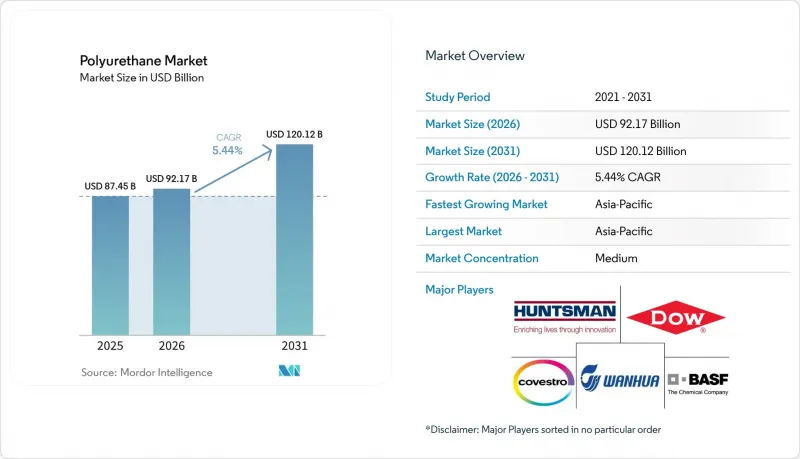
本報告按原料(二苯基甲烷二異氰酸酯(MDI)、甲苯二異氰酸酯 (TDI) 及其他)、類型(硬質發泡體、軟質發泡體及其他)、終端用戶產業(建築、家具及其他)和地區(亞太、北美、歐洲、南美、中東和非洲)進行細分。市場預測以美元 (USD) 為單位。
全球聚氨酯市場趨勢與洞察
汽車輕量化導致需求增加
為了達到歐盟2025年平均車輛二氧化碳排放93.6克/公里的目標以及美國2026年企業平均燃油經濟性標準49英里/加侖,汽車製造商正使用聚氨酯複合材料取代鋼和鋁。BASF的噴塗傳遞模塑技術在不影響碰撞安全性的前提下,將福特F-150 Lightning的前橫樑重量減輕了30%。 Jeep大切諾基4xe採用的聚氨酯複合材料複合材料比沖壓鋼尾門輕18%,豐田透過使用聚氨酯座椅框架,使Tundra Hybrid每輛車的重量減輕了2.4公斤。每減輕1公斤重量,電池式電動車的續航里程就能增加1到2公里,而且隨著電池組容量的增加,這種優勢會更加顯著。
建築和施工業對隔熱材料的需求激增。
歐盟指令2024/1275要求歐盟成員國報告隔熱材料在整個生命週期內的全球暖化潛勢(GWP),並要求在2030年實現營運建築零排放。導熱係數為0.022 W/m*K的硬質聚氨酯泡棉可用於高價值占地面積的薄牆維修。美國環保署(EPA)分階段減少氫氟碳化合物(HFCs)的使用,將在2025年後將發泡的GWP限制在150,迫使化合物生產商轉向高成本更高的氫氟烯烴(HFOs)。沙烏地阿拉伯在2024年授予的一份價值1,443億美元的合約規定,在沙漠地區使用硬質聚氨酯板以達到被動式房屋的性能水準。這些政策共同推動了對硬質聚氨酯的需求,其成長速度超過了軟質泡沫。儘管生產成本不斷上升,聚氨酯市場的複合年成長率(CAGR)仍成長了1.5個百分點。
異氰酸酯原料價格波動劇烈
2025年4月,中國市場供應過剩,加上下游需求疲軟,導致MDI和TDI價格較去年同期下降18%至22%。 ResourceWise證實,2025年11月價格仍維持在低位,迫使一體化生產商放緩生產步伐。受現貨市場影響的中小型加工商面臨原物料價格波動,這可能佔其成本的60%。如果價格上漲導致建築商推遲專案或轉而使用礦物棉,將導致需求下降,從而使聚氨酯市場的複合年成長率下降0.9個百分點。
細分市場分析
預計到2025年,二苯基甲烷二異氰酸酯(TDI)將佔據聚氨酯市場38.17%的佔有率,凸顯其在硬質隔熱材料和熱塑性聚氨酯領域的領先地位。儘管TDI仍然是軟質家具泡沫材料的關鍵成分,但自2024年中期以來,供應過剩已使其價格保持在低位。雖然聚醚和聚酯多元醇仍是配方中的主流,但在嘉吉公司的大豆油和科思創公司的「Cardyon」二氧化碳技術的推動下,生物基多元醇正以12.60%的複合年成長率快速成長。這些配方趨勢表明,未來傳統原料將透過規模經濟維持產量水平,而可再生多元醇將佔據那些對低碳足跡有檢驗要求的細分市場。
生物多元醇的普及符合歐盟範圍3報告的要求以及美國品牌的努力,儘管成本溢價高達20-30%,但仍能提升利潤率。科思創首款商業化Cardyon®產品含有20%的回收二氧化碳,顯示製程創新可取代化石衍生中間體,並實現產品差異化。聚酯多元醇在風力發電機樹脂灌注和汽車膠膜等領域的市場佔有率不斷成長,其中芳香族化學成分增強了紫外線穩定性。同時,受價格主導的TDI市場趨勢迫使歐美生產商精簡資產,陶氏對其歐洲業務的策略評估便印證了這一點。聚氨酯市場正在透過平衡低成本的亞洲異氰酸酯與北美和歐洲高利潤的特殊系統來應對這些變化。
區域分析
預計到2025年,亞太地區將佔聚氨酯市場銷售額的47.05%,並在2031年之前以6.80%的複合年成長率持續成長。這主要得益於萬華計劃在寧波將其MDI產能進一步提升40萬噸/年,並在福建實現類似的產能提升,目標是在2027年前完成。中國的優勢在於其從煤炭到苯胺的完整生產路線。同時,印度2024會計年度的汽車產量預計將達到2,590萬輛,這將推動對片狀泡棉和建築隔熱材料的需求。東南亞國協,特別是印尼和越南的建築業蓬勃發展,進一步增加了該地區對軟質泡沫進口的需求。儘管日本和韓國的市場已經成熟,但它們在採用生物基多元醇方面處於領先地位,以幫助企業實現淨零排放承諾。
在北美,住宅開工量仍比2020年的尖峰時段低20%,減緩了對硬質發泡體的需求成長。美國環保署(EPA)的GWP 150法規使每板英尺的成本增加了0.15至0.25美元,給小規模噴塗泡沫安裝商帶來了壓力。加拿大的氣候區建築規範要求牆體保溫性能達到R-30至R-40,促使建築商轉向性能更高的泡沫材料。墨西哥受益於家用電器和電子產品的近岸外包,刺激了對柔軟性和硬質聚氨酯系統的需求。
歐洲正處於十字路口,2024/1275 號指令推動了維修熱潮,而飆升的能源和合規成本正在削弱生產商的競爭力。儘管 2024 年住宅建築許可數量下降了 8%,但北歐國家的維修獎勵涵蓋了 40% 的隔熱成本,刺激了噴塗泡沫的需求。 REACH 法規的暴露限制迫使投資傾向於合併後的跨國公司,而陶氏化學的資產重組則預示著產業可能出現整合。
南美洲、中東和非洲正依賴大型企劃。沙烏地阿拉伯2024年的訂單價值1,443億美元,其中包括為新城NEOM採購符合被動式房屋標準的硬質板材。阿拉伯聯合大公國價值813億美元的合約正在推動隧道建設中噴塗泡沫防水技術的應用。在巴西和阿根廷,隨著消費信貸的寬鬆,對軟性泡沫的需求正在復甦。在奈及利亞,硬質泡沫正被應用於藥品低溫運輸倉庫,儘管仍處於起步階段,但已展現出成為戰略成長中心的潛力。
其他好處:
- Excel格式的市場預測(ME)表
- 3個月的分析師支持
目錄
第1章:引言
- 研究假設和市場定義
- 調查範圍
第2章:調查方法
第3章執行摘要
第4章 市場狀況
- 市場概覽
- 市場促進因素
- 汽車輕量化導致需求增加
- 建築和施工用隔熱材料的需求激增。
- 家具和床上用品用高回彈泡沫的需求正在激增。
- 在離岸風力發電機葉片和機艙罩中採用聚氨酯材料
- 利用PU積層製造技術進行鞋類大規模客製化
- 市場限制因素
- 異氰酸酯原料價格波動很大。
- 加強全球對接觸全氟烷基和二異氰酸酯的監管
- 與生物基熱塑性聚合物的競爭
- 價值鏈分析
- 波特五力模型
第5章 市場規模與成長預測
- 按成分
- 二苯基甲烷二異氰酸酯(MDI)
- 甲苯二異氰酸酯(TDI)
- 聚醚多元醇
- 聚酯多元醇
- 生物基多元醇
- 按類型
- 硬質發泡體
- 靈活形式
- CASE(油漆、黏合劑、密封劑、彈性體)
- 熱塑性聚氨酯(TPU)
- 其他類型(例如聚氨酯泡沫塗料(SPF))
- 按最終用戶行業分類
- 建築/施工
- 家具
- 電子設備/家用電器
- 車
- 鞋類
- 包裝
- 其他終端用戶產業(醫療、工業機械等)
- 按地區
- 亞太地區
- 中國
- 印度
- 日本
- 韓國
- 東南亞國協
- 其他亞太國家
- 北美洲
- 美國
- 加拿大
- 墨西哥
- 歐洲
- 德國
- 英國
- 法國
- 義大利
- 西班牙
- 北歐國家
- 其他歐洲國家
- 南美洲
- 巴西
- 阿根廷
- 其他南美國家
- 中東和非洲
- 沙烏地阿拉伯
- 南非
- 阿拉伯聯合大公國
- 奈及利亞
- 其他中東和非洲國家
- 亞太地區
第6章 競爭情勢
- 市場集中度
- 策略趨勢
- 市佔率和排名分析
- 公司簡介
- BASF
- Carpenter Co.
- Covestro AG
- DIC Corporation
- Dow
- FoamPartner Group
- FXI
- Huntsman International LLC
- INOAC Corporation
- LANXESS
- Lubrizol
- Mitsui Chemicals Inc.
- Rogers Corporation
- Rymbal
- Sekisui Chemical Co., Ltd.
- Sheela Foam Ltd.
- Tosoh Corporation
- UFP Technologies, Inc.
- Wanhua
第7章 市場機會與未來展望
According to Mordor Intelligence, the polyurethane market size is projected to be USD 87.45 billion in 2025, USD 92.17 billion in 2026, and reach USD 120.12 billion by 2031, growing at a CAGR of 5.44% from 2026 to 2031.
This report is Segmented by Raw Material (Methylene Diphenyl Di-Isocyanate (MDI), Toluene Di-Isocyanate (TDI), and Others), Type (Rigid Foam, Flexible Foam, and Others), End-User Industry (Building and Construction, Furniture, and Others), and Geography (Asia-Pacific, North America, Europe, South America, and Middle East and Africa). The Market Forecasts are Provided in Terms of Value (USD).
Global Polyurethane Market Trends and Insights
Growing Demand from Automotive Lightweighting
Automakers are replacing steel and aluminum with polyurethane composites to meet the European Union's 93.6 g/km fleet-average CO2 target for 2025 and the United States' corporate average fuel-economy standard of 49 mpg for 2026. BASF's spray-transfer molding cut the Ford F-150 Lightning front crossmember mass by 30% without sacrificing crash safety. Jeep's Grand Cherokee 4xe uses a polyurethane composite tailgate that is 18% lighter than stamped steel, and Toyota trims 2.4 kg per Tundra hybrid using polyurethane seat frames. Each kilogram saved extends battery-electric-vehicle range by 1-2 km, a benefit that amplifies as battery packs grow.
Booming Building and Construction Insulation Demand
Directive 2024/1275 obliges EU members to report life-cycle global-warming potential for insulation and mandates zero-operational-emission buildings by 2030. Rigid polyurethane foam, with thermal conductivity of 0.022 W/m*K, enables thin-wall retrofits where floor-space premiums are high. The U.S. EPA's hydrofluorocarbon phase-down caps blowing agents at GWP 150 from 2025, pushing formulators toward costlier hydrofluoroolefins . Saudi Arabia's USD 144.3 billion 2024 contract awards specify rigid polyurethane panels for desert passive-house performance. Together, these policies lift demand faster than flexible foam, explaining the 1.5 percentage-point boost to the polyurethane market CAGR despite rising production costs.
Volatile Isocyanate Feedstock Prices
MDI and TDI prices declined 18-22% year-on-year in April 2025 as Chinese overcapacity met muted downstream demand. ResourceWise confirmed sustained weakness in November 2025, compelling integrated producers to curb rates. Smaller converters, exposed to spot markets, face feedstock swings that can equal 60% of cost of goods. Demand destruction ensues when spikes prompt builders to delay projects or shift to mineral wool, knocking 0.9 percentage points from the polyurethane market CAGR.
Other drivers and restraints analyzed in the detailed report include:
- Surge in High-Resilience Furniture and Bedding Foams
- Adoption of PU in Offshore Wind Turbine Blades and Nacelle Covers
- Tightening Global PFAS and Di-Isocyanate Exposure Regulations
For complete list of drivers and restraints, kindly check the Table Of Contents.
Segment Analysis
Methylene diphenyl di-isocyanate secured 38.17% of polyurethane market share in 2025, underscoring its position in rigid insulation and thermoplastic polyurethane. TDI remains essential for flexible furniture foam, though oversupply has suppressed prices since mid-2024. Polyether and polyester polyols fill mainstream formulations, while bio-based polyols advance at a 12.60% CAGR on the back of Cargill soybean oils and Covestro cardyon CO2 technology. The resulting mix points to a future where conventional feedstocks protect volume through economies of scale, and renewable polyols capture niches demanding verified low carbon footprints.
Bio-polyol penetration aligns with EU Scope 3 reporting and U.S. brand commitments, lifting margins despite a 20-30% cost premium. Covestro's inaugural commercial cardyon(R) grades incorporate 20% captured CO2, illustrating how process innovation can offset fossil-based intermediates and differentiate offerings. Polyester polyols gain share in wind-turbine resin infusion and automotive adhesive films where aromatic chemistry enhances UV stability. Meanwhile, price-driven TDI dynamics force Western producers to rationalize assets, evidenced by Dow's European strategic review. The polyurethane market absorbs these shifts by balancing low-cost Asian isocyanates with high-margin specialty systems in North America and Europe.
Geography Analysis
Asia-Pacific captured 47.05% of polyurethane market revenue in 2025 and is set for a 6.80% CAGR to 2031 as Wanhua expands MDI capacity by another 400,000 tpa at Ningbo and eyes a similar addition in Fujian by 2027. China's dominance rests on integrated coal-to-aniline routes, while India's 25.9 million vehicle output in fiscal 2024 drives dual demand for seat foam and building insulation. ASEAN construction booms in Indonesia and Vietnam augment regional pull on flexible-foam imports. Japan and South Korea, though mature, pioneer bio-based polyols to meet corporate net-zero pledges.
In North America, housing starts remain 20% below 2020 highs, muting rigid-foam momentum. The EPA's GWP 150 limit adds USD 0.15-0.25 per board foot to costs, pressuring smaller spray-foam applicators. Canada's climate-zone codes require R-30-40 walls, steering builders toward high-performance foams. Mexico benefits from nearshoring of appliances and electronics, stimulating demand for both flexible and rigid polyurethane systems.
Europe sits at a crossroads where Directive 2024/1275 underpins a renovation wave, but elevated energy and compliance costs erode producer competitiveness. Residential permits fell 8% in 2024, yet Nordic retrofit incentives cover 40% of insulation costs, spurring spray-foam demand. REACH exposure limits compel investments that favor integrated multinationals, while Dow's asset review hints at potential consolidation.
South America and the Middle East and Africa hinge on mega-projects. Saudi Arabia's USD 144.3 billion in 2024 awards includes passive-house-spec rigid panels for NEOM. The UAE's USD 81.3 billion contract slate boosts spray-foam waterproofing in tunneling. Brazil and Argentina recover flexible-foam demand as consumer credit loosens. Nigeria deploys rigid foam in pharmaceutical cold-chain warehouses, signaling embryonic but strategic growth nodes.
- BASF
- Carpenter Co.
- Covestro AG
- DIC Corporation
- Dow
- FoamPartner Group
- FXI
- Huntsman International LLC
- INOAC Corporation
- LANXESS
- Lubrizol
- Mitsui Chemicals Inc.
- Rogers Corporation
- Rymbal
- Sekisui Chemical Co., Ltd.
- Sheela Foam Ltd.
- Tosoh Corporation
- UFP Technologies, Inc.
- Wanhua
Additional Benefits:
- The market estimate (ME) sheet in Excel format
- 3 months of analyst support
TABLE OF CONTENTS
1 Introduction
- 1.1 Study Assumptions and Market Definition
- 1.2 Scope of the Study
2 Research Methodology
3 Executive Summary
4 Market Landscape
- 4.1 Market Overview
- 4.2 Market Drivers
- 4.2.1 Growing Demand from Automotive Lightweighting
- 4.2.2 Booming Building and Construction Insulation Demand
- 4.2.3 Surge in High-Resilience Furniture and Bedding Foams
- 4.2.4 Adoption of PU in Offshore Wind Turbine Blades And Nacelle Covers
- 4.2.5 Mass-Customization of Footwear Using PU Additive Manufacturing
- 4.3 Market Restraints
- 4.3.1 Volatile Isocyanate Feedstock Prices
- 4.3.2 Tightening Global PFAS and Di-Isocyanate Exposure Regulations
- 4.3.3 Competition from Bio-Based Thermoplastic Polymers
- 4.4 Value Chain Analysis
- 4.5 Porter's Five Forces
- 4.5.1 Bargaining Power of Suppliers
- 4.5.2 Bargaining Power of Buyers
- 4.5.3 Threat of New Entrants
- 4.5.4 Threat of Substitute Products and Services
- 4.5.5 Degree of Competition
5 Market Size and Growth Forecasts (Value)
- 5.1 By Raw Material
- 5.1.1 Methylene Diphenyl Di-isocyanate (MDI)
- 5.1.2 Toluene Di-isocyanate (TDI)
- 5.1.3 Polyether Polyols
- 5.1.4 Polyester Polyols
- 5.1.5 Bio-based Polyols
- 5.2 By Type
- 5.2.1 Rigid Foam
- 5.2.2 Flexible Foam
- 5.2.3 CASE (Coatings, Adhesives, Sealants and Elastomers)
- 5.2.4 Thermoplastic Polyurethane (TPU)
- 5.2.5 Other Types (Spray Polyurethane Foam (SPF), etc.)
- 5.3 By End-user Industry
- 5.3.1 Building and Construction
- 5.3.2 Furniture
- 5.3.3 Electronics and Appliances
- 5.3.4 Automotive
- 5.3.5 Footwear
- 5.3.6 Packaging
- 5.3.7 Other End-user Industries (Healthcare, Industrial Machinery, etc.)
- 5.4 By Geography
- 5.4.1 Asia-Pacific
- 5.4.1.1 China
- 5.4.1.2 India
- 5.4.1.3 Japan
- 5.4.1.4 South Korea
- 5.4.1.5 ASEAN Countries
- 5.4.1.6 Rest of Asia-Pacific
- 5.4.2 North America
- 5.4.2.1 United States
- 5.4.2.2 Canada
- 5.4.2.3 Mexico
- 5.4.3 Europe
- 5.4.3.1 Germany
- 5.4.3.2 United Kingdom
- 5.4.3.3 France
- 5.4.3.4 Italy
- 5.4.3.5 Spain
- 5.4.3.6 NORDIC Countries
- 5.4.3.7 Rest of Europe
- 5.4.4 South America
- 5.4.4.1 Brazil
- 5.4.4.2 Argentina
- 5.4.4.3 Rest of South America
- 5.4.5 Middle East and Africa
- 5.4.5.1 Saudi Arabia
- 5.4.5.2 South Africa
- 5.4.5.3 United Arab Emirates
- 5.4.5.5 Nigeria
- 5.4.5.6 Rest of Middle East and Africa
- 5.4.1 Asia-Pacific
6 Competitive Landscape
- 6.1 Market Concentration
- 6.2 Strategic Moves
- 6.3 Market Share(%)/Ranking Analysis
- 6.4 Company Profiles (includes Global level Overview, Market level overview, Core Segments, Financials as available, Strategic Information, Market Rank/Share for key companies, Products and Services, and Recent Developments)
- 6.4.1 BASF
- 6.4.2 Carpenter Co.
- 6.4.3 Covestro AG
- 6.4.4 DIC Corporation
- 6.4.5 Dow
- 6.4.6 FoamPartner Group
- 6.4.7 FXI
- 6.4.8 Huntsman International LLC
- 6.4.9 INOAC Corporation
- 6.4.10 LANXESS
- 6.4.11 Lubrizol
- 6.4.12 Mitsui Chemicals Inc.
- 6.4.13 Rogers Corporation
- 6.4.14 Rymbal
- 6.4.15 Sekisui Chemical Co., Ltd.
- 6.4.16 Sheela Foam Ltd.
- 6.4.17 Tosoh Corporation
- 6.4.18 UFP Technologies, Inc.
- 6.4.19 Wanhua
7 Market Opportunities and Future Outlook
- 7.1 White-space and Unmet-need Assessment

 水性聚氨酯泡沫塑膠市場規模、佔有率和成長分析:按產品類型、應用、最終用途產業、固態含量、分銷通路和地區分類-2026-2033年產業預測
 中東和非洲聚氨酯市場:市場佔有率分析、行業趨勢和統計數據以及成長預測(2026-2031 年)
 2026年全球聚氨酯(PU)樹脂市場報告
 MDI、TDI 與聚氨酯市場-2026-2032 年全球市場預測水性聚氨酯市場-2026-2032年全球市場預測聚氨酯市場:材料類型、形狀、加工技術、發泡、應用、最終用途-2026-2032年全球市場預測2026年全球聚異氰酸酯市場報告(使用1,6-己二異氰酸酯)
 聚氨酯護腿板市場規模、佔有率和成長分析:按產品類型、材料成分、尺寸、運動應用、價格範圍和地區分類-2026-2033年產業預測
 北美聚氨酯市場規模、佔有率和趨勢分析報告:按產品、應用、國家和細分市場預測(2026-2033 年)2026年全球聚氨酯泡棉(PUF)保溫夾板市場報告