


 |
市場調查報告書
商品編碼
2121440
中東和非洲聚氨酯市場:市場佔有率分析、行業趨勢和統計數據以及成長預測(2026-2031 年)Middle East And Africa Polyurethane - Market Share Analysis, Industry Trends & Statistics, Growth Forecasts (2026 - 2031) |
||||||

※ 本網頁內容可能與最新版本有所差異。詳細情況請與我們聯繫。
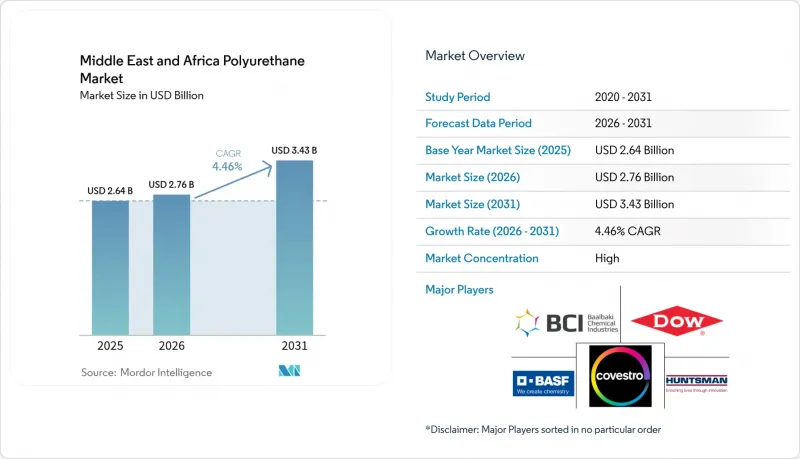
據 Mordor Intelligence 稱,2025 年中東和非洲的聚氨酯市值為 26.4 億美元,預計到 2031 年將從 2026 年的 27.6 億美元成長至 34.3 億美元,預測期(2026-2031 年)的複合年成長率為 4.46%。
本報告按應用(發泡體、塗料、黏合劑和密封劑、彈性體、其他)、最終用戶行業(建築和施工、家具和床上用品、汽車、電子和家用電器、其他)、原料(MDI、TDI、聚醚多元醇、聚酯多元醇、其他)和地區(沙烏地阿拉伯、阿拉伯聯合大公國、南非、埃及、科威特、其他)進行分類。
中東和非洲聚氨酯市場趨勢與洞察
海灣合作主導基礎建設熱潮
海灣國家數十億美元的計畫正在推動對硬質發泡體、密封劑和噴塗隔熱材料的最大需求。諸如NEOM新城、紅海旅遊走廊和杜拜2040城市復興計畫等大型開發項目,需要能夠將營運排放量減少至少50%的建築圍護結構解決方案。聚氨酯板材和噴塗系統即使在長期暴露於沙漠環境的情況下,也能提供必要的隔熱和防潮性能。現場模組化工人宿舍和臨時物流設施全年都在推動預製板材(包括硬質聚氨酯芯材)的需求。強制性的在地採購要求已經促使國際化合物製造商在沙烏地阿拉伯和阿拉伯聯合大公國建立混合工廠,從而縮短了前置作業時間並降低了進口關稅。因此,中東和非洲的聚氨酯市場正直接受益於該地區致力於擺脫對碳氫化合物依賴的多元化發展的決心。
冷鏈物流和隔熱材料需求的成長
隨著糧食安全日益重要,疫苗分發計畫不斷推進,對溫控倉庫、太陽能冷藏亭和保溫貨櫃的投資正在加速成長。撒哈拉以南非洲地區約一半的農業損失歸因於冷凍基礎設施不足。採用聚氨酯保溫板和相變儲能模組的分散式冷凍系統能夠防止農產品變質,提高農民收入,並符合氣候變遷調適計畫的資金籌措需求。自2020年以來,非洲新創公司已部署了數千套太陽能冷凍設備,這表明硬質發泡體市場潛力巨大。國際開發銀行通常要求使用高R值隔熱材料以最大限度地提高能源效率,這使得聚氨酯成為專案規範中的必備組件。這些趨勢增強了中東和非洲聚氨酯市場的長期需求前景。
對TDI/MDI產品實施更嚴格的VOC與工人安全標準
美國工業衛生學會 (ACGIH) 已將 TDI 的 8 小時暴露限值降低至 1 ppb。區域工廠需要即時監測、專用通風系統和生物監測程序才能符合法規要求。這些資本投資帶來的成本增加將給無法享有規模經濟效益的中小型加工商帶來最大負擔,並可能加速產業整合。儘管跨國公司正在修訂安全資料表 (SDS) 並提供單體含量較低的替代品,但價格上漲已不可避免。預計為符合法規要求而產生的支出將抑制中東和非洲聚氨酯市場的短期利潤率。
細分市場分析
預計到2025年,發泡體將佔銷售額的59.28%,鞏固其作為隔熱材料、座椅和包裝材料基礎的地位。硬質發泡體材料主要受益於區域冷卻系統和節能建築標準,而軟質發泡體則受益於汽車和家具市場的擴張。在屋頂維修,噴塗泡棉的使用量正在增加,因為無縫塗層在熱循環應力下的性能優於片材產品。塗料產業雖然規模較小,但正以5.19%的複合年成長率保持強勁成長,這主要得益於船舶防腐蝕合約和工業地面維修。化合物製造商正在採用不含揮發性有機化合物(VOC)的聚氨酯分散技術,以滿足日益嚴格的排放法規。這些趨勢共同推動了中東和非洲聚氨酯市場的強勁銷售。
彈性體化學的進步正在開拓一些利基市場,例如石油管道清管器、礦用篩網和輸送機等需要耐磨性的應用領域。模組化施工方法的普及也使黏合劑和密封劑受益,濕固化產品能夠實現現場快速組裝。 ADNOC收購科思創及其帶來的垂直整合預計將為當地加工商帶來成本最佳化的發泡系統,並提高中東和非洲聚氨酯市場的供應鏈彈性。
其他好處:
- Excel格式的市場預測(ME)表
- 3個月的分析師支持
目錄
第1章:引言
- 研究假設和市場定義
- 調查範圍
第2章:調查方法
第3章執行摘要
第4章 市場狀況
- 市場概覽
- 市場促進因素
- 海灣合作主導基礎建設熱潮
- 冷鏈物流的擴張和對隔熱材料需求的增加
- 汽車和電動車生產的本地化
- 該地區家具和床墊製造業的發展
- 強制性區域供冷正在推動對高R值面板的需求。
- 市場限制因素
- 異氰酸酯和多元醇的價格波動很大。
- 對TDI/MDI產品實施更嚴格的VOC與工人安全標準
- 能源補貼削減導致聚氨酯(PU)加工成本上升。
- 價值鏈分析
- 波特五力模型
第5章 市場規模與成長預測
- 透過使用
- 發泡體
- 硬質發泡體
- 軟性發泡體
- 噴塗泡沫
- 塗層
- 黏合劑和密封劑
- 彈性體
- 其他
- 發泡體
- 按最終用戶行業分類
- 建築/施工
- 家具和床上用品
- 車
- 電子設備及家用電器
- 鞋類
- 包裝
- 石油、天然氣和採礦業
- 其他
- 按成分
- MDI
- TDI
- 聚醚多元醇
- 聚酯多元醇
- 其他(生物衍生多元醇)
- 按地區
- 沙烏地阿拉伯
- 阿拉伯聯合大公國
- 南非
- 埃及
- 科威特
- 卡達
- 摩洛哥
- 其他中東和非洲國家
第6章 競爭情勢
- 市場集中度
- 策略趨勢
- 市佔率** / 排名分析
- 公司簡介
- BASF
- BCI Holding SA
- Covestro AG
- Dow
- Foamhouse
- Huntsman International LLC
- Kuwait Polyurethane Industries WLL
- LANXESS
- Mitsui Chemicals, Inc.
- Pearl Polyurethane
- Perfect Rubber
- Recticel NV
- Royal Foam Products Ltd.
- SABIC
- SAFIC ALCAN
- Saudi Industrial Resins Limited
- Sika AG
- Synthomer plc
- Vitafoam Nigeria PLC
- Wanhua Chemical Group Co., Ltd.
- Woodbridge
第7章 市場機會與未來展望
According to Mordor Intelligence, the Middle East and Africa polyurethane market size was valued at USD 2.64 billion in 2025 and estimated to grow from USD 2.76 billion in 2026 to reach USD 3.43 billion by 2031, at a CAGR of 4.46% during the forecast period (2026-2031).
This report is Segmented by Application (Foams, Coatings, Adhesives and Sealants, Elastomers, Others), End-User Industry (Building and Construction, Furniture and Bedding, Automotive, Electronics and Appliances, and More), Raw Material (MDI, TDI, Polyether Polyols, Polyester Polyols, Others), and Geography (Saudi Arabia, United Arab Emirates, South Africa, Egypt, Kuwait, and More).
Middle East And Africa Polyurethane Market Trends and Insights
Infrastructure-Led Construction Boom in GCC
The Gulf's multibillion-dollar project pipeline is the single largest demand catalyst for rigid foams, sealants, and spray-applied insulation. Mega-developments such as NEOM, the Red Sea tourism corridor, and Dubai 2040 urban upgrades specify building-envelope solutions that cut operational emissions by at least 50%. Polyurethane panels and spray systems deliver the required thermal resistance and moisture control under prolonged desert exposure. Modular on-site worker housing and temporary logistics facilities add year-round volume for prefabricated panels containing rigid polyurethane cores. Mandatory local-content thresholds are already encouraging international formulators to build blending plants inside Saudi Arabia and the UAE, shortening lead times and lowering import tariffs. The Middle East and Africa polyurethane market therefore benefits directly from the region's determination to diversify beyond hydrocarbons.
Expansion of Cold-Chain Logistics and Insulation Demand
Rising food-security priorities and vaccine-distribution programs are accelerating investment in temperature-controlled warehouses, solar-powered refrigeration kiosks, and insulated shipping containers. Roughly half of produce losses in sub-Saharan Africa are linked to inadequate cooling infrastructure. Distributed cold rooms equipped with polyurethane-insulated panels and phase-change storage modules cut spoilage, enhance farmer incomes, and meet climate-adaptation funding criteria. African start-ups have deployed thousands of solar refrigeration units since 2020, illustrating the scalable addressable volume for rigid foams. International development banks routinely stipulate high-R-value insulation to maximize energy savings, locking polyurethane into project specifications. These trends reinforce long-run demand visibility for the Middle East and Africa polyurethane market.
Stricter VOC and Worker-Safety Limits on TDI/MDI
The American Conference of Governmental Industrial Hygienists has cut the 8-hour exposure limit for TDI to 1 ppb. Regional factories will need real-time monitoring, specialized ventilation, and biomonitoring programs to remain compliant. Capital upgrades weigh heaviest on small and mid-sized converters that lack scale economies, potentially accelerating consolidation. Multinationals are revising SDS documentation and offering lower-monomer alternatives, but pricing uplifts are unavoidable. Compliance spending is expected to temper near-term margins inside the Middle East and Africa polyurethane market.
Other drivers and restraints analyzed in the detailed report include:
- Automotive and EV Production Localization
- Growth in Regional Furniture and Mattress Manufacturing
- Reduced Energy Subsidies Inflating Processing Costs
For complete list of drivers and restraints, kindly check the Table Of Contents.
Segment Analysis
Foams generated 59.28% of revenue in 2025, cementing their role as the backbone of insulation, seating, and packaging. Rigid foams benefit most from district-cooling lines and energy-efficient building codes, while flexible foams ride the wave of automotive and furniture expansion. Spray foam usage is climbing in roof retrofits where seamless coverage outperforms board products under thermal-cycling stress. The coatings subsector, though smaller, is growing at a robust 5.19% CAGR on the back of marine anti-corrosion contracts and industrial floor refurbishments. Formulators are introducing zero-VOC polyurethane dispersion technologies to meet tighter emission caps. Collectively, these dynamics reinforce the revenue resilience of the Middle East and Africa polyurethane market.
Advances in elastomer chemistry are opening niches in oil-field pipeline pigs, mining screens, and conveyor belts that demand abrasion resistance. Adhesives and sealants profit from modular construction practices, with moisture-cured grades enabling rapid on-site assembly. Vertical integration by ADNOC after acquiring Covestro is expected to yield cost-optimized foam systems for local converters, enhancing supply-chain agility inside the Middle East and Africa polyurethane market.
Complete Report Scope:
- By Application
- Foams
- Rigid Foam
- Flexible Foam
- Spray Foam
- Coatings
- Adhesives and Sealants
- Elastomers
- Others
- Foams
- By End-user Industry
- Building and Construction
- Furniture and Bedding
- Automotive
- Electronics and Appliances
- Footwear
- Packaging
- Oil and Gas and Mining
- Others
- By Raw Material
- MDI
- TDI
- Polyether Polyols
- Polyester Polyols
- Others (Bio-based Polyols)
- By Geography
- Saudi Arabia
- United Arab Emirates
- South Africa
- Egypt
- Kuwait
- Qatar
- Morocco
- Rest of Middle-East and Africa
List of Companies Covered in this Report:
- BASF
- BCI Holding SA
- Covestro AG
- Dow
- Foamhouse
- Huntsman International LLC
- Kuwait Polyurethane Industries W.L.L.
- LANXESS
- Mitsui Chemicals, Inc.
- Pearl Polyurethane
- Perfect Rubber
- Recticel NV
- Royal Foam Products Ltd.
- SABIC
- SAFIC ALCAN
- Saudi Industrial Resins Limited
- Sika AG
- Synthomer plc
- Vitafoam Nigeria PLC
- Wanhua Chemical Group Co., Ltd.
- Woodbridge
Additional Benefits:
- The market estimate (ME) sheet in Excel format
- 3 months of analyst support
TABLE OF CONTENTS
1 Introduction
- 1.1 Study Assumptions and Market Definition
- 1.2 Scope of the Study
2 Research Methodology
3 Executive Summary
4 Market Landscape
- 4.1 Market Overview
- 4.2 Market Drivers
- 4.2.1 Infrastructure-led construction boom in GCC
- 4.2.2 Expansion of cold-chain logistics and insulation demand
- 4.2.3 Automotive and EV production localisation
- 4.2.4 Growth in regional furniture and mattress manufacturing
- 4.2.5 District-cooling mandates driving high-R-value panels
- 4.3 Market Restraints
- 4.3.1 Volatile isocyanate and polyol prices
- 4.3.2 Stricter VOC and worker-safety limits on TDI/MDI
- 4.3.3 Reduced energy subsidies inflating PU processing costs
- 4.4 Value Chain Analysis
- 4.5 Porter's Five Forces
- 4.5.1 Bargaining Power of Suppliers
- 4.5.2 Bargaining Power of Buyers
- 4.5.3 Threat of New Entrants
- 4.5.4 Threat of Substitutes
- 4.5.5 Degree of Competition
5 Market Size and Growth Forecasts (Value)
- 5.1 By Application
- 5.1.1 Foams
- 5.1.1.1 Rigid Foam
- 5.1.1.2 Flexible Foam
- 5.1.1.3 Spray Foam
- 5.1.2 Coatings
- 5.1.3 Adhesives and Sealants
- 5.1.4 Elastomers
- 5.1.5 Others
- 5.1.1 Foams
- 5.2 By End-user Industry
- 5.2.1 Building and Construction
- 5.2.2 Furniture and Bedding
- 5.2.3 Automotive
- 5.2.4 Electronics and Appliances
- 5.2.5 Footwear
- 5.2.6 Packaging
- 5.2.7 Oil and Gas and Mining
- 5.2.8 Others
- 5.3 By Raw Material
- 5.3.1 MDI
- 5.3.2 TDI
- 5.3.3 Polyether Polyols
- 5.3.4 Polyester Polyols
- 5.3.5 Others (Bio-based Polyols)
- 5.4 By Geography
- 5.4.1 Saudi Arabia
- 5.4.2 United Arab Emirates
- 5.4.3 South Africa
- 5.4.4 Egypt
- 5.4.5 Kuwait
- 5.4.6 Qatar
- 5.4.7 Morocco
- 5.4.8 Rest of Middle-East and Africa
6 Competitive Landscape
- 6.1 Market Concentration
- 6.2 Strategic Moves
- 6.3 Market Share**/Ranking Analysis
- 6.4 Company Profiles (includes Global level Overview, Market level overview, Core Segments, Financials as available, Strategic Information, Market Rank/Share for key companies, Products and Services, and Recent Developments)
- 6.4.1 BASF
- 6.4.2 BCI Holding SA
- 6.4.3 Covestro AG
- 6.4.4 Dow
- 6.4.5 Foamhouse
- 6.4.6 Huntsman International LLC
- 6.4.7 Kuwait Polyurethane Industries W.L.L.
- 6.4.8 LANXESS
- 6.4.9 Mitsui Chemicals, Inc.
- 6.4.10 Pearl Polyurethane
- 6.4.11 Perfect Rubber
- 6.4.12 Recticel NV
- 6.4.13 Royal Foam Products Ltd.
- 6.4.14 SABIC
- 6.4.15 SAFIC ALCAN
- 6.4.16 Saudi Industrial Resins Limited
- 6.4.17 Sika AG
- 6.4.18 Synthomer plc
- 6.4.19 Vitafoam Nigeria PLC
- 6.4.20 Wanhua Chemical Group Co., Ltd.
- 6.4.21 Woodbridge
7 Market Opportunities and Future Outlook
- 7.1 White-space and Unmet-Need Assessment

 水性聚氨酯泡沫塑膠市場規模、佔有率和成長分析:按產品類型、應用、最終用途產業、固態含量、分銷通路和地區分類-2026-2033年產業預測
 2026年全球聚氨酯(PU)樹脂市場報告
 MDI、TDI 與聚氨酯市場-2026-2032 年全球市場預測水性聚氨酯市場-2026-2032年全球市場預測聚氨酯市場:材料類型、形狀、加工技術、發泡、應用、最終用途-2026-2032年全球市場預測2026年全球聚異氰酸酯市場報告(使用1,6-己二異氰酸酯)
 聚氨酯:市場佔有率分析、產業趨勢與統計、成長預測(2026-2031)
 聚氨酯護腿板市場規模、佔有率和成長分析:按產品類型、材料成分、尺寸、運動應用、價格範圍和地區分類-2026-2033年產業預測
 北美聚氨酯市場規模、佔有率和趨勢分析報告:按產品、應用、國家和細分市場預測(2026-2033 年)2026年全球聚氨酯泡棉(PUF)保溫夾板市場報告