


 |
市場調查報告書
商品編碼
2065782
歐洲機器人割草機:市佔率分析、產業趨勢與統計及成長預測(2026-2031 年)Europe Robotic Lawn Mower - Market Share Analysis, Industry Trends & Statistics, Growth Forecasts (2026 - 2031) |
||||||

※ 本網頁內容可能與最新版本有所差異。詳細情況請與我們聯繫。
據 Mordor Intelligence 稱,歐洲機器人割草機市場預計到 2026 年價值 6.358 億美元,高於 2025 年的 5.9243 億美元,預計到 2031 年將達到 9.0562 億美元。
預計從 2026 年到 2031 年,其複合年成長率將達到 7.32%。
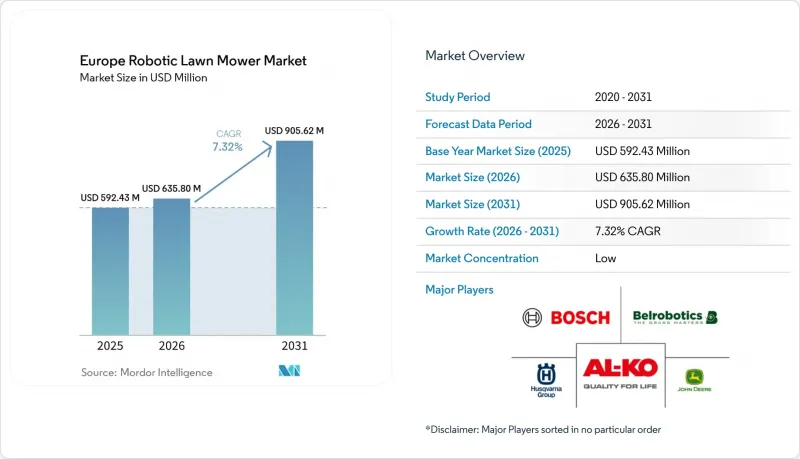
本報告按續航里程(低續航、高續航、其他)、電池容量(低於20V、高於30V、其他)、銷售管道(零售、線上、其他)、應用領域(住宅和商業)、最終用戶(住宅、市政當局、其他)、連接方式(邊界連接、視訊引導、其他)和國家進行細分。市場預測以美元計價。
歐洲機器人割草機市場趨勢與洞察
消費者對能夠節省時間的智慧家庭設備的需求日益成長。
受時間限制和生活方式偏好的影響,歐洲住宅正擴大將機器人割草機融入全面的智慧家庭生態系統中。隨著製造商開發出與現有家庭自動化平台無縫連接的產品,實現語音控制和智慧型手機管理,這一趨勢正在加速發展。 STIHL 的 iMOW 系列將智慧家庭系統與語音控制功能結合,滿足了消費者對統一自動化體驗的需求。這種整合不僅限於基本的割草功能,還包括根據天氣狀況進行定時修剪和維護提醒。雙薪家庭的出現推動了對能夠免除週末草坪維護負擔的自動化解決方案的需求。北歐市場的智慧家庭普及率與機器人割草機的普及趨勢直接相關,這表明對技術的熟悉程度是購買決策的關鍵因素。
歐盟綠色交易獎勵旨在促進電池供電設備的發展
歐盟的法規結構透過多項政策管道,賦予電池驅動的機器人割草機結構性優勢。 《淨零排放產業法案》優先考慮乾淨科技的在地化生產,而歐盟第2023/1542號法規下的新電池法規則設定了永續性要求,優先考慮電動設備而非石化燃料動力設備。生態設計要求強制進行產品生命週期評估,而機器人割草機因其高能源效率和動力來源備受青睞。成員國還推出了配套獎勵,例如對電動園藝設備提供稅額扣抵,以及限制在都市區使用汽油動力工具。這種監管勢頭使傳統割草機處於競爭劣勢,同時為機器人割草機等替代產品提供了長期的市場利好。此外,新框架下的強制性電池回收正在刺激永續能源系統的創新,並使投資於循環經濟項目的製造商受益。
與傳統割草機相比,初始成本較高
價格敏感度仍然是機器人割草機普及的主要障礙,尤其是在東歐和南歐市場,這些地區的家庭可支配收入遠低於西歐水準。高階無邊框機型的售價超過3000歐元,是同類傳統割草機的3到5倍。這種價格差異在高容量系統中最為顯著,因為先進的GPS導航和人工智慧障礙物偵測功能是其價格溢價的主要因素。雖然消費者融資和租賃方案正在湧現以解決價格問題,但與汽車和家電行業相比,它們的普及程度仍然有限。總擁有成本(TCO)計算通常表明,考慮到人事費用和燃料成本的降低,機器人系統在5-7年的使用週期內更具優勢。然而,消費者通常更關注初始購買價格,而非整個生命週期的經濟效益。製造商正在開發入門級機型以降低市場准入門檻,但這些機型的功能可能有限,因此對要求較高的用戶群吸引力不足。
細分市場分析
到2025年,中階機器人割草機將佔據最大的市場佔有率,達到44.10%,但高階機型的普及速度正在加快,到2031年複合年成長率將達到15.55%。高階機型價格較高,是因為其技術高度成熟,包括先進的人工智慧導航、更長的電池續航時間和全面的連接功能。低價機型迎合了價格敏感型消費者的需求,但面臨著功能豐富的同類產品的利潤壓力。專業園林綠化公司擴大採用高階系統進行商業應用,因為在這些應用中,可靠性和覆蓋範圍比成本更為重要。向無邊界電纜技術的轉變使高階機型受益,由於其高精度GPS定位和障礙物偵測功能,高階機型可以賣出更高的價格。 Husqvarna計劃在2025年推出13款新的無邊界電纜機型,顯示該公司致力於拓展高階市場。
該產品線的細分反映了消費者日益精細化的需求,早期用戶正從基礎型號轉向功能更豐富的升級產品。中價位產品是住宅屋主尋求可靠自動化解決方案且不願支付過高價格的理想選擇,這也解釋了該產品組在市場上的主導地位。高價位產品的快速成長表明,其關於高級功能和長期可靠性的價值提案已成功傳達。
預計到2025年,20-30V型號將佔據50.25%的最大市場佔有率,而30V以上的系統正以13.2%的年複合成長率(CAGR)推動技術變革,直至2031年。高壓系統能夠延長運作時間、縮短充電時間,並在複雜地形中實現更佳的割草性能,從而吸引更多高要求用戶的青睞。 20V以下型號主要面向小型草坪護理應用,但面臨來自更強勁替代品的競爭壓力。這種電壓演變與電動工具產業的大趨勢相吻合:即轉向具有更高單位重量性能的高容量鋰離子系統。 STIHL的電池產品策略目標是到2027年使電池驅動工具的銷售額佔其總銷售額的35%,這反映了該公司對高容量系統的重視。
鋰離子電池生產的規模經濟正在降低高壓系統的成本溢價,並加速市場轉型。此外,基於容量的細分反映了歐洲市場可用面積的分佈情況,在大型郊區場所,延長運作變得越來越重要。歐盟法規 2023/1542 中的電池回收規定鼓勵製造商投資於永續的高容量系統,而不是一次性的低壓產品。
其他好處:
- Excel格式的市場預測(ME)表
- 3個月的分析師支持
目錄
第1章:引言
- 研究假設和市場定義
- 調查範圍
第2章:調查方法
第3章執行摘要
第4章 市場狀況
- 市場概覽
- 市場促進因素
- 消費者對能夠節省時間的智慧家庭設備的需求日益成長。
- 歐盟綠色交易獎勵旨在促進電池供電設備的發展
- 邊緣視覺人工智慧技術無需邊界佈線即可實現安裝。
- 建造一座配備整合式草坪管理系統的智慧住宅。
- 隨著住宅年齡成長,對低維護成本的草坪護理解決方案的需求也越來越大。
- 向訂閱式/機器人即服務經營模式轉型
- 市場限制因素
- 初始成本高,且與傳統割草機相比
- 合租房屋及都市區竊盜風險
- 陡峭或不平坦的草坪會限制割草效率。
- 歐盟安全標準的不一致導致該產品在歐盟範圍內的上市進程被推遲。
- 價值供應鏈分析
- 技術展望
- 監理情勢
- 波特五力分析
第5章 市場規模與成長預測
- 按範圍
- 低範圍
- 中距離
- 廣大區域
- 按電池容量
- 低於20伏
- 20~30 V
- 超過30伏
- 按銷售管道
- 零售商
- 專賣店
- 線上
- 透過使用
- 住宅
- 商業的
- 最終用戶
- 住宅
- 園林綠化公司
- 體育設施和公園
- 地方政府
- 高爾夫球場
- 其他
- 透過連接方式
- Boundary-Wire
- 智慧GPS/Wi-Fi
- 視覺引導類型(攝影機/LiDAR)
- 國家
- 德國
- 英國
- 法國
- 義大利
- 西班牙
- 瑞典
- 荷蘭
- 比利時
- 奧地利
- 瑞士
- 波蘭
- 其他歐洲國家
第6章 競爭情勢
- 市場集中度
- 策略趨勢
- 市佔率分析
- 公司簡介
- Husqvarna Group
- Robert Bosch GmbH
- ANDREAS STIHL AG and Co. KG
- Deere and Company
- STIGA SpA
- Positec Tool Corp.(WORX)
- Honda Motor Co., Ltd.
- AL-KO Gardentech
- Belrobotics
- Zucchetti Centro Sistemi(Ambrogio)
- Segway Inc.
- The Toro Company
- Stanley Black and Decker(Craftsman)
- WIPER SRL
- Greenworks Tools
- MTD Products(Cub Cadet, Kress)
- Makita Corp.
第7章 市場機會與未來展望
According to Mordor Intelligence, the europe robotic lawn mower market size in 2026 is estimated at USD 635.8 million, growing from 2025 value of USD 592.43 million with 2031 projections showing USD 905.62 million, growing at 7.32% CAGR over 2026-2031.
This report is Segmented by Range (Low Range, High Range, and More), Battery Capacity (Less Than 20 V, More Than 30 V, and More), Sales Channel (Retailers, Online, and More), Application (Residential and Commercial), End-User (Homeowners, Municipalities, and More), Connectivity (Boundary-Wire, Vision-Guided, and More), and Country. The Market Forecasts are Provided in Terms of Value (USD).
Europe Robotic Lawn Mower Market Trends and Insights
Rising Demand for Time-Saving Home-Automation Devices
European homeowners increasingly integrate robotic lawn mowers into comprehensive smart home ecosystems, driven by time constraints and lifestyle preferences. The trend accelerates as manufacturers develop seamless connectivity with existing home automation platforms, enabling voice control and smartphone management. STIHL's iMOW series now integrates smart home systems and voice command capabilities, reflecting consumer demand for unified automation experiences. This integration extends beyond basic mowing to include weather-responsive scheduling and maintenance alerts. The demographic shift toward dual-income households amplifies demand for autonomous solutions that eliminate weekend lawn care obligations. Smart home penetration rates in Northern European markets correlate directly with robotic mower adoption patterns, suggesting that technology familiarity drives purchase decisions.
EU Green Deal Incentives Favoring Battery-Powered Equipment
The European Union's regulatory framework creates structural advantages for battery-powered robotic mowers through multiple policy channels. The Net Zero Industry Act prioritizes local manufacturing of clean technologies, while new battery regulations under EU 2023/1542 establish sustainability requirements that favor electric equipment over fossil fuel alternatives. Ecodesign requirements mandate product lifecycle assessments that inherently favor robotic mowers due to their energy efficiency and reduced emissions profiles. Member states are implementing complementary incentives, including tax credits for electric garden equipment and restrictions on gas-powered tools in urban areas. The regulatory momentum creates competitive disadvantages for conventional mowers while establishing long-term market tailwinds for robotic alternatives. Battery recycling mandates under the new framework also drive innovation in sustainable power systems, benefiting manufacturers investing in circular economy approaches.
High Upfront Cost Versus Conventional Mowers
Price sensitivity remains the primary barrier to robotic mower adoption, particularly in Eastern and Southern European markets where household disposable income lags Western European levels. Premium boundary wire-free models command prices exceeding EUR 3,000, representing 3-5 times the cost of equivalent conventional mowers. The cost differential is most pronounced for larger-capacity systems, where advanced GPS navigation and AI-powered obstacle detection drive significant price premiums. Consumer financing options and leasing programs are emerging to address affordability constraints, though adoption remains limited compared to the automotive or appliance sectors. The total cost of ownership calculation often favors robotic systems over 5-7 year periods when factoring labor savings and fuel costs. Yet, consumers typically focus on initial purchase price rather than lifecycle economics. Manufacturers are developing entry-level models to expand market accessibility, though feature limitations may constrain appeal among demanding users.
Other drivers and restraints analyzed in the detailed report include:
- Ageing Homeowner Population Boosting Demand for Low-Effort Lawn Care
- Construction of Smart-Homes with Integrated Turf-Management Hubs
- Theft-Vulnerability in Shared-Housing and Urban Settings
For complete list of drivers and restraints, kindly check the Table Of Contents.
Segment Analysis
Medium-range robotic mowers hold the largest market share at 44.10% in 2025, while high-range models are experiencing accelerated adoption with a CAGR of 15.55% through 2031.The premium segment benefits from technological sophistication, including advanced AI navigation, extended battery life, and comprehensive connectivity features that justify higher price points. Low-range models serve price-sensitive consumers but face margin pressure from feature-rich alternatives. Professional landscapers increasingly specify high-end systems for commercial applications where reliability and coverage capacity outweigh cost considerations. The shift toward boundary wire-free technology benefits high-end segments where GPS precision and obstacle detection capabilities command premium pricing. Husqvarna's launch of 13 new boundary wire-free models in 2025 demonstrates the manufacturer's focus on premium market expansion.
The range segmentation reflects evolving consumer sophistication as early adopters graduate from basic models to feature-rich alternatives. Medium-range products occupy the sweet spot for suburban homeowners seeking reliable automation without premium pricing, explaining their dominant market position. High-range growth acceleration suggests successful value proposition communication around advanced features and long-term reliability benefits.
The 20 to 30V models hold the largest market share at 50.25% in 2025, while more-than-30V systems drive a technological transition with a CAGR of 13.2% through 2031. Higher-voltage systems enable extended runtime, faster charging, improved cutting performance on challenging terrain, driving adoption among demanding users. Less-than-20V models serve compact lawn applications but face competitive pressure from more capable alternatives. The voltage evolution parallels broader power tool industry trends toward higher-capacity lithium-ion systems that deliver superior performance per unit weight. STIHL's battery product strategy targets 35% of sales from battery-operated tools by 2027, indicating the manufacturer's commitment to higher-capacity systems.
Manufacturing economies of scale in lithium-ion production are reducing cost premiums for higher-voltage systems, accelerating market transition. The capacity segmentation also reflects lawn size distributions across European markets, where larger suburban properties increasingly demand extended runtime capabilities. Battery recycling regulations under EU 2023/1542 favor manufacturers investing in sustainable, higher-capacity systems over disposable, lower-voltage alternatives.
List of Companies Covered in this Report:
- Husqvarna Group
- Robert Bosch GmbH
- ANDREAS STIHL AG and Co. KG
- Deere and Company
- STIGA S.p.A.
- Positec Tool Corp. (WORX)
- Honda Motor Co., Ltd.
- AL-KO Gardentech
- Belrobotics
- Zucchetti Centro Sistemi (Ambrogio)
- Segway Inc.
- The Toro Company
- Stanley Black and Decker (Craftsman)
- WIPER S.R.L.
- Greenworks Tools
- MTD Products (Cub Cadet, Kress)
- Makita Corp.
Additional Benefits:
- The market estimate (ME) sheet in Excel format
- 3 months of analyst support
TABLE OF CONTENTS
1 Introduction
- 1.1 Study Assumptions and Market Definition
- 1.2 Scope of the Study
2 Research Methodology
3 Executive Summary
4 Market Landscape
- 4.1 Market Overview
- 4.2 Market Drivers
- 4.2.1 Rising Demand for Time-Saving Home-Automation Devices
- 4.2.2 EU Green Deal Incentives Favouring Battery-Powered Equipment
- 4.2.3 Edge-Vision AI Enabling Boundary-Wire-Free Installation
- 4.2.4 Construction of Smart-Homes With Integrated Turf-Management Hubs
- 4.2.5 Ageing Homeowner Population Boosting Demand for Low-Effort Lawn Care
- 4.2.6 Shift to Subscription/Robot-as-a-Service Business Models
- 4.3 Market Restraints
- 4.3.1 High Upfront Cost Versus Conventional Mowers
- 4.3.2 Theft-Vulnerability in Shared-Housing and Urban Settings
- 4.3.3 Limited Cutting Efficiency on Steep or Multi-Tier Lawns
- 4.3.4 Fragmented EU Safety Standards Delaying Pan-EU Launches
- 4.4 Value / Supply-Chain Analysis
- 4.5 Technological Outlook
- 4.6 Regulatory Landscape
- 4.7 Porter's Five Forces Analysis
- 4.7.1 Bargaining Power of Buyers
- 4.7.2 Bargaining Power of Suppliers
- 4.7.3 Threat of New Entrants
- 4.7.4 Threat of Substitutes
- 4.7.5 Intensity of Competitive Rivalry
5 Market Size & Growth Forecasts (Value (USD))
- 5.1 By Range
- 5.1.1 Low Range
- 5.1.2 Medium Range
- 5.1.3 High Range
- 5.2 By Battery Capacity
- 5.2.1 Less Than 20 V
- 5.2.2 20 to 30 V
- 5.2.3 More Than 30 V
- 5.3 By Sales Channel
- 5.3.1 Retailers
- 5.3.2 Specialty Stores
- 5.3.3 Online
- 5.4 By Application
- 5.4.1 Residential
- 5.4.2 Commercial
- 5.5 By End-User
- 5.5.1 Homeowners
- 5.5.2 Landscaping Companies
- 5.5.3 Sports Grounds and Parks
- 5.5.4 Municipalities
- 5.5.5 Golf Courses
- 5.5.6 Others
- 5.6 By Connectivity
- 5.6.1 Boundary-Wire
- 5.6.2 Smart-GPS / Wi-Fi
- 5.6.3 Vision-Guided (Camera/LiDAR)
- 5.7 By Country
- 5.7.1 Germany
- 5.7.2 United Kingdom
- 5.7.3 France
- 5.7.4 Italy
- 5.7.5 Spain
- 5.7.6 Sweden
- 5.7.7 Netherlands
- 5.7.8 Belgium
- 5.7.9 Austria
- 5.7.10 Switzerland
- 5.7.11 Poland
- 5.7.12 Rest of Europe
6 Competitive Landscape
- 6.1 Market Concentration
- 6.2 Strategic Moves
- 6.3 Market Share Analysis
- 6.4 Company Profiles (Includes Global Level Overview, Market Level Overview, Core Segments, Financials as Available, Strategic Information, Market Rank/Share for Key Companies, Products and Services, and Recent Developments)
- 6.4.1 Husqvarna Group
- 6.4.2 Robert Bosch GmbH
- 6.4.3 ANDREAS STIHL AG and Co. KG
- 6.4.4 Deere and Company
- 6.4.5 STIGA S.p.A.
- 6.4.6 Positec Tool Corp. (WORX)
- 6.4.7 Honda Motor Co., Ltd.
- 6.4.8 AL-KO Gardentech
- 6.4.9 Belrobotics
- 6.4.10 Zucchetti Centro Sistemi (Ambrogio)
- 6.4.11 Segway Inc.
- 6.4.12 The Toro Company
- 6.4.13 Stanley Black and Decker (Craftsman)
- 6.4.14 WIPER S.R.L.
- 6.4.15 Greenworks Tools
- 6.4.16 MTD Products (Cub Cadet, Kress)
- 6.4.17 Makita Corp.
7 Market Opportunities and Future Outlook
- 7.1 White-space and Unmet-Need Assessment

 電池驅動機器人割草機市場規模:按類型、連接方式、應用、地區和預測分類。
 機器人割草機:市佔率分析、產業趨勢與統計及成長預測(2026-2031 年)
 機器人割草機市場:按類型、動力來源、草坪面積、刀片類型、電壓、銷售管道和最終用戶分類-2026-2032年全球市場預測
 2026年全球人工智慧(AI)割草機市場報告
 機器人割草機市場機會、成長要素、產業趨勢分析及2026-2035年預測無線割草機器人市場:按類型、電源、最終用戶和銷售管道,全球預測,2026-2032年
 機器人割草機市場規模、佔有率和趨勢分析報告:按電池容量、銷售管道、最終用途、地區和細分市場預測(2026-2033 年)2026年全球機器人割草機市場報告
 全球機器人割草機市場-產業規模、佔有率、趨勢、機會與預測:電池容量、草坪面積、連結性、分銷管道、最終用戶、地區和競爭格局(2021-2031)機器人割草機市場-2026-2031年預測