


 |
市場調查報告書
商品編碼
2065733
家居建材零售:市場佔有率分析、產業趨勢與統計、成長預測(2026-2031)Hardware Stores Retail - Market Share Analysis, Industry Trends & Statistics, Growth Forecasts (2026 - 2031) |
||||||

※ 本網頁內容可能與最新版本有所差異。詳細情況請與我們聯繫。
根據 Mordor Intelligence 預測,到 2025 年,家居裝修零售市場規模將達到 1.92 兆美元,到 2026 年將達到 2.01 兆美元,到 2031 年將達到 2.51 兆美元,2026 年至 2031 年的複合年成長率為 4.54%。
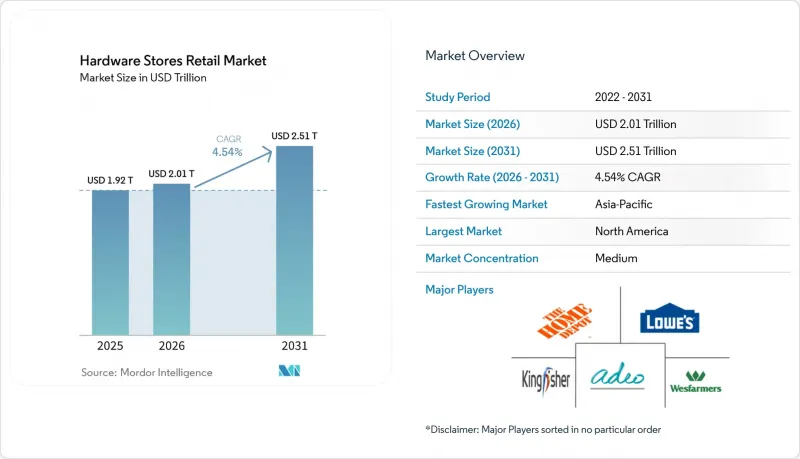
本報告按產品類型(工具和金屬製品、建材、管道和電氣、油漆和黏合劑等)、客戶類型(DIY愛好者、專業承包商、機構和MRO企業)、商店形式(大型量販店、傳統金屬製品等)以及地區(北美、南美、歐洲、亞太、中東和非洲)進行細分。市場預測以美元計價。
全球家居建材零售市場趨勢及洞察
「翻新房屋而不是搬家」的趨勢正在日益成長。
到2026年,「翻新而非搬遷」的趨勢仍將是家居裝修零售市場最清晰的需求基礎。儘管預計2026年1月美國二手住宅銷售量將達到年化391萬套,但2025年獨棟住宅建築許可數量降至七年來的最低水平,導致更多家庭維修現有住宅而非搬遷。根據HIRI的報告,預計到2025年,專業市場的銷售額將超過消費者市場的銷售額,這表明市場正在從大型、技術要求高的項目轉向熟練的承包商。這種市場結構的轉變正在推高家居裝修零售市場的平均客戶支出,即使消費者到店頻率變得更難預測。擁有種類齊全的專案導向產品、與安裝服務緊密結合以及面向承包商的庫存的零售商將更有利於抓住消費者需求。同時,預計住宅市場的「鎖定效應」將在整個預測期內持續存在。
社群媒體主導的自主學習的傳播
社群媒體降低了人們首次嘗試家居改造專案的心理門檻,為小規模維修和維修拓展了家居裝修市場的入口。短影片項目演示可幫助消費者在前往實體店或在線訂購之前,了解如何選擇工具、所需材料以及工作流程。這種趨勢在油漆、黏合劑、收納用品、園藝用品和入門級工具等類別中尤其重要,因為消費者的產品搜尋往往始於簡單的專案構想,而非計畫性的更換週期。因此,家居裝修零售市場受益於各種靈感主導的購買行為,這些行為透過搜尋、數位商品行銷和當日提貨轉化為實際銷售。這種影響在短期內最為顯著,因為它鼓勵消費者參與和產品測試,儘管更複雜的任務仍然傾向於外包給專業人士。
從 DIY 服務過渡到 DIFM 服務
從DIY(自己動手)到DIFM(無需DIY的家居裝修)的轉變正在縮小部分家居裝修零售市場面向消費者的商機。根據HIRI的報告,預計到2025年,專業市場的銷售額將超過消費者市場的銷售額,這表明許多項目正在轉向由技術嫻熟的承包商完成。此外,Wickes的報告顯示,TradePro會員數在2025會計年度達到64.3萬,比2024年的58.1萬增加了10.7%。這凸顯了零售商為留住這部分消費而透過承包商忠誠度計畫所做的努力。在家居裝修零售市場,問題不在於需求減少,而在於誰控制了銷售點的貨源。如果零售商無法在同一生態系統中同時滿足消費者和承包商的需求,則可能面臨銷售量被專業批發商和專業銷售管道蠶食的風險。
細分市場分析
到2025年,建築材料將佔總銷售額的28.73%,成為家居裝飾零售市場中最大的產品類別。其規模的成長與覆材、隔熱材料、框架木材和屋頂材料的穩定翻新需求密切相關,尤其是在家庭選擇維修現有住宅而非搬遷的情況下。隨著老舊住宅市場的發展,維修、維修和結構維修工程的需求持續成長,建築材料類別也因此受益,在這些項目中,項目規模比住宅的供應周轉率更為重要。根據目前的預測,到2031年,管道和電氣產品預計將以5.46%的複合年成長率成長,成為家裝零售市場中成長最快的產品線。這一成長趨勢反映了隨著電氣化專案和節能措施的推進,對電氣控制面板、線路、控制設備和熱泵組件的需求不斷成長。
產品組合的這種轉變意義重大,因為家裝零售業不再只依靠低價工具和日常消耗品來驅動。 「水暖和電氣」作為高價值品類,其策略重要性日益凸顯,不僅配置需求更加多樣化,增值機會眾多,而且與合格的安裝工作緊密相關。 「建材」仍然是重要的銷售量基礎,涵蓋了必要的維修和結構維修成本,並在滿足消費者和建築商的需求方面發揮著廣泛的作用。根據美國國家家裝協會 (NHPA) 2026 年的調查,48% 的家裝零售商投資於油漆和一般商品,43% 投資於草坪和花園用品,這表明零售商正在積極拓展其品類組合的平衡,並圍繞其傳統核心品類展開。即使大規模專案變得更加挑剔,油漆、黏合劑、戶外設備以及高階廚房和浴室產品對於維持重複購買、季節性客流量和提高利潤率仍然至關重要。
區域分析
到2025年,北美將佔全球市場規模的37.95%,成為家居裝潢零售業最大的區域市場。該地區受益於大規模的住宅維修市場、分佈廣泛且組織完善的零售網路,以及家庭對維修和翻新的濃厚興趣。根據HIRI預測,儘管到2025年單住宅建築許可證數量預計將下降至909,600份,但近80%的美國住宅仍計劃在2026年第一季進行維護和維修工作,這表明翻新需求仍然是主要的驅動力。北美也持續保持其作為全通路策略、承包商客戶開發和數位化技術驅動型履約模式領先試驗場的地位。各州的電氣化補貼和野火預防要求進一步增加了區域需求的複雜性,使得整個家裝零售市場的區域庫存規劃變得更加重要。
預計到2031年,亞太地區將以5.69%的複合年成長率成長,成為家居建材零售市場成長最快的地區。這一成長主要得益於快速的都市化、不斷提高的住宅擁有率,以及印度和東南亞地區有組織的家居建材零售體系的持續發展。在那些採購仍以分散的本地供應商為主、現代連鎖店滲透率有限的市場,這一成長機會尤為顯著。這種緩慢的滲透為大型連鎖店、區域網路和混合零售模式提供了發展空間,使其能夠隨著時間的推移,逐步擴大門市數量、服務範圍和產品類別。而在亞太地區較為成熟的地區,能源效率的提高、智慧家庭的融合以及老舊住宅的翻新改造則提供了不同的成長路徑,這些地區更注重產品種類的豐富而非網路的擴張。
歐洲家裝零售市場處於成熟的需求環境與顯著的國別差異之間。該地區已證明,由於各國住宅政策、消費者情緒和銷售管道結構存在巨大差異,同樣的宏觀經濟壓力可能無法帶來完全相同的結果。隨著專案需求日益挑剔,線上研究的重要性也與日俱增,歐洲商店型零售商面臨著提升數位化服務、加速產品提貨速度以及改善客戶服務水準的壓力。南美、中東和非洲雖然市場規模仍然相對較小,但預計隨著城市發展、維修需求以及五金購買習慣的逐步普及,這些地區的需求將會成長。在所有這些地區,家居裝飾零售市場的發展都受到區域門市密度、房屋裝修需求以及零售商提升購物便利性和可及性的速度之間平衡的影響。
其他好處:
- Excel格式的市場預測(ME)表
- 3個月的分析師支持
目錄
第1章:引言
- 研究假設和市場定義
- 調查範圍
第2章:調查方法
第3章執行摘要
第4章 市場狀況
- 市場概覽
- 市場促進因素
- 選擇房屋翻新而不是搬家的趨勢正在上升。
- 社群媒體正在推動自主學習的普及。
- 對全通路「點擊提貨」的需求不斷成長
- 增加維修工程以提高能源效率
- 州政府擴大電氣化補貼計劃
- 加大防火維修力度,以應對野火
- 市場限制因素
- 從 DIY 服務過渡到 DIFM 服務
- 住宅負擔限制了該專案的進度。
- 組織零售犯罪數量增加
- 關於退稅和關稅的政策波動
- 價值供應鏈分析
- 監理情勢
- 技術展望
- 波特五力模型
第5章 市場規模與成長預測
- 產品類型
- 工具和五金
- 建材
- 管道和電氣設備
- 油漆、黏合劑和住宅維修用品
- 戶外及花園
- 廚房、浴室、置物間
- 依客戶類型
- DIY愛好者
- 專業承包商和工匠
- 機構和MRO買家
- 按商店類型
- 大型家居建材商店
- 傳統家居裝修商店
- 木材和建材零售商
- 農場/牧場用品商店
- 純線上平台
- 按地區
- 北美洲
- 美國
- 加拿大
- 墨西哥
- 南美洲
- 巴西
- 秘魯
- 智利
- 阿根廷
- 其他南美國家
- 歐洲
- 英國
- 德國
- 法國
- 西班牙
- 義大利
- 比荷盧經濟聯盟(比利時、荷蘭、盧森堡)
- 北歐國家(丹麥、芬蘭、冰島、挪威、瑞典)
- 其他歐洲國家
- 亞太地區
- 印度
- 中國
- 日本
- 澳洲
- 韓國
- 東南亞(新加坡、馬來西亞、泰國、印尼、越南、菲律賓)
- 其他亞太國家
- 中東和非洲
- 阿拉伯聯合大公國
- 沙烏地阿拉伯
- 南非
- 奈及利亞
- 其他中東和非洲國家
- 北美洲
第6章 競爭情勢
- 市場集中度
- 策略趨勢
- 市佔率分析
- 公司簡介
- The Home Depot, Inc.
- Lowe's Companies, Inc.
- Ace Hardware Corporation
- Menard, Inc.
- Do it Best Group
- True Value Company
- Wesfarmers Limited(Bunnings Group)
- ADEO
- Kingfisher plc
- OBI Group Holding SE & Co. KGaA
- HORNBACH Holding AG & Co. KGaA
- BAUHAUS AG
- hagebau Handelsgesellschaft fur Baustoffe mbH & Co. KG
- Travis Perkins plc
- Wickes Group plc
- Grafton Group plc
- Kesko Corporation
- Mr. DIY Group(M)Berhad
- Canadian Tire Corporation, Limited
- Metcash Limited(Mitre 10/Total Tools)
第7章 市場機會與未來展望
According to Mordor Intelligence, the hardware stores retail market size is projected to be USD 1.92 trillion in 2025, USD 2.01 trillion in 2026, and reach USD 2.51 trillion by 2031, growing at a CAGR of 4.54% from 2026 to 2031.
This report is Segmented by Product Category (Tools & Hardware, Building Materials, Plumbing & Electrical, Paint & Adhesives, and More), by Customer Type (DIY, Professional Contractors, Institutional & MRO), by Store Format (Big-Box, Traditional Hardware, and More), and by Geography (North America, South America, Europe, Asia-Pacific, and MEA). The Market Forecasts are Provided in Terms of Value (USD).
Global Hardware Stores Retail Market Trends and Insights
Rising Renovation Over Relocation Trend
The renovation-over-relocation pattern remains the clearest demand base for the hardware retail market in 2026. U.S. existing home sales were running at a 3.91 million annual rate in January 2026, while single-family permits fell to a seven-year low in 2025, prompting more households to improve their current homes rather than move. HIRI reported that professional market sales are projected to grow faster than consumer market sales in 2025, pointing to larger and more technical projects moving toward skilled execution. This mix is lifting average ticket values in the hardware retail market, even when store visit frequency becomes less predictable. Retailers with deeper project assortments, stronger installed-sales links, and contractor-ready inventory are better placed to capture spending. At the same time, the housing lock-in effect stays in place through the forecast period.
Social Media Driven DIY Learning Adoption
Social media is lowering the confidence barrier to first-time project work, giving the hardware retail market a wider entry funnel for smaller repair and improvement jobs. Short-form project demonstrations are helping consumers understand tool selection, material needs, and sequencing before they visit a store or place an online order. That behavior matters most in categories such as paint, adhesives, storage, garden products, and entry-level tools, where product discovery often starts with simple project ideas rather than planned replacement cycles. The hardware retail market is therefore benefiting from a broader set of inspiration-led purchases that can be converted through search, digital merchandising, and same-day pickup. The effect is strongest in the short term because it encourages participation and product trial, even if more advanced work still shifts toward professional execution.
Shift From DIY to DIFM Services
The shift from do-it-yourself to do-it-for-me activity is narrowing the direct consumer opportunity in parts of the hardware retail market. HIRI reported that professional market sales are projected to grow faster than consumer market sales in 2025, which shows that more project volume is moving toward skilled execution. Wickes also reported that TradePro membership reached 643,000 in FY2025, up 10.7% from 581,000 in 2024, highlighting retailers' efforts to retain this spend through trade-focused loyalty systems. For the hardware retail market, the issue is less about demand disappearance and more about who controls procurement at the point of sale. Retailers that fail to serve both consumer and contractor missions in the same ecosystem risk losing volume to trade distributors and specialist merchant channels.
Other drivers and restraints analyzed in the detailed report include:
- Growing Omnichannel Click-and-Collect Demand
- Increasing Energy Efficiency Retrofit Upgrades
- Housing Affordability Limiting Projects
For complete list of drivers and restraints, kindly check the Table Of Contents.
Segment Analysis
Building Materials accounted for 28.73% of the total value in 2025, making it the largest product segment in the hardware retail market. Its scale is tied to steady renovation demand for sheathing, insulation, framing lumber, and roofing products, especially when households choose to improve existing homes rather than relocate. This category continues to benefit from repair, rehabilitation, and structural retrofit work in aging housing markets, where project depth matters more than new-home turnover. Plumbing & Electrical is projected to grow at a 5.46% CAGR through 2031, making it the fastest-growing product line in the hardware retail market under the current forecast. That trajectory reflects stronger demand for electrical panels, wiring, controls, and heat pump components as electrification programs and efficiency upgrades expand.
The product mix shift matters because the hardware retail industry is no longer driven only by low-ticket tools and routine consumables. Plumbing & Electrical is gaining strategic weight as a higher-value category with more configuration needs, better attachment opportunities, and stronger links to licensed installation work. Building Materials still anchors volume because it captures both essential repair spend and structural renovation outlays, which gives it a broad role across consumer and contractor demand. The NHPA's 2026 survey found that 48% of hardware retailers were investing in paint and sundries, while 43% were investing in lawn and garden, which shows that merchants are actively widening category balance around the traditional core. Paint, adhesives, outdoor products, and premium kitchen and bath lines remain important because they support repeat purchases, seasonal traffic, and margin expansion even as large project work becomes more selective.
Geography Analysis
North America accounted for 37.95% of the global value in 2025, making it the largest regional market in hardware retail. The region benefits from a large home-improvement base, widespread organized retail networks, and a durable culture of household investment in repair and renovation. HIRI reported that single-family permits fell to 909,600 in 2025, yet nearly 80% of U.S. homeowners were still planning maintenance or improvement work in Q1 2026, which shows why renovation demand remains the main support line. North America also remains the main test bed for omnichannel execution, contractor account development, and digitally supported fulfillment models. State-level electrification rebates and wildfire-hardening requirements add another layer of local demand variation, which makes regional inventory planning more important across the hardware retail market.
Asia-Pacific is projected to grow at a 5.69% CAGR through 2031, which makes it the fastest-expanding geography in the hardware retail market. Growth is being supported by rapid urbanization, rising homeownership, and the continued development of organized hardware retail structures in India and Southeast Asia. The opportunity is especially notable in markets where fragmented local trade still dominates procurement and modern chain penetration remains limited. That underpenetration gives large-format chains, local networks, and hybrid retail models room to expand store count, service coverage, and category sophistication over time. In more mature parts of the region, energy-efficiency upgrades, smart-home integration, and aging-home renovation offer a different growth path, less dependent on network expansion and more on product mix.
Europe sits between mature demand conditions and uneven country-level performance in the hardware retail market. The region shows that the same macro pressure does not yield identical outcomes because housing policy, consumer sentiment, and channel structure differ widely across countries. Store-based players in Europe are under pressure to improve digital access, pickup speed, and trade-customer service as project demand becomes more selective and online research becomes more important. South America, the Middle East, and Africa remain smaller in absolute terms, but they still offer incremental demand through urban development, repair activity, and the gradual formalization of hardware buying. Across all these regions, the hardware retail market is being shaped by the balance between local store density, renovation demand, and the pace at which organized retail can improve convenience and product access.
- The Home Depot, Inc.
- Lowe's Companies, Inc.
- Ace Hardware Corporation
- Menard, Inc.
- Do it Best Group
- True Value Company
- Wesfarmers Limited (Bunnings Group)
- ADEO
- Kingfisher plc
- OBI Group Holding SE & Co. KGaA
- HORNBACH Holding AG & Co. KGaA
- BAUHAUS AG
- hagebau Handelsgesellschaft fur Baustoffe mbH & Co. KG
- Travis Perkins plc
- Wickes Group plc
- Grafton Group plc
- Kesko Corporation
- Mr. D.I.Y. Group (M) Berhad
- Canadian Tire Corporation, Limited
- Metcash Limited (Mitre 10 / Total Tools)
Additional Benefits:
- The market estimate (ME) sheet in Excel format
- 3 months of analyst support
TABLE OF CONTENTS
1 Introduction
- 1.1 Study Assumptions & Market Definition
- 1.1.1 Scope of the Study
2 Research Methodology
3 Executive Summary
4 Market Landscape
- 4.1 Market Overview
- 4.2 Market Drivers
- 4.2.1 Rising renovation over relocation trend
- 4.2.2 Social media driven DIY learning adoption
- 4.2.3 Growing omnichannel click-and-collect demand
- 4.2.4 Increasing energy efficiency retrofit upgrades
- 4.2.5 Expansion of state rebate electrification programs
- 4.2.6 Rising wildfire hardening retrofit initiatives
- 4.3 Market Restraints
- 4.3.1 Shift from DIY to DIFM services
- 4.3.2 Housing affordability limiting projects
- 4.3.3 Rising organized retail crime incidents
- 4.3.4 Policy volatility in rebates and tariffs
- 4.4 Value / Supply-Chain Analysis
- 4.5 Regulatory Landscape
- 4.6 Technological Outlook
- 4.7 Porter's Five Forces
- 4.7.1 Bargaining Power of Suppliers
- 4.7.2 Bargaining Power of Buyers
- 4.7.3 Threat of New Entrants
- 4.7.4 Threat of Substitutes
- 4.7.5 Intensity of Competitive Rivalry
5 Market Size & Growth Forecasts (Value)
- 5.1 By Product Category
- 5.1.1 Tools & Hardware
- 5.1.2 Building Materials
- 5.1.3 Plumbing & Electrical
- 5.1.4 Paint, Adhesives & Home Improvement Consumables
- 5.1.5 Outdoor & Garden
- 5.1.6 Kitchen, Bath & Storage
- 5.2 By Customer Type
- 5.2.1 DIY Consumers
- 5.2.2 Professional Contractors & Tradespeople
- 5.2.3 Institutional & MRO Buyers
- 5.3 By Store Format
- 5.3.1 Big-Box Home Centers
- 5.3.2 Traditional Hardware Stores
- 5.3.3 Lumber & Building Material Yards
- 5.3.4 Farm & Ranch Supply Stores
- 5.3.5 Online-Only Platforms
- 5.4 By Geography
- 5.4.1 North America
- 5.4.1.1 United States
- 5.4.1.2 Canada
- 5.4.1.3 Mexico
- 5.4.2 South America
- 5.4.2.1 Brazil
- 5.4.2.2 Peru
- 5.4.2.3 Chile
- 5.4.2.4 Argentina
- 5.4.2.5 Rest of South America
- 5.4.3 Europe
- 5.4.3.1 United Kingdom
- 5.4.3.2 Germany
- 5.4.3.3 France
- 5.4.3.4 Spain
- 5.4.3.5 Italy
- 5.4.3.6 BENELUX (Belgium, Netherlands, and Luxembourg)
- 5.4.3.7 NORDICS (Denmark, Finland, Iceland, Norway, and Sweden)
- 5.4.3.8 Rest of Europe
- 5.4.4 Asia-Pacific
- 5.4.4.1 India
- 5.4.4.2 China
- 5.4.4.3 Japan
- 5.4.4.4 Australia
- 5.4.4.5 South Korea
- 5.4.4.6 South East Asia (Singapore, Malaysia, Thailand, Indonesia, Vietnam, and Philippines)
- 5.4.4.7 Rest of Asia-Pacific
- 5.4.5 Middle East And Africa
- 5.4.5.1 United Arab Emirates
- 5.4.5.2 Saudi Arabia
- 5.4.5.3 South Africa
- 5.4.5.4 Nigeria
- 5.4.5.5 Rest of Middle East And Africa
- 5.4.1 North America
6 Competitive Landscape
- 6.1 Market Concentration
- 6.2 Strategic Moves
- 6.3 Market Share Analysis
- 6.4 Company Profiles {(includes Global level Overview, Market level overview, Core Segments, Financials as available, Strategic Information, Market Rank/Share for key companies, Products & Services, and Recent Developments)}
- 6.4.1 The Home Depot, Inc.
- 6.4.2 Lowe's Companies, Inc.
- 6.4.3 Ace Hardware Corporation
- 6.4.4 Menard, Inc.
- 6.4.5 Do it Best Group
- 6.4.6 True Value Company
- 6.4.7 Wesfarmers Limited (Bunnings Group)
- 6.4.8 ADEO
- 6.4.9 Kingfisher plc
- 6.4.10 OBI Group Holding SE & Co. KGaA
- 6.4.11 HORNBACH Holding AG & Co. KGaA
- 6.4.12 BAUHAUS AG
- 6.4.13 hagebau Handelsgesellschaft fur Baustoffe mbH & Co. KG
- 6.4.14 Travis Perkins plc
- 6.4.15 Wickes Group plc
- 6.4.16 Grafton Group plc
- 6.4.17 Kesko Corporation
- 6.4.18 Mr. D.I.Y. Group (M) Berhad
- 6.4.19 Canadian Tire Corporation, Limited
- 6.4.20 Metcash Limited (Mitre 10 / Total Tools)
7 Market Opportunities & Future Outlook
- 7.1 White-space & unmet-need assessment
- 7.2 Expansion of Smart Home and Energy-Efficient Retrofit Products
- 7.3 Growth of Pro-Contractor Loyalty and Omnichannel Retail Platforms

 不鏽鋼櫥櫃五金市場-2026年至2032年全球市場預測
 美國金屬製品零售市場:市場佔有率分析、產業趨勢與統計、成長預測(2026-2031)
 全球建築與金屬製品五金市場
 五金工具市場:依產品類型、最終用途產業及地區分類建築金屬製品市場:2026-2032年全球市場預測(依產品類型、材料、操作機制、安裝方式、通路和最終用戶分類)
 2026年全球人工智慧硬體市場報告自助服務終端硬體市場按組件、部署方式、支付方式、應用和垂直產業分類-全球預測,2026-2032年2026年全球硬體市場報告印度家具金屬製品市場:市場佔有率分析、產業趨勢與統計、成長預測(2026-2031)
 家具金屬製品:全球市佔率及排名、總收入及需求預測(2025-2031年)