


 |
市場調查報告書
商品編碼
2065620
飼料適應原:市佔率分析、產業趨勢與統計、成長預測(2026-2031)Feed Adaptogens - Market Share Analysis, Industry Trends & Statistics, Growth Forecasts (2026 - 2031) |
||||||

※ 本網頁內容可能與最新版本有所差異。詳細情況請與我們聯繫。
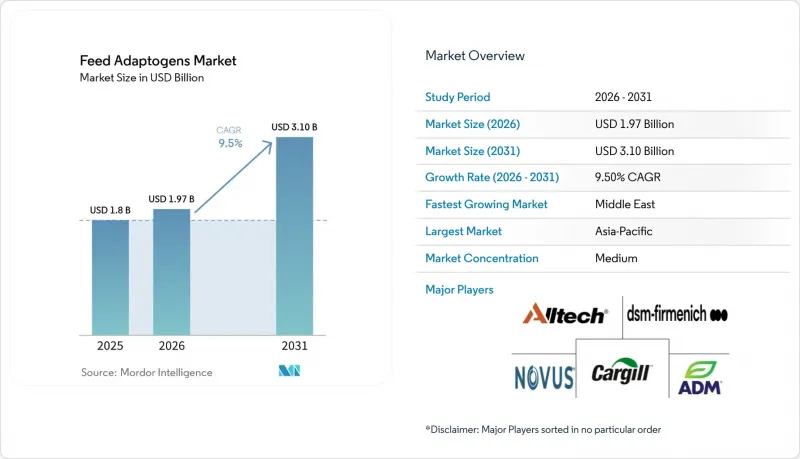
根據 Mordor Intelligence 預測,飼料適應原市場將從 2025 年的 18 億美元成長到 2026 年的 19.7 億美元,到 2031 年達到 31 億美元,預計 2026 年至 2031 年的複合年成長率為 9.50%。
本報告依原料(草藥適應原、蘑菇適應原)、劑型(粉末、液體、膠囊/微丸)、畜禽(家禽、豬、反芻動物、水產養殖、寵物)、功能(緩解壓力、增強免疫力、提高飼料轉換率)和地區(北美、南美、歐洲及其他地區)進行分類。市場預測以美元計價。
全球飼料適應原市場趨勢及洞察
禁止使用抗生素作為生長促進劑
禁用抗生素生長促進劑為飼料適應原市場帶來了最顯著的結構性推動作用。這是因為幾個主要畜牧經濟體已經淘汰了最成熟、成本最低的生長促進劑。美國已停止生產和使用具有重要醫療價值的抗菌藥物,中國已逐步淘汰抗生素生長促進劑,加拿大也取消了抗菌藥物的生長促進標籤,這些都促使飼料供應商轉向非抗生素飼料解決方案。此外,中等收入生產國對抗生素的使用仍較為靈活,而出口壓力也推動了飼料適應原市場的發展。這是因為出口商越來越需要滿足目的地市場買家的要求。
對源自天然草藥的畜牧產品的需求不斷成長
飼料適應原市場正獲得買家的青睞,他們尋求的是來自低抗生素使用、高投入透明度生產系統的肉類、牛奶、雞蛋和水產品。食品零售商、連鎖餐廳和進口商要求供應商提供無抗生素生產的認證,這使得飼料選擇不再僅取決於農場層面的偏好,而是需要經過採購審核。斯洛伐克尼特拉農業大學的研究人員在2026年的研究中發現,植物來源飼料添加劑可以提高家禽、豬和反芻動物的飼料轉換率、腸道健康和抗氧化能力。這進一步提升了草藥適應原在那些力求擺脫常規抗生素使用的生產系統中的商業性價值。這種轉變的影響範圍更廣,不僅在北美和歐盟,而且在巴西、印度和泰國等以出口為導向的生產商中,採用天然飼料方案的速度也超過了國內政策的要求。因此,飼料適應原市場不僅在監管嚴格的地區擴張,而且在那些需要依靠清潔生產和可追溯飼料管理實踐才能獲得高品質出口管道的地區也在擴張。
植物性飼料添加劑面臨監管障礙和複雜的核准流程
監管仍然是飼料適應原市場面臨的最大限制因素之一。這是因為植物來源添加劑的核准流程比許多傳統飼料原料更為複雜。根據歐盟法規 (EC) 1831/2003,歐洲食品安全局 (EFSA) 要求在產品進入審查程序之前,必須提交涵蓋目標物種安全性、消費者安全性、使用者安全性和環境安全性的完整文件。 EFSA 指出,科學評估只有在提交完整的申請文件後才會開始,而要求補充資料可能會使審查流程超出最短所需時間。這可能導致商業化進程的延遲和合遵循成本的增加。 2025 年發布的關於迷迭香、薰衣草、薄荷和野生百里香酊劑的意見充分說明了這一流程的複雜性,其中包括物種特定的含量限制、甲基丁香酚的法規以及基於危害分析和關鍵控制點 (HACCP) 的品質要求。
細分市場分析
到2025年,草本適應原將佔據最大的市場佔有率,達到61.2%,憑藉其與現有家禽和豬飼料配方的契合度,繼續保持其在飼料適應原市場的領先地位。牛至、百里香、薑黃、南非醉茄和睡茄等植物的精油混合物、酊劑和乾提取物的商業用途已確立多年,使買家能夠更好地了解其處理方法、配方和功能作用。與新興功能性產品相比,草本成分擁有更完善的供應鏈和更廣泛的功效研究,進一步鞏固了其市場地位。
以蘑菇來源的適應原為核心的飼料適應原市場預計到2031年將以9.8%的複合年成長率成長,成為目前預測期間內成長最快的原料細分市場。在飼料適應原產業,靈芝、猴頭菇、蛹蟲草和雙孢蘑菇等蘑菇來源的原料正日益受到關注,因為它們在禽類和反芻動物飼料的研究基礎日益深厚。此外,與某些野生採摘的植物相比,使用廢棄的蘑菇培養基和可控栽培模式更符合循環生產的目標,從而從永續性的角度支持了該細分市場的發展。
到2025年,粉劑將佔據最大的市場佔有率,達到52.3%。這反映出粉劑與商業性家禽和生豬生產中常用的主流飼料生產系統高度契合。乾粉預混合料和顆粒飼料生產線的設計已能高效處理粉劑,從而降低了轉換成本,並易於整合到現有製程中。此外,許多植物萃取物和蘑菇多醣在適當製備後,能夠承受調質和製粒溫度,即使在大規模研磨過程中也能保持良好的性能。
預計到2031年,液態飼料適應原市場將以8.5%的複合年成長率成長,隨著集約化養殖系統的擴張,液態適應原有望成為成長最快的細分市場。液態給藥方式在肉雞和蛋雞養殖中極具吸引力,因為它可以透過飲水系統實現均勻分配,從而在出現熱應激或疾病威脅時,能夠比傳統的飼料生產週期更快地做出反應。水溶性睡茄萃取物和精油乳劑在這些環境中變得越來越重要,因為它們使農場管理者能夠快速調整劑量,而無需等待新的飼料批次。
區域分析
預計到2025年,亞太地區將佔據35.4%的最大市場佔有率,繼續保持其在飼料適應原市場的核心地位。這主要得益於該地區龐大的畜牧業規模和深厚的草藥原料使用傳統。中國仍然是主要驅動力,因為該國禁用抗生素生長促進劑的政策促使這個全球最大的畜牧系統之一轉向替代飼料。印度是第二大成長基地,其不斷擴張的複合飼料產業和成熟的阿育吠陀獸醫實踐,如今正支持更大規模的產品開發。日本和澳洲的市場規模小規模,但兩國都在推動高階水產飼料的創新以及以生物安全主導的配方標準。因此,亞太地區的飼料適應原市場正受到規模和品質雙重提升的驅動,東南亞家禽和蝦類養殖系統對飼料規格的要求也日益提高。
中東是成長最快的區域市場,在糧食安全政策推動下,畜牧業和水產養殖業集約化發展,預計到2031年,飼料適應原市場將以8.9%的複合年成長率成長。沙烏地阿拉伯、阿拉伯聯合大公國和土耳其正利用政府主導的發展計畫和長期供應契約,比許多新興地區更快地將現代飼料添加劑引入家禽和魚類生產。這縮短了標準的採用週期,並透過規範的採購為國際供應商提供了更清晰的市場准入機會。非洲仍然是最小的區域市場,但蘊藏著長期發展機遇,因為南非、埃及和奈及利亞政府正致力於提高畜牧業生產力,以滿足都市區日益成長的動物性蛋白質需求。
北美和歐洲是下一個主要需求區域,這得益於相關法規、大規模一體化畜牧系統以及消費者對更清潔畜牧模式的偏好。美國是北美需求的主要驅動力,因為其家禽和生豬產業已通過大規模的商業網路運營,從而能夠迅速吸收經過檢驗的非抗生素添加劑。在飼料適應原市場,歐洲的監管力道仍高於其他任何地區。這是因為植物來源添加劑必須經過嚴格的核准流程,雖然這會延緩產品上市,但卻能增強消費者對已核准產品的信心。德國、法國和英國是歐洲的主要需求中心,零售商的採購標準和永續性要求會影響添加劑的選擇。
其他好處:
- Excel格式的市場預測(ME)表
- 3個月的分析師支持
目錄
第1章:引言
- 研究假設和市場定義
- 調查範圍
第2章:調查方法
第3章執行摘要
第4章 市場狀況
- 市場概覽
- 市場促進因素
- 禁止使用抗生素作為生長促進劑
- 對天然和草本畜牧產品的需求不斷成長
- 商業畜牧業中的熱應激管理
- 全球水產養殖業的快速成長
- 透過補充適應原最佳化飼料成本。
- 精準畜牧養殖技術的引進
- 市場限制因素
- 植物來源飼料添加劑面臨監管障礙和複雜的核准流程
- 植物性原料中黴菌毒素污染的風險
- 草本適應原生產擴充性不穩定
- 植物性原料供不應求和價格波動
- 監理情勢
- 技術展望
- 波特五力分析
第5章 市場規模與成長預測
- 按原料
- 草本適應原
- 蘑菇來源的適應原
- 按形式
- 粉末
- 液體
- 包封和微珠
- 畜牧業
- 家禽
- 豬
- 反芻動物
- 水產養殖
- 寵物
- 按功能
- 減輕壓力
- 增強免疫功能
- 提高飼料轉換率
- 按地區
- 北美洲
- 美國
- 加拿大
- 墨西哥
- 其他北美國家
- 南美洲
- 巴西
- 阿根廷
- 其他南美國家
- 歐洲
- 德國
- 法國
- 英國
- 義大利
- 俄羅斯
- 其他歐洲國家
- 亞太地區
- 中國
- 印度
- 日本
- 澳洲
- 其他亞太國家
- 中東
- 沙烏地阿拉伯
- 阿拉伯聯合大公國
- 土耳其
- 其他中東國家
- 非洲
- 南非
- 埃及
- 奈及利亞
- 其他非洲國家
- 北美洲
第6章 競爭情勢
- 市場集中度
- 策略趨勢
- 市佔率分析
- 公司簡介
- Cargill, Incorporated
- DSM-Firmenich AG
- Archer Daniels Midland Company
- Alltech, Inc.
- Kemin Industries, Inc.
- Trouw Nutrition International BV(Nutreco NV)
- Novus International, Inc.
- Phytobiotics Futterzusatzstoffe GmbH
- EW Nutrition GmbH
- Nutrex NV
- Ayurvet Limited
- Indian Herbs Specialities Private Limited
- Natural Remedies Private Limited
- Zinpro Corporation
- Phytoline GmbH
第7章 市場機會與未來展望
According to Mordor Intelligence, the feed adaptogens market size is projected to increase from USD 1.80 billion in 2025 to USD 1.97 billion in 2026 and reach USD 3.10 billion by 2031, growing at a CAGR of 9.50% over 2026-2031.
This report is Segmented by Source (Herbal Adaptogens, and Mushroom Adaptogens), by Form (Powder, Liquid, and Encapsulated and Beadlet), by Livestock (Poultry, Swine, Ruminants, Aquaculture, and Pets ), by Function (Stress Mitigation, Immune Enhancement, and Feed Conversion), and by Geography (North America, South America, Europe, and More). The Market Forecasts are Provided in Terms of Value (USD).
Global Feed Adaptogens Market Trends and Insights
Ban on Antibiotics as Growth Promoters
The ban on antibiotic growth promoters has become the clearest structural support for the feed adaptogens market, as it removed the most established, low-cost growth tool from several major livestock economies. The United States ended the production and use of medically important antimicrobials, China eliminated antibiotic growth promoters, and Canada removed growth-promotion claims from antimicrobial labels, thereby shifting procurement toward non-antibiotic feed solutions. The feed adaptogens market is also benefiting from export pressure in middle-income producer countries, where antibiotic use remains more flexible, as exporters increasingly need to comply with buyer requirements in destination markets.
Rising Demand for Natural and Herbal Livestock Products
The feed adaptogens market is gaining support from buyers seeking meat, milk, eggs, and seafood from systems with lower antibiotic use and greater input transparency. Food retailers, restaurant chains, and importers are asking suppliers to document antibiotic-free production, which brings feed decisions into procurement audits rather than leaving them as farm-level preferences. A 2026 review published by researchers of the Slovak University of Agriculture in Nitra found that phytogenic feed additives improved feed conversion ratio, intestinal integrity, and antioxidant status across poultry, swine, and ruminants, strengthening the commercial case for herbal adaptogens in production systems seeking to move away from routine antibiotic support. This change matters beyond North America and the European Union because export-oriented producers in Brazil, India, and Thailand are adopting natural feed programs earlier than local policy alone would require. As a result, the feed adaptogens market is expanding not only in regions with strict regulation but also in those where access to premium export channels depends on cleaner production claims and traceable feed practices.
Regulatory Barriers and Complex Approval Processes for Botanical Feed Additives
Regulation remains one of the clearest limits on the feed adaptogens market because botanical additives face a more detailed approval process than many conventional feed inputs. Under Regulation (EC) No. 1831/2003, the European Food Safety Authority requires complete dossiers that cover target species safety, consumer safety, user safety, and environmental safety before a product can move through review. The European Food Safety Authority states that scientific assessment begins only after a complete submission, and additional data requests can lengthen the process beyond the minimum review window, which delays commercialization and increases compliance expense. Its 2025 opinions on rosemary, lavender, peppermint, and wild thyme tinctures show how specific this process can become, including species-based inclusion limits, methyleugenol controls, and hazard analysis and critical control point quality expectations.
Other drivers and restraints analyzed in the detailed report include:
- Heat-Stress Management in Commercial Livestock
- Rapid Growth of Global Aquaculture Sector
- Mycotoxin Contamination Risk in Botanical Raw Materials
For complete list of drivers and restraints, kindly check the Table Of Contents.
Segment Analysis
Herbal adaptogens held the largest market share at 61.2% in 2025, keeping them firmly ahead in the feed adaptogens market because they already fit established poultry and swine feed programs. Commercial use has been built over many years around essential oil blends, tinctures, and dry extracts from oregano, thyme, turmeric, ashwagandha, and astragalus, so buyers are more familiar with their handling, inclusion rates, and performance role. This established base is reinforced by sourcing depth and by the wider set of documented efficacy studies available for herbal materials than for newer functional categories.
The feed adaptogens market for mushroom adaptogens is projected to expand at a 9.8% CAGR through 2031, making them the fastest-growing source segment in the current forecast period. The feed adaptogens industry is giving mushroom-derived inputs more attention because species such as Ganoderma lucidum, Hericium erinaceus, Cordyceps militaris, and Agaricus bisporus now have a stronger research base across poultry and ruminant diets. Sustainability also supports this segment, as spent mushroom substrate and controlled cultivation models better align with circular production goals than some wild-harvested botanicals.
Powder accounted for the largest market share at 52.3% in 2025, reflecting how closely this format aligns with the dominant feed manufacturing systems used in commercial poultry and swine production. Dry premixes and pelleted feed lines are already designed to handle powders efficiently, which lowers changeover costs and keeps the format easy to integrate into existing routines. Powder also performs well in large-scale milling because many botanical extracts and mushroom polysaccharides can tolerate conditioning and pelleting temperatures when properly prepared.
The feed adaptogens market size for liquid formats is projected to grow at an 8.5% CAGR through 2031, making liquid the fastest-growing segment as intensive housing systems expand. Liquid delivery is attractive in broiler and layer operations because drinking water systems allow uniform dosing and a much faster response during heat stress events or disease pressure than a normal feed production cycle can provide. Water-soluble ashwagandha extracts and essential oil emulsions are becoming more relevant in these settings because farm managers can change dose levels quickly without waiting for a new feed batch.
Geography Analysis
Asia-Pacific held the largest regional market share at 35.4% in 2025, keeping it at the center of the feed adaptogens market, as the region combines large livestock volumes with deep herbal raw material traditions. China remains the main anchor because its ban on antibiotic growth promoters shifted one of the world's largest animal production systems toward alternative feed tools. India adds a second growth base through its expanding compound feed sector and through established Ayurvedic veterinary practice that now supports more industrial-scale product development. Japan and Australia are smaller in total volume, but both influence premium aquafeed innovation and biosecurity-led formulation standards. The feed adaptogens market in Asia-Pacific is therefore driven by both scale and quality progression, with Southeast Asian poultry and shrimp systems also upgrading feed specifications.
The Middle East is the fastest regional segment, with the feed adaptogens market projected to expand at an 8.9% CAGR through 2031 as food security policies drive livestock and aquaculture intensification. Saudi Arabia, the United Arab Emirates, and Turkey are using state-backed development programs and long-term supply arrangements to bring modern feed additives into poultry and fish production faster than many emerging regions. That shortens the standard adoption cycle and provides international suppliers with clearer entry points through organized procurement. Africa remains the smallest regional segment, but it offers a longer-term opportunity, as governments in South Africa, Egypt, and Nigeria work to boost livestock productivity amid rising urban demand for animal protein.
North America and Europe formed the next major demand bloc, supported by regulation, large integrated livestock systems, and buyer preference for cleaner animal production models. The United States leads North American demand because its poultry and swine industries already operate through large commercial networks that can quickly absorb validated non-antibiotic additives. Europe remains more regulated than any other region in the feed adaptogens market, since botanical additives must pass a strict authorization process that slows launches but raises confidence in approved products. Germany, France, and the United Kingdom are the main European demand centers, where retailer sourcing standards and sustainability requirements influence additive selection.
- Cargill, Incorporated
- DSM-Firmenich AG
- Archer Daniels Midland Company
- Alltech, Inc.
- Kemin Industries, Inc.
- Trouw Nutrition International B.V. (Nutreco N.V.)
- Novus International, Inc.
- Phytobiotics Futterzusatzstoffe GmbH
- EW Nutrition GmbH
- Nutrex N.V.
- Ayurvet Limited
- Indian Herbs Specialities Private Limited
- Natural Remedies Private Limited
- Zinpro Corporation
- Phytoline GmbH
Additional Benefits:
- The market estimate (ME) sheet in Excel format
- 3 months of analyst support
TABLE OF CONTENTS
1 Introduction
- 1.1 Study Assumptions and Market Definition
- 1.2 Scope of the Study
2 Research Methodology
3 Executive Summary
4 Market Landscape
- 4.1 Market Overview
- 4.2 Market Drivers
- 4.2.1 Ban on antibiotics as growth promoters
- 4.2.2 Rising demand for natural and herbal livestock products
- 4.2.3 Heat-stress management in commercial livestock
- 4.2.4 Rapid growth of global aquaculture sector
- 4.2.5 Feed-cost optimization through adaptogen supplementation
- 4.2.6 Adoption of precision livestock farming practices
- 4.3 Market Restraints
- 4.3.1 Regulatory barriers and complex approval processes for botanical feed additives
- 4.3.2 Mycotoxin contamination risk in botanical raw materials
- 4.3.3 Volatile scalability of herbal adaptogen production
- 4.3.4 Limited supply and price volatility of botanical raw materials
- 4.4 Regulatory Landscape
- 4.5 Technological Outlook
- 4.6 Porter's Five Forces Analysis
- 4.6.1 Threat of New Entrants
- 4.6.2 Bargaining Power of Suppliers
- 4.6.3 Bargaining Power of Buyers
- 4.6.4 Threat of Substitutes
- 4.6.5 Intensity of Competitive Rivalry
5 Market Size and Growth Forecasts (Value, USD)
- 5.1 By Source
- 5.1.1 Herbal Adaptogens
- 5.1.2 Mushroom Adaptogens
- 5.2 By Form
- 5.2.1 Powder
- 5.2.2 Liquid
- 5.2.3 Encapsulated and Beadlet
- 5.3 By Livestock Species
- 5.3.1 Poultry
- 5.3.2 Swine
- 5.3.3 Ruminants
- 5.3.4 Aquaculture
- 5.3.5 Pets
- 5.4 By Function
- 5.4.1 Stress Mitigation
- 5.4.2 Immune Enhancement
- 5.4.3 Feed Conversion Improvement
- 5.5 By Region
- 5.5.1 North America
- 5.5.1.1 United States
- 5.5.1.2 Canada
- 5.5.1.3 Mexico
- 5.5.1.4 Rest of North America
- 5.5.2 South America
- 5.5.2.1 Brazil
- 5.5.2.2 Argentina
- 5.5.2.3 Rest of South America
- 5.5.3 Europe
- 5.5.3.1 Germany
- 5.5.3.2 France
- 5.5.3.3 United Kingdom
- 5.5.3.4 Italy
- 5.5.3.5 Russia
- 5.5.3.6 Rest of Europe
- 5.5.4 Asia-Pacific
- 5.5.4.1 China
- 5.5.4.2 India
- 5.5.4.3 Japan
- 5.5.4.4 Australia
- 5.5.4.5 Rest of Asia-Pacific
- 5.5.5 Middle East
- 5.5.5.1 Saudi Arabia
- 5.5.5.2 United Arab Emirates
- 5.5.5.3 Turkey
- 5.5.5.4 Rest of Middle East
- 5.5.6 Africa
- 5.5.6.1 South Africa
- 5.5.6.2 Egypt
- 5.5.6.3 Nigeria
- 5.5.6.4 Rest of Africa
- 5.5.1 North America
6 Competitive Landscape
- 6.1 Market Concentration
- 6.2 Strategic Moves
- 6.3 Market Share Analysis
- 6.4 Company Profiles (Includes Global Level Overview, Market Level Overview, Core Segments, Financials as Available, Strategic Information, Market Rank/Share for Key Companies, Products and Services, and Recent Developments)
- 6.4.1 Cargill, Incorporated
- 6.4.2 DSM-Firmenich AG
- 6.4.3 Archer Daniels Midland Company
- 6.4.4 Alltech, Inc.
- 6.4.5 Kemin Industries, Inc.
- 6.4.6 Trouw Nutrition International B.V. (Nutreco N.V.)
- 6.4.7 Novus International, Inc.
- 6.4.8 Phytobiotics Futterzusatzstoffe GmbH
- 6.4.9 EW Nutrition GmbH
- 6.4.10 Nutrex N.V.
- 6.4.11 Ayurvet Limited
- 6.4.12 Indian Herbs Specialities Private Limited
- 6.4.13 Natural Remedies Private Limited
- 6.4.14 Zinpro Corporation
- 6.4.15 Phytoline GmbH


