


 |
市場調查報告書
商品編碼
2065586
人力資本管理與薪資核算整合平台:市場佔有率分析、產業趨勢與統計及成長預測(2026-2031 年)HCM And Payroll Convergence Platform - Market Share Analysis, Industry Trends & Statistics, Growth Forecasts (2026 - 2031) |
||||||

※ 本網頁內容可能與最新版本有所差異。詳細情況請與我們聯繫。
據 Mordor Intelligence 稱,HCM 和薪資核算整合平台市場預計將從 2025 年的 274.8 億美元成長到 2026 年的 297.7 億美元,到 2031 年達到 476.5 億美元,2026 年至 2031 年的複合年成長率為 9.86%。
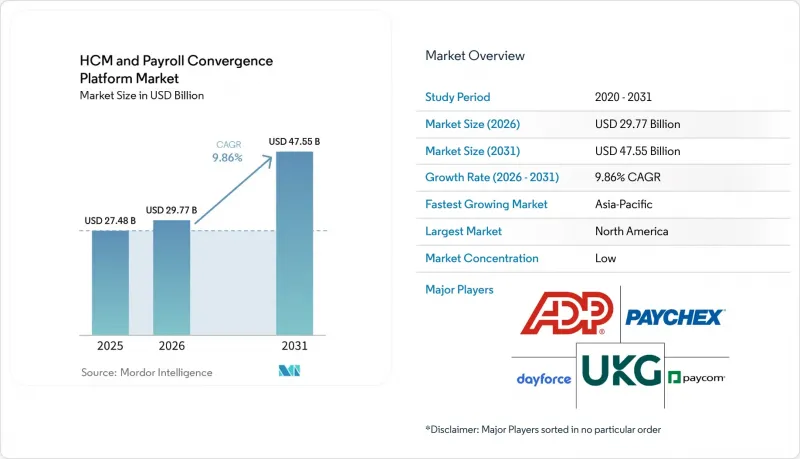
本報告按元件(軟體和服務)、部署模式(雲端、本地部署、混合部署)、企業規模(大型企業和中小企業)、最終用戶產業(銀行、金融服務和保險 (BFSI)、醫療保健和生命科學、資訊科技和電信、其他)以及地區進行細分。市場預測以美元 (USD) 為單位。
全球人力資本管理與薪資核算整合平台市場趨勢及洞察
從傳統人力資源和薪資系統遷移到雲端
隨著傳統人力資源和薪資系統維護難度加大,更新耗時,雲端遷移仍然是人力資本管理 (HCM) 和薪資核算整合平台市場最強勁的結構性驅動力。 SAP SE 和塔塔諮詢服務公司 (TCS) 於 2026 年 5 月完成的薪資轉型項目,充分展現了雲端環境為企業實際營運帶來的諸多優勢:遷移到 SAP Cloud ERP Private 後,薪資處理週期縮短了 30% 至 40%。此外,雲端原生平台允許供應商以統一的方式在整個租戶環境中應用規則變更,從而簡化了合規性更新。而本地部署用戶仍然依賴內部修補程式計劃和現場測試週期。隨著監管變化日益頻繁,薪資核算團隊對政策和配置變更之間延遲的接受度越來越低,差距正變得越來越顯著。 SAP 本地部署 HCM 軟體的標準維護計畫將於 2027 年終止,這促使許多企業客戶從被動考慮遷移轉變為主動簽訂合約。類似的壓力也體現在實際營運中。 Strada 2026 年 5 月的一份報告顯示,儘管 77% 的大型企業使用 HCM 平台,但他們仍然依賴人工薪資核算備份流程,而遺留環境中的技術債繼續減緩現代化進程。
多邊薪資核算和勞工合規問題的日益複雜化。
合規性正變得日益複雜,其發展速度令許多薪資核算團隊難以跟上,人力資本管理 (HCM) 和薪資核算整合平台市場與監管合規性的關聯度也越來越高,而非軟體偏好。歐盟的《工資透明指令》規定,各國必須在 2026 年 6 月 7 日前將其納入國家法律,相關雇主將被要求在 2027 年 6 月提交首個性別薪資差距報告週期。這凸顯了在薪資核算和人力資源系統中採用通用薪酬資料模型的必要性。在歐洲以外,諸如巴西的 eSocial 和印度的僱員公積金 (EPFO) 等數位化報告框架的報告要求正在推動本地化工作,而全球性公司無法透過分散的系統有效地管理這些要求。因此,買家越來越傾向於選擇能夠將集中管理與本地監管合規性和本地文件支援相結合的平台。這些營運負擔並非只有大規模套件產品才能勝任。對本地合規性的深入了解也是國家引擎專家的優勢,他們能夠提供可靠的司法管轄區合規性。因此,HCM(人力資本管理)和薪資核算整合平台市場不僅透過軟體訂閱不斷擴張,而且還透過實施、檢驗和薪資核算管理服務不斷擴張,這些服務可以幫助公司在多個國家保持合規性。
薪資資料遷移的轉換成本高且風險巨大
遷移薪資資料的成本仍然是人力資本管理 (HCM) 和薪資核算整合平台市場面臨的最大障礙之一,因為它直接涉及財務、法律和聲譽風險。 Strada 於 2026 年 5 月發布的一項關於依賴人工薪資處理備份的研究表明,即使擁有 HCM 平台的企業仍然依賴備用流程,這凸顯了薪資變更專案需要高度謹慎的運作。這種困難不僅限於系統切換;企業還必須轉換歷史記錄、檢驗、測試當地法規,並記錄每個步驟以進行審計。這使得替換現有供應商更具挑戰性,因為這些供應商內建的薪資核算配置通常包含多年來開發的組織特定邏輯,這使得買家不願意輕易更改。因此,在 HCM 和薪資核算整合平台市場,僅憑不滿很少足以成為更換供應商的理由,新參與企業通常必須先證明其產品遷移風險低,才能證明其產品的經濟優勢。
細分市場分析
到2025年,軟體收入將佔總收入的68.14%,訂閱式授權模式仍將是企業預算的最大組成部分,並繼續成為人力資本管理(HCM)和薪資核算整合平台市場的支柱。軟體收入佔HCM和薪資核算整合平台市場佔有率的68.14%,顯示買家在添加外部支援之前,仍然優先考慮核心平台的所有權。在這一領域,核心人力資源和薪資核算仍將是大多數買家的基礎契約,在此基礎上,供應商正在將業務擴展到考勤管理、福利管理、人才管理工具和勞動力管理等領域。隨著雇主需要集中查看跨轄區的薪資帳簿、人事費用和合規狀態,市場需求正迅速轉向全球薪資編配和分析模組。這種擴展模式確保了軟體仍然是供應商收入的核心,因為每個新增模組都會使平台更難被取代,並提升其對財務和人力資源團隊的價值。
預計到2031年,服務業將以12.47%的複合年成長率成長。儘管其收入基數較小,但預計它將成為人力資本管理(HCM)和薪資核算整合平台市場中成長最快的細分市場。這一成長反映出,許多買家發現購買軟體比在每個國家/地區建立管治、檢驗當地法規以及管理生產遷移要快速得多。在跨國部署中,實施諮詢、薪資核算管理支援、平行運作測試和變更管理仍然必不可少,尤其是在內部人力資源團隊缺乏相關領域專業知識的情況下。雖然人工智慧驅動的模板和預先配置的國家/地區工作流程有可能縮短部分部署流程,但這並不能消除對專業服務的需求。相反,HCM和薪資核算整合平台產業的服務重點正在轉向管治、異常處理和長期最佳化。
預計到2025年,基於雲端的採用將佔總收入的70.82%,這反映了整個人力資本管理(HCM)和薪資核算整合平台市場長期以來對SaaS模式的偏好。雲端平台之所以持續吸引人,是因為它們簡化了更新流程,減輕了本地基礎設施的負擔,並提供了比許多老舊的本地系統更完善的員工自助服務體驗。對於希望快速更新合規性或尋求在人力資源、薪資和勞動力管理方面實現更統一介面的企業而言,這一優勢尤其明顯。然而,受監管的企業部署基地限制了某些工作負載完全遷移到公共雲端環境的速度。因此,在資料儲存位置、稽核實務或內部風險管理等方面仍優先考慮本地處理的領域,本地系統將繼續發揮至關重要的作用。
預計到2031年,混合部署的複合年成長率將達到14.63%,使其成為成長最快的模式,也是人力資本管理 (HCM) 和薪資核算整合平台市場規模分階段現代化討論的關鍵要素。 Mercans 和 PayrollOrg 聯合發布的一份2025年報告顯示,37% 的企業採用混合薪資核算模式,結合內部和外包,而 21% 的企業則完全外包給國內供應商。這凸顯了靈活交付架構在商業性的重要性。大型企業傾向於將自助服務、勞動力管理和分析功能遷移到雲端,同時保留運算引擎和敏感的特定國家流程。能夠與傳統 SAP、Oracle 和 PeopleSoft 系統整合的供應商正受益於此趨勢,因為它降低了遷移風險,而無需從一開始就強制進行完整的系統替換。在 HCM 和薪資核算整合平台產業,混合模式不再只是一種臨時的妥協方案,而是正在成為擁有多層 ERP 環境和嚴格管治要求的企業的切實可行的長期模式。
區域分析
2025年,北美地區佔全球整體收入的41.26%,是人力資本管理(HCM)和薪資核算整合平台市場中最大的區域佔有率。北美地區2025年41.26%的市佔率主要得益於企業級HCM套件的廣泛部署和成熟的人力資源薪資核算採購慣例。美國仍然是主要驅動力,這主要源於其對平台的持續投資,因為雇主經常面臨工資稅義務,以及日益多樣化和不斷變化各州的假日和工資法規。 Paylocity 2026年的一項調查顯示,只有13%的組織會在單一原生平台上運行人力資源和財務,這凸顯了該地區在系統遷移和整合方面仍然存在大規模的機會。在加拿大和墨西哥,跨境勞動力流動和承包商付款的複雜性進一步推動了這一需求,促使中型企業轉向原生多司法管轄區功能。
歐洲仍然是人力資本管理 (HCM) 和薪資核算整合平台的第二大市場,同時也承受著最沉重的監管負擔。歐盟的《工資透明指令》規定,必須在 2026 年 6 月 7 日前納入各國法律。自 2027 年 6 月起,適用的雇主將被要求每年報告性別薪資差距。這迫使企業建立整合的人力資源和薪資記錄,以支援薪酬分析和報告。德國和英國仍然是該地區最大的兩個市場,因為共同決策規則、合約工身份的複雜性以及當地的合規要求都增加了對整合的需求。 Personio 在 2026 年第一季實現了首次獲利,客戶數量達到 16,000 家,終端用戶達到 150 萬。這表明,歐洲中小企業對整合人力資源和薪資管理的需求已達到相當規模。此外,由於巴西的 eSocial 框架和阿根廷的工資指數化製度的複雜性,對具有增強的區域合規能力的平台的需求不斷成長,南美洲的重要性日益凸顯。
預計到2031年,亞太地區將以15.12%的複合年成長率成長,成為人力資本管理(HCM)和薪資核算整合平台市場成長最快的地區。 2026年3月,ADP報告稱,該地區49%的企業正在考慮在薪資核算營運中採用人工智慧(AI),33%的企業已將AI列為未來兩到三年技術投資的首要任務。這凸顯了營運現代化的迫切性以及企業採用新型薪資核算工具的意願。印度和東南亞的薪資核算規範化進程正在推進,而中國、澳洲和日本對支援平台升級的電子申報的期望也在不斷提高。在中東和非洲,勞動力在地化計畫、薪資核算基礎設施的建設以及早期市場對「行動優先」理念的採用正在推動市場需求,並將HCM和薪資核算整合平台市場的機會拓展到成熟企業區域之外。
其他好處:
- Excel格式的市場預測(ME)表
- 3個月的分析師支持
目錄
第1章:引言
- 研究假設和市場定義
- 調查範圍
第2章:調查方法
第3章執行摘要
第4章 市場狀況
- 市場概覽
- 市場促進因素
- 從傳統人力資源和薪資系統遷移到雲端
- 跨國薪資核算和勞動合規的複雜性日益增加
- 對一體化員工體驗和自助服務的需求。
- 人工智慧驅動的自動化薪資核算和勞動力分析
- 歐盟工資透明度指令正在推廣共用薪酬數據的模式。
- 薪水支付與勞動力支付管道和承包商支付管道整合起來。
- 市場限制因素
- 遷移薪資資料需要付出高昂的轉換成本和風險。
- 資料隱私、網路安全以及跨境資料傳輸相關的風險
- 國內支付基礎設施和地方銀行監管的碎片化
- 全球索賠數據之所以存在總結偏差,是因為各國引擎的覆蓋範圍有限。
- 產業價值鏈分析
- 監理情勢
- 技術展望
- 宏觀經濟因素對市場的影響
- 波特五力分析
第5章 市場規模與成長預測
- 按組件
- 軟體
- 核心人力資源與薪資管理
- 勞動力管理
- 人才管理
- 考勤管理
- 員工福利管理
- 勞動力分析與人工智慧
- 全球薪酬管理編配
- 服務
- 軟體
- 按部署模式
- 基於雲端的
- 現場
- 混合
- 按公司規模
- 大公司
- 小型企業
- 按最終用戶行業分類
- BFSI
- 醫療保健和生命科學
- IT/通訊
- 零售與電子商務
- 工業製造
- 政府/公共部門
- 按地區
- 北美洲
- 美國
- 加拿大
- 墨西哥
- 南美洲
- 巴西
- 阿根廷
- 其他南美國家
- 歐洲
- 德國
- 英國
- 法國
- 義大利
- 西班牙
- 俄羅斯
- 荷蘭
- 其他歐洲國家
- 亞太地區
- 中國
- 日本
- 印度
- 韓國
- 澳洲和紐西蘭
- 其他亞太國家
- 中東
- 沙烏地阿拉伯
- 阿拉伯聯合大公國
- 其他中東國家
- 非洲
- 南非
- 奈及利亞
- 其他非洲國家
- 北美洲
第6章 競爭情勢
- 市場集中度
- 策略趨勢
- 市佔率分析
- 公司簡介。
- Automatic Data Processing, Inc.
- Dayforce, Inc.
- UKG Inc.
- Paychex, Inc.
- Paycom Software, Inc.
- Paylocity Holding Corporation
- Gusto, Inc.
- Rippling People Center Inc.
- Deel Inc.
- Papaya Global Ltd.
- Bamboo HR LLC
- Hi Bob Limited
- Personio SE and Co. KG
- Darwinbox Digital Solutions Private Limited
- Workday, Inc
- isolved, inc.
- Zellis UK Limited
- Zalaris ASA
- Remote Technology, Inc.
- Oyster HR, Inc.
- Namely, Inc.
第7章 市場機會與未來展望
According to Mordor Intelligence, the hCM and payroll convergence platform market size is expected to increase from USD 27.48 billion in 2025 to USD 29.77 billion in 2026 and reach USD 47.65 billion by 2031, growing at a CAGR of 9.86% over 2026-2031.
This report is Segmented by Component (Software, and Services), Deployment Model (Cloud-Based, On-Premises, and Hybrid), Enterprise Size (Large Enterprises, and Small and Medium Enterprises), End-User Industry (BFSI, Healthcare and Life Sciences, Information Technology and Telecom, and More), and Geography. The Market Forecasts are Provided in Terms of Value (USD).
Global HCM And Payroll Convergence Platform Market Trends and Insights
Cloud Migration from Legacy HR and Payroll Stacks
Cloud migration remains the strongest structural force in the HCM and payroll convergence platform market because older HR and payroll estates are becoming harder to maintain and slower to update. A May 2026 payroll transformation completed by SAP SE and Tata Consultancy Services delivered 30-40% faster payroll processing cycles after migration to SAP Cloud ERP Private, showing the operating advantage that cloud environments are now producing in live enterprise settings. Cloud-native platforms also make compliance updates easier because vendors can push rule changes across tenant environments at once, while on-premise users still depend on internal patching schedules and local testing cycles. This gap matters more as regulatory changes become more frequent and payroll teams have less tolerance for the lag between policy and configuration changes. SAP's standard maintenance for on-premises HCM software is due to end in 2027, turning passive interest in migration into active contract decisions for many enterprise accounts. The same pressure is evident in operating practice, as Strada reported in May 2026 that 77% of large employers still relied on manual payroll backup processes despite using an HCM platform, indicating that technical debt in legacy environments continues to slow modernization.
Rising Complexity of Multi-country Payroll and Labor Compliance
Compliance complexity is rising faster than many payroll teams can absorb, keeping the HCM and payroll convergence platform market closely tied to regulatory execution rather than software preference alone. The EU Pay Transparency Directive set a June 7, 2026, transposition deadline and will require the first gender pay gap reporting cycle in June 2027 for covered employers, underscoring the need for shared compensation data models across payroll and HR systems. Outside Europe, digital reporting frameworks such as Brazil's eSocial and India's Employees' Provident Fund Organization filing requirements are adding local configuration work that global employers cannot manage well through fragmented systems. That is why buyers increasingly value platforms that can combine centralized oversight with local rule execution and local documentation support. The operational strain does not benefit only the biggest suites; deep local compliance knowledge also protects in-country engine specialists who can deliver trusted jurisdiction coverage. As a result, the HCM and payroll convergence platform market is expanding not only through software subscriptions but also through implementation, validation, and managed payroll services that help enterprises stay compliant across multiple countries.
High Switching Costs And Payroll Data Migration Risk
Switching costs remain one of the strongest brakes on the HCM and payroll convergence platform market, as payroll migration carries direct financial, legal, and reputational risks. Strada's May 2026 findings on manual payroll backup dependence show that even organizations with HCM platforms still rely on fallback processes, indicating the extent of operational caution around payroll change programs. The difficulty is not limited to system cutover, since enterprises must also convert historical records, run parallel validations, test local rules, and document every step for audit readiness. That makes established vendors harder to displace because their embedded payroll configurations often hold years of organization-specific logic that buyers hesitate to disturb. The result is an HCM and payroll convergence platform market where dissatisfaction alone is rarely enough to trigger replacement, and challengers must usually prove lower migration risk before they can prove better product economics.
Other drivers and restraints analyzed in the detailed report include:
- Demand For Unified Employee Experience and Self-service
- AI-enabled Payroll Automation and Workforce Intelligence
- Data Privacy, Cybersecurity, And Cross-border Data Transfer Exposure
For complete list of drivers and restraints, kindly check the Table Of Contents.
Segment Analysis
Software accounted for 68.14% of total revenue in 2025 and remained the anchor of the HCM and payroll convergence platform market, as subscription licensing still accounts for the largest share of enterprise budgets. Software held 68.14% of the HCM and payroll convergence platform market share in 2025, showing that buyers continue to prioritize core platform ownership before layering external support. Within this layer, core HR and payroll remained the base contract for most buyers, and that base is still the point from which vendors expand into time and attendance, benefits administration, talent tools, and workforce management. Demand is moving quickly toward global payroll orchestration and analytics modules, as employers seek a single view of payroll registers, workforce costs, and compliance status across jurisdictions. That expansion pattern keeps software central to vendor revenue because each additional module makes the platform harder to replace and more valuable to finance and HR teams.
Services are projected to expand at a 12.47% CAGR through 2031, making them the fastest-growing component of the HCM and payroll convergence platform market, despite starting from a smaller revenue base. This growth reflects the fact that many buyers can purchase software faster than they can configure governance, validate local rules, and manage live cutovers across countries. Multi-country deployments still need implementation consulting, managed payroll support, parallel-run testing, and change management, especially when internal HR teams lack jurisdiction-specific expertise. AI-assisted templates and pre-configured country workflows may shorten parts of the deployment process, but they do not eliminate the need for specialist services. Instead, they are shifting service effort toward governance, exception handling, and long-term optimization inside the HCM and payroll convergence platform industry.
Cloud-based deployment accounted for 70.82% of revenue in 2025, reflecting the long-standing preference for SaaS in new implementations across the HCM and payroll convergence platform market. Cloud platforms remain attractive because they simplify updates, reduce internal infrastructure burdens, and support a cleaner employee self-service experience than many older local installations. That advantage is strongest in organizations that want faster compliance updates and a more unified interface across HR, payroll, and workforce management. Even so, the installed base of regulated enterprises still limits how quickly some workloads can be fully migrated to public cloud environments. On-premises systems, therefore, retain a meaningful role in sectors where data residency, audit practice, or internal risk controls still favor local processing.
Hybrid deployment is projected to record a 14.63% CAGR through 2031, making it the fastest-growing model and an important part of the HCM and payroll convergence platform market size discussion for phased modernization. Mercans and PayrollOrg reported in 2025 that 37% of organizations used a hybrid in-house and outsourced payroll model, while 21% fully outsourced to in-country providers, underscoring why a flexible delivery architecture remains commercially important. Large enterprises often prefer to keep calculation engines or sensitive country processes in place while moving self-service, workforce management, and analytics to the cloud. Vendors with connectors to older SAP, Oracle, and PeopleSoft estates are benefiting from this pattern, as it reduces cutover risk without forcing a full replacement on day 1. In the HCM and payroll convergence platform industry, hybrid is acting less like a temporary compromise and more like a practical long-term model for organizations with layered ERP estates and strict governance requirements.
Geography Analysis
North America accounted for 41.26% of global revenue in 2025 and represented the largest regional position in the HCM and payroll convergence platform market. North America held 41.26% of the HCM and payroll convergence platform market share in 2025, supported by a deep installed base of enterprise HCM suites and mature HR technology procurement practices. The United States remains the main engine because employers face frequent payroll tax obligations and a growing mix of state-level leave and wage rules that favor ongoing platform investment. Paylocity's 2026 survey also showed that only 13% of organizations operated HR and finance on a single native platform, which confirms that large replacement and consolidation opportunities still exist in the region. Canada and Mexico add to this demand through cross-border workforce mobility and the complexity of contractor payments, pushing mid-market firms toward native multi-jurisdictional capability.
Europe remained the second-largest region in the HCM and payroll convergence platform market and carried the heaviest regulatory burden. The EU Pay Transparency Directive set a June 7, 2026, transposition deadline and will require annual gender pay gap reporting for covered employers from June 2027, pushing organizations toward unified HR and payroll records that support compensation analysis and reporting. Germany and the United Kingdom remained the two largest national markets in the region because codetermination rules, contractor status complexity, and local compliance expectations all increase integration needs. Personio reported its first profitable quarter in Q1 2026, with 16,000 customers and 1.5 million end users, demonstrating that integrated HR and payroll demand in the European SME base has reached meaningful scale. South America is also gaining relevance as Brazil's eSocial framework and Argentina's wage indexation complexity increase demand for platforms with stronger native regional compliance support.
Asia-Pacific is projected to grow at a 15.12% CAGR through 2031, making it the fastest-growing region in the HCM and payroll convergence platform market. ADP reported in March 2026 that 49% of organizations in the region were exploring AI for learner payroll operations, and 33% viewed AI as their primary technology investment priority for the next 2-3 years, highlighting both the urgency of modernization and the willingness to adopt new payroll tools. India and Southeast Asia are benefiting from payroll formalization, while China, Australia, and Japan continue to raise digital filing expectations that support platform upgrades. In the Middle East and Africa, demand is being shaped by workforce nationalization programs, the formalization of payroll infrastructure, and mobile-first adoption in early-stage markets, extending the HCM and payroll convergence platform market opportunity beyond the most mature enterprise regions.
- Automatic Data Processing, Inc.
- Dayforce, Inc.
- UKG Inc.
- Paychex, Inc.
- Paycom Software, Inc.
- Paylocity Holding Corporation
- Gusto, Inc.
- Rippling People Center Inc.
- Deel Inc.
- Papaya Global Ltd.
- Bamboo HR LLC
- Hi Bob Limited
- Personio SE and Co. KG
- Darwinbox Digital Solutions Private Limited
- Workday, Inc
- isolved, inc.
- Zellis UK Limited
- Zalaris ASA
- Remote Technology, Inc.
- Oyster HR, Inc.
- Namely, Inc.
Additional Benefits:
- The market estimate (ME) sheet in Excel format
- 3 months of analyst support
TABLE OF CONTENTS
1 INTRODUCTION
- 1.1 Study Assumptions and Market Definition
- 1.2 Scope of the Study
2 RESEARCH METHODOLOGY
3 EXECUTIVE SUMMARY
4 MARKET LANDSCAPE
- 4.1 Market Overview
- 4.2 Market Drivers
- 4.2.1 Cloud Migration From Legacy HR and Payroll Stacks
- 4.2.2 Rising Complexity of Multi-country Payroll and Labor Compliance
- 4.2.3 Demand for Unified Employee Experience and Self-service
- 4.2.4 AI-enabled Payroll Automation and Workforce Intelligence
- 4.2.5 EU Pay Transparency Directive Driving Shared Compensation Data Models
- 4.2.6 Convergence of Payroll With Workforce Payments and Contractor Payout Rails
- 4.3 Market Restraints
- 4.3.1 High Switching Costs and Payroll Data Migration Risk
- 4.3.2 Data Privacy, Cybersecurity, and Cross-border Data Transfer Exposure
- 4.3.3 In-country Payment Rail Fragmentation and Local Banking Mandates
- 4.3.4 Limited Native Country Engine Coverage Behind Aggregated Global Claims
- 4.4 Industry Value-Chain Analysis
- 4.5 Regulatory Landscape
- 4.6 Technological Outlook
- 4.7 Impact of Macroeconomic Factors on the Market
- 4.8 Porter's Five Forces Analysis
- 4.8.1 Threat of New Entrants
- 4.8.2 Bargaining Power of Buyers
- 4.8.3 Bargaining Power of Suppliers
- 4.8.4 Threat of Substitutes
- 4.8.5 Intensity of Competitive Rivalry
5 MARKET SIZE AND GROWTH FORECASTS (VALUE)
- 5.1 By Component
- 5.1.1 Software
- 5.1.1.1 Core HR and Payroll
- 5.1.1.2 Workforce Management
- 5.1.1.3 Talent Management
- 5.1.1.4 Time and Attendance
- 5.1.1.5 Benefits Administration
- 5.1.1.6 Workforce Analytics and AI
- 5.1.1.7 Global Payroll Orchestration
- 5.1.2 Services
- 5.1.1 Software
- 5.2 By Deployment Model
- 5.2.1 Cloud-based
- 5.2.2 On-premises
- 5.2.3 Hybrid
- 5.3 By End User Enterprise Size
- 5.3.1 Large Enterprises
- 5.3.2 Small and Medium Enterprises
- 5.4 By End-user Industry
- 5.4.1 BFSI
- 5.4.2 Healthcare and Life Sciences
- 5.4.3 Information Technology and Telecom
- 5.4.4 Retail and E-commerce
- 5.4.5 Industrial Manufacturing
- 5.4.6 Government and Public Sector
- 5.5 By Geography
- 5.5.1 North America
- 5.5.1.1 United States
- 5.5.1.2 Canada
- 5.5.1.3 Mexico
- 5.5.2 South America
- 5.5.2.1 Brazil
- 5.5.2.2 Argentina
- 5.5.2.3 Rest of South America
- 5.5.3 Europe
- 5.5.3.1 Germany
- 5.5.3.2 United Kingdom
- 5.5.3.3 France
- 5.5.3.4 Italy
- 5.5.3.5 Spain
- 5.5.3.6 Russia
- 5.5.3.7 Netherlands
- 5.5.3.8 Rest of Europe
- 5.5.4 Asia-Pacific
- 5.5.4.1 China
- 5.5.4.2 Japan
- 5.5.4.3 India
- 5.5.4.4 South Korea
- 5.5.4.5 Australia and New Zealand
- 5.5.4.6 Rest of Asia-Pacific
- 5.5.5 Middle East
- 5.5.5.1 Saudi Arabia
- 5.5.5.2 United Arab Emirates
- 5.5.5.3 Rest of Middle East
- 5.5.6 Africa
- 5.5.6.1 South Africa
- 5.5.6.2 Nigeria
- 5.5.6.3 Rest of Africa
- 5.5.1 North America
6 COMPETITIVE LANDSCAPE
- 6.1 Market Concentration
- 6.2 Strategic Moves
- 6.3 Market Share Analysis
- 6.4 Company Profiles (includes Global Level Overview, Market Level Overview, Core Segments, Financials as available, Strategic Information, Market Rank/Share, Products and Services, Recent Developments).
- 6.4.1 Automatic Data Processing, Inc.
- 6.4.2 Dayforce, Inc.
- 6.4.3 UKG Inc.
- 6.4.4 Paychex, Inc.
- 6.4.5 Paycom Software, Inc.
- 6.4.6 Paylocity Holding Corporation
- 6.4.7 Gusto, Inc.
- 6.4.8 Rippling People Center Inc.
- 6.4.9 Deel Inc.
- 6.4.10 Papaya Global Ltd.
- 6.4.11 Bamboo HR LLC
- 6.4.12 Hi Bob Limited
- 6.4.13 Personio SE and Co. KG
- 6.4.14 Darwinbox Digital Solutions Private Limited
- 6.4.15 Workday, Inc
- 6.4.16 isolved, inc.
- 6.4.17 Zellis UK Limited
- 6.4.18 Zalaris ASA
- 6.4.19 Remote Technology, Inc.
- 6.4.20 Oyster HR, Inc.
- 6.4.21 Namely, Inc.
7 MARKET OPPORTUNITIES AND FUTURE OUTLOOK
- 7.1 White-space and unmet-need assessment

 價格最佳化與管理軟體市場規模、佔有率及成長分析:按應用程式、部署類型、組織規模、定價功能、最終用戶和地區分類-2026-2033年產業預測
 全球GPU即服務市場(至2040年):按組件、部署模式、經營模式、企業規模、應用、最終用戶、地區和主要參與者分類
 平台工程和內部開發者平台(IDP):市場佔有率分析、行業趨勢和統計數據以及成長預測(2026-2031 年)
 2026年全球清潔管理軟體市場報告2026年全球價格優化與管理軟體市場報告2026年全球雲端田野歷史資料庫市場報告
 2026-2030年全球平台工程工具市場
 平台工程市場預測至2032年:按組件、平台使用者、技術、最終用戶和地區分類的全球分析全球GPU即服務(GPUaaS)市場:未來預測(至2032年)-依服務模式、部署方式、GPU類型、組織規模、應用程式、最終用戶和地區進行分析2025年全球雲端財務營運市場報告