


 |
市場調查報告書
商品編碼
2065574
ERP實施服務:市場佔有率分析、產業趨勢與統計、成長預測(2026-2031年)ERP Implementation Services - Market Share Analysis, Industry Trends & Statistics, Growth Forecasts (2026 - 2031) |
||||||

※ 本網頁內容可能與最新版本有所差異。詳細情況請與我們聯繫。
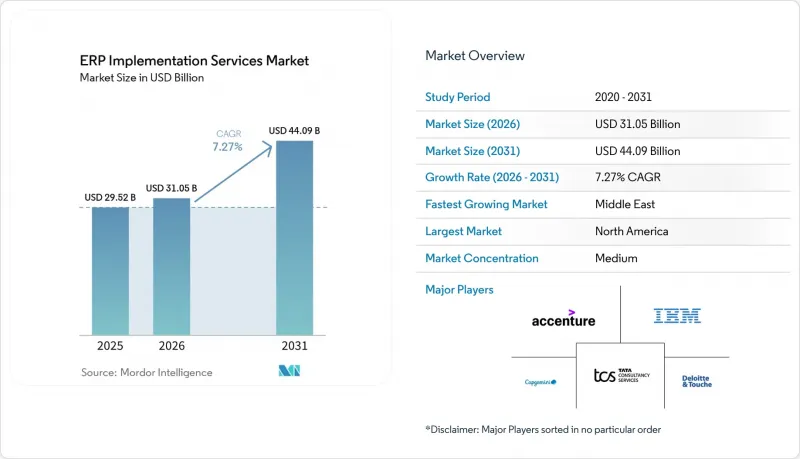
根據 Mordor Intelligence 預測,eRP 實施服務市場將從 2025 年的 295.2 億美元成長到 2026 年的 310.5 億美元,到 2031 年達到 440.9 億美元,2026 年至 2031 年的複合年成長率為 7.27%。
本報告按部署模式(本地部署、雲端部署、混合部署)、組織規模(中小企業和大型企業)、最終用戶行業(製造業、零售和電子商務、銀行、金融服務和保險、醫療保健、政府和公共部門、IT和電信等)以及地區進行細分。市場預測以美元計價。
全球ERP實施服務市場趨勢與洞察
推動「雲端優先」數位轉型
世界各國政府正將現代化預算與經認證的雲端部署相結合,以縮短採購週期,並推動公共部門支出轉向超大規模資料中心業者雲端託管的ERP系統。美國管理和預算辦公室(OMB)的《2024年雲端指令》和歐盟的「數位十年」計畫正在推動這項轉型,而沙烏地阿拉伯的《2025年國家雲端運算框架》則禁止採購新的本地部署ERP系統。整合商正面臨技能缺口的困境,因為他們40%的顧問仍然缺乏多租戶SaaS的專業知識。
即時數據驅動決策的激增
製造商們正將ERP系統整合到其營運技術(OT)網路中,以便在供應鏈出現異常情況時能夠立即重新設計生產計畫。西門子計劃在2025年將其15家工廠的SAP S/4HANA系統與其MindSphere物聯網套件整合,從而降低18%的庫存持有成本。汽車製造商和大型零售商也正在效仿這種模式,透過將需求預測與其供應商的生產線和POS數據關聯起來,將每月結算週期從10天縮短至3天。
棕地整合的總擁有成本高
調查顯示,68%的SAP ECC用戶擁有超過500個自訂對象,遷移到S/4HANA時,他們的重構預算增加了40%至60%。 Oracle E-Business Suite客戶也面臨類似的挑戰,他們發現其獨特的客製化表單缺乏直接升級到Oracle雲端ERP的途徑。整合數十個附加元件應用程式通常會占到專案成本的30%至40%,34%的中型製造商選擇延長其本地支援契約,而不是遷移到雲端。
細分市場分析
從2026年到2031年,混合部署的複合年成長率(CAGR)將達到17.8%,成為所有模式中成長最快的。這是因為銀行、醫療連鎖機構和國防相關企業正在將分析處理路由到公共雲端,同時將主資料保留在防火牆後。到2025年,雲端配置仍佔營收的58%,這主要得益於將基礎設施視為公共事業的數位化原生企業和中小企業。儘管本地部署環境正在萎縮,但在與空氣間隙的國防網路中仍然存在。 SAP和Oracle在2025年推出的主權雲端變體將資料保留在國家範圍內,並收取25-35%的溢價,這表明主權雖然增加了複雜性,但也創造了價值。系統整合商正在透過銷售管治框架來利用這種複雜性,這些框架可以將運作後事件減少40%,從而增強與託管服務相關的持續收入來源。
依賴混合模式的公司正擴大將事件流平台與其ERP核心系統整合,使製造工廠能夠在本地處理遙測數據,同時將匯總的洞察結果發送到雲湖進行高級分析。這種雙堆疊方法正在擴大ERP實施服務市場,因為系統整合商需要設計安全的網路疊加層、延遲感知的資料管道和標準化的整合模式。到2031年,混合架構有望成為處理個人識別資訊、國家安全資料和受監管財務記錄的行業合規性的基礎,從而進一步鞏固其在彌合舊有系統投資與向全雲過渡之間長期差距方面的作用。
區域分析
預計到2025年,北美將佔總收入的37%。這主要得益於金融服務和醫療保健產業合規主導的系統更新週期,以及美國聯邦政府2024年強制推行的雲端採用政策(該政策將每年投資35億美元用於雲端ERP)。在加拿大,各省正在進行系統整合以降低營運成本;墨西哥汽車出口商正在對其ERP系統進行現代化改造,以滿足《美國-墨西哥-加拿大協定》(USMCA)的可追溯性要求。獲得FedRAMP認證的實施合作夥伴不僅主導聯邦政府相關項目,而且還向受監管的私營部門交叉銷售類似的管治框架。
中東是成長最快的地區,預計2026年至2031年間的複合年成長率將達到16%。沙烏地阿拉伯的「2030願景」和阿拉伯聯合大公國的「雲端優先」聯邦政策禁止政府機構採購新的本地部署ERP系統,這使得每年有12億美元的資金流入該地區的超大規模資料中心業者。像NEOM這樣的項目,著眼於未來百萬人口規模,並正在實施一個整合的ERP平台來管理建築、公共產業和市政服務,是波灣合作理事會(GCC)智慧城市計畫的值得關注的案例。
亞太地區呈現兩極化的局面。中國的《資料安全法》強制國有製造商使用國產ERP系統,增加了整合複雜性和成本;而印度的「數位印度」政策和補貼計畫則推動了中小企業採用全球雲端平台。日本正利用ERP和物聯網的整合來應對勞動力短缺問題,而澳洲公共部門則積極推動雲端ERP的普及,以提高透明度。在歐洲,重點在於將永續性和網路彈性指標納入ERP系統,以符合《企業永續性報告指令》(CSRD)的要求。南美和非洲仍在發展中,但在巴西、阿根廷、南非和奈及利亞等國已出現局部趨勢,電子帳單和核心銀行系統升級構成了需求的局部。
其他好處:
- Excel格式的市場預測(ME)表
- 3個月的分析師支持
目錄
第1章:引言
- 研究假設與市場定義* 研究範圍
第2章:調查方法
第3章執行摘要
第4章 市場狀況
- 市場概覽
- 市場促進因素
- 透過「雲端優先」的方式推動數位轉型。
- 基於即時數據的決策激增
- 訂閱式ERP系統在中小企業中迅速普及。
- 受監管產業合規驅動的ERP系統現代化
- 人工智慧驅動的自動化設定和測試(媒體報告不足)
- 產業專用可組合微服務框架(媒體報導不足)
- 市場限制因素
- 棕地整合的總擁有成本高
- 缺乏熟練的ERP功能顧問
- 多租戶環境下資料主權面臨的障礙(報告不足)
- 低程式碼擴充平台存在的供應商鎖定風險(報告不足)
- 產業價值鏈分析
- 監理情勢
- 技術展望
- 宏觀經濟因素對市場的影響
- 波特五力分析
第5章 市場規模與成長預測
- 按部署模式
- 現場
- 雲
- 混合
- 按組織規模
- 小型企業
- 大公司
- 產業最終用途
- 製造業
- 零售與電子商務
- 銀行業、金融服務業及保險業
- 衛生保健
- 政府/公共部門
- 資訊科技/通訊
- 其他終端用戶產業
- 按地區
- 北美洲
- 美國
- 加拿大
- 墨西哥
- 南美洲
- 巴西
- 阿根廷
- 智利
- 其他南美國家
- 歐洲
- 德國
- 英國
- 法國
- 義大利
- 西班牙
- 俄羅斯
- 其他歐洲國家
- 亞太地區
- 中國
- 日本
- 印度
- 韓國
- 澳洲
- 其他亞太國家
- 中東
- 沙烏地阿拉伯
- 阿拉伯聯合大公國
- 土耳其
- 其他中東國家
- 非洲
- 南非
- 埃及
- 奈及利亞
- 其他非洲國家
- 北美洲
第6章 競爭情勢
- 市場集中度
- 策略趨勢
- 市佔率分析
- 公司簡介
- Accenture plc
- Deloitte Touche Tohmatsu Limited
- International Business Machines Corporation
- Capgemini SE
- Infosys Limited
- Tata Consultancy Services Limited
- Wipro Limited
- Cognizant Technology Solutions Corporation
- SAP SE
- Oracle Corporation
- Tech Mahindra Limited
- HCL Technologies Limited
- DXC Technology Company
- CGI Inc.
- NTT DATA Corporation
- Atos SE
- PricewaterhouseCoopers International Limited
- KPMG International Limited
- Fujitsu Limited
- Hitachi Ltd.
第7章 市場機會與未來展望
According to Mordor Intelligence, the eRP implementation services market size expanded from USD 29.52 billion in 2025 to USD 31.05 billion in 2026 and is projected to reach USD 44.09 billion by 2031, registering a 7.27% CAGR over 2026-2031.
This report is Segmented by Deployment Model (On-Premises, Cloud, and Hybrid), Organization Size (Small and Medium Enterprises and Large Enterprises), End-Use Industry (Manufacturing, Retail and E-Commerce, Banking, Financial Services, and Insurance, Healthcare, Government and Public Sector, IT and Telecom, and More), and Geography. The Market Forecasts are Provided in Terms of Value (USD).
Global ERP Implementation Services Market Trends and Insights
Cloud-First Digital Transformation Mandates
Governments have tied modernization budgets to certified cloud adoption, compressing purchasing cycles and steering public-sector spending toward hyperscaler-hosted ERP. The United States Office of Management and Budget's 2024 cloud directive and the European Union's Digital Decade program are propelling migrations, while Saudi Arabia's 2025 National Cloud Computing Framework bans new on-premises ERP purchases. Integrators are grappling with a skills gap because 40% of consultants still lack multi-tenant SaaS expertise.
Surge in Real-Time Data-Driven Decision Making
Manufacturers now embed ERP systems within operational technology networks to re-plan production the moment supply-chain anomalies surface. Siemens integrated SAP S/4HANA with its MindSphere IoT suite across 15 factories in 2025, reducing inventory holding costs by 18%. Automotive OEMs and large retailers are echoing the model, linking demand forecasts to supplier lines and point-of-sale feeds, respectively, thereby reducing monthly close cycles from 10 days to 3 days.
High Total Cost of Ownership for Brownfield Integrations
Surveys show that 68% of SAP ECC customers have more than 500 custom objects, ballooning refactoring budgets by 40-60% during migration to S/4HANA. Similar challenges plague Oracle E-Business Suite customers whose bespoke forms lack direct upgrade paths to Oracle Cloud ERP. Integration of dozens of bolt-on applications often consumes 30-40% of project spend, prompting 34% of mid-market manufacturers to extend on-premises support contracts instead of moving to the cloud.
Other drivers and restraints analyzed in the detailed report include:
- Rapid Subscription-Based ERP Uptake Among SMEs
- Compliance-Induced ERP Modernization in Regulated Sectors
- Shortage of Skilled ERP Functional Consultants
For complete list of drivers and restraints, kindly check the Table Of Contents.
Segment Analysis
Hybrid deployments captured 17.8% CAGR during 2026-2031, the fastest pace among models, as banks, healthcare chains, and defense contractors hold master data behind the firewall while routing analytics to public cloud. Cloud configurations still accounted for 58% of 2025 revenue, primarily from digital-native firms and SMEs that treat infrastructure as a utility, whereas on-premises estates contracted but persisted in air-gapped defense networks. Sovereign cloud variants introduced by SAP and Oracle in 2025 keep data within national borders and command 25-35% price premiums, illustrating how sovereignty adds complexity but also value. Integrators monetize the intricacy by selling governance frameworks that trim post-go-live incidents 40%, thereby reinforcing recurring revenue streams tied to managed services.
Enterprises that lean on hybrid models increasingly blend event-streaming platforms with ERP cores, enabling manufacturing plants to process telemetry locally while still pushing aggregated insights to cloud lakes for advanced analytics. The dual-stack approach expands the ERP implementation services market by requiring system integrators to design secure network overlays, latency-aware data pipelines, and standardized integration patterns. By 2031, hybrid architectures are expected to underpin compliance in sectors dealing with personally identifiable information, national security data, and regulated financial records, reinforcing their role as a long-term bridge between legacy investments and full-cloud aspirations.
Geography Analysis
North America generated 37% of 2025 revenue, supported by compliance-driven refresh cycles in financial services and healthcare, and by the 2024 U.S. federal cloud mandate, which channels USD 3.5 billion per year into cloud ERP. Canada is consolidating provincial systems to cut operating costs, and Mexico's automotive exporters are modernizing their ERPs to meet United States-Mexico-Canada Agreement traceability requirements. Implementation partners with FedRAMP accreditation both dominate federal work and cross-sell similar governance frameworks to regulated private sectors.
The Middle East is the fastest-growing region, charting a 16% CAGR over 2026-2031. Saudi Arabia's Vision 2030 and the UAE's cloud-first federal policy have banned fresh on-premises ERP purchases for government agencies, funneling USD 1.2 billion annually into local hyperscaler regions. Projects such as NEOM showcase integrated ERP platforms managing construction, utilities, and municipal services for an eventual population of 1 million, providing a marquee reference for Gulf Cooperation Council smart-city initiatives.
Asia-Pacific is bifurcated. China's Data Security Law forces state-owned manufacturers onto domestic ERP stacks, raising integration complexity and cost, while India's Digital India subsidies encourage SMEs to adopt global cloud platforms. Japan leverages ERP-IoT fusion to offset labor shortages, and Australia's public sector pursues cloud ERP to bolster transparency. Europe is focusing on embedding sustainability and cyber-resilience metrics into ERP systems to comply with the Corporate Sustainability Reporting Directive. South America and Africa remain nascent but show pockets of activity in Brazil, Argentina, South Africa, and Nigeria, where electronic invoicing and core banking upgrades anchor demand.
- Accenture plc
- Deloitte Touche Tohmatsu Limited
- International Business Machines Corporation
- Capgemini SE
- Infosys Limited
- Tata Consultancy Services Limited
- Wipro Limited
- Cognizant Technology Solutions Corporation
- SAP SE
- Oracle Corporation
- Tech Mahindra Limited
- HCL Technologies Limited
- DXC Technology Company
- CGI Inc.
- NTT DATA Corporation
- Atos SE
- PricewaterhouseCoopers International Limited
- KPMG International Limited
- Fujitsu Limited
- Hitachi Ltd.
Additional Benefits:
- The market estimate (ME) sheet in Excel format
- 3 months of analyst support
TABLE OF CONTENTS
1 INTRODUCTION
- 1.1 Study Assumptions and Market Definition * Scope of the Study
2 RESEARCH METHODOLOGY
3 EXECUTIVE SUMMARY
4 MARKET LANDSCAPE
- 4.1 Market Overview
- 4.2 Market Drivers
- 4.2.1 Cloud-First Digital Transformation Mandates
- 4.2.2 Surge in Real-Time Data-Driven Decision Making
- 4.2.3 Rapid Subscription-Based ERP Uptake Among SMEs
- 4.2.4 Compliance-Induced ERP Modernisation in Regulated Sectors
- 4.2.5 AI-Enabled Automated Configuration and Testing (under-reported)
- 4.2.6 Vertical-Specific Composable Micro-Service Frameworks (under-reported)
- 4.3 Market Restraints
- 4.3.1 High Total Cost of Ownership for Brownfield Integrations
- 4.3.2 Shortage of Skilled ERP Functional Consultants
- 4.3.3 Data Sovereignty Barriers in Multi-Tenant Environments (under-reported)
- 4.3.4 Vendor Lock-In Risks with Low-Code Extension Platforms (under-reported)
- 4.4 Industry Value Chain Analysis
- 4.5 Regulatory Landscape
- 4.6 Technological Outlook
- 4.7 Impact of Macroeconomic Factors on the Market
- 4.8 Porter's Five Forces Analysis
- 4.8.1 Bargaining Power of Suppliers
- 4.8.2 Bargaining Power of Buyers
- 4.8.3 Threat of New Entrants
- 4.8.4 Threat of Substitutes
- 4.8.5 Competitive Rivalry
5 MARKET SIZE AND GROWTH FORECASTS (VALUE)
- 5.1 By Deployment Model
- 5.1.1 On-Premises
- 5.1.2 Cloud
- 5.1.3 Hybrid
- 5.2 By Organization Size
- 5.2.1 Small and Medium Enterprises
- 5.2.2 Large Enterprises
- 5.3 By End-Use Industry
- 5.3.1 Manufacturing
- 5.3.2 Retail and E-Commerce
- 5.3.3 Banking, Financial Services and Insurance
- 5.3.4 Healthcare
- 5.3.5 Government and Public Sector
- 5.3.6 IT and Telecom
- 5.3.7 Other End-Use Industries
- 5.4 By Geography
- 5.4.1 North America
- 5.4.1.1 United States
- 5.4.1.2 Canada
- 5.4.1.3 Mexico
- 5.4.2 South America
- 5.4.2.1 Brazil
- 5.4.2.2 Argentina
- 5.4.2.3 Chile
- 5.4.2.4 Rest of South America
- 5.4.3 Europe
- 5.4.3.1 Germany
- 5.4.3.2 United Kingdom
- 5.4.3.3 France
- 5.4.3.4 Italy
- 5.4.3.5 Spain
- 5.4.3.6 Russia
- 5.4.3.7 Rest of Europe
- 5.4.4 Asia-Pacific
- 5.4.4.1 China
- 5.4.4.2 Japan
- 5.4.4.3 India
- 5.4.4.4 South Korea
- 5.4.4.5 Australia
- 5.4.4.6 Rest of Asia-Pacific
- 5.4.5 Middle East
- 5.4.5.1 Saudi Arabia
- 5.4.5.2 United Arab Emirates
- 5.4.5.3 Turkey
- 5.4.5.4 Rest of Middle East
- 5.4.6 Africa
- 5.4.6.1 South Africa
- 5.4.6.2 Egypt
- 5.4.6.3 Nigeria
- 5.4.6.4 Rest of Africa
- 5.4.1 North America
6 COMPETITIVE LANDSCAPE
- 6.1 Market Concentration
- 6.2 Strategic Moves
- 6.3 Market Share Analysis
- 6.4 Company Profiles (includes Global Level Overview, Market Level Overview, Core Segments, Financials as available, Strategic Information, Market Rank/Share, Products and Services, Recent Developments)
- 6.4.1 Accenture plc
- 6.4.2 Deloitte Touche Tohmatsu Limited
- 6.4.3 International Business Machines Corporation
- 6.4.4 Capgemini SE
- 6.4.5 Infosys Limited
- 6.4.6 Tata Consultancy Services Limited
- 6.4.7 Wipro Limited
- 6.4.8 Cognizant Technology Solutions Corporation
- 6.4.9 SAP SE
- 6.4.10 Oracle Corporation
- 6.4.11 Tech Mahindra Limited
- 6.4.12 HCL Technologies Limited
- 6.4.13 DXC Technology Company
- 6.4.14 CGI Inc.
- 6.4.15 NTT DATA Corporation
- 6.4.16 Atos SE
- 6.4.17 PricewaterhouseCoopers International Limited
- 6.4.18 KPMG International Limited
- 6.4.19 Fujitsu Limited
- 6.4.20 Hitachi Ltd.
7 MARKET OPPORTUNITIES AND FUTURE OUTLOOK
- 7.1 White-Space and Unmet-Need Assessment

 電力資訊市場系統整合服務:全球市場預測(2026-2032年)
 2026年全球傳統系統整合市場報告2026年全球系統整合服務市場報告2026年全球飯店自動化系統市場報告2026年併購後全球綜合服務市場報告
 空中交通管制系統整合服務市場規模、佔有率和成長分析:按服務類型、部署模式、企業規模、業務職能、產業和地區分類-2026-2033年產業預測
 系統整合軟體市場-全球產業規模、佔有率、趨勢、機會及預測(依服務、最終用途、地區及競爭格局分類,2021-2031年預測)
 系統整合服務市場規模、佔有率和成長分析(按服務、產業和地區分類)-2026-2033年產業預測
 全球系統整合服務市場按服務類型、組織規模、產業垂直領域和地區分類-預測至2030年
 2025-2029年全球系統整合服務市場