


 |
市場調查報告書
商品編碼
2065573
零售業ERP:市場佔有率分析、產業趨勢與統計及成長預測(2026-2031)Retail Enterprise Resource Planning (ERP) - Market Share Analysis, Industry Trends & Statistics, Growth Forecasts (2026 - 2031) |
||||||

※ 本網頁內容可能與最新版本有所差異。詳細情況請與我們聯繫。
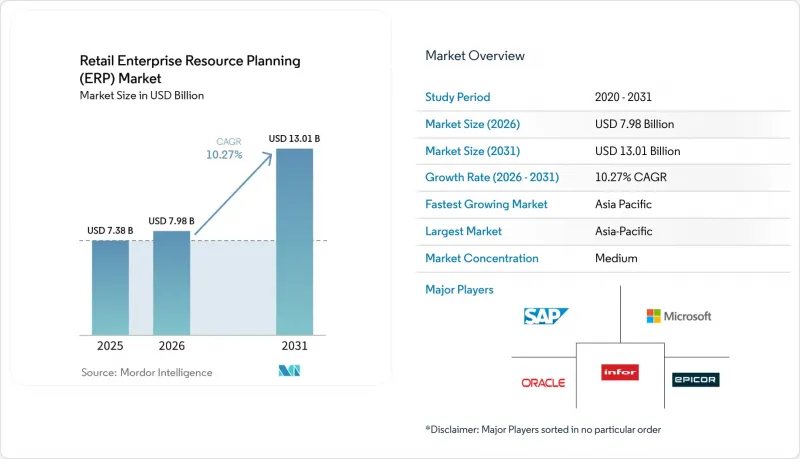
根據 Mordor Intelligence 預測,零售 ERP 市場規模將從 2025 年的 73.8 億美元和 2026 年的 79.8 億美元成長到 2031 年的 130.1 億美元,2026 年至 2031 年的年複合成長率(CAGR)為 10.27%。
本報告按部署類型(雲端、本地部署、混合部署)、組織規模(中小企業、大型企業)、組件(財務會計、庫存倉儲、銷售和客戶關係管理、人力資源管理等)、零售業態(超級市場、大賣場、專賣店、百貨公司等)以及地區進行細分。市場預測以美元計價。
全球零售ERP市場趨勢與洞察
零售業向雲端ERP的轉型正在加速。
到2025年,雲端訂閱將成為新增雲端服務的主要形式,這主要得益於零售商對自動化升級、彈性運算和降低基礎設施成本的需求。混合雲策略正日益普及:連鎖店將敏感的客戶資料保存在本地伺服器上,以符合資料居住法的要求;同時,在公共雲端上運行串流分析工作負載,以確保可擴展性。中型專業零售商從中受益最大,因為按門市收費已被價格高達六位數的永久許可所取代,從而顯著降低了前期成本,並將部署時間縮短至不到18個月。這種轉變也使他們能夠利用嵌入式人工智慧功能,例如動態定價,而這些功能依賴於傳統資料中心無法提供的可擴展運算能力。
全通路零售日益複雜
諸如線上訂購線下取貨、店內配送和無限貨架等服務正在推動對即時訂單管理引擎的需求。庫存、定價和會員資料被整合到單一帳本中,涵蓋門市、網站和社交電商平台,從而降低了分散出貨成本並最佳化了履約決策。現代ERP系統無需隔夜批量傳輸,即可讓降價決策在幾分鐘內反映所有銷售點。與社群電商的整合進一步增加了挑戰,迫使零售商在傳統系統從未預料到的外部平台上展示產品、處理付款和解決服務工單。
實施成本高且預算超支
由於專案範圍擴大、資料遷移混亂以及因變更管理不足而導致服務工時增加,近期近四分之三的專案都超出了預算。中型零售商受到的影響最大,因為他們的IT人才儲備不足,而且往往為時已晚才意識到,即使是現成的模板也需要客製化。第三方整合授權、新舊系統並行運作以及旺季期間SaaS用戶使用費的激增等隱性成本,都可能導致總擁有成本超過10年永久授權的費用。
細分市場分析
在零售ERP市場,「混合部署」模式正蓬勃發展。在這種模式下,連鎖商店將本地資料儲存與雲端分析結合,在利用彈性運算的同時,也符合當地法規。隨著邊緣伺服器的普及,混合解決方案的零售ERP市場規模正在不斷擴大。邊緣伺服器即使在網路故障期間也能確保POS系統運作,並在之後同步資料以進行集中式報告。在中國和歐盟營運的跨國公司更傾向於這種配置,因為客戶資料無需跨境傳輸,且匯總的分析結果會反映在全球儀表板上。運行在小型伺服器上的邊緣模組即使在寬頻連接不穩定的農村門市也能延長運作,並確保即使在通訊中斷期間也能記錄所有銷售數據。
混合部署也支援分階段遷移路徑。零售商可以先將財務和人力資源系統遷移到 SaaS,測試整合情況,然後在資料完整性提升後再處理庫存和訂單工作流程。 Azure Stack 和類似平台提供統一的管理平台,使 IT 團隊能夠透過單一主機監控本地端和雲端工作負載,從而減輕管理負擔。本地解決方案在需要嚴格控制的環境中仍然存在,例如奢侈品和藥局,但由於補丁和硬體更新周期帶來的營運負擔,其市場佔有率持續下降。
預計到2025年,中小企業將佔所有部署的62.4%,並且由於基於資源的收費無需支付高達六位數的預付款,其成長速度將繼續超過大型企業。包含基礎設施、支援和未來升級的訂閱方案將部署時間縮短至90天以內,使規模小規模的連鎖企業能夠專注於產品規劃而非伺服器維護。供應商現在提供預先配置的會計科目表和促銷引擎,無需編碼即可直接部署到新租戶,從而減輕顧問的工作量並加速價值實現。然而,零售ERP產業仍面臨技能缺口。中小企業很少聘用專門的ERP管理員,只能依賴供應商提供的服務進行故障排除。
大型企業正在採購諸如多營業單位合併會計、全球稅務引擎和複雜的供應鏈規劃等高階功能,這推高了平均合約規模。然而,由於這些功能的複雜性,實施週期通常超過一年,客製化預算也大幅增加,尤其是在特許經營和合資企業需要獨特的會計數據模型時。因此,企業級授權的總收入現在超過了中小企業的銷售額,系統整合商也繼續專注於大規模項目,主要服務大型連鎖企業。
區域分析
亞太地區是零售業ERP市場的中心,這主要得益於嚴格的電子帳單法規和行動商務交易量的爆炸性成長。在印度,政府入口網站將在2025會計年度處理數十億張發票,因此自動稅務核對已成為必需,而非未來的願景。在中國,超過三分之二的大規模零售連鎖企業已經部署了雲端ERP系統,透過將本地付款閘道直接整合到後勤部門帳簿中,加快了現金支付速度。在東南亞區域市場分店的經銷商必須履行24小時內完成訂單的承諾,這就要求ERP主導能夠確保經銷商層級(而不僅僅是倉庫層級)的庫存準確性。
北美市場成熟且充滿創新活力,其重點正從轉型轉向最佳化。零售商正在最佳化線上實體門市流程,降低分批配送成本,並在門市應用程式中試行人工智慧驅動的產品建議。嚴格的省級隱私法推動了ERP資料庫中細粒度的、基於角色的存取控制和客戶識別碼令牌化。加拿大也出現了類似的趨勢,但雙語要求進一步增加了設計的複雜性。
在歐洲,現代化與合規之間需要取得平衡。 GDPR審計耗時數月才選定雲端供應商,但即將推出的「數位時代增值稅」計畫已促使連鎖企業將業務集中到一個平台上,以便在27個司法管轄區內進行持續的交易報告。北歐零售商率先採用了“可組合微服務”,這種服務允許在不徹底改造平台的情況下替換模組;而南歐連鎖企業則專注於透過SaaS訂閱來控制成本,以取代老舊的本地部署系統。
其他好處:
- Excel格式的市場預測(ME)表
- 3個月的分析師支持
目錄
第1章:引言
- 研究假設和市場定義
- 調查範圍
第2章:調查方法
第3章執行摘要
第4章 市場狀況
- 市場概覽
- 市場促進因素
- 零售業向基於雲端的ERP系統轉型正在加速。
- 全通路零售日益複雜
- 對即時庫存可見性的需求日益成長
- 政府關於電子帳單和數位稅務合規的強制性規定
- 人工智慧驅動的需求預測可以減少缺貨和降價。
- 將嵌入式支付整合到零售ERP生態系統中
- 市場限制因素
- 實施成本高且預算超支
- 對資料安全和隱私的擔憂
- 零售業ERP實施專業人員短缺
- 可組合微服務架構帶來的顛覆性風險
- 產業價值鏈分析
- 監理情勢
- 技術展望
- 宏觀經濟因素對市場的影響
- 波特五力分析
第5章 市場規模與成長預測
- 依部署類型
- 基於雲端的
- 現場
- 混合
- 按組織規模
- 小型企業
- 大公司
- 按組件
- 財會
- 庫存和倉庫管理
- 銷售和客戶關係管理
- 人力資源管理
- 供應鏈管理
- 彙報與分析
- 其他
- 按零售業態
- 超級市場和大賣場
- 專賣店
- 百貨公司
- 便利商店
- 電子商務和全通路零售商
- 按地區
- 北美洲
- 美國
- 加拿大
- 墨西哥
- 南美洲
- 巴西
- 阿根廷
- 其他南美國家
- 歐洲
- 德國
- 英國
- 法國
- 義大利
- 俄羅斯
- 其他歐洲國家
- 亞太地區
- 中國
- 日本
- 印度
- 澳洲
- 其他亞太國家
- 中東
- 沙烏地阿拉伯
- 阿拉伯聯合大公國
- 土耳其
- 其他中東國家
- 非洲
- 南非
- 奈及利亞
- 肯亞
- 其他非洲國家
- 北美洲
第6章 競爭情勢
- 市場集中度
- 策略趨勢
- 市佔率分析
- 公司簡介
- SAP SE
- Oracle Corporation
- Microsoft Corporation
- Infor, Inc.
- Epicor Software Corporation
- The Sage Group plc
- Acumatica, Inc.
- LS Retail ehf.
- Odoo SA
- Brightpearl Limited
- Lightspeed Commerce Inc.
- IFS AB
- Blue Yonder Group, Inc.
- Aptos, LLC
- Cegid Group SA
- Retail Pro International, LLC
- CitiXsys India Private Limited
- Marg ERP Limited
- Logic ERP Solutions Private Limited
- Erply Limited
第7章 市場機會與未來展望
According to Mordor Intelligence, the retail enterprise resource planning market size is projected to expand from USD 7.38 billion in 2025 and USD 7.98 billion in 2026 to USD 13.01 billion by 2031, registering a CAGR of 10.27% between 2026 to 2031.
This report is Segmented by Deployment Type (Cloud-Based, On-Premise, and Hybrid), Organization Size (SMEs and Large Enterprises), Component (Finance and Accounting, Inventory and Warehouse Management, Sales and CRM, HR Management, and More), Retail Format (Supermarkets and Hypermarkets, Specialty Stores, Department Stores, and More), and Geography. The Market Forecasts are Provided in Terms of Value (USD).
Global Retail Enterprise Resource Planning (ERP) Market Trends and Insights
Accelerating Shift to Cloud-Based ERP In Retail
Cloud subscriptions represented most new installs in 2025 because retailers want automatic upgrades, elastic compute, and lower infrastructure costs. Hybrid strategies are catching on as chains keep sensitive customer data on local servers to meet data-residency laws, while stream analytics workloads run in public clouds for scale. Mid-sized specialty retailers gain the most because per-store pricing now replaces six-figure perpetual licenses, slashing up-front costs and shrinking implementation windows to under 18 months. The transition also unlocks embedded AI features, such as dynamic pricing, that depend on scalable compute unavailable in legacy data centers.
Growing Omnichannel Retail Complexity
Click-and-collect, ship-from-store, and endless aisle services drive demand for real-time order-management engines. Split-shipment costs drop and fulfillment decisions are optimized when inventory, pricing, and loyalty data live in a single ledger that spans stores, websites, and social-commerce feeds. Modern ERP suites eliminate overnight batch transfers, so a markdown decision propagates in minutes across all locations where the product appears. Social-commerce integrations raise the bar further, compelling retailers to surface products, process payments, and resolve service tickets on external platforms that their legacy systems never contemplated.
High Implementation Costs and Budget Overruns
Nearly three-quarters of recent projects ran over budget, with overruns due to scope creep, messy data migrations, and underestimated change management inflate service hours. Mid-market retailers feel the crunch most because they lack deep IT benches and discover too late that canned templates still need customization. Hidden costs such as third-party integration licenses, dual-running old and new systems, and per-user SaaS fees that spike during peak seasons can drive total ownership above a decade of perpetual-license spend.
Other drivers and restraints analyzed in the detailed report include:
- Rising Demand for Real-Time Inventory Visibility
- Government Mandates for E-Invoicing and Digital Tax Compliance
- Data Security and Privacy Concerns
For complete list of drivers and restraints, kindly check the Table Of Contents.
Segment Analysis
Hybrid deployments are gaining ground in the retail enterprise resource planning market as chains mix on-premises data stores with cloud analytics to comply with local regulations while still tapping elastic compute. The retail enterprise resource planning market size for hybrid solutions is advancing alongside edge servers that keep point-of-sale running during network outages, then synchronize later for central reporting. Multinationals operating in China or the European Union prefer this setup because customer data never leaves national borders, while aggregate insights roll into a global dashboard. Edge modules running on compact servers extend uptime in rural stores where broadband is shaky, ensuring every sale posts even during outages.
Hybrid adoption also supports phased migration paths. Retailers move finance and HR to SaaS first, test integrations, then tackle inventory and order workflows once data cleanliness improves. Azure Stack and similar platforms provide a unified management plane, so IT teams can monitor on-premises and cloud workloads from a single console, reducing admin effort. While on-premise still survives in high-control environments such as luxury or pharmacy, the operational burden of patches and hardware refresh cycles continues to erode its share.
SMEs accounted for 62.4% of deployments in 2025 and will continue to expand faster than their larger peers because per-resource pricing eliminates six-figure entry fees. Subscription bundles that include infrastructure, support, and future upgrades compress implementation to fewer than 90 days, allowing small chains to focus on merchandising rather than server upkeep. Vendors now ship pre-configured chart-of-accounts and promotional engines that drop into a new tenant without coding, shaving consultant hours, and accelerating value capture. The retail enterprise resource planning industry nevertheless faces a skills gap, as SMEs rarely employ full-time ERP administrators and must rely on vendor-managed services for troubleshooting.
Large enterprises buy deeper functionality such as multi-entity consolidations, global tax engines, and advanced supply-chain planning, which boosts average deal size. Yet complexity stretches deployments well beyond a year and inflates customization budgets, especially where franchise or joint-venture accounting demands unique data models. As a result, total enterprise license revenue outweighs sheer SME volume, and system integrators still build sizable practices around big-chain projects.
Geography Analysis
Asia-Pacific anchors the retail enterprise resource planning market, driven by stringent e-invoicing laws and exploding mobile commerce volume. Government portals in India processed billions of invoices in fiscal 2025, making automated tax reconciliation a must-have rather than a future wish. In China, over two-thirds of sizable retail chains already run cloud ERP, integrating local payment gateways directly into back-office ledgers to accelerate cash settlement. Southeast Asian sellers on regional marketplaces must meet 24-hour fulfillment promises, which requires ERP-driven inventory accuracy at the seller level rather than the warehouse level.
North America is a mature yet innovative landscape, shifting its focus from migration to optimization. Retailers fine-tune buy-online-pick-up-in-store workflows, trim split-shipment costs, and pilot AI recommendations inside store apps. Stringent state privacy laws drive granular role-based access controls and tokenization of customer identifiers inside ERP databases. Canada shows parallel trends, though bilingual requirements add another layer of design complexity.
Europe balances modernization with compliance. GDPR audits add months to cloud-vendor selection, but the upcoming VAT-in-the-Digital-Age program is already prompting chains to centralize onto platforms that can deliver continuous transaction reporting across 27 jurisdictions. Nordic retailers push early into composable microservices, swapping modules without full re-platforming, while Southern European chains focus on cost control through SaaS subscriptions that replace aging on-premise systems.
- SAP SE
- Oracle Corporation
- Microsoft Corporation
- Infor, Inc.
- Epicor Software Corporation
- The Sage Group plc
- Acumatica, Inc.
- LS Retail ehf.
- Odoo SA
- Brightpearl Limited
- Lightspeed Commerce Inc.
- IFS AB
- Blue Yonder Group, Inc.
- Aptos, LLC
- Cegid Group SA
- Retail Pro International, LLC
- CitiXsys India Private Limited
- Marg ERP Limited
- Logic ERP Solutions Private Limited
- Erply Limited
Additional Benefits:
- The market estimate (ME) sheet in Excel format
- 3 months of analyst support
TABLE OF CONTENTS
1 INTRODUCTION
- 1.1 Study Assumptions and Market Definition
- 1.2 Scope of the Study
2 RESEARCH METHODOLOGY
3 EXECUTIVE SUMMARY
4 MARKET LANDSCAPE
- 4.1 Market Overview
- 4.2 Market Drivers
- 4.2.1 Accelerating Shift to Cloud-Based ERP in Retail
- 4.2.2 Growing Omnichannel Retail Complexity
- 4.2.3 Rising Demand for Real-Time Inventory Visibility
- 4.2.4 Government Mandates for E-Invoicing and Digital Tax Compliance
- 4.2.5 AI-Driven Demand Forecasting Reduces Stockouts and Markdowns
- 4.2.6 Integration of Embedded Payments within Retail ERP Ecosystems
- 4.3 Market Restraints
- 4.3.1 High Implementation Costs and Budget Overruns
- 4.3.2 Data Security and Privacy Concerns
- 4.3.3 Shortage of Retail-Specific ERP Implementation Talent
- 4.3.4 Disruption Risk from Composable Microservices Architectures
- 4.4 Industry Value Chain Analysis
- 4.5 Regulatory Landscape
- 4.6 Technological Outlook
- 4.7 Impact of Macroeconomic Factors on the Market
- 4.8 Porter's Five Forces Analysis
- 4.8.1 Threat of New Entrants
- 4.8.2 Bargaining Power of Buyers
- 4.8.3 Bargaining Power of Suppliers
- 4.8.4 Threat of Substitutes
- 4.8.5 Intensity of Competitive Rivalry
5 MARKET SIZE AND GROWTH FORECASTS (VALUE)
- 5.1 By Deployment Type
- 5.1.1 Cloud-Based
- 5.1.2 On-Premise
- 5.1.3 Hybrid
- 5.2 By Organization Size
- 5.2.1 Small and Medium-Sized Enterprises
- 5.2.2 Large Enterprises
- 5.3 By Component
- 5.3.1 Finance and Accounting
- 5.3.2 Inventory and Warehouse Management
- 5.3.3 Sales and Customer Relationship Management
- 5.3.4 Human Resource Management
- 5.3.5 Supply Chain Management
- 5.3.6 Reporting and Analytics
- 5.3.7 Other Components
- 5.4 By Retail Format
- 5.4.1 Supermarkets and Hypermarkets
- 5.4.2 Specialty Stores
- 5.4.3 Department Stores
- 5.4.4 Convenience Stores
- 5.4.5 E-Commerce and Omnichannel Retailers
- 5.5 By Geography
- 5.5.1 North America
- 5.5.1.1 United States
- 5.5.1.2 Canada
- 5.5.1.3 Mexico
- 5.5.2 South America
- 5.5.2.1 Brazil
- 5.5.2.2 Argentina
- 5.5.2.3 Rest of South America
- 5.5.3 Europe
- 5.5.3.1 Germany
- 5.5.3.2 United Kingdom
- 5.5.3.3 France
- 5.5.3.4 Italy
- 5.5.3.5 Russia
- 5.5.3.6 Rest of Europe
- 5.5.4 Asia-Pacific
- 5.5.4.1 China
- 5.5.4.2 Japan
- 5.5.4.3 India
- 5.5.4.4 Australia
- 5.5.4.5 Rest of Asia-Pacific
- 5.5.5 Middle East
- 5.5.5.1 Saudi Arabia
- 5.5.5.2 United Arab Emirates
- 5.5.5.3 Turkey
- 5.5.5.4 Rest of Middle East
- 5.5.6 Africa
- 5.5.6.1 South Africa
- 5.5.6.2 Nigeria
- 5.5.6.3 Kenya
- 5.5.6.4 Rest of Africa
- 5.5.1 North America
6 COMPETITIVE LANDSCAPE
- 6.1 Market Concentration
- 6.2 Strategic Moves
- 6.3 Market Share Analysis
- 6.4 Company Profiles (includes Global Level Overview, Market Level Overview, Core Segments, Financials as available, Strategic Information, Market Rank/Share, Products and Services, Recent Developments)
- 6.4.1 SAP SE
- 6.4.2 Oracle Corporation
- 6.4.3 Microsoft Corporation
- 6.4.4 Infor, Inc.
- 6.4.5 Epicor Software Corporation
- 6.4.6 The Sage Group plc
- 6.4.7 Acumatica, Inc.
- 6.4.8 LS Retail ehf.
- 6.4.9 Odoo SA
- 6.4.10 Brightpearl Limited
- 6.4.11 Lightspeed Commerce Inc.
- 6.4.12 IFS AB
- 6.4.13 Blue Yonder Group, Inc.
- 6.4.14 Aptos, LLC
- 6.4.15 Cegid Group SA
- 6.4.16 Retail Pro International, LLC
- 6.4.17 CitiXsys India Private Limited
- 6.4.18 Marg ERP Limited
- 6.4.19 Logic ERP Solutions Private Limited
- 6.4.20 Erply Limited
7 MARKET OPPORTUNITIES AND FUTURE OUTLOOK
- 7.1 White-Space and Unmet-Need Assessment

 2026年全球目標設定規劃師市場報告
 大量管理軟體市場規模、佔有率和成長分析:按部署類型、應用、企業規模、最終用戶產業、交付方式、整合和地區分類-2026-2033年產業預測
 許可證管理軟體市場:依產品/服務、許可證類型、部署模式、組織規模和產業分類-2026-2032年全球市場預測現場服務管理軟體市場:按組件、使用者介面、定價模式、部署模式、組織規模、應用程式和最終用戶產業分類-2026-2032年全球市場預測
 全球倡導軟體市場規模、佔有率、趨勢和成長分析報告(2026-2034)
 2026-2030年全球圖書館管理軟體市場
 製造業勞動力管理(WFM):市場佔有率分析、產業趨勢與統計、成長預測(2026-2031 年)2026年全球起重機狀態監測市場報告2026年全球電競管理平台市場報告2026年全球整合開發環境(IDE)軟體市場報告