


 |
市場調查報告書
商品編碼
2064528
製造業勞動力管理(WFM):市場佔有率分析、產業趨勢與統計、成長預測(2026-2031 年)Workforce Management (WFM) In Manufacturing - Market Share Analysis, Industry Trends & Statistics, Growth Forecasts (2026 - 2031) |
||||||

※ 本網頁內容可能與最新版本有所差異。詳細情況請與我們聯繫。
根據 Mordor Intelligence 預測,製造業勞動力管理 (WFM) 市場預計將在 2025 年達到 15.2 億美元,並在 2026 年至 2031 年以 9.44% 的複合年成長率成長,到 2031 年達到 25.9 億美元。
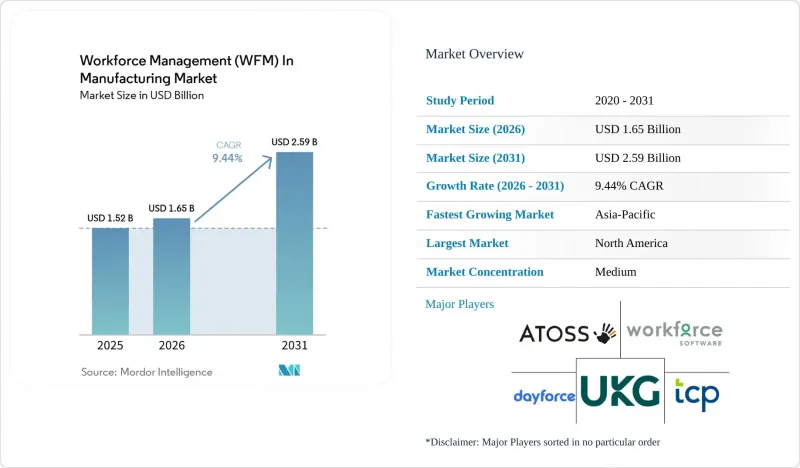
本報告按產品類型(軟體、服務)、部署方式(雲端、本地部署、混合部署)、最終用戶公司規模(大型企業和中小企業)、最終用戶行業(汽車、電子/半導體、工業機械/設備等)以及地區進行細分。市場預測以美元計價。
全球製造業勞動力管理市場趨勢與分析
技術純熟勞工短缺和勞動力老化
在製造業勞動力管理 (WFM) 市場,勞動力短缺使得勞動力規劃與日常生產管理更加緊密地交織在一起。製造商面臨著如何長期填補技術工人空缺的挑戰,預計到 2033 年,美國將出現 380 萬個職缺,其中可能包括 190 萬個空缺。這種壓力凸顯了技能映射、輪班覆蓋率可視化和交叉培訓工作流程的重要性,因為在關鍵崗位人員難以填補的情況下,工廠不能再依賴非正式的排班決策。在製造業勞動力管理中,這些工具正被擴大用於識別哪些合格、哪些員工可以上崗以及有哪些技能缺口,從而避免生產中斷。這種需求在多層輪班制運作中尤其突出,因為即使只有一個職缺,也會增加加班風險,並威脅生產的穩定性。正因如此,製造業勞動力管理正超越簡單的後勤部門運營,深入融入業務永續營運計畫、人才保留策略和工廠層面的風險管理。
工業4.0專案需要動態調整勞動力
在製造業勞動力管理 (WFM) 市場,對智慧工廠的投資正在推動對能夠即時回應機器和生產訊號的勞動力管理系統的需求。當工業物聯網 (IIoT) 數據、線上事件或邊緣警報表明生產中斷時,數位化調度工具可以比基於電子表格的計劃更快地部署合適的勞動力。一項發表於 2025 年的研究表明,基於雲端邊緣基礎設施的 AI 驅動調度可以將工業行動裝置的充電頻率降低高達 31.35%,這表明更有效率的編配如何消除複雜生產環境中的時間浪費。基於 IIoT、AI、巨量資料和雲端運算的開創性工廠勞動力管理解決方案也已發布,旨在實現製造環境中的即時勞動力調度。在製造業勞動力管理市場,這些合作正在推動買家對能夠將勞動力可用性、資格狀態和生產變更訊號整合到單一操作層的平台產生興趣。此外,許多製造商希望在工廠附近保留一些營運控制,同時在雲端進行分析和用戶訪問,這也推動了對混合架構日益成長的興趣。
與舊工廠系統整合的困難。
在製造業勞動力管理市場,整合仍是推廣應用的最大障礙。許多工廠使用的ERP、MES和本地考勤管理系統彼此獨立,互不互聯。一份2025年的報告指出,75%的製造業仍依賴人工排班,而系統間的資料碎片化導致生產計畫變更後返工率高達30%。這個問題增加了專案成本,因為供應商通常要求建立自訂介面、進行資料清理並分階段部署,直到工廠車間能夠信任自動化排班的輸出結果。製造業勞動力管理市場中最具挑戰性的環境通常是最複雜的工廠,這些工廠雖然最能從最佳化中獲益,但其技術基礎設施的零碎程度也最高。採購企業通常會推遲大規模部署,直到所有工廠的薪資核算規則、生產事件和技能記錄統一為止,這導致引進週期延長,供應商的獲利能力也隨之下降。這項限制也解釋了為什麼在製造業勞動力管理市場中,服務的成長速度快於軟體。因為整合和配置工作對於真正成功的實施仍然至關重要。
細分市場分析
到2025年,軟體將佔據製造業勞動力管理(WFM)市場72.18%的佔有率,並繼續在整個工廠的採購決策中佔據核心地位。考勤管理是最大的細分市場,佔軟體總收入的28.31%,這反映出薪資核算審計和考勤管理是許多製造商的首要任務。在製造業勞動力管理市場,由於考勤管理影響每個班次、每份員工記錄和每個薪資核算週期,因此它通常是首批投資領域。加班規則、休息時間追蹤和疲勞管理也提升了核心考勤管理系統在高度監管的製造環境中的重要性。一旦基礎架構建置完成,製造商通常會擴展其功能,包括員工排班、需求預測、缺勤管理、勞動力分析、任務管理和自助溝通,因為這些功能透過共用單一的勞動力資料平台可以更有效地運作。
預計到2031年,服務業將以13.12%的複合年成長率成長,成為製造業勞動力管理市場中成長最快的服務類型。這一成長反映了老舊工廠部署的複雜性,僅靠軟體無法滿足連接器設計、工廠規則設定、工會邏輯或變更管理等方面的需求。在製造業勞動力管理市場,能夠將軟體與製造業專屬服務團隊結合的供應商更有利於降低部署風險並縮短價值實現時間。 2024年10月的收購進一步強化了這一點,增強了對非固定職位、小時工、工會成員和多站點員工的支持,這些員工通常需要更詳細的配置支持。此外,在製造業勞動力管理市場,能夠將產品功能與在實際工廠環境中執行的能力相結合的供應商越來越受到青睞,而不是那些只能在基本服務環境中運作的簡單部署模型。
預計到2025年,雲端採用率將佔市場佔有率的61.47%,而基於SaaS的產品目前是製造業部署新型勞動力管理(WFM)系統的主要途徑。製造商之所以青睞雲端系統,是因為它們簡化了合規性更新、行動存取、員工自助服務以及跨多個地點的集中監控。 2025年上半年,雲端和訂閱營收年增30%,達到4,410萬歐元(4,760萬美元),雲在軟體總收入的佔比從39%上升至48%。這一結果表明,即使客戶對各種企業技術的支出仍然保持謹慎,雲端收入的重要性也日益凸顯。在勞動力管理(WFM)市場,雲端也有助於供應商在地理位置分散的業務地點提供一致的規則、員工工具和分析功能。
預計到2031年,混合部署將以14.37%的複合年成長率成長,成為製造業勞動力管理(WFM)市場中成長最快的部署模式。其優勢在於平衡:製造商可以利用雲端實現自助服務、儀表板和全面的規劃功能,同時將敏感的工作流程邏輯和本地資料處理保留在工廠附近。這種模式適用於那些無法完全淘汰本地系統,但又希望實現勞動力管理和使用者體驗現代化的工廠。在製造業,混合部署通常是成熟度的徵兆,其驅動力來自那些尋求現代化營運柔軟性,同時又不願犧牲對關鍵流程的本地管治的買家。
區域分析
截至2025年,北美將佔據製造業勞動力管理市場39.12%的佔有率,成為最大的區域貢獻者。該地區受益於勞動力短缺、嚴格的工資和工時法規以及成熟的數位化製造投資基礎。美國製造業持續面臨勞動力短缺問題,預計2033年將有380萬個職缺,其中190萬個職缺可能無人填補。因此,製造業勞動力管理(WFM)市場不僅在確保薪資核算準確性方面,而且在人員配置規劃、交叉培訓透明度和加班管理方面都繼續發揮著至關重要的作用。雖然南美市場規模仍然較小,但巴西的汽車產業基礎持續產生集中需求,跨國標準也促使當地供應商實施更完善的排班和勞動力管理措施。
以德國、英國和法國為首的歐洲,一直是製造業勞動力管理市場的重要區域。預計到2025年,雲端運算的發展動能將加速,2025年上半年雲端服務和訂閱收入將達到4,410萬歐元(4,760萬美元),雲端服務收入將佔軟體總收入的48%。歐洲的產品設計也受到消費者對自動化勞動力分配決策透明度和可解釋性日益成長的需求的影響,這使得擁有本地合規專業知識的供應商更具優勢。在製造業勞動力管理市場,歐洲更重視特定國家的勞動力專業知識和可審計的規則引擎,而非通用的排班功能集。
預計到2031年,亞太地區將以15.23%的複合年成長率成長,成為製造業勞動力管理(WFM)市場成長最快的地區。這一成長主要得益於中國工廠的數位轉型、印度的工業擴張以及日本和韓國的人口壓力。 2026年2月,已實施數位化人力資源和考勤管理系統的製造商報告稱,其員工資料收集準確率超過99%,這推動了注重合規性的日本製造業對該技術的採用。中國供應商也在推動創新;GaiaWorks發布了「燈塔工廠」的勞動力管理解決方案,該方案整合了工業物聯網(IIoT)、人工智慧(AI)、巨量資料和雲端運算技術,可實現即時工作排班。中東和非洲仍然是製造業勞動力管理市場的長期發展機會。在這些地區,該技術的應用更有可能跟隨工廠建設和工業擴張而發展,而非引領其發展。
其他好處:
- Excel格式的市場預測(ME)表
- 3個月的分析師支持
目錄
第1章:引言
- 市場分析與定義的前提條件
- 分析範圍
第2章 分析方法
第3章執行摘要
第4章 市場狀況
- 市場概覽
- 市場促進因素
- 技術純熟勞工短缺和現場工人老化
- 工業4.0專案需要動態調整勞動力
- 更嚴格遵守加班、休息、疲勞和薪資核算的規定。
- 對即時勞動力可視性和成本管理的需求。
- 透過邊緣運算和物聯網重新安排生產活動日程
- 擴大承包商、臨時派遣機構和多技能工人的勞動力儲備
- 市場限制因素
- 與舊工廠系統整合的困難。
- 多廠區工廠(有工會)變革管理的負擔。
- 人工智慧調度中的資料居住要求和演算法透明度的局限性
- 中型企業工廠數位化應對力低
- 產業價值鏈分析
- 監理情勢
- 技術展望
- 波特五力分析
第5章:預測市場規模與成長率
- 透過提供的內容
- 軟體
- 員工工作日程管理,勞動力最佳化
- 考勤管理
- 勞動力分析與預測
- 休假和缺勤管理
- 任務與執行管理
- 員工自助溝通
- 服務
- 軟體
- 透過部署方法
- 雲
- 現場
- 混合
- 按最終用戶公司規模分類
- 大公司
- 小型企業
- 按最終用戶行業分類
- 車
- 電子和半導體
- 工業機械和設備
- 藥品和化學品
- 食品/飲料
- 航太/國防
- 按地區
- 北美洲
- 美國
- 加拿大
- 墨西哥
- 南美洲
- 巴西
- 阿根廷
- 智利
- 其他南美國家
- 歐洲
- 德國
- 英國
- 法國
- 義大利
- 西班牙
- 其他歐洲國家
- 亞太地區
- 中國
- 日本
- 印度
- 韓國
- 澳洲
- 其他亞太國家
- 中東
- 沙烏地阿拉伯
- 阿拉伯聯合大公國
- 其他中東國家
- 非洲
- 南非
- 埃及
- 奈及利亞
- 其他非洲國家
- 北美洲
第6章 競爭情勢
- 市場集中度
- 策略趨勢
- 市佔率分析
- 公司簡介。
- UKG Inc.
- Dayforce, Inc.
- WorkForce Software, LLC
- ATOSS Software SE
- TimeClock Plus, LLC
- Humanforce Pty Ltd.
- Shiftboard, Inc.
- Deputy Corporation
- Connecteam Ltd.
- WorkJam Inc.
- SISQUAL Workforce Management, Lda.
- Worklinq A/S
- Flash Romeo Inc.
- Legion Technologies, Inc.
- Paycor HCM, Inc.
- Paylocity Holding Corporation
- isolved HCM, LLC
- Zellis UK Limited
- Ramco Systems Limited
- LumApps SAS
第7章 市場機會與未來展望
According to Mordor Intelligence, the workforce management (WFM) market in the manufacturing industry was USD 1.52 billion in 2025 and is forecast to reach USD 2.59 billion by 2031, at a CAGR of 9.44% during 2026-2031.
This report is Segmented by Offering (Software and Services), Deployment Mode (Cloud, On-Premise, and Hybrid), End-User Enterprise Size (Large Enterprises and Small and Medium-Sized Enterprises), End-User Industry (Automotive, Electronics and Semiconductors, Industrial Machinery and Equipment, and More), and Geography. The Market Forecasts are Provided in Terms of Value (USD).
Global Workforce Management (WFM) In Manufacturing Market Trends and Insights
Skilled Labor Shortages and Aging Shop-Floor Workforce
In the workforce management (WFM) in the manufacturing market, labor scarcity is pushing workforce planning closer to daily production control. Manufacturers are facing a long replacement cycle for skilled roles, and it is projected that 3.8 million positions will open in U.S. manufacturing through 2033, with 1.9 million potentially unfilled. That pressure makes skill mapping, shift coverage visibility, and cross-training workflows more valuable because plants cannot rely on informal scheduling decisions when critical roles are hard to backfill. In the workforce management in the manufacturing market, these tools are increasingly used to show who is qualified, who is available, and where single-point skill gaps sit before they disrupt production. The need is strongest in multi-shift operations where every uncovered position raises overtime risk and puts output stability under pressure. This is why the WFM in manufacturing market is being drawn deeper into continuity planning, retention efforts, and plant-level risk control, rather than remaining limited to back-office administration.
Industry 4.0 Programs Requiring Dynamic Labor Orchestratio
In the manufacturing workforce management (WFM) market, smart-factory investments are driving demand for labor systems that can respond to machine and production signals in real time. When IIoT data, line events, or edge alerts indicate a disruption, digital scheduling tools can move qualified labor faster than spreadsheet-based planning. Research published in 2025 showed that AI-driven scheduling on cloud-edge infrastructure reduced the recharging frequency of industrial mobile equipment by up to 31.35%, demonstrating how better orchestration can eliminate wasted time in complex production settings.A lighthouse factory workforce management solution was also launched, built around IIoT, AI, big data, and cloud computing for real-time labor scheduling in manufacturing environments. In the workforce management market for manufacturing, that linkage is driving buyer interest in platforms that combine labor availability, certification status, and production change signals into a single operating layer. It also supports the growing interest in hybrid architectures, as many manufacturers seek to run analytics and user access in the cloud while keeping parts of operational control close to the plant.
Legacy Plant Systems and Difficult Integrations
In the manufacturing workforce management market, integration remains the biggest barrier to adoption because many plants still operate across disconnected ERP, MES, and local attendance systems. In 2025, it was reported that 75% of manufacturing enterprises still relied on manual scheduling methods, with data fragmentation across systems leading to a 30% rework rate when plans changed after production events. That problem increases project costs because vendors often need custom interfaces, data cleanup, and staged deployments before a site can trust automated scheduling outputs. In the manufacturing workforce management market, the hardest environments are usually the most complex plants, since they offer the greatest optimization upside but also the most fragmented technology estates. Buyers often delay wider rollouts until payroll rules, production events, and skill records are aligned across sites, which lengthens implementation cycles and slows revenue conversion for vendors. This restraint also explains why services are growing faster than software in the workforce management market for manufacturing, because integration and configuration work remain essential for real deployment success.
Other drivers and restraints analyzed in the detailed report include:
- Tighter Overtime, Break, Fatigue and Payroll Compliance
- Demand for Real-Time Labor Visibility and Cost Control
- High Change-Management Burden in Unionized Multisite Plants
For complete list of drivers and restraints, kindly check the Table Of Contents.
Segment Analysis
Software accounted for 72.18% of the workforce management (WFM) in manufacturing market share in 2025, keeping it at the center of purchasing decisions across factories. Time and attendance management was the largest software sub-segment at 28.31% of total software revenue, reflecting that payroll auditability and attendance control remain the first pain points many manufacturers seek to address. In workforce management in the manufacturing market, this layer is often funded first because it affects every shift, every employee record, and every payroll cycle. Overtime rules, break tracking, and fatigue-related controls have also made core time systems more important in regulated manufacturing settings. Once this base is in place, manufacturers usually expand into employee scheduling, forecasting, absence management, workforce analytics, task management, and self-service communication, as these functions work more effectively when they share a single labor data backbone.
Services are projected to grow at a 13.12% CAGR through 2031, making it the fastest-growing offering type in the workforce management in manufacturing market. That growth reflects the implementation complexity in older plants, where software alone cannot address connector design, plant-rule configuration, union logic, or change-management needs. In the workforce management in the manufacturing market, vendors that can pair software with manufacturing-specific service teams are better placed to reduce deployment risk and improve time to value. An October 2024 acquisition underlined this point by strengthening coverage for deskless, hourly, unionized, and multi-site workforces that usually require deeper configuration support. This is also where workforce management in manufacturing industry rewards providers that combine product capability with plant-ready execution rather than selling a light implementation model that works only in simpler service environments.
Cloud deployment accounted for 61.47% of the market in 2025, indicating that SaaS-based delivery is now the primary route for new workforce management (WFM) in manufacturing market rollouts. Manufacturers are drawn to cloud systems because they simplify compliance updates, mobile access, employee self-service, and centralized oversight across multiple sites. Cloud and subscription revenues grew 30% year over year to EUR 44.1 million, or USD 47.6 million, in H1 2025, while cloud's share of total software revenue increased from 39% to 48% over 12 months. That result shows that recurring cloud revenue is becoming increasingly important even as customers remain cautious about broader enterprise technology spending. In the manufacturing workforce management market, cloud also helps vendors deliver consistent rules, employee-facing tools, and analytics across geographically dispersed operations.
Hybrid deployment is projected to grow at a 14.37% CAGR through 2031, the fastest among deployment modes in the WFM in manufacturing market. Its appeal lies in balance: manufacturers can keep sensitive workflow logic or local data processing near the plant while using the cloud for self-service, dashboards, and broader planning access. This model fits plants that cannot fully retire on-premise systems but still want to modernize workforce control and user experience. In the manufacturing industry, hybrid adoption often signals a maturity phase in which buyers seek modern operating flexibility without sacrificing local governance over critical processes.
Geography Analysis
North America held 39.12% of the workforce management in manufacturing market share in 2025, making it the largest regional contributor. The region benefits from labor scarcity, strict wage-and-hour enforcement, and a mature base of digital manufacturing investment. U.S. manufacturing continues to face open roles, with projections showing that 3.8 million positions will open through 2033, and 1.9 million of those positions may remain unfilled. That keeps the workforce management (WFM) in manufacturing market relevant not only for payroll accuracy but also for coverage planning, cross-training visibility, and overtime control. South America remained smaller, but Brazil's automotive base still generated focused demand, driving multinational standards that pushed local suppliers toward stronger scheduling and labor governance practices.
Europe remained a structurally important region in the workforce management in the manufacturing market, led by Germany, the United Kingdom, and France. Strong cloud momentum was reported in 2025, with cloud and subscription revenues reaching EUR 44.1 million (USD 47.6 million) in H1 2025 and cloud's share of software revenue rising to 48%. European product design is also being shaped by tighter expectations for transparency and explainability in automated workforce decisions, favoring vendors with deeper local compliance. In the workforce management market for manufacturing, country-specific labor expertise and audit-ready rule engines are more important in Europe than a generic scheduling feature set alone.
Asia-Pacific is projected to expand at a 15.23% CAGR through 2031, making it the fastest-growing region in the WFM in manufacturing market. Growth is being driven by factory digitalization in China, industrial expansion in India, and demographic pressure in Japan and South Korea. In February 2026, it was reported that manufacturers using digital HR and attendance systems achieved more than 99% accuracy in employee data collection, which supports adoption in Japan's compliance-sensitive manufacturing base. Chinese vendors are also pushing innovation, with GaiaWorks launching a lighthouse factory workforce management solution that links IIoT, AI, big data, and cloud computing for real-time labor scheduling. The Middle East and Africa remain longer-horizon opportunities in the workforce management in the manufacturing market, where adoption is likely to follow factory build-outs and industrial expansion rather than lead them.
- UKG Inc.
- Dayforce, Inc.
- WorkForce Software, LLC
- ATOSS Software SE
- TimeClock Plus, LLC
- Humanforce Pty Ltd.
- Shiftboard, Inc.
- Deputy Corporation
- Connecteam Ltd.
- WorkJam Inc.
- SISQUAL Workforce Management, Lda.
- Worklinq A/S
- Flash Romeo Inc.
- Legion Technologies, Inc.
- Paycor HCM, Inc.
- Paylocity Holding Corporation
- isolved HCM, LLC
- Zellis UK Limited
- Ramco Systems Limited
- LumApps SAS
Additional Benefits:
- The market estimate (ME) sheet in Excel format
- 3 months of analyst support
TABLE OF CONTENTS
1 INTRODUCTION
- 1.1 Study Assumptions and Market Definition
- 1.2 Scope of the Study
2 RESEARCH METHODOLOGY
3 EXECUTIVE SUMMARY
4 MARKET LANDSCAPE
- 4.1 Market Overview
- 4.2 Market Drivers
- 4.2.1 Skilled Labor Shortages and Aging Shop-Floor Workforce
- 4.2.2 Industry 4.0 Programs Requiring Dynamic Labor Orchestration
- 4.2.3 Tighter Overtime, Break, Fatigue and Payroll Compliance
- 4.2.4 Demand for Real-Time Labor Visibility and Cost Control
- 4.2.5 Edge and IoT-Triggered Rescheduling from Production Events
- 4.2.6 Growth of Contractor, Agency and Cross-Trained Labor Pools
- 4.3 Market Restraints
- 4.3.1 Legacy Plant Systems and Difficult Integrations
- 4.3.2 High Change-Management Burden in Unionized Multisite Plants
- 4.3.3 Data Residency and Algorithmic Transparency Limits for AI Scheduling
- 4.3.4 Weak Digital Readiness in Mid-Market Plants
- 4.4 Industry Value-Chain Analysis
- 4.5 Regulatory Landscape
- 4.6 Technological Outlook
- 4.7 Porter's Five Forces Analysis
- 4.7.1 Bargaining Power of Suppliers
- 4.7.2 Bargaining Power of Buyers
- 4.7.3 Threat of New Entrants
- 4.7.4 Threat of Substitutes
- 4.7.5 Intensity of Competitive Rivalry
5 MARKET SIZE AND GROWTH FORECASTS (VALUE)
- 5.1 By Offering
- 5.1.1 Software
- 5.1.1.1 Employee Scheduling and Labor Optimization
- 5.1.1.2 Time and Attendance Management
- 5.1.1.3 Workforce Analytics and Forecasting
- 5.1.1.4 Leave and Absence Management
- 5.1.1.5 Task and Execution Management
- 5.1.1.6 Employee Self-service and Communication
- 5.1.2 Services
- 5.1.1 Software
- 5.2 By Deployment Mode
- 5.2.1 Cloud
- 5.2.2 On-premise
- 5.2.3 Hybrid
- 5.3 By End User Enterprise Size
- 5.3.1 Large Enterprises
- 5.3.2 Small and Medium-sized Enterprises
- 5.4 By End-user Industry
- 5.4.1 Automotive
- 5.4.2 Electronics and Semiconductors
- 5.4.3 Industrial Machinery and Equipment
- 5.4.4 Pharmaceuticals and Chemicals
- 5.4.5 Food and Beverage
- 5.4.6 Aerospace and Defense
- 5.5 By Geography
- 5.5.1 North America
- 5.5.1.1 United States
- 5.5.1.2 Canada
- 5.5.1.3 Mexico
- 5.5.2 South America
- 5.5.2.1 Brazil
- 5.5.2.2 Argentina
- 5.5.2.3 Chile
- 5.5.2.4 Rest of South America
- 5.5.3 Europe
- 5.5.3.1 Germany
- 5.5.3.2 United Kingdom
- 5.5.3.3 France
- 5.5.3.4 Italy
- 5.5.3.5 Spain
- 5.5.3.6 Rest of Europe
- 5.5.4 Asia-Pacific
- 5.5.4.1 China
- 5.5.4.2 Japan
- 5.5.4.3 India
- 5.5.4.4 South Korea
- 5.5.4.5 Australia
- 5.5.4.6 Rest of Asia-Pacific
- 5.5.5 Middle East
- 5.5.5.1 Saudi Arabia
- 5.5.5.2 United Arab Emirates
- 5.5.5.3 Rest of Middle East
- 5.5.6 Africa
- 5.5.6.1 South Africa
- 5.5.6.2 Egypt
- 5.5.6.3 Nigeria
- 5.5.6.4 Rest of Africa
- 5.5.1 North America
6 COMPETITIVE LANDSCAPE
- 6.1 Market Concentration
- 6.2 Strategic Moves
- 6.3 Market Share Analysis
- 6.4 Company Profiles (includes Global Level Overview, Market Level Overview, Core Segments, Financials as available, Strategic Information, Market Rank/Share, Products and Services, Recent Developments).
- 6.4.1 UKG Inc.
- 6.4.2 Dayforce, Inc.
- 6.4.3 WorkForce Software, LLC
- 6.4.4 ATOSS Software SE
- 6.4.5 TimeClock Plus, LLC
- 6.4.6 Humanforce Pty Ltd.
- 6.4.7 Shiftboard, Inc.
- 6.4.8 Deputy Corporation
- 6.4.9 Connecteam Ltd.
- 6.4.10 WorkJam Inc.
- 6.4.11 SISQUAL Workforce Management, Lda.
- 6.4.12 Worklinq A/S
- 6.4.13 Flash Romeo Inc.
- 6.4.14 Legion Technologies, Inc.
- 6.4.15 Paycor HCM, Inc.
- 6.4.16 Paylocity Holding Corporation
- 6.4.17 isolved HCM, LLC
- 6.4.18 Zellis UK Limited
- 6.4.19 Ramco Systems Limited
- 6.4.20 LumApps SAS
7 MARKET OPPORTUNITIES AND FUTURE OUTLOOK
- 7.1 White-space and Unmet-Need Assessment

 2026年全球目標設定規劃師市場報告
 大量管理軟體市場規模、佔有率和成長分析:按部署類型、應用、企業規模、最終用戶產業、交付方式、整合和地區分類-2026-2033年產業預測
 許可證管理軟體市場:依產品/服務、許可證類型、部署模式、組織規模和產業分類-2026-2032年全球市場預測現場服務管理軟體市場:按組件、使用者介面、定價模式、部署模式、組織規模、應用程式和最終用戶產業分類-2026-2032年全球市場預測
 全球倡導軟體市場規模、佔有率、趨勢和成長分析報告(2026-2034)
 2026-2030年全球圖書館管理軟體市場
 零售業ERP:市場佔有率分析、產業趨勢與統計及成長預測(2026-2031)2026年全球起重機狀態監測市場報告2026年全球電競管理平台市場報告2026年全球整合開發環境(IDE)軟體市場報告