


 |
市場調查報告書
商品編碼
2065569
汽車產業ERP:市場佔有率分析、產業趨勢與統計、成長預測(2026-2031)Automotive Enterprise Resource Planning - Market Share Analysis, Industry Trends & Statistics, Growth Forecasts (2026 - 2031) |
||||||

※ 本網頁內容可能與最新版本有所差異。詳細情況請與我們聯繫。
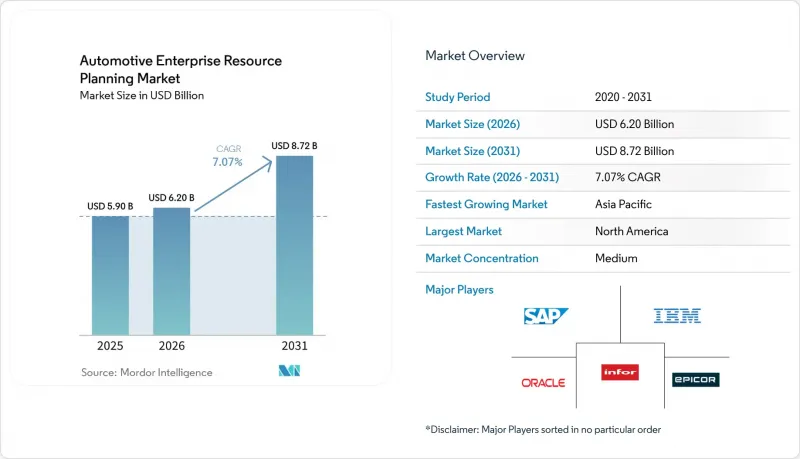
根據 Mordor Intelligence 預測,汽車 ERP 市場規模將從 2025 年的 59 億美元和 2026 年的 62 億美元成長到 2031 年的 87.2 億美元,2026 年至 2031 年的複合年成長率為 7.07%。
本報告按部署模式(雲端/本地部署)、組織規模(中小企業/大型企業)、應用領域(生產計畫/排程、供應鏈/庫存管理、財務/會計、人力資源/薪資、品管等)、最終用戶(原始設備製造商、一級/二級供應商等)和地區進行細分。市場預測以美元計價。
全球汽車產業ERP市場趨勢與洞察
汽車製造業中基於雲端的ERP應用擴展
2024年至2025年間,成本結構向訂閱模式轉變,資本支出轉化為營運費用,減輕了對現場基礎設施的負擔,加速了汽車工廠採用雲端運算的進程。目前,原始設備製造商(OEM)正在將區域實例整合到單一租戶雲端上,即時掌握數十家工廠的庫存情況,從而將週期縮短一周以上,並能快速應對零件短缺。然而,早期採用者意識到不間斷連接的必要性,並正在轉向混合拓撲結構,將執行資料快取在本地,並按計劃的時間間隔進行同步。這種折衷方案既能利用雲端分析,又能保持現場可靠性,但增加了中間件的複雜性,並要求IT團隊掌握新的整合技能。因此,能夠設計零停機切換和邊緣到雲端同步模式的諮詢合作夥伴正在獲得利潤豐厚的服務業務。
人工智慧與物聯網的融合在預測性維護與品管的應用
最新的汽車產業ERP套件能夠從可程式邏輯控制器(PLC)和機器人單元擷取振動、溫度和聲學遙測數據,並產生基於機器學習的預測,從而提前3-4天向維修團隊發出故障預警。已實施這些功能的供應商報告稱,透過將電腦視覺缺陷檢測整合到品質工作流程中,意外停機時間減少了兩位數,並且一次合格率也得到了提高。隨著ERP從單純的交易帳簿轉變為指導性決策引擎,員工技能也必須隨之提升,工作重點從人工檢查轉向解讀演算法建議。提供無程式碼模型學習環境和預訓練缺陷庫的供應商正在降低缺乏資料科學人才的二級供應商的進入門檻,從而加速這些技術在生產網路中的應用。
二級供應商面臨高昂的初始成本和較長的引進週期。
二級機械加工和模具供應商的淨利率通常較低,因此,高達六位數的軟體投資和長達一年的實施項目會給他們帶來沉重的財務負擔。學術研究表明,資料清理、客製化範圍擴展以及對外部顧問的依賴等意外問題都會導致成本超支。季節性生產高峰會進一步加劇這些挑戰,因為在訂單量高峰期,很難安排負責人參與車間和用戶驗收測試。雖然雲端訂單可以減輕資本投資負擔,但持續的營運成本可能會對盈利造成壓力,除非供應商與客戶重新協商價格。因此,許多二級供應商正在推遲全面實施ERP系統,或選擇功能有限的方案,從而延緩了OEM廠商期望從端到端數位化整合中獲得的網路效應。
細分市場分析
預計到2025年,雲端平台將佔汽車ERP支出的62%,並有望在2031年之前以13.40%的複合年成長率成長,超過整體汽車ERP市場的表現。這一成長動能反映了供應商的藍圖優先考慮雲端專屬創新,例如人工智慧驅動的需求預測和零接觸升級。儘管一級供應商的本地部署汽車ERP市場持續萎縮,但在寬頻不穩定或有嚴格主權要求的工廠中,仍有抵觸情緒。混合配置將製造執行工作負載保留在本地並定期同步,可以平衡延遲和容錯能力,但會增加中間件開銷和監控負擔。隨著時間的推移,功能差距不斷擴大,尋求傳統版本不具備的預測性維護和供應鏈控制塔功能的客戶將被迫遷移到雲端,即使他們並不情願採用雲端服務。
2024年6月發生的一起網路安全事件導致數千家經銷商癱瘓,此後,新的採購流程要求供應商進行嚴格的第三方安全審計,並購買數百萬美元的網路保險。供應商透過獲得ISO 27001認證、實施零信任框架以及設定15分鐘恢復點目標(RPO)重新贏得了買家的信任。雖然訂閱式定價模式能夠將成本分攤到長期,對小規模供應商來說相當有吸引力,但其總生命週期成本仍需與折舊免稅額的本地部署資產競爭。因此,買家現在發布的提案(RFP)要求供應商提供清晰的五年總擁有成本(TCO)模型、透明的終止條款以及基於地理位置分類的數據存儲方案,這表明汽車ERP市場的採購方法正日趨成熟。
到2025年,大型企業將佔銷售額的54%,反映出目的地設備製造商(OEM)在財務、物流和設計變更管理方面的應用將達到數十億美元。隨著電子資料交換(EDI)的強制使用使得基於電子表格的工作流程難以為繼,中小企業在汽車ERP領域的市場佔有率正在迅速擴大。供應商正瞄準此細分市場,提供預先配置模板,承諾在120天內運作,並提供快速實施支援工具。然而,這種以速度為導向的方法往往限制了客製化,並導致後續返工。成功實施這些解決方案的公司表示,物料訂購現在與客戶的生產計劃直接關聯,從而避免了緊急應變,並減少了生產線停機時間。
實施的成功仍取決於經營團隊的支持和變革管理技能,而許多中小企業恰恰缺乏這些能力,導致專案延期和預算超支。為了彌合這一差距,生態系統合作夥伴正在打包提供遠端應用管理和定期流程審核的託管服務,將ERP從一次性技術採購轉變為營運訂閱模式。隨著雲端技術成熟度的提高,集體知識的累積將減少配置錯誤,模板也將從一開始就融入故障模式及影響分析(FMEA)等行業最佳實踐。這將降低風險,並進一步促進中小企業進入汽車ERP市場。
區域分析
到2025年,北美將佔全球銷量的33%,成為領先地區,這得益於底特律汽車製造商成熟的ERP環境以及經銷商管理系統更新的激增。隨著汽車ERP供應商利用可擴展的基礎設施和人工智慧(AI)功能,雲端採用正在加速,北美買家也迅速將其商業化。相對寬鬆的資料本地化法規正在加速跨區域租戶部署,從而整合加拿大、墨西哥和美國的營運。
預計到2031年,亞太地區的複合年成長率將達到11.90%。這主要得益於中國龐大的汽車生產基地以及政府扶持本土ERP巨頭的政策,這些巨頭目前已佔據中國製造業近四分之三的市場佔有率。印度零件出口的成長正在推動二級供應商快速採用雲端運算,以滿足全球電子資料交換(EDI)和永續發展的要求。在日本,面對傳統基礎設施的“2025年問題”,緊急的現代化改造項目正在進行中,但文化上的謹慎仍然促使企業傾向於採用本土管理的混合雲端和私有雲端。
歐洲嚴格的環境指令重塑了採購標準,更加強調碳核算功能,鞏固了ERP在合規工作流程中的作用。由於資金限制和通訊基礎設施不足,南美、中東和非洲的成長速度相對較慢,但組裝廠數量的激增吸引了提供軟體訂閱和通訊硬體捆綁服務的SaaS供應商。總體而言,這些區域趨勢表明,汽車ERP市場不僅受到技術因素的影響,還受到政策和數據主權的強烈影響。
其他好處:
- Excel格式的市場預測(ME)表
- 3個月的分析師支持
目錄
第1章:引言
- 研究假設與市場定義* 研究範圍
第2章:調查方法
第3章執行摘要
第4章 市場狀況
- 市場概覽
- 市場促進因素
- 汽車製造業中基於雲端的ERP應用擴展
- 人工智慧與物聯網的融合在預測性維護與品管的應用
- 向支援軟體定義車輛(SDV)的模組化架構過渡
- 遵守嚴格的排放氣體和可追溯性法規
- 半導體短缺後全球供應鏈重組
- 電動汽車電池生命週期管理中對即時分析的需求日益成長
- 市場限制因素
- 二級供應商的初始成本高,引進週期長。
- 雲端採用過程中對資料安全和智慧財產權保護的擔憂
- 新興市場缺乏熟練的ERP專家
- 在大型 OEM 環境中整合舊有系統所帶來的複雜性。
- 產業價值鏈分析
- 監理情勢
- 技術展望
- 宏觀經濟因素對市場的影響
- 波特五力分析
第5章 市場規模與成長預測
- 按部署模式
- 基於雲端的
- 現場
- 按組織規模
- 小型企業
- 大公司
- 透過申請
- 生產計畫和調度
- 供應鏈和庫存管理
- 財會
- 人力資源和薪資
- 品管
- 客戶關係管理
- 其他
- 最終用戶
- OEM
- 一級和二級供應商
- 銷售代理商和經銷商
- 車隊營運商
- 按地區
- 北美洲
- 美國
- 加拿大
- 墨西哥
- 南美洲
- 巴西
- 阿根廷
- 其他南美國家
- 歐洲
- 德國
- 法國
- 英國
- 義大利
- 俄羅斯
- 其他歐洲國家
- 亞太地區
- 中國
- 日本
- 印度
- 韓國
- 澳洲
- 其他亞太國家
- 中東
- 土耳其
- 沙烏地阿拉伯
- 阿拉伯聯合大公國
- 其他中東國家
- 非洲
- 南非
- 埃及
- 奈及利亞
- 其他非洲國家
- 北美洲
第6章 競爭情勢
- 市場集中度
- 策略趨勢
- 市佔率分析
- 公司簡介
- SAP SE
- Oracle Corporation
- Microsoft Corporation
- Infor, Inc.
- Epicor Software Corporation
- QAD Inc.
- Plex Systems, Inc.
- IFS AB
- Sage Group plc
- Acumatica, Inc.
- SYSPRO(Pty)Ltd.
- CDK Global, Inc.
- Tekion Corp.
- Auto/Mate Dealership Systems, Inc.
- AutoSoft, Inc.
- DealerTrack, Inc.
- Reynolds and Reynolds Company
- PBS Systems Group Inc.
- Dominion Enterprises
- RouteOne LLC
第7章 市場機會與未來展望
According to Mordor Intelligence, the automotive ERP market size is projected to expand from USD 5.90 billion in 2025 and USD 6.20 billion in 2026 to USD 8.72 billion by 2031, registering a CAGR of 7.07% between 2026 and 2031.
This report is Segmented by Deployment Model (Cloud-Based and On-Premises), Organization Size (SMEs and Large Enterprises), Application (Production Planning and Scheduling, Supply Chain and Inventory Management, Finance and Accounting, HR and Payroll, Quality Management, and More), End User (OEMs, Tier 1 and Tier 2 Suppliers, and More), and Geography. The Market Forecasts are Provided in Terms of Value (USD).
Global Automotive Enterprise Resource Planning Market Trends and Insights
Rising Adoption of Cloud-Based ERP in Automotive Manufacturing
Cloud adoption in automotive plants rose between 2024 and 2025 as subscription economics converted capital expenses into operating expenses, reducing the burden of on-site infrastructure. Original equipment manufacturers now unify regional instances on single-tenant clouds to gain real-time inventory visibility across dozens of factories, cutting close-cycle times by more than one week and enabling faster responses to part shortages. Early adopters, however, discovered that uninterrupted connectivity is essential, prompting hybrid topologies in which execution data is cached locally and synchronized at scheduled intervals. This compromise preserves shop-floor reliability while still tapping cloud analytics, although it introduces middleware complexity that requires new integration skills inside information technology teams. Consequently, consulting partners that can blueprint zero-downtime cutovers and edge-to-cloud synchronization patterns are winning high-margin service work.
Integration of AI and IoT for Predictive Maintenance and Quality Control
Modern automotive ERP suites ingest vibration, temperature, and acoustic telemetry from programmable logic controllers and robot cells, generating machine-learning forecasts that warn maintenance teams of failures three to four days ahead of time. Suppliers deploying these capabilities have reported double-digit reductions in unplanned downtime and a boost in first-pass yield after embedding computer-vision defect detection into quality workflows. As ERP morphs from a transactional ledger into a prescriptive decision engine, workforce skills must evolve to focus on interpreting algorithmic recommendations rather than manual inspections. Vendors that supply no-code model-training environments and pre-trained defect libraries lower the barrier for Tier-2 suppliers that lack data-science talent, accelerating diffusion across the production network.
High Upfront Costs and Lengthy Implementation Cycles for Tier-2 Suppliers
Tier-2 machining and molding firms often operate on thin net margins, making six-figure software investments and year-long deployment projects financially daunting. Academic research highlights cost overruns rooted in data-cleansing surprises, customization creep, and reliance on external consultants. Seasonal production peaks compound the challenge, as subject-matter experts cannot be spared for workshops and user acceptance testing during order surges. Cloud subscriptions ease capital expenditure yet introduce permanent operating charges that shrink profitability unless suppliers renegotiate prices with customers. Consequently, many Tier-2 firms defer full-scale ERP adoption or choose narrow functional rollouts, delaying the network effects that original equipment manufacturers expect from end-to-end digital integration.
Other drivers and restraints analyzed in the detailed report include:
- Shift Toward Modular Architectures to Support Software-Defined Vehicles
- Compliance with Stringent Emissions and Traceability Regulations
- Data Security and IP Protection Concerns in Cloud Deployments
For complete list of drivers and restraints, kindly check the Table Of Contents.
Segment Analysis
Cloud platforms represented 62% of spending in 2025 and are projected to outpace the overall automotive ERP market at a 13.40% CAGR through 2031. This momentum reflects vendor roadmaps that prioritize cloud-only innovation, such as artificial intelligence-driven demand sensing and zero-touch upgrades. The automotive ERP market size for on-premises solutions continues to shrink among Tier-1 suppliers, yet pockets of resistance remain in plants with unreliable broadband or stringent sovereignty mandates. Hybrid configurations, where manufacturing execution workloads remain local and synchronize periodically, balance latency and resilience but add middleware overhead and monitoring burden. Over time, the widening functionality gap pushes even reluctant customers toward cloud adoption as they seek predictive maintenance and supply chain control tower features unavailable in legacy releases.
The June 2024 cyber incident that crippled thousands of dealerships stimulated rigorous third-party security audits and multimillion-dollar cyber-insurance requirements in new procurement cycles. Providers responded with ISO 27001 certifications, zero-trust frameworks, and recovery point objectives of 15 minutes or less, restoring buyer confidence. Subscription pricing that spreads expenses over time appeals to small suppliers, yet total lifetime costs must still compete with depreciated on-premises assets. Consequently, buyers now issue requests for proposal that demand clear five-year total cost of ownership models, transparent exit clauses, and regionally partitioned data-storage options, shaping a maturing procurement discipline inside the automotive ERP market.
Large enterprises accounted for 54% of revenue in 2025, reflecting multibillion-dollar original equipment manufacturer rollouts across finance, logistics, and engineering change control. The automotive ERP market share among small and medium enterprises is expanding rapidly as electronic data interchange mandates make spreadsheet-based workflows untenable. Vendors court this segment with pre-configured templates and rapid deployment accelerators that promise go-live in under 120 days, though such speed often limits customization and later triggers rework. Successful adopters report reduced line-stop incidents because material call-offs now synchronize directly from customer production schedules, eliminating phone-call firefighting.
Implementation success still hinges on executive sponsorship and change management skills that many small firms lack, resulting in projects missing timelines or budgets. To mitigate the gap, ecosystem partners bundle managed services that provide remote application management and periodic process audits, turning ERP into an operational subscription rather than a one-time technology purchase. As cloud maturity rises, collective learning reduces configuration errors, and templates embed industry best practices such as failure mode and effects analysis out of the box, lowering risk and encouraging broader SME participation in the automotive ERP market.
Geography Analysis
North America led with 33% revenue share in 2025, buoyed by entrenched ERP estates at Detroit original equipment manufacturers and a wave of dealer management system replacements. Cloud adoption accelerates as automotive ERP vendors capitalize on scalable infrastructure and artificial intelligence features that North American buyers quickly monetize. Data-localization rules are comparatively lenient, enabling faster rollout of multi-region tenants that consolidate operations across Canada, Mexico, and the United States.
Asia-Pacific is on track to post an 11.90% CAGR through 2031, driven by China's vast vehicle production base and government policies favoring domestic ERP champions that already hold nearly three-quarters of the local manufacturing segment. India's component export growth fuels rapid cloud uptake among Tier-2 suppliers aiming to meet global electronic data interchange and sustainability requirements. Japan faces the 2025 cliff for legacy infrastructure, prompting urgent modernization projects, even as cultural caution continues to favor hybrid or private-cloud deployments under domestic control.
Europe's stringent environmental directives reshape buying criteria toward carbon-accounting capabilities, cementing ERP's role in compliance workflows. South America and the Middle East and Africa expand more modestly as capital constraints and limited connectivity slow migrations, but burgeoning assembly plants attract SaaS vendors that bundle connectivity hardware alongside software subscriptions. Overall, regional dynamics underscore that the automotive ERP market is governed as much by policy and data sovereignty as by pure technology considerations.
- SAP SE
- Oracle Corporation
- Microsoft Corporation
- Infor, Inc.
- Epicor Software Corporation
- QAD Inc.
- Plex Systems, Inc.
- IFS AB
- Sage Group plc
- Acumatica, Inc.
- SYSPRO (Pty) Ltd.
- CDK Global, Inc.
- Tekion Corp.
- Auto/Mate Dealership Systems, Inc.
- AutoSoft, Inc.
- DealerTrack, Inc.
- Reynolds and Reynolds Company
- PBS Systems Group Inc.
- Dominion Enterprises
- RouteOne LLC
Additional Benefits:
- The market estimate (ME) sheet in Excel format
- 3 months of analyst support
TABLE OF CONTENTS
1 INTRODUCTION
- 1.1 Study Assumptions and Market Definition * Scope of the Study
2 RESEARCH METHODOLOGY
3 EXECUTIVE SUMMARY
4 MARKET LANDSCAPE
- 4.1 Market Overview
- 4.2 Market Drivers
- 4.2.1 Rising Adoption of Cloud-Based ERP in Automotive Manufacturing
- 4.2.2 Integration of AI and IoT for Predictive Maintenance and Quality Control
- 4.2.3 Shift Toward Modular Architectures to Support Software-Defined Vehicles
- 4.2.4 Compliance with Stringent Emissions and Traceability Regulations
- 4.2.5 Consolidation of Global Supply Chains Post Semiconductor Shortages
- 4.2.6 Growing Demand for Real-Time Analytics in EV Battery Lifecycle Management
- 4.3 Market Restraints
- 4.3.1 High Upfront Costs and Lengthy Implementation Cycles for Tier-2 Suppliers
- 4.3.2 Data Security and IP Protection Concerns in Cloud Deployments
- 4.3.3 Shortage of Skilled ERP Professionals in Emerging Markets
- 4.3.4 Legacy System Integration Complexities in Large OEM Environments
- 4.4 Industry Value Chain Analysis
- 4.5 Regulatory Landscape
- 4.6 Technological Outlook
- 4.7 Impact of Macroeconomic Factors on the Market
- 4.8 Porter's Five Forces Analysis
- 4.8.1 Threat of New Entrants
- 4.8.2 Bargaining Power of Suppliers
- 4.8.3 Bargaining Power of Buyers
- 4.8.4 Threat of Substitutes
- 4.8.5 Competitive Rivalry
5 MARKET SIZE AND GROWTH FORECASTS (VALUE)
- 5.1 By Deployment Model
- 5.1.1 Cloud-Based
- 5.1.2 On-Premises
- 5.2 By Organization Size
- 5.2.1 Small and Medium Enterprises
- 5.2.2 Large Enterprises
- 5.3 By Application
- 5.3.1 Production Planning and Scheduling
- 5.3.2 Supply Chain and Inventory Management
- 5.3.3 Finance and Accounting
- 5.3.4 Human Resources and Payroll
- 5.3.5 Quality Management
- 5.3.6 Customer Relationship Management
- 5.3.7 Other Applications
- 5.4 By End User
- 5.4.1 Original Equipment Manufacturers
- 5.4.2 Tier 1 and Tier 2 Suppliers
- 5.4.3 Dealerships and Distributors
- 5.4.4 Fleet Operators
- 5.5 By Geography
- 5.5.1 North America
- 5.5.1.1 United States
- 5.5.1.2 Canada
- 5.5.1.3 Mexico
- 5.5.2 South America
- 5.5.2.1 Brazil
- 5.5.2.2 Argentina
- 5.5.2.3 Rest of South America
- 5.5.3 Europe
- 5.5.3.1 Germany
- 5.5.3.2 France
- 5.5.3.3 United Kingdom
- 5.5.3.4 Italy
- 5.5.3.5 Russia
- 5.5.3.6 Rest of Europe
- 5.5.4 Asia-Pacific
- 5.5.4.1 China
- 5.5.4.2 Japan
- 5.5.4.3 India
- 5.5.4.4 South Korea
- 5.5.4.5 Australia
- 5.5.4.6 Rest of Asia-Pacific
- 5.5.5 Middle East
- 5.5.5.1 Turkey
- 5.5.5.2 Saudi Arabia
- 5.5.5.3 United Arab Emirates
- 5.5.5.4 Rest of Middle East
- 5.5.6 Africa
- 5.5.6.1 South Africa
- 5.5.6.2 Egypt
- 5.5.6.3 Nigeria
- 5.5.6.4 Rest of Africa
- 5.5.1 North America
6 COMPETITIVE LANDSCAPE
- 6.1 Market Concentration
- 6.2 Strategic Moves
- 6.3 Market Share Analysis
- 6.4 Company Profiles (includes Global Level Overview, Market Level Overview, Core Segments, Financials as available, Strategic Information, Market Rank/Share, Products and Services, Recent Developments)
- 6.4.1 SAP SE
- 6.4.2 Oracle Corporation
- 6.4.3 Microsoft Corporation
- 6.4.4 Infor, Inc.
- 6.4.5 Epicor Software Corporation
- 6.4.6 QAD Inc.
- 6.4.7 Plex Systems, Inc.
- 6.4.8 IFS AB
- 6.4.9 Sage Group plc
- 6.4.10 Acumatica, Inc.
- 6.4.11 SYSPRO (Pty) Ltd.
- 6.4.12 CDK Global, Inc.
- 6.4.13 Tekion Corp.
- 6.4.14 Auto/Mate Dealership Systems, Inc.
- 6.4.15 AutoSoft, Inc.
- 6.4.16 DealerTrack, Inc.
- 6.4.17 Reynolds and Reynolds Company
- 6.4.18 PBS Systems Group Inc.
- 6.4.19 Dominion Enterprises
- 6.4.20 RouteOne LLC
7 MARKET OPPORTUNITIES AND FUTURE OUTLOOK
- 7.1 White-space and Unmet-Need Assessment

 2026年全球發布管理市場報告
 託管應用服務市場報告:按服務、組織規模、應用程式、產業和地區分類(2026-2034 年)
 託管應用服務市場:按組織規模、最終用戶和地區分類2026年全球託管應用服務市場報告
 軟體設計與交付服務市場:依服務類型、產業垂直領域、部署模式、合作模式、組織規模與技術分類,全球預測,2026-2032年
 全球託管應用服務市場規模研究與預測:依組織規模、最終用戶產業和地區,2025年至2035年應用演進託管服務市場(依服務類型、部署模式、組織規模及產業垂直分類)-2025 年至 2030 年全球預測
 託管應用服務:市場佔有率分析、行業趨勢和統計、成長預測(2025-2030 年)