


 |
市場調查報告書
商品編碼
2064524
模塑纖維蛋盒:市場佔有率分析、行業趨勢和統計數據、成長預測(2026-2031)Molded Fiber Egg Carton - Market Share Analysis, Industry Trends & Statistics, Growth Forecasts (2026 - 2031) |
||||||

※ 本網頁內容可能與最新版本有所差異。詳細情況請與我們聯繫。
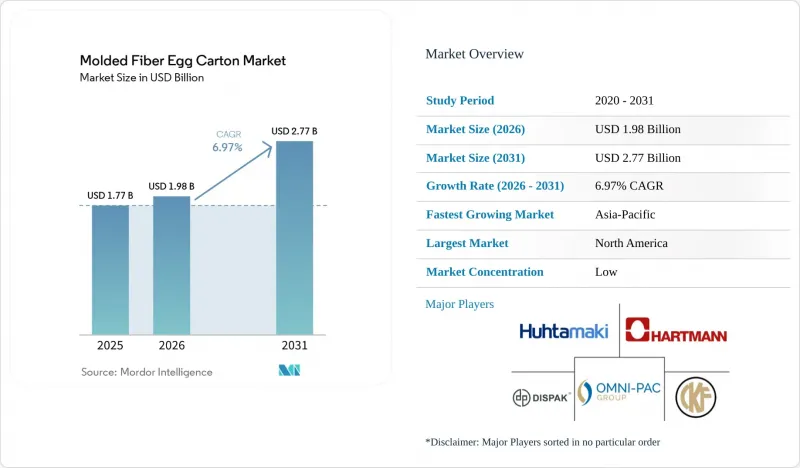
根據 Mordor Intelligence 預測,模塑纖維蛋盒的市場規模預計將從 2025 年的 17.7 億美元和 2026 年的 19.8 億美元成長到 2031 年的 27.7 億美元,2026 年至 2031 年的年複合成長率(CAGR)為 6.97%。
本報告按產品類型(標準蛋盒、特殊蛋盒)、容量(6個及以下、7-12個、13-18個、19-30個)、模塑纖維類型(轉注成型、熱成型模塑纖維、厚壁模塑纖維)、應用領域(零售、商業、工業)和地區進行細分。市場預測以美元(USD)為單位。
全球模塑纖維蛋盒市場趨勢與分析
逐步淘汰塑膠使用和強制循環包裝方面取得進展
歐盟第2025/40號條例於2026年8月12日全面生效,該條例對歐盟範圍內的食品接觸包裝材料的可回收性和全氟烷基和多氟烷基物質(PFAS)含量製定了具有約束力的規定。該條例規定,自2030年1月1日起,可回收等級低於C級的包裝材料將不得在歐盟市場銷售。這一最後期限迫使生產商做出轉型決策,因為他們已無力繼續投資那些在其正常設備週期內可能失去市場進入的產品。北美地區的監管趨勢也正朝著對發泡材和其他可回收性較低的材料施加更嚴格的限制的方向發展,這將縮短這些材料在雞蛋包裝中的實際期限。在模塑纖維雞蛋盒市場,其優勢不僅限於環保性能。當PFAS相關法規得到加強時,纖維包裝通常比塑膠或塗層紙包裝需要更少的重新設計。因此,對於向零售商和品牌所有者提供產品的供應商而言,他們無法承擔改變包裝的風險,尤其是在實施日期臨近的情況下,遵守法規的準備情況已成為模塑纖維雞蛋盒市場的直接購買因素。
雞蛋消費量和家禽產量增加
模塑纖維蛋盒市場持續受益於主要產蛋國雞蛋產量的成長,這些國家的商業性包裝系統也不斷擴張。預計到2026年,印度的雞蛋產量將成長5%,巴西同期預計也將成長3%。全球禽肉產量預計在2026年達到1.107億噸,比2025年增加3%。這反映出中國和巴西等國的禽肉生產能力大幅擴張。隨著禽肉養殖規模的擴大,在超級市場和出口供應鏈中,由於需要標準化的堆疊、搬運和包裝完整性,非正式的、可重複使用的包裝變得越來越不實用。這種轉變正在推動模塑纖維蛋盒市場的基本需求成長,尤其是在南亞和南美洲,這些地區的加工能力因一體化雞蛋生產而不斷提高。在模塑纖維蛋盒市場,禽肉養殖的擴張不僅透過增加雞蛋產量來支撐包裝需求,而且還透過推廣正規的包裝標準來支撐包裝需求。
再生纖維和乾燥能源成本波動很大
模塑纖維蛋盒市場持續受到再生纖維供應波動和乾燥能源成本的影響。傳統的濕式模塑生產依賴穩定的紙漿供應和高熱乾燥工藝,因此短期利潤率的波動性可能大於最終需求。 PulPac 和 Nippon Molding 的商業化應用,其能耗遠低於傳統濕式模塑,凸顯了能源強度在當前生產系統中仍然至關重要。當原料市場緊張或運輸成本上升時,缺乏長期再生纖維供應的製造商更容易受到衝擊。在蛋品生產商關注單價的大宗合約中,這些壓力尤其難以克服。因此,即使法規和零售環境持續支持銷售量成長,模塑纖維蛋盒市場的利潤率仍可能面臨壓力。
細分市場分析
截至2025年,標準蛋盒將佔據模塑纖維蛋盒市場64.83%的佔有率,這反映出其在通用雞蛋配銷通路中的強勢地位,在這些管道中,成本效益和與現有包裝生產線的兼容性至關重要。標準蛋盒適用於轉注成型和熱成型生產流程,加上其可利用的再生纖維來源,確保了其在有組織的零售通路中穩定的銷售量。預計2026年至2031年間,用於包裝放養雞蛋、有機雞蛋、自由放養和草飼雞蛋的特種蛋盒將以7.73%的複合年成長率成長,表明產品組合最佳化領域正在不斷擴大。
哈特曼為伯恩布雷農場「島嶼黃金」系列產品設計的出色包裝表明,特種模塑纖維紙盒正日益成為一種品牌資產,而不僅僅是通用包裝材料。此外,向非籠養雞蛋生產的轉型不僅推動了產量的成長,也提高了紙盒的基本要求。由於這種生產方式生產的雞蛋容易出現大小和蛋殼外觀的差異,因此需要提高紙盒的抗衝擊性和密封性。為了滿足這項需求,更高性能的模塑紙盒應運而生,它們既能保護產品,又能提升包裝的吸引力。
預計2026年至2031年間,19-30枚裝雞蛋盒市場將以8.12%的複合年成長率成長,成為模塑纖維雞蛋盒市場中成長最快的產能細分市場。這一細分市場的成長主要得益於亞太和南美地區工業包裝的擴張,這些地區的綜合家禽養殖企業正在運作高產能生產線。 Big Herdsman公司銷售的智慧托盤包裝機每小時可處理36,000至72,000枚雞蛋,這充分體現了大規模包裝系統的部署規模。 2026年1月,該公司向印度交付了一條每小時可生產5,000個雞蛋托盤的自動化生產線,這將加速南亞地區包裝基礎設施的投資步伐。
受北美和歐洲單身人士及小規模購買習慣的影響,6枚或以下規格的雞蛋盒預計將在2025年佔56.75%的市場佔有率。 「7-12枚裝」仍是零售和餐飲業的主流包裝規格,而「13-18枚裝」則滿足了較大家庭和會員制零售商的需求。此外,更大容量的包裝能夠提高每枚雞蛋的纖維成本效益,這與加工商的經濟效益和不斷成長的工業需求相契合。這種協同效應正推動模塑纖維雞蛋盒市場繼續向散裝形式轉型,規模、自動化和運輸效率等因素對消費者的購買決策的影響日益增強。
區域分析
到2025年,北美將佔市場總值的34.91%,佔據當年模塑纖維蛋盒市場的最大佔有率。據哈特曼稱,2024年至2027年間,Huta Maki在密蘇裡州勞拉和安大略省布蘭特福德的累積投資將超過1億美元,第一階段已完成,第二階段將於2026年初啟動。 2025年4月,Huta Maki以1,800萬美元收購了Zelwyn Farms公司,進一步鞏固了在美國東南部的地位,新增業務的年淨銷售額約為2,000萬美元。儘管與高致病性禽流感 (HPAI) 相關的雞群損失導致 2025 年的計畫出現波動,但 Target 仍堅持其目標,即到 2026 年底,非籠養雞蛋的銷售額佔比達到 57-61%。預計墨西哥雞蛋產量在 2026 銷售年度將達到 660 億枚,這將支撐該地區的紙盒雞蛋需求。
歐洲擁有龐大的雞蛋消費量,同時也是紙盒加工商合規要求最嚴格的地區之一。 2024年,德國的雞蛋消費量達到208億枚,自由放養的產量增加了5.4%,新增了63.4萬個養殖位。歐盟第2025/40號法規於2026年8月12日全面生效,其關於可回收性和全氟烷基和多氟烷基物質(PFAS,即塑膠紙漿農業標準)的規定,全部區域的不合規包裝構成了一道屏障。在南美洲,巴西的雞蛋產量預計將在2026年成長3%,隨著家禽養殖業的擴張,這將支撐當地對模塑紙漿蛋盒的需求。
亞太地區是成長最快的地區,預計2026年至2031年間,模塑纖維蛋盒市場將以7.66%的年複合成長率(CAGR)成長。 2026年銷售年度,中國雞蛋產量預計將達到6,820億枚,印度雞蛋產量預計將增加5%至1,560億枚,將使該地區成為未來蛋盒需求的主要供應基地。日本新模塑株式會社(Nippon Molding)在日本擴大模塑紙漿(DMF)生產規模,顯示亞洲已開發市場對資源高效纖維包裝的需求日益成長。 MyPak在澳洲和紐西蘭供應不含PFAS且通過BRC認證的模塑纖維包裝,顯示大洋洲地區對高品質和合規性產品的需求也不斷成長。雖然中東和非洲仍處於起步階段,但家禽業的標準化、都市區零售業的成長以及低溫運輸系統的完善正在穩步推動標準化模塑纖維蛋盒的普及應用。
其他好處:
- Excel格式的市場預測(ME)表
- 3個月的分析師支持
目錄
第1章:引言
- 市場分析與定義的前提條件
- 分析範圍
第2章 分析方法
第3章執行摘要
第4章 市場狀況
- 市場概覽
- 市場促進因素
- 逐步淘汰塑膠使用,並擴大強制性循環包裝的範圍
- 雞蛋消費量和家禽產量增加
- 為有機雞蛋、自由放養雞蛋和非籠養雞蛋增加高價值。
- 零售業對可回收和可堆肥的貨架即用包裝的偏好
- 與自動包裝機的相容性將作為採購標準之一。
- 食品接觸適用性,即“完全不含化學物質”,正在推動人們選擇經過認證的紡織材料。
- 市場限制因素
- 再生纖維和乾燥能源成本波動很大
- 來自低成本塑膠、發泡材和瓦楞紙板替代品的競爭。
- 再生纖維的化學遷移和可追溯性問題
- 禽流感導致蛋雞數量波動,扭曲了紙箱需求計畫。
- 產業價值鏈分析
- 監理情勢
- 技術展望
- 波特五力分析
第5章:預測市場規模與成長率
- 依產品類型
- 標準雞蛋盒
- 特製雞蛋盒
- 按產能
- 6 件或以下
- 7-12 件
- 13-18 件
- 19-30件
- 按模塑纖維類型
- 轉注成型
- 熱成型模塑纖維
- 厚壁模塑纖維
- 透過使用
- 零售
- 商業的
- 工業的
- 按地區
- 北美洲
- 美國
- 加拿大
- 墨西哥
- 南美洲
- 巴西
- 阿根廷
- 其他南美國家
- 歐洲
- 德國
- 英國
- 法國
- 義大利
- 西班牙
- 俄羅斯
- 其他歐洲國家
- 亞太地區
- 中國
- 日本
- 韓國
- 印度
- 澳洲和紐西蘭
- 其他亞太國家
- 中東和非洲
- 中東
- 沙烏地阿拉伯
- 阿拉伯聯合大公國
- 土耳其
- 其他中東國家
- 非洲
- 南非
- 奈及利亞
- 其他非洲國家
- 中東
- 北美洲
第6章 競爭情勢
- 市場集中度
- 策略趨勢
- 市佔率分析
- 公司簡介
- Hartmann Packaging A/S
- Huhtamaki Oyj
- CKF Inc.
- Nippon Molding Co., Ltd.
- Omni-Pac Ekco GmbH
- Dispak Ltd.
- Dentas Kagit Sanayi AS
- Henry Molded Products, Inc.
- Claridge Moulded Fibre Limited
- Berkley International Packaging, LLC
- Qingdao Xinya Molded Pulp Packaging Products Co., Ltd.
- Best Plus Pulp Co., Ltd.
- Celluloses de la Loire
- Pacific Pulp Molding, Inc.
- Kpack UK Ltd.
- World Centric, Inc.
- MyPak Packaging Pty Ltd.
- Al Ghadir Group
第7章 市場機會與未來展望
According to Mordor Intelligence, the molded fiber egg carton market size is projected to expand from USD 1.77 billion in 2025 and USD 1.98 billion in 2026 to USD 2.77 billion by 2031, registering a CAGR of 6.97% between 2026 to 2031.
This report is Segmented by Product Type (Standard Egg Cartons, and Specialty Egg Cartons), Capacity (Up To 6 Eggs, 7 To 12 Eggs, 13 To 18 Eggs, and 19 To 30 Eggs), Molded Fiber Type (Transfer Molded, Thermoformed Fiber, and Thick-Wall Molded Fiber), Application (Retail, Commercial, and Industrial), and Geography. The Market Forecasts are Provided in Terms of Value (USD).
Global Molded Fiber Egg Carton Market Trends and Insights
Rising Plastic Phaseout and Circular Packaging Mandates
Regulation (EU) 2025/40 enters into full force on August 12, 2026, and establishes binding recyclability and PFAS rules for food-contact packaging across the EU. The same regulation states that packaging with a recyclability grade below C cannot be placed on the EU market from January 1, 2030. That deadline is changing conversion decisions now because producers cannot afford to keep investing in formats that may lose market access within a normal equipment cycle. The direction of regulation in North America has also moved toward tighter limits on foam and other low-recyclability materials, which shortens the practical runway for those formats in egg packaging. In the molded fiber egg carton market, the advantage is not only environmental positioning; fiber formats usually require less reformulation than plastic or coated paperboard when PFAS-related rules tighten. This is making compliance readiness a direct purchasing factor in the molded fiber egg carton market, especially for suppliers serving retailers and brand owners that cannot risk packaging changes close to enforcement dates.
Growing Egg Consumption and Poultry Output
The molded fiber egg carton market continues to benefit from rising egg output in major producing countries where commercial packing systems are expanding. India's egg production is forecast to grow 5% in marketing year 2026, while Brazil is projected to add 3% output in the same period. Global poultry meat production is forecast to reach 110.7 million metric tons in 2026, up 3% from 2025, reflecting broader poultry capacity expansion in countries such as China and Brazil. As poultry operations scale, informal reuse packaging becomes less workable in supermarket and export supply chains that need standardized stacking, handling, and pack integrity. That shift raises baseline demand in the molded fiber egg carton market, especially in South Asia and South America, where integrated egg operations are adding throughput. In the molded fiber egg carton market, poultry expansion supports carton demand not only by increasing egg production but also by advancing formal packing standards.
Volatile Recovered Fiber and Drying Energy Costs
The molded fiber egg carton market remains exposed to swings in recovered fiber availability and drying energy costs. Traditional wet-process production depends on steady pulp input and heat-intensive drying, so short-term margins can move more sharply than end demand. PulPac's commercial rollout with Nippon Molding was positioned on materially lower energy use than conventional wet forming, underscoring how important energy intensity remains across the current production base. Producers without long-term recycled fiber coverage are more vulnerable when raw material markets tighten or freight costs rise. These pressures are hardest to overcome in high-volume contracts, where egg producers focus on carton cost per unit. As a result, the molded fiber egg carton market can face margin compression even when regulatory and retail conditions continue to support volume growth.
Other drivers and restraints analyzed in the detailed report include:
- Premiumization of Organic, Free-Range, and Cage-Free Eggs
- Retail Preference for Recyclable and Compostable Shelf-Ready Packs
- Competition from Low-Cost Plastic, foam, and Corrugated Alternatives
For complete list of drivers and restraints, kindly check the Table Of Contents.
Segment Analysis
Standard Egg Cartons held 64.83% of the molded fiber egg carton market share in 2025, reflecting their strong position in commodity egg channels where cost per unit and compatibility with legacy packing lines matter most. Their fit with both transfer-molded and thermoformed production, along with familiar recycled-fiber sourcing, keeps volumes steady across organized retail. Specialty Egg Cartons for cage-free, organic, free-range, and pasture-raised eggs are projected to grow at a 7.73% CAGR through 2026-2031, indicating where mix improvement is developing.
Hartmann's premium work on Burnbrae Farms' Island Gold packaging illustrates how specialty molded fiber cartons are increasingly being used as brand assets rather than simple commodity inputs. The cage-free transition is also pushing higher baseline carton requirements, not only more units. Eggs from these systems can show greater variation in size and shell appearance, underscoring the need for better nest tolerance and more secure closure performance. That gap favors higher-specification fiber formats that can protect the product while carrying stronger on-pack communication.
The 19 to 30 Eggs segment is projected to grow at 8.12% CAGR through 2026-2031, making it the fastest-rising capacity band in the molded fiber egg carton market. The segment is supported by industrial packing expansion in Asia-Pacific and South America, where integrated poultry operators are running higher-throughput lines. Big Herdsman markets intelligent tray packers capable of 36,000 to 72,000 eggs per hour, which shows the scale at which large-format packing systems are now being deployed. Shipped a 5,000-units-per-hour automated egg tray production line to India in January 2026, reinforcing the pace of packaging infrastructure investment in South Asia.
The Up to 6 Eggs segment held 56.75% of the 2025 market value, supported by single-serve and small-household purchasing patterns in North America and Europe. The 7 to 12 Eggs format remains the mainstream retail and foodservice pack, while 13 to 18 Eggs serves larger households and club retail needs. Larger pack sizes also offer better fiber cost efficiency per egg, which aligns converter economics with rising industrial demand. That combination keeps the molded fiber egg carton market tilted toward bulk formats, where scale, automation, and freight efficiency increasingly shape purchasing decisions.
Geography Analysis
North America held 34.91% of the 2025 market value, giving it the largest share of the molded fiber egg carton market that year. Hartmann said its cumulative North American investments exceeded USD 100 million across Rolla, Missouri, and Brantford, Ontario, from 2024 through 2027, with Phase 1 completed and Phase 2 underway in early 2026. Huhtamaki strengthened its southeastern US position through the April 2025 acquisition of Zellwin Farms Company for USD 18 million, adding a business with annual net sales of around USD 20 million. HPAI-related flock losses created planning volatility through 2025, while Target maintained a 57-61% cage-free unit egg sales goal for end-2026, and Mexico's egg production is forecast to reach 66 billion units in marketing year 2026, which keeps regional carton demand supported.
Europe combines large-volume egg consumption with the most demanding compliance environment for carton converters. Germany consumed 20.8 billion eggs in 2024, and free-range housing expanded by 5.4% that year, adding 634,000 new places. Regulation (EU) 2025/40 takes full effect on August 12, 2026, and its recyclability and PFAS provisions are creating barriers to non-compliant packaging across the region. In South America, Brazil's egg production is projected to grow 3% in marketing year 2026, which supports local demand for molded pulp cartons tied to expanding poultry output.
Asia-Pacific is the fastest-growing region, with a projected CAGR of 7.66% from 2026 to 2031 in the molded fiber egg carton market. China's egg production is forecast at 682 billion units in marketing year 2026, while India is forecast at 156 billion units with 5% growth, making the region the main volume base for future carton demand. Nippon Molding's DMF rollout in Japan points to rising demand for more resource-efficient fiber packaging in advanced Asian markets. MyPak supplies PFAS-free and BRC-certified molded fiber packs across Australia and New Zealand, which shows how premium and compliance-led demand is also deepening in Oceania. Middle East and Africa remain earlier-stage opportunities where poultry formalization, urban retail growth, and upgraded cold-chain systems are steadily improving the case for standardized molded fiber cartons.
- Hartmann Packaging A/S
- Huhtamaki Oyj
- CKF Inc.
- Nippon Molding Co., Ltd.
- Omni-Pac Ekco GmbH
- Dispak Ltd.
- Dentas Kagit Sanayi A.S.
- Henry Molded Products, Inc.
- Claridge Moulded Fibre Limited
- Berkley International Packaging, LLC
- Qingdao Xinya Molded Pulp Packaging Products Co., Ltd.
- Best Plus Pulp Co., Ltd.
- Celluloses de la Loire
- Pacific Pulp Molding, Inc.
- Kpack UK Ltd.
- World Centric, Inc.
- MyPak Packaging Pty Ltd.
- Al Ghadir Group
Additional Benefits:
- The market estimate (ME) sheet in Excel format
- 3 months of analyst support
TABLE OF CONTENTS
1 INTRODUCTION
- 1.1 Study Assumptions and Market Definition
- 1.2 Scope of the Study
2 RESEARCH METHODOLOGY
3 EXECUTIVE SUMMARY
4 MARKET LANDSCAPE
- 4.1 Market Overview
- 4.2 Market Drivers
- 4.2.1 Rising Plastic Phaseout and Circular Packaging Mandates
- 4.2.2 Growing Egg Consumption and Poultry Output
- 4.2.3 Premiumization of Organic, Free-Range, and Cage-Free Eggs
- 4.2.4 Retail Preference for Recyclable and Compostable Shelf-Ready Packs
- 4.2.5 Auto-packer Compatibility Becomes a Procurement Criterion
- 4.2.6 Forever-chemical-free Food-Contact Compliance Favors Qualified Fiber Formats
- 4.3 Market Restraints
- 4.3.1 Volatile Recovered Fiber and Drying Energy Costs
- 4.3.2 Competition from Low-Cost Plastic, Foam, and Corrugated Alternatives
- 4.3.3 Recycled-Fiber Chemical Migration and Traceability Burden
- 4.3.4 Avian Influenza-led Layer Flock Volatility Distorts Carton Demand Planning
- 4.4 Industry Value Chain Analysis
- 4.5 Regulatory Landscape
- 4.6 Technological Outlook
- 4.7 Porter's Five Forces Analysis
- 4.7.1 Threat of New Entrants
- 4.7.2 Bargaining Power of Suppliers
- 4.7.3 Bargaining Power of Buyers
- 4.7.4 Threat of Substitutes
- 4.7.5 Competitive Rivalry
5 MARKET SIZE AND GROWTH FORECASTS (VALUE)
- 5.1 By Product Type
- 5.1.1 Standard Egg Cartons
- 5.1.2 Specialty Egg Cartons
- 5.2 By Capacity
- 5.2.1 Up to 6 Eggs
- 5.2.2 7 to 12 Eggs
- 5.2.3 13 to 18 Eggs
- 5.2.4 19 to 30 Eggs
- 5.3 By Molded Fiber Type
- 5.3.1 Transfer Molded
- 5.3.2 Thermoformed Fiber
- 5.3.3 Thick-wall Molded Fiber
- 5.4 By Application
- 5.4.1 Retail
- 5.4.2 Commercial
- 5.4.3 Industrial
- 5.5 By Geography
- 5.5.1 North America
- 5.5.1.1 United States
- 5.5.1.2 Canada
- 5.5.1.3 Mexico
- 5.5.2 South America
- 5.5.2.1 Brazil
- 5.5.2.2 Argentina
- 5.5.2.3 Rest of South America
- 5.5.3 Europe
- 5.5.3.1 Germany
- 5.5.3.2 United Kingdom
- 5.5.3.3 France
- 5.5.3.4 Italy
- 5.5.3.5 Spain
- 5.5.3.6 Russia
- 5.5.3.7 Rest of Europe
- 5.5.4 Asia-Pacific
- 5.5.4.1 China
- 5.5.4.2 Japan
- 5.5.4.3 South Korea
- 5.5.4.4 India
- 5.5.4.5 Australia and New Zealand
- 5.5.4.6 Rest of Asia-Pacific
- 5.5.5 Middle East and Africa
- 5.5.5.1 Middle East
- 5.5.5.1.1 Saudi Arabia
- 5.5.5.1.2 United Arab Emirates
- 5.5.5.1.3 Turkey
- 5.5.5.1.4 Rest of Middle East
- 5.5.5.2 Africa
- 5.5.5.2.1 South Africa
- 5.5.5.2.2 Nigeria
- 5.5.5.2.3 Rest of Africa
- 5.5.5.1 Middle East
- 5.5.1 North America
6 COMPETITIVE LANDSCAPE
- 6.1 Market Concentration
- 6.2 Strategic Moves
- 6.3 Market Share Analysis
- 6.4 Company Profiles (includes Global level Overview, Market level overview, Core Segments, Financials as available, Strategic Information, Market Rank/Share for key companies, Products and Services, and Recent Developments)
- 6.4.1 Hartmann Packaging A/S
- 6.4.2 Huhtamaki Oyj
- 6.4.3 CKF Inc.
- 6.4.4 Nippon Molding Co., Ltd.
- 6.4.5 Omni-Pac Ekco GmbH
- 6.4.6 Dispak Ltd.
- 6.4.7 Dentas Kagit Sanayi A.S.
- 6.4.8 Henry Molded Products, Inc.
- 6.4.9 Claridge Moulded Fibre Limited
- 6.4.10 Berkley International Packaging, LLC
- 6.4.11 Qingdao Xinya Molded Pulp Packaging Products Co., Ltd.
- 6.4.12 Best Plus Pulp Co., Ltd.
- 6.4.13 Celluloses de la Loire
- 6.4.14 Pacific Pulp Molding, Inc.
- 6.4.15 Kpack UK Ltd.
- 6.4.16 World Centric, Inc.
- 6.4.17 MyPak Packaging Pty Ltd.
- 6.4.18 Al Ghadir Group
7 MARKET OPPORTUNITIES AND FUTURE OUTLOOK
- 7.1 White-Space and Unmet-Need Assessment

 雞蛋包裝市場成長機會、成長要素、產業趨勢分析及2026-2035年預測。
 雞蛋盒和托盤市場規模、佔有率和趨勢分析報告:按分銷管道、應用、材料、產品類型、地區和細分市場預測(2026-2033 年)
 雞蛋包裝:市場佔有率分析、產業趨勢與統計、成長預測(2026-2031)
 2026-2030年全球雞蛋包裝市場
 雞蛋包裝市場報告:按產品類型、材料、應用和地區分類(2026-2034 年)
 雞蛋包裝市場:全球市場預測(按產品類型、材料類型、包裝類型、分銷管道和最終用途分類)- 2026-2032年
 2026年全球雞蛋托盤市場報告
 雞蛋包裝市場規模、佔有率和成長分析(按材料類型、包裝類型、雞蛋品種和地區分類)-2026-2033年產業預測
 全球雞蛋包裝市場全球雞蛋托盤市場