


 |
市場調查報告書
商品編碼
2064493
可重複使用罐:市場佔有率分析、行業趨勢和統計數據、成長預測(2026-2031)Resealable Cans - Market Share Analysis, Industry Trends & Statistics, Growth Forecasts (2026 - 2031) |
||||||

※ 本網頁內容可能與最新版本有所差異。詳細情況請與我們聯繫。
根據 Mordor Intelligence 預測,可重複密封罐市場規模將從 2025 年的 23.2 億美元和 2026 年的 25.7 億美元成長到 2031 年的 33.1 億美元,2026 年至 2031 年的複合年成長率為 5.23%。
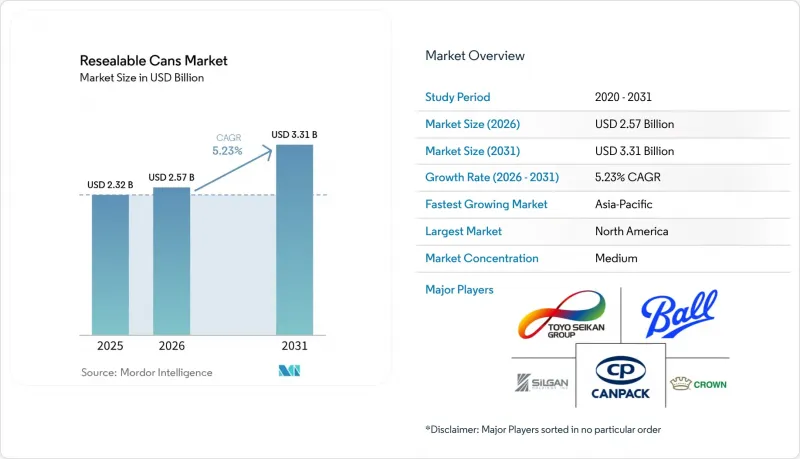
本報告按產品類型(標準可重複密封罐、螺旋蓋罐、混合/複合材料罐)、材料類型(鋁、鋼和馬口鐵、塑膠)、容量(350毫升以下、351-750毫升、750毫升以上)、終端用戶行業(食品飲料、個人護理和化妝品、藥品等)以及地區進行細分。市場預測以美元計價。
全球可重複密封罐市場趨勢及洞察
攜帶式飲料包裝的需求日益成長。
隨著消費者擴大在戶外和各種場合使用飲料,攜帶式消費持續推動可重複密封罐市場的發展。對於330毫升至500毫升的產品而言,這點尤其重要,因為消費者並非一次飲用完所有飲料,而防漏包裝則能提供直接的功能價值。能量飲料、氣泡水和健身飲料更能受益於可重複密封的特性,因為開封後的洩漏會改變消費者飲用這些飲料的方式和地點。品牌也開始將可重複密封包裝作為零售店的差異化優勢。例如,Re:Lid USA於2026年4月在南加州的Gelson's Markets超市推出產品。隨著這一趨勢擴展到便利商店和即時消費管道,可重複密封罐市場預計將在飲料產品組合中佔據更廣泛的地位。
過渡到可回收金屬包裝
可重複密封罐市場正受到鋁製飲料包裝環境優勢的推動。在美國,預計到2024年,鋁製飲料罐的閉合迴路回收率將達到96.7%,平均回收材料含量為71%,遠高於玻璃和PET的同類水準。在歐洲,2023年鋁製飲料罐的回收率已達到76.3%,這進一步增強了金屬包裝在日益重視回收和回收材料含量的法規環境的吸引力。如果罐蓋系統保持單一材料結構,可重複密封罐市場將受益更多,因為這可以降低包裝的複雜性並提高可回收性。在2026年國際包裝展(Interpack 2026)上,索諾科公司(Sonoco)正是基於這一點,重點展示了其CapOnCan系統,強調其單一材料的鋼結構以及在食品和寵物食品應用中降低的生產者延伸責任(EPR)成本。
與標準端蓋相比,其容量和製造成本更高。
可重複密封罐市場最大的結構性障礙仍然是瓶蓋相對於標準拉環式瓶蓋的額外成本。可重複密封系統需要更多零件、更嚴格的製造公差,在某些情況下,還需要對填充線的操作進行改造,而許多飲料生產商尚未採用這些改造。對於中小品牌而言,這一負擔尤其沉重,因為它們無法將設備和加工成本分攤到非常大的生產批量上。因此,高階飲料項目比大眾市場產品更容易進入這個市場,因為零售商和品牌所有者對包裝成本極為敏感。 XOLUTION公司計劃將瓶蓋年產能提升至9億個,顯示擴大生產規模是降低可重複密封罐市場成本的關鍵。
細分市場分析
到2025年,標準可重複密封罐將佔據可重複密封罐市場68.73%的佔有率,顯著超越其他產品形式。這一主導地位源於其與現有高速灌裝和封口生產線的兼容性,從而減少了飲料生產商的額外資本投資需求。這種基礎設施相容性確保了標準罐型在加工能力和易操作性比先進罐蓋功能更為重要的領域保持優勢。因此,儘管高階細分市場的新設計日益受到關注,可重複密封罐市場仍將繼續以標準罐型作為其主要銷售基礎。現有生產線的這項優勢應能確保標準罐型在整個預測期內保持其重要性。
螺紋蓋和螺旋蓋罐預計到2031年將以5.86%的複合年成長率成長,這主要得益於它們能夠在高碳酸飲料應用場景中長時間保持超過90 psi的壓力。這種性能使它們成為氣泡飲料、精釀啤酒和某些能量飲料的理想選擇,因為在這些應用中,開封後保持碳酸化至關重要。雖然滑動拉環和卡扣式系統正在不斷發展,但在嚴苛的加壓環境下,螺紋蓋仍然是更優的解決方案。混合/多材料罐在可重複密封罐市場中所佔佔有率仍然小規模,並且在個人護理、藥品和其他一些阻隔性足以抵消額外成本的應用領域中應用有限。隨著罐蓋經濟效益的提高,螺紋蓋罐可能會在可重複密封罐市場中佔據更大的佔有率,尤其是在高級產品上市時。
截至2025年,鋁製可重複密封罐市場佔有率將達到41.58%,預計到2031年,鋁製可重複密封罐市場將以6.08%的複合年成長率成長。鋁製可重複密封罐的主導地位得益於其輕質、耐腐蝕、優異的阻隔性能以及完善的回收利用記錄,這些優勢便於品牌所有者向零售商和消費者清晰地傳達。此外,鋁材尤其適用於碳酸飲料,因為碳酸飲料對結構可靠性要求極高,這也支撐了可重複密封罐市場的發展。在美國,到2025年,鋁製飲料罐從回收箱回收再製成新罐的平均時間將不到60天,這充分展現了閉合迴路價值提案的高效性和可見性。這種功能性和循環性的結合,確保了鋁製可重複密封罐市場持續佔據核心地位。
閉合迴路回收還能提升材料的長期吸引力,因為與原生鋁生產相比,罐到罐循環系統可將碳足跡減少90%以上。國際鋁業協會(IAI)也指出,與重熔混合合金相比,先進的閉合迴路製程可多回收18%的金屬,並降低15%的能耗。鋼板和馬口鐵在乾貨、糖果甜點、營養粉和工業化學品的三片式罐體中仍然發揮著重要作用,因為這些應用對耐壓性要求較低,成本競爭力更為重要。塑膠可重複密封罐在低壓個人保健產品和化妝品應用領域仍佔有一席之地,但在產品理念中包含可回收性的應用中,可重複密封罐行業仍然與金屬材料聯繫更為緊密。
區域分析
截至2025年,北美將佔據可重複密封罐市場38.53%的佔有率,成為最大的區域市場。該地區受益於即飲飲料的高滲透率、密集的配送基礎設施以及成熟的鋁罐製造地。美國可重複密封罐市場也得益於品牌在包裝差異化方面的持續投資,尤其是在貨架可見性和便攜性至關重要的飲料品類。皇冠控股公司宣布,其位於巴西蓬塔格羅薩的工廠擴建工程預計將於2026年第三季開始商業化生產。該工廠的年產能將達到36億個罐,足以支持整個美洲地區的廣泛供應。北美仍面臨來自232條款下鋁關稅的成本壓力。這些關稅將維持在50%的稅率,直到2026年5月。此外,中西部地區的溢價在2026年1月下旬超過了每磅1美元,增加了加工商的不確定性。
預計到2031年,亞太地區將以6.12%的複合年成長率成長,成為可重複密封罐市場成長最快的地區。在主要國家,可支配收入的成長、快速的都市化以及即飲飲料(RTD)品類的擴張是推動這一成長的主要因素。繼2024年在印度塔羅賈投資5500萬美元之後,波爾公司於2025年在斯里城投資6000萬美元,理由是印度飲料罐行業的強勁成長以及對即飲飲料和乳製品的需求不斷增加。皇冠控股公司也於2026年4月宣布將在印度北部新建兩條生產線,預計從2027年下半年開始投產,年產量將達22億罐。 Canpack在2025年獲利報告中指出,印度是銷售成長的主要貢獻者,這與其對可重複密封罐市場的整體區域展望相符。
到2025年,歐洲將在可重複密封罐市場中佔據重要地位,其中德國、英國、法國和義大利是主要的消費中心。該地區正透過實施押金返還計畫(DRS)來促進市場發展,該計畫提高了易拉罐回收的經濟效益,並強化了優質金屬包裝的長期合理性。葡萄牙將於2026年4月10日推出「Volta DRS」計劃,對3公升以下的鋁罐和鋼罐徵收每罐0.10美元的押金。西班牙飲料容器押金返還計畫的法定截止日期為2026年11月,而英國已確認將於2027年10月推出每罐20便士的固定押金。
其他好處:
- Excel格式的市場預測(ME)表
- 3個月的分析師支持
目錄
第1章:引言
- 研究假設和市場定義
- 調查範圍
第2章:調查方法
第3章執行摘要
第4章 市場狀況
- 市場概覽
- 市場促進因素
- 對攜帶式飲料包裝的需求不斷成長
- 過渡到可回收金屬包裝
- 即飲飲料的高階化
- 一種創新、人性化的瓶蓋系統。
- 擴大押金退款制度將提高罐頭換罐頭的經濟可行性。
- 從衛生和防止刺傷的角度來看,在某些應用場景中,帶蓋的飲料表面是更好的選擇。
- 市場限制因素
- 與標準最終產品相比,其關閉和轉換成本更高。
- 與標準易拉罐和寶特瓶的競爭
- PFAS 和雙酚類物質不含食品接觸系統的合規性複雜性。
- 鋁關稅和溢價波動
- 產業價值鏈分析
- 監理情勢
- 技術展望
- 波特五力分析
第5章 市場規模與成長預測
- 依產品類型
- 標準可重複密封罐
- 螺紋/螺帽罐
- 混合/多材料可
- 材料類型
- 鋁
- 鋼板和馬口鐵
- 塑膠
- 按產能
- 350毫升或以下
- 351 ml~750 ml
- 超過750毫升
- 按最終用戶行業分類
- 食品/飲料
- 個人護理化妝品
- 化學品
- 製藥
- 油漆和潤滑劑
- 其他終端用戶產業
- 按地區
- 北美洲
- 美國
- 加拿大
- 墨西哥
- 南美洲
- 巴西
- 阿根廷
- 其他南美國家
- 歐洲
- 德國
- 英國
- 法國
- 義大利
- 西班牙
- 俄羅斯
- 其他歐洲國家
- 亞太地區
- 中國
- 日本
- 韓國
- 印度
- 澳洲和紐西蘭
- 其他亞太國家
- 中東和非洲
- 中東
- 沙烏地阿拉伯
- 阿拉伯聯合大公國
- 土耳其
- 其他中東國家
- 非洲
- 南非
- 奈及利亞
- 其他非洲國家
- 中東
- 北美洲
第6章 競爭情勢
- 市場集中度
- 策略趨勢
- 市佔率分析
- 公司簡介
- Crown Holdings, Inc.
- Ball Corporation
- Ardagh Metal Packaging SA
- CANPACK SA
- Toyo Seikan Group Holdings, Ltd.
- Silgan Holdings Inc.
- CPMC Holdings Limited
- Nampak Limited
- Envases Universales de Mexico, SAPI de CV
- Kian Joo Can Factory Berhad
- Mahmood Saeed Can and End Industry Company Limited
- SWAN Industries(Thailand)Company Limited
- Showa Aluminum Can Corporation
- XOLUTION Germany GmbH
- can2close GmbH
- Top Cap Holding GmbH
- Save-ty Can Cap BV
- Canovation LLC
第7章 市場機會與未來展望
According to Mordor Intelligence, the resealable cans market size is projected to expand from USD 2.32 billion in 2025 and USD 2.57 billion in 2026 to USD 3.31 billion by 2031, registering a CAGR of 5.23% between 2026 and 2031.
This report is Segmented by Product Type (Standard Resealable Cans, Threaded/Screw-Top Cans, and Hybrid/Multi-Material Cans), Material Type (Aluminum, Steel and Tinplate, and Plastic), Capacity (Up To 350 Ml, 351-750 Ml, and Above 750 Ml), End-User Industry (Food and Beverage, Personal Care and Cosmetics, Pharmaceuticals, and More), and Geography. The Market Forecasts are Provided in Terms of Value (USD).
Global Resealable Cans Market Trends and Insights
Rising Demand for On-The-Go Beverage Packaging
Portable consumption continues to support the resealable cans market because consumers increasingly use beverage packs outside the home and across multiple occasions. This matters most in 330 ml to 500 ml products, where not every drink is consumed at once, and spill resistance adds direct functional value. Energy drinks, sparkling water, and fitness beverages benefit more from resealability because product loss after opening can change how and where consumers use them. Brands also started using resealable packaging as a visible retail differentiator, as shown by Re: Lid USA's April 2026 launch at Gelson's Markets in Southern California. As this behavior spreads across convenience and immediate-consumption channels, the resealable cans market is likely to secure broader placement in beverage portfolios.
Shift Toward Recyclable Metal Packaging
The resealable cans market is gaining support from aluminum beverage packaging's stronger environmental position. Aluminum beverage cans in the United States had a closed-loop circularity rate of 96.7% and an average recycled content of 71% in 2024, well above comparable levels for glass and PET. In Europe, the aluminum beverage can recycling rate reached 76.3% in 2023, reinforcing the appeal of metal packaging in regulatory environments that are increasingly focused on recovery and recycled content. The resealable cans market benefits even more when closure systems preserve mono-material construction, because that lowers packaging complexity and improves recycling alignment. Sonoco positioned its CapOnCan system in exactly that way at Interpack 2026, highlighting mono-material steel construction and lower EPR fee exposure for food and pet food applications.
High Closure and Conversion Costs Versus Standard Ends
The largest structural brake on the resealable cans market remains the extra cost of the closure compared with a standard stay-on-tab end. Resealable systems require more parts, tighter manufacturing tolerances, and, in some cases, changes in filling-line handling that many beverage producers have not yet installed. That burden is more difficult for smaller and mid-sized brands because they cannot spread equipment and conversion costs across very high production runs. The market is therefore more accessible to premium beverage programs than to mass-market products, where retailers and brand owners are highly sensitive to packaging cost. XOLUTION's move toward a capacity of up to 900 million lids per year shows why scale is central to cost compression in the resealable cans market.
Other drivers and restraints analyzed in the detailed report include:
- Premiumization of Ready-To-Drink Beverages
- Innovation In User-Friendly Closure Systems
- Competition from Standard Cans and PET Bottles
For complete list of drivers and restraints, kindly check the Table Of Contents.
Segment Analysis
Standard resealable cans accounted for 68.73% of the resealable cans market in 2025, leaving them well ahead of other product formats. Their lead stemmed from compatibility with the installed base of high-speed filling and seaming lines, reducing the need for additional capital spending by beverage producers. That infrastructure fit gives standard formats a durable advantage in categories where throughput and operational simplicity still carry more weight than closure sophistication. The resealable cans market, therefore, continues to rely on standard configurations as its main volume base, even while newer designs gain attention in premium niches. This installed-line advantage should keep standard formats relevant through the forecast period.
Threaded and screw-top cans are projected to expand at a 5.86% CAGR through 2031, supported by their ability to retain pressure above 90 psi for longer periods in high-carbonation use cases. That performance makes them attractive for sparkling beverages, craft beer, and selected energy drink applications where carbonation retention after reopening is essential. Slide-tab and snap-fit systems have advanced, but threaded formats still offer a stronger solution in demanding pressure environments. Hybrid/multi-material cans remain a smaller part of the resealable cans industry, with more selective relevance in personal care, pharmaceuticals, and other applications where barrier properties justify added cost. As closure economics improve, the resealable cans market is likely to see threaded variants take a larger share of premium launch activity.
Aluminum held 41.58% of the resealable cans market share in 2025, and the aluminum resealable cans market is projected to expand at a 6.08% CAGR through 2031. Aluminum leads because it combines low weight, corrosion resistance, and strong barrier performance with an established recycling narrative that brand owners can communicate clearly to retailers and consumers. The resealable cans market is also supported by the material's suitability for carbonated beverage applications, where structural reliability is critical. In the United States, aluminum beverage cans moved from the recycling bin to a newly formed can in less than 60 days on average in 2025, reinforcing the speed and visibility of the closed-loop value proposition. This combination of functionality and circularity keeps aluminum at the center of the resealable cans market.
Closed-loop recycling also improves the material's long-term appeal because can-to-can systems can cut carbon footprint by more than 90% compared with primary aluminum production. The International Aluminum Institute also stated that advanced closed-loop processes can recover up to 18% more metal and lower energy use by 15% compared with mixed-alloy remelting. Steel and tinplate remain important in three-piece can formats for dry goods, confectionery, nutritional powders, and industrial chemicals, where pressure demands are lower and cost competitiveness matters more. Plastic resealable cans keep a role in low-pressure personal care and cosmetic uses, but the resealable cans industry remains more strongly aligned with metal in applications where recycling performance is part of the product story.
Geography Analysis
North America accounted for 38.53% of the resealable cans market in 2025, making it the largest regional market. The region benefits from strong penetration of ready-to-drink beverages, a dense distribution infrastructure, and an established aluminum can manufacturing base. The resealable cans market in the United States is also supported by ongoing brand investment in packaging differentiation, especially in beverage categories where shelf visibility and portability matter. Crown Holdings stated that its expanded Ponta Grossa plant in Brazil is expected to begin commercial production in Q3 2026, with an annual capacity of 3.6 billion cans, supporting broader regional supply across the Americas. North America still faces cost pressure from Section 232 aluminum tariffs, which maintained a 50% rate on aluminum articles through May 2026 and pushed converter uncertainty higher as the Midwest Premium moved above USD 1 per pound in late January 2026.
Asia-Pacific is projected to expand at a 6.12% CAGR through 2031, making it the fastest-growing region in the resealable cans market. Rising disposable income, rapid urbanization, and expanding ready-to-drink categories are driving that pace across major countries. Ball invested USD 60 million in Sri City in 2025, following a USD 55 million investment in Taloja in 2024, citing strong growth in India's beverage can sector and stronger demand for ready-to-drink beverages and dairy products. Crown Holdings also announced a greenfield two-line facility in Northern India in April 2026, with expected output of 2.2 billion cans annually from the second half of 2027. CANPACK reported 2025 results that pointed to India as a meaningful incremental contributor to volume growth, which fits the broader regional outlook for the resealable cans market.
Europe held a significant position in the resealable cans market in 2025, with Germany, the United Kingdom, France, and Italy serving as the main consumption centers. The region is also gaining support from deposit return systems, because those programs strengthen can recovery economics and improve the long-term case for premium metal packaging. Portugal launched the Volta DRS on April 10, 2026, covering aluminum and steel cans below 3 liters with a USD 0.10 deposit per unit. Spain's statutory deadline for a beverage container deposit return system is November 2026, and the UK's confirmed scheme is scheduled for October 2027 with a flat 20 pence deposit.
- Crown Holdings, Inc.
- Ball Corporation
- Ardagh Metal Packaging S.A.
- CANPACK S.A.
- Toyo Seikan Group Holdings, Ltd.
- Silgan Holdings Inc.
- CPMC Holdings Limited
- Nampak Limited
- Envases Universales de Mexico, S.A.P.I. de C.V.
- Kian Joo Can Factory Berhad
- Mahmood Saeed Can and End Industry Company Limited
- SWAN Industries (Thailand) Company Limited
- Showa Aluminum Can Corporation
- XOLUTION Germany GmbH
- can2close GmbH
- Top Cap Holding GmbH
- Save-ty Can Cap B.V.
- Canovation LLC
Additional Benefits:
- The market estimate (ME) sheet in Excel format
- 3 months of analyst support
TABLE OF CONTENTS
1 INTRODUCTION
- 1.1 Study Assumptions and Market Definition
- 1.2 Scope of the Study
2 RESEARCH METHODOLOGY
3 EXECUTIVE SUMMARY
4 MARKET LANDSCAPE
- 4.1 Market Overview
- 4.2 Market Drivers
- 4.2.1 Rising Demand for On-the-Go Beverage Packaging
- 4.2.2 Shift Toward Recyclable Metal Packaging
- 4.2.3 Premiumization of Ready-to-Drink Beverages
- 4.2.4 Innovation in User-Friendly Closure Systems
- 4.2.5 Deposit Return Scheme Expansion Improving Can-to-Can Economics
- 4.2.6 Hygiene and Anti-Spiking Use Cases Favoring Covered Drinking Surfaces
- 4.3 Market Restraints
- 4.3.1 High Closure and Conversion Costs Versus Standard Ends
- 4.3.2 Competition From Standard Cans and PET Bottles
- 4.3.3 Compliance Complexity for PFAS and Bisphenol-Free Food-Contact Systems
- 4.3.4 Aluminum Tariffs and Premium Volatility
- 4.4 Industry Value Chain Analysis
- 4.5 Regulatory Landscape
- 4.6 Technological Outlook
- 4.7 Porter's Five Forces Analysis
- 4.7.1 Threat of New Entrants
- 4.7.2 Bargaining Power of Suppliers
- 4.7.3 Bargaining Power of Buyers
- 4.7.4 Threat of Substitutes
- 4.7.5 Competitive Rivalry
5 MARKET SIZE AND GROWTH FORECASTS (VALUE)
- 5.1 By Product Type
- 5.1.1 Standard Resealable Cans
- 5.1.2 Threaded / Screw-Top Cans
- 5.1.3 Hybrid / Multi-Material Cans
- 5.2 By Material Type
- 5.2.1 Aluminum
- 5.2.2 Steel and Tinplate
- 5.2.3 Plastic
- 5.3 By Capacity
- 5.3.1 Up to 350 ml
- 5.3.2 351 ml to 750 ml
- 5.3.3 Above 750 ml
- 5.4 By End-User Industry
- 5.4.1 Food and Beverage
- 5.4.2 Personal Care and Cosmetics
- 5.4.3 Chemicals
- 5.4.4 Pharmaceuticals
- 5.4.5 Paints and Lubricants
- 5.4.6 Other End-User Industries
- 5.5 By Geography
- 5.5.1 North America
- 5.5.1.1 United States
- 5.5.1.2 Canada
- 5.5.1.3 Mexico
- 5.5.2 South America
- 5.5.2.1 Brazil
- 5.5.2.2 Argentina
- 5.5.2.3 Rest of South America
- 5.5.3 Europe
- 5.5.3.1 Germany
- 5.5.3.2 United Kingdom
- 5.5.3.3 France
- 5.5.3.4 Italy
- 5.5.3.5 Spain
- 5.5.3.6 Russia
- 5.5.3.7 Rest of Europe
- 5.5.4 Asia-Pacific
- 5.5.4.1 China
- 5.5.4.2 Japan
- 5.5.4.3 South Korea
- 5.5.4.4 India
- 5.5.4.5 Australia and New Zealand
- 5.5.4.6 Rest of Asia-Pacific
- 5.5.5 Middle East and Africa
- 5.5.5.1 Middle East
- 5.5.5.1.1 Saudi Arabia
- 5.5.5.1.2 United Arab Emirates
- 5.5.5.1.3 Turkey
- 5.5.5.1.4 Rest of Middle East
- 5.5.5.2 Africa
- 5.5.5.2.1 South Africa
- 5.5.5.2.2 Nigeria
- 5.5.5.2.3 Rest of Africa
- 5.5.5.1 Middle East
- 5.5.1 North America
6 COMPETITIVE LANDSCAPE
- 6.1 Market Concentration
- 6.2 Strategic Moves
- 6.3 Market Share Analysis
- 6.4 Company Profiles (includes Global level Overview, Market level overview, Core Segments, Financials as available, Strategic Information, Market Rank/Share for key companies, Products and Services, and Recent Developments)
- 6.4.1 Crown Holdings, Inc.
- 6.4.2 Ball Corporation
- 6.4.3 Ardagh Metal Packaging S.A.
- 6.4.4 CANPACK S.A.
- 6.4.5 Toyo Seikan Group Holdings, Ltd.
- 6.4.6 Silgan Holdings Inc.
- 6.4.7 CPMC Holdings Limited
- 6.4.8 Nampak Limited
- 6.4.9 Envases Universales de Mexico, S.A.P.I. de C.V.
- 6.4.10 Kian Joo Can Factory Berhad
- 6.4.11 Mahmood Saeed Can and End Industry Company Limited
- 6.4.12 SWAN Industries (Thailand) Company Limited
- 6.4.13 Showa Aluminum Can Corporation
- 6.4.14 XOLUTION Germany GmbH
- 6.4.15 can2close GmbH
- 6.4.16 Top Cap Holding GmbH
- 6.4.17 Save-ty Can Cap B.V.
- 6.4.18 Canovation LLC
7 MARKET OPPORTUNITIES AND FUTURE OUTLOOK
- 7.1 White-Space and Unmet-Need Assessment

 兒童安全及老年人友善包裝市場預測至2034年-按包裝類型、材料、機制、分銷管道、最終用戶和地區分類的全球分析
 再生塑膠屋頂瓦市場規模、佔有率和成長分析:按產品類型、材料來源、應用、分銷管道和地區分類-產業預測(2026-2033 年)
 PVC包裝帶市場:策略洞察與預測(2026-2031年)
 自黏氈墊市場:全球市場預測(2026-2032 年)
 再生材料包裝解決方案:市場佔有率分析、產業趨勢與統計、成長預測(2026-2031)兒童安全藥品包裝市場預測至2034年-按包裝類型、材料類型、藥品類型、最終用戶和地區分類的全球分析PCB先進材料市場預測至2034年-按PCB類型、材料類型、功能、最終用戶和地區分類的全球分析包裝材料市場預測至2034年-按材料、包裝類型、應用、最終用戶和地區分類的全球分析
 2026-2030年全球包裝材料市場鍵合線封裝材料市場:依材料、封裝類型、線徑及最終用途產業分類-2026-2032年全球市場預測