


 |
市場調查報告書
商品編碼
2064383
員工評估與薪酬平台:市場佔有率分析、產業趨勢與統計、成長預測(2026-2031)Employee Recognition And Rewards Platform - Market Share Analysis, Industry Trends & Statistics, Growth Forecasts (2026 - 2031) |
||||||

※ 本網頁內容可能與最新版本有所差異。詳細情況請與我們聯繫。
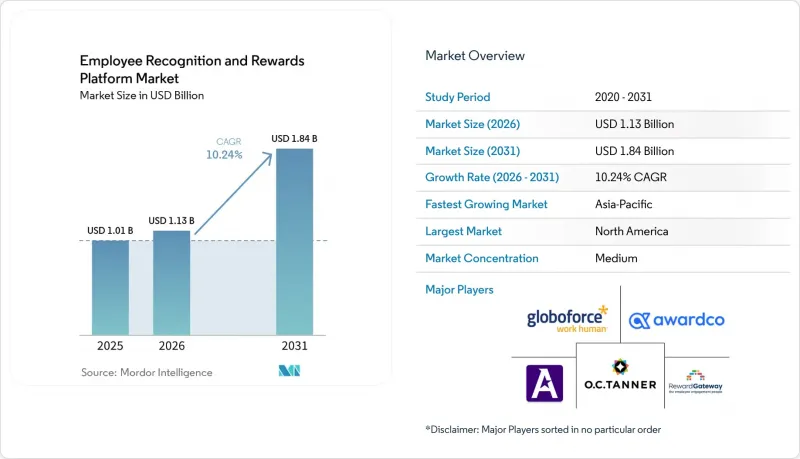
根據 Mordor Intelligence 預測,員工評估和薪酬平台市場規模預計將在 2025 年達到 10.1 億美元,2026 年達到 11.3 億美元,2031 年達到 18.4 億美元。
預計從 2026 年到 2031 年,其複合年成長率將達到 10.24%。
本報告按元件(軟體/平台、服務)、部署方式(雲端、本地部署、混合部署)、企業規模(大型企業、中小企業)、最終用戶產業(銀行、金融服務和保險、醫療保健和生命科學、IT和電信、其他)以及地區進行細分。市場預測以美元計價。
全球員工評估與薪酬平台市場趨勢及分析
降低員工自願離職率和職業倦怠的需求日益成長。
員工離職率仍然是員工評估和薪酬平台市場中最突出的需求推動要素。這是因為企業現在能夠更直接地將獎勵品質與員工留任率連結起來。 2024年9月,蓋洛普公司報告稱,獲得符合五大戰略支柱中至少四項的獎勵的員工,比獲得低品質獎勵的員工主動尋找新工作的可能性低65%。蓋洛普和Workhuman公司也發現,在一個擁有1萬名員工的企業中,將每週獎勵的頻率提高一倍,每年可減少1,610萬美元的員工流失成本,提高9,190萬美元的生產力,並減少380萬美元的缺勤成本。該研究還表明,獲得適當獎勵的員工報告職業倦怠的可能性降低了90%,這表明獎勵與員工留任率和員工福祉密切相關。 2026年3月,OC Tanner公司報告稱,接受綜合評估的員工計劃再留任一年的可能性是其他員工的26倍,這為人力資源部門與財務領導討論投資回報率(ROI)提供了更有力的依據。因此,員工評估和薪酬平台市場正在受益於這樣一種轉變:評估項目不僅被視為文化舉措,而且被視為人才保留的基礎設施。
混合辦公模式和擴大現場員工規模
工作方式日趨碎片化,這正在改變員工評估和薪酬平台市場的設計和行銷方式。蓋洛普的一份報告顯示,截至2025年3月,57%的完全遠距辦公人員和57%的混合辦公人員都在積極尋找新工作,而全職辦公室員工的比例僅為45%。這種差異促使雇主需要能夠更清楚地展現分散式團隊獎勵的工具,而這些工具不應依賴員工的接近性。供應商正在透過提供行動優先的產品設計、即使在離線環境下也能輕鬆存取的功能,以及為那些不經常使用桌面辦公工具的員工提供的簡化工作流程來滿足這一需求。據 OC Tanner 稱,2026 年第一季對 Culture Cloud 行動應用程式進行的改進,使得截至 2026 年 1 月,航空、金融和軟體行業客戶的用戶參與度提升了 200% 以上。這一點至關重要,因為在員工評估和薪資平台市場,平台能否像服務辦公室員工一樣,持續有效地觸及現場工作人員和輪班員工,正變得越來越關鍵。
預算審查和投資報酬率歸因壓力
隨著財務部門越來越要求提供證據,證明員工獎勵和獎勵方面的支出能夠提高員工留任率和生產力,預算核准仍然是員工認可和獎勵平台市場面臨的最大障礙之一。 2026年5月,HiBob的報告顯示,60%的受訪人力資源負責人需要花費超過三個小時才能收集到用於決策的基本員工數據,而只有2%的人能夠存取整合的人力資源和財務儀錶板。這一差距意義重大,因為獎勵計劃通常需要6到12個月的時間,離職率和缺勤率的變化才能在統計上具有可靠性,而預算週期通常要求更快地提供論證。當人力資源部門無法證明獎勵支出與工作績效之間有明確的關聯時,獎勵工具更有可能被視為「可有可無」而非企業必需品。因此,負責人往往更傾向於選擇能夠提供即時儀錶板、更強大的衡量框架和更清晰的績效報告的供應商。這種壓力並沒有抑制員工認可和獎勵平台市場的需求,但確實提高了供應商在採購或續約合約時必須證明的資格標準。
細分市場分析
到2025年,軟體/平台將佔據員工評估和獎勵平台市場69.42%的佔有率,這證實了持續的SaaS產品仍然是該類別商業性的核心。這一主導地位反映了企業傾向於選擇標準化平台層,以便能夠擴展獎勵工作流程、報告和獎勵管理,從而涵蓋大規模的員工群體。 Awardco透過獎勵「Awardco 2.0」強化了這一模式,在其現有獎勵引擎的基礎上增加了模組化的員工反饋功能、基於人工智慧的分析、市場個性化以及更廣泛的工作流程柔軟性。這些舉措表明,供應商正在透過擴展單一平台許可證可支援的用例數量來確保軟體收入。軟體仍然是員工評估和獎勵平台行業的核心產品,因為它支撐著獎勵數據、用戶訪問以及與更廣泛的人力資源體系的整合。
服務業是成長最快的領域,員工評估和薪酬平台服務市場預計到2031年將以12.12%的複合年成長率成長。這一成長與一些簡單的營運挑戰密切相關。雖然許多組織可以快速部署軟體,但它們仍需要在部署設計、行為改變實施、管治和部署後最佳化方面獲得協助。由於專案涉及多個國家,並且需要適應不同的區域薪資系統、稅收制度和工資處理流程,因此託管部署的價值日益凸顯。此外,隨著買家尋求將獎勵活動轉化為經理和員工在部署後實際可用的實施計劃方面的幫助,對服務的需求也在不斷成長。隨著員工評估和薪酬平台市場的擴張,服務並沒有取代軟體的核心作用,而是擴展規模以適應組織的複雜性。
到2025年,基於雲端的部署將佔員工評估和薪資平台市場71.18%的佔有率,這反映出企業人力資源應用領域正向SaaS產品廣泛轉型。許多獎勵現在都透過Microsoft Teams和Workday等工具頒發,而這兩款工具本身就運行在雲端原生環境中,這為雲端帶來了明顯的優勢。這種模式還支援更快的產品更新、更便捷的遠端存取以及更簡化的分散式員工部署。在一些政府機構、國防組織和金融業,由於內部審計管理和資料主權法規的限制,全面採用雲端技術仍然十分重要。儘管如此,符合現代人力資源軟體買家營運模式的雲端優先解決方案在員工評估和薪資平台市場仍然備受青睞。
混合部署是成長最快的部署方式,預計到 2031 年將達到 13.42% 的複合年成長率。這主要是由於大型企業試圖將雲端協作工具與本地人力資源資訊系統 (HRIS) 和薪資核算系統整合。這種情況在跨國公司中尤其常見,因為在某些司法管轄區,本地資料處理仍然是強制性的;此外,一些公司的傳統核心系統尚未完全遷移到雲端。 Semos Cloud 提供了多環境架構,該架構僅同步必要的員工字段,採用 TLS 1.2 或更高版本進行傳輸,對靜態資料進行 AES-256 加密,並使用 OAuth 2.0 進行 API 身份驗證,充分展現了混合設計如何在速度和控制之間取得平衡。在員工評估和薪酬平台產業,混合部署的成長與其說是對雲端的排斥,不如說是企業架構變革落後於獎勵的產品創新步伐的徵兆。
區域分析
到2025年,北美將佔據員工認可和獎勵平台市場38.77%的佔有率,成為收入最高的區域貢獻者。該地區之所以仍是需求中心,是因為其人力資源技術預算較為成熟,經營團隊更加重視員工自願離職,以及一些業內領先供應商的存在。根據美國勞工統計局預測,到2026年2月,自願離職人數預計將達到300萬,凸顯了人才獎勵成本的持續高昂,並推動了人們對員工認可計畫的持續關注。加拿大也為市場成長做出貢獻,尤其是在零售和娛樂產業,人工智慧驅動的獎勵計畫與提升客戶體驗密切相關。據Achievers公司稱,Cineplex利用其平台提升了旗下45%門市的淨推薦值(NPS),這表明在該地區,獎勵與實際服務效果緊密相連。
預計到2031年,亞太地區員工認可和薪酬平台市場將以14.31%的複合年成長率(CAGR)實現最高成長。這一成長主要得益於企業數位轉型、勞動力規模擴大以及印度、中國和東南亞等大規模勞動力市場員工期望值的不斷提高。印度和韓國擁有最大的市場規模機遇,因為雇主正在採用基於應用程式的獎勵、具備協作功能的工具以及適合大規模分散式團隊的區域性薪酬方案。中國市場依然具有吸引力,但由於資料居住要求和跨境使用條款可能會限制全球平台的營運和擴張,因此其市場情況更為複雜。
到2025年,歐洲將佔據第二大區域市場佔有率,其中德國、英國和法國是員工認可和薪資平台市場最成熟的各國市場。 GDPR對歐洲平台設計的影響比其他大多數地區更大,這使得能夠提供清晰的同意記錄、可配置的資料居住和最小限度的員工資料傳輸的供應商更具優勢。南美市場仍處於發展階段,但由於巴西和阿根廷擁有龐大的服務業勞動力,且在桌上型電腦普及率不高的地區,行動優先工具的使用率不斷提高,因此這兩個國家的市場應用正在穩步推進。中東和非洲地區的市場規模目前較小,但隨著公共機構和酒店業雇主正式採用員工獎勵計劃,沙烏地阿拉伯和阿拉伯聯合大公國的需求正在成長。
其他好處:
- Excel格式的市場預測(ME)表
- 3個月的分析師支持
目錄
第1章:引言
- 市場分析與定義的前提條件
- 分析範圍
第2章 分析方法
第3章執行摘要
第4章 市場狀況
- 市場概覽
- 市場促進因素
- 降低員工自願離職率和職業倦怠的需求日益成長。
- 混合辦公模式和擴大現場員工規模
- 雲端原生人力資源技術堆疊的主流化
- 與協作和人力資源資訊系統工作流程的更深層整合
- 擴大評估數據在人力資本報告中的使用
- 擴展本地化世界的獎勵目錄
- 市場限制因素
- 預算審查和投資報酬率歸因壓力
- 整合傳統人力資源系統的複雜性
- 跨境稅費實施的複雜性
- 認知疲勞與人工智慧管治的風險
- 產業價值鏈分析
- 監理情勢
- 技術展望
- 宏觀經濟因素對市場的影響
- 波特五力分析
第5章:預測市場規模與成長率
- 按組件
- 軟體/平台
- 服務
- 透過部署方法
- 基於雲端的
- 現場
- 混合
- 按最終用戶公司規模分類
- 大公司
- 小型企業
- 按最終用戶行業分類
- 銀行、金融服務和保險業 (BFSI)
- 醫學與生命科學
- IT/通訊
- 零售與電子商務
- 工業/製造業
- 政府/公共部門
- 按地區
- 北美洲
- 美國
- 加拿大
- 墨西哥
- 南美洲
- 巴西
- 阿根廷
- 其他南美國家
- 歐洲
- 德國
- 英國
- 法國
- 義大利
- 西班牙
- 俄羅斯
- 荷蘭
- 其他歐洲國家
- 亞太地區
- 中國
- 日本
- 印度
- 韓國
- 澳洲和紐西蘭
- 其他亞太國家
- 中東
- 沙烏地阿拉伯
- 阿拉伯聯合大公國
- 其他中東國家
- 非洲
- 南非
- 奈及利亞
- 其他非洲國家
- 北美洲
第6章 競爭情勢
- 市場集中度
- 策略趨勢
- 市佔率分析
- 公司簡介。
- Globoforce, Inc. d/b/a Workhuman
- Awardco, Inc.
- OC Tanner Company
- Achievers Solutions Inc.
- Reward Gateway UK Limited
- Motivosity Inc.
- Kudos, Inc.
- Terryberry Company, LLC
- Smartly, Inc. d/b/a Bonusly
- PerkCity, Inc. d/b/a Nectar HR
- The Guusto Gifts Inc.
- Bucketlist Rewards Inc.
- Vantage Circle Technologies Pvt. Ltd
- Advantage Club Technologies Private Limited
- Workstars Global Ltd.
- Rewardian LLC
- Friendefi Inc. d/b/a Qarrot
- MatterApp, Inc.
- Engagedly Inc
- Emgage Private Limited
第7章 市場機會與未來展望
According to Mordor Intelligence, the employee recognition and rewards platform market size is projected to be USD 1.01 billion in 2025, USD 1.13 billion in 2026, and reach USD 1.84 billion by 2031, growing at a CAGR of 10.24% from 2026 to 2031.
This report is Segmented by Component (Software/Platform, and Services), Deployment Mode (Cloud-Based, On-Premises, and Hybrid), Enterprise Size (Large Enterprises, and Small and Medium-Sized Enterprises), End-User Industry (BFSI, Healthcare and Life Sciences, Information Technology and Telecom, and More), and Geography. The Market Forecasts are Provided in Terms of Value (USD).
Global Employee Recognition And Rewards Platform Market Trends and Insights
Rising Need To Reduce Voluntary Attrition And Burnout
Employee turnover remains the clearest demand driver in the employee recognition and rewards platform market because organizations can now connect recognition quality more directly to retention outcomes. Gallup reported in September 2024 that employees who received recognition that met at least 4 of 5 strategic pillars were 65% less likely to be actively job hunting than those who received lower-quality recognition. Gallup and Workhuman also found that in a 10,000-person organization, doubling weekly recognition frequency can produce USD 16.1 million in annual turnover cost avoidance, USD 91.9 million in productivity gains, and USD 3.8 million in lower absenteeism. The same research showed that adequately recognized employees were up to 90% less likely to report burnout, suggesting that recognition is relevant to both retention and workforce health. O.C. Tanner reported in March 2026 that employees receiving integrated recognition had 26 times the odds of planning to stay another year, providing HR teams with a stronger basis for ROI discussions with finance leaders. As a result, the employee recognition and rewards platform market is benefiting from a shift where recognition programs are being evaluated less as culture initiatives and more as retention infrastructure.
Expansion Of Hybrid And Frontline Workforces
Work patterns are now more fragmented, and that is changing how the employee recognition and rewards platform market is designed and sold. Gallup reported that in March 2025, 57% of exclusively remote workers and 57% of hybrid workers were actively watching for new jobs, compared with 45% of fully on-site employees. That gap has pushed employers to look for tools that make recognition more visible across distributed teams and less dependent on physical proximity. Vendors are responding with mobile-first product design, offline-friendly access, and simpler workflows for workers who do not spend the day inside desktop productivity tools. O.C. Tanner said its Q1 2026 Culture Cloud mobile app enhancements drove more than 200% growth in user engagement among client organizations in the airline, financial, and software sectors during January 2026. This matters because the employee recognition and rewards platform market is increasingly shaped by whether platforms can reach frontline and shift-based workers with the same consistency as office staff.
Budget Scrutiny And ROI Attribution Pressure
Budget approval remains one of the clearest barriers in the employee recognition and rewards platform market, as finance teams increasingly want proof that recognition spending drives changes in retention and productivity outcomes. HiBob said in May 2026 that 60% of surveyed people managers spent 3 or more hours gathering basic workforce data for a single decision, while only 2% had access to a unified HR and finance dashboard. That gap matters because recognition programs often need 6 to 12 months before changes in retention or absenteeism become statistically credible, yet budget cycles usually require faster justification. When HR teams cannot demonstrate clear links between recognition spend and labor outcomes, recognition tools are more likely to be classified as optional rather than operational. Buyers are therefore leaning toward vendors that provide real-time dashboards, stronger measurement frameworks, and clearer outcome reporting. This pressure does not stop demand in the employee recognition and rewards platform market, but it does raise the standard for what vendors must prove during procurement and renewal.
Other drivers and restraints analyzed in the detailed report include:
- Mainstreaming Of Cloud-Native HR Technology Stacks
- Deeper Integration With Collaboration And HRIS Workflows
- Integration Complexity Across Legacy HR Systems
For complete list of drivers and restraints, kindly check the Table Of Contents.
Segment Analysis
Software/platform held 69.42% of the employee recognition and rewards platform market share in 2025, which confirms that recurring SaaS delivery remains the commercial core of the category. That leadership reflects enterprises' preference for a standardized platform layer that can scale recognition workflows, reporting, and reward administration across large employee populations. Awardco reinforced this model through its Awardco 2.0 redesign, which added modular employee listening, AI-based analytics, marketplace personalization, and broader workflow flexibility to the existing recognition engine. Moves like this show how vendors are protecting software revenue by widening the number of use cases served from a single platform seat. In the employee recognition and rewards platform industry, software remains the core product because it anchors recognition data, user access, and integration with the wider HR stack.
Services is the fastest-growing component, with the employee recognition and rewards platform market size for services projected to expand at a 12.12% CAGR through 2031. That growth is tied to a simple operational issue because many organizations can buy software quickly but still need help with rollout design, behavioral adoption, governance, and post-launch optimization. Managed implementation has become more valuable as programs move across multiple countries and must account for localized reward catalogs, tax rules, and payroll treatment. Services demand is also rising because buyers want help translating recognition activity into adoption plans that managers and employees will actually use after launch. As the employee recognition and rewards platform market expands, services are scaling with enterprise complexity rather than replacing the central role of software.
Cloud-based deployment accounted for 71.18% of the employee recognition and rewards platform market in 2025, reflecting the broader shift toward SaaS delivery across enterprise HR applications. Cloud has a clear advantage because many recognition moments now happen inside tools like Microsoft Teams and Workday, both of which already operate as cloud-native environments. This model also supports faster product updates, easier remote access, and simpler rollout across dispersed workforces. On-premises deployment still matters in some government, defense, and financial environments where internal audit control or data sovereignty rules limit full cloud adoption. Even so, the employee recognition and rewards platform market continues to favor cloud-first solutions because they align with the operational patterns of modern HR software buyers.
Hybrid deployment is the fastest-growing mode, with a 13.42% CAGR through 2031, as large employers seek to connect cloud collaboration tools with on-premises HRIS and payroll systems. This is especially common in multinational enterprises where some jurisdictions still require local data handling or where legacy core systems have not yet moved fully to the cloud. Semos Cloud has outlined a multi-environment architecture that syncs only the required employee fields, uses TLS 1.2+ for transfers, AES-256 data encryption at rest, and OAuth 2.0 API authentication, reflecting how the hybrid design balances speed and control. In the employee recognition and rewards platform industry, hybrid growth is less a rejection of the cloud than a sign that enterprise architecture changes more slowly than recognition product innovation.
Geography Analysis
North America held 38.77% of the employee recognition and rewards platform market in 2025, making it the largest regional contributor to revenue. The region remains the center of demand because HR technology budgets are more mature, voluntary attrition is closely watched by leadership teams, and several of the category's best-known vendors are based there. The U.S. Bureau of Labor Statistics reported 3.0 million voluntary quits in February 2026, which kept retention costs visible and supported ongoing interest in recognition-linked employee programs. Canada is also contributing to growth, especially in retail and entertainment, where AI-supported recognition programs are being linked to customer experience improvement. Achievers noted that Cineplex used its platform to improve Net Promoter Scores at 45% of locations, which shows how recognition is being connected with front-line service outcomes in the region.
Asia-Pacific is forecast to grow at the fastest CAGR of 14.31% through 2031 in the employee recognition and rewards platform market. Growth is being driven by enterprise digitalization, the size of frontline workforces, and rising employee expectations in large labor markets such as India, China, and Southeast Asia. India and South Korea are among the strongest volume opportunities because employers are adopting app-based recognition, collaboration-native tools, and localized reward options that fit large distributed teams. China remains attractive but more complex because data residency expectations and cross-border redemption rules can limit how global platforms operate or scale.
Europe held the second-largest regional share in 2025, with Germany, the United Kingdom, and France representing the most established country markets in the employee recognition and rewards platform market. GDPR has had a stronger effect on platform design in Europe than in most other regions, which favors vendors that can offer clear consent trails, configurable data residency, and minimal employee data transfer. South America is still an earlier-stage market, but Brazil and Argentina are supporting adoption through large service-sector workforces and growing use of mobile-first tools where desktop access is uneven. The Middle East and Africa remains a smaller opportunity set today, although Saudi Arabia and the United Arab Emirates are showing stronger demand from public-sector bodies and hospitality employers that are formalizing workforce recognition programs.
- Globoforce, Inc. d/b/a Workhuman
- Awardco, Inc.
- O.C. Tanner Company
- Achievers Solutions Inc.
- Reward Gateway UK Limited
- Motivosity Inc.
- Kudos, Inc.
- Terryberry Company, LLC
- Smartly, Inc. d/b/a Bonusly
- PerkCity, Inc. d/b/a Nectar HR
- The Guusto Gifts Inc.
- Bucketlist Rewards Inc.
- Vantage Circle Technologies Pvt. Ltd
- Advantage Club Technologies Private Limited
- Workstars Global Ltd.
- Rewardian LLC
- Friendefi Inc. d/b/a Qarrot
- MatterApp, Inc.
- Engagedly Inc
- Emgage Private Limited
Additional Benefits:
- The market estimate (ME) sheet in Excel format
- 3 months of analyst support
TABLE OF CONTENTS
1 INTRODUCTION
- 1.1 Study Assumptions and Market Definition
- 1.2 Scope of the Study
2 RESEARCH METHODOLOGY
3 EXECUTIVE SUMMARY
4 MARKET LANDSCAPE
- 4.1 Market Overview
- 4.2 Market Drivers
- 4.2.1 Rising Need to Reduce Voluntary Attrition and Burnout
- 4.2.2 Expansion of Hybrid and Frontline Workforces
- 4.2.3 Mainstreaming of Cloud-Native HR Technology Stacks
- 4.2.4 Deeper Integration With Collaboration and HRIS Workflows
- 4.2.5 Growing Use of Recognition Data in Human Capital Reporting
- 4.2.6 Expansion of Localized Global Reward Catalogs
- 4.3 Market Restraints
- 4.3.1 Budget Scrutiny and ROI Attribution Pressure
- 4.3.2 Integration Complexity Across Legacy HR Systems
- 4.3.3 Cross-Border Tax and Reward Fulfillment Complexity
- 4.3.4 Recognition Fatigue and AI Governance Risks
- 4.4 Industry Value Chain Analysis
- 4.5 Regulatory Landscape
- 4.6 Technological Outlook
- 4.7 Impact of Macroeconomic Factors on the Market
- 4.8 Porter's Five Forces Analysis
- 4.8.1 Bargaining Power of Buyers
- 4.8.2 Bargaining Power of Suppliers
- 4.8.3 Threat of New Entrants
- 4.8.4 Threat of Substitutes
- 4.8.5 Intensity of Competitive Rivalry
5 MARKET SIZE AND GROWTH FORECASTS (VALUE)
- 5.1 By Component
- 5.1.1 Software/Platform
- 5.1.2 Services
- 5.2 By Deployment Mode
- 5.2.1 Cloud-Based
- 5.2.2 On-Premises
- 5.2.3 Hybrid
- 5.3 By End User Enterprise Size
- 5.3.1 Large Enterprises
- 5.3.2 Small and Medium-Sized Enterprises
- 5.4 By End User Industry
- 5.4.1 BFSI
- 5.4.2 Healthcare and Life Sciences
- 5.4.3 Information Technology and Telecom
- 5.4.4 Retail and E-commerce
- 5.4.5 Industrial Manufacturing
- 5.4.6 Government and Public Sector
- 5.5 By Geography
- 5.5.1 North America
- 5.5.1.1 United States
- 5.5.1.2 Canada
- 5.5.1.3 Mexico
- 5.5.2 South America
- 5.5.2.1 Brazil
- 5.5.2.2 Argentina
- 5.5.2.3 Rest of South America
- 5.5.3 Europe
- 5.5.3.1 Germany
- 5.5.3.2 United Kingdom
- 5.5.3.3 France
- 5.5.3.4 Italy
- 5.5.3.5 Spain
- 5.5.3.6 Russia
- 5.5.3.7 Netherlands
- 5.5.3.8 Rest of Europe
- 5.5.4 Asia-Pacific
- 5.5.4.1 China
- 5.5.4.2 Japan
- 5.5.4.3 India
- 5.5.4.4 South Korea
- 5.5.4.5 Australia and New Zealand
- 5.5.4.6 Rest of Asia-Pacific
- 5.5.5 Middle East
- 5.5.5.1 Saudi Arabia
- 5.5.5.2 United Arab Emirates
- 5.5.5.3 Rest of Middle East
- 5.5.6 Africa
- 5.5.6.1 South Africa
- 5.5.6.2 Nigeria
- 5.5.6.3 Rest of Africa
- 5.5.1 North America
6 COMPETITIVE LANDSCAPE
- 6.1 Market Concentration
- 6.2 Strategic Moves
- 6.3 Market Share Analysis
- 6.4 Company Profiles (includes Global Level Overview, Market Level Overview, Core Segments, Financials as available, Strategic Information, Market Rank/Share, Products and Services, Recent Developments).
- 6.4.1 Globoforce, Inc. d/b/a Workhuman
- 6.4.2 Awardco, Inc.
- 6.4.3 O.C. Tanner Company
- 6.4.4 Achievers Solutions Inc.
- 6.4.5 Reward Gateway UK Limited
- 6.4.6 Motivosity Inc.
- 6.4.7 Kudos, Inc.
- 6.4.8 Terryberry Company, LLC
- 6.4.9 Smartly, Inc. d/b/a Bonusly
- 6.4.10 PerkCity, Inc. d/b/a Nectar HR
- 6.4.11 The Guusto Gifts Inc.
- 6.4.12 Bucketlist Rewards Inc.
- 6.4.13 Vantage Circle Technologies Pvt. Ltd
- 6.4.14 Advantage Club Technologies Private Limited
- 6.4.15 Workstars Global Ltd.
- 6.4.16 Rewardian LLC
- 6.4.17 Friendefi Inc. d/b/a Qarrot
- 6.4.18 MatterApp, Inc.
- 6.4.19 Engagedly Inc
- 6.4.20 Emgage Private Limited
7 MARKET OPPORTUNITIES AND FUTURE OUTLOOK
- 7.1 White-space and Unmet-Need Assessment

 2026年全球員工社交獎勵系統市場報告
 員工獎勵軟體市場規模、佔有率和成長分析:按軟體類型、部署模式、最終用戶類型和地區分類-2026-2033年產業預測
 員工社交獎勵系統市場分析及預測(至2035年):按類型、產品、服務、技術、組件、應用、部署、最終用戶、模組和功能分類
 社群員工獎勵系統市場 - 全球產業規模、佔有率、趨勢、機會、預測:部署類型、企業規模、產業、地區和競爭格局,2021-2031年
 獎勵與獎勵軟體市場:2026-2032年全球預測(依獎勵與獎勵類型、整合類型、經營模式、部署類型、產業垂直領域與公司規模分類)
 員工社會認可系統市場:依部署、公司規模、產業及地區分類