


 |
市場調查報告書
商品編碼
2063734
嬰幼兒含氧食品:市場佔有率分析、產業趨勢與統計及成長預測(2026-2031)Infant Oxygen Hoods - Market Share Analysis, Industry Trends & Statistics, Growth Forecasts (2026 - 2031) |
||||||

※ 本網頁內容可能與最新版本有所差異。詳細情況請與我們聯繫。
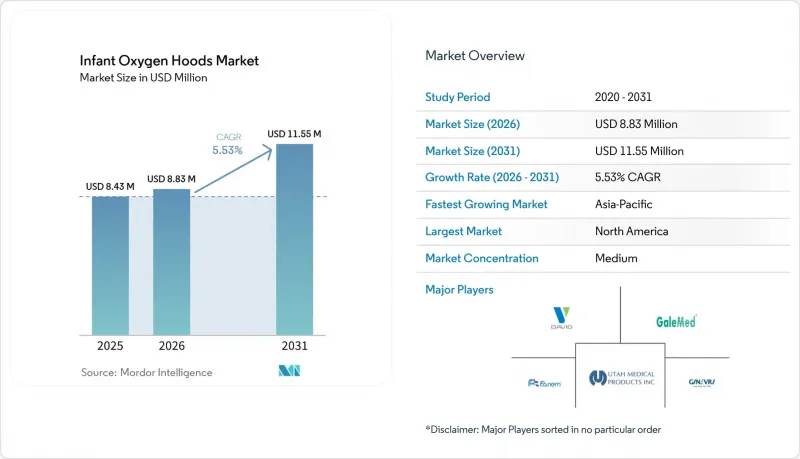
根據 Mordor Intelligence 預測,嬰兒氧氣食品市場規模將從 2025 年的 843 萬美元和 2026 年的 883 萬美元成長到 2031 年的 1155 萬美元,2026 年至 2031 年的年複合成長率(CAGR)為 5.53%。
本報告按產品類型(一次性、可重複使用)、最終用戶(三/四級新生兒重症監護室、二級特殊護理嬰兒室、產科和分娩中心、兒童病房/急診科、居家照護/運輸)以及地區(北美、南美、歐洲、亞太、中東和非洲)進行細分。市場預測以價值(百萬美元)表示。
全球嬰幼兒氧氣食品市場趨勢及洞察
早產和新生兒缺氧增加
在高所得市場,早產仍然是新生兒氧氣需求的主要促進因素。美國2024年的早產率預計為10.4%,這意味著大量嬰兒面臨低氧血症風險,需要在生命早期接受精心調整的氧氣療法。氧氣罩為那些在短期穩定期無法耐受氧氣鼻管或CPAP介面的新生兒提供了一種非接觸式替代方案,有助於減輕組織完整性脆弱狀態下的鼻損傷。由於缺乏吐氣末正壓(PEEP),氧氣罩的效用受到限制,因此其僅限於氧合支持,而無法像CPAP那樣用於肺表面活性物質缺乏或肺塌陷等肺復張策略。早產兒的目標氧飽和度範圍較窄,凸顯了嚴格管理和持續監測吸入氧濃度(FiO2)的必要性。指引建議,對於極低出生體重兒,應將FiO2維持在90-95%左右,以降低早產兒視網膜病變和肺支氣管發育不良的風險。這些臨床參數使氧氣罩在嬰兒氧氣罩市場中佔據了明確的市場地位,尤其是在不需要正壓的短期使用情況下。同時,監測和升級方案也已準備就緒。
擴大新興市場的新生兒加護病房/特殊護理重症監護室容量
亞洲和非洲政府主導的新生兒護理擴建計畫正在增加二級醫療機構和社區健康服務機構(這些機構並非總能配備非侵入性正壓通氣系統)所需的基本呼吸設備,包括氧氣罩。在印度尼西亞,薩瓦胡倫托地區綜合醫院於2026年4月開設了一間4床新生兒加護病房(NICU)和一間4床兒童重症監護室(PICU)。該計畫由一項總額為24億印尼幣的專案撥款資助,旨在透過與SIHREN(國際新生兒健康資源網路)的整合,加強轉診協調並實現各醫療機構設備的標準化。根據世界衛生組織支持的模型,中低收入國家估計每1,000名新生兒需要2.8張新生兒床位,運轉率85%。這超過了部分地區的現有容量,隨著醫療機構增加床位和醫護人員,對以衛生為重點的耗材的需求也在增加。中國的分階段能力清單規定,縣級醫療機構應在轉診前穩定中重症病例,並使用持續性呼吸道正壓通氣(CPAP)治療指定時間。該框架還預見在初始穩定階段鼻罩不適用的情況下,可使用氧氣罩。隨著醫療保健系統的擴展,由於強調感染控制和快速週轉,一次性耗材更受青睞;而在消毒流程管理完善且營運預算有限的情況下,可重複使用的氧氣罩仍在使用。這為新生兒氧氣罩市場創造了一個平衡的市場,滿足了不同地區的不同價格範圍和性能水平。來自合作夥伴的多邊資金,例如世界銀行為加強奈及利亞初級醫療保健網路(包括氧氣供應和新生兒復甦設備)提供的資金,正在進一步擴大基本呼吸耗材的目標市場。
過渡到高流量鼻導管/持續性氣道正壓通氣治療後,每日食物攝取量減少了。
在三級醫療機構中,高流量鼻導管氧療 (HFNC) 和持續性正壓呼吸器 (CPAP) 已成為新生兒一線無創呼吸支持手段,而氧氣罩的使用僅限於特定情況,例如鼻罩耐受性差或在過渡到更高級治療方案前進行短期穩定。一項在英國25家兒童重症監護中心進行的隨機對照試驗 (RCT) 顯示,HFNC 與 CPAP 在脫離呼吸支持所需時間方面相當,但 CPAP 在拔管後的主要終點指標上表現更佳,這支持了在需要正壓支持時推薦使用 CPAP 的觀點。一項比較新生兒使用氣泡式 CPAP 和加熱/濕化 HFNC 的三級醫療機構研究報告稱,CPAP 組的呼吸支持時間和人工呼吸器使用時間更短,這支持了 CPAP 在需要正壓支持的急性護理中的效用。鑑於這些臨床趨勢,嬰兒氧氣罩的市場僅限於被動供氧充足、鼻腔接觸禁忌或耐受性差,以及缺乏複雜設備和呼吸治療師的輕症護理環境。在這種情況下,供應商強調產品的易用性和快速安裝,同時保留在同一護理過程中將CPAP和HFNC整合到升級治療方案中的選項。
細分市場分析
預計到2025年,一次性氧氣罩將佔市場佔有率的45.92%,並在2031年之前以6.57%的複合年成長率成長。這反映了由於強制性感染控制措施以及產科和小兒科病房患者周轉率高,每位患者需要使用一次性氧氣罩的營運需求。預計到2025年,可重複使用氧氣罩將佔市場佔有率的54.08%,這主要得益於預算緊張但已建立完善消毒流程的醫療機構;然而,由於再處理的複雜性以及消毒不徹底的風險,許多醫療機構在新競標中優先考慮一次性產品。在嬰兒氧氣罩市場,人們對生物基聚合物和無塑化劑樹脂等材料的興趣日益濃厚,這些材料符合永續性標準,有助於實現高週轉率護理區域的感染控制目標。隨著醫院尋求簡化繁忙的產房和兒童急診室的設置流程,採用沿罩面佈置氣體入口和透明外殼的設計(可提高手術過程中的可視性和操作便利性)正成為差異化優勢。受新冠疫情安全措施影響的感染預防政策,促使在消毒能力有限或員工防護方案優先考慮過濾呼出氣體和減少重複使用的環境中使用一次性產品的比例進一步增加。
一次性使用模式符合旨在簡化醫療器材法規 (MDR)、ISO 13485 及相關品質標準合規流程的採購架構。這是因為一次性設備減輕了檢驗不同醫院規程和儀器的再處理程序的負擔。在嬰兒氧氣罩市場,擁有廣泛新生兒呼吸器相關產品組合的供應商正在銷售與 CPAP 介面和人工呼吸器迴路捆綁銷售的氧氣罩,以利用規模經濟效益。這種方法有助於在單一供應商生態系統內進行升級程序的教育和交叉培訓。雖然對於資源有限且擁有高效消毒部門的醫院而言,可重複使用的氧氣罩仍然是重要的成本控制措施,但在優先考慮衛生和處理時間的競標中,日常人工和品質保證檢查的隱性成本正受到越來越多的審查。總體而言,一次性產品的市佔率持續成長。這是因為隨著全球採購標準中納入感染預防和永續性要求,一次性嬰兒氧氣罩的市場規模預計將會擴大。
區域分析
2025年,北美地區的銷售額佔全球的46.11%。這主要得益於三級新生兒加護病房(NICU)和婦產科醫院積極採用拋棄式呼吸器產品、嚴格的感染控制標準以及能夠適應拋棄式呼吸機耗材的支付模式。此外,2024年美國早產率仍維持在10.4%,該地區的基本需求依然旺盛,尤其是在早期穩定階段仍需補充氧氣,儘管高流量氧氣鼻管(HFNC)和持續氣道正壓通氣(CPAP)在後續治療中已廣泛應用。在此背景下,呼吸器頭罩最常用於農村醫院,這些醫院主要關注產後短期穩定期和轉院前的新生兒緊急護理,而此時鼻導管不適用。供應鏈脆弱性仍然存在,部分供應商報告樹脂和矽膠供應受限,對2024年的設備出貨量產生了負面影響。這凸顯了新生兒耗材來源多角化和庫存緩衝的重要性。因此,嬰兒氧氣罩市場將繼續根據醫院優先考慮衛生、可用性和易用性的採購政策而發展。
歐洲的採購環境受醫療設備法規 (MDR) 的影響,該法規增加了現有器材重新批准所需的成本和時間,並提高了臨床評估和上市後監測的證據要求。早期獲得 MDR 認證的供應商正利用其地位,確保大規模醫院網路(包括人工呼吸器和 CPAP 機的輔助耗材)的持續供應。優先考慮綜合呼吸護理平台的框架協議正在影響耗材供應鏈,通常將迴路、介面和相容的氧氣罩作為套裝出售,以簡化服務和培訓。這些趨勢意味著氧氣罩在特定應用場景中仍扮演輔助角色,而採購重點則放在提供正壓支撐和被動氧合的多重模式系統上。在此框架下,新生兒氧氣罩的市場佔有率主要由那些優先考慮一次性產品以控制感染和使用透明外殼以簡化床邊操作的醫療機構支撐。
亞太地區正經歷最快的成長,複合年成長率達6.24%,這反映出政府對新生兒病床的大量投資,以及分階段的能力建設框架,該框架將護理服務擴展到更靠近分娩地點的地方。印尼將新的新生兒加護病房(NICU)納入其轉診網路,顯示標準化採購(包括一次性氧氣加護病房)如何擴大都市區地區的新生兒穩定照護能力。中國採用改良的德爾菲法對新生兒病房進行評估,有助於明確省級層面的護理範圍和升級路徑,並確定氧氣罩與持續氣道正壓通氣(CPAP)在穩定護理流程中的應用。在非洲和中東,多邊融資計畫將氧氣供應設備和新生兒復甦設備引入基層醫療機構和轉診中心,擴大了基本呼吸耗材的目標市場。
其他好處:
- Excel格式的市場預測(ME)表
- 3個月的分析師支持
目錄
第1章:引言
- 研究假設和市場定義
- 調查範圍
第2章:調查方法
第3章執行摘要
第4章 市場狀況
- 市場概覽
- 市場促進因素
- 早產和新生兒缺氧負擔加重
- 擴大新興市場的新生兒加護病房/特殊護理重症監護室容量
- 臨床指引規定了在特定情況下使用氧氣罩的規定。
- 為控制感染而提供的一次性食品
- 在特定足月新生兒中使用氧氣罩進行iNO給藥的可行性
- 設計上的進步提高了二氧化碳排放效率,並方便了醫護人員使用。
- 市場限制因素
- 由於改用高流量鼻導管/持續性呼吸道正壓通氣治療,每日食物攝取量減少。
- 無需分析儀即可評估二氧化碳儲存風險和吸入氧濃度波動
- 雖然通常不建議這樣做,但當患者無法耐受插管時,就會使用這種方法。
- 可重複使用產品帶來的再處理負擔和潛在的醫院感染風險
- 價值供應鏈分析
- 監理情勢
- 技術展望
- 五力分析
第5章 市場規模與成長預測
- 依產品類型
- 拋棄式氧氣罩
- 可重複使用的氧氣面罩
- 最終用戶
- 三級/四級新生兒加護病房(三級護理)
- 二級新生兒加護病房/過渡病房
- 婦產科中心和兒童病房/急診科
- 居家照護/交通使用
- 按地區
- 北美洲
- 美國
- 加拿大
- 墨西哥
- 歐洲
- 德國
- 法國
- 英國
- 義大利
- 西班牙
- 其他歐洲國家
- 亞太地區
- 中國
- 印度
- 日本
- 韓國
- 澳洲
- 其他亞太國家
- 中東和非洲
- GCC
- 南非
- 其他中東和非洲國家
- 南美洲
- 巴西
- 阿根廷
- 其他中南美洲
- 北美洲
第6章 競爭情勢
- 市場集中度
- 市佔率分析
- 公司簡介
- ATEFCO
- Fanem
- Farstar(Wuxi)Medical Equipment
- GaleMed Corporation
- GIGANTE Recem Nascido
- GINEVRI srl
- HEMC Medical
- IndoSurgicals
- JDMeditech
- Medical Dynamics(SuperDome)
- Mercury Medical
- Ningbo David Medical Device
- nice Neotech Medical Systems
- Olidef Medical
- Phoenix Medical Systems
- Plasti-med
- Qingdao Hiprove Medical
- SoCare India
- Utah Medical Products
- VNG Medical
第7章 市場機會與未來展望
According to Mordor Intelligence, the infant oxygen hoods market size is projected to expand from USD 8.43 million in 2025 and USD 8.83 million in 2026 to USD 11.55 million by 2031, registering a CAGR of 5.53% between 2026 to 2031.
This report is Segmented by Product Type (Disposable, Reusable), End User (Level III/IV NICUs, Level II SCBUs, Maternity/Birthing Centers and Pediatric Wards/ER, Home Care/Transport), and Geography (North America, South America, Europe, Asia Pacific, Middle East and Africa). Market Forecasts are Provided in Value (USD Million).
Global Infant Oxygen Hoods Market Trends and Insights
Rising Preterm Births and Neonatal Hypoxemia Burden
Preterm births remain a stable driver of neonatal oxygen needs in high-income markets, with the United States recording a 2024 preterm rate of 10.4%, indicating steady inflows of infants at risk of hypoxemia who require carefully titrated oxygen therapy in early life. Oxygen hoods offer a non-contact alternative for newborns that do not tolerate nasal prongs or CPAP interfaces during short stabilization periods, helping reduce nasal trauma when tissue integrity is fragile. Their utility is bounded by the absence of positive end-expiratory pressure, which limits application to oxygenation support rather than lung recruitment strategies that CPAP provides in surfactant-deficient or atelectatic lungs. Narrow oxygen saturation targets for preterm infants reinforce the need for tight FiO2 control and continuous monitoring, with guidelines emphasizing ranges around 90-95% in extremely low-birth-weight infants to mitigate retinopathy of prematurity and bronchopulmonary dysplasia risk. These clinical parameters preserve a targeted place for oxygen hoods in the infant oxygen hoods market, particularly for brief use cases that do not require positive pressure, while ensuring monitoring and escalation protocols are readily available.
NICU/SNCU Capacity Expansion in Emerging Markets
Government-backed neonatal-care upgrades in Asia and Africa are expanding the installed base for essential respiratory equipment, including oxygen hoods in level II and district facilities where noninvasive positive-pressure systems are not always present. Indonesia's Sawahlunto Regional General Hospital opened a four-bed NICU and four-bed pediatric ICU in April 2026, funded by Special Allocation Funds totaling Rp 2.4 billion, with integration into SIHREN to strengthen referral alignment and standardize equipment across facilities. A WHO-supported model estimates that low and middle-income countries require 2.8 neonatal beds per 1,000 live births at 85% occupancy, exceeding current capacity in several regions, which raises demand for hygiene-focused consumables as facilities add beds and staff. China's tiered capability lists specify that county-level units should stabilize moderate acuity cases and deliver CPAP for defined durations before escalation, a framework that also accommodates oxygen hoods for cases where nasal interfaces are not tolerated during initial stabilization. As systems expand, disposable consumables are favored for infection control and fast turnover, while reusable hoods remain present where sterilization workflows are well-managed and operating budgets are tight, positioning the infant oxygen hoods market to serve distinct price and performance tiers across geographies. Funding from multilateral partners, such as the World Bank's financing to strengthen Nigeria's primary healthcare network with oxygen access and neonatal resuscitation equipment, further broadens the addressable base for basic respiratory consumables.
Shift to HFNC/CPAP Reducing Routine Hood Use
HFNC and CPAP have become first-line modalities for noninvasive neonatal respiratory support in tertiary environments, limiting oxygen hoods to defined indications such as poor tolerance of nasal interfaces or short stabilization prior to escalation. In a pediatric critical care RCT across 25 U.K. units, HFNC was non-inferior to CPAP for time to liberation from respiratory support, though post-extubation outcomes favored CPAP for key endpoints, reinforcing CPAP's preferred role when positive-pressure support is a priority. A tertiary-center study comparing bubble CPAP to heated humidified HFNC in neonates reported shorter durations of respiratory support and ventilator days in CPAP cohorts, which strengthens the case for CPAP in acute management where pressure support is crucial. These clinical patterns confine the infant oxygen hoods market to scenarios where passive oxygen delivery suffices and where nasal contact is contraindicated or poorly tolerated, as well as to lower-acuity points of care that lack complex equipment or a respiratory therapist. In this environment, vendors emphasize ease of use and fast setup, while maintaining integration options for escalation pathways that involve CPAP and HFNC within the same care episode.
Other drivers and restraints analyzed in the detailed report include:
- Availability of Disposable Hoods for Infection Control
- Clinical Guidance Formalizing Oxygen Hood Use in Defined Scenarios
- CO2 Retention Risk and Variable FiO2 Without Analyzer
For complete list of drivers and restraints, kindly check the Table Of Contents.
Segment Analysis
Disposable oxygen hoods accounted for 45.92% in 2025 and are projected to grow at a 6.57% CAGR through 2031, reflecting infection-control mandates and the operational need for single-patient-use devices during rapid patient turnover in maternity and pediatric units. Reusable hoods held 54.08% of 2025 volume, supported by budget-constrained facilities with established sterilization workflows, although reprocessing complexity and the risk of suboptimal disinfection have led many providers to prioritize disposables in new tenders. The infant oxygen hoods market is seeing greater attention to materials, such as bio-based polymers and plasticizer-free resins, in line with sustainability standards that complement infection-control objectives in high-throughput care areas. Engineering choices that spread gas inlets along the hood surface, along with transparent shells that improve visualization and access for care procedures, have become differentiators as hospitals aim to reduce setup friction in busy delivery suites and pediatric emergency rooms. Infection-prevention policies influenced by COVID-19-era safeguards further entrench disposables in environments with limited sterilization capacity or where staff protection protocols prioritize filtered expiratory pathways and minimized reuse.
Disposable models align with purchasing frameworks that aim to streamline compliance with MDR, ISO 13485, and related quality standards, since single-use devices reduce the burden of validating reprocessing instructions across diverse hospital protocols and equipment fleets. In the infant oxygen hoods market, vendors with broader neonatal respiratory portfolios bundle hoods with CPAP interfaces and ventilator circuits to leverage scale in procurement, an approach that supports education and cross-training for escalation pathways within a single vendor ecosystem. For resource-limited hospitals that maintain effective sterilization departments, reusable hoods remain relevant as a cost-control measure, although recurring labor and quality assurance checks add hidden costs that are increasingly scrutinized in tenders focused on hygiene and turnaround times. On balance, disposables continue to gain share as the infant oxygen hoods market size for disposables is projected to expand in line with infection prevention and sustainability specifications embedded in global procurement standards.
Geography Analysis
North America held 46.11% of 2025 revenue, driven by strong adoption of disposables in tertiary NICUs and maternity hospitals, tight infection-control standards, and payment models that accommodate single-use respiratory consumables. The region also sustains baseline demand as the United States preterm rate remained at 10.4% in 2024, which supports the need for supplemental oxygen during early stabilization despite the dominance of HFNC and CPAP in ongoing management. In this environment, hoods are most common when nasal interfaces are contraindicated, during short stabilization periods in labor and delivery, and in rural hospitals that focus on immediate postnatal care prior to transfer. Supply chain sensitivity persists, with some vendors reporting resin and silicone constraints that weighed on device shipments in 2024, underscoring the importance of diversified inputs and inventory buffering in neonatal consumables. As a result, the infant oxygen hoods market continues to track hospital purchasing policies that align hygiene, availability, and ease of use.
Europe's procurement landscape is shaped by the Medical Device Regulation, which adds cost and time for reapproval of legacy devices and raises evidence expectations for clinical evaluations and post-market surveillance. Vendors with early MDR certification leverage that status to ensure continuity of supply across large hospital networks, including for accessory consumables that complement ventilators and CPAP. Framework agreements that prioritize comprehensive respiratory platforms influence consumable adoption paths, often bundling circuits, interfaces, and compatible hoods to streamline service and training. These dynamics keep oxygen hoods in ancillary roles for defined use cases, while procurement concentrates on multi-modality systems that deliver both positive-pressure support and passive oxygenation. Within this construct, the infant oxygen hoods market share is sustained by facilities that value disposable options for infection control and transparent shells that simplify procedures at the bedside.
Asia Pacific is the fastest-growing region at a 6.24% CAGR, reflecting significant public investment in neonatal beds and tiered capability frameworks that expand care closer to where births occur. Indonesia's integration of new NICU capacity into its referral network is an example of how standardized procurement, including disposable oxygen hoods, can extend neonatal stabilization capabilities in both urban and rural districts. China's modified Delphi approach for neonatal units clarifies the scope of county-level care and escalation pathways, which helps define where oxygen hoods fit within stabilization workflows alongside CPAP . In Africa and the Middle East, multilateral financing programs that upgrade primary and referral facilities with oxygen access and neonatal resuscitation equipment expand the addressable base for basic respiratory consumables.
- ATEFCO
- Fanem
- Farstar (Wuxi) Medical Equipment
- GaleMed Corporation
- GIGANTE Recem Nascido
- GINEVRI srl
- HEMC Medical
- IndoSurgicals
- JDMeditech
- Medical Dynamics (SuperDome)
- Mercury Medical
- Ningbo David Medical Device
- nice Neotech Medical Systems
- Olidef Medical
- Phoenix Medical Systems
- Plasti-med
- Qingdao Hiprove Medical
- SoCare India
- Utah Medical Products
- VNG Medical
Additional Benefits:
- The market estimate (ME) sheet in Excel format
- 3 months of analyst support
TABLE OF CONTENTS
1 Introduction
- 1.1 Study Assumptions & Market Definition
- 1.2 Scope of the Study
2 Research Methodology
3 Executive Summary
4 Market Landscape
- 4.1 Market Overview
- 4.2 Market Drivers
- 4.2.1 Rising preterm births and neonatal hypoxemia burden
- 4.2.2 NICU/SNCU capacity expansion in emerging markets
- 4.2.3 Clinical guidance formalizing oxygen hood use in defined scenarios
- 4.2.4 Availability of disposable hoods for infection control
- 4.2.5 Feasibility of iNO delivery via oxygen hood in select term neonates
- 4.2.6 Design advances improving CO2 washout and caregiver access
- 4.3 Market Restraints
- 4.3.1 Shift to HFNC/CPAP reducing routine hood use
- 4.3.2 CO2 retention risk and variable FiO2 without analyzer
- 4.3.3 Not routinely recommended; used when cannula not tolerated
- 4.3.4 Reprocessing burden and potential HAI risk with reusables
- 4.4 Value / Supply-Chain Analysis
- 4.5 Regulatory Landscape
- 4.6 Technological Outlook
- 4.7 Porter-s Five Forces
5 Market Size & Growth Forecasts (Value)
- 5.1 By Product Type
- 5.1.1 Disposable oxygen hoods
- 5.1.2 Reusable oxygen hoods
- 5.2 By End User
- 5.2.1 Level III/IV NICUs (tertiary)
- 5.2.2 Level II SCBUs/step-down units
- 5.2.3 Maternity/birthing centers and pediatric wards/ER
- 5.2.4 Home care/transport use
- 5.3 By Geography
- 5.3.1 North America
- 5.3.1.1 United States
- 5.3.1.2 Canada
- 5.3.1.3 Mexico
- 5.3.2 Europe
- 5.3.2.1 Germany
- 5.3.2.2 France
- 5.3.2.3 United Kingdom
- 5.3.2.4 Italy
- 5.3.2.5 Spain
- 5.3.2.6 Rest of Europe
- 5.3.3 Asia-Pacific
- 5.3.3.1 China
- 5.3.3.2 India
- 5.3.3.3 Japan
- 5.3.3.4 South Korea
- 5.3.3.5 Australia
- 5.3.3.6 Rest of Asia Pacific
- 5.3.4 Middle East and Africa
- 5.3.4.1 GCC
- 5.3.4.2 South Africa
- 5.3.4.3 Rest of Middle East and Africa
- 5.3.5 South America
- 5.3.5.1 Brazil
- 5.3.5.2 Argentina
- 5.3.5.3 Rest of South and Central America
- 5.3.1 North America
6 Competitive Landscape
- 6.1 Market Concentration
- 6.2 Market Share Analysis
- 6.3 Company Profiles
- 6.3.1 ATEFCO
- 6.3.2 Fanem
- 6.3.3 Farstar (Wuxi) Medical Equipment
- 6.3.4 GaleMed Corporation
- 6.3.5 GIGANTE Recem Nascido
- 6.3.6 GINEVRI srl
- 6.3.7 HEMC Medical
- 6.3.8 IndoSurgicals
- 6.3.9 JDMeditech
- 6.3.10 Medical Dynamics (SuperDome)
- 6.3.11 Mercury Medical
- 6.3.12 Ningbo David Medical Device
- 6.3.13 nice Neotech Medical Systems
- 6.3.14 Olidef Medical
- 6.3.15 Phoenix Medical Systems
- 6.3.16 Plasti-med
- 6.3.17 Qingdao Hiprove Medical
- 6.3.18 SoCare India
- 6.3.19 Utah Medical Products
- 6.3.20 VNG Medical
7 Market Opportunities & Future Outlook
- 7.1 White-space & unmet-need assessment

 氧氣:市場佔有率分析、行業趨勢和統計數據、成長預測(2026-2031 年)
 高頻氧燃(HVOF)塗料市場規模:依材料類型、應用、終端用戶產業、地區和預測分類
 化學需氧量(COD)測量儀器市場:2026-2032年全球市場預測(依產品類型、技術、最終用戶、應用及銷售管道)
 工業氧氣市場分析及預測(至2035年):類型、產品類型、應用、技術、最終用戶、組件、部署形式、製程、安裝類型
 2026年全球氧氣市場報告
 氧氣市場-全球產業規模、佔有率、趨勢、機會、預測:按形態、應用、地區和競爭格局分類,2021-2031年工業氧氣市場按類型、純度等級、生產方法、應用和通路分類-2026-2032年全球預測高速氧燃料噴射服務市場按服務類型、設備類型、塗層材料、應用和最終用途產業分類-2026-2032年全球預測
 日本鱈魚市場報告(按品種(大西洋鱈魚、太平洋鱈魚、格陵蘭鱈魚及其他)、來源(養殖、野生捕撈)、產品類型(鮮、罐裝、冷凍及其他)、配銷通路(機構、零售)和地區分類,2026-2034年)
 工業氧氣市場規模、佔有率和成長分析(按產品類型、氧氣純度、形態、用途、應用、最終用戶和地區分類)-2026-2033年產業預測