


 |
市場調查報告書
商品編碼
2125306
氧氣:市場佔有率分析、行業趨勢和統計數據、成長預測(2026-2031 年)Oxygen - Market Share Analysis, Industry Trends & Statistics, Growth Forecasts (2026 - 2031) |
||||||

※ 本網頁內容可能與最新版本有所差異。詳細情況請與我們聯繫。
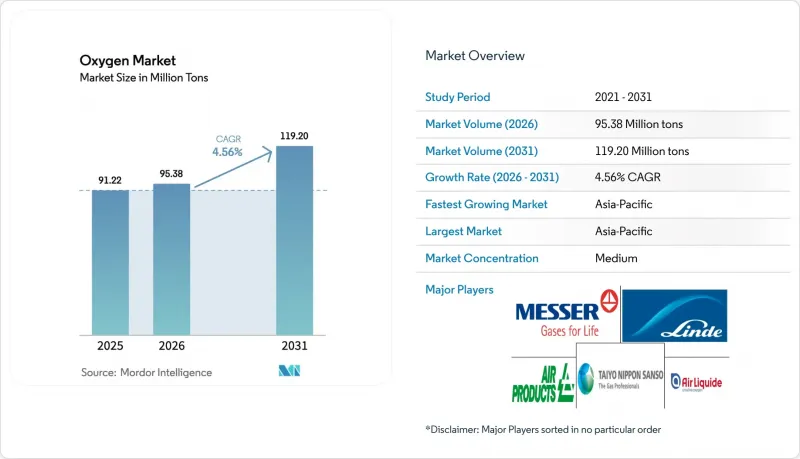
根據 Mordor Intelligence 預測,氧氣市場預計將從 2025 年的 9,122 萬噸成長到 2026 年的 9,538 萬噸,到 2031 年達到 1.192 億噸,預計 2026 年至 2031 年的複合年成長率為 4.56%。
本報告按形態(氣體、液體、固體)、類型(工業、醫療)、應用領域(金屬和採礦、化學、石油和天然氣、醫療保健、製藥及其他應用)和地區(亞太、北美、歐洲、南美、中東和非洲)進行細分。市場預測以噸為單位。
全球氧氣市場趨勢及洞察
急性和慢性呼吸系統疾病發生率增加
預計到2023年,全球慢性阻塞性肺病(COPD)和氣喘患者人數將達到5.45億,在空氣品質差、吸菸現象普遍存在的低收入和中等收入國家,這一數字將以每年3.2%的速度成長。呼吸系統疾病導致的失能調整後存活年(DALYs)已佔南亞總負擔的7.8%,迫使印度、孟加拉和巴基斯坦的醫院迅速擴大醫用氣體系統。在美國急診科,2020年至2024年間,氧氣依賴病例數量激增18%,導致主要都市區的氧氣儲存方式從鋼瓶組轉向散裝液體儲存。世界衛生組織最新的治療指南要求所有配備呼吸照護設施的醫院病房必須持續供應高流量氧氣,這加速了在全部區域部署變壓式吸附(PSA)裝置和鋼瓶充填站。這些因素共同導致了氧氣直接需求的增加,以及公共和私人醫療保健網路的持續需求。
亞洲鐵及非鐵金屬產量成長
2024年,中國粗鋼產量達10.2億噸,佔全球市佔率的53%。同時,印度粗鋼產量年增7.4%,達到1.44億噸。透過將高爐氧氣進料濃度從21%提高到28%,每噸鐵水的焦炭消耗量降低了12%,降低了中國鋼鐵廠的成本曲線,並收緊了排放限制。在印尼和越南,每噸產品耗氧量高達1.2噸的鎳基生鐵冶煉廠已投入運作,為蘇拉威西島廣義省創造了穩定的氧氣需求。韓國浦項的直接氫氣還原先導計畫表明,下游溶解工藝正轉向耗氧量較大的工藝,這將為東亞氧氣市場帶來未來的成長動力。因此,強勁的鋼鐵和非鐵金屬生產將為遠超預測期的長期工業氣體需求提供堅實支撐。
替代切割氣體和燃料氣體(液化石油氣、乙炔)的可用性
在小型焊接中,便攜性比單純的火焰溫度更為重要,這導致液化石油氣 (LPG) 和乙炔取代氧氣-燃料組合的趨勢日益成長。根據美國焊接學會 (AWS) 2024 年的一項調查,美國和墨西哥 38% 的車間已改用 LPG-空氣焊炬切割厚度達 25 毫米的鋼材,每月可節省 120 美元的鋼瓶租賃費用。在印度的造船廠和建築工地,丙烷-氧氣混合系統的應用使每次切割的氧氣消耗量降低了 15%,同時簡化了物流。在歐洲,由於設備成本的下降,壓縮空氣或氮氣驅動的等離子弧系統目前佔據了 22% 的切割市場佔有率,逐漸蠶食了氧氣在製造業的市場佔有率。雖然這些替代方案在切割品質和速度方面存在一些不足,但它們較低的操作風險和成本優勢正在減緩氧氣在某些用戶群體中的普及速度。
細分市場分析
到2025年,氣態氧將佔據氧氣市場87.68%的佔有率,其流量為5至40巴,由現場空氣分離裝置直接供應給煉鋼爐、化學反應器和半導體製造廠。液態氧市場正以4.55%的複合年成長率成長,這主要得益於低溫運輸車能夠穩定地向管道建設不經濟的地區(例如智利的阿塔卡馬銅礦、澳洲的皮爾巴拉礦以及液化天然氣發電島嶼)輸送液態氧。固體氧的市場規模仍然微乎其微,因為其用途僅限於航太和實驗室領域。
一種新的趨勢是將電解槽制氧添加到現有供氧網路中。在蒂森克虜伯和液化空氣集團主導的德國魯爾區試點計畫中,電解制氧使混合成本降低了8%。埃克森美孚位於賈姆訥格爾的貝城信實液化天然氣發電廠將液態氧儲存在低溫儲槽中,以應對工廠緊急情況,這表明液態物流如何增強工廠的韌性。諸如容器設計標準ISO 21969和高壓氧氣管道標準ASME等法律規範正在縮短檢驗週期,這有利於能夠將工程和合規性納入長期合約的大型供應商。這些機制共同鞏固了氣態氧在氧氣市場的主導地位,同時也為液態氧的清晰成長路徑鋪平了道路。
區域分析
預計到2025年,亞太地區將佔據全球氧氣市場佔有率的41.52%,並預計在2031年之前以5.45%的複合年成長率成長。中國10.2億噸的鋼鐵產量和印度1.44億噸的鋼鐵產量支撐著區域需求,而印尼的鎳冶煉廠和越南的電子產業群聚則是需求集中的區域。在韓國,隨著三星和SK海力士向3奈米及以下製程節點轉型,對高純度氧的需求激增。亞洲開發銀行(亞銀)向東協提供的財政援助支持了420套變壓吸附(PSA)制氧裝置的投入使用,從而減少了印尼、菲律賓和緬甸農村地區對氧氣瓶的依賴。
在北美,氫能樞紐、氧氣燃料設備升級和醫院設施維修是主要支柱。該國的七個樞紐計畫全面運作後每年生產80萬噸氧氣,其中40%已透過墨西哥灣沿岸的石化合約得到保障。加拿大正在安大略省進行氫煉鋼試點項目,墨西哥的汽車產業走廊正在推動蒙特雷和瓜納華託的焊接需求。在歐洲,碳捕獲獎勵和嚴格的醫療器材法規(MDR)純度規定的結合,正在增加醫療用品供應商的資本密集度。
儘管南美、中東和非洲的總合佔有率較小,但其成長速度卻超過了成熟經濟體。在巴西,綠色氫能試驗計畫和電弧爐煉鋼的擴張正在推動氧氣需求;而在阿根廷,氧氣浸出法正被用於鋰的提取。沙烏地阿拉伯的Neom綜合體每年120萬噸的氧氣產量大部分用於內部消費,限制了其對外市場的出口,但隨著其本地網路的成熟,未來銷售成長潛力巨大。南非的鉑金精煉廠和PSA(壓縮吸附)技術的引入,是對新冠疫情期間供不應求經驗的回應。從巴西國家衛生監督局(ANVISA)到南非基本藥物清單,各國的法規都在加強市場准入要求,鞏固了氧氣市場的持續成長。
其他好處:
- Excel格式的市場預測(ME)表
- 3個月的分析師支持
目錄
第1章:引言
- 研究假設和市場定義
- 調查範圍
第2章:調查方法
第3章執行摘要
第4章 市場狀況
- 市場概覽
- 市場促進因素
- 急性和慢性呼吸系統疾病發生率增加
- 亞洲鐵及非鐵金屬產量成長
- 針對特定應用擴大氫能和富氧燃燒項目
- 新興市場醫院向PSA微型工廠的轉型
- 先進節點半導體對超高純度氧氣(O2)的需求
- 市場限制因素
- 替代切割氣體和燃料氣體(液化石油氣、乙炔)的可用性
- 全球大直徑低溫等離子罐車短缺
- 歐盟醫療器材法規對氧氣製劑中微量雜質的限制
- 價值鏈分析
- 波特五力模型
第5章 市場規模與成長預測
- 按形式
- 氣體
- 液體
- 固體的
- 按類型
- 產業
- 醫療保健
- 透過使用
- 金屬和採礦
- 化工
- 石油和天然氣
- 衛生保健
- 製藥
- 其他用途
- 按地區
- 亞太地區
- 中國
- 印度
- 日本
- 韓國
- 東南亞國協
- 其他亞太國家
- 北美洲
- 美國
- 加拿大
- 墨西哥
- 歐洲
- 德國
- 英國
- 法國
- 義大利
- 北歐國家
- 其他歐洲國家
- 南美洲
- 巴西
- 阿根廷
- 其他南美國家
- 中東和非洲
- 沙烏地阿拉伯
- 南非
- 其他中東和非洲國家
- 亞太地區
第6章 競爭情勢
- 市場集中度
- 策略趨勢
- 市佔率和排名分析
- 公司簡介
- Air Liquide
- Air Products and Chemicals, Inc.
- AIR WATER INC
- Axcel Gases
- Gruppo SIAD
- Guangdong Huate Gas Co., Ltd.
- Gulfcryo
- Hangzhou Oxygen Group Co., Ltd.
- INOX-Air Products Inc.
- International Industrial Gases Ltd
- Iwatani Corporation
- Linde PLC
- Messer SE & Co. KGaA
- NIPPON SANSO HOLDINGS CORPORATION
- Sauerstoffwerk Friedrichshafen GmbH
- SOL Spa
- Steelman Gases Pvt. Ltd.
- Yingde Gas Shanghai
第7章 市場機會與未來展望
According to Mordor Intelligence, the oxygen market size is expected to increase from 91.22 Million tons in 2025 to 95.38 Million tons in 2026 and reach 119.20 Million tons by 2031, growing at a CAGR of 4.56% over 2026-2031.
This report is Segmented by Form (Gas, Liquid, and Solid), Type (Industrial and Medical), Application (Metals and Mining, Chemical Industry, Oil and Gas, Healthcare, Pharmaceutical, and Other Applications), and Geography (Asia-Pacific, North America, Europe, South America, and Middle-East and Africa). The Market Forecasts are Provided in Terms of Volume (Tons).
Global Oxygen Market Trends and Insights
Rising Incidence of Acute and Chronic Respiratory Disorders
Global prevalence of chronic obstructive pulmonary disease and asthma reached 545 million in 2023, climbing 3.2% annually in low- and middle-income nations where air-quality deterioration and tobacco use persist. Disability-adjusted life years tied to respiratory illness rose to 7.8% of the total burden in South Asia, pushing hospitals in India, Bangladesh, and Pakistan to scale medical-gas systems quickly. Emergency departments in the United States logged an 18% jump in oxygen-dependent episodes between 2020 and 2024, a shift that triggered upgrades from cylinder bundles to bulk liquid storage in major urban centers. WHO's updated treatment guidelines now require that every inpatient ward equipped for respiratory care maintain continuous high-flow oxygen availability, ensuring that procurement of pressure-swing-adsorption (PSA) plants and cylinder-filling hubs accelerates across lower-income regions. Collectively, these factors add direct volume and ensure recurring demand for the oxygen market across both public and private healthcare networks.
Steel and Non-Ferrous Metal Production Growth in Asia
China produced 1.02 billion tons of crude steel in 2024, capturing a 53% global share, while India's output reached 144 million tons on a 7.4% year-on-year rise. Blast-furnace oxygen enrichment that lifts inlet concentration from 21% to 28% is trimming furnace coke consumption by 12% per ton of hot metal, lowering cost curves and tightening emission caps at Chinese mills. Indonesia and Vietnam commissioned nickel-pig-iron smelters that each consume up to 1.2 tons of oxygen per ton of product, generating steady offtake in Sulawesi and Quang Ngai. South Korea's hydrogen direct-reduction pilot at Pohang signals a pivot to oxygen-intensive downstream melting, adding future strength to the oxygen market in East Asia. Robust ferrous and non-ferrous production therefore anchors long-run industrial gas demand well beyond the forecast window.
Availability of Alternate Cutting/Fuel Gases (LPG, Acetylene)
Liquefied petroleum gas and acetylene increasingly displace oxygen-fuel pairs in small-scale welding where portability outweighs pure flame temperature. A 2024 American Welding Society survey showed 38% of workshops in the United States and Mexico moved to LPG-air torches for steel up to 25 mm thick, saving USD 120 per month on cylinder rental. Propane-oxygen hybrids in Indian shipyards and construction sites reduce overall oxygen draw per cut by 15% while simplifying logistics. Plasma-arc systems based on compressed air or nitrogen capture 22% cutting share in Europe on falling equipment costs, nudging down oxygen market volumes in fabrication. Although these alternatives carry trade-offs in cut quality and speed, their lower handling risks and cost advantages slow oxygen penetration in selected user segments.
Other drivers and restraints analyzed in the detailed report include:
- Expansion of On-Purpose Hydrogen and Oxy-Fuel Projects
- Hospital Shift to PSA Micro-Plants in Emerging Markets
- Trace-Contaminant Limits for EU MDR Oxygen APIs
For complete list of drivers and restraints, kindly check the Table Of Contents.
Segment Analysis
Gaseous supply held 87.68% oxygen market share in 2025 as on-site air-separation units dispatch flows at 5-40 bar straight into steel furnaces, chemical reactors, and chip fabs. Liquid oxygen expands at a 4.55% CAGR because cryogenic trucks deliver steady volumes to Chile's Atacama copper belt, Australia's Pilbara mines, and LNG-to-power islands where pipelines prove uneconomical. The oxygen market size attributable to solid oxygen remains marginal because of limited aerospace and laboratory usage.
Emerging trends add electrolyzer-generated oxygen to existing networks, cutting blended costs by 8% in Germany's Ruhr Valley pilot led by ThyssenKrupp and Air Liquide. LNG power complexes at ExxonMobil's Baytown and Reliance Jamnagar now store liquid oxygen in cryogenic tanks to cushion plant upsets, illustrating how liquid logistics underpin resiliency. Regulatory frameworks-ISO 21969 for vessel design and ASME codes for high-pressure oxygen piping-tighten inspection intervals, favoring large suppliers that can bundle engineering and compliance into long-term contracts. Collectively, these mechanics reinforce gaseous leadership while carving a distinct growth lane for liquid in the oxygen market.
Complete Report Scope:
- By Form
- Gas
- Liquid
- Solid
- By Type
- Industrial
- Medical
- By Application
- Metals and Mining
- Chemical Industry
- Oil and Gas
- Healthcare
- Pharmaceutical
- Other Applications
- By Geography
- Asia-Pacific
- China
- India
- Japan
- South Korea
- ASEAN Countries
- Rest of Asia-Pacific
- North America
- United States
- Canada
- Mexico
- Europe
- Germany
- United Kingdom
- France
- Italy
- NORDIC Countries
- Rest of Europe
- South America
- Brazil
- Argentina
- Rest of South America
- Middle-East and Africa
- Saudi Arabia
- South Africa
- Rest of Middle-East and Africa
- Asia-Pacific
Geography Analysis
Asia-Pacific led with a 41.52% oxygen market share in 2025 and is on track for a 5.45% CAGR through 2031. China's 1.02 billion-ton steel output and India's 144 million tons anchor regional volume, while Indonesia's nickel smelters and Vietnam's electronics corridors add pockets of intensity. South Korea contributes high-purity spikes as Samsung and SK Hynix move to sub-3 nm nodes. ASEAN financing through the Asian Development Bank supported 420 PSA installations that shrink rural cylinder dependence in Indonesia, the Philippines, and Myanmar.
North America is anchored by hydrogen hubs, oxy-fuel retrofits, and hospital upgrades. Seven domestic hubs aim to yield 800,000 tons of co-product oxygen yearly once fully operational, with 40% already tied up in Gulf Coast petrochemical contracts. Canada pilots hydrogen iron-making in Ontario, and Mexico's automotive corridor lifts welding demand in Monterrey and Guanajuato. In Europe, mixing carbon-capture incentives with stringent MDR purity rules raises capital intensity for medical suppliers.
South America and the Middle East and Africa collectively weigh in a smaller share but outpace mature economies. Brazil's green-hydrogen pilots and EAF steel expansions shape demand, while Argentina's lithium extraction relies on oxygenated leaching . Saudi Arabia's Neom complex will internally absorb most of its 1.2 million-ton output, limiting merchant spillover yet signaling potential for future offtake if local networks mature. South Africa's platinum smelters and PSA deployments respond to lessons from COVID-19-era shortages. National regulations, from Brazil's ANVISA to South Africa's Essential Medicines List, reinforce market access requirements that cement sustained oxygen market growth.
- Air Liquide
- Air Products and Chemicals, Inc.
- AIR WATER INC
- Axcel Gases
- Gruppo SIAD
- Guangdong Huate Gas Co., Ltd.
- Gulfcryo
- Hangzhou Oxygen Group Co., Ltd.
- INOX-Air Products Inc.
- International Industrial Gases Ltd
- Iwatani Corporation
- Linde PLC
- Messer SE & Co. KGaA
- NIPPON SANSO HOLDINGS CORPORATION
- Sauerstoffwerk Friedrichshafen GmbH
- SOL Spa
- Steelman Gases Pvt. Ltd.
- Yingde Gas Shanghai
Additional Benefits:
- The market estimate (ME) sheet in Excel format
- 3 months of analyst support
TABLE OF CONTENTS
1 Introduction
- 1.1 Study Assumptions and Market Definition
- 1.2 Scope of the Study
2 Research Methodology
3 Executive Summary
4 Market Landscape
- 4.1 Market Overview
- 4.2 Market Drivers
- 4.2.1 Rising Incidence of Acute and Chronic Respiratory Disorders
- 4.2.2 Steel and Non-Ferrous Metal Production Growth in Asia
- 4.2.3 Expansion of On-Purpose Hydrogen and Oxy-Fuel Projects
- 4.2.4 Hospital Shift to PSA Micro-Plants in Emerging Markets
- 4.2.5 Ultra-High-Purity O2 Demand from Advanced-Node Semiconductors
- 4.3 Market Restraints
- 4.3.1 Availability of Alternate Cutting/Fuel Gases (LPG, Acetylene)
- 4.3.2 Global Shortage of Large-Bore Cryogenic Iso-Tankers
- 4.3.3 Trace-Contaminant Limits for EU MDR Oxygen Apis
- 4.4 Value Chain Analysis
- 4.5 Porter's Five Forces
- 4.5.1 Bargaining Power of Suppliers
- 4.5.2 Bargaining Power of Buyers
- 4.5.3 Threat of New Entrants
- 4.5.4 Threat of Substitutes
- 4.5.5 Degree of Competition
5 Market Size and Growth Forecasts (Volume)
- 5.1 By Form
- 5.1.1 Gas
- 5.1.2 Liquid
- 5.1.3 Solid
- 5.2 By Type
- 5.2.1 Industrial
- 5.2.2 Medical
- 5.3 By Application
- 5.3.1 Metals and Mining
- 5.3.2 Chemical Industry
- 5.3.3 Oil and Gas
- 5.3.4 Healthcare
- 5.3.5 Pharmaceutical
- 5.3.6 Other Applications
- 5.4 By Geography
- 5.4.1 Asia-Pacific
- 5.4.1.1 China
- 5.4.1.2 India
- 5.4.1.3 Japan
- 5.4.1.4 South Korea
- 5.4.1.5 ASEAN Countries
- 5.4.1.6 Rest of Asia-Pacific
- 5.4.2 North America
- 5.4.2.1 United States
- 5.4.2.2 Canada
- 5.4.2.3 Mexico
- 5.4.3 Europe
- 5.4.3.1 Germany
- 5.4.3.2 United Kingdom
- 5.4.3.3 France
- 5.4.3.4 Italy
- 5.4.3.5 NORDIC Countries
- 5.4.3.6 Rest of Europe
- 5.4.4 South America
- 5.4.4.1 Brazil
- 5.4.4.2 Argentina
- 5.4.4.3 Rest of South America
- 5.4.5 Middle-East and Africa
- 5.4.5.1 Saudi Arabia
- 5.4.5.2 South Africa
- 5.4.5.3 Rest of Middle-East and Africa
- 5.4.1 Asia-Pacific
6 Competitive Landscape
- 6.1 Market Concentration
- 6.2 Strategic Moves
- 6.3 Market Share (%)/Ranking Analysis
- 6.4 Company Profiles (includes Global level Overview, Market level overview, Core Segments, Financials as available, Strategic Information, Products and Services, Recent Developments)
- 6.4.1 Air Liquide
- 6.4.2 Air Products and Chemicals, Inc.
- 6.4.3 AIR WATER INC
- 6.4.4 Axcel Gases
- 6.4.5 Gruppo SIAD
- 6.4.6 Guangdong Huate Gas Co., Ltd.
- 6.4.7 Gulfcryo
- 6.4.8 Hangzhou Oxygen Group Co., Ltd.
- 6.4.9 INOX-Air Products Inc.
- 6.4.10 International Industrial Gases Ltd
- 6.4.11 Iwatani Corporation
- 6.4.12 Linde PLC
- 6.4.13 Messer SE & Co. KGaA
- 6.4.14 NIPPON SANSO HOLDINGS CORPORATION
- 6.4.15 Sauerstoffwerk Friedrichshafen GmbH
- 6.4.16 SOL Spa
- 6.4.17 Steelman Gases Pvt. Ltd.
- 6.4.18 Yingde Gas Shanghai
7 Market Opportunities and Future Outlook
- 7.1 White-space and Unmet-need Assessment

 高頻氧燃(HVOF)塗料市場規模:依材料類型、應用、終端用戶產業、地區和預測分類
 嬰幼兒含氧食品:市場佔有率分析、產業趨勢與統計及成長預測(2026-2031)
 化學需氧量(COD)測量儀器市場:2026-2032年全球市場預測(依產品類型、技術、最終用戶、應用及銷售管道)
 工業氧氣市場分析及預測(至2035年):類型、產品類型、應用、技術、最終用戶、組件、部署形式、製程、安裝類型
 2026年全球氧氣市場報告
 氧氣市場-全球產業規模、佔有率、趨勢、機會、預測:按形態、應用、地區和競爭格局分類,2021-2031年工業氧氣市場按類型、純度等級、生產方法、應用和通路分類-2026-2032年全球預測高速氧燃料噴射服務市場按服務類型、設備類型、塗層材料、應用和最終用途產業分類-2026-2032年全球預測
 日本鱈魚市場報告(按品種(大西洋鱈魚、太平洋鱈魚、格陵蘭鱈魚及其他)、來源(養殖、野生捕撈)、產品類型(鮮、罐裝、冷凍及其他)、配銷通路(機構、零售)和地區分類,2026-2034年)
 工業氧氣市場規模、佔有率和成長分析(按產品類型、氧氣純度、形態、用途、應用、最終用戶和地區分類)-2026-2033年產業預測