


 |
市場調查報告書
商品編碼
2063693
美國大型廢棄物收集服務:市場佔有率分析、行業趨勢和統計數據以及成長預測(2026-2031 年)United States Bulky Waste Collection Services - Market Share Analysis, Industry Trends & Statistics, Growth Forecasts (2026 - 2031) |
||||||

※ 本網頁內容可能與最新版本有所差異。詳細情況請與我們聯繫。
據 Mordor Intelligence 稱,2025 年美國重型廢棄物收集服務市值為 82.6 億美元,預計到 2031 年將從 2026 年的 86.9 億美元成長至 114.1 億美元,預測期(2026-2031 年)的複合年成長率為 5.58%。
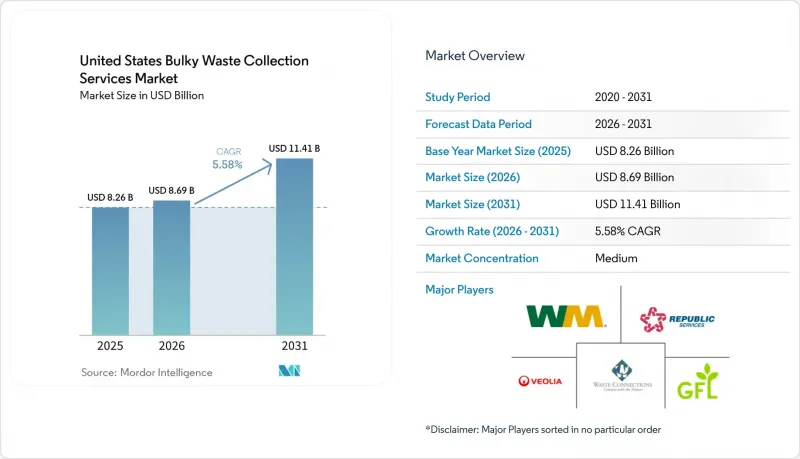
本報告按收集模式(路邊收集、按需收集、混合收集、B2B合約收集及其他)、來源(住宅、商業、工業、市政及其他)和廢棄物類型(家具及室內裝飾、金屬及廢料、白色家電、建築及拆除廢棄物及其他)進行細分。市場預測以價值(美元)和數量(噸)表示。
美國重型廢棄物收集服務市場趨勢與洞察。
陽光地帶各州的多用戶住宅建設熱潮
高密度多用戶住宅專案因家具更換和租戶入住而產生的廢棄物量不斷增加,導致物業管理公司對按需大件廢棄物收集和垃圾箱服務的需求日益成長。新建項目擴大採用集中式垃圾處理設施,限制大型物品的運送,並鼓勵定期或透過應用程式進行收集,而不是隨意丟棄在路邊。大規模大樓的最低服務標準傾向於那些能夠快速回應並向居住者和物業管理辦公室提供電子確認通知的供應商。隨著這些社區集中在人口持續湧入且建設計畫活躍的大都會圈,美國的大型廢棄物收集服務市場正從中受益。由此帶來的服務需求成長提高了私人運輸車輛的運輸路線密度,減少了車輛閒置時間,並有助於維持多年內的價格穩定。
執行業主協會關於路邊廢棄物堆放的規定和限制
住宅協會 (HOA) 通常會限制大件廢棄物的排放時間,並對違規行為處以罰款。這促使居民使用透過線上管道預訂的當日或隔天上門收集服務。這種趨勢在總體規劃社區中尤其明顯,這些社區的設計標準旨在避免路邊垃圾堆積,而業主委員會的規定則將不規則的市政垃圾收集服務改為定期的私人垃圾收集服務。因此,按需垃圾收集公司正在將業務拓展到業主協會覆蓋率高且對非道路垃圾收集要求明確的特定郵遞區號區域。隨著家庭權衡罰款和卡車租賃成本與預約上門收集服務的便利性,美國的大型廢棄物收集服務市場正在成長。這種執法環境促使居民、業主委員會和垃圾收集公司在提供透明定價的同時,也積極配合居民的短期時限獎勵。
聯邦和地方公共土地上非法傾倒垃圾的現像日益增多
在公共土地上非法傾倒垃圾會造成清理成本,並阻礙服務擴展,尤其是在合法處置場所偏遠的農村地區。清理工作規模大小不一,從小小規模清理到涉及危險物質的複雜項目,都可能增加成本和工期。此外,顯眼的非法傾倒點會吸引更多違法者,降低房產價值,並增加執法部門的需求。在美國的大型廢棄物收集服務市場,由於廢棄物繞過官方路線傾倒在聯邦土地上,可處理的垃圾量正在減少。聯邦機構和地方政府正在為此付出持續的成本,這凸顯了提供便捷合法的替代方案和進行公眾宣傳活動的重要性。
細分市場分析
到2025年,路邊垃圾收集服務將佔據46.21%的市場。這得益於其結構化的模式,該模式承諾為居民和物業管理人員提供可預測的收集時間表、清晰的排放指南和可靠的服務。住宅協會(HOA)的規章制度和市政框架規範了廢棄物方法和路邊排放收集流程,使這一領域受益匪淺。在設有專用收集路線且大件廢棄物預算充足的地區,市政路邊垃圾收集計畫已廣泛實施,確保了服務的穩定性。像Waste Management Inc.和Republic Services這樣的領先公司正透過最佳化路線和整合廢棄物收集業務。總之,路邊垃圾收集服務構成了美國大件廢棄物收集市場的基礎,尤其是在規劃完善的都市區。
受多車特許經營模式的擴張以及快速成長地區收集路線密度增加的推動,美國按需大件廢棄物收集服務市場預計到2031年將以6.34%的複合年成長率成長。這些趨勢將擴大採用集中調度系統和行動工具進行司機協調的綜合收集業者和加盟網路的目標基本客群。縣級緊急應變機制和季節性活動需要快速部署額外的卡車、工作人員和垃圾箱,這進一步推動了按需需求的成長。將常規大件廢棄物收集日與按需收集相結合的混合模式對郊區市政當局頗具吸引力,但在預算受限的地區,這種模式的普及速度仍然緩慢。與多用戶住宅社區和住宅營運商簽訂的B2B合約提供了穩定的基礎,但與零售業的按需服務相比,其較長的合約週期導致成長速度較慢。
其他好處:
- Excel格式的市場預測(ME)表
- 3個月的分析師支持
目錄
第1章:引言
- 研究假設和市場定義
- 調查範圍
第2章:調查方法
第3章執行摘要
第4章 市場狀況
- 市場概覽
- 市場促進因素
- 陽光地帶各州多戶住宅的蓬勃發展
- 執行業主協會規章制度及路邊裝飾相關規定
- 颶風和野生火災害後的災害復原重建
- 市政特許經營協議續約有利於綜合服務供應商。
- 電子商務中「快時尚家具」的更換週期正在加快。
- 透過垃圾清運特許經營和私募股權進行產業重組
- 市場限制因素
- 聯邦和地方公共土地上非法傾倒垃圾的現像日益增多
- 人手不足和人工收款方式導致的保險費上漲。
- 各州床墊回收基礎設施有差異
- 疫情後捐贈中心容量飽和
- 價值供應鏈分析
- 收款計劃系統
- 路徑最佳化方法
- 分銷和物流框架
- 監理情勢
- 技術展望
- 波特五力模型
- 人工智慧驅動的生成式廢棄物收集對服務供應商收入成長的影響
第5章 市場規模與成長預測
- 按集合模型
- 路邊
- 一經請求
- 混合
- 基於合約的B2B
- 其他
- 來源
- 住宅
- 商業的
- 產業
- 市政當局/政府
- 其他用途(宗教場所、臨時災難避難所、電影和電視拍攝場地)
- 廢棄物類型
- 家具和室內裝飾
- 金屬和廢料
- 白色家電/家用電器
- 建設與拆除
- 其他
第6章 競爭情勢
- 市場集中度
- 策略趨勢
- 市佔率分析
- 公司簡介
- Waste Management, Inc.
- Republic Services, Inc.
- Veolia Environment SA
- GFL Environmental Inc.
- Waste Connections, Inc.
- Recology Inc
- SUEZ SA
- Groot Industries
- Valet Living
- Stericycle, Inc.
- Airtasker Limited
- Casella Waste Systems, Inc.
- Rumpke Waste & Recycling
- Neighborly(Junk King parent)
- Waste Pro
- Waste Connections
- Junk King
- LoadUp Technologies
- Barna Recycling
- Bin There Dump That
第7章 市場機會與未來展望
According to Mordor Intelligence, the united states bulky waste collection services market size was valued at USD 8.26 billion in 2025 and is estimated to grow from USD 8.69 billion in 2026 to reach USD 11.41 billion by 2031, at a CAGR of 5.58% during the forecast period (2026-2031).
This report is Segmented by Collection Model (Curbside, On-Demand, Hybrid, Contracted B2B, and Others), by Source (Residential, Commercial, Industrial, Municipal, and Others), and by Waste Type (Furniture & Upholstery, Metal & Scrap Items, White Goods/Appliances, Construction & Demolition, and Others). The Market Forecasts are Provided in Terms of Value (USD) and Volume (Tons).
United States Bulky Waste Collection Services Market Trends and Insights
Multifamily Housing Construction Boom in Sunbelt States
High-density multifamily projects increase furniture turnover and move-in discard events, leading to more on-demand bulky pickups and roll-off requests for property managers. New developments often use centralized enclosures that restrict oversized items and encourage scheduled or app-based removal instead of uncoordinated curbside placement. Minimum-service standards in large complexes favor operators that can respond quickly and provide digital confirmations for residents and leasing offices. The United States bulky waste collection services market benefits as these communities cluster in metros with sustained in-migration and active building pipelines. The resulting increase in service demand raises route density and reduces deadhead time for private fleets, supporting stable pricing over multi-year windows.
HOA Covenant Enforcement and Curbside Placement Restrictions
Homeowners associations commonly restrict bulk-item placement to narrow windows and assess fines for violations, which steers residents toward same-day or next-day removal booked through digital channels. This pattern is most visible in master-planned communities where design standards discourage curb piles and board rules convert occasional municipal pickups into recurring private calls. As a result, on-demand haulers expand into targeted ZIP codes with high HOA penetration and clear off-street pick-up requirements. The United States bulky waste collection services market is growing as households weigh the cost of a ticket and truck rental against the convenience of a scheduled garage-to-truck service. The enforcement environment aligns the incentives of residents, HOA boards, and haulers to meet short service windows while offering transparent pricing.
Illegal Dumping Epidemic on Federal and Rural Public Lands
Illegal dumping on public lands diverts funds to cleanup and weakens service expansion in rural counties, especially where distances to permitted sites are long. Cleanups range from modest efforts to complex projects involving hazardous materials, which can escalate costs and timelines. The visibility of dump sites then attracts more offenders, degrading property values and increasing enforcement demands. The United States bulky waste collection services market loses reportable volume when material bypasses formal channels and ends up on federal tracts. Federal agencies and cities document persistent costs, which reinforce the value of accessible legal options and resident education.
Other drivers and restraints analyzed in the detailed report include:
- Hurricane and Wildfire Disaster Recovery Recurring Cycles
- Municipal Franchise Agreement Renewals Favoring Integrated Service Providers
- Labor Shortage and Rising Insurance Costs for Manual Collection
For complete list of drivers and restraints, kindly check the Table Of Contents.
Segment Analysis
In 2025, curbside services captured a 46.21% market share, owing to their structured model that promises predictable collection schedules, clear placement guidelines, and dependable service for both residents and property managers. This segment benefits from HOA regulations and municipal frameworks that standardize waste placement and curbside collection processes. Regions with dedicated routes for bulky waste and adequate budget allocations have widely adopted municipal curbside programs, ensuring consistent service. Major players like Waste Management Inc. and Republic Services bolster curbside operations by focusing on route optimization and integration with disposal services. In summary, curbside services are a cornerstone of the United States' bulky waste collection market, especially in well-organized urban and suburban areas.
The United States bulky waste collection services market for on-demand collection is projected to grow at a 6.34% CAGR through 2031, supporting multi-truck franchise scaling and gains in route density in high-growth corridors. These patterns increase the addressable base for integrated haulers and franchise networks that coordinate through centralized dispatch and mobile driver tools.Growth in On-Demand is further reinforced by county emergency protocols and seasonal events that require rapid deployment of extra trucks, crews, and containers. Hybrid models that combine scheduled bulk days with on-demand pickups appeal to suburban municipalities, though adoption remains incremental in tight-budget areas. Contracted B2B agreements with multifamily communities and senior-living operators provide a stable base, but they grow more slowly than retail on-demand due to longer contract cycles.
List of Companies Covered in this Report:
- Waste Management, Inc.
- Republic Services, Inc.
- Veolia Environment S.A.
- GFL Environmental Inc.
- Waste Connections, Inc.
- Recology Inc
- SUEZ S.A.
- Groot Industries
- Valet Living
- Stericycle, Inc.
- Airtasker Limited
- Casella Waste Systems, Inc.
- Rumpke Waste & Recycling
- Neighborly (Junk King parent)
- Waste Pro
- Waste Connections
- Junk King
- LoadUp Technologies
- Barna Recycling
- Bin There Dump That
Additional Benefits:
- The market estimate (ME) sheet in Excel format
- 3 months of analyst support
TABLE OF CONTENTS
1 Introduction
- 1.1 Study Assumptions & Market Definition
- 1.2 Scope of the Study
2 Research Methodology
3 Executive Summary
4 Market Landscape
- 4.1 Market Overview
- 4.2 Market Drivers
- 4.2.1 Multifamily Housing Construction Boom in Sunbelt States
- 4.2.2 HOA Covenant Enforcement and Curbside Placement Restrictions
- 4.2.3 Hurricane and Wildfire Disaster Recovery Recurring Cycles
- 4.2.4 Municipal Franchise Agreement Renewals Favoring Integrated Service Providers
- 4.2.5 "Fast Furniture" E-Commerce Replacement Cycles Accelerating
- 4.2.6 Junk Removal Franchising and Private Equity Consolidation
- 4.3 Market Restraints
- 4.3.1 Illegal Dumping Epidemic on Federal and Rural Public Lands
- 4.3.2 Labor Shortage and Rising Insurance Costs for Manual Collection
- 4.3.3 State-by-State Mattress Recycling Infrastructure Gaps
- 4.3.4 Donation Center Capacity Saturation Post-Pandemic
- 4.4 Value / Supply-Chain Analysis
- 4.4.1 Collection scheduling systems
- 4.4.2 Route optimization methods
- 4.4.3 Dispatch and logistics framework
- 4.5 Regulatory Landscape
- 4.6 Technological Outlook
- 4.7 Porter's Five Forces
- 4.7.1 Threat of New Entrants
- 4.7.2 Bargaining Power of Suppliers
- 4.7.3 Bargaining Power of Buyers
- 4.7.4 Threat of Substitutes
- 4.7.5 Industry Rivalry
- 4.8 Impact of GenAI-Powered Waste Collection on Service Providers' Revenue Growth
5 Market Size & Growth Forecasts
- 5.1 By Collection Model
- 5.1.1 Curbside
- 5.1.2 On-Demand
- 5.1.3 Hybrid
- 5.1.4 Contracted B2B
- 5.1.5 Others
- 5.2 By Source
- 5.2.1 Residential
- 5.2.2 Commercial
- 5.2.3 Industrial
- 5.2.4 Municipal/Government
- 5.2.5 Others (Religious Institutions, Temporary Disaster Relief Camps, Film/TV Production Sets)
- 5.3 By Waste Type
- 5.3.1 Furniture & Upholstery
- 5.3.2 Metal & Scrap Items
- 5.3.3 White Goods/Appliances
- 5.3.4 Construction & Demolition
- 5.3.5 Others
6 Competitive Landscape
- 6.1 Market Concentration
- 6.2 Strategic Moves
- 6.3 Market Share Analysis
- 6.4 Company Profiles {(includes Global level Overview, Market level overview, Core Segments, Financials as available, Strategic Information, Products & Services, and Recent Developments)}
- 6.4.1 Waste Management, Inc.
- 6.4.2 Republic Services, Inc.
- 6.4.3 Veolia Environment S.A.
- 6.4.4 GFL Environmental Inc.
- 6.4.5 Waste Connections, Inc.
- 6.4.6 Recology Inc
- 6.4.7 SUEZ S.A.
- 6.4.8 Groot Industries
- 6.4.9 Valet Living
- 6.4.10 Stericycle, Inc.
- 6.4.11 Airtasker Limited
- 6.4.12 Casella Waste Systems, Inc.
- 6.4.13 Rumpke Waste & Recycling
- 6.4.14 Neighborly (Junk King parent)
- 6.4.15 Waste Pro
- 6.4.16 Waste Connections
- 6.4.17 Junk King
- 6.4.18 LoadUp Technologies
- 6.4.19 Barna Recycling
- 6.4.20 Bin There Dump That
7 Market Opportunities & Future Outlook
- 7.1 Smart Cities & IoT Integration
- 7.2 Producer Responsibility Expansion

 廢棄物回收服務市場:全球預測,2026-2032年
 循環產品設計軟體市場預測至2034年:按部署類型、設計策略、技術、功能、最終用戶和地區分類的全球分析
 全球廢棄物回收服務市場規模、佔有率、趨勢和成長分析報告(2026-2034年)
 廢棄物回收服務:市場佔有率分析、產業趨勢與統計資料、成長預測(2026-2031 年)
 2026-2030年全球回收檢測系統市場2034年循環家具及室內裝修市場預測-全球循環家具、室內裝修解決方案、材料及組件、服務及經營模式、最終用戶及區域分析循環設計和生物模擬解決方案市場預測至2034年-按設計方法、調查方法、應用、最終用戶和地區分類的全球分析全球廢棄物收集和回收應用程式市場預測至2034年—按平台、功能、技術整合、廢棄物類型、部署模式、最終用戶和地區分類的分析超本地化廢棄物分類和堆肥服務市場預測至2034年——按服務類型、廢棄物類型、堆肥方法、收集方法、技術、最終用戶和地區分類的全球分析
 全球回收檢驗市場(至2031年):依回收材料、技術、終端用戶設施及地區分類