


 |
市場調查報告書
商品編碼
2063667
API可觀測性和測試軟體:市場佔有率分析、產業趨勢和統計數據以及成長預測(2026-2031年)API Observability And Testing Software - Market Share Analysis, Industry Trends & Statistics, Growth Forecasts (2026 - 2031) |
||||||

※ 本網頁內容可能與最新版本有所差異。詳細情況請與我們聯繫。
根據 Mordor Intelligence 預測,API 可觀測性和測試軟體市場將從 2025 年的 31.2 億美元成長到 2026 年的 34.7 億美元,到 2031 年將達到 63.2 億美元,2026 年至 2031 年的複合年成長率為 12.73%。
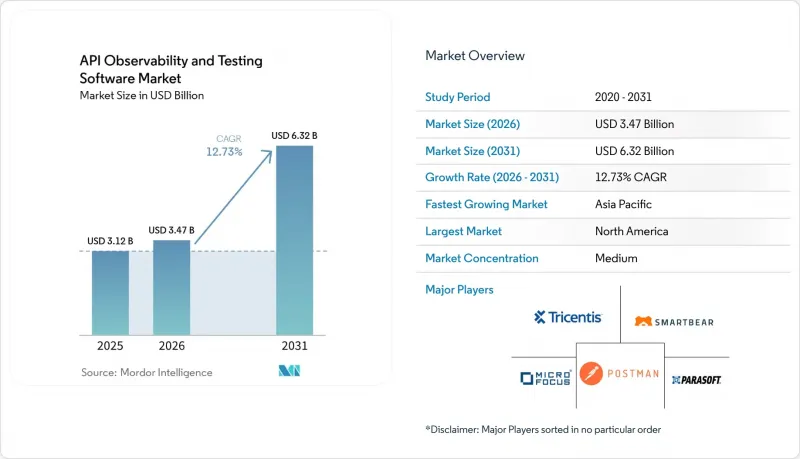
本報告按組件(解決方案和服務)、部署類型(雲端、本地部署等)、組織規模(大型企業和中小企業)、最終用戶行業(IT和電信、銀行、金融服務和保險、醫療保健、零售和電子商務、政府、製造業等)以及地區進行細分。市場預測以美元計價。
全球API可觀測性與測試軟體市場趨勢及洞察
微服務架構的廣泛應用
企業正在將單體架構拆分成數百個鬆散耦合的服務,每個服務都暴露多個端點,這需要自動化合約測試、模式檢驗和分散式追蹤。一筆數位交易可能需要經過 15 到 20 個內部 API,這增加了系統的複雜性和相互依賴性。為了應對這種情況,開發團隊正在實施服務網格整合,以即時檢測延遲峰值和錯誤鏈。金融服務、零售和媒體流等行業認為細粒度的可觀測性至關重要,因為系統停機會直接影響客戶信任、業務連續性和產生收入。
加速 CI/CD 和 DevOps 流水線
DevSecOps 工具鏈支援每天多次程式碼發布,API 測試週期應在幾分鐘內完成,而非幾小時。自動化回歸測試套件、契約測試和安全掃描作為管線每個階段的強制查核點,確保在部署到生產環境之前儘早發現破壞性變更。這種轉變將品質和安全直接整合到開發生命週期中。此外,聯邦和國防機構的合規性要求也強化了這種方法,禁止部署未通過預生產 API 安全檢驗的版本,凸顯了在持續整合和交付環境中建立強大、自動化測試框架的重要性。
與舊有系統整合的複雜性
運行混合環境的企業需要管理跨主機、中介軟體和雲端原生服務的 REST、SOAP、GraphQL 和 gRPC 負載。只有少數企業使用統一平台來關聯這些異質遙測數據,迫使團隊依賴特定協議的監控工具,從而增加運維開銷並延長平均恢復時間 (MTTR)。此外,將傳統的 COBOL 副本資料結構轉換為現代 JSON 格式會引入延遲和新的故障來源。這種複雜性需要專用的監控管道,進一步分散了可觀測性,並使端到端效能追蹤和事件解決更加困難。
細分市場分析
到2025年,解決方案將佔API可觀測性和測試軟體市場收入的63.42%,這表明市場對整合到DevOps管線中的平台主導部署方案有著強烈的偏好。買家優先考慮可擴展性、與CI/CD工作流程的整合以及集中式管治,因此他們更傾向於基於許可的工具而非分散式方案。同時,服務領域正以13.57%的複合年成長率快速成長,這主要得益於對測試案例開發、執行和持續監控外包服務的需求。託管服務供應商正在將諮詢、環境配置和合規性監控整合到基於訂閱的模式中,從而緩解內部資源的限制。例如,Katalon計劃在2026年推出MSP項目,透過AI產生的測試庫和預先配置的配置框架來縮短新用戶的上線時間。
解決方案生態系統在結構上仍然較為分散,涵蓋低程式碼平台、企業級套件和開放原始碼工具,各自面向不同的使用者成熟度等級。低程式碼環境彌合了技能差距,使缺乏技術專長的團隊也能設計和運行測試;而來自 IBM 和 SmartBear 的企業級平台則強調管治、可觀測性和生命週期整合。 Postman 等開放原始碼工具仍然是開發人員的入門途徑,但隨著服務供應商提供基於服務等級協定 (SLA) 的支援和客製化服務,這些工具正日益商業化。這種多層次的生態系統正被大型企業和中型數位原生公司廣泛採用,推動了整體市場滲透率和支出成長。
預計到 2025 年,基於雲端的部署將佔 API 可觀測性和測試軟體市場收入的 65.21%,複合年成長率 (CAGR) 為 14.57%,這主要得益於向 SaaS 消費模式的結構性轉變。雲端原生工具無需初始硬體投資,即可實現全球分散式負載測試,並透過將定價與實際 API 使用量掛鉤來提高成本透明度。然而,在金融服務、醫療保健和國防等受監管行業,本地部署仍然至關重要,因為資料主權和合規性要求必須確保本地執行。混合模式正日益受到關注,在這種模式下,企業將工作負載拆分,並在雲端運行功能和混合模式測試,同時在本地檢驗敏感數據,以符合 DORA 和 FedRAMP 等框架的要求。
透過與超大規模資料中心業者雲端服務供應商的生態系統整合,雲端採用正在加速推進。 AWS API Gateway、Azure API Management 和 Google Apigee 等服務提供原生整合功能,簡化身分驗證、降低延遲並簡化配置流程。此外,IBM API Connect 透過其共同運行時模型,實現了跨多重雲端環境的集中式管治,從而提升了平台採用率。儘管傳統的本地部署工具仍在一些特定用例中使用,但企業自有資料中心的持續減少以及 IT 支出模式向營運支出 (OpEx)主導型模式的廣泛轉變,預計將繼續鞏固雲端在 API 可觀測性和測試軟體市場的主導地位。
區域分析
到2025年,北美將佔API可觀測性和測試軟體市場34.70%的營收佔有率。這得歸功於成熟的DevOps應用、高度集中的超大規模資料中心業者以及嚴格的法規結構,例如《健康保險互通性與課責法案》(HIPAA),該法案提高了API品質標準。聯邦機構正在擴大檢驗要求,加拿大金融機構也持續加強其開放銀行基礎設施。然而,由於大型企業精簡供應商體系,供應商整合導致市場成長放緩。儘管如此,在國防、省級政府和製造業等滲透率較低的領域,尤其是在舊有系統向API主導架構遷移的過程中,新的機會正在湧現。
亞太地區是成長最快的地區,複合年成長率高達13.72%,這主要得益於數位基礎設施的快速擴張和API交易量的激增。印度的統一支付介面(UPI)預計到2025年將處理超過1000億筆交易,顯示其對API的高度依賴,也凸顯了對可擴展的雲端測試解決方案的需求。儘管中國的自主雲端政策傾向扶持國內供應商,但國際供應商也正透過在地化部署和合資企業進入中國市場。與此同時,日本和韓國正在將API檢驗融入其智慧製造舉措,而澳洲則在「消費者資料權」框架下推動合規性。標準的碎片化和本地化要求雖然增加了實施的複雜性,但也支撐了長期的需求。
歐洲市場趨勢受《資料便攜性權法案》(DORA) 和《一般資料保護規則》(GDPR) 等相關法規的嚴格執行以及嚴格的資料管治要求的影響。英國、德國和法國的金融機構正在投資先進的測試框架,以模擬網路故障並檢驗復原服務等級協定 (SLA)。瑞士和北歐國家正在支持跨境支付的整合,從而推動了對延遲敏感型 API 測試的需求。南美、中東和非洲雖然規模仍然較小,但正透過基於 SaaS 的定價模式迅速擴張。巴西的 Pix 計畫和沙烏地阿拉伯的數位政府計畫等措施正在推動 API 測試的持續普及。
其他好處:
- Excel格式的市場預測(ME)表
- 3個月的分析師支持
目錄
第1章:引言
- 研究假設和市場定義
- 調查範圍
第2章:調查方法
第3章執行摘要
第4章 市場狀況
- 市場概覽
- 市場促進因素
- 微服務架構的日益普及
- 加速 CI/CD 和 DevOps 流水線
- API 安全事件增加和合規要求更加嚴格
- 擴展雲端原生和無伺服器工作負載
- 低程式碼和無程式碼測試自動化平台
- 基於終端的定價模式加速了中小企業的採用。
- 市場限制因素
- 與舊有系統整合的複雜性
- 熟練的API測試工程師短缺
- 大規模部署中可觀測性資料成本不斷上升
- 工具的激增帶來了管治的挑戰。
- 產業價值鏈分析
- 監理情勢
- 技術展望
- 宏觀經濟因素對市場的影響
- 波特五力分析
第5章 市場規模與成長預測
- 按組件
- 解決方案
- 服務
- 部署模式
- 基於雲端的
- 現場
- 混合
- 按組織規模
- 大公司
- 中小企業
- 按最終用戶行業分類
- 資訊科技/通訊
- 銀行、金融服務和保險(BFSI)
- 衛生保健
- 零售與電子商務
- 政府
- 製造業
- 其他終端用戶產業
- 按地區
- 北美洲
- 美國
- 墨西哥
- 加拿大
- 歐洲
- 英國
- 德國
- 法國
- 義大利
- 西班牙
- 瑞士
- 比荷盧經濟聯盟
- 俄羅斯
- 北歐的
- 其他歐洲國家
- 亞太地區
- 中國
- 印度
- 日本
- 韓國
- 澳洲
- 其他亞太國家
- 南美洲
- 阿根廷
- 巴西
- 其他南美國家
- 中東和非洲
- 中東
- 沙烏地阿拉伯王國
- 阿拉伯聯合大公國
- 其他中東國家
- 非洲
- 南非
- 奈及利亞
- 其他非洲國家
- 中東
- 北美洲
第6章 競爭情勢
- 市場集中度
- 策略趨勢
- 市佔率分析
- 公司簡介
- Postman, Inc.
- SmartBear Software, Inc.
- Tricentis GmbH
- Micro Focus International plc
- Parasoft Corporation
- Katalon, Inc.
- RapidAPI, Inc.
- Sauce Labs, Inc.
- IBM Corporation
- Oracle Corporation
- Google LLC(Apigee)
- Kong, Inc.
- MuleSoft LLC
- Axway Software SA
- WSO2, Inc.
- Broadcom, Inc.(Layer7)
- Tyk Technologies Ltd.
- Solo.io, Inc.
- Stoplight, Inc.
- Assertible, Inc.
第7章 市場機會與未來展望
According to Mordor Intelligence, the aPI observability and testing software market size is expected to grow from USD 3.12 billion in 2025 to USD 3.47 billion in 2026 and is forecast to reach USD 6.32 billion by 2031 at 12.73% CAGR over 2026-2031.
This report is Segmented by Component (Solutions, and Services), Deployment Mode (Cloud-Based, On-Premises, and More), Organization Size (Large Enterprises, and Small and Medium Enterprises), End-User Industry (IT and Telecommunications, BFSI, Healthcare, Retail and E-Commerce, Government, Manufacturing, and More), and Geography. The Market Forecasts are Provided in Terms of Value (USD).
Global API Observability And Testing Software Market Trends and Insights
Growing Adoption of Microservices Architectures
Organizations are decomposing monolithic architectures into hundreds of loosely coupled services, each exposing multiple endpoints that require automated contract testing, schema validation, and distributed tracing. A single digital transaction can traverse 15-20 internal APIs, increasing system complexity and interdependencies. To manage this, development teams deploy service mesh integrations to detect latency spikes and error cascades in real time. Industries such as financial services, retail, and media streaming consider deep observability essential, as system downtime directly impacts customer trust, operational continuity, and revenue generation.
Acceleration of CI/CD and DevOps Pipelines
DevSecOps toolchains enable multiple daily code releases, requiring API testing cycles to complete within minutes rather than hours. Automated regression suites, contract testing, and security scans function as mandatory checkpoints across each pipeline stage, ensuring early detection of breaking changes before production deployment. This shift embeds quality and security directly into the development lifecycle. Additionally, compliance mandates from federal and defense agencies reinforce this approach by prohibiting deployments that fail pre-production API security validations, increasing the criticality of robust, automated testing frameworks within continuous integration and delivery environments.
Integration Complexity with Legacy Systems
Enterprises operating hybrid environments must manage REST, SOAP, GraphQL, and gRPC payloads across mainframes, middleware, and cloud native services. Only a minority use a unified platform to correlate such heterogeneous telemetry, forcing teams to rely on protocol-specific monitoring tools that increase operational overhead and extend mean time to recovery. Additionally, translating legacy COBOL copybook data structures into modern JSON formats introduces latency and new failure points. These complexities require dedicated monitoring pipelines, further fragmenting observability and making end-to-end performance tracking and incident resolution more difficult.
Other drivers and restraints analyzed in the detailed report include:
- Rising API Security Incidents and Compliance Mandates
- Expansion of Cloud-Native and Serverless Workloads
- Shortage of Skilled API Test Engineer
For complete list of drivers and restraints, kindly check the Table Of Contents.
Segment Analysis
Solutions accounted for 63.42% of API Observability And Testing Software Market revenue in 2025, indicating strong enterprise preference for platform-led adoption embedded within DevOps pipelines. Buyers prioritize scalability, integration with CI/CD workflows, and centralized governance, which favors licensed tools over fragmented approaches. In parallel, the services segment is expanding at a 13.57% CAGR, driven by demand for outsourced test-case development, execution, and continuous monitoring. Managed service providers are consolidating consulting, environment provisioning, and compliance oversight into subscription-based models, reducing internal resource constraints. For instance, Katalon introduced its 2026 MSP Program, accelerating onboarding timelines through AI-generated test libraries and pre-configured deployment frameworks.
The solutions ecosystem remains structurally fragmented across low-code platforms, enterprise-grade suites, and open-source tools, each targeting distinct user maturity levels. Low-code environments address skill gaps by enabling non-technical teams to design and execute tests, while enterprise platforms from IBM and SmartBear emphasize governance, observability, and lifecycle integration. Open-source tools such as Postman continue to serve as entry points for developers, but are increasingly commercialized via service providers offering SLA-backed support and customization. This layered ecosystem is expanding adoption across both large enterprises and mid-market digital-native firms, thereby increasing overall market penetration and spend.
Cloud-based deployment accounted for 65.21% of API observability and testing software market revenue in 2025 and is projected to expand at a 14.57% CAGR, driven by structural shifts toward SaaS consumption models. Cloud-native tools remove the need for upfront hardware investment, enable globally distributed load testing, and align pricing with actual API usage volumes, improving cost transparency. Despite this, on-premises deployments remain relevant in regulated sectors such as financial services, healthcare, and defense, where data sovereignty and compliance requirements mandate localized execution. Hybrid models are gaining traction as enterprises split workloads, running functional and scalability tests in the cloud while retaining sensitive data validation on-site to comply with frameworks such as DORA and FedRAMP.
Ecosystem integration with hyperscalers is further accelerating cloud adoption. Services like AWS API Gateway, Azure API Management, and Google Apigee provide native integrations that streamline authentication, reduce latency, and simplify deployment pipelines. Additionally, IBM API Connect enables centralized governance across multi-cloud environments through a federated runtime model, increasing platform stickiness. While legacy on-premises tools persist in niche use cases, the ongoing decline of enterprise-owned data centers and a broader shift toward OpEx-driven IT spending models are expected to sustain cloud dominance in the API observability and testing software market.
Geography Analysis
North America accounted for 34.70% of the API observability and testing software market revenue in 2025, supported by mature DevOps adoption, high hyperscaler concentration, and strict regulatory frameworks such as the Health Insurance Portability and Accountability Act that elevate API quality standards. Federal agencies are expanding validation mandates, while Canadian financial institutions continue strengthening open-banking infrastructure. However, growth is moderating due to vendor consolidation as large enterprises rationalize supplier bases. Despite this, underpenetrated segments, including defense, state government, and industrial manufacturing, offer incremental opportunities, particularly as legacy systems transition to API-driven architectures.
Asia-Pacific is the fastest-growing region, with a 13.72% CAGR, driven by the rapid expansion of digital infrastructure and high API transaction volumes. India's Unified Payments Interface, which processed over 100 billion transactions in 2025, underscores the scale of API dependency, underscoring the need for scalable, cloud-based testing solutions. China's sovereign cloud policies favor domestic vendors, although international providers are entering through localized deployments and joint ventures. Meanwhile, Japan and South Korea are embedding API validation within smart manufacturing initiatives, and Australia is advancing compliance under its Consumer Data Right framework. Fragmentation in standards and localization requirements introduces execution complexity but sustains long-term demand.
Europe's market trajectory is shaped by regulatory enforcement under DORA and stringent data governance requirements linked to the General Data Protection Regulation. Financial institutions across the United Kingdom, Germany, and France are investing in advanced testing frameworks to simulate cyber disruptions and validate recovery SLAs. Switzerland and Nordic countries are supporting cross-border payment integration, increasing demand for latency-sensitive API testing. South America, the Middle East, and Africa remain smaller in absolute terms but are scaling through SaaS-based pricing models. Initiatives such as Brazil's Pix and Saudi Arabia's digital government programs are reinforcing sustained adoption of API testing.
- Postman, Inc.
- SmartBear Software, Inc.
- Tricentis GmbH
- Micro Focus International plc
- Parasoft Corporation
- Katalon, Inc.
- RapidAPI, Inc.
- Sauce Labs, Inc.
- IBM Corporation
- Oracle Corporation
- Google LLC (Apigee)
- Kong, Inc.
- MuleSoft LLC
- Axway Software SA
- WSO2, Inc.
- Broadcom, Inc. (Layer7)
- Tyk Technologies Ltd.
- Solo.io, Inc.
- Stoplight, Inc.
- Assertible, Inc.
Additional Benefits:
- The market estimate (ME) sheet in Excel format
- 3 months of analyst support
TABLE OF CONTENTS
1 INTRODUCTION
- 1.1 Study Assumptions and Market Definition
- 1.1.1 Scope of the Study
2 RESEARCH METHODOLOGY
3 EXECUTIVE SUMMARY
4 MARKET LANDSCAPE
- 4.1 Market Overview
- 4.2 Market Drivers
- 4.2.1 Growing Adoption of Microservices Architectures
- 4.2.2 Acceleration of CI/CD and DevOps Pipelines
- 4.2.3 Rising API Security Incidents and Compliance Mandates
- 4.2.4 Expansion of Cloud-Native and Serverless Workloads
- 4.2.5 Low-Code and No-Code Test Automation Platforms
- 4.2.6 Per-Endpoint Pricing Models Driving SME Uptake
- 4.3 Market Restraints
- 4.3.1 Integration Complexity with Legacy Systems
- 4.3.2 Shortage of Skilled API Test Engineers
- 4.3.3 Observability Data Cost Inflation in Large-Scale Deployments
- 4.3.4 Tool-Sprawl Leading to Governance Challenges
- 4.4 Industry Value-Chain Analysis
- 4.5 Regulatory Landscape
- 4.6 Technological Outlook
- 4.7 Impact of Macroeconomic Factors on the Market
- 4.8 Porter's Five Forces Analysis
- 4.8.1 Threat of New Entrants
- 4.8.2 Bargaining Power of Suppliers
- 4.8.3 Bargaining Power of Buyers
- 4.8.4 Threat of Substitutes
- 4.8.5 Intensity of Competitive Rivalry
5 MARKET SIZE AND GROWTH FORECASTS (VALUE)
- 5.1 By Component
- 5.1.1 Solutions
- 5.1.2 Services
- 5.2 By Deployment Mode
- 5.2.1 Cloud-Based
- 5.2.2 On-Premises
- 5.2.3 Hybrid
- 5.3 By Organization Size
- 5.3.1 Large Enterprises
- 5.3.2 Small and Medium Enterprises (SMEs)
- 5.4 By End-User Industry
- 5.4.1 IT and Telecommunications
- 5.4.2 Banking, Financial Services and Insurance (BFSI)
- 5.4.3 Healthcare
- 5.4.4 Retail and E-commerce
- 5.4.5 Government
- 5.4.6 Manufacturing
- 5.4.7 Other End-User Industries
- 5.5 By Geography
- 5.5.1 North America
- 5.5.1.1 United States
- 5.5.1.2 Mexico
- 5.5.1.3 Canada
- 5.5.2 Europe
- 5.5.2.1 United Kingdom
- 5.5.2.2 Germany
- 5.5.2.3 France
- 5.5.2.4 Italy
- 5.5.2.5 Spain
- 5.5.2.6 Switzerland
- 5.5.2.7 Benelux
- 5.5.2.8 Russia
- 5.5.2.9 Nordics
- 5.5.2.10 Rest of Europe
- 5.5.3 Asia-Pacific
- 5.5.3.1 China
- 5.5.3.2 India
- 5.5.3.3 Japan
- 5.5.3.4 South Korea
- 5.5.3.5 Australia
- 5.5.3.6 Rest of Asia Pacific
- 5.5.4 South America
- 5.5.4.1 Argentina
- 5.5.4.2 Brazil
- 5.5.4.3 Rest of South America
- 5.5.5 Middle East and Africa
- 5.5.5.1 Middle East
- 5.5.5.1.1 Kingdom of Saudi Arabia
- 5.5.5.1.2 United Arab Emirates
- 5.5.5.1.3 Rest of Middle East
- 5.5.5.2 Africa
- 5.5.5.2.1 South Africa
- 5.5.5.2.2 Nigeria
- 5.5.5.2.3 Rest of Africa
- 5.5.5.1 Middle East
- 5.5.1 North America
6 COMPETITIVE LANDSCAPE
- 6.1 Market Concentration
- 6.2 Strategic Moves
- 6.3 Market Share Analysis
- 6.4 Company Profiles (includes Global Level Overview, Market Level Overview, Core Segments, Financials as available, Strategic Information, Market Rank/Share, Products and Services, Recent Developments)
- 6.4.1 Postman, Inc.
- 6.4.2 SmartBear Software, Inc.
- 6.4.3 Tricentis GmbH
- 6.4.4 Micro Focus International plc
- 6.4.5 Parasoft Corporation
- 6.4.6 Katalon, Inc.
- 6.4.7 RapidAPI, Inc.
- 6.4.8 Sauce Labs, Inc.
- 6.4.9 IBM Corporation
- 6.4.10 Oracle Corporation
- 6.4.11 Google LLC (Apigee)
- 6.4.12 Kong, Inc.
- 6.4.13 MuleSoft LLC
- 6.4.14 Axway Software SA
- 6.4.15 WSO2, Inc.
- 6.4.16 Broadcom, Inc. (Layer7)
- 6.4.17 Tyk Technologies Ltd.
- 6.4.18 Solo.io, Inc.
- 6.4.19 Stoplight, Inc.
- 6.4.20 Assertible, Inc.
7 MARKET OPPORTUNITIES AND FUTURE OUTLOOK
- 7.1 White-Space and Unmet-Need Assessment

 網站和伺服器監控服務市場:全球市場預測,2026-2032年
 監控即服務 (MaaS) 市場規模、佔有率和成長分析:按系統類型、部署方式、企業規模、最終用戶產業和地區分類-2026-2033 年產業預測
 雲端監控:市場佔有率分析、產業趨勢和統計數據、成長預測(2026-2031)
 雲端監控市場預測至 2034 年—按組件、部署模式、企業規模、最終用戶和地區分類的全球分析雲端監控市場:按組件、服務模型、監控類型、部署模式、組織規模和最終用戶分類-2026-2032年全球市場預測
 雲端監控市場規模、佔有率和趨勢分析報告:按類型、服務模式、企業規模、最終用途、地區和細分市場預測(2026-2033 年)
 2026年全球全端可觀測性服務市場報告
 雲端監控市場分析及預測(至 2035 年):類型、產品類型、服務、技術、元件、應用、部署模式、最終使用者、解決方案2026年全球雲端監控市場報告
 全球雲端監控市場規模、佔有率、趨勢和成長分析報告(2026-2034年)