

 |
市場調查報告書
商品編碼
2063634
歐洲建築和拆除廢棄物管理:市場佔有率分析、行業趨勢和統計數據以及成長預測(2026-2031 年)Europe Construction And Demolition Waste Management - Market Share Analysis, Industry Trends & Statistics, Growth Forecasts (2026 - 2031) |
||||||

※ 本網頁內容可能與最新版本有所差異。詳細情況請與我們聯繫。
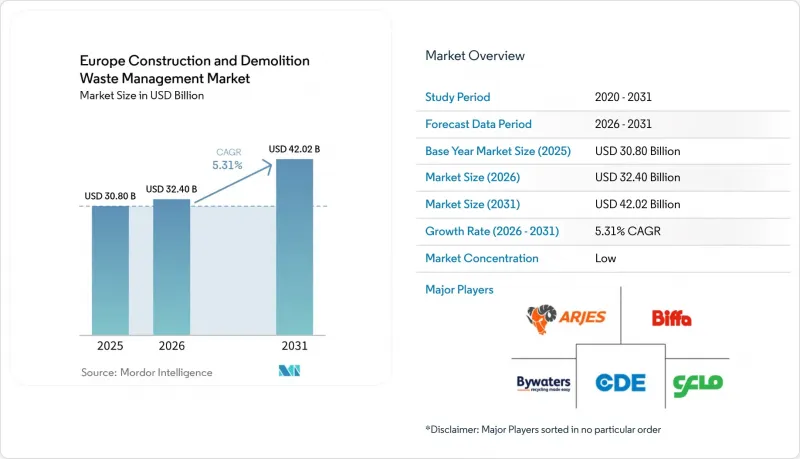
根據 Mordor Intelligence 預測,歐洲建築和拆除廢棄物管理市場預計將從 2025 年的 308 億美元成長到 2026 年的 324 億美元,到 2031 年將達到 420.2 億美元,2026 年至 2031 年的複合年成長率為 5.31%。
本報告廢棄物廢棄物類型(非危險廢棄物和危險廢棄物)、材料(混凝土、磚塊、瀝青等)、服務(收集和運輸、分類和分離等)以及地區(英國、德國、法國、義大利、西班牙、比荷盧經濟聯盟、北歐國家和其他歐洲國家)進行細分。市場預測以美元計價。
歐洲建築和拆除廢棄物管理市場的趨勢和見解。
企業永續發展措施和ESG報告要求正在推動減少廢棄物。
自2024年起,《企業永續發展報告指令》加強了對大型企業的資訊揭露要求,更加重視廢棄物產生、回收和價值鏈影響。領先的建設公司目前在其績效評估系統中優先考慮廢棄物再利用,揭露廢棄物流向,並強調檢驗的回收解決方案。 CRH報告稱,截至2024年,其98%的工地已製定廢棄物管理計劃,並回收了4,470萬噸廢棄物和產品。 Balfour Beatty在其2024年永續發展計畫中取得了進展,透過保證溫室氣體揭露,增強了客戶對循環供應鏈的信心。隨著檢驗的廢棄物和循環數據影響綠色融資的合格,資金籌措環境也正在改變。愛爾蘭綠色建築委員會的住宅性能指數將循環性納入住宅設計,並推廣材料回收。法國建設產業的生產者延伸責任制(EPR)組織擴大了其專業收集中心,並改善了各地區建築公司的收集和報告系統。
在歐洲建設產業推廣循環經濟原則
歐盟循環材料利用率在2024年達到12.2%,顯示再生材料的利用取得了穩定進展。各地區正透過強制性分類收集、現場分類和選擇性拆解等方式實施循環經濟政策。FLANDERS地區在2024年擴大了分類義務,強制要求對更多類型的材料進行分類處理,並提高了回收原料的品質。北歐國家根據新法規加強了建築調查和材料測繪工作,提高了拆解流程的透明度。在丹麥的Solum工廠,機器人分類技術展現了其在提高材料純度和減少排放的潛力。歐盟委員會針對骨材和其他材料的「廢棄物終止」計劃旨在統一定義,從而促進跨境自由流動,並將其應用於更高附加價值的應用領域。這些進展加強了市場與循環經濟法規的銜接,並提高了選擇性拆解和品管的標準。
對先進的廢棄物處理設施和設備進行了大量前期投資。
從人工分類過渡到自動化分類需要大量資金,而小規模企業往往資金籌措。新的解決方案將機器人系統與光學和高光譜影像相結合,除了系統整合成本外,還增加了初始成本。丹麥的一項示範計畫表明,機器人分類可以提高純度並降低每噸排放,但要實現這一目標仍然需要合作資金籌措和技術夥伴關係,而小規模企業往往難以獲得這些資源。法國的政策支持包括為擴大建材回收能力提供資金,但中期產能擴張仍然受到前置作業時間和整個工廠嚴格品管需求的限制。歐盟聯合研究中心 (JRC) 的一項研究表明,先進的建築和拆除 (C&D) 回收方法可以降低每噸產品的生命週期排放,但仍需要新的投資來彌合歐盟範圍內的產能缺口。隨著各國框架內廢棄物處置標準的更新,企業還必須投資於文件編制和合格評定,這增加了高等級生產獲利前的推出成本。這些現實情況使資本雄厚的公司以及擁有長期供應合約以降低償還風險的公司獲得了優勢,這正在影響歐洲建築和拆除廢棄物管理市場的整合趨勢。
細分市場分析
到2025年,非危險廢棄物將佔歐洲建築和拆除廢棄物管理市場佔有率的98.1%,這反映出該地區廢棄物成分中礦物含量極高。在整個歐洲,建築環境排放大量的混凝土、磚塊和瀝青,這些廢棄物支撐著處理設施的處理能力。歐盟每年產生的建築和拆除廢棄物高達數億噸。強制分類和選擇性拆除等政策措施提高了回收標準,並建立了穩定的物流系統,確保了可預測的物料流動。法國的國家藍圖設定了2027年實現礦物廢棄物分類的宏偉目標,並輔以國家層級的生產者延伸責任制(EPR),有助於規範各地區的做法。在這種政策環境下,非危險廢棄物管理正穩步發展,目前正加大投資,旨在開發更高純度和更高附加價值的再生骨材和其他礦物衍生物市場。
儘管危險廢棄物量仍然較低,但隨著拆除前審計和更嚴格的處理法規日益普及並加強執行,其受到的關注度正在不斷提高。制定了石棉清除和木材污染主動治理計畫的成員國正在更嚴格的監管下,拓展此類廢棄物的回收和處理方案。在北歐國家,新的法律體制正在加強建築檢查,提高維修工程產生的危險廢棄物的檢出率,並確保更可靠的運輸路線。基於環境管理認證的國家級文件化處理要求也在加強危險廢棄物的資料收集和管治。實際上,危險物質的運輸會增加專案層面的成本和時間,並需要專門的物流服務,因此具備處理能力的綜合營運商更具商業價值。這一點也體現在合約結構中,這些結構在拆除和後處理階段之間分擔風險,並協調安全和合規方面的獎勵。
其他好處:
- Excel格式的市場預測(ME)表
- 3個月的分析師支持
目錄
第1章:引言
- 研究假設和市場定義
- 調查範圍
第2章:調查方法
第3章執行摘要
第4章 市場狀況
- 市場概覽
- 產業價值/價值鏈分析
- 市場促進因素
- 企業永續發展措施和ESG報告要求正在推動減少廢棄物。
- 歐洲建設產業日益廣泛地採用循環經濟原則
- 由於自然資源枯竭和骨材短缺,對再生骨材的需求增加。
- 歐洲老化城市基礎設施維修和城市更新項目日益增加。
- 自動化分類和人工智慧驅動的廢棄物分離系統的技術進步
- 受住宅需求和綠建築計劃的推動,建設活動活性化。
- 市場限制因素
- 先進廢棄物處理設施和設備的前期投資成本很高。
- 污染問題會降低迴收建築和拆除 (C&D) 材料的品質和市場接受度。
- 歐盟成員國之間對再生材料的品質標準沒有統一標準。
- 東歐國家廢棄物收集基礎設施碎片化
- 監理情勢
- 技術展望
- 波特五力模型
- 循環經濟與物質流分析
- 環境和生命週期評估考慮因素
第5章 市場規模與成長預測
- 廢棄物類型
- 無害廢棄物
- 危險廢棄物
- 材料
- 混凝土磚
- 瀝青
- 金屬
- 木頭
- 沉澱
- 石膏板/乾牆
- 其他材質(塑膠、木材、玻璃)
- 按服務
- 收集和運輸
- 分類和分離
- 回收和資源回收
- 掩埋和廢物處理
- 按地區
- 英國
- 德國
- 法國
- 義大利
- 西班牙
- 比荷盧經濟聯盟(比利時、荷蘭、盧森堡)
- 北歐國家(丹麥、芬蘭、冰島、挪威、瑞典)
- 其他歐洲國家
第6章 競爭情勢
- 市場集中度
- 策略趨勢
- 市佔率分析
- 公司簡介
- ARJES
- Biffa
- Bywaters
- CDE Group
- CFlo World Limited
- DAW Group
- Eastern Waste Disposal(EWD)
- EnviroCraft Waste Solutions
- Geocycle(Holcim Group)
- ISM Waste & Recycling
- McLanahan
- Metso
- REMEX GmbH
- Renewi
- SmartEnds
- Stena Metall AB
- SUEZ
- Veolia
- AESG
第7章 市場機會與未來展望
According to Mordor Intelligence, the europe construction and demolition waste management market size is expected to grow from USD 30.80 billion in 2025 to USD 32.40 billion in 2026 and is forecast to reach USD 42.02 billion by 2031 at 5.31% CAGR over 2026-2031.
This report is Segmented by Waste Type (Non-Hazardous Waste, and Hazardous Waste), by Material (Concrete & Bricks, Asphalt, and More), by Service (Collection & Transportation, Sorting & Segregation, and More), and by Geography (United Kingdom, Germany, France, Italy, Spain, BENELUX, NORDICS, and Rest of Europe). Market Forecasts are Provided in Terms of Value (USD).
Europe Construction And Demolition Waste Management Market Trends and Insights
Corporate Sustainability Commitments and ESG Reporting Requirements Pushing Waste Reduction
The Corporate Sustainability Reporting Directive has increased disclosure requirements for large companies in 2024, emphasizing waste generation, recycling, and value chain impacts. Large contractors now prioritize waste diversion in performance systems and disclose waste flows, favoring verified recovery solutions. CRH reported 98% of its locations had waste management plans in 2024, recovering 44.7 million tonnes of waste and by-products. Balfour Beatty showed progress in its 2024 sustainability plan, with assured greenhouse gas disclosures boosting customer confidence in circular delivery. Financial access is shifting as verified waste and circularity data influence green financing eligibility. The Irish Green Building Council's Home Performance Index integrates circularity into housing design, enhancing material recovery. France's EPR organization for construction expanded professional deposit sites, improving collection and reporting for contractors across regions.
Growing Adoption of Circular Economy Principles Across the European Construction Sector
The EU's Circular Material Use Rate reached 12.2% in 2024, reflecting gradual progress in secondary material usage. Regions are implementing circular policies through mandates for separate collection, on-site sorting, and selective demolition. Flanders expanded mandatory sorting in 2024, requiring more material streams to be handled separately, improving feedstock quality for recyclers. Nordic countries enhanced building surveys and material mapping under new rules, increasing transparency of demolition flows. Denmark's Solum facility showcased robotic sorting's potential to improve purity and reduce emissions. The European Commission's end-of-waste work for aggregates and other materials aims to harmonize definitions, enabling freer cross-border movement and scaling into higher-value applications. These developments strengthen market alignment with circular rules and raise standards for selective demolition and quality control.
High Initial Capital Investment for Advanced Waste Processing Facilities and Equipment
Shifting from manual to automated sorting requires significant capital that smaller operators struggle to finance. New deployments combine robotic systems with optical and hyperspectral imaging, which adds to upfront costs alongside systems integration. Danish evidence shows that robotic sorting can improve purity and lower emissions per tonne, but the pathway still demands coordinated funding and technical partnerships that smaller firms cannot easily secure. France's policy support includes funding to increase recycling capacity for building materials, yet medium-term capacity build-out remains constrained by lead times and the need for robust quality management across plants. The Joint Research Centre finds that advanced C&D recycling methods can reduce life cycle emissions per tonne but still require new investments to close the processing gap across the EU. Where national frameworks update end-of-waste rules, operators must also invest in documentation and conformity assessment, which increases setup costs before monetization of higher-grade outputs begins. These realities favor well-capitalized firms or those with long-term supply contracts that de-risk repayment, which influences consolidation dynamics in the Europe construction and demolition waste management market.
Other drivers and restraints analyzed in the detailed report include:
- Rising Demand for Recycled Aggregates Due to Natural Resource Depletion and Aggregate Shortages
- Increasing Infrastructure Renovation and Urban Regeneration Projects in Aging European Cities
- Contamination Issues Reducing Quality and Market Acceptance of Recycled C&D Materials
For complete list of drivers and restraints, kindly check the Table Of Contents.
Segment Analysis
The non-hazardous segment accounted for 98.1% of the Europe construction and demolition waste management market share in 2025, which reflects the mass dominance of mineral fractions in the regional waste mix. Across Europe, the built environment produces large volumes of concrete, brick, and asphalt flows that underpin throughput at processing sites, with annual C&D waste generation measured in the hundreds of millions of tonnes across the EU. Policy actions such as separate collection mandates and selective demolition protocols are raising the baseline for recovery and creating stable logistics for predictable material streams. France's national roadmap sets aggressive targets for the separate collection of mineral waste by 2027, backed by national EPR implementation that helps standardize practice across regions. Under this policy environment, non-hazardous waste management is on a steady expansion path, with investments now targeting greater purity and higher-value outlets for recycled aggregates and other mineral derivatives.
Hazardous waste remains small by tonnage, yet it is gaining traction because pre-demolition audits and stricter handling rules are more common and better enforced. Member states with forward plans on asbestos removal and wood contamination are scaling up solutions to capture and treat this fraction under tighter supervision frameworks. Nordic countries have strengthened building surveys under new legal frameworks, which improves discovery and more reliable routing of hazardous fractions from rehabilitation projects. National requirements for documented handling under environmental management certifications also tighten data capture and governance for hazardous loads. In practice, hazardous material routing increases cost and time requirements per project and requires specialized logistics, which supports the business case for integrated operators with treatment capacity. This also materializes in contract structures that partition risk across the demolition and post-processing phases and align incentives for safety and compliance.
List of Companies Covered in this Report:
- ARJES
- Biffa
- Bywaters
- CDE Group
- CFlo World Limited
- DAW Group
- Eastern Waste Disposal (EWD)
- EnviroCraft Waste Solutions
- Geocycle (Holcim Group)
- ISM Waste & Recycling
- McLanahan
- Metso
- REMEX GmbH
- Renewi
- SmartEnds
- Stena Metall AB
- SUEZ
- Veolia
- AESG
Additional Benefits:
- The market estimate (ME) sheet in Excel format
- 3 months of analyst support
TABLE OF CONTENTS
1 Introduction
- 1.1 Study Assumptions & Market Definition
- 1.2 Scope of the Study
2 Research Methodology
3 Executive Summary
4 Market Landscape
- 4.1 Market Overview
- 4.2 Industry Value / Supply-Chain Analysis
- 4.3 Market Drivers
- 4.3.1 Corporate sustainability commitments and ESG reporting requirements pushing waste reduction
- 4.3.2 Growing adoption of circular economy principles across European construction sector
- 4.3.3 Rising demand for recycled aggregates due to natural resource depletion and aggregate shortages
- 4.3.4 Increasing infrastructure renovation and urban regeneration projects in aging European cities
- 4.3.5 Technological advancements in automated sorting and AI-based waste segregation systems
- 4.3.6 Rising construction activity driven by residential housing demand and green building initiatives
- 4.4 Market Restraints
- 4.4.1 High initial capital investment for advanced waste processing facilities and equipment
- 4.4.2 Contamination issues reducing quality and market acceptance of recycled C&D materials
- 4.4.3 Lack of standardized quality specifications for recycled materials across EU member states
- 4.4.4 Fragmented waste collection infrastructure in Eastern European countries
- 4.5 Regulatory Landscape
- 4.6 Technological Outlook
- 4.7 Porter's Five Forces
- 4.7.1 Threat of New Entrants
- 4.7.2 Bargaining Power of Suppliers
- 4.7.3 Bargaining Power of Buyers
- 4.7.4 Threat of Substitutes
- 4.7.5 Industry Rivalry
- 4.8 Circular Economy & Material Flow Analysis
- 4.9 Environmental & Life-Cycle Assessment Considerations
5 Market Size & Growth Forecasts
- 5.1 By Waste Type
- 5.1.1 Non-Hazardous Waste
- 5.1.2 Hazardous Waste
- 5.2 By Material
- 5.2.1 Concrete & Bricks
- 5.2.2 Asphalt
- 5.2.3 Metal
- 5.2.4 Timber
- 5.2.5 Soil and Sand
- 5.2.6 Gypsum & Drywall
- 5.2.7 Others (Plastic, Wood, Glass)
- 5.3 By Service
- 5.3.1 Collection & Transportation
- 5.3.2 Sorting & Segregation
- 5.3.3 Recycling & Material Recovery
- 5.3.4 Landfilling & Disposal
- 5.4 By Geography
- 5.4.1 United Kingdom
- 5.4.2 Germany
- 5.4.3 France
- 5.4.4 Italy
- 5.4.5 Spain
- 5.4.6 BENELUX (Belgium, Netherlands, and Luxembourg)
- 5.4.7 NORDICS (Denmark, Finland, Iceland, Norway, and Sweden)
- 5.4.8 Rest of Europe
6 Competitive Landscape
- 6.1 Market Concentration
- 6.2 Strategic Moves
- 6.3 Market Share Analysis
- 6.4 Company Profiles (includes Global level Overview, Market level overview, Core Segments, Financials as available, Strategic Information, Products & Services, and Recent Developments)
- 6.4.1 ARJES
- 6.4.2 Biffa
- 6.4.3 Bywaters
- 6.4.4 CDE Group
- 6.4.5 CFlo World Limited
- 6.4.6 DAW Group
- 6.4.7 Eastern Waste Disposal (EWD)
- 6.4.8 EnviroCraft Waste Solutions
- 6.4.9 Geocycle (Holcim Group)
- 6.4.10 ISM Waste & Recycling
- 6.4.11 McLanahan
- 6.4.12 Metso
- 6.4.13 REMEX GmbH
- 6.4.14 Renewi
- 6.4.15 SmartEnds
- 6.4.16 Stena Metall AB
- 6.4.17 SUEZ
- 6.4.18 Veolia
- 6.4.19 AESG
7 Market Opportunities & Future Outlook
- 7.1 White-space & unmet-need assessment

 建築和拆除廢棄物管理市場-全球產業規模、佔有率、趨勢、機會和預測:按材料、來源、服務、最終用戶、地區和競爭格局分類,2021-2031年
 建築和拆除廢棄物回收市場預測至2034年-按廢棄物類型、來源、服務類型、設備、應用、最終用戶和地區分類的全球分析
 亞太地區建築和拆除廢棄物管理:市場佔有率分析、行業趨勢和統計數據以及成長預測(2026-2031 年)
 建築和拆除廢棄物管理市場報告:按行業、服務、廢棄物類型和地區分類(2026-2034 年)
 建築和拆除廢棄物市場:廢棄物類型、收集方法、處理方法、最終用途和應用分類-2026-2032年全球市場預測
 2026年全球建築與廢棄物廢棄物管理市場報告
 建築與拆除廢棄物管理市場規模、佔有率、成長及全球產業分析:依類型、應用和地區劃分的洞察與預測(2026-2034年)按材料類型、原料來源、加工技術、應用、最終用戶和通路骨材回收市場-2026-2032年全球預測全球挖掘與拆除市場:機會與策略展望(至2034年)
 全球建築和拆除廢棄物管理市場