


 |
市場調查報告書
商品編碼
2063463
醫療無人機配送服務:市場佔有率分析、產業趨勢與統計及成長預測(2026-2031 年)Medical Drone Delivery Services - Market Share Analysis, Industry Trends & Statistics, Growth Forecasts (2026 - 2031) |
||||||

※ 本網頁內容可能與最新版本有所差異。詳細情況請與我們聯繫。
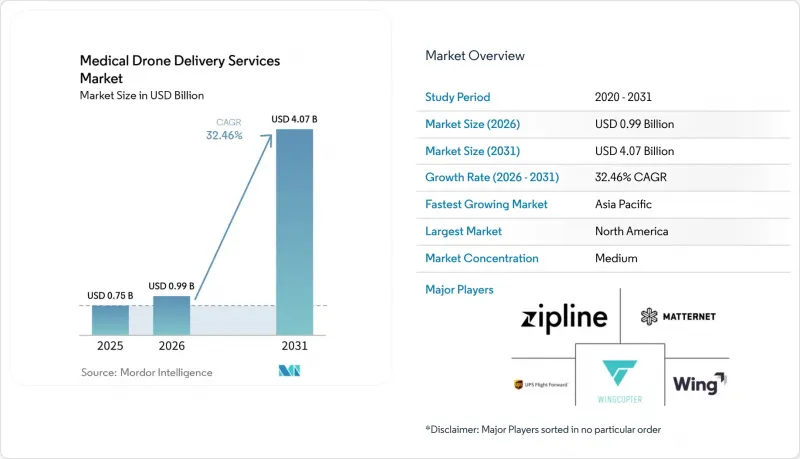
據 Mordor Intelligence 稱,醫療無人機配送服務的市場規模預計將從 2025 年的 7.5 億美元成長到 2026 年的 9.9 億美元,到 2031 年達到 40.7 億美元,2026 年至 2031 年的複合年成長率為 32.46%。
本報告按應用領域(血液運輸、疫苗接種、藥品、器官運輸、診斷、急救包)、平台(多旋翼飛行器、固定翼飛行器、混合動力垂直起降飛行器)、最終用戶(醫院、急救醫療服務機構 (EMS)、血庫、政府機構、藥房、實驗室)、交付模式(B2B、B2C、緊急配送)和北美地區(AME、AMEAME)預測以美元 (USD) 為單位。
全球醫療無人機配送服務市場趨勢及洞察
國家公共衛生計畫將常規實施無人機物流
加納、盧安達和印度的政府資助網路已從試點計畫過渡到機構採購,在五年內實現了全國覆蓋,同時將疫苗浪費減少了高達 80%,血液浪費減少了 67%。這些結果表明,在需求可預測、道路狀況不佳且臨床情況高度緊急的情況下,醫療無人機配送服務市場可以取代地面運輸。世界衛生組織 2024 年發布的《低溫低溫運輸指南》進一步論證了在 mRNA 疫苗接種宣傳活動中使用無人機的合理性,並為預算分配提供了指南。因此,各國衛生部正在將無人機納入其基本醫療服務預算,以確保穩定的飛行量,從而支持商業性永續性。
BVLOS 的規範化實現了對多對一的操作和擴展。
美國提案的第108部分法規和英國民航局(CAA)的2025年藍圖從法律層面界定了探測和規避能力、指揮控制鏈路以及航空風險評估的性能標準,將此前僅基於豁免的許可製度轉變為可重複的認證制度。 DroneUp公司於2024年獲得了超視距(BVLOS)認證,使其能夠從單一樞紐向多家沃爾瑪藥房配送,從而將每次配送的人事費用降低了60%。在歐洲,U-space法規要求在27個國家實現電子可見性,允許跨國業者將歐盟視為單一市場。這個協調一致的框架將加速醫療無人機配送服務市場的擴張,因為航線擴展現在可以透過軟體更新而非新的豁免來實現。
複雜且不斷變化的超視距空域/空域核准限制了日常運作。
儘管監管發展取得了進展,但營運商仍需根據美國聯邦航空管理局 (FAA) 的豁免和歐洲航空安全局 (EASA) 的 SORA 協議,經歷長達 12 至 24 個月的認證週期,導致其投資回報率比預先批准的航線低 40% 至 60%。小規模公司缺乏足夠的資金來應對多年的資金外流,在自動化核准系統成熟之前,醫療無人機配送服務市場仍將繼續有利於資金雄厚、營運成熟的公司。
細分市場分析
在醫療無人機配送服務市場中,血液運輸佔最大佔有率,預計到2025年將達到35.31%。這主要是因為在重症創傷救治和產科出血病例中,需要在1小時內補充血液。到2024年,盧安達的無人機網路將把該國四分之三的血液空運到基加利以外的地區,從而將死亡率降低一半,並顯著減少浪費。疫苗接種計畫位居第二,利用世界衛生組織建議的低溫無人機運輸路線將疫苗送達偏遠診所。隨著檢測結果的快速出爐對癌症和心臟病的治療效果產生影響,檢測樣本的運輸需求正在迅速成長;而緊急AED(自動體外除顫器)的配送量成長最為迅速,這主要得益於各市政府將心臟麻痹生存率提高10%的目標。
然而,成長重心正轉向器官和組織運輸,預計到2031年,其複合年成長率將達到33.64%。這代表著醫療無人機配送服務市場所有應用領域中最高的成長率。新一代無人機,例如Wingcopter 198,可攜帶高達6公斤的負荷,並同時向三個地點運送物資,使移植網路能夠在滿足低溫運輸要求的前提下,進行角膜、皮膚移植和骨髓的運輸試驗。另一個推動因素是美國食品藥物管理局(FDA)將於2024年批准在無人機上安裝電池供電的溫度記錄器。這項變更將使醫院採購團隊能夠確保運輸高價值器官所需的必要文件齊全。
截至2025年,固定翼飛機將佔據45.21%的平台佔有率,繼續保持其在農村樞紐輻射航線上每噸公里成本的標竿地位。此外,在某些航線上,即使使用相同的電池組,固定翼飛機的航程也比多旋翼飛機更遠。 Zipline公司的「P2 Zip」無人機可攜帶3.5公斤的負載容量飛行100公里,從單一停機坪即可為數十家診所提供服務,顯著提高利用率並將每次配送成本降低至個位數。然而,醫療無人機配送服務市場正日益受到混合動力垂直起降(VTOL)飛機的衝擊。隨著營運商對能夠在狹窄的都市區屋頂降落並抵達偏遠農村基地的飛機機隊的需求不斷成長,預計到2031年,該市場將以34.31%的複合年成長率成長。
Wingcopter 198 充分體現了這款混合動力飛機的魅力。它能夠垂直起降,攜帶 6 公斤負載容量飛行 75 公里,並且無需充電即可連續進行三次投放。目前,馬拉威和愛爾蘭的公共衛生系統正在使用這架飛機。
區域分析
北美是全球市佔率最大的地區,佔比高達39.23%。這得歸功於獲得美國聯邦航空條例第135部分認證的運營商以及各州的農村醫療保健項目。 2024年在北卡羅來納州的部署,使阿巴拉契亞地區與三級醫療中心之間的交通連接縮短至不到一小時,展現了無人機在蜿蜒山路上的相對優勢。美國退伍軍人事務部(VA)於2025年啟動的試點計畫將加強聯邦政府的支持,並預計在2027年之前將服務中心擴展至50個。同年,加拿大將迎來首個超視距(BVLOS)無人機服務許可,開始為原住民社區提供服務;同時,墨西哥正在探索從瓜達拉哈拉醫療區到當地診所的「沙盒走廊」模式。
預計亞太地區將經歷最快的成長,到2031年將以35.61%的複合年成長率成長。印度2024年的無人機監管改革將使Skye Air Mobility能夠將其在特倫甘納邦的成功案例推廣至19個邦。同時,中國民用航空局(CAAC)正在深圳和杭州支持設立低空測試區,以測試特大城市規模的都市區。日本正致力於透過全日空(ANA)和雅瑪多航空(Yamato)的航班來彌合離島的醫療服務缺口,其模式借鑒了澳洲昆士蘭州經民航安全局(CASA)批准的醫療網路。
在歐洲,2024年即將實施的無人機空間法規正在推動無人機技術的發展。英國國民醫療服務體系(NHS)正在利用Apian無人機航線顯著縮短病理檢體的運輸時間;德國正在資助一項州際器官檢體試點計畫;愛爾蘭衛生服務執行署(HSE)正在為當地全科醫生引入Wingcopter混合動力無人機。中東和非洲地區擁有一些歷史最悠久的國家級無人機網路。加納的六個樞紐、盧安達的全國覆蓋範圍以及肯亞的放射治療檢體運輸路線,全年都展現出極高的穩定性,即使在季風季節也不例外。拉丁美洲的發展相對落後,但巴西國家航空運輸協會(ANAC)正在製定超視距(BVLOS)標準,這顯示醫療無人機配送服務市場蘊藏新的潛力。
其他好處:
- Excel格式的市場預測(ME)表
- 3個月的分析師支持
目錄
第1章:引言
- 研究假設和市場定義
- 調查範圍
第2章:調查方法
第3章執行摘要
第4章 市場狀況
- 市場概覽
- 市場促進因素
- 一項全國性的公共衛生計劃,該計劃常規性地實施無人機物流。
- 超視距飛行標準化實現了對多操作和擴展。
- 居家醫療和遠端醫療正在推動小批量處方箋的配發。
- 低溫運輸的最後一公里,保障對溫度敏感的疫苗和生技藥品的運輸安全
- 與醫院、LIS 和 ERP 系統整合,實現自動補貨。
- UTM/ADSP 服務可減少空域摩擦和營運成本。
- 市場限制因素
- 複雜多變的超視距飛行和空域授權限制了日常操作。
- 受天氣條件、負載容量和電池能量密度等因素的限制。
- 對附近居民的噪音影響/人口密集地區可接受的噪音限制
- 在「一對多」關係普及之前,單位經濟效益容易受到勞動密集度的影響。
- 價值鏈分析
- 監理情勢
- 技術展望
- 波特五力模型
第5章 市場規模與成長預測
- 透過使用
- 輸血和血漿
- 免疫接種計劃
- 製藥
- 器官和組織運輸
- 診斷檢體和物流
- 急救箱/自動體外心臟去顫器/抗毒素
- 依平台類型
- 多旋翼飛行器
- 固定翼飛機
- 混合垂直起降飛行器
- 按服務模式
- 醫院和醫療系統
- 緊急醫療服務(EMS)/救護車
- 血庫和輸血中心
- 政府和公共衛生項目
- 藥局和批發商
- 檢查室/病理網路
- 按型號提供
- B2B機構間交易
- B2C 家庭及居家醫療
- 緊急調度員前往現場
- 按地區
- 北美洲
- 美國
- 加拿大
- 墨西哥
- 歐洲
- 德國
- 英國
- 法國
- 義大利
- 西班牙
- 其他歐洲國家
- 亞太地區
- 中國
- 印度
- 日本
- 韓國
- 澳洲
- 其他亞太國家
- 中東和非洲
- GCC
- 南非
- 其他中東和非洲國家
- 南美洲
- 巴西
- 阿根廷
- 其他南美國家
- 北美洲
第6章 競爭情勢
- 市場集中度
- 市佔率分析
- 公司簡介
- Apian
- Avy
- DHL Parcelcopter
- Drone Delivery Canada
- Jedsy
- Matternet
- MissionGO
- RigiTech
- Skye Air Mobility
- Skyports Drone Services
- Spright(Air Methods)
- Swoop Aero
- TechEagle
- UPS Flight Forward
- Vayu
- Wing
- Wingcopter
- Zipline
第7章 市場機會與未來展望
According to Mordor Intelligence, the medical drone delivery services market size is expected to increase from USD 0.75 billion in 2025 to USD 0.99 billion in 2026 and reach USD 4.07 billion by 2031, growing at a CAGR of 32.46% over 2026-2031.
This report is Segmented by Application (Blood Transfer, Vaccination, Drugs, Organ Transport, Diagnostics, Emergency Kits), Platform (Multirotor, Fixed-Wing, Hybrid VTOL), End-User (Hospitals, EMS, Blood Banks, Government, Pharmacies, Labs), Delivery Model (B2B, B2C, Emergency), and Geography (North America, Europe, Asia-Pacific, MEA, South America). Forecasts are in Value (USD).
Global Medical Drone Delivery Services Market Trends and Insights
National-Scale Public-Health Programs Adopting Routine Drone Logistics
Government-funded networks in Ghana, Rwanda, and India have moved from demonstrations to institutional procurement, cutting vaccine spoilage by up to 80% and blood waste by 67% while achieving nationwide coverage within five years. These outcomes show that the medical drone delivery services market can displace ground fleets when demand is predictable, roads are poor, and clinical urgency is high. WHO's 2024 ultra-cold-chain guidance further legitimizes drones for mRNA campaigns, providing a template for budget allocation. Ministries are therefore bundling drones into their essential-health-services line items, ensuring steady flight volumes that underpin commercial sustainability.
BVLOS Normalization Enabling 1-to-Many Operations and Scale
The proposed U.S. Part 108 rule and the UK CAA's 2025 roadmap codify performance criteria for detect-and-avoid, C2 links, and air-risk assessment, turning waiver-only permissions into repeatable certifications. DroneUp's BVLOS approval in 2024 let it serve multiple Walmart pharmacies from one hub, slashing per-delivery labor costs by 60%. In Europe, U-space regulations mandate electronic conspicuity across 27 countries, letting cross-border operators treat the EU as a single market. These aligned frameworks accelerate the medical drone delivery services market because route expansion now scales through software updates rather than new exemptions.
Complex, Evolving BVLOS/Airspace Approvals Limit Routine Ops
Even with rulemaking underway, operators still navigate 12- to 24-month certification cycles under FAA waivers and EASA SORA, depressing ROI by 40-60% versus pre-approved corridors. Smaller firms lack the capital to endure multi-year burn, tilting the medical drone delivery services market toward well-funded incumbents until automated approval portals mature
Other drivers and restraints analyzed in the detailed report include:
- Hospital-at-Home and Telehealth Driving Small-Batch Prescription Fulfillment
- Cold-Chain Last-Mile for Temperature-Sensitive Vaccines and Biologics
- Weather, Payload, and Battery-Energy-Density Constraints
For complete list of drivers and restraints, kindly check the Table Of Contents.
Segment Analysis
Blood transfer controls the largest share of the medical drone delivery services market, with 35.31% in 2025, as golden-hour trauma protocols and OB hemorrhage cases demand sub-hour replenishment . Rwanda's network delivered three-quarters of national blood outside Kigali by air in 2024, halving mortality and slashing waste. Vaccination programs rank second, leveraging WHO-endorsed ultra-cold drone corridors to remote clinics. Diagnostic samples gain momentum as lab turnaround drives oncology and cardiac outcomes, and emergency AED drops post the steepest volume growth, as municipalities target 10% gains in cardiac-arrest survival.
The growth spotlight, however, is shifting to organ and tissue consignments, which are projected to expand at a 33.64% CAGR through 2031, the fastest rate among all applications in the medical drone delivery services market size. Next-generation airframes such as Wingcopter 198 can carry up to 6 kg and support triple-drop missions, enabling transplant networks to test cornea, skin-graft, and bone-marrow runs while meeting cold-chain requirements. Momentum also comes from the FDA's 2024 green light for battery-powered temperature loggers on drones, a change that gives hospital procurement teams the documentation trail they need for high-value organs.
Fixed-wing designs held 45.21% of platform share in 2025 and still set the benchmark for cost per ton-kilometer on rural hub-and-spoke lanes, with some routes posting longer endurance than multirotors on identical battery packs. Zipline's P2 Zip flies 100 km with 3.5 kg payloads, servicing dozens of clinics from a single dock and pushing utilization rates high enough to drop per-delivery costs into single-digit territory. The medical drone delivery services market, however, is increasingly influenced by hybrid VTOL airframes, which are forecast to grow at a 34.31% CAGR to 2031 as operators seek a single fleet that can land on tight urban rooftops while still reaching distant rural posts.
Wingcopter 198 typifies this hybrid appeal: it lifts vertically, cruises 75 km with a 6 kg payload, and can make three sequential drops without recharging, a profile now in use in Malawi and Ireland's public health systems.
Geography Analysis
North America generated the highest regional revenue, holding 39.23% share, underwritten by Part 135-certified operators and statewide rural-health programs. North Carolina's 2024 rollout links Appalachia to tertiary centers in under an hour, confirming drones' comparative advantage over winding mountain roads. The U.S. VA's 2025 pilot adds federal heft and may scale to 50 centers by 2027. Canada's first BVLOS approval in the same year serves Indigenous communities, while Mexico explores sandbox corridors from Guadalajara medical districts to regional clinics.
Asia-Pacific posts the steepest outlook, expanding at 35.61% CAGR through 2031. India's 2024 Drone Rules amendments let Skye Air Mobility replicate Telangana successes across 19 states, while CAAC-backed low-altitude pilot zones in Shenzhen and Hangzhou test urban corridors at megacity scale. Japan solves island medicine gaps via ANA and Yamato flights, mirroring Australia's CASA-approved Queensland network.
Europe benefits from 2024 U-space enforcement. The UK NHS slices the majority off pathology transit times with Apian routes, Germany funds cross-state organ sample pilots, and Ireland's HSE adopts Wingcopter hybrids for rural GPs. Middle East & Africa host the oldest national drone grids; Ghana's six hubs, Rwanda's countrywide coverage and Kenya's radiotherapy sample lanes demonstrate year-round resilience even through monsoons. Latin America lags but Brazil's ANAC is drafting BVLOS norms, hinting at new frontiers for the medical drone delivery services market.
- Apian
- Avy
- DHL Parcelcopter
- Drone Delivery Canada
- Jedsy
- Matternet
- MissionGO
- RigiTech
- Skye Air Mobility
- Skyports Drone Services
- Spright (Air Methods)
- Swoop Aero
- TechEagle
- UPS Flight Forward
- Vayu
- Wing
- Wingcopter
- Zipline
Additional Benefits:
- The market estimate (ME) sheet in Excel format
- 3 months of analyst support
TABLE OF CONTENTS
1 Introduction
- 1.1 Study Assumptions & Market Definition
- 1.2 Scope of the Study
2 Research Methodology
3 Executive Summary
4 Market Landscape
- 4.1 Market Overview
- 4.2 Market Drivers
- 4.2.1 National-Scale Public Health Programs Adopting Routine Drone Logistics
- 4.2.2 BVLOS Normalization Enabling 1-To-Many Operations and Scale
- 4.2.3 Hospital-At-Home and Telehealth Driving Small-Batch Prescription Fulfillment
- 4.2.4 Cold-Chain Last-Mile for Temperature-Sensitive Vaccines and Biologics
- 4.2.5 Integration With Hospital/LIS/ERP For Automated Replenishment
- 4.2.6 UTM/ADSP Services Reduce Airspace Friction and Operational Cost
- 4.3 Market Restraints
- 4.3.1 Complex, Evolving BVLOS/Airspace Approvals Limit Routine Operations
- 4.3.2 Weather, Payload, And Battery-Energy-Density Constraints
- 4.3.3 Community Noise/Acceptance Constraints in Dense Areas
- 4.3.4 Unit Economics Sensitive to Labor Intensity Until 1-To-Many Is Routine
- 4.4 Value Chain Analysis
- 4.5 Regulatory Landscape
- 4.6 Technological Outlook
- 4.7 Porter's Five Forces
- 4.7.1 Threat of New Entrants
- 4.7.2 Bargaining Power of Suppliers
- 4.7.3 Bargaining Power of Buyers
- 4.7.4 Threat of Substitutes
- 4.7.5 Competitive Rivalry
5 Market Size & Growth Forecasts (Value, USD)
- 5.1 By Application
- 5.1.1 Blood & Plasma Transfer
- 5.1.2 Vaccination Programs
- 5.1.3 Drugs/Pharmaceuticals
- 5.1.4 Organ & Tissue Transport
- 5.1.5 Diagnostic Samples & Lab Logistics
- 5.1.6 Emergency Kits/AED/Antivenom
- 5.2 By Platform Type
- 5.2.1 Multirotor
- 5.2.2 Fixed-Wing
- 5.2.3 Hybrid VTOL
- 5.3 By Service Model
- 5.3.1 Hospitals & Health Systems
- 5.3.2 Emergency Medical Services (EMS)/Ambulance
- 5.3.3 Blood Banks & Transfusion Centers
- 5.3.4 Government & Public Health Programs
- 5.3.5 Pharmacies & Distributors
- 5.3.6 Laboratories/Pathology Networks
- 5.4 By Delivery Model
- 5.4.1 B2B Facility-to-Facility
- 5.4.2 B2C Home & Hospital-at-Home
- 5.4.3 Emergency Dispatch to Scene
- 5.5 By Geography
- 5.5.1 North America
- 5.5.1.1 United States
- 5.5.1.2 Canada
- 5.5.1.3 Mexico
- 5.5.2 Europe
- 5.5.2.1 Germany
- 5.5.2.2 United Kingdom
- 5.5.2.3 France
- 5.5.2.4 Italy
- 5.5.2.5 Spain
- 5.5.2.6 Rest of Europe
- 5.5.3 Asia-Pacific
- 5.5.3.1 China
- 5.5.3.2 India
- 5.5.3.3 Japan
- 5.5.3.4 South Korea
- 5.5.3.5 Australia
- 5.5.3.6 Rest of Asia-Pacific
- 5.5.4 Middle East and Africa
- 5.5.4.1 GCC
- 5.5.4.2 South Africa
- 5.5.4.3 Rest of Middle East and Africa
- 5.5.5 South America
- 5.5.5.1 Brazil
- 5.5.5.2 Argentina
- 5.5.5.3 Rest of South America
- 5.5.1 North America
6 Competitive Landscape
- 6.1 Market Concentration
- 6.2 Market Share Analysis
- 6.3 Company Profiles (includes Global level Overview, Market level overview, Core Segments, Financials as available, Strategic Information, Market Rank/Share for key companies, Products & Services, and Recent Developments)
- 6.3.1 Apian
- 6.3.2 Avy
- 6.3.3 DHL Parcelcopter
- 6.3.4 Drone Delivery Canada
- 6.3.5 Jedsy
- 6.3.6 Matternet
- 6.3.7 MissionGO
- 6.3.8 RigiTech
- 6.3.9 Skye Air Mobility
- 6.3.10 Skyports Drone Services
- 6.3.11 Spright (Air Methods)
- 6.3.12 Swoop Aero
- 6.3.13 TechEagle
- 6.3.14 UPS Flight Forward
- 6.3.15 Vayu
- 6.3.16 Wing
- 6.3.17 Wingcopter
- 6.3.18 Zipline
7 Market Opportunities & Future Outlook
- 7.1 White-space & Unmet-Need Assessment

 無人機配送市場預測至2034年—按無人機類型、負載容量、配送範圍、應用、最終用戶和地區分類的全球分析無人機配送服務市場預測至2034年—全球無人機類型、服務類型、有效載荷能力、距離、應用、最終用戶和區域分析2034年物流無人機配送市場預測:按產品類型、應用、最終用戶和地區分類的全球分析
 醫療無人機配送服務市場:市場機會、成長要素、產業趨勢分析及2026-2035年預測
 無人機配送服務市場規模、佔有率、成長及全球產業分析:按類型、應用和地區分類的洞察,2026-2034 年預測無人機配送和航空物流市場預測至2032年:全球解決方案、平台、航程、有效載荷能力、應用、最終用戶和區域分析
 無人機配送:全球市場佔有率和排名、總收入和需求預測(2025-2031 年)
 2025年全球醫療無人機配送服務市場報告
 垂直起降與無人機配送市場報告:2031 年趨勢、預測與競爭分析