


 |
市場調查報告書
商品編碼
1982319
醫療無人機配送服務市場:市場機會、成長要素、產業趨勢分析及2026-2035年預測Medical Drone Delivery Services Market Opportunity, Growth Drivers, Industry Trend Analysis, and Forecast 2026 - 2035 |
||||||

全球醫療無人機配送服務市場預計到 2025 年價值 1.665 億美元,預計到 2035 年將達到 21 億美元,年複合成長率為 29.1%。
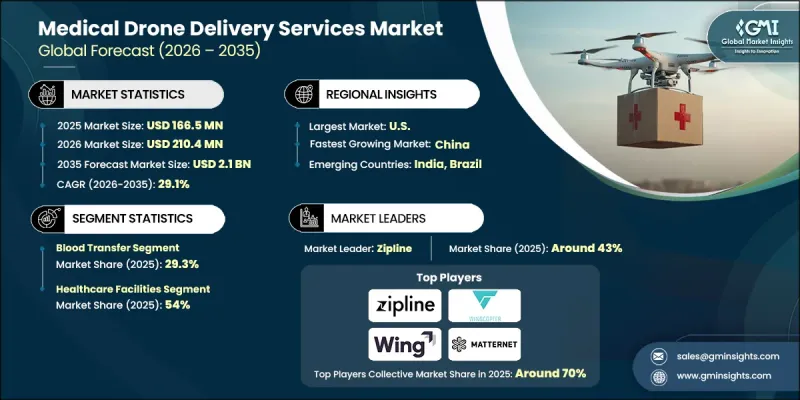
政府扶持政策、無人機系統技術的快速發展以及醫療物流領域無人機應用的日益普及,共同推動了這個市場的成長。此外,隨著醫療機構和急救部門對更快、更經濟、更可靠的供應鏈的需求不斷成長,民眾對無人機配送解決方案的接受度也不斷提高。醫療無人機能夠及時運送必需品,尤其是在偏遠和醫療資源匱乏的地區,有助於解決緊急應變、疫苗分發和特殊藥品運輸的物流難題。自主導航技術、輕量化材料、改良電池和先進推進系統的進步,提高了無人機的運作可靠性、有效載荷能力和航程,使其成為傳統運輸方式的可行替代方案。此外,政府、私人公司和全球衛生組織之間的合作正在擴大無人機的部署範圍,並進一步加速其普及應用。
| 市場範圍 | |
|---|---|
| 開始年份 | 2025 |
| 預測期 | 2026-2035 |
| 上市時的市場規模 | 1.665億美元 |
| 預計金額 | 21億美元 |
| 複合年成長率 | 29.1% |
到2025年,疫苗接種項目將佔全球市場佔有率的21.3%。無人機正擴大用於向偏遠地區運送疫苗,以滿足低溫運輸要求並減少廢棄物。該領域受益於疫情應對策略,並將繼續在全球正在進行的免疫接種宣傳活動中發揮關鍵作用。
到2025年,醫療機構領域將佔據54%的市場。無人機正在推動醫院和診所之間快速運輸檢體、血液製品、藥品和專科藥物。分散式醫療模式和中心輻射式醫院網路進一步推動了對無人機物流的需求,與傳統陸路運輸相比,無人機物流能夠提供更快、更經濟高效的解決方案。
美國醫療無人機配送服務市場預計到2025年將達到4,180萬美元。這項技術在醫院和急救醫療系統中正加速普及,尤其是在運送急救物資方面,將醫療網路內的配送時間從一個多小時縮短到幾分鐘。無人機在軍事和民用領域的應用也日益廣泛,確保了救生醫療用品的及時送達。
目錄
第1章:調查方法
- 研究途徑
- 品質改進計劃
- GMI人工智慧政策及對資料完整性的承諾
- 資訊來源一致性通訊協定
- GMI人工智慧政策及對資料完整性的承諾
- 調查過程和可靠性評分
- 研究路徑的組成部分
- 評分組成部分
- 數據收集
- 主要來源部分列表
- 資料探勘資訊來源
- 付費資訊來源
- 特定國家的資訊來源
- 付費資訊來源
- 基本估算和計算方法
- 基準年的計算
- 預測模型
- 量化市場影響分析
- 生長參數對預測的數學影響
- 量化市場影響分析
- 關於調查透明度的補充資訊
- 資訊來源歸屬框架
- 品質保證指標
- 對信任的承諾
第2章執行摘要
第3章業界考察
- 生態系分析
- 影響產業的因素
- 促進因素
- 醫療無人機在醫療產業的應用日益廣泛
- 政府主導的措施增加
- 技術進步
- 公眾接受度不斷提高的國家
- 產業潛在風險與挑戰
- 醫療無人機面臨的挑戰
- 機會
- 擴大偏遠和農村地區的醫療保健服務覆蓋範圍
- 與智慧醫療基礎設施的整合
- 促進因素
- 成長潛力分析
- 監理情勢
- 美國
- 盧安達
- 迦納
- 中國
- 瑞士
- 德國
- 日本
- 科技與創新趨勢
- 當前技術趨勢
- 新興技術
- 未來市場趨勢
- 波特的分析
- PESTEL 分析
- 差距分析
第4章 競爭情勢
- 介紹
- Zipline
- Wingcopter
- Wing(Alphabet Inc.)
- 企業矩陣分析
- 企業市佔率分析
- 主要市場公司的競爭分析
- 競爭定位矩陣
- 主要進展
- 併購
- 夥伴關係與合作
- 新產品發布
- 業務拓展計劃
第5章 市場估計與預測:依應用領域分類,2022-2035年
- 輸血
- 藥品和藥物產品的運輸
- 免疫接種計劃
- 測試檢體
- 其他用途
第6章 市場估算與預測:依最終用途分類,2022-2035年
- 醫療設施
- 血庫
- 其他最終用戶
第7章 市場估計與預測:依國家分類,2022-2035年
- 美國
- 盧安達
- 迦納
- 中國
- 瑞士
- 德國
- 日本
- 其他國家
第8章:公司簡介
- Air Taurus
- Alphabet Inc(Wing)
- Draganfly Inc
- Manna Air Delivery
- Matternet
- MightyFly
- Rigitech
- Sky Air Mobility Private Limited
- Speedbird Aero
- Valqari
- Wingcopter
- Zipline
The Global Medical Drone Delivery Services Market was valued at USD 166.5 million in 2025 and is estimated to grow at a CAGR of 29.1% to reach USD 2.1 billion by 2035.
The market growth is propelled by supportive government policies, rapid technological advancements in drone systems, and increasing integration of drones in healthcare logistics. Public acceptance of drone-based delivery solutions is also gaining momentum as healthcare providers and emergency services seek faster, cost-efficient, and reliable supply chains. Medical drones enable the timely delivery of essential supplies, particularly to remote or underserved regions, and help address logistical challenges in emergency response, vaccine distribution, and specialty medicine transport. The evolution of autonomous navigation, lightweight materials, improved batteries, and advanced propulsion systems is enhancing operational reliability, payload capacity, and range, making drones a viable alternative to traditional transport. Additionally, collaboration between governments, private companies, and global health organizations is expanding deployment, further accelerating adoption.
| Market Scope | |
|---|---|
| Start Year | 2025 |
| Forecast Year | 2026-2035 |
| Start Value | $166.5 Million |
| Forecast Value | $2.1 Billion |
| CAGR | 29.1% |
The vaccination program segment accounted for 21.3% share in 2025. Drones are increasingly used to deliver vaccines to remote areas, maintain cold chain requirements, and reduce wastage. The segment benefited from pandemic response strategies and remains crucial for ongoing immunization campaigns worldwide.
The healthcare facilities segment held 54% share in 2025. Drones are enabling rapid transport of lab samples, blood products, medications, and specialty pharmaceuticals between hospitals and clinics. Decentralized healthcare models and hub-and-spoke hospital networks further boost demand for drone-enabled logistics, offering faster and more cost-effective solutions compared to traditional ground transport.
U.S. Medical Drone Delivery Services Market was valued at USD 41.8 million in 2025. Adoption is accelerating in hospitals and emergency medical systems, particularly for critical supplies, reducing delivery times from over an hour to minutes within healthcare networks. Drones are also being implemented in military and civilian contexts to ensure the timely delivery of life-saving medical items.
Prominent players operating in the Global Medical Drone Delivery Services Market include Air Taurus, Dragonfly Inc, Wingcopter, Matternet, Manna Air Delivery, Alphabet Inc (Wing), MightyFly, Speedbird Aero, Valqari, Zipline, Rigitech, and Sky Air Mobility Private Limited. Companies in the Medical Drone Delivery Services Market are strengthening their foothold by investing in autonomous navigation systems, developing drones with greater payload capacities, and improving battery efficiency for longer flight ranges. They are forming strategic partnerships with healthcare providers, governments, and logistics platforms to expand operational networks and ensure regulatory compliance. Additionally, firms are focusing on building robust digital platforms for real-time tracking, route optimization, and delivery monitoring to enhance service reliability. Continuous R&D, participation in pilot programs, and integration into public health initiatives also help companies demonstrate efficacy and gain trust, supporting adoption and long-term market growth.
Table of Contents
Chapter 1 Research Methodology
- 1.1 Research approach
- 1.2 Quality commitments
- 1.2.1 GMI AI policy & data integrity commitment
- 1.2.1.1 Source consistency protocol
- 1.2.1 GMI AI policy & data integrity commitment
- 1.3 Research trail & confidence scoring
- 1.3.1 Research trail components
- 1.3.2 Scoring components
- 1.4 Data collection
- 1.4.1 Partial list of primary sources
- 1.5 Data mining sources
- 1.5.1 Paid sources
- 1.5.1.1 Sources, by country
- 1.5.1 Paid sources
- 1.6 Base estimates and calculations
- 1.6.1 Base year calculation
- 1.7 Forecast model
- 1.7.1 Quantified market impact analysis
- 1.7.1.1 Mathematical impact of growth parameters on forecast
- 1.7.1 Quantified market impact analysis
- 1.8 Research transparency addendum
- 1.8.1 Source attribution framework
- 1.8.2 Quality assurance metrics
- 1.8.3 Our commitment to trust
Chapter 2 Executive Summary
- 2.1 Industry 360° synopsis
- 2.2 Key market trends
- 2.2.1 Country trends
- 2.2.2 Application trends
- 2.2.3 End use trends
- 2.3 CXO perspectives: Strategic imperatives
Chapter 3 Industry Insights
- 3.1 Industry ecosystem analysis
- 3.2 Industry impact forces
- 3.2.1 Growth drivers
- 3.2.1.1 Increasing application of medical drone in the healthcare industry
- 3.2.1.2 Rising number of government initiatives
- 3.2.1.3 Technological advancements
- 3.2.1.4 Growing public acceptance countries
- 3.2.2 Industry pitfalls and challenges
- 3.2.2.1 Complications associated with medical drone
- 3.2.3 Opportunities
- 3.2.3.1 Expansion in remote and rural healthcare access
- 3.2.3.2 Integration with smart healthcare infrastructure
- 3.2.1 Growth drivers
- 3.3 Growth potential analysis
- 3.4 Regulatory landscape
- 3.4.1 U.S.
- 3.4.2 Rwanda
- 3.4.3 Ghana
- 3.4.4 China
- 3.4.5 Switzerland
- 3.4.6 Germany
- 3.4.7 Japan
- 3.5 Technology and innovation landscape
- 3.5.1 Current technological trends
- 3.5.2 Emerging technologies
- 3.6 Future market trends
- 3.7 Porter's analysis
- 3.8 PESTEL analysis
- 3.9 Gap analysis
Chapter 4 Competitive Landscape, 2025
- 4.1 Introduction
- 4.1.1 Zipline
- 4.1.2 Wingcopter
- 4.1.3 Wing (Alphabet Inc.)
- 4.2 Company matrix analysis
- 4.3 Company market share analysis
- 4.4 Competitive analysis of major market players
- 4.5 Competitive positioning matrix
- 4.6 Key developments
- 4.6.1 Mergers & acquisitions
- 4.6.2 Partnerships & collaborations
- 4.6.3 New product launches
- 4.6.4 Expansion plans
Chapter 5 Market Estimates and Forecast, By Application, 2022 - 2035 ($ Mn)
- 5.1 Key trends
- 5.2 Blood transfer
- 5.3 Drugs/pharmaceutical transfer
- 5.4 Vaccination program
- 5.5 Lab sample
- 5.6 Other applications
Chapter 6 Market Estimates and Forecast, By End Use, 2022 - 2035 ($ Mn)
- 6.1 Key trends
- 6.2 Healthcare facilities
- 6.3 Blood banks
- 6.4 Other end users
Chapter 7 Market Estimates and Forecast, By Country, 2022 - 2035 ($ Mn)
- 7.1 Key trends
- 7.2 U.S.
- 7.3 Rwanda
- 7.4 Ghana
- 7.5 China
- 7.6 Switzerland
- 7.7 Germany
- 7.8 Japan
- 7.9 Other countries
Chapter 8 Company Profiles
- 8.1 Air Taurus
- 8.2 Alphabet Inc (Wing)
- 8.3 Draganfly Inc
- 8.4 Manna Air Delivery
- 8.5 Matternet
- 8.6 MightyFly
- 8.7 Rigitech
- 8.8 Sky Air Mobility Private Limited
- 8.9 Speedbird Aero
- 8.10 Valqari
- 8.11 Wingcopter
- 8.12 Zipline

 無人機配送市場預測至2034年—按無人機類型、負載容量、配送範圍、應用、最終用戶和地區分類的全球分析無人機配送服務市場預測至2034年—全球無人機類型、服務類型、有效載荷能力、距離、應用、最終用戶和區域分析2034年物流無人機配送市場預測:按產品類型、應用、最終用戶和地區分類的全球分析
 醫療無人機配送服務:市場佔有率分析、產業趨勢與統計及成長預測(2026-2031 年)
 無人機配送服務市場規模、佔有率、成長及全球產業分析:按類型、應用和地區分類的洞察,2026-2034 年預測無人機配送和航空物流市場預測至2032年:全球解決方案、平台、航程、有效載荷能力、應用、最終用戶和區域分析
 無人機配送:全球市場佔有率和排名、總收入和需求預測(2025-2031 年)
 2025年全球醫療無人機配送服務市場報告
 垂直起降與無人機配送市場報告:2031 年趨勢、預測與競爭分析