

 |
市場調查報告書
商品編碼
2063383
零售業巨量資料分析:市佔率分析、產業趨勢與統計及成長預測(2026-2031)Big Data Analytics In Retail - Market Share Analysis, Industry Trends & Statistics, Growth Forecasts (2026 - 2031) |
||||||

※ 本網頁內容可能與最新版本有所差異。詳細情況請與我們聯繫。
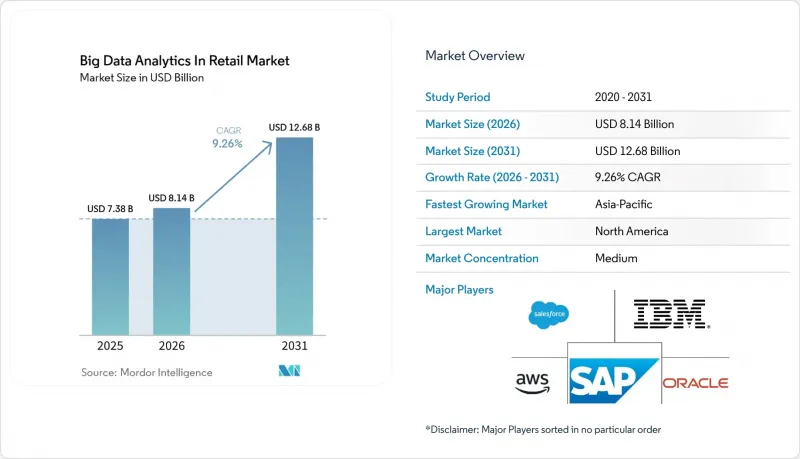
根據 Mordor Intelligence 預測,零售業巨量資料分析市場規模預計將在 2025 年達到 73.8 億美元,2026 年達到 81.4 億美元,2031 年達到 126.8 億美元,在此期間的複合年成長率為 9.26%。
本報告按應用領域(商品行銷和供應鏈分析、其他)、商業模式(中小企業、其他)、部署模式(本地部署和雲端部署)、分析類型(說明分析、其他)、元件(軟體和服務)、零售業態(電子商務商店、其他)和地區進行細分。市場預測以美元(USD)為單位。
全球巨量資料分析市場趨勢及零售業洞察
即時全通路個性化的激增
零售商正在整合串流媒體引擎,以毫秒級的速度捕捉點選流、POS機和行動應用程式事件,從而提供能夠反映消費者最新行為的優惠和建議。亞馬遜網路服務(AWS)在其2025年主題演講中強調了這項功能,認為它對於降低尖峰時段的購物車放棄率至關重要。沃爾瑪在全國4700家門市推出的一項舉措中,將信標訊號與線上歷史記錄相結合,使跨品類購物籃價值提升了12%。這種方法需要嚴格的公平性檢查,因為低估的群體可能會扭曲訓練資料。歐洲人工智慧法透過透明度義務來應對此風險。
零售媒體網路與第一方數據的整合
以購買導向為核心,將廣告顯示與購物車銷售額關聯起來的網站廣告平台預計到2025年將創造500億美元的全球整體收入。克羅格公司利用隱私保護型潔淨室中的匿名化會員數據,使其廣告客戶群成長了38%。 Snowflake和Google雲端將於2026年初正式發布其聯合推出的無塵室產品,該產品能夠在不洩露原始資料的情況下整合資料集。
傳統POS和ERP系統的細分
根據美國零售聯合會 (NRF) 2025 年的一項調查,63% 的美國連鎖店至少經營三個缺乏互通性的交易系統,這阻礙了統一客戶檔案和即時庫存管理的建立。對於大型連鎖店而言,系統更換成本通常超過 5,000 萬美元,這對客戶的投資帶來了壓力。大量擷取資料會阻礙亞秒決策,限制即時個人化和價格最佳化的益處。
細分市場分析
到2031年,詐欺偵測市場將以10.76%的複合年成長率成長,成為零售業巨量資料分析市場中成長最快的應用領域。針對全通路支付流程的帳戶盜用和合成身分攻擊正在推動對圖分析和行為生物辨識技術的投資。客戶分析將在2025年佔總營收的37.29%,但隨著客戶細分和生命週期價值(LTV)模式的成熟,其成長曲線正趨於平緩。如今,商品行銷和供應鏈團隊依靠預測引擎,根據天氣和社群媒體情緒等外部因素自動進行補貨。
營運智慧儀錶板正日益商品化,迫使供應商整合行業特定的附加元件功能,例如藥房的合規性追蹤。隨著「先買後付」和數位錢包的普及,威脅範圍不斷擴大,零售業巨量資料分析市場中用於詐欺偵測的佔有率預計將進一步成長。供應商正透過降低誤報率並保持流暢的支付體驗來脫穎而出。零售商也正在透過將詐欺洞察整合到個人化工作流程中,並對高風險用戶進行額外檢驗,來平衡安全性和客戶體驗。
預計中小企業將透過利用計量收費的雲端平台(這些平台整合了倉庫管理、機器學習和視覺化功能)實現9.61%的複合年成長率。大型企業憑藉多年期供應商合約和更充足的人才預算,將在2025年佔據63.24%的支出佔有率。自動化機器學習(AutoML)功能和預置連接器使本地雜貨店無需內部資料工程師即可採用先進工具,而進階分析功能也正日益普及。
大型連鎖企業仍在努力爭取大幅的批量折扣,但其複雜的組織結構阻礙了全公司範圍內的部署。可組合式商務模式正在擴大零售市場(尤其是中小企業)的巨量資料分析規模,它允許中小企業整合最佳組合模組,而無需徹底改造整個技術堆疊。雲端服務供應商正透過可擴展的入門計畫吸引這些零售商,使他們能夠在零資本風險的情況下進行實驗。人才短缺仍然是一個限制因素,但託管服務和指導式學習手冊正在彌合技能差距。
區域分析
北美地區預計在2025年將佔總營收的47.62%,這得益於客戶資料平台的早期應用以及密集的分析供應商生態系統。該地區目前正朝著分階段最佳化的方向發展,零售商在現有投資的基礎上,不斷增加無塵室和可解釋人工智慧的投入。亞太地區預計將以11.01%的複合年成長率實現最高成長,這主要得益於中國社交電商巨頭和印度統一支付介面(UPI)的推動。 UPI在2025年12月處理了116億筆交易,並為其分析流程產生了詳細的行為數據。
在中國,閉合迴路歸因成為可能,因為支付寶和微信將支付、社交互動和會員忠誠度整合到一個統一的生態系統中。這是西方市場難以複製的優點。在日本和韓國,無人商店的運作正在推進,這增加了對邊緣推理和電腦視覺的需求。澳洲正在擴大資料共用法規,以促進零售交易資料的可攜性,類似於開放銀行模式,這很可能為其他地區樹立先例。
儘管歐洲因嚴格的資料保護法規而增速放緩,但它在聯邦學習試點計畫中發揮主導作用。聯邦學習無需移動原始資料即可在分散式節點上訓練模型。隨著旅遊業的復甦,中東的高階零售商和大賣場正在部署高利潤的個人化引擎;而非洲新興的電子商務則依賴輕量級、行動優先的分析技術,這些技術專為間歇性網路連接而設計。在南美洲,由於宏觀經濟波動和雲端基礎設施的不均衡,成長正在放緩,但巴西的主要連鎖店正在測試能夠調整外匯波動和進口關稅的模型。
其他好處
- Excel格式的市場預測(ME)表
- 3個月的分析師支持
目錄
第1章:引言
- 研究假設和市場定義
- 調查範圍
第2章:調查方法
第3章執行摘要
第4章 市場狀況
- 市場概覽
- 市場促進因素
- 即時全通路個性化的激增
- 無頭商務架構的興起
- 零售媒體網路與第一方數據的整合
- 擴展店內物聯網的邊緣分析
- 人工智慧驅動的價格最佳化引擎的廣泛應用
- 客戶資料平台(CDP)在零售業的普及
- 市場限制因素
- 傳統POS和ERP系統的細分
- 注重隱私的瀏覽器和作業系統限制
- 零售業資料科學人才短缺
- 雲端出站通訊成本和資料傳輸成本飆升
- 產業價值/價值鏈分析
- 宏觀經濟因素對市場的影響
- 監理情勢
- 技術展望
- 波特五力分析
第5章 市場規模與成長預測
- 透過使用
- 商品行銷與供應鏈分析
- 社群媒體分析
- 客戶分析
- 作戰情報
- 價格最佳化
- 詐欺偵測
- 其他用途和應用
- 依業務類型
- 小型企業
- 大公司
- 按實現類型
- 現場
- 雲
- 按分析類型
- 說明分析
- 診斷分析
- 預測分析
- 指示性分析
- 按組件
- 軟體
- 服務
- 按零售業態
- 電子商務商店
- 實體店面
- 全通路零售商
- D2C品牌
- 按地區
- 北美洲
- 美國
- 加拿大
- 墨西哥
- 歐洲
- 英國
- 德國
- 法國
- 義大利
- 其他歐洲國家
- 亞太地區
- 中國
- 日本
- 印度
- 韓國
- 其他亞太國家
- 中東
- 以色列
- 沙烏地阿拉伯
- 阿拉伯聯合大公國
- 土耳其
- 其他中東國家
- 非洲
- 南非
- 埃及
- 其他非洲國家
- 南美洲
- 巴西
- 阿根廷
- 南美洲其他地區
- 北美洲
第6章 競爭情勢
- 市場集中度
- 策略趨勢
- 市佔率分析
- 公司簡介
- SAP SE
- International Business Machines Corporation
- Oracle Corporation
- Salesforce, Inc.
- Amazon Web Services, Inc.
- Adobe Inc.
- Microsoft Corporation
- Google LLC
- QlikTech International AB
- Zoho Corporation Pvt. Ltd.
- Alteryx, Inc.
- RetailNext Inc.
- MicroStrategy Incorporated
- Hitachi Vantara LLC
- Fuzzy Logix, Inc.
- Teradata Corporation
- Cloudera, Inc.
- Informatica LLC
- Splunk Inc.
- Databricks, Inc.
- Snowflake Inc.
- SAS Institute Inc.
- dunnhumby Ltd.
第7章 市場機會與未來展望
According to Mordor Intelligence, the big data analytics in retail market size is projected to be USD 7.38 billion in 2025, USD 8.14 billion in 2026, and reach USD 12.68 billion by 2031, advancing at a 9.26% CAGR across the period.
This report is Segmented by Application (Merchandising and Supply Chain Analytics, and More), Business Type (Small and Medium Enterprises, and More), Deployment Mode (On-Premise, and Cloud), Analytics Type (Descriptive Analytics, and More), Component (Software, and Services), Retail Format (E-Commerce Stores, and More), and Geography. The Market Forecasts are Provided in Terms of Value (USD).
Global Big Data Analytics In Retail Market Trends and Insights
Surge in Real-Time Omni-Channel Personalisation
Retailers have embedded streaming engines that ingest clickstream, point-of-sale, and mobile-app events within milliseconds, allowing offers and recommendations that mirror a shopper's most recent action. Amazon Web Services spotlighted this capability in its 2025 keynote as critical for reducing cart abandonment during seasonal peaks. Walmart's rollout across 4,700 United States stores combined beacon signals and online histories to boost cross-category basket value by 12%. The approach requires rigorous fairness checks because under-represented cohorts can skew training data, a risk the European Artificial Intelligence Act addresses through transparency mandates.
Integration of Retail Media Networks with First-Party Data
On-site advertising platforms generated USD 50 billion global revenue in 2025, fueled by purchase-based targeting that links impressions to in-basket sales. Kroger grew its advertiser base 38% by activating anonymized loyalty data inside privacy-preserving clean rooms. Snowflake and Google Cloud formalized joint clean-room products in early 2026, enabling cross-dataset joins without exposing raw records.
Fragmentation of Legacy POS and ERP Stacks
A 2025 National Retail Federation survey showed 63% of United States chains operate at least three transaction systems lacking interoperability, delaying unified customer profiles and real-time inventory. Replacement costs often exceed USD 50 million for large chains, crowding out customer-facing investments. Batch extracts inhibit sub-second decisioning, limiting benefits from real-time personalization and price optimization.
Other drivers and restraints analyzed in the detailed report include:
- Expansion of Edge Analytics for In-Store IoT
- Growing Adoption of AI-Powered Price Optimisation Engines
- Privacy-Centric Browser and OS Restrictions
For complete list of drivers and restraints, kindly check the Table Of Contents.
Segment Analysis
Fraud Detection is growing at a 10.76% CAGR through 2031, making it the fastest-moving application within the big data analytics in retail market. Account-takeover and synthetic identity attacks targeting omnichannel payment flows are driving investment in graph-analysis and behavioral biometrics. Customer Analytics still delivered 37.29% of 2025 revenue, but its trajectory is flattening as segmentation and lifetime-value models mature. Merchandising and supply-chain teams now rely on prescriptive engines that automate replenishment based on external factors such as weather and social sentiment.
Operational intelligence dashboards have become commoditized, pressuring vendors to embed vertical add-ons like pharmacy compliance tracking. The big data analytics in retail market size attributed to Fraud Detection is expected to widen as buy-now-pay-later and digital wallets expand the threat surface. Vendors are differentiating through low-false-positive models that preserve frictionless checkout. Retailers also integrate fraud insights into personalization workflows so high-risk profiles trigger additional verification, balancing security with customer experience.
Small and Medium Enterprises are set to expand revenue at 9.61% CAGR, leveraging usage-based cloud platforms that bundle warehousing, machine learning, and visualization. Large Enterprises controlled 63.24% of 2025 spending, anchored by multi-year vendor contracts and larger staffing budgets. AutoML features and pre-built connectors let regional grocers deploy advanced tools without in-house data engineers, democratizing sophisticated analytics capabilities.
Large chains still negotiate deep volume discounts, yet their complex organizations slow company-wide rollouts. The big data analytics in retail market size flowing from SMEs is rising as composable commerce lets them plug in best-of-breed modules instead of overhauling entire stacks. Cloud providers lure these retailers with starter tiers that scale elastically, allowing experimentation without capital risk. Talent shortages remain a constraint, though managed services and guided notebooks mitigate the skills gap.
Geography Analysis
North America supplied 47.62% of 2025 revenue, supported by early adoption of customer data platforms and a dense ecosystem of analytics vendors. The region is now shifting toward incremental optimization, with retailers layering clean rooms and explainable AI atop existing investments. Asia-Pacific is forecast to record the highest 11.01% CAGR, propelled by China's social-commerce giants and India's Unified Payments Interface, which processed 11.6 billion transactions in December 2025, producing granular behavioral data for analytics pipelines.
In China, closed-loop attribution is feasible because Alipay and WeChat integrate payments, social engagement, and loyalty in a single ecosystem, an advantage Western markets struggle to replicate. Japan and South Korea are piloting cashierless stores, boosting demand for edge inference and computer vision. Australia is expanding data-sharing regulations that encourage open banking-style portability for retail transaction data, setting a precedent for other jurisdictions.
Europe faces slower growth owing to stringent data-protection rules, yet it plays a lead role in federated learning trials that train models across decentralized nodes without moving raw data. Middle East luxury retailers and hypermarkets are adopting high-margin personalization engines as tourism rebounds, while Africa's nascent e-commerce relies on lightweight, mobile-first analytics designed for intermittent connectivity. South America's expansion is tempered by macroeconomic volatility and cloud-infrastructure gaps, though Brazil's leading chains are piloting models that adjust for currency swings and import tariffs.
- SAP SE
- International Business Machines Corporation
- Oracle Corporation
- Salesforce, Inc.
- Amazon Web Services, Inc.
- Adobe Inc.
- Microsoft Corporation
- Google LLC
- QlikTech International AB
- Zoho Corporation Pvt. Ltd.
- Alteryx, Inc.
- RetailNext Inc.
- MicroStrategy Incorporated
- Hitachi Vantara LLC
- Fuzzy Logix, Inc.
- Teradata Corporation
- Cloudera, Inc.
- Informatica LLC
- Splunk Inc.
- Databricks, Inc.
- Snowflake Inc.
- SAS Institute Inc.
- dunnhumby Ltd.
Additional Benefits:
- The market estimate (ME) sheet in Excel format
- 3 months of analyst support
TABLE OF CONTENTS
1 INTRODUCTION
- 1.1 Study Assumptions and Market Definition
- 1.2 Scope of the Study
2 RESEARCH METHODOLOGY
3 EXECUTIVE SUMMARY
4 MARKET LANDSCAPE
- 4.1 Market Overview
- 4.2 Market Drivers
- 4.2.1 Surge in Real-Time Omni-Channel Personalisation
- 4.2.2 Rise of Headless Commerce Architectures
- 4.2.3 Integration of Retail Media Networks with First-Party Data
- 4.2.4 Expansion of Edge Analytics for In-Store IoT
- 4.2.5 Growing Adoption of AI-Powered Price Optimisation Engines
- 4.2.6 Mainstreaming of Customer Data Platforms (CDPs) in Retail
- 4.3 Market Restraints
- 4.3.1 Fragmentation of Legacy POS and ERP Stacks
- 4.3.2 Privacy-Centric Browser and OS Restrictions
- 4.3.3 Shortage of Retail Data Science Talent
- 4.3.4 Escalating Cloud Egress and Data Movement Costs
- 4.4 Industry Value / Supply-Chain Analysis
- 4.5 Impact of Macroeconomic Factors on the Market
- 4.6 Regulatory Landscape
- 4.7 Technological Outlook
- 4.8 Porter's Five Forces Analysis
- 4.8.1 Threat of New Entrants
- 4.8.2 Bargaining Power of Buyers
- 4.8.3 Bargaining Power of Suppliers
- 4.8.4 Threat of Substitute Products
- 4.8.5 Intensity of Competitive Rivalry
5 MARKET SIZE AND GROWTH FORECASTS (VALUE)
- 5.1 By Application
- 5.1.1 Merchandising and Supply Chain Analytics
- 5.1.2 Social Media Analytics
- 5.1.3 Customer Analytics
- 5.1.4 Operational Intelligence
- 5.1.5 Pricing Optimisation
- 5.1.6 Fraud Detection
- 5.1.7 Other Applications, Application
- 5.2 By Business Type
- 5.2.1 Small and Medium Enterprises
- 5.2.2 Large Enterprises
- 5.3 By Deployment Mode
- 5.3.1 On-Premise
- 5.3.2 Cloud
- 5.4 By Analytics Type
- 5.4.1 Descriptive Analytics
- 5.4.2 Diagnostic Analytics
- 5.4.3 Predictive Analytics
- 5.4.4 Prescriptive Analytics
- 5.5 By Component
- 5.5.1 Software
- 5.5.2 Services
- 5.6 By Retail Format
- 5.6.1 E-Commerce Stores
- 5.6.2 Brick-and-Mortar Stores
- 5.6.3 Omnichannel Retailers
- 5.6.4 Direct-to-Consumer Brands
- 5.7 By Geography
- 5.7.1 North America
- 5.7.1.1 United States
- 5.7.1.2 Canada
- 5.7.1.3 Mexico
- 5.7.2 Europe
- 5.7.2.1 United Kingdom
- 5.7.2.2 Germany
- 5.7.2.3 France
- 5.7.2.4 Italy
- 5.7.2.5 Rest of Europe
- 5.7.3 Asia-Pacific
- 5.7.3.1 China
- 5.7.3.2 Japan
- 5.7.3.3 India
- 5.7.3.4 South Korea
- 5.7.3.5 Rest of Asia-Pacific
- 5.7.4 Middle East
- 5.7.4.1 Israel
- 5.7.4.2 Saudi Arabia
- 5.7.4.3 United Arab Emirates
- 5.7.4.4 Turkey
- 5.7.4.5 Rest of Middle East
- 5.7.5 Africa
- 5.7.5.1 South Africa
- 5.7.5.2 Egypt
- 5.7.5.3 Rest of Africa
- 5.7.6 South America
- 5.7.6.1 Brazil
- 5.7.6.2 Argentina
- 5.7.6.3 Rest of South America
- 5.7.1 North America
6 COMPETITIVE LANDSCAPE
- 6.1 Market Concentration
- 6.2 Strategic Moves
- 6.3 Market Share Analysis
- 6.4 Company Profiles (includes Global Level Overview, Market Level Overview, Core Segments, Financials as available, Strategic Information, Market Rank/Share, Products and Services, Recent Developments)
- 6.4.1 SAP SE
- 6.4.2 International Business Machines Corporation
- 6.4.3 Oracle Corporation
- 6.4.4 Salesforce, Inc.
- 6.4.5 Amazon Web Services, Inc.
- 6.4.6 Adobe Inc.
- 6.4.7 Microsoft Corporation
- 6.4.8 Google LLC
- 6.4.9 QlikTech International AB
- 6.4.10 Zoho Corporation Pvt. Ltd.
- 6.4.11 Alteryx, Inc.
- 6.4.12 RetailNext Inc.
- 6.4.13 MicroStrategy Incorporated
- 6.4.14 Hitachi Vantara LLC
- 6.4.15 Fuzzy Logix, Inc.
- 6.4.16 Teradata Corporation
- 6.4.17 Cloudera, Inc.
- 6.4.18 Informatica LLC
- 6.4.19 Splunk Inc.
- 6.4.20 Databricks, Inc.
- 6.4.21 Snowflake Inc.
- 6.4.22 SAS Institute Inc.
- 6.4.23 dunnhumby Ltd.
7 MARKET OPPORTUNITIES AND FUTURE OUTLOOK
- 7.1 White-Space and Unmet-Need Assessment

 通訊巨量資料分析市場預測至2034年-全球分析(按組件、分析類型、部署模型、資料類型、應用、最終使用者和地區分類)
 每機架PB級:AI流量正在重塑網路—OFC 2026揭示網路架構、測量差距和供應鏈風險。流處理平台市場預測至2034年-按組件、部署類型、組織規模、最終用戶和地區分類的全球分析
 2026年全球建築業巨量資料分析市場報告超大規模市場追蹤(2025年第四季):2025年資本支出成長65%,超過5,000億美元2026年全球農業衛星資訊服務市場報告
 巨量資料分析市場:按組件、分析類型、資料類型、部署模型、應用、企業規模和產業分類-2026-2032年全球市場預測
 巨量資料分析市場規模、佔有率、成長率及全球產業分析(按類型、應用和地區分類):2026-2034 年預測2026年國防與航太領域巨量資料分析全球市場報告航太巨量資料分析市場預測至2034年-按組件、部署模式、資料類型、應用、最終用戶和地區分類的全球分析