


 |
市場調查報告書
商品編碼
2063349
太陽能灌溉系統:市場佔有率分析、行業趨勢和統計數據以及成長預測(2026-2031 年)Solar Powered Irrigation System - Market Share Analysis, Industry Trends & Statistics, Growth Forecasts (2026 - 2031) |
||||||

※ 本網頁內容可能與最新版本有所差異。詳細情況請與我們聯繫。
據 Mordor Intelligence 稱,2025 年太陽能灌溉系統市場價值 550 億美元,預計將從 2026 年的 616 億美元成長到 2031 年的 1175.8 億美元,在預測期(2026-2031 年)內複合年成長率為 13.5%。
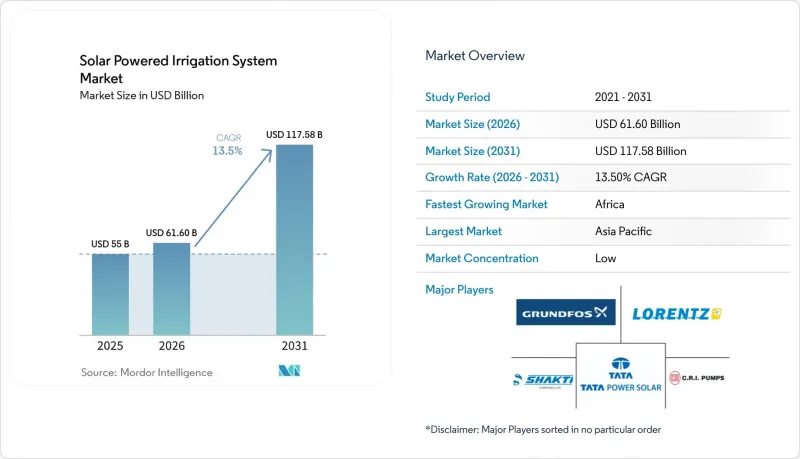
本報告按產品類型(潛水泵、地面泵及其他)、灌溉系統(滴灌及其他)、輸出功率(3馬力及以下及其他)、組件(太陽能板、水泵及其他)、最終用戶(小規模農戶、商業農場及其他)和地區(北美、歐洲、亞太及其他)進行細分。市場預測以美元計價。
全球太陽能灌溉系統市場趨勢及洞察
光學模組價格下降和效率提高
光學模組價格的下降和效率的持續提升,使得太陽能灌溉系統更具成本效益。組件成本的降低減少了初始投資,而效率的提高則提高了單位面積的能量輸出,從而可以縮小系統體積並簡化安裝。這些進步對於成本敏感度較高的離網農業地區尤其有利。例如,由於全球供應過剩和生產規模的擴大,預計到2024年,晶體矽太陽能組件的價格將降至每瓦0.11美元左右,這將使太陽能灌溉系統更容易被農民所接受。
政府補貼和獎勵計劃
政府的支持措施透過緩解農民面臨的經濟挑戰,顯著促進了太陽能灌溉系統的普及。這些措施包括資本補貼、優惠貸款和績效獎勵,使這些系統價格更加親民,並促進了其推廣應用,尤其是在農村和偏遠地區。這些措施正在刺激投資,並推動小規模農戶和商業農業部門的大規模採用。例如,印度的「總理庫蘇姆計畫」(PM-KUSUM)已批准到2025年投入3,442.2億印度盧比(約37.1億美元)的預算,用於支持農業領域採用太陽能水泵和分散式可再生能源解決方案。
高昂的初始投資成本
高昂的初始投資仍然是推廣太陽能灌溉系統的主要障礙,尤其對於資金籌措有限的小規模農戶而言更是如此。儘管太陽能灌溉系統在燃料和電力方面具有長期節省的潛力,但其水泵、安裝及相關基礎設施的成本構成了成本效益挑戰。在開發中國家的農業收入相對較低,融資管道也有限。太陽能灌溉幫浦系統的成本因容量和配置而異,但通常在2000美元到10000美元之間。
細分市場分析
截至2025年,潛水泵浦將繼續保持領先地位,在太陽能灌溉系統中佔據54%的市場佔有率。其主導地位源自於其適用於深井應用,以及在亞洲和非洲等依賴地下水的地區可靠的性能。這些水泵即使在水下也能有效運作,確保了耐用性,減少了維護,並能提供穩定的水源以滿足灌溉需求。地下水開採量的增加和地下水位的下降進一步推動了市場需求,使得潛水泵系統成為全球小規模農戶和商業農業環境中可靠灌溉基礎設施的必備之選。
預計2026年至2031年間,浮體式水泵市場將以19.3%的複合年成長率(CAGR)高速成長。這一成長主要得益於水產養殖場、水庫以及其他土地資源受限、難以安裝傳統設備的場所對浮式水泵的日益普及。浮體式系統能夠減少蒸發損失,提高效率和土地利用率,並可與浮體式太陽能板搭配使用。預計對水利農業投資的增加以及可再生能源的整合將加速浮式水泵的普及,尤其是在東南亞、中東和非洲其他地區,這些地區地表水資源豐富,灌溉需求不斷成長。
至2025年,滴灌將佔太陽能灌溉系統市場佔有率的42.5%。其普及得益於滴灌能夠精準、直接地向植物根部供水,從而最大限度地減少水分損失並提高作物產量。這些系統在低壓下運作,降低了能耗,並提高了與太陽能發電裝置的兼容性。日益嚴重的水資源短缺以及對更高效灌溉方式日益嚴格的法規要求,進一步加速了滴灌在全部區域的普及。在面臨地下水枯竭和用水法規嚴格限制的地區,這一趨勢尤其顯著。
預計2026年至2031年間,滴灌市場將以18.7%的複合年成長率成長,成為該市場中成長最快的領域。這一成長主要得益於持續的技術創新,包括自動流量控制、感測器整合和智慧灌溉調度。這些創新提高了用水效率,減少了勞動力需求,使滴灌系統對小規模農戶和商業農場都極具吸引力。人們對永續農業實踐的日益關注以及政府對微灌技術推廣的獎勵不斷增加,預計將持續推動全球對太陽能灌溉應用領域滴灌解決方案的強勁需求。
區域分析
預計到2025年,亞太地區將佔據全球太陽能灌溉系統45.1%的市場佔有率。這一主導歸功於強而有力的政府扶持政策、不斷成長的農業需求,以及印度和中國等國家對太陽能灌溉系統的快速普及。產能的提升和有利的政策環境正在提高該地區太陽能灌溉系統的可負擔性和普及性。同時,在非洲,能源成本的上漲、投資的增加以及農業密集型經濟體對可靠灌溉解決方案日益成長的需求,正在加速太陽能灌溉系統的普及。
預計2026年至2031年間,非洲市場將以17.9%的複合年成長率(CAGR)實現最高成長。在亞太地區,對可再生能源灌溉基礎設施的持續投資以及先進灌溉技術的整合正在推動市場成長。非洲的快速擴張得益於「按需付費」等創新資金籌措模式以及離網地區太陽能解決方案的日益普及。此外,柴油燃料成本的上漲和電網接入的限制正在加速以農業為主的開發中國家向太陽能灌溉系統的轉型。
區域成長趨勢受政策支持、能源成本壓力以及農業經濟體中永續灌溉技術日益普及的驅動。亞太地區受益於健全的製度架構和先進的製造業能力,而非洲則憑藉著資金籌措管道的改善和可再生能源解決方案的普及,正在崛起成為重要的成長中心。肯亞國家灌溉部門投資計畫(NSIP)的灌溉策略將在未來十年投資5,980億肯亞先令(約46億美元)用於擴大灌溉基礎設施。這項資金籌措舉措旨在改善農民的灌溉條件,並促進太陽能灌溉解決方案的採用。
其他好處
- Excel格式的市場預測(ME)表
- 3個月的分析師支持
目錄
第1章:引言
- 研究假設和市場定義
- 調查範圍
第2章:調查方法
第3章執行摘要
第4章 市場狀況
- 市場概覽
- 市場促進因素
- 光學模組價格下降和效率提高
- 政府補貼和激勵措施
- 柴油燃料成本和電力價格上漲
- Agribolteik公司引進了土地雙重用途模式
- 採用「按需付費」模式進行設備租賃,並利用碳權收入。
- 人工智慧驅動的泵浦選型和最佳化工具
- 市場限制因素
- 高初始投資
- 太陽能發電的不穩定性以及儲能的必要性
- 假冒偽劣的低效率太陽能板正在削弱農民的信心。
- 物聯網幫浦控制器之間缺乏互通性
- 監理情勢
- 技術展望
- 波特五力分析
第5章 市場規模與成長預測
- 依產品類型
- 潛水泵
- 地面泵浦
- 浮球泵
- 透過灌溉系統
- 滴灌
- 噴水灌溉
- 中心樞軸和橫向移動
- 按類型分類的額定輸出
- 3馬力或以下
- 3.1~10HP
- 10馬力或以上
- 按組件
- 太陽能板
- 泵浦
- 控制器
- 逆變器
- 最終用戶
- 小規模農戶
- 商業農場
- 溫室
- 牲畜飲水
- 按地區
- 北美洲
- 美國
- 加拿大
- 墨西哥
- 其他北美國家
- 南美洲
- 巴西
- 阿根廷
- 其他南美國家
- 歐洲
- 德國
- 法國
- 英國
- 俄羅斯
- 其他歐洲國家
- 亞太地區
- 中國
- 印度
- 日本
- 澳洲
- 其他亞太國家
- 中東
- 沙烏地阿拉伯
- 阿拉伯聯合大公國
- 其他中東國家
- 非洲
- 南非
- 肯亞
- 其他非洲地區
- 北美洲
第6章 競爭情勢
- 市場集中度
- 策略趨勢
- 市佔率分析
- 公司簡介
- Grundfos Holding A/S
- Franklin Electric Co., Inc.
- LORENTZ GmbH
- Tata Power Solar Systems Limited
- Shakti Pumps (India) Limited
- CRI Pumps Private Limited
- Jain Irrigation Systems Limited
- Bright Solar Limited
- JNTech Renewable Energy Co., Ltd.
- Ecozen Solutions Private Limited
- Novergy Energy Solutions Private Limited
- Valmont Industries, Inc.
- Lubi Industries LLP
- American West Windmill & Solar Company, LLC
第7章 市場機會與未來展望
According to Mordor Intelligence, the solar-powered irrigation system market was valued at USD 55.00 billion in 2025 and is projected to grow from USD 61.60 billion in 2026 to USD 117.58 billion by 2031, registering a CAGR of 13.5% during the forecast period (2026-2031).
This report is Segmented by Product Type (Submersible Pumps, Surface Pumps, and More), Irrigation System (Drip Irrigation, and More), Power Rating (Up To 3 HP, and More), Component (Solar Panels, Pumps, and More), End-User (Smallholder Farms, Commercial Farms, and More), and Geography (North America, Europe, Asia-Pacific, and More). The Market Forecasts are Provided in Terms of Value (USD).
Global Solar Powered Irrigation System Market Trends and Insights
Declining Photovoltaic Module Prices and Rising Efficiency
Declining photovoltaic module prices and ongoing advancements in efficiency are improving the cost-effectiveness of solar-powered irrigation systems. Reduced module costs lower the initial capital investment, while enhanced efficiency boosts energy output per unit area, reducing system size and simplifying installation. These advancements are particularly beneficial in off-grid agricultural areas with high cost sensitivity. For example, crystalline silicon solar module prices were approximately USD 0.11 per watt in 2024, driven by global oversupply and increased manufacturing scale, making solar irrigation systems more accessible to farmers .
Government Subsidies and Incentive Programs
Government support mechanisms are significantly contributing to the adoption of solar-powered irrigation systems by alleviating the financial challenges farmers face. These initiatives include capital subsidies, concessional financing, and performance-linked incentives, collectively improving affordability and facilitating deployment, especially in rural and off-grid areas. Such policies boost investment confidence and promote large-scale adoption among both smallholder and commercial farming sectors. For instance, India's PM-KUSUM scheme has an approved budget of INR 34,422 crore (USD 3.71 billion) in 2025 to support the installation of solar pumps and decentralized renewable energy solutions in agriculture .
High Up-Front Capital Expenditure
High initial investment continues to be a significant barrier to the adoption of solar-powered irrigation systems, especially for smallholder farmers with limited access to financing. The expenses associated with solar pumps, installation, and related infrastructure pose affordability challenges, despite the potential for long-term savings on fuel and electricity. This issue is particularly evident in developing agricultural economies, where farm incomes are relatively low, and access to credit is constrained. Solar irrigation pump systems typically range in cost from USD 2,000 to USD 10,000, depending on their capacity and configuration.
Other drivers and restraints analyzed in the detailed report include:
- Escalating Diesel and Grid-Electricity Costs
- Agrivoltaic Dual-Land-Use Adoption
- Solar-Resource Intermittency and Need for Storage
For complete list of drivers and restraints, kindly check the Table Of Contents.
Segment Analysis
Submersible pumps led with the largest 54% of the solar powered irrigation system market share in 2025. Their dominance is driven by strong suitability for deep borewell applications and consistent performance in groundwater-dependent regions across Asia and Africa. These pumps operate efficiently under submerged conditions, ensuring durability, reduced maintenance, and stable water output for irrigation needs. Increasing groundwater extraction and declining water tables further reinforce demand, making submersible systems essential for reliable irrigation infrastructure in both smallholder and commercial farming environments globally.
The floating pumps market size is projected to expand at the fastest 19.3% CAGR from 2026 to 2031. Growth is driven by rising adoption in aquaculture, reservoirs, and water bodies where land constraints limit traditional installations. Floating systems reduce evaporation losses and enable dual use with floating solar panels, improving efficiency and land utilization. Increasing investments in water-based agriculture and renewable energy integration are projected to accelerate adoption, particularly in Southeast Asia and other regions with abundant surface water resources and expanding irrigation requirements.
Drip irrigation captured the largest 42.5% of the solar powered irrigation system market share in 2025. Adoption is driven by its ability to deliver precise water supply directly to plant roots, minimizing losses and improving crop productivity. These systems operate at lower pressure, reducing energy consumption and enhancing compatibility with solar-powered setups. Increasing water scarcity and regulatory mandates for efficient irrigation practices are further strengthening adoption across agricultural regions, particularly in areas facing groundwater depletion and stringent water-use regulations.
The drip irrigation market size is anticipated to advance at the fastest 18.7% CAGR from 2026 to 2031. Growth is supported by continuous technological advancements, including automated flow control, sensor integration, and smart irrigation scheduling. These innovations improve water-use efficiency and reduce labor requirements, making drip systems attractive for both smallholder and commercial farms. Expanding awareness regarding sustainable farming practices and increasing government incentives for micro-irrigation adoption are projected to sustain strong demand for drip irrigation solutions in solar-powered irrigation applications globally.
Geography Analysis
Asia-Pacific is projected to account for the largest 45.1% of the solar-powered irrigation system market share in 2025. This dominance is attributed to robust government programs, increasing agricultural demand, and the rapid deployment of solar irrigation systems in countries like India and China. Expanding manufacturing capacities and favorable policy frameworks are enhancing affordability and accessibility in the region. Meanwhile, Africa is experiencing accelerated adoption due to rising energy costs, increased investments, and the growing need for reliable irrigation solutions in agriculture-dependent economies.
Africa's market size is projected to grow at the fastest CAGR of 17.9% from 2026 to 2031. In the Asia-Pacific, growth is driven by sustained investments in renewable irrigation infrastructure and the integration of advanced irrigation technologies. Africa's rapid expansion is supported by innovative financing models, such as pay-as-you-grow, and the increasing adoption of solar solutions in off-grid regions. Additionally, rising diesel costs and limited grid access are accelerating the transition to solar-powered irrigation systems in developing agricultural economies.
Regional growth dynamics are influenced by policy support, energy cost pressures, and the increasing adoption of sustainable irrigation technologies in agricultural economies. Asia-Pacific benefits from strong institutional frameworks and advanced manufacturing capabilities, while Africa is emerging as a key growth hub due to improved access to financing and renewable energy solutions. Kenya's National Irrigation Sector Investment Plan (NSIP) irrigation strategy involves an investment of Sh598 billion (USD 4.6 billion) over a 10-year period to expand irrigation infrastructure . This funding initiative aims to enhance farmer accessibility and expedite the adoption of solar irrigation solutions.
- Grundfos Holding A/S
- Franklin Electric Co., Inc.
- LORENTZ GmbH
- Tata Power Solar Systems Limited
- Shakti Pumps (India) Limited
- C.R.I. Pumps Private Limited
- Jain Irrigation Systems Limited
- Bright Solar Limited
- JNTech Renewable Energy Co., Ltd.
- Ecozen Solutions Private Limited
- Novergy Energy Solutions Private Limited
- Valmont Industries, Inc.
- Lubi Industries LLP
- American West Windmill & Solar Company, LLC
Additional Benefits:
- The market estimate (ME) sheet in Excel format
- 3 months of analyst support
TABLE OF CONTENTS
1 Introduction
- 1.1 Study Assumptions and Market Definition
- 1.2 Scope of the Study
2 Research Methodology
3 Executive Summary
4 Market Landscape
- 4.1 Market Overview
- 4.2 Market Drivers
- 4.2.1 Declining photovoltaic module prices and rising efficiency
- 4.2.2 Government subsidies and incentive programs
- 4.2.3 Escalating diesel and grid-electricity costs
- 4.2.4 Agrivoltaic dual-land-use adoption
- 4.2.5 Pay-as-you-grow equipment leasing via carbon-credit revenues
- 4.2.6 AI-driven pump-sizing optimization tools
- 4.3 Market Restraints
- 4.3.1 High up-front capital expenditure
- 4.3.2 Solar-resource intermittency and need for storage
- 4.3.3 Counterfeit low-efficiency panels eroding farmer trust
- 4.3.4 Lack of interoperability among IoT pump controllers
- 4.4 Regulatory Landscape
- 4.5 Technological Outlook
- 4.6 Porter's Five Forces Analysis
- 4.6.1 Threat of New Entrants
- 4.6.2 Bargaining Power of Suppliers
- 4.6.3 Bargaining Power of Buyers
- 4.6.4 Threat of Substitutes
- 4.6.5 Intensity of Competitive Rivalry
5 Market Size and Growth Forecasts (Value)
- 5.1 By Product Type
- 5.1.1 Submersible Pumps
- 5.1.2 Surface Pumps
- 5.1.3 Floating Pumps
- 5.2 By Irrigation System
- 5.2.1 Drip Irrigation
- 5.2.2 Sprinkler Irrigation
- 5.2.3 Center Pivot and Lateral-Move
- 5.3 By Power Rating (HP)
- 5.3.1 Up to 3 HP
- 5.3.2 3.1 to 10 HP
- 5.3.3 Above 10 HP
- 5.4 By Component
- 5.4.1 Solar Panels
- 5.4.2 Pumps
- 5.4.3 Controllers
- 5.4.4 Inverters
- 5.5 By End-user
- 5.5.1 Smallholder Farms
- 5.5.2 Commercial Farms
- 5.5.3 Greenhouses
- 5.5.4 Livestock Watering
- 5.6 By Geography
- 5.6.1 North America
- 5.6.1.1 United States
- 5.6.1.2 Canada
- 5.6.1.3 Mexico
- 5.6.1.4 Rest of North America
- 5.6.2 South America
- 5.6.2.1 Brazil
- 5.6.2.2 Argentina
- 5.6.2.3 Rest of South America
- 5.6.3 Europe
- 5.6.3.1 Germany
- 5.6.3.2 France
- 5.6.3.3 United Kingdom
- 5.6.3.4 Russia
- 5.6.3.5 Rest of Europe
- 5.6.4 Asia-Pacific
- 5.6.4.1 China
- 5.6.4.2 India
- 5.6.4.3 Japan
- 5.6.4.4 Australia
- 5.6.4.5 Rest of Asia-Pacific
- 5.6.5 Middle East
- 5.6.5.1 Saudi Arabia
- 5.6.5.2 United Arab Emirates
- 5.6.5.3 Rest of Middle East
- 5.6.6 Africa
- 5.6.6.1 South Africa
- 5.6.6.2 Kenya
- 5.6.6.3 Rest of Africa
- 5.6.1 North America
6 Competitive Landscape
- 6.1 Market Concentration
- 6.2 Strategic Moves
- 6.3 Market Share Analysis
- 6.4 Company Profiles (Includes Global Level Overview, Market Level Overview, Core Segments, Financials as Available, Strategic Information, Market Rank/Share for Key Companies, Products and Services, and Recent Developments)
- 6.4.1 Grundfos Holding A/S
- 6.4.2 Franklin Electric Co., Inc.
- 6.4.3 LORENTZ GmbH
- 6.4.4 Tata Power Solar Systems Limited
- 6.4.5 Shakti Pumps (India) Limited
- 6.4.6 C.R.I. Pumps Private Limited
- 6.4.7 Jain Irrigation Systems Limited
- 6.4.8 Bright Solar Limited
- 6.4.9 JNTech Renewable Energy Co., Ltd.
- 6.4.10 Ecozen Solutions Private Limited
- 6.4.11 Novergy Energy Solutions Private Limited
- 6.4.12 Valmont Industries, Inc.
- 6.4.13 Lubi Industries LLP
- 6.4.14 American West Windmill & Solar Company, LLC
7 Market Opportunities and Future Outlook

 全球太陽能灌溉系統市場規模、佔有率、趨勢和成長分析報告(2026-2034年)
 家用小型太陽能發電系統市場分析與預測(至2035年):類型、產品、服務、技術、組件、應用、功能、安裝類型、解決方案對即插即用型家用太陽能儲能系統市場進行分析和預測,直至 2035 年:按類型、產品、服務、技術、組件、應用、最終用戶、功能和安裝配置進行分析和預測。
 太陽能電池市場-2026-2032年全球市場預測太陽能行動電池市場:2026-2032年全球市場預測(依容量範圍、面板類型、相容設備、終端用戶和分銷管道分類)
 2026 年至 2035 年太陽能灌溉系統的市場機會、成長要素、產業趨勢分析與預測。
 太陽能電池市場報告:按類型、容量、最終用戶和地區分類(2026-2034 年)
 全球太陽能電池市場,2026-2030年
 太陽能灌溉系統市場-全球產業規模、佔有率、趨勢、機會和預測,按類型、組件、應用、地區和競爭格局分類,2021-2031年預測
 太陽能電池市場規模、佔有率和成長分析(按類型、容量、最終用戶和地區分類)—2026-2033年產業預測