


 |
市場調查報告書
商品編碼
2063348
蝦飼料:市場佔有率分析、產業趨勢與統計、成長預測(2026-2031)Shrimp Feed - Market Share Analysis, Industry Trends & Statistics, Growth Forecasts (2026 - 2031) |
||||||

※ 本網頁內容可能與最新版本有所差異。詳細情況請與我們聯繫。
根據 Mordor Intelligence 預測,蝦飼料市場規模預計將在 2025 年達到 75 億美元,從 2026 年的 78.8 億美元成長到 2031 年的 102.2 億美元,在 2026 年至 2031 年的預測期內,複合年成長率將達到 5.35%。
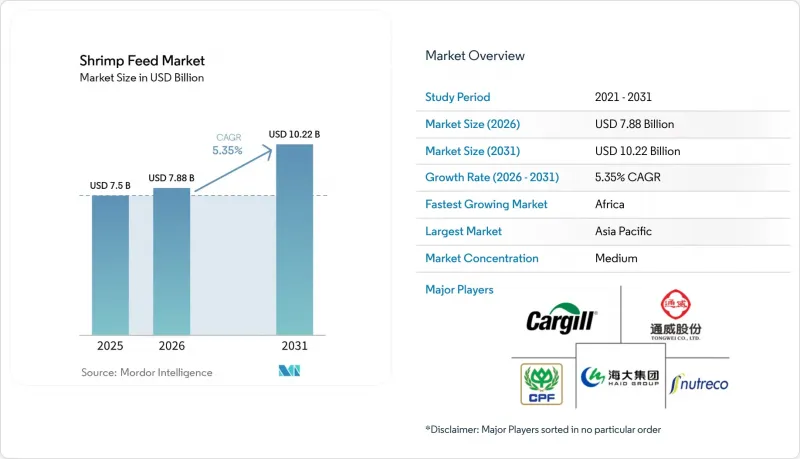
本報告按飼料類型(幼畜飼料、生長飼料、育肥飼料、功能性/藥用飼料)、形態(顆粒、碎粒、粉末、液體飼料)、蝦類品種(太平洋白蝦、黑虎蝦、其他)和地區(北美、南美、歐洲、亞太、中東和非洲)進行細分。市場預測以美元(USD)為單位。
全球蝦飼料市場趨勢及洞察
水產品消費量增加以及高蛋白食品的需求上升
全球對蝦飼料的需求正受到水產養殖產量成長的推動,預計到2025年,全球水產養殖產量將達到約600萬噸。隨著養殖戶提高養殖密度並採用高蛋白飼料以加速蝦子的生長週期,蝦飼料市場正從中直接受益。到2025年,厄瓜多爾的蝦子出口量將達到139萬噸,其中中國約佔總出口量的48%,凸顯了亞洲在全球蝦子消費成長中的重要地位。飼料生產商正在添加益生菌和活化,以減少抗生素的使用,並符合歐盟和美國的永續性標準。
主要地區集約化蝦類養殖的擴張
印尼正在打造一個以蝦類養殖和飼料生產為核心的綜合水產養殖中心,旨在減少飼料進口並最佳化價值鏈。越南計畫到2025年,重點擴大金甌省的循環水養殖系統,特別是蝦類養殖,並優先獲得最佳水產養殖規範(BAP)認證。同樣,中國正在採用生物絮凝池養殖系統來提高蝦類養殖效率,目標是改善水質和飼料利用率。同時,厄瓜多爾的商業蝦場正努力最佳化飼料轉換率,而印度的黑虎蝦養殖試驗池也正在製定新的效率標準。
魚粉和魚油價格波動
近年來,秘魯魚粉離岸價(FOB)持續上漲。第四季供應減少的預期鞏固了魚粉價格飆升的「新常態」。 2025年12月,儘管配額調整為163萬噸,魚粉價格仍持續攀升。這主要是由於鳀魚配額減少,導致原料供應受限。中國在全球供應中佔據較大佔有率,並維持高於以往水準的價格下限。據Avanti Feed稱,秘魯國內魚粉價格已大幅上漲。這些價格上漲對利潤率帶來壓力,並促使企業轉向大豆、昆蟲和單細胞蛋白等替代蛋白來源。
細分市場分析
預計到2025年,生長飼料將在蝦飼料市場佔據最大的市場佔有率(45.5%)。這是因為生長飼料的飼餵期最長,此時蝦子的日飼料量達到高峰。功能性和藥用性飼料市場預計將在2026年至2031年間以9.0%的複合年成長率(CAGR)實現最高成長。這主要歸因於美國和歐盟更嚴格的殘留物標準推動了免疫力增強添加劑使用量的增加。雛蝦飼料的銷售量較低,但由於幼蝦在早期階段死亡率較高,因此價格較高。飼料生產商如Grobest報告稱,使用其專有功能性成分後,實際飼料轉換率可達1.3%或更低,這充分證明了其經濟效益,也支持其持續推廣應用。
功能性飼料混合物有助於提高生產商的利潤率。越南水產養殖池使用添加BETA-聚葡萄糖的飼料已證明盈利,凸顯了水產養殖戶投資疾病防治策略的意願。在印度,黑虎蝦幼蝦生產的擴張預計將推動對客製化氨基酸成分的蝦苗飼料的需求。雖然育肥飼料仍屬於小眾市場,但配方正在重新評估,以增強蝦子的色澤和肉質緊實度,滿足高階零售商日益成長的需求。這些趨勢共同代表著蝦飼料市場的質的轉變。
區域分析
到2025年,亞太地區將佔全球蝦飼料市場70%的佔有率。這一主導地位將主要得益於中國的生產目標以及印度黑虎蝦養殖規模的不斷擴大。越南循環水養殖池塘的引進以及印尼對蝦養殖基地的投資,將推動產量結構性成長。各地區政府都在積極推廣無抗生素養殖方案,以滿足歐盟和美國市場標準,這將有助於功能性飼料的普及應用。跨國飼料生產商正在中國、越南和印度擴大產能,進一步鞏固亞洲在蝦飼料市場的主導地位。
預計2026年至2031年間,非洲蝦類市場將以9.0%的複合年成長率成長。由世界銀行資助、於2026年在坦尚尼亞啟動的TASFAM計畫旨在擴大水產養殖業,包括蝦類養殖。同時,埃及繼續主導非洲水產養殖市場。奈及利亞和肯亞新建的飼料廠正在縮短供應鏈距離並降低運輸成本,使小規模水產養殖戶更容易獲得商業蝦飼料。鑑於目前蝦飼料的普及率較低,產能的提升將直接轉化為新的需求,使非洲成為蝦飼料市場的重要成長前沿。
南美洲是全球第二大蝦飼料市場,預計2025年,厄瓜多爾的蝦飼料出貨量將持續成長。精準投餵系統的日益普及正在降低飼料轉換率,並改善全部區域的飼料配方。為了滿足國內零售需求,巴西東北沿海的半集約化蝦場正在擴張;而中美洲的養殖場則轉向生產高價值的「帶頭帶殼」蝦,這類蝦需要使用特定的飼料進行著色。這些發展趨勢鞏固了南美洲作為全球成長最快、最成熟的蝦飼料市場的地位。
其他好處
- Excel格式的市場預測(ME)表
- 3個月的分析師支持
目錄
第1章:引言
- 研究假設和市場定義
- 調查範圍
第2章:調查方法
第3章執行摘要
第4章 市場狀況
- 市場概覽
- 市場促進因素
- 水產品消費量增加以及高蛋白食品的需求上升
- 主要地區集約化蝦類養殖的擴張
- 功能性添加劑和活化的應用進展
- 引進人工智慧驅動的精密送料系統
- 碳標籤將促進昆蟲和藻類來源蛋白質的使用。
- 對抗病幼蟲專用飼料的需求
- 市場限制因素
- 魚粉和魚油價格波動
- 疾病爆發對蝦飼料需求的影響
- 加強對市面上抗生素和添加劑的監管
- 主要胺基酸原料的反傾銷風險
- 監理情勢
- 技術展望
- 波特五力分析
第5章 市場規模與成長預測
- 按飼料類型
- 幼畜飼料
- 促進生長的飼料
- 牲畜飼料
- 功能性/藥用飼料
- 按形式
- 顆粒
- 攀爬
- 粉末
- 液態飼料
- 按品種分類的蝦
- 太平洋白
- 黑虎
- 其他
- 按地區
- 北美洲
- 美國
- 加拿大
- 墨西哥
- 其他北美國家
- 南美洲
- 巴西
- 厄瓜多
- 其他南美國家
- 歐洲
- 德國
- 英國
- 俄羅斯
- 其他歐洲國家
- 亞太地區
- 中國
- 印度
- 越南
- 印尼
- 其他亞太國家
- 中東
- 沙烏地阿拉伯
- 阿拉伯聯合大公國
- 其他中東國家
- 非洲
- 埃及
- 南非
- 其他非洲地區
- 北美洲
第6章 競爭情勢
- 市場集中度
- 策略趨勢
- 市佔率分析
- 公司簡介
- Charoen Pokphand Foods Public Company Limited
- Cargill, Incorporated
- Skretting(Nutreco NV)
- BioMar Group A/S(Schouw & Co.)
- Guangdong Haid Group Co., Ltd.
- Tongwei Co., Ltd.
- Avanti Feeds Limited
- Grobest Holdings Limited
- Guangdong Yuehai Feed Group Co., Ltd.
- BernAqua NV
- Ridley Corporation Limited
- INVE Aquaculture Holding BV
- Uni-President Enterprises Corporation
- Thai Union Group Public Company Limited
第7章 市場機會與未來展望
According to Mordor Intelligence, the shrimp feed market was valued at USD 7.5 billion in 2025 and is projected to grow from USD 7.88 billion in 2026 to USD 10.22 billion by 2031, registering a CAGR of 5.35% during the forecast period from 2026 to 2031.
This report is Segmented by Feed Type (Starter Feed, Grower Feed, Finisher Feed, and Functional/Medicated Feed), by Form (Pellets, Crumbles, Powder, and Liquid Feed), by Shrimp Species (Pacific White, Black Tiger, and Other Species), and by Geography (North America, South America, Europe, Asia-Pacific, Middle East, and Africa). The Market Forecasts are Provided in Terms of Value (USD).
Global Shrimp Feed Market Trends and Insights
Rising Seafood Consumption and Protein-Rich Diet Demand
Global shrimp feed demand is supported by rising aquaculture output, with farmed shrimp production reaching around 6 million metric tons in 2025. The shrimp feed market has directly benefited as farmers increase stocking densities and adopt high-protein diets to accelerate grow-out cycles. Ecuador's shrimp exports reached 1.39 million metric tons in 2025, with China accounting for approximately 48% of total shipments, underscoring Asia's significant role in driving global shrimp consumption growth. Feed manufacturers are incorporating probiotics and immunostimulants to reduce antibiotic usage and comply with sustainability standards in the European Union and the United States.
Expansion of Intensive Shrimp Aquaculture in Key Regions
Indonesia is developing an integrated aquaculture hub focused on shrimp farming and feed production to decrease feed imports and enhance value chain efficiency. In 2025, Vietnam is focusing on expanding recirculating aquaculture systems in Ca Mau, particularly for shrimp farming, with an emphasis on obtaining Best Aquaculture Practices (BAP) certification. Similarly, China is adopting biofloc pond systems to enhance shrimp farming, aiming to improve water quality and feed utilization efficiency. Meanwhile, Ecuador's commercial shrimp farms are striving to optimize feed-conversion ratios, and pilot ponds in India for black tiger shrimp farming are setting new efficiency benchmarks.
Volatility in Fishmeal and Fish Oil Prices
Peru's fishmeal free-on-board quotations have been rising over the past few years. The prospect of lower supply in the final quarter created a "new normal" for higher fishmeal prices. In December 2025, fishmeal prices continued to rise, even with the revised USD 1.63 million mt quota. This is primarily due to reduced anchovy quotas, which constrained the supply of raw materials. China accounts for a significant share of global supply, maintaining a higher price floor than earlier levels. Avanti Feeds reported that domestic fishmeal prices have risen substantially over time. These price surges have compressed profit margins and driven a shift toward alternative protein sources such as soybean, insect, and single-cell proteins.
Other drivers and restraints analyzed in the detailed report include:
- Advances in Functional Additives and Immunostimulants Usage
- Adoption of AI-Enabled Precision Feeding Systems
- Disease Outbreaks Disrupting Shrimp Feed Demand
For complete list of drivers and restraints, kindly check the Table Of Contents.
Segment Analysis
Grower feed is projected to account for the largest market share of 45.5% in the shrimp feed market by 2025, as it corresponds to the longest production phase when daily feed intake is at its peak. The functional and medicated feed market size is projected to grow at the fastest CAGR of 9.0% from 2026 to 2031, driven by stricter residue limits in the United States and European Union, which encourage the use of additives that boost immunity. Starter formulas, while generating lower revenue, command premium pricing due to the high mortality risk during the initial days. Feed mills, such as Grobest, have reported field feed-conversion ratios below 1.3 when using proprietary functional ingredients, demonstrating the economic benefits that support their continued adoption.
Functional blends contribute to improved manufacturer margins. Vietnamese ponds utilizing beta-glucan fortified diets have demonstrated profitability, highlighting farmers' readiness to invest in disease mitigation strategies. In India, the growing production of black tiger post-larvae is projected to drive demand for nursery diets with customized amino acid profiles. While finisher diets remain a niche segment, they are being reformulated to enhance pigmentation and flesh firmness, attributes increasingly sought by premium retailers. These developments collectively signify a qualitative transformation in the shrimp feed market.
Geography Analysis
In 2025, the Asia-Pacific region accounted for the largest market share of 70% in the shrimp feed market. This dominance was driven by China's target and India's increasing shift toward black tiger shrimp production. Vietnam introduced recirculating ponds, while Indonesia invested in a shrimp production hub, contributing to structural volume growth. Regional governments are promoting antibiotic-free protocols to meet European Union and United States market standards, encouraging the adoption of functional feeds. Multinational feed mills are expanding their capacities in China, Vietnam, and India, reinforcing Asia's leading position in the shrimp feed market.
The African shrimp market size is projected to grow at a CAGR of 9.0% from 2026 to 2031. Tanzania's World Bank-funded TASFAM program, launched in 2026, aims to expand aquaculture production, including shrimp output, while Egypt continues to dominate continental aquaculture. New feed plants in Nigeria and Kenya are reducing supply chain distances and freight costs, making commercial shrimp diets more accessible to small-scale farmers. With low baseline adoption, incremental capacity increases directly translate into new demand, positioning Africa as a key growth frontier in the shrimp feed market.
South America ranks as the second-largest shrimp feed market, with Ecuador achieving shipment growth in 2025. Precision feeding systems are becoming widespread, reducing feed conversion ratios and driving formulation improvements across the region. Brazil's northeast coast is expanding semi-intensive shrimp ponds to meet domestic retail demand, while Central American farms are shifting toward value-added headless-shell-on shrimp packs, which require specific diet pigmentation. These advancements solidify South America's position as the fastest-growing mature market for shrimp feed.
- Charoen Pokphand Foods Public Company Limited
- Cargill, Incorporated
- Skretting (Nutreco N.V.)
- BioMar Group A/S (Schouw & Co.)
- Guangdong Haid Group Co., Ltd.
- Tongwei Co., Ltd.
- Avanti Feeds Limited
- Grobest Holdings Limited
- Guangdong Yuehai Feed Group Co., Ltd.
- BernAqua NV
- Ridley Corporation Limited
- INVE Aquaculture Holding B.V.
- Uni-President Enterprises Corporation
- Thai Union Group Public Company Limited
Additional Benefits:
- The market estimate (ME) sheet in Excel format
- 3 months of analyst support
TABLE OF CONTENTS
1 Introduction
- 1.1 Study Assumptions and Market Definition
- 1.2 Scope of the Study
2 Research Methodology
3 Executive Summary
4 Market Landscape
- 4.1 Market Overview
- 4.2 Market Drivers
- 4.2.1 Rising seafood consumption and protein-rich diet demand
- 4.2.2 Expansion of intensive shrimp aquaculture in key regions
- 4.2.3 Advances in functional additives and immunostimulants usage
- 4.2.4 Adoption of AI-enabled precision feeding systems
- 4.2.5 Carbon labeling driving insect and algae protein adoption
- 4.2.6 Demand for specialized feeds for disease-resistant larvae
- 4.3 Market Restraints
- 4.3.1 Volatility in fishmeal and fish oil prices
- 4.3.2 Disease outbreaks disrupting shrimp feed demand
- 4.3.3 Stricter antibiotic and additive regulations in markets
- 4.3.4 Anti-dumping risks on key amino acid inputs
- 4.4 Regulatory Landscape
- 4.5 Technological Outlook
- 4.6 Porter's Five Forces Analysis
- 4.6.1 Threat of New Entrants
- 4.6.2 Bargaining Power of Suppliers
- 4.6.3 Bargaining Power of Buyers
- 4.6.4 Threat of Substitutes
- 4.6.5 Intensity of Competitive Rivalry
5 Market Size and Growth Forecasts (Value)
- 5.1 By Feed Type
- 5.1.1 Starter Feed
- 5.1.2 Grower Feed
- 5.1.3 Finisher Feed
- 5.1.4 Functional / Medicated Feed
- 5.2 By Form
- 5.2.1 Pellets
- 5.2.2 Crumbles
- 5.2.3 Powder
- 5.2.4 Liquid Feed
- 5.3 By Shrimp Species
- 5.3.1 Pacific White
- 5.3.2 Black Tiger
- 5.3.3 Other Species
- 5.4 By Geography
- 5.4.1 North America
- 5.4.1.1 United States
- 5.4.1.2 Canada
- 5.4.1.3 Mexico
- 5.4.1.4 Rest of North America
- 5.4.2 South America
- 5.4.2.1 Brazil
- 5.4.2.2 Ecuador
- 5.4.2.3 Rest of South America
- 5.4.3 Europe
- 5.4.3.1 Germany
- 5.4.3.2 United Kingdom
- 5.4.3.3 Russia
- 5.4.3.4 Rest of Europe
- 5.4.4 Asia-Pacific
- 5.4.4.1 China
- 5.4.4.2 India
- 5.4.4.3 Vietnam
- 5.4.4.4 Indonesia
- 5.4.4.5 Rest of Asia-Pacific
- 5.4.5 Middle East
- 5.4.5.1 Saudi Arabia
- 5.4.5.2 United Arab Emirates
- 5.4.5.3 Rest of Middle East
- 5.4.6 Africa
- 5.4.6.1 Egypt
- 5.4.6.2 South Africa
- 5.4.6.3 Rest of Africa
- 5.4.1 North America
6 Competitive Landscape
- 6.1 Market Concentration
- 6.2 Strategic Moves
- 6.3 Market Share Analysis
- 6.4 Company Profiles (Includes Global level Overview, Market level Overview, Core Segments, Financials as Available, Strategic Information, Market Rank/Share, Products and Services, and Recent Developments)
- 6.4.1 Charoen Pokphand Foods Public Company Limited
- 6.4.2 Cargill, Incorporated
- 6.4.3 Skretting (Nutreco N.V.)
- 6.4.4 BioMar Group A/S (Schouw & Co.)
- 6.4.5 Guangdong Haid Group Co., Ltd.
- 6.4.6 Tongwei Co., Ltd.
- 6.4.7 Avanti Feeds Limited
- 6.4.8 Grobest Holdings Limited
- 6.4.9 Guangdong Yuehai Feed Group Co., Ltd.
- 6.4.10 BernAqua NV
- 6.4.11 Ridley Corporation Limited
- 6.4.12 INVE Aquaculture Holding B.V.
- 6.4.13 Uni-President Enterprises Corporation
- 6.4.14 Thai Union Group Public Company Limited
7 Market Opportunities and Future Outlook

 蝦飼料市場:全球市場預測,2026-2032年
 蝦飼料市場規模、佔有率、成長分析、2025-2032 年產業預測(按成分、類型、添加劑、蝦種和地區)
 蝦飼料市場機會、成長動力、產業趨勢分析及2025-2034年預測