


 |
市場調查報告書
商品編碼
2063264
多域控制器:市場佔有率分析、產業趨勢與統計、成長預測(2026-2031)Multi Domain Controller - Market Share Analysis, Industry Trends & Statistics, Growth Forecasts (2026 - 2031) |
||||||

※ 本網頁內容可能與最新版本有所差異。詳細情況請與我們聯繫。
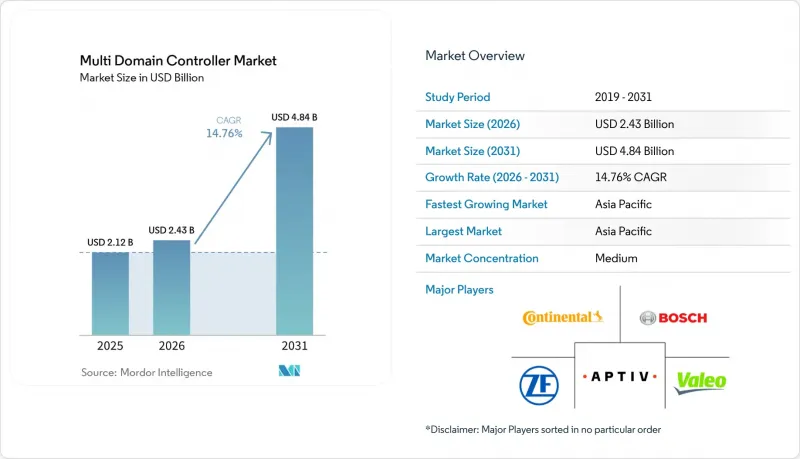
根據 Mordor Intelligence 預測,多網域控制站市場將從 2025 年的 21.2 億美元成長到 2026 年的 24.3 億美元,到 2031 年達到 48.4 億美元。
預計 2026 年至 2031 年的複合年成長率為 14.76%。
本報告按應用領域(ADAS和安全、車身和舒適性、其他)、車輛類型(乘用車、輕型商用車、其他)、動力系統(純電動車、混合動力電動車、其他)、自動化程度(自動駕駛和半自動駕駛汽車)、作業系統(QNX、其他)和地區進行細分。市場預測以美元計價。
全球多域控制器市場趨勢與洞察
ADAS 的普及率不斷提高,以及 L2-L3 級自動駕駛技術的發展。
汽車製造商正在將車道維持、自動停車和高速公路輔助駕駛等功能標準化,這些功能依賴雷達、攝影機和雷射雷達的融合數據。集中式控制器透過共用記憶體和電源資源,消除了各個單元之間的延遲並降低了材料成本。高通最新的驍龍平台展示了單塊電路板如何在主流車型中支援免手駕駛。中國和歐洲對自動緊急煞車系統的監管要求設定了最低運算能力標準,而分散式拓樸結構難以滿足這些標準。隨著感測器套件的擴展和頻寬需求的成長,向可擴展控制器的轉變正在加速,這種控制器可以透過軟體升級,而不是透過硬體重新設計。
向集中式和分區式電子電氣架構過渡
分區設計根據實體位置對線路進行分組,從而縮短線束長度並減輕重量,同時簡化軟體生命週期管理。 BMW的「Neue Klasse」平台以三個區域控制器取代了數十個傳統單元,這些控制器在單一虛擬機器管理程式下運行多個虛擬機器。供應商正在發布整合乙太網路交換、電源分配和即時處理的參考板,使即使是小規模整合商也能更快地達到合規要求。透過將網路安全邏輯整合到少數幾個節點中,汽車製造商可以在滿足 UNECE R155 要求的同時,減少穿透測試週期。最終形成了一個可重複使用的電氣主幹,無需重新佈線即可支援未來的自動駕駛功能升級。
高效能SoC的熱限制與功耗限制
推理工作負載的增加會產生熱量,而這些熱量難以在儀錶板和引擎室內散發。儘管供應商採用了預測性節流和先進的冷卻材料,但在極端天氣條件下,持續的峰值性能仍可能下降。一些汽車製造商將任務分配到多個低功耗電路板上,這降低了完全整合帶來的成本節約。在空間和氣流受限的小型車中,封裝限制最為嚴峻。因此,散熱設計成為決定實際性能範圍的關鍵因素,這可能會延緩雄心勃勃的單晶片藍圖的進展。
細分市場分析
到2025年,ADAS和安全功能將佔據多域控制器市場43.44%的佔有率,凸顯了計算密集型感測器融合和目標分類工作負載的重要性,這些工作負載支持高速公路上的自動駕駛和泊車。汽車製造商正依靠集中式電路板來降低雷達、攝影機和LiDAR輸入之間的延遲,使單一處理器能夠管理多個感知層。標準化硬體也有助於空中升級安全更新,隨著車道維持和緊急煞車法規的不斷擴展,空中升級已成為監管重點。供應商正在捆綁預先認證的功能安全軟體,使品牌能夠在全球範圍內推出產品,而無需重複冗長的檢驗週期。目前,競爭差異化主要集中在平衡效能、功耗和成本,同時滿足ISO 26262 ASIL-D要求。
預計到2031年,駕駛座電子市場將以18.21%的複合年成長率成長,成為該細分市場中成長最快的領域。儀錶叢集、資訊娛樂系統和擴增實境(AR)抬頭顯示器正被整合到單一系統晶片(SoC)中,從而減少了佈線並實現了螢幕間的圖形同步。將安全關鍵型警告顯示與富媒體分離的虛擬機器管理程式使得在單一電路板上運行這兩種工作負載成為可能。汽車製造商看重這種剩餘的運算能力,因為它使他們能夠遠端部署新的使用者體驗功能,而無需重新設計硬體。雖然這種轉變增加了訂閱收入的潛力,但也增加了溫度控管的複雜性,因為圖形和ADAS(高級駕駛輔助系統)領域共用了更多的晶片資源。
到2025年,乘用車將佔據多域控制器市場66.19%的佔有率。這反映了緊湊型和中型汽車的大規模生產以及消費者對高級駕駛輔助功能的高需求。集中式運算將使汽車品牌無需額外添加控制單元即可部署駕駛員監視錄影機、預測性維護警報和語音控制資訊娛樂系統。銷量的成長將使開發成本分攤到數百萬輛汽車上,從而使高性能晶片能夠以更低的價格快速普及。消費者也期望汽車的更新周期與智慧型手機類似,這推動乘用車平台向軟體定義架構發展,從而實現功能的持續添加。這些趨勢正在促成雲端分析與車載硬體之間的緊密協作,加速標準化控制器參考設計的普及。
預計從2026年到2031年,乘用車領域將以15.01%的複合年成長率(CAGR)實現最高成長,新興市場正轉向配備高級駕駛輔助系統(ADAS)的車輛,而成熟市場則透過升級車輛來實現空中下載(OTA)更新。共享出行和汽車共享車隊的採購者也在採用類似的硬體,因為遠端診斷可以減少停機時間。汽車製造商正在提供分級訂閱的軟體套餐,將集中式控制器轉變為長期收入來源。目前的競爭焦點在於如何在控制成本的同時,平衡網路安全、資料隱私和使用者體驗。隨著原始設備製造商(OEM)加速推進軟體定義策略,能夠將晶片、中間件和雲端服務捆綁在一起的一級供應商在執行方面保持優勢。
區域分析
亞太地區佔全球多域控制器市場規模的40.34%,預計到2031年將以15.41%的複合年成長率成長,並持續引領技術進步。中國汽車製造商正透過自主研發控制器來規避出口限制,而日韓品牌則依賴與一級供應商的長期夥伴關係。強大的供應商生態系統降低了原型成本,加快了檢驗速度,使平台能夠更快地推向展示室。政府對車道維持和自動煞車系統的監管,即使在入門車型中也推動了對控制器的需求,從而保證了控制器銷售的穩定成長。本地晶片生產、強力的政策支持和充足的資金投入,形成良性循環,賦予了該地區強大的競爭優勢。
北美是車上用軟體的發源地,至今仍是多域控制器市場的戰略支柱。本土汽車製造商正在部署高速公路自動駕駛功能的升級,這需要整合感知、地圖繪製和駕駛員監控等功能的強大運算能力。該地區還有大量新創公司向小規模品牌授權參考電路板,從而形成新的競爭壓力。美國國家公路交通安全管理局 (NHTSA) 提出的網路安全法規要求所有程式在硬體層具備安全啟動和入侵偵測功能,而集中式平台最容易實現這項功能。叫車和最後一公里配送車隊的採購商要求控制器可在路邊更換,這催生了豐富的售後服務管道。
歐洲對多域控制器市場的貢獻是基於先進的工程技術和嚴格的法規結構。德國和瑞典的軟體定義汽車 (SDV) 等領先舉措採用虛擬機器管理程序,將安全相關的工作負載與資訊娛樂系統隔離,這表明單一電路板即可滿足嚴格的功能安全標準。儘管責任談判的延遲延緩了消費性產品的上市,但供應商仍在不斷改進特定區域的線束和晶片封裝,預計未來的發展速度將更快。中東進口商正在為豪華車型配備高階控制器,以實現智慧運輸目標;而在非洲和南美部分地區,價格敏感性依然很高,因此他們採用了成本更低的混合方案,將傳統的電控系統與入門級域板相結合。由此形成了一個由不同地區交錯構成的複雜格局,但全球洞察仍在不斷轉化為新的晶片藍圖。
其他好處:
- Excel格式的市場預測(ME)表
- 3個月的分析師支持
目錄
第1章:引言
- 研究假設和市場定義
- 調查範圍
第2章:調查方法
第3章執行摘要
第4章 市場狀況
- 市場概覽
- 市場促進因素
- ADAS的廣泛應用以及L2-L3級自動駕駛技術的發展。
- 向集中式和分區式電子電氣架構過渡
- 原始設備製造商正在推動軟體定義汽車和OTA功能的發展。
- 功能安全法規(ISO 26262,UNECE R155/156)
- 駕駛座+駕駛領域「1板→1晶片」整合
- 汽車晶片組的興起與UCIe生態系統
- 市場限制因素
- 高效能SoC的熱限制與功耗限制
- 複雜的ASIL-D認證所涉及的成本和時間。
- 一級企業垂直整合加劇了對中小供應商的擠壓。
- 全球對人工智慧智慧財產權的出口限制擾亂了供應鏈
- 價值供應鏈分析
- 監理情勢
- 技術展望
- 波特五力分析
第5章 市場規模與成長預測
- 透過使用
- ADAS及安全性
- 身體舒適度
- 駕駛座電子設備
- 動力傳動系統
- 車輛類型
- 搭乘用車
- 輕型商用車
- 中型和大型商用車輛
- 依推進類型
- 電池式電動車
- 油電混合車
- 插電式混合動力汽車
- 內燃機
- 自主
- 自動駕駛汽車
- 半自動駕駛汽車
- 透過作業系統
- QNX
- Linux
- 安德維爾
- 按地區
- 北美洲
- 美國
- 加拿大
- 其他北美國家
- 南美洲
- 巴西
- 阿根廷
- 其他南美國家
- 歐洲
- 英國
- 德國
- 西班牙
- 義大利
- 法國
- 俄羅斯
- 其他歐洲國家
- 亞太地區
- 印度
- 中國
- 日本
- 韓國
- 其他亞太國家
- 中東和非洲
- 阿拉伯聯合大公國
- 沙烏地阿拉伯
- 土耳其
- 埃及
- 南非
- 其他中東和非洲國家
- 北美洲
第6章 競爭情勢
- 市場集中度
- 策略趨勢
- 市佔率分析
- 公司簡介
- Continental AG
- Robert Bosch GmbH
- ZF Friedrichshafen AG
- Aptiv PLC
- Valeo SA
- BlackBerry(QNX)
- NVIDIA Corporation
- Qualcomm Technologies Inc.
- NXP Semiconductors NV
- Renesas Electronics Corporation
- Infineon Technologies AG
- Texas Instruments Inc.
- Visteon Corporation
- Huawei Technologies Co. Ltd.
- Magna International Inc.
- Denso Corporation
第7章 市場機會與未來展望
According to Mordor Intelligence, the multi-domain controller market is projected to grow from USD 2.12 billion in 2025 to USD 2.43 billion in 2026, reaching USD 4.84 billion by 2031, with a CAGR of 14.76% from 2026 to 2031.
This report is Segmented by Application (ADAS and Safety, Body and Comfort, and More), Vehicle Type (Passenger Vehicle, Light Commercial Vehicle, and More), Propulsion Type (Battery Electric Vehicle, Hybrid Electric Vehicle, and More), Autonomy (Autonomous Vehicle and Semi-Autonomous Vehicle), Operating System (QNX and More), and Geography. The Market Forecasts are Provided in Terms of Value (USD).
Global Multi Domain Controller Market Trends and Insights
Rising ADAS Penetration and L2-L3 Autonomy Rollout
Automakers are standardizing lane-keeping, automated parking, and highway pilot features that rely on fused radar, camera, and lidar data. Centralized controllers eliminate latency between separate units and trim material cost by sharing memory and power resources. Qualcomm's latest Snapdragon platform shows how a single board can support hands-free driving in mainstream models. Regulatory requirements for automatic emergency braking in China and Europe lock in minimum compute thresholds that distributed topologies struggle to meet. As sensor suites expand, bandwidth demand reinforces the move to a scalable controller that can be upgraded via software rather than hardware redesign.
Shift Toward Centralized and Zonal E/E Architectures
Zonal designs group wiring by physical location, cutting harness length and weight while simplifying software life-cycle management. BMW's Neue Klasse platform replaces dozens of legacy units with three zone controllers that host multiple virtual machines under a single hypervisor. Suppliers are releasing reference boards that blend Ethernet switching, power distribution, and real-time processing, giving smaller integrators a faster route to compliance. By consolidating cybersecurity logic into a handful of nodes, automakers also meet UNECE R155 obligations with fewer penetration testing cycles. The result is a repeatable electrical backbone that supports future autonomous upgrades without re-wiring the vehicle.
Thermal-Power Limits of High-Compute SoCs
Rising inference workloads generate heat that is hard to dissipate inside dashboards and engine bays. Vendors incorporate predictive throttling and advanced cooling materials, yet sustained peak performance can still drop in extreme climates. Some automakers split tasks across multiple lower-power boards, diluting the cost savings of full consolidation. Packaging constraints are tightest in compact vehicles, where space and airflow are limited. Thermal engineering, therefore, dictates realistic performance envelopes and may slow aggressive one-chip roadmaps.
Other drivers and restraints analyzed in the detailed report include:
- OEM Push for Software-Defined Vehicles and OTA Capability
- Functional-Safety Regulation (ISO 26262, UNECE R155/156)
- Complex ASIL-D Certification Cost/Time
For complete list of drivers and restraints, kindly check the Table Of Contents.
Segment Analysis
ADAS and safety accounted for 43.44% of the Multi Domain Controller market share in 2025, underscoring the compute-hungry sensor-fusion and object-classification workloads that support highway piloting and automated parking. Automakers rely on centralized boards to cut latency between radar, camera, and lidar inputs, allowing a single processor to supervise multiple perception layers. The standardized hardware also eases over-the-air safety updates, a regulatory priority as lane-keeping and emergency-braking rules widen. Suppliers bundle pre-certified functional-safety software so brands can launch across global regions without repeating long validation cycles. Competitive differentiation now centers on balancing performance, power, and cost while meeting ISO 26262 ASIL-D obligations.
Cockpit electronics is advancing at an 18.21% CAGR through 2031, the fastest pace within the segment hierarchy. Instrument clusters, infotainment, and augmented-reality head-up displays are merging onto a single system-on-chip, shrinking wiring mass and enabling synchronized graphics across screens. A hypervisor separates safety-critical telltales from rich media, allowing one board to host both workloads legally. Automakers value the extra compute headroom because it lets them deploy new user-experience features remotely rather than redesigning hardware. This shift adds subscription revenue potential yet raises thermal-management complexity as graphics and ADAS domains increasingly share silicon.
Passenger vehicles captured 66.19% of the Multi Domain Controller market share in 2025, reflecting high production scale and consumer appetite for advanced driver-assistance features in compact and midsize models. Centralized compute helps brands roll out driver-monitoring cameras, predictive maintenance alerts, and voice-controlled infotainment without adding separate control units. Higher sales volumes spread development cost across millions of cars, enabling premium silicon to reach lower price points quickly. Consumers also expect smartphone-like update cycles, which push passenger-car platforms toward software-defined architectures that permit ongoing feature drops. These dynamics forge a tight loop between cloud analytics and in-car hardware, accelerating the adoption of standardized controller reference designs.
The same passenger segment also posts the fastest 15.01% CAGR over 2026-2031, as emerging markets upgrade to ADAS-equipped vehicles and mature markets refresh fleets to enable over-the-air updates. Fleet buyers in ride-hailing and car-sharing adopt similar hardware because remote diagnostics cut downtime. Automakers offer tiered software packages unlocked by subscription, turning centralized controllers into long-term revenue engines. Competition now centers on balancing cybersecurity, data privacy, and user experience while maintaining cost discipline. Tier-one suppliers that can bundle silicon, middleware, and cloud services hold an execution edge as OEMs race to scale software-defined strategies.
Geography Analysis
Asia-Pacific accounted for 40.34% of the Multi Domain Controller market size and continues to set the technology pace, growing at 15.41% CAGR to 2031. Chinese automakers design controllers in-house to avoid export limits, while Japanese and South Korean brands rely on long-term tier-one partnerships. A dense supplier ecosystem lowers prototype costs and speeds validation, so platforms reach showrooms more quickly. Government mandates for lane-keeping and automatic braking reinforce demand even in entry vehicles, locking in steady controller volume. This virtuous cycle of local silicon, strong policy, and supportive capital keeps the region firmly in front of rivals.
North America is the historical cradle of in-vehicle software and remains a strategic pillar for the Multi Domain Controller market. Domestic original-equipment manufacturers are rolling out highway pilot updates that require unified compute across perception, mapping, and driver monitoring. The region also houses many start-ups that license reference boards to smaller brands, adding fresh competitive pressure. Cybersecurity draft rules from NHTSA require every program to embed secure boot and intrusion detection at the hardware layer, a feature most easily implemented on centralized platforms. Fleet buyers in ride-hailing and last-mile delivery demand controllers that can be swapped curbside, creating a rich after-sales channel.
Europe's contribution to the Multi Domain Controller market rests on engineering depth and a stringent regulatory framework. Flagship programs such as software-defined vehicle initiatives in Germany and Sweden showcase hypervisors that quarantine safety workloads from infotainment, demonstrating how a single board can respect strict functional-safety doctrine. Delays tied to liability negotiations slow consumer launches, yet the supplier base keeps refining zonal harnesses and chiplet packages so future rollouts will move faster. Middle-East importers layer premium controllers onto luxury models to meet smart-mobility targets, while Africa and parts of South America remain price-sensitive, adopting low-cost hybrids of legacy electronic control units and entry-level domain boards. The collective outcome is a tiered regional mosaic that still funnels global learning back into new silicon road maps.
- Continental AG
- Robert Bosch GmbH
- ZF Friedrichshafen AG
- Aptiv PLC
- Valeo SA
- BlackBerry (QNX)
- NVIDIA Corporation
- Qualcomm Technologies Inc.
- NXP Semiconductors N.V.
- Renesas Electronics Corporation
- Infineon Technologies AG
- Texas Instruments Inc.
- Visteon Corporation
- Huawei Technologies Co. Ltd.
- Magna International Inc.
- Denso Corporation
Additional Benefits:
- The market estimate (ME) sheet in Excel format
- 3 months of analyst support
TABLE OF CONTENTS
1 Introduction
- 1.1 Study Assumptions and Market Definition
- 1.2 Scope of the Study
2 Research Methodology
3 Executive Summary
4 Market Landscape
- 4.1 Market Overview
- 4.2 Market Drivers
- 4.2.1 Rising ADAS Penetration and L2-L3 Autonomy Rollout
- 4.2.2 Shift Toward Centralized and Zonal E/E Architectures
- 4.2.3 OEM Push for Software-Defined Vehicles and OTA Capability
- 4.2.4 Functional-Safety Regulation (ISO 26262, UNECE R155/156)
- 4.2.5 One-Board -> One-Chip Fusion of Cockpit + Driving Domains
- 4.2.6 Emergence of Automotive Chiplet And UCIe Ecosystems
- 4.3 Market Restraints
- 4.3.1 Thermal-Power Limits of High-Compute SoCs
- 4.3.2 Complex ASIL-D Certification Cost/Time
- 4.3.3 Tier-1 Vertical Integration Squeezing Smaller Suppliers
- 4.3.4 Global AI-IP Export Controls Disrupting Supply Chains
- 4.4 Value / Supply-Chain Analysis
- 4.5 Regulatory Landscape
- 4.6 Technological Outlook
- 4.7 Porter's Five Forces Analysis
- 4.7.1 Threat of New Entrants
- 4.7.2 Bargaining Power of Suppliers
- 4.7.3 Bargaining Power of Buyers
- 4.7.4 Threat of Substitutes
- 4.7.5 Intensity of Competitive Rivalry
5 Market Size and Growth Forecasts (Value (USD))
- 5.1 By Application
- 5.1.1 ADAS and Safety
- 5.1.2 Body and Comfort
- 5.1.3 Cockpit Electronics
- 5.1.4 Powertrain
- 5.2 By Vehicle Type
- 5.2.1 Passenger Vehicle
- 5.2.2 Light Commercial Vehicle
- 5.2.3 Medium and Heavy Commercial Vehicle
- 5.3 By Propulsion Type
- 5.3.1 Battery Electric Vehicle
- 5.3.2 Hybrid Electric Vehicle
- 5.3.3 Plug-in Hybrid Vehicle
- 5.3.4 Internal Combustion Engine
- 5.4 By Autonomy
- 5.4.1 Autonomous Vehicle
- 5.4.2 Semi-Autonomous Vehicle
- 5.5 By Operating System
- 5.5.1 QNX
- 5.5.2 Linux
- 5.5.3 Android
- 5.6 By Geography
- 5.6.1 North America
- 5.6.1.1 United States
- 5.6.1.2 Canada
- 5.6.1.3 Rest of North America
- 5.6.2 South America
- 5.6.2.1 Brazil
- 5.6.2.2 Argentina
- 5.6.2.3 Rest of South America
- 5.6.3 Europe
- 5.6.3.1 United Kingdom
- 5.6.3.2 Germany
- 5.6.3.3 Spain
- 5.6.3.4 Italy
- 5.6.3.5 France
- 5.6.3.6 Russia
- 5.6.3.7 Rest of Europe
- 5.6.4 Asia-Pacific
- 5.6.4.1 India
- 5.6.4.2 China
- 5.6.4.3 Japan
- 5.6.4.4 South Korea
- 5.6.4.5 Rest of Asia-Pacific
- 5.6.5 Middle East and Africa
- 5.6.5.1 United Arab Emirates
- 5.6.5.2 Saudi Arabia
- 5.6.5.3 Turkey
- 5.6.5.4 Egypt
- 5.6.5.5 South Africa
- 5.6.5.6 Rest of Middle East and Africa
- 5.6.1 North America
6 Competitive Landscape
- 6.1 Market Concentration
- 6.2 Strategic Moves
- 6.3 Market Share Analysis
- 6.4 Company Profiles (Includes Global Level Overview, Market Level Overview, Core Segments, Financials as Available, Strategic Information, Market Rank/Share for Key Companies, Products and Services, SWOT Analysis, and Recent Developments)
- 6.4.1 Continental AG
- 6.4.2 Robert Bosch GmbH
- 6.4.3 ZF Friedrichshafen AG
- 6.4.4 Aptiv PLC
- 6.4.5 Valeo SA
- 6.4.6 BlackBerry (QNX)
- 6.4.7 NVIDIA Corporation
- 6.4.8 Qualcomm Technologies Inc.
- 6.4.9 NXP Semiconductors N.V.
- 6.4.10 Renesas Electronics Corporation
- 6.4.11 Infineon Technologies AG
- 6.4.12 Texas Instruments Inc.
- 6.4.13 Visteon Corporation
- 6.4.14 Huawei Technologies Co. Ltd.
- 6.4.15 Magna International Inc.
- 6.4.16 Denso Corporation
7 Market Opportunities and Future Outlook
- 7.1 White-space and Unmet-Need Assessment

 汽車域控制單元 (DCU) 市場分析及預測(至 2035 年):類型、產品、服務、技術、組件、應用、功能、安裝配置、解決方案
 2026年全球行星滾柱螺桿市場報告
 多域控制器市場規模、佔有率和成長分析:按平台、車輛類型、動力系統、應用、位元架構、銷售管道和地區分類-2026-2033年產業預測
 中央域控制(動力傳動系統、底盤、車身)和運動控制器市場(2026 年)2026年全球中央車輛控制設備市場報告2026年全球多網域控制器市場報告
 全球多域控制器市場規模、佔有率、趨勢和成長分析報告(2026-2034)
 汽車控制器市場按控制器類型、車輛類型、技術、應用和分銷管道分類,全球預測(2026-2032年)汽車行星滾柱螺桿市場(按類型、材料類型、負載能力、應用類型和最終用途)—全球預測,2025-2030 年
 中央車輛控制器市場機會、成長動力、產業趨勢分析與預測 2025 - 2034