


 |
市場調查報告書
商品編碼
2062398
可伸縮遮陽篷:市場佔有率分析、行業趨勢和統計數據、成長預測(2026-2031 年)Retractable Awnings - Market Share Analysis, Industry Trends & Statistics, Growth Forecasts (2026 - 2031) |
||||||

※ 本網頁內容可能與最新版本有所差異。詳細情況請與我們聯繫。
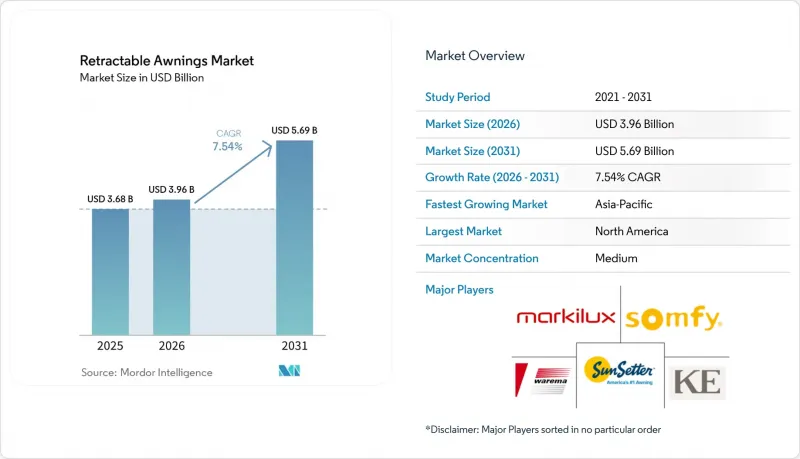
據 Mordor Intelligence 稱,2025 年可伸縮遮陽篷市場價值為 36.8 億美元,預計到 2031 年將達到 56.9 億美元,而 2026 年成長率為 39.6 億美元,預測期(2026-2031 年)的複合年成長率為 7.54%。
本報告按類型(手動、電動、智慧/自動、太陽能)、產品類型(適用於露台、窗戶、門、獨立式、涼棚、垂直落水式)、最終用戶產業(住宅、商業、飯店、公共機構、工業)和地區(亞太、北美、歐洲、南美、中東和非洲)進行細分。市場預測以美元計價。
全球伸縮遮陽棚市場趨勢及洞察
獨立式住宅戶外生活空間的擴建
越來越多的住宅將露台視為生活空間的延伸。隨著房價上漲,業主們都在尋求最大化利用現有空間。由專業人員進行的客製化安裝不僅能確保結構完整性,還有助於維持保固。環保布料的需求日益成長,尤其是由再生PET混紡布料製成的布料。此外,主流智慧家居助理的語音控制功能已將遮陽篷轉變為可程式設計的氣候管理工具。經銷商網路正透過年度維護計畫擴大業務收益。這些趨勢共同推動了伸縮遮陽篷市場持續的高階需求。
提高能源效率標準將加速被動式冷卻系統的維修。
2025年加州第24號法規修正案和歐盟指令2024/1275將外部遮陽系統納入合格評定軟體。這項整合正式確立了伸縮式產品在維修護照中的預算分配。因此,商業建築業主對動態遮陽解決方案的需求日益成長,旨在實現年度能源消耗的顯著降低。此外,標準化的生命週期資料和小時績效指標正逐漸成為產品規格中的關鍵要素。能夠有效證明其產品能夠減少太陽輻射熱增益並透過自然採光提高能源自給率的供應商將佔據競爭優勢,並有望在2026年至2031年的預測期內被列入節能維修的優先名單。
電氣組件的初始成本和維護成本都很高。
注重成本的住宅往往會避免購買價格較高的產品,即使事實證明這些產品可以節省冷氣成本。除了高昂的初始成本外,這些住宅還面臨額外的費用,例如電路改造、控制程式設定和馬達定期維護。為了解決這些問題,供應商推出了電池供電和太陽能供電的馬達。這些技術進步不僅減少了大規模的佈線工作,而且還有降低能源成本的潛力。此外,像 PowerView XL 馬達這樣的創新產品,具有更安靜的驅動機制和更大的扭矩,適用於更大的簾子,因此其價格差異也物有所值。
細分市場分析
從2026年到2031年,智慧自動化系統將以8.37%的複合年成長率成長,成長速度超過整體伸縮遮陽篷市場。到2025年,電動伸縮遮陽篷將佔據51.97%的市場佔有率,凸顯其強勁的市場地位。雖然太陽能伸縮遮陽篷的市場規模仍然小規模,但由於無需佈線安裝帶來的省力優勢,其市場正經歷快速成長。永續性指標在產品規格中的重要性日益凸顯,能源負責人正利用這些詳細資訊來評估維修專案的投資報酬率(ROI)。建築業主往往更傾向於能夠輕鬆整合到能源管理儀錶板中的產品。
此外,諸如自動儲風等功能已被證明能有效降低織物更換頻率。這些節約成本的效果證明了高昂的初始投資是值得的,從而促使智慧模式在多用戶住宅、飯店和公共設施領域得到更廣泛的應用。然而,在租賃物業中,由於對投資回報率的擔憂,手動模式仍然佔據主導地位。
區域分析
預計到2025年,北美將佔全球銷售額的38.41%,這得益於該地區較高的獨棟住宅擁有率和密集的經銷商網路。在加州,對符合加州能源法規第24條(Title 24)的專案中的自動遮陽篷進行即時監控,凸顯了遮陽篷作為一項可衡量的節能資產的價值。儘管加拿大市場存在季節性波動,但墨西哥全年對戶外用餐的需求穩定,這為永久性安裝遮陽篷提供了強力的依據。
亞太地區已成為伸縮遮陽篷市場成長最快的地區,預計2026年至2031年期間的複合年成長率將達到8.77%。日本、新加坡和澳洲引領了這一趨勢,重點關注與智慧家庭的融合以及節能維修中的ESG融資。在建築成本不斷上漲的背景下,業主們轉向遮陽篷維修,從而在無需大量資本投入的情況下享受降溫效果。同時,印度和東協市場也展現出發展潛力,但需要對安裝人員進行培訓並提供本地支援才能充分發揮其潛力。
歐洲的趨勢受到2024/1275號指令的影響,該指令強調了遮陽產品在能源認證中的作用。在競爭激烈的市場中,德國、法國和義大利憑藉著對設計的重視主導,消費者也對再生布料系列青睞有加。儘管夏季短暫,北歐國家仍憑藉其強大的購買力和環保意識佔據市場主導地位,而南歐的需求則保持穩定,主要由酒店業推動。
其他好處:
- Excel格式的市場預測(ME)表
- 3個月的分析師支持
目錄
第1章:引言
- 研究假設和市場定義
- 調查範圍
第2章:調查方法
第3章執行摘要
第4章 市場狀況
- 市場概覽
- 市場促進因素
- 獨立式住宅戶外生活空間的擴建
- 提高能源效率標準正在推動被動式冷卻維修。
- 透過智慧家庭生態系統,人們對電動和應用程式控制的遮陽產品的需求日益成長。
- 疫情期間,後院整修成為「居家待客」的場所。
- 政府對綠色建築項目中的外部遮陽設備提供稅額扣抵。
- 市場限制因素
- 電動組件的初始成本和維護成本都很高。
- 寒冷地區和降雪量大的地區季節性變化顯著
- 新興國家安裝人員密度低
- 價值鏈分析
- 技術展望
- 波特五力模型
第5章 市場規模與成長預測
- 按類型
- 手動伸縮式遮陽篷
- 電動伸縮遮陽篷
- 智慧型/自動伸縮遮陽篷
- 太陽能伸縮遮陽篷
- 依產品類型
- 露台遮陽篷
- 窗戶遮陽篷
- 門廊遮陽篷
- 獨立式遮陽篷
- 涼棚的遮陽篷
- 垂直遮陽篷
- 按最終用戶行業分類
- 住宅
- 商業(咖啡館、飯店、餐廳、零售店)
- 飯店和休閒設施
- 機構和公共基礎設施
- 工業建築和倉庫
- 按地區
- 亞太地區
- 中國
- 印度
- 日本
- 韓國
- 東南亞國協
- 其他亞太國家
- 北美洲
- 美國
- 加拿大
- 墨西哥
- 歐洲
- 德國
- 英國
- 法國
- 義大利
- 西班牙
- 俄羅斯
- 北歐國家
- 其他歐洲國家
- 南美洲
- 巴西
- 阿根廷
- 其他南美國家
- 中東和非洲
- 沙烏地阿拉伯
- 南非
- 其他中東和非洲國家
- 亞太地區
第6章 競爭情勢
- 市場集中度
- 策略趨勢
- 市佔率分析
- 公司簡介
- Advaning Awning
- ALEKO
- Awntech Corporation
- Brustor NV
- Corradi SpA
- Gibus SpA
- Griesser International
- Hunter Douglas UK Retail Ltd
- KE USA Inc.
- markilux GmbH+Co. KG
- Nuimage Outdoors
- ShadeFX Canopies
- Somfy Systems Inc
- Stobag AG
- Sunair Awnings
- Sunesta
- SunSetter Products
- Thompson Awning Co.
- Warema Renkhoff SE
第7章 市場機會與未來展望
According to Mordor Intelligence, the retractable awnings market size was valued at USD 3.68 billion in 2025 and is estimated to grow from USD 3.96 billion in 2026 to reach USD 5.69 billion by 2031, at a CAGR of 7.54% during the forecast period (2026-2031).
This report is Segmented by Type (Manual, Motorized, Smart/Automated, and Solar-Powered), Product Type (Patio, Window, Door, Freestanding, Pergola, and Vertical-Drop), End-User Sector (Residential, Commercial, Hospitality, Institutional, and Industrial), and Geography (Asia-Pacific, North America, Europe, South America, and Middle-East and Africa). Market Forecasts are Provided in Terms of Value (USD).
Global Retractable Awnings Market Trends and Insights
Expansion of Outdoor-Living Spaces in Single-Family Homes
Homeowners are increasingly treating patios and terraces as essential extensions of their living spaces. As real estate prices continue to rise, property owners are optimizing their existing spaces. Professional custom installations not only ensure structural integrity but also help to maintain warranties. There is a rising demand for eco-friendly fabrics, especially those made from recycled PET blends. Furthermore, with voice control features from leading smart-home assistants, awnings have evolved into programmable tools for climate management. Dealer networks are capitalizing on service revenues through annual maintenance programs. Collectively, these trends are driving a consistent premium demand in the retractable awnings market.
Heightened Energy-Efficiency Codes Spurring Passive-Cooling Retrofits
California's 2025 Title 24 update and the EU's Directive 2024/1275 are now incorporating exterior shading into their compliance software. This integration formalizes the budget allocations for retractable products in renovation passports. Consequently, commercial building owners are increasingly seeking dynamic shading solutions, targeting measurable reductions in their yearly energy consumption. Additionally, standardized life-cycle data and hourly performance metrics have emerged as crucial for product specification. Suppliers who effectively document their solar-heat-gain savings and improvements in daylight autonomy are positioned to secure a competitive advantage, ensuring their inclusion on energy-retrofit priority lists for the forecast period 2026-2031.
High Upfront and Maintenance Costs of Motorized Assemblies
Homeowners who are mindful of costs often avoid premium units, even when these units offer documented cooling savings. In addition to the initial premium, these homeowners face extra costs such as electrical coordination, control programming, and regular motor servicing. To address these concerns, vendors have introduced battery-powered and solar-powered motors. These advancements not only reduce the need for extensive cabling but also suggest lower energy bills. Furthermore, innovations such as the PowerView XL Motor, which features quieter drives and enhanced torque, have become more suitable for larger shades, making the price difference more justifiable.
Other drivers and restraints analyzed in the detailed report include:
- Smart-Home Ecosystem Pull for Motorized and App-Controlled Shading
- Pandemic-Accelerated Back-Yard Upgrading for Hospitality at Home
- Strong Seasonality in Cold and Snow-Prone Regions
For complete list of drivers and restraints, kindly check the Table Of Contents.
Segment Analysis
Smart and automated systems are growing at a 8.37% CAGR from 2026 to 2031, outpacing the broader retractable awnings market. By 2025, motorized units captured a notable 51.97% of the market revenue, highlighting their established presence. Although the market for solar-powered retractable awnings remains modest, it is witnessing rapid growth, driven by the labor-saving benefits of wiring-free installations. Sustainability metrics are becoming crucial in product specifications, with energy auditors using these details to assess retrofit ROI. Building owners are showing a preference for products that easily integrate with energy dashboards.
Additionally, features such as automated wind retraction are proving advantageous, as they reduce fabric replacement rates. These savings help justify the higher initial investment, leading to a greater adoption of smart models in multifamily, hospitality, and institutional sectors. However, in rental properties, where payback concerns are significant, manual formats remain dominant.
Geography Analysis
North America captured 38.41% of 2025's revenue, boasts a strong single-family homeownership rate, and a dense dealer network. In California, Title 24 compliance projects spotlighted real-time monitoring of automated shading, elevating awnings to measurable energy assets. While Canada's market faced seasonal ups and downs, Mexico enjoyed a steady year-round dining demand, making a strong case for permanent installations.
Asia-Pacific, with a 8.77% CAGR in the forecast period of 2026 to 2031, emerged as the fastest-growing region in the retractable awnings market. Japan, Singapore, and Australia led the way, emphasizing smart-home integration and ESG financing for energy retrofits. As construction costs climbed, property owners turned to shading retrofits, enjoying cooling benefits without the burden of hefty capital expenses. Meanwhile, while India and ASEAN markets showed promise, they required installer training and localized support to fully realize their potential.
Europe's path was influenced by Directive 2024/1275, underscoring shading's role in energy certifications. In the competitive arena, Germany, France, and Italy took the lead, emphasizing design, while consumers gravitated towards recycled fabric collections. The Nordic regions, despite short summer seasons, capitalized on their high purchasing power and environmental awareness, and Southern Europe witnessed steady demand, largely fueled by the hospitality sector.
- Advaning Awning
- ALEKO
- Awntech Corporation
- Brustor NV
- Corradi S.p.A.
- Gibus SpA
- Griesser International
- Hunter Douglas UK Retail Ltd
- KE USA Inc.
- markilux GmbH + Co. KG
- Nuimage Outdoors
- ShadeFX Canopies
- Somfy Systems Inc
- Stobag AG
- Sunair Awnings
- Sunesta
- SunSetter Products
- Thompson Awning Co.
- Warema Renkhoff SE
Additional Benefits:
- The market estimate (ME) sheet in Excel format
- 3 months of analyst support
TABLE OF CONTENTS
1 Introduction
- 1.1 Study Assumptions and Market Definition
- 1.2 Scope of the Study
2 Research Methodology
3 Executive Summary
4 Market Landscape
- 4.1 Market Overview
- 4.2 Market Drivers
- 4.2.1 Expansion of outdoor-living spaces in single-family homes
- 4.2.2 Heightened energy-efficiency codes spurring passive-cooling retrofits
- 4.2.3 Smart-home ecosystem pull for motorized and app-controlled shading
- 4.2.4 Pandemic-accelerated "back-yard upgrading" for hospitality-at-home
- 4.2.5 Government tax credits for exterior shading in green-building schemes
- 4.3 Market Restraints
- 4.3.1 High upfront and maintenance cost of motorized assemblies
- 4.3.2 Strong seasonality in cold and snow-prone regions
- 4.3.3 Low installer density in emerging economies
- 4.4 Value Chain Analysis
- 4.5 Technological Outlook
- 4.6 Porter's Five Forces
- 4.6.1 Threat of New Entrants
- 4.6.2 Bargaining Power of Buyers
- 4.6.3 Bargaining Power of Suppliers
- 4.6.4 Threat of Substitutes
- 4.6.5 Competitive Rivalry
5 Market Size and Growth Forecasts (Value)
- 5.1 By Type
- 5.1.1 Manual Retractable Awnings
- 5.1.2 Motorized Retractable Awnings
- 5.1.3 Smart/Automated Retractable Awnings
- 5.1.4 Solar-powered Retractable Awnings
- 5.2 By Product Type
- 5.2.1 Patio Awnings
- 5.2.2 Window Awnings
- 5.2.3 Door Awnings
- 5.2.4 Freestanding Awnings
- 5.2.5 Pergola Awnings
- 5.2.6 Vertical-drop Awnings
- 5.3 By End-user Sector
- 5.3.1 Residential
- 5.3.2 Commercial (Cafes, Hotels, Restaurants, Retail)
- 5.3.3 Hospitality and Leisure Facilities
- 5.3.4 Institutional and Public Infrastructure
- 5.3.5 Industrial Buildings and Warehouses
- 5.4 By Geography
- 5.4.1 Asia-Pacific
- 5.4.1.1 China
- 5.4.1.2 India
- 5.4.1.3 Japan
- 5.4.1.4 South Korea
- 5.4.1.5 ASEAN Countries
- 5.4.1.6 Rest of Asia-Pacific
- 5.4.2 North America
- 5.4.2.1 United States
- 5.4.2.2 Canada
- 5.4.2.3 Mexico
- 5.4.3 Europe
- 5.4.3.1 Germany
- 5.4.3.2 United Kingdom
- 5.4.3.3 France
- 5.4.3.4 Italy
- 5.4.3.5 Spain
- 5.4.3.6 Russia
- 5.4.3.7 Nordic Countries
- 5.4.3.8 Rest of Europe
- 5.4.4 South America
- 5.4.4.1 Brazil
- 5.4.4.2 Argentina
- 5.4.4.3 Rest of South America
- 5.4.5 Middle-East and Africa
- 5.4.5.1 Saudi Arabia
- 5.4.5.2 South Africa
- 5.4.5.3 Rest of Middle-East and Africa
- 5.4.1 Asia-Pacific
6 Competitive Landscape
- 6.1 Market Concentration
- 6.2 Strategic Moves
- 6.3 Market Share Analysis
- 6.4 Company Profiles (includes Global overview, Market level overview, Core Segments, Financials, Strategic Info, Rank/Share, Products and Services, Recent Developments)
- 6.4.1 Advaning Awning
- 6.4.2 ALEKO
- 6.4.3 Awntech Corporation
- 6.4.4 Brustor NV
- 6.4.5 Corradi S.p.A.
- 6.4.6 Gibus SpA
- 6.4.7 Griesser International
- 6.4.8 Hunter Douglas UK Retail Ltd
- 6.4.9 KE USA Inc.
- 6.4.10 markilux GmbH + Co. KG
- 6.4.11 Nuimage Outdoors
- 6.4.12 ShadeFX Canopies
- 6.4.13 Somfy Systems Inc
- 6.4.14 Stobag AG
- 6.4.15 Sunair Awnings
- 6.4.16 Sunesta
- 6.4.17 SunSetter Products
- 6.4.18 Thompson Awning Co.
- 6.4.19 Warema Renkhoff SE
7 Market Opportunities and Future Outlook
- 7.1 White-space and Unmet-need Assessment
- 7.2 Growth in Automated Awning Systems for Smart Buildings
- 7.3 Opportunities in Sustainable and Recyclable Fabric Materials


