


 |
市場調查報告書
商品編碼
2062322
汽車售後市場電子商務:市場佔有率分析、產業趨勢與統計及成長預測(2026-2031)E-Commerce Automotive Aftermarket - Market Share Analysis, Industry Trends & Statistics, Growth Forecasts (2026 - 2031) |
||||||

※ 本網頁內容可能與最新版本有所差異。詳細情況請與我們聯繫。
根據 Mordor Intelligence 預測,汽車售後市場電子商務市場規模將從 2025 年的 1,102.5 億美元成長到 2026 年的 1,286.1 億美元,到 2031 年將達到 2,777.7 億美元,2026 年至 2031 年的複合年成長率為 16.65%。
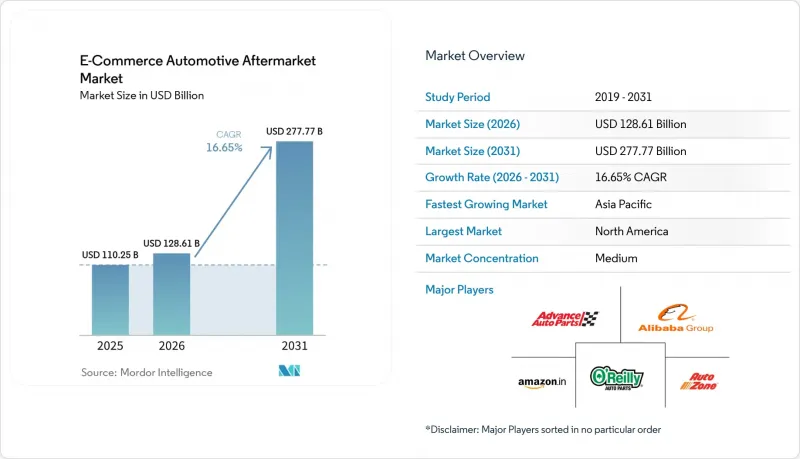
本報告按替換零件(引擎零件、變速箱和轉向系統、煞車系統等)、銷售管道(企業對企業 (B2B) 和企業對消費者 (B2C))、車輛類型(乘用車等)、動力系統(內燃機 (ICE) 車輛等)以及地區(北美、南美等)進行細分。市場預測以美元 (USD) 為單位。
全球汽車售後市場電子商務市場趨勢及洞察
車輛平均使用壽命的延長推高了對替換零件的需求。
到2025年,美國車輛的平均擁有年限將達到12.8年,其中85%的車輛車齡超過四年——這一趨勢在已開發市場普遍存在。這種結構性老化導致車輛保養頻率增加,維修成本上升,從而催生了對提供豐富選擇和透明定價的數位零售商的新需求。線上搜尋演算法簡化了複雜零件的採購流程,使電子商務相對於實體店擁有了決定性的優勢。經濟壓力促使消費者延長車輛使用壽命而非購買新車,這進一步鞏固了電子商務汽車售後市場的長期發展勢頭。
智慧型手機和網路的快速普及正在加速網路購物的發展。
在南美洲,網路普及率顯著提高,這得益於巴西Pix等即時支付系統的普及,電子商務用戶群也不斷擴大。在印度,電動車註冊量大幅成長,支援本地語言的行動優先平台簡化了首次購車者的流程。 WhatsApp和微信上的社群電商功能促進了團購。此外,DIY愛好者也越來越依賴影片教學進行安裝指導。這些行為轉變正推動汽車零件的需求從傳統商店轉向電商汽車後市場。
對假冒零件的擔憂削弱了消費者的信心。
歐盟的一項調查顯示,查獲的大部分假零件都來自中國,這凸顯了安全氣囊、煞車皮和機油濾清器等關鍵零件可能存在的安全隱患。為了應對這一問題,電商平台正在利用機器學習工具來識別並警告可疑賣家。同時,品牌擁有者也在引入QR碼和區塊鏈ID,以實現終端用戶的檢驗。然而,儘管身分驗證率不斷提高,非法經營者仍在迅速轉移銷售地點。此外,在價格敏感的地區,由於消費者仍然優先考慮價格,這些保護措施在汽車售後電商市場的有效性正在降低。
細分市場分析
預計到2025年,懸吊相關產品將佔汽車售後市場電商銷售額的26.64%,鞏固其作為易耗品的地位。隨著感測器、控制單元和高壓線束在駕駛輔助系統和電氣化平台的應用日益廣泛,電子元件的複合年成長率(CAGR)正以17.66%的速度成長。照明設備正從鹵素燈轉向LED燈組,刺激了高階升級產品的需求。同時,儘管雨刷和濾清器等產品的利潤率較低,但它們卻推動了消費者的重複購買。
對電子元件SKU的需求反映了控制單元價格的上漲,有時甚至超過1000美元,這些控制單元通常與車輛識別碼(VIN)綁定。懸吊零件雖然仍屬於商品化產品,但銷售量穩定,原廠配套產品、高性能產品和價格更低的替代品在保固和價格方面展開競爭。儘管懸吊市場的成熟導致利潤率不高,但訂單的可預測性支撐了整個汽車售後電商市場高效的履約網路。
到2025年,DIY愛好者對送貨上門的需求將持續成長,B2C(企業對消費者)訂單將佔總銷售額的66.59%。同時,基於API的採購方式在車隊營運商、維修店和經銷商中日益普及,推動了B2B(企業對企業)交易的激增。預計2026年至2031年,B2B市場將以22.70%的複合年成長率穩定成長。同時服務B2C和B2B市場的平台,會巧妙地利用不同的價格表、信用條款和專屬客戶成功團隊,並最佳化通用庫存。
受遠端資訊處理警報的推動,車隊營運商正在加速採用基於訂閱的補給模式,這些警報簡化了機油、煞車片和濾清器的訂購流程。這些模式定價為每輛車每月 15 至 75 美元,正在汽車售後市場電子商務領域建立穩定的收入來源。儘管零售消費者的需求會隨著可支配收入和季節性維護趨勢而波動,但車隊的需求保持穩定,這得益於運轉率指標和服務等級協定 (SLA)。
區域分析
由於較高的汽車擁有率、全通路專家以及《維修法案》下有利於數據存取的監管政策,預計到2025年,北美將佔汽車售後市場電子商務收入的38.45%。加拿大的需求與美國趨勢相似,但在冬季電池、懸吊系統和暖氣系統故障更為頻繁時,需求會激增。
亞太地區是成長最快的地區,預計到2031年將成長24.70%。印度的電動車保有量非常龐大,而中國則在銷量方面領先。在中國,阿里巴巴旗下的天貓汽車等平台透過整合支付和倉儲,簡化了營運流程,最大限度地減少了摩擦。在東協市場,微型車的銷售量正在成長,其中很大一部分是電動車。這一成長帶動了零件訂單的成長,越來越多的訂單透過智慧型手機應用程式和無現金錢包下單。
在歐洲,「維修權」法規強制要求長期供應備件,這正推動零件採購迅速轉向線上採購。德國、英國、法國和義大利等國走在這一趨勢的前沿,並從中獲得了豐厚的收益。同時,歐洲單一市場內高效率的跨境物流確保了具有競爭力的交貨時間。拉丁美洲的汽車產業仍在發展中,但受益於Pix等即時支付系統。相較之下,中東和非洲則面臨監管和基礎設施分散帶來的挑戰。
其他好處:
- Excel格式的市場預測(ME)表
- 3個月的分析師支持
目錄
第1章:引言
- 研究假設和市場定義
- 調查範圍
第2章:調查方法
第3章執行摘要
第4章 市場狀況
- 市場概覽
- 市場促進因素
- 車輛平均使用壽命的延長推高了對替換零件的需求。
- 智慧型手機和網路的快速普及正在加速網路購物的發展。
- 擴大最後一公里物流及當日送達網路
- OEM廠商開設官方電商通路。
- 人工智慧驅動的零件匹配引擎降低了退貨率
- 面向車隊的訂閱式補給模式
- 市場限制因素
- 對假冒零件的擔憂削弱了消費者的信心。
- 危險物質跨境監管的複雜性
- 「維修權」法案正在給零售商的利潤率帶來壓力。
- 半導體短缺限制了電子元件的供應。
- 價值供應鏈分析
- 監理情勢
- 技術展望
- 波特五力分析
第5章 市場規模與成長預測
- 按類別分類的替換零件
- 引擎部件
- 傳動與轉向
- 煞車系統
- 照明
- 電氣元件
- 懸吊系統
- 雨刷
- 其他
- 按銷售管道
- 企業對企業 (B2B) 交易
- B2C(Business-to-Consumer)
- 車輛類型
- 搭乘用車
- 輕型商用車(LCV)
- 中型和重型商用車輛(MHCV)
- 透過推進力
- 內燃機車
- 電動車(EV)
- 混合動力汽車
- 地區
- 北美洲
- 美國
- 加拿大
- 其他北美國家
- 南美洲
- 巴西
- 阿根廷
- 其他南美國家
- 歐洲
- 英國
- 德國
- 法國
- 西班牙
- 義大利
- 荷蘭
- 俄羅斯
- 其他歐洲國家
- 亞太地區
- 中國
- 印度
- 日本
- 韓國
- 澳洲
- 其他亞太國家
- 中東和非洲
- 阿拉伯聯合大公國
- 沙烏地阿拉伯
- 南非
- 其他中東和非洲國家
- 北美洲
第6章 競爭情勢
- 市場集中度
- 策略趨勢
- 市佔率分析
- 公司簡介
- Advance Auto Parts
- Alibaba Group Holding
- Amazon.com, Inc.
- AutoZone
- CARiD
- eBay
- Flipkart
- National Automotive Parts Association(NAPA)
- O'Reilly Auto Parts
- RockAuto
- US Auto Parts Network
- Walmart
- Bosch Auto-Parts Online
- Mister-Auto(Stellantis)
- PartsTech
- LKQ Corporation
- Dana Aftermarket eStore
- DENSO Auto-Parts Hub
- Continental Aftermarket E-shop
- Tenneco(DRiV)Online
第7章 市場機會與未來展望
According to Mordor Intelligence, the e-commerce automotive aftermarket market size is expected to increase from USD 110.25 billion in 2025 to USD 128.61 billion in 2026 to USD 277.77 billion by 2031, growing at a CAGR of 16.65% over 2026-2031.
This report is Segmented by Replacement Part (Engine Parts, Transmission and Steering, Brake System, and More), Sales Channel (Business-To-Business (B2B) and Business-To-Consumer (B2C)), Vehicle Type (Passenger Cars and More), Propulsion (Internal Combustion Engine (ICE) Vehicles and More), and Geography (North America, South America, and More). Market Forecasts are Provided in Value (USD).
Global E-Commerce Automotive Aftermarket Market Trends and Insights
Rising Average Vehicle Age Boosts Replacement Part Demand
The average United States vehicle age reached 12.8 years in 2025, with 85% of cars older than four years, a pattern replicated across developed markets. This structural aging drives more frequent maintenance cycles and higher-ticket repairs, channeling incremental demand toward digital retailers that offer deep catalogs and transparent pricing. Online search algorithms ease sourcing for complex components, giving e-commerce a decisive edge over brick-and-mortar stores. Economic pressure to keep vehicles longer instead of purchasing new models further magnifies this long-run tailwind for the e-commerce automotive aftermarket market.
Rapid Smartphone and Internet Penetration Accelerates Online Purchases
South America has achieved significant internet penetration and a large base of e-commerce users, supported by instant-payment systems such as Brazil's Pix. In India, electric vehicle registrations have grown substantially, and mobile-first platforms with local-language support are simplifying the process for first-time buyers. Social-commerce features on WhatsApp and WeChat are fostering group buying. Additionally, DIY enthusiasts are increasingly relying on video tutorials for installation guidance. These behavioral changes are driving parts traffic away from traditional storefronts and toward the e-commerce automotive aftermarket.
Counterfeit Parts Concerns Erode Consumer Trust
An EU study found that the majority of counterfeit parts seized originated in China, underscoring potential safety hazards to critical components such as airbags, brake pads, and oil filters. To combat this, marketplaces are leveraging machine-learning tools to identify and flag dubious sellers. Concurrently, brand owners are embedding QR codes and blockchain IDs to enable end-user verification. Yet, despite rising authentication rates, illicit operators swiftly rotate their storefronts. Moreover, in price-sensitive regions, consumers continue to prioritize cost, which diminishes the effectiveness of these protective measures in the E-commerce automotive aftermarket.
Other drivers and restraints analyzed in the detailed report include:
- Expansion of Last-Mile Logistics and Same-Day Delivery Networks
- OEMs Launching Official E-commerce Channels
- Complex Cross-Border Hazardous-Part Regulations
For complete list of drivers and restraints, kindly check the Table Of Contents.
Segment Analysis
Suspension items accounted for 26.64% of 2025 revenue in the E-commerce automotive aftermarket market, confirming their status as high-frequency wear components. Electrical parts are expanding at a 17.66% CAGR as sensors, control units, and high-voltage harnesses proliferate in driver-assistance and electrified platforms. Lighting is migrating from halogen to LED arrays, unlocking premium upgrades, while wipers and filters drive repeat traffic despite slim margins.
Demand for electrical SKUs also reflects rising control-unit prices that can exceed USD 1,000, often software-locked to a unique VIN. Suspension parts remain commoditized yet stable volume anchors, with OEM-equivalent, performance, and budget tiers competing on warranty and price. The maturity of the suspension market keeps gross margins modest, but order predictability supports efficient fulfillment networks across the E-commerce automotive aftermarket.
In 2025, DIY owners' preference for doorstep delivery propelled business-to-consumer orders to account for 66.59% of total revenue. Meanwhile, API-based procurement is gaining traction among fleet operators, workshops, and dealers, fueling a surge in business-to-business (B2B) transactions. B2B is projected to expand at a robust 22.70% CAGR from 2026 to 2031. Platforms serving both B2C and B2B segments strategically leverage distinct price lists, credit terms, and dedicated customer success teams, while optimizing a shared central inventory.
Fleets are increasingly adopting subscription replenishment models, spurred by telematics alerts that streamline orders for oil, brakes, and filters. With pricing set at USD 15-75 per vehicle per month, these models are establishing consistent revenue streams in the E-commerce automotive aftermarket. While retail-consumer demand fluctuates with discretionary income and seasonal maintenance trends, fleet demand remains anchored to uptime metrics and service-level agreements.
Geography Analysis
North America held 38.45% of 2025 revenue in the E-commerce automotive aftermarket market, supported by high vehicle ownership, omnichannel pure-plays, and a favorable regulatory push for data access under the REPAIR Act. Canadian demand mirrors United States trends but spikes in winter, when batteries, suspension systems, and heating systems fail more often.
Asia-Pacific is the fastest-growing region, with 24.70% growth through 2031. India has a significant electric vehicle parc, while China leads in sales. Platforms like Alibaba's Tmall Auto in China are streamlining operations by integrating payments and warehouses to minimize friction. ASEAN markets have seen growth in light-vehicle sales, with a notable percentage being electrified. This surge is propelling parts orders, increasingly driven by smartphone apps and cashless wallets.
Europe is swiftly pivoting to online parts sourcing, spurred by right-to-repair regulations mandating long-term availability of spare parts. Countries like Germany, the United Kingdom, France, and Italy are at the forefront, reaping the revenue benefits. Meanwhile, efficient cross-border logistics within Europe's single market ensure competitive shipping times. Latin America's automotive scene is still in its infancy, yet it's reaping rewards from instant-payment systems like Pix. In contrast, the Middle East and Africa grapple with challenges, hindered by fragmented regulations and infrastructure.
- Advance Auto Parts
- Alibaba Group Holding
- Amazon.com, Inc.
- AutoZone
- CARiD
- eBay
- Flipkart
- National Automotive Parts Association (NAPA)
- O'Reilly Auto Parts
- RockAuto
- U.S. Auto Parts Network
- Walmart
- Bosch Auto-Parts Online
- Mister-Auto (Stellantis)
- PartsTech
- LKQ Corporation
- Dana Aftermarket eStore
- DENSO Auto-Parts Hub
- Continental Aftermarket E-shop
- Tenneco (DRiV) Online
Additional Benefits:
- The market estimate (ME) sheet in Excel format
- 3 months of analyst support
TABLE OF CONTENTS
1 Introduction
- 1.1 Study Assumptions and Market Definition
- 1.2 Scope of the Study
2 Research Methodology
3 Executive Summary
4 Market Landscape
- 4.1 Market Overview
- 4.2 Market Drivers
- 4.2.1 Rising Average Vehicle Age Boosts Replacement Part Demand
- 4.2.2 Rapid Smartphone and Internet Penetration Accelerates Online Purchases
- 4.2.3 Expansion Of Last-Mile Logistics and Same-Day Delivery Networks
- 4.2.4 OEMs Launching Official E-Commerce Channels
- 4.2.5 AI-Powered Parts-Fitment Engines Reduce Return Rates
- 4.2.6 Subscription-Based Replenishment Models for Fleets
- 4.3 Market Restraints
- 4.3.1 Counterfeit Parts Concerns Erode Consumer Trust
- 4.3.2 Complex Cross-Border Hazardous-Part Regulations
- 4.3.3 Right-To-Repair Laws Squeezing Retailer Margins
- 4.3.4 Semiconductor Shortages Limiting Electronic Components Supply
- 4.4 Value / Supply-Chain Analysis
- 4.5 Regulatory Landscape
- 4.6 Technological Outlook
- 4.7 Porter's Five Forces Analysis
- 4.7.1 Threat of New Entrants
- 4.7.2 Bargaining Power of Buyers
- 4.7.3 Bargaining Power of Suppliers
- 4.7.4 Threat of Substitutes
- 4.7.5 Intensity of Competitive Rivalry
5 Market Size and Growth Forecasts (Value, USD)
- 5.1 By Replacement Part
- 5.1.1 Engine Parts
- 5.1.2 Transmission and Steering
- 5.1.3 Brake System
- 5.1.4 Lighting
- 5.1.5 Electrical Parts
- 5.1.6 Suspension System
- 5.1.7 Wipers
- 5.1.8 Others
- 5.2 By Sales Channel
- 5.2.1 Business-to-Business (B2B)
- 5.2.2 Business-to-Consumer (B2C)
- 5.3 By Vehicle Type
- 5.3.1 Passenger Cars
- 5.3.2 Light Commercial Vehicles (LCVs)
- 5.3.3 Medium and Heavy Commercial Vehicles (MHCVs)
- 5.4 By Propulsion
- 5.4.1 Internal Combustion Engine (ICE) Vehicles
- 5.4.2 Electric Vehicles (EVs)
- 5.4.3 Hybrid Vehicles
- 5.5 Geography
- 5.5.1 North America
- 5.5.1.1 United States
- 5.5.1.2 Canada
- 5.5.1.3 Rest of North America
- 5.5.2 South America
- 5.5.2.1 Brazil
- 5.5.2.2 Argentina
- 5.5.2.3 Rest of South America
- 5.5.3 Europe
- 5.5.3.1 United Kingdom
- 5.5.3.2 Germany
- 5.5.3.3 France
- 5.5.3.4 Spain
- 5.5.3.5 Italy
- 5.5.3.6 Netherlands
- 5.5.3.7 Russia
- 5.5.3.8 Rest of Europe
- 5.5.4 Asia-Pacific
- 5.5.4.1 China
- 5.5.4.2 India
- 5.5.4.3 Japan
- 5.5.4.4 South Korea
- 5.5.4.5 Australia
- 5.5.4.6 Rest of Asia-Pacific
- 5.5.5 Middle East and Africa
- 5.5.5.1 United Arab Emirates
- 5.5.5.2 Saudi Arabia
- 5.5.5.3 South Africa
- 5.5.5.4 Rest of Middle-East and Africa
- 5.5.1 North America
6 Competitive Landscape
- 6.1 Market Concentration
- 6.2 Strategic Moves
- 6.3 Market Share Analysis
- 6.4 Company Profiles (Includes Global level Overview, Market level overview, Core Segments, Financials as available, Strategic Information, Market Rank/Share for key companies, Products and Services, and Recent Developments)
- 6.4.1 Advance Auto Parts
- 6.4.2 Alibaba Group Holding
- 6.4.3 Amazon.com, Inc.
- 6.4.4 AutoZone
- 6.4.5 CARiD
- 6.4.6 eBay
- 6.4.7 Flipkart
- 6.4.8 National Automotive Parts Association (NAPA)
- 6.4.9 O'Reilly Auto Parts
- 6.4.10 RockAuto
- 6.4.11 U.S. Auto Parts Network
- 6.4.12 Walmart
- 6.4.13 Bosch Auto-Parts Online
- 6.4.14 Mister-Auto (Stellantis)
- 6.4.15 PartsTech
- 6.4.16 LKQ Corporation
- 6.4.17 Dana Aftermarket eStore
- 6.4.18 DENSO Auto-Parts Hub
- 6.4.19 Continental Aftermarket E-shop
- 6.4.20 Tenneco (DRiV) Online
7 Market Opportunities and Future Outlook
- 7.1 White-space and Unmet-Need Assessment

 汽車售後線上零售市場:全球市場預測,2026-2032年
 汽車售後市場電子商務市場規模、佔有率和成長分析:按產品類型、車輛類型、平台、最終用戶和地區分類-2026-2033年產業預測
 2026年全球汽車售後市場電子商務市場報告
 2026-2034年全球汽車售後市場電子商務市場規模、佔有率、趨勢和成長分析報告
 汽車電子商務市場規模、佔有率和成長分析(按零件類型、供應商類型、車輛類型、營運模式和地區分類)-2026-2033年產業預測
 汽車電子商務零件市場,依產品類型、銷售通路、客戶類型、支付方式、國家及地區分類-全球產業分析、市場規模、市場佔有率及2025-2032年預測
 2025-2029年全球汽車電子商務市場2026-2032 年全球汽車售後電子商務市場(依消費者、產品、生活型態及地區分類)
 電子商務汽車售後市場的全球市場 (~2032年):產品類型·車輛類型·流通管道·用途·售後市場產品·各地區