


 |
市場調查報告書
商品編碼
2062280
硫酸鋁鉀:市場佔有率分析、產業趨勢與統計、成長預測(2026-2031)Aluminium Potash Sulphate - Market Share Analysis, Industry Trends & Statistics, Growth Forecasts (2026 - 2031) |
||||||

※ 本網頁內容可能與最新版本有所差異。詳細情況請與我們聯繫。
根據 Mordor Intelligence 預測,硫酸鋁鉀的市場規模預計將在 2025 年達到 12.8 億美元,2026 年達到 13.4 億美元,到 2031 年達到 16.8 億美元,2026 年至 2031 年的複合年成長率為 4.59%。
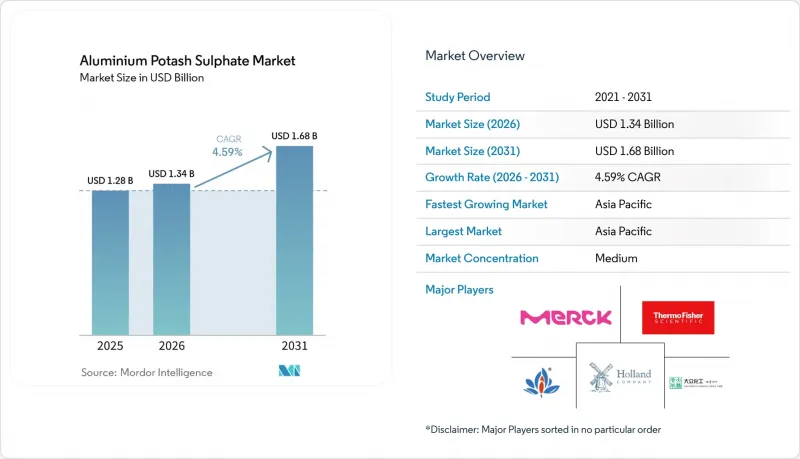
本報告按形態(固體、液體溶液)、等級(工業級、食品級等)、應用(用水和污水處理、紡織和皮革加工等)、最終用戶(市政、工業、商業、家庭)以及地區(亞太地區、北美、歐洲、南美、中東和非洲)進行細分。市場預測以美元計價。
全球硫酸鋁鉀市場趨勢及洞察
天然除臭劑和個人護理收斂劑的使用量增加
2024年4月,監管機構批准了明礬在特定濃度下的安全性。此後,天然除臭產品在大眾市場和高階市場的推出量均增加。臨床研究表明,濃度為2-5%的配方可在兩週內有效減少腋下異味,且刺激性極小。這使得各大品牌能夠強調其產品植物來源,不會阻塞汗腺。滾珠和凝膠等劑型,尤其是採用水凝膠載體的產品,正吸引消費者的目光。此外,透明的成分標籤也符合消費者對清潔美容產品的偏好。美國和德國的自有品牌零售商現在將明礬晶體與合成止汗劑並列銷售,反映出市場對明礬晶體的接受度正在不斷提高。噴霧產品中粒徑小於10微米(µm)的供應商也迎來了銷售量的成長。
亞太地區紡織皮革加工業的擴張
隨著服裝和鞋類生產從中國轉移到印度、越南和孟加拉國,區域加工商正在提升其媒染和鞣革能力。中國對鋁製品徵收高達30%的出口關稅,導致全球明礬供應緊張,促使下游買家爭相簽訂多年供應合約。歐盟限制鉻排放的法規正在加速向毒性較低的鋁基鞣劑的轉變。此外,印度紡織業的生產連結獎勵計畫計畫也促進了明礬的消費。跨國皮革品牌正在實施採購評分卡,優先考慮使用低碳明礬的供應商,鼓勵制革廠採用高效利用廢鋁的方法。
對食品和化妝品中鋁含量實施更嚴格的限制
歐洲消費者安全科學委員會 (SCCS) 在其意見文件中設定了鋁的最高允許含量限值,消費者日益嚴格的審查要求產品開發商降低鋁含量或投資進行分析檢驗。德國法規禁止未塗層的鋁與酸性食品接觸,促使鋁材必須進行塗層維修,降低了對散裝鋁的需求。此外,消除奈米級鋁的測試也增加了額外的測試成本。雖然這些法規提高了消費者安全,但它們對市場成長產生了負面影響,尤其是在噴霧除臭劑和酸性醃菜等領域。
細分市場分析
2025年,固體粉末和晶體形式的硫酸鋁鉀佔了63.24%的市場佔有率,這得益於其高密度儲存、成熟的分配設備以及成本效益等優勢。預計到2031年,液體溶液的複合年成長率將達到5.51%。這一成長主要得益於數位化管道的普及,使中小企業無需現場溶解罐,從而降低了資本投入。法國的現場試驗表明,50%的液態鋁採購量可以用電芬頓污泥替代,且不會影響絮凝效率。儘管地方政府公共產業仍然偏愛乾粉形式,因為其在大規模儲存過程中穩定性更佳,但手工化妝品製造商則傾向於選擇預溶解產品,以最大限度地減少粉塵暴露。此外,專為自動分配器設計的混合濃縮包裝袋正與傳統包裝形式融合,使供應商能夠同時銷售這兩種產品。
在北美,由於美國職業安全與健康管理局 (OSHA) 的粉塵暴露標準建議採用液體給藥方式,液體溶液的使用量正在顯著增加。同時,亞太地區的紡織廠由於人事費用較低且供應鏈成熟,仍依賴粉末供應系統。隨著貨櫃運輸效率的提高,液體貨物的經濟效益正在改善,與水重相關的傳統挑戰也正在逐步克服。競爭格局的關鍵在於供應商能否確保水溶液的保存期限穩定性並防止微生物滋生。
2025年,工業級硫酸鋁鉀佔硫酸鋁鉀市場60.56%的佔有率,主要得益於水處理和紡織媒染劑的應用。預計到2031年,醫藥級和化妝品級硫酸鋁鉀將以5.83%的複合年成長率成長,因為歐盟對氣溶膠顆粒大小的法規要求其純度幾乎達到美國藥典(USP)等級。 30-50%的價格溢價促使生產商投資於重結晶和感應耦合電漿質譜(ICP-MS)技術。食品級明礬在烘焙和快速成長的植物蛋白市場中佔據中間地位,這些市場要求符合「公認安全(GRAS)」標準,但無需完全符合藥典標準。
採用封閉回路型過濾和高效微粒空氣 (HEPA) 過濾器的製造商,可將重金屬基準值控制在 10 ppm(百萬分之十)以下,符合北歐生態標示標準。儘管亞太地區的工業買家仍注重成本,但韓國化妝品出口商正日益尋求歐洲藥典 (EP) 和美國藥典 (USP) 認證,以滿足歐盟進口標準。這種市場細分將硫酸鉀鋁市場分類為以銷售主導的工業通路和以價值主導的專業應用領域,促進了雙線生產策略的實施。
區域分析
預計到2025年,亞太地區將佔硫酸鋁鉀市場46.88%的佔有率,到2031年將維持5.81%的複合年成長率。中國7.11億噸的礬土蘊藏量和出口關稅導致明礬原料供應緊張。因此,印度和越南的加工商正在探索替代供應鏈,並投資利用廢鋁作為原料生產鋁。在日本和韓國,高純度鋁被用於半導體級水處理系統,而東南亞國協的紡織和皮革產業則在有利的貿易協定下不斷擴張。都市化、更嚴格的廢水處理標準以及促進循環經濟的政策都為該地區的成長提供了支撐。
在北美,市政需求保持穩定,家用和化妝品應用領域則呈現顯著成長。為去除磷而添加鋁的需求持續受到美國環保署營養物標準的推動,從而維持了基本的消費水準。由於位置薩斯喀徹爾溫省的鉀礦,可靠的原料供應得到保障,而高純度水處理解決方案在墨西哥的加工出口產業也不斷普及。
在歐洲,隨著化學品註冊、評估、授權和限制法規 (REACH) 和消費者安全科學委員會 (SCCS) 的嚴格監管,對粒徑精確可控的藥用級明礬的需求日益成長。鉀供應的地緣政治動盪推高了成本,但循環經濟的獎勵正在推動鋁廢料的利用。德國和法國是化妝品應用的主要市場,而北歐的公共產業正在採用基於可再生能源的結晶技術,以滿足低碳採購的要求。
南美洲、中東和非洲是該領域的新興市場。巴西的衛生項目和沙烏地阿拉伯的海水淡化預處理舉措正在推動該領域的基本成長。然而,物流方面的挑戰和分析能力的不足限制了短期內的擴張。預計未來十年,多邊基礎建設資金將加速市場滲透。
其他好處:
- Excel格式的市場預測(ME)表
- 3個月的分析師支持
目錄
第1章:引言
- 研究假設和市場定義
- 調查範圍
第2章:調查方法
第3章執行摘要
第4章 市場狀況
- 市場概覽
- 市場促進因素
- 個人護理中天然除臭劑和收斂劑的使用量增加。
- 亞太地區紡織皮革加工業的擴張
- 將鋁廢棄物增值回收再造成高純度明礬
- 在植物來源肉加工中採用潔淨標示凝固劑
- 數位化直接B2B分銷刺激了中小企業的需求。
- 市場限制因素
- 對食品和化妝品中鋁含量的監管將更加嚴格
- 影響鉀供應的地緣政治因素(制裁、出口禁令)
- 明礬結晶過程中的高能量消耗限制了其環境性能。
- 價值鏈分析
- 波特五力模型
第5章 市場規模與成長預測
- 按形式
- 固體(粉末、晶體)
- 液體溶液
- 按年級
- 工業級
- 食品級
- 醫藥級和化妝品級
- 透過使用
- 用水和污水處理
- 紡織皮革加工
- 化妝品和個人護理
- 食品和飲料添加劑
- 藥品和醫療保健
- 造紙和紙漿工業
- 其他(攝影、消防、農業)
- 按最終用戶行業分類
- 地方政府
- 產業
- 商業的
- 家
- 按地區
- 亞太地區
- 中國
- 日本
- 印度
- 韓國
- 東南亞國協
- 其他亞太國家
- 北美洲
- 美國
- 加拿大
- 墨西哥
- 歐洲
- 德國
- 英國
- 法國
- 義大利
- 西班牙
- 俄羅斯
- 北歐國家
- 其他歐洲國家
- 南美洲
- 巴西
- 阿根廷
- 其他南美國家
- 中東和非洲
- 沙烏地阿拉伯
- 南非
- 其他中東和非洲國家
- 亞太地區
第6章 競爭情勢
- 市場集中度
- 策略趨勢
- 市佔率和排名分析
- 公司簡介
- Alpha Chemika
- Amar Narain Industries
- American Elements
- Arch Industries
- Avantor, Inc.
- GEO Specialty Chemicals
- GFS Chemicals, Inc.
- Hengyang Jianheng Industry Development Co., Ltd.
- HOLLAND COMPANY
- K+S Aktiengesellschaft
- Merck KGaA
- NATIONAL CHEMICAL INDUSTRIES
- Otto Chemie Pvt. Ltd.
- Thermo Fisher Scientific Inc.
- Zibo Dazhong Edible Chemical Co., LTD.
第7章 市場機會與未來展望
According to Mordor Intelligence, the aluminium potash sulphate market size is projected to be USD 1.28 billion in 2025, USD 1.34 billion in 2026, and reach USD 1.68 billion by 2031, growing at a CAGR of 4.59% from 2026 to 2031.
This report is Segmented by Form (Solid, Liquid Solutions), Grade (Industrial Grade, Food Grade, and More), Application (Water and Wastewater Treatment, Textile and Leather Processing, and More), End-User (Municipal, Industrial, Commercial, Household), and Geography (Asia-Pacific, North America, Europe, South America, Middle East and Africa). The Market Forecasts are Provided in Terms of Value (USD).
Global Aluminium Potash Sulphate Market Trends and Insights
Increased Use in Natural Deodorants and Personal-Care Astringents
In April 2024, regulators endorsed potassium alum's safety at specific concentrations. This approval led to an increase in natural deodorant launches across both mass and premium markets. Clinical studies indicate that 2-5% formulations reduce underarm odor in less than two weeks with minimal irritation. This enables brands to promote a plant-based narrative without blocking sweat ducts. Formats such as roll-ons and gels, particularly those using hydrogel carriers, are attracting consumers. Additionally, transparent ingredient labels are aligning with the preferences of clean-beauty consumers. Private-label retailers in the United States and Germany are now placing alum crystals alongside synthetic antiperspirants, reflecting broader market acceptance. Suppliers certifying particle sizes under 10 micrometers (µm) for sprays are experiencing increased sales volumes.
Expansion of Textile and Leather Processing in Asia-Pacific
As apparel and footwear production shifts from China to India, Vietnam, and Bangladesh, regional processors are increasing their mordanting and tanning capacities. China's export duties of up to 30% on aluminum products are tightening global alum feedstocks, prompting downstream buyers to secure multi-year supply contracts. European Union (EU) regulations limiting chromium effluent are accelerating the transition to aluminum-based tanning agents, which are less toxic. Furthermore, India's Production Linked Incentive scheme for textiles is driving alum consumption. Multinational leather brands are implementing purchasing scorecards that prioritize suppliers using lower-carbon alum, encouraging mills to adopt waste-aluminum valorization methods.
Stricter Limits on Aluminium in Foods and Cosmetics
Formulators are required to either reduce aluminum levels or invest in analytical verifications due to maximum aluminum thresholds set by the European Scientific Committee on Consumer Safety (SCCS) opinion and increasing consumer scrutiny. Germany's regulations prohibit uncoated aluminum from coming into contact with acidic foods, necessitating retrofits for coatings and reducing the demand for bulk aluminum. Additionally, testing for nanoform exclusions introduces additional laboratory costs. These regulations enhance consumer safety but also impact growth, particularly in sectors like spray deodorants and acidic pickling.
Other drivers and restraints analyzed in the detailed report include:
- Up-Cycling of Aluminium Waste into High-Purity Potassium Alum
- Adoption in Plant-Based Meat Processing as Clean-Label Firming Agent
- Geopolitical Potash-Supply Volatility
For complete list of drivers and restraints, kindly check the Table Of Contents.
Segment Analysis
In 2025, solid powder and crystal formats held a 63.24% share of the aluminium potash sulphate market, supported by advantages such as dense storage, established dosing equipment, and cost-efficiency. Liquid solutions are projected to grow at a 5.51% compound annual growth rate (CAGR) through 2031. This growth is driven by digital channels enabling small and medium enterprises (SMEs) to avoid on-site dissolution tanks, reducing capital expenditures. Field trials in France demonstrated that electro-Fenton sludge can replace 50% of purchased liquid alum without affecting coagulation efficiency. Municipal utilities continue to prefer dry forms for their bulk storage stability, while craft cosmetic producers opt for pre-dissolved grades to minimize dust exposure. Additionally, hybrid concentrate pouches designed for automated dispensers are merging traditional formats, allowing suppliers to market both.
North America is experiencing significant growth in liquid solutions due to the Occupational Safety and Health Administration (OSHA) dust-exposure limits encouraging liquid dosing. Conversely, textile mills in the Asia-Pacific region maintain powder-feed systems due to lower labor costs and established supply chains. As containerized shipping becomes more efficient, the economics of liquid freight improve, addressing previous challenges associated with water weight. The competitive landscape will depend on suppliers' ability to ensure shelf-life stability and prevent microbial growth in aqueous solutions.
In 2025, industrial grades accounted for 60.56% of the aluminium potash sulphate market, driven by applications in water treatment and textile mordanting. Pharmaceutical and cosmetic grades are forecast to grow at a 5.83% CAGR through 2031, supported by European Union (EU) regulations on particle sizes for aerosols, which effectively require near-United States Pharmacopeia (USP) purity. Price premiums of 30-50% are encouraging producers to invest in recrystallization and inductively coupled plasma mass spectrometry (ICP-MS) analytics. Food-grade alum occupies a middle ground, catering to baking and the growing plant-protein market, which demands Generally Recognized as Safe (GRAS) compliance but not full pharmacopeial standards.
Producers implementing closed-loop rinsing and high-efficiency particulate air (HEPA) filtration are achieving heavy-metal baselines below 10 parts per million (ppm), meeting Nordic eco-label standards. While industrial buyers in Asia-Pacific remain cost-focused, cosmetics exporters in South Korea are increasingly requiring European Pharmacopeia (EP)/USP certification to meet EU import standards. This segmentation divides the aluminium potash sulphate market into volume-driven industrial channels and value-driven specialty segments, encouraging dual-line manufacturing strategies.
Geography Analysis
In 2025, the Asia-Pacific region accounted for 46.88% of the aluminium potash sulphate market share and is projected to achieve a 5.81% compound annual growth rate (CAGR) through 2031. China's 711 million-ton bauxite reserves, along with its export-duty regime, are tightening the supply of alum feedstock. This has led processors in India and Vietnam to explore alternative supply chains and invest in scrap-based alum production. Japan and South Korea are utilizing high-purity alum in semiconductor-grade water systems, while ASEAN nations are expanding their textile and leather industries under favorable trade agreements. Regional growth is supported by urbanization, stricter wastewater standards, and policies promoting a circular economy.
North America demonstrates stable municipal demand, with notable growth in household and cosmetics applications. The United States Environmental Protection Agency's (EPA) nutrient criteria continue to drive alum dosing for phosphorus removal, maintaining baseline consumption. Proximity to Saskatchewan potash ensures a reliable feedstock supply, while Mexico's maquiladora industries are increasingly adopting high-purity water treatment solutions.
Europe, operating under stringent Registration, Evaluation, Authorization, and Restriction of Chemicals (REACH) and Scientific Committee on Consumer Safety (SCCS) regulations, is experiencing increased demand for pharmaceutical-grade alum with precise particle-size control. Geopolitical disruptions in potash supply have raised costs, but circular economy incentives are encouraging aluminum-scrap utilization. Germany and France are key markets for cosmetics applications, while Nordic utilities are implementing renewable-powered crystallisation to meet low-carbon procurement requirements.
South America and the Middle East & Africa are emerging markets in this sector. Brazil's sanitation programs and Saudi Arabia's desalination pre-treatment initiatives are driving baseline growth. However, logistical challenges and limited analytical capacity are constraining short-term expansion. Multilateral infrastructure funding is expected to enhance market penetration over the next decade.
- Alpha Chemika
- Amar Narain Industries
- American Elements
- Arch Industries
- Avantor, Inc.
- GEO Specialty Chemicals
- GFS Chemicals, Inc.
- Hengyang Jianheng Industry Development Co., Ltd.
- HOLLAND COMPANY
- K+S Aktiengesellschaft
- Merck KGaA
- NATIONAL CHEMICAL INDUSTRIES
- Otto Chemie Pvt. Ltd.
- Thermo Fisher Scientific Inc.
- Zibo Dazhong Edible Chemical Co., LTD.
Additional Benefits:
- The market estimate (ME) sheet in Excel format
- 3 months of analyst support
TABLE OF CONTENTS
1 Introduction
- 1.1 Study Assumptions and Market Definition
- 1.2 Scope of the Study
2 Research Methodology
3 Executive Summary
4 Market Landscape
- 4.1 Market Overview
- 4.2 Market Drivers
- 4.2.1 Increased use in natural deodorants and personal-care astringents
- 4.2.2 Expansion of textile and leather processing in Asia-Pacific
- 4.2.3 Up-cycling of aluminium waste into high-purity potassium alum
- 4.2.4 Adoption in plant-based meat processing as clean-label firming agent
- 4.2.5 Digital-direct B2B distribution unlocking SME demand
- 4.3 Market Restraints
- 4.3.1 Stricter limits on aluminium in foods and cosmetics
- 4.3.2 Geopolitical potash-supply volatility (sanctions, export bans)
- 4.3.3 High energy intensity of alum crystallisation limiting green credentials
- 4.4 Value Chain Analysis
- 4.5 Porter's Five Forces
- 4.5.1 Threat of New Entrants
- 4.5.2 Bargaining Power of Buyers
- 4.5.3 Bargaining Power of Suppliers
- 4.5.4 Threat of Substitutes
- 4.5.5 Competitive Rivalry
5 Market Size and Growth Forecasts (Value)
- 5.1 By Form
- 5.1.1 Solid (Powder, Crystals)
- 5.1.2 Liquid Solutions
- 5.2 By Grade
- 5.2.1 Industrial Grade
- 5.2.2 Food Grade
- 5.2.3 Pharmaceutical/Cosmetic Grade
- 5.3 By Application
- 5.3.1 Water and Wastewater Treatment
- 5.3.2 Textile and Leather Processing
- 5.3.3 Cosmetics and Personal Care
- 5.3.4 Food and Beverage Additives
- 5.3.5 Pharmaceuticals and Medical
- 5.3.6 Paper and Pulp Industry
- 5.3.7 Other (Photography, Fireproofing, Agriculture)
- 5.4 By End-User Industry
- 5.4.1 Municipal
- 5.4.2 Industrial
- 5.4.3 Commercial
- 5.4.4 Household
- 5.5 By Geography
- 5.5.1 Asia-Pacific
- 5.5.1.1 China
- 5.5.1.2 Japan
- 5.5.1.3 India
- 5.5.1.4 South Korea
- 5.5.1.5 ASEAN Countries
- 5.5.1.6 Rest of Asia-Pacific
- 5.5.2 North America
- 5.5.2.1 United States
- 5.5.2.2 Canada
- 5.5.2.3 Mexico
- 5.5.3 Europe
- 5.5.3.1 Germany
- 5.5.3.2 United Kingdom
- 5.5.3.3 France
- 5.5.3.4 Italy
- 5.5.3.5 Spain
- 5.5.3.6 Russia
- 5.5.3.7 NORDIC Countries
- 5.5.3.8 Rest of Europe
- 5.5.4 South America
- 5.5.4.1 Brazil
- 5.5.4.2 Argentina
- 5.5.4.3 Rest of South America
- 5.5.5 Middle-East and Africa
- 5.5.5.1 Saudi Arabia
- 5.5.5.2 South Africa
- 5.5.5.3 Rest of Middle-East and Africa
- 5.5.1 Asia-Pacific
6 Competitive Landscape
- 6.1 Market Concentration
- 6.2 Strategic Moves
- 6.3 Market Share(%)/Ranking Analysis
- 6.4 Company Profiles (includes Global Overview, Market Overview, Core Segments, Financials, Strategic Information, Products and Services, and Recent Developments)
- 6.4.1 Alpha Chemika
- 6.4.2 Amar Narain Industries
- 6.4.3 American Elements
- 6.4.4 Arch Industries
- 6.4.5 Avantor, Inc.
- 6.4.6 GEO Specialty Chemicals
- 6.4.7 GFS Chemicals, Inc.
- 6.4.8 Hengyang Jianheng Industry Development Co., Ltd.
- 6.4.9 HOLLAND COMPANY
- 6.4.10 K+S Aktiengesellschaft
- 6.4.11 Merck KGaA
- 6.4.12 NATIONAL CHEMICAL INDUSTRIES
- 6.4.13 Otto Chemie Pvt. Ltd.
- 6.4.14 Thermo Fisher Scientific Inc.
- 6.4.15 Zibo Dazhong Edible Chemical Co., LTD.
7 Market Opportunities and Future Outlook
- 7.1 White-space and Unmet-need Assessment

 2026-2030年全球山梨酸鉀市場
 辛酸鉀市場-2026年至2032年全球市場預測
 銫市場規模、佔有率和成長分析:按產品類型、化合物類型、終端用戶產業、等級、分銷管道和地區分類-2026-2033年產業預測
 硫酸鋁鉀市場規模、佔有率和成長分析:依產品形態、等級、應用、最終用途產業、通路和地區分類-2026-2033年產業預測
 四氯鉑酸鉀市場-全球產業規模、佔有率、趨勢、機會、預測:銷售管道、最終用途、地區和競爭格局分類,2021-2031年
 高鐵酸鉀市場規模、佔有率和成長分析:按產品形式、生產通路、應用、最終用途和地區分類-2026-2033年產業預測銫市場:按組件、部署模式、資料類型、應用程式和最終用戶分類-2026-2032年全球市場預測
 銫:市場佔有率分析、產業趨勢與統計、成長預測(2026-2031 年)碘乙烷市場:依純度、包裝、應用及分銷管道分類的全球市場預測,2026-2032年
 2026-2030年全球銫市場